
Life, 1923-11-08 · page 20 of 36
Life — November 8, 1923 — page 20: what you’re looking at
What you’re looking at
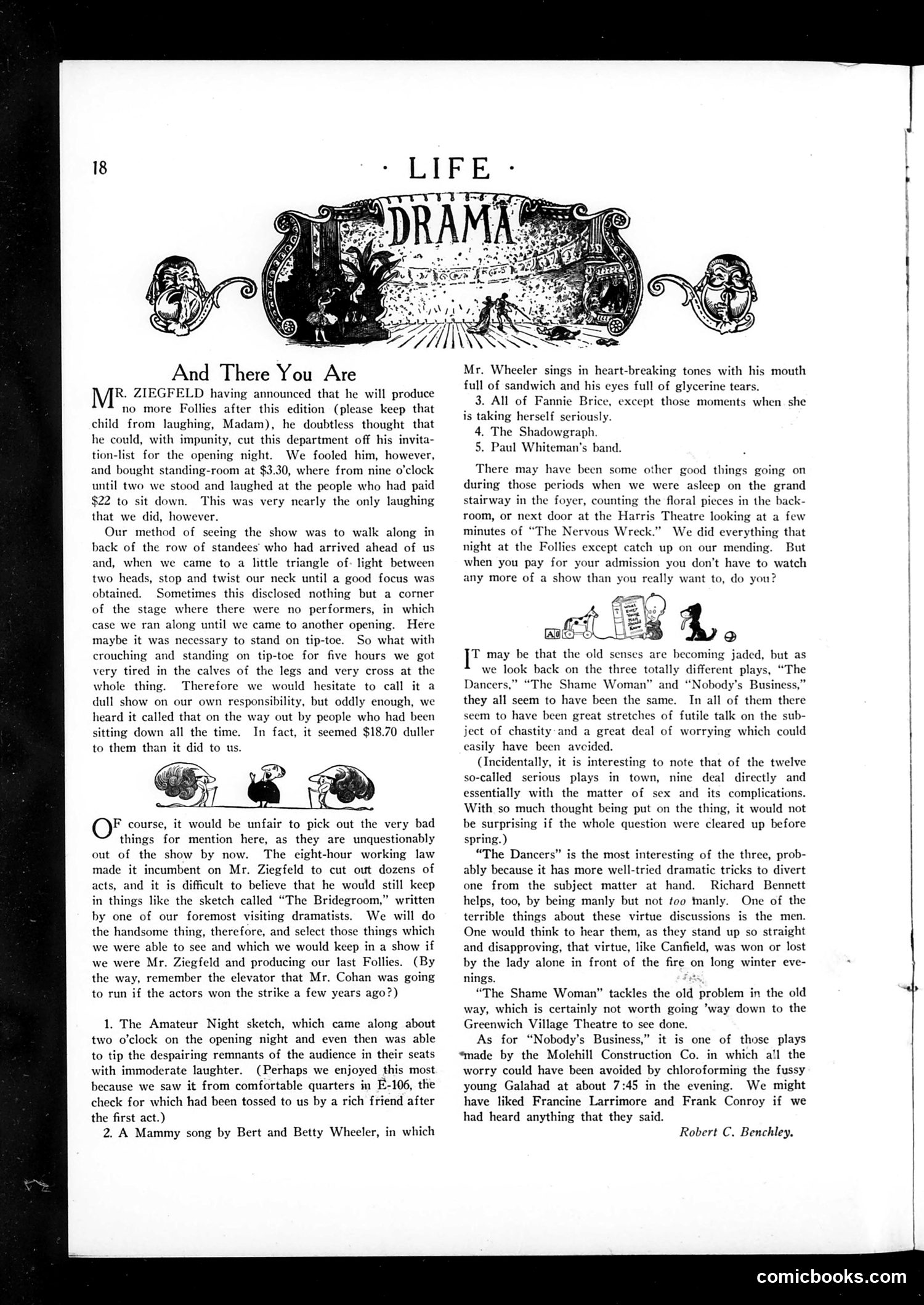
This is a satirical theater review mocking the Ziegfeld Follies' final edition. The author humorously describes attending standing-room only ($3.30), forced to crane their neck through gaps between other spectators for five hours, while paying patrons who sat down ($22) complained the show was dull. The joke is the reviewer's physical discomfort versus seated viewers' boredom—inverting expectations about who had the worse experience. The piece then praises specific acts: an "Amateur Night" sketch, Bert and Betty Wheeler's "Mammy" song, Fannie Brice's performances, shadowgraph, and Paul Whiteman's band. It critiques contemporary serious plays ("The Dancers," "The Shame Woman," "Nobody's Business") for repetitive moralizing about chastity, suggesting they're indistinguishable from one another. The satire targets both theatrical excess and period preoccupations with sexual propriety.
📄 Transcribed text from this page (OCR, searchable)
Machine-transcribed from the original scan — historical spelling and the odd misread are preserved.
And There You Are R. ZIEGFELD having announced that he will produce no more Follies after this edition (please keep that child from laughing, Madam), he doubtless thought that he could, with impunity, cut this department off his invita- tion-list for the opening night. We fooled him, however, and bought standing-room at $3.30, where from nine o'clock until two we stood and laughed at the people who had paid $22 to sit down. This was very nearly the only laughing that we did, however. Our method of seeing the show was to walk along in back of the row of standees’ who had arrived ahead of us and, when we came to a little triangle of- light between two heads, stop and twist our neck until a good focus was obtained. Sometimes this disclosed nothing but a corner of the stage where there were no performers, in which case we ran along until we came to another opening. Here maybe it was necessary to stand on tip-toe. So what with crouching and standing on tip-toe for five hours we got very tired in the calves of the legs and very cross at the whole thing. Therefore we would hesitate to call it a dull show on our own responsibility, but oddly enough, we heard it called that on the way out by people who had been sitting down all the time. In fact, it seemed $18.70 duller to them than it did to us. OF course, it would be unfair to pick out the very bad things for mention here, as they are unquestionably out of the show by now. The eight-hour working law made it incumbent on Mr. Ziegfeld to cut out dozens of acts, and it is difficult to believe that he would still keep in things like the sketch called “The Bridegroom,” written by one of our foremost visiting dramatists. We will do the handsome thing, therefore, and select those things which we were able to see and which we would keep in a show if we were Mr. Ziegfeld and producing our last Follies. (By the way, remember the elevator that Mr. Cohan was going to run if the actors won the strike a few years ago?) 1. The Amateur Night sketch, which came along about two o’clock on the opening night and even then was able to tip the despairing remnants of the audience in their seats with immoderate laughter. (Perhaps we enjoyed this most because we saw it from comfortable quarters in E-106, the check for which had been tossed to us by a rich friend after the first act.) 2. A Mammy song by Bert and Betty Wheeler, in which Mr. Wheeler sings in heart-breaking tones with his mouth full of sandwich and his eyes full of glycerine tears. 3. All of Fannie Brice, except those moments when she is taking herself seriously. 4. The Shadowgraph. 5. Paul Whiteman’s band. There may have been some other good things going on during those periods when we were asleep on the grand stairway in the foyer, counting the floral pieces in the back- room, or next door at the Harris Theatre looking at a few minutes of “The Nervous Wreck.” We did everything that night at the Follies except catch up on our mending. But when you pay for your admission you don’t have to watch any more of a show than you really want to, do you? T may be that the old senses are becoming jaded, but as we look back on the three totally different plays, “The Dancers,” “The Shame Woman” and “Nobody's Business,” they all seem to have been the same. In all of them there seem to have been great stretches of futile talk on the sub- ject of chastity:and a great deal of worrying which could easily have been avcided. (Incidentally, it is interesting to note that of the twelve so-called serious plays in town, nine deal directly and essentially with the matter of sex and its complications. With so much thought being put on the thing, it would not be surprising if the whole question were cleared up before spring.) “The Dancers” is the most interesting of the three, prob- ably because it has more well-tried dramatic tricks to divert one from the subject matter at hand. Richard Bennett helps, too, by being manly but not too manly. One of the terrible things about these virtue discussions is the men. One would think to hear them, as they stand up so straight and disapproving, that virtue, like Canfield, was won or lost by the lady alone in front of the fire on long winter eve- nings. % “The Shame Woman” tackles the old problem in the old way, which is certainly not worth going ’way down to the Greenwich Village Theatre to see done. As for “Nobody’s Business,” it is one of those plays “made by the Molehill Construction Co. in which all the worry could have been avoided by chloroforming the fussy young Galahad at about 7:45 in the evening. We might have liked Francine Larrimore and Frank Conroy if we had heard anything that they said. Robert C. Benchley. comicbooks.com