
Life, 1923-11-08 · page 16 of 36
Life — November 8, 1923 — page 16: what you’re looking at
What you’re looking at
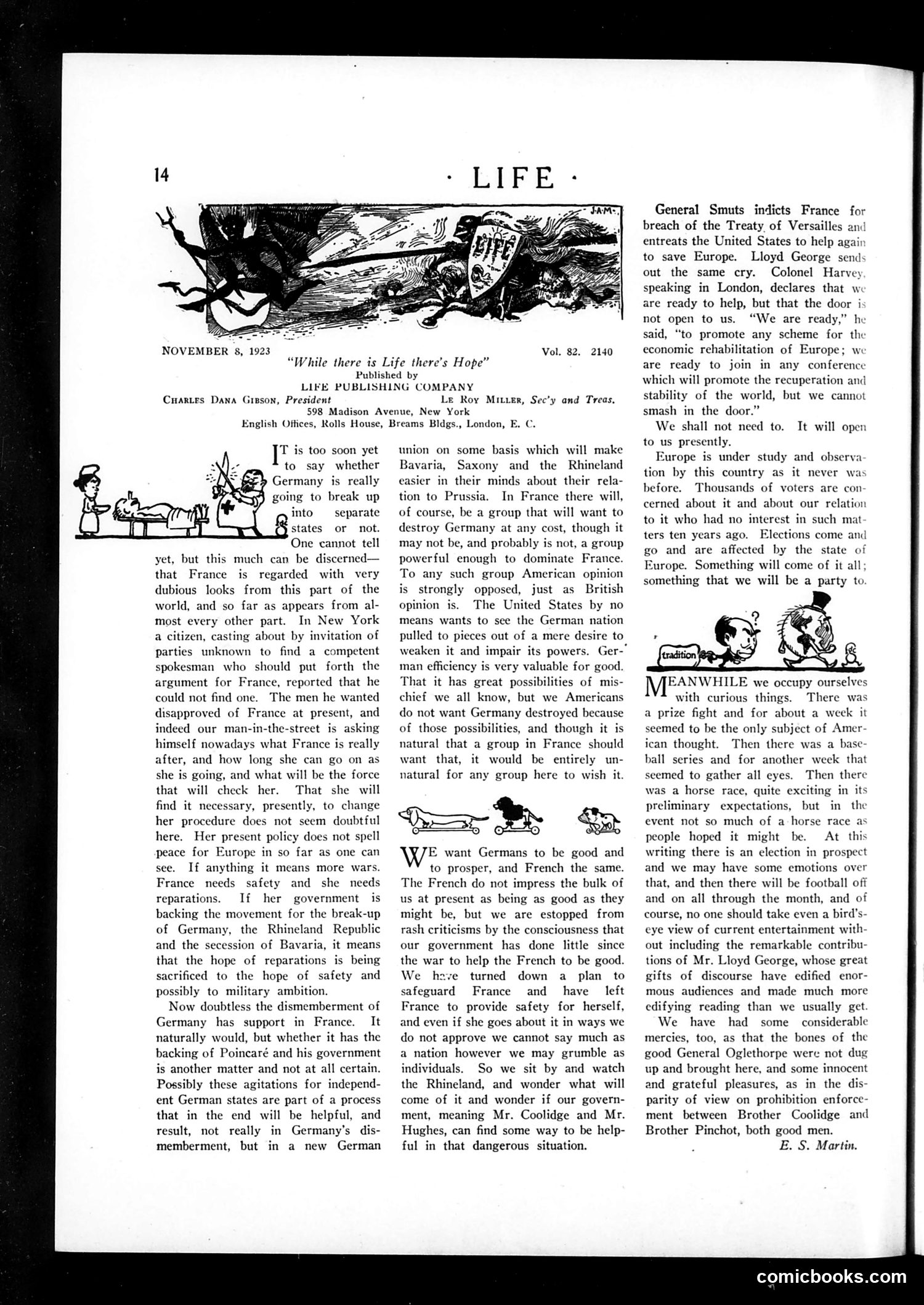
The main cartoon at top depicts Germany "breaking into separate pieces"—a visual metaphor for the political fragmentation occurring in post-WWI Germany. The illustration shows a figure (representing Germany) literally splintering apart, reflecting anxieties about the Rhineland Republic and Bavarian independence movements discussed in the article. The accompanying text discusses whether France can remain unified while Germany splinters, and debates American policy toward European reconstruction. The article expresses skepticism about both German and French intentions while advocating American caution in European affairs. The smaller cartoon below depicts various modes of transportation (horse, car, motorcycle), likely illustrating the article's discussion about diverse American interests and perspectives on European matters. The satire critiques post-war European instability and American isolationism.
📄 Transcribed text from this page (OCR, searchable)
Machine-transcribed from the original scan — historical spelling and the odd misread are preserved.
NOVEMBER §, 1923 Vol. 82. 2140 “While there is Life there’s Hope” Published by LIFE PUBLISHING COMPANY Cartes Dana Gipson, President Le Roy Mitzer, Sec’y and Treas, 598 Madison Avenue, New York English Offices, Rolls House, Breams Bldgs., London, E. C. T is too soon yet to say whether % Germany is really going to break up into separate states or not. One cannot tell yet, but this much can be discerned— that France is regarded with very dubious looks from this part of the world, and so far as appears from al- most every other part. In New York a citizen, casting about by invitation of parties unknown to find a competent spokesman who should put forth the argument for France, reported that he could not find one. The men he wanted disapproved of France at present, and indeed our man-in-the-street is asking himself nowadays what France is really after, and how long she can go on as she is going, and what will be the force that will check her. That she will find it necessary, presently, to change her procedure does not seem doubtful here. Her present policy does not spell peace for Europe in so far as one can s If anything it means more wars. France needs safety and she reparations. If her government is backing the movement for the break-up of Germany, the Rhineland Republic and the secession of Bavaria, it means that the hope of reparations is being sacrificed to the hope of safety and possibly to military ambition. Now doubtless the dismemberment of Germany has support in France. It naturally would, but whether it has the backing of Poincaré and his government is another matter and not at all certain. Possibly these agitations for independ- ent German states are part of a process that in the end will be helpful, and result, not really in Germany's dis- memberment, but in a new German needs union on some basis which will make Bavaria, Saxony and the Rhineland easier in their minds about their rela- tion to Prussia. In France there will, of course, be a group that will want to destroy Germany at any cost, though it may not be, and probably is not, a group powerful enough to dominate France. To any such group American opinion is strongly opposed, just as British The United States by no means wants to see the German nation opinion is. pulled to pieces out of a mere desire to weaken it and impair its powers. Ger-" man efficiency is very valuable for good. That it has great pos: ities of mis- chief we all know, but we Americans do not want Germany destroyed because of those possibilities, and though it is natural that a group in France should want that, it would be entirely un- natural for any group here to wish it. GB & E want Germans to be good and to prosper, and French the same. The French do not impress the bulk of us at present as being as good as they might be, but we are estopped from rash criticisms by the consciousness that our government has done little since the war to help the French to be good. We heve turned down a plan to safeguard France and have left France to provide safety for herself, and even if she goes about it in ways we do not approve we cannot say much as a nation however we may grumble as individuals. So we sit by and watch the Rhineland, and wonder what will come of it and wonder if our govern- ment, meaning Mr. Coolidge and Mr. Hughes, can find some way to be help- ful in that dangerous situation. General Smuts indicts France for breach of the Treaty of Versailles and entreats the United States to help again to save Europe. Lloyd George sends out the same cry. Colonel Harvey speaking in London, declares that w are ready to help, but that the door i not open to us. “We are ready,” he said, “to promote any scheme for the economic rehabilitation of Europe; we are ready to join in any conference which will promote the recuperation and stability of the world, but we cannot smash in the door.” We shall not need to. to us presently. Europe is under study and observa tion by this country as it never was before. Thousands of voters are con cerned about it and about our relation to it who had no interest in such mat ters ten years ago. Elections come and go and are affected by the state of Europe. Something will come of it all; something that we will be a party to. Tt will open SANWHILE we occupy ourselves with curious things. There v a prize fight and for about a week it seemed to be the only subject of Amer- ican thought. Then there was a base- ball series and for another week that seemed to gather all eyes. Then there was a horse race, quite exciting in its preliminary expectations, but in the event not so much of a horse race as people hoped it might be. At this writing there is an election in prospect and we may have some emotions over that, and then there will be football off and on all through the month, and of course, no one should take even a bird’s- eye view of current entertainment with- out including the remarkable contribu- tions of Mr. Lloyd George, whose great gifts of discourse have edified enor- mous audiences and made much more edifying reading than we usually get We have had some considerable mercies, too, as that the bones of the good General Oglethorpe were not dug up and brought here, and some innocent and grateful pleasures, as in the dis- parity of view on prohibition enforce- ment between Brother Coolidge and Brother Pinchot, both good men. E. S. Martin. comicbooks.com