
Life, 1923-11-08 · page 13 of 36
Life — November 8, 1923 — page 13: what you’re looking at
What you’re looking at
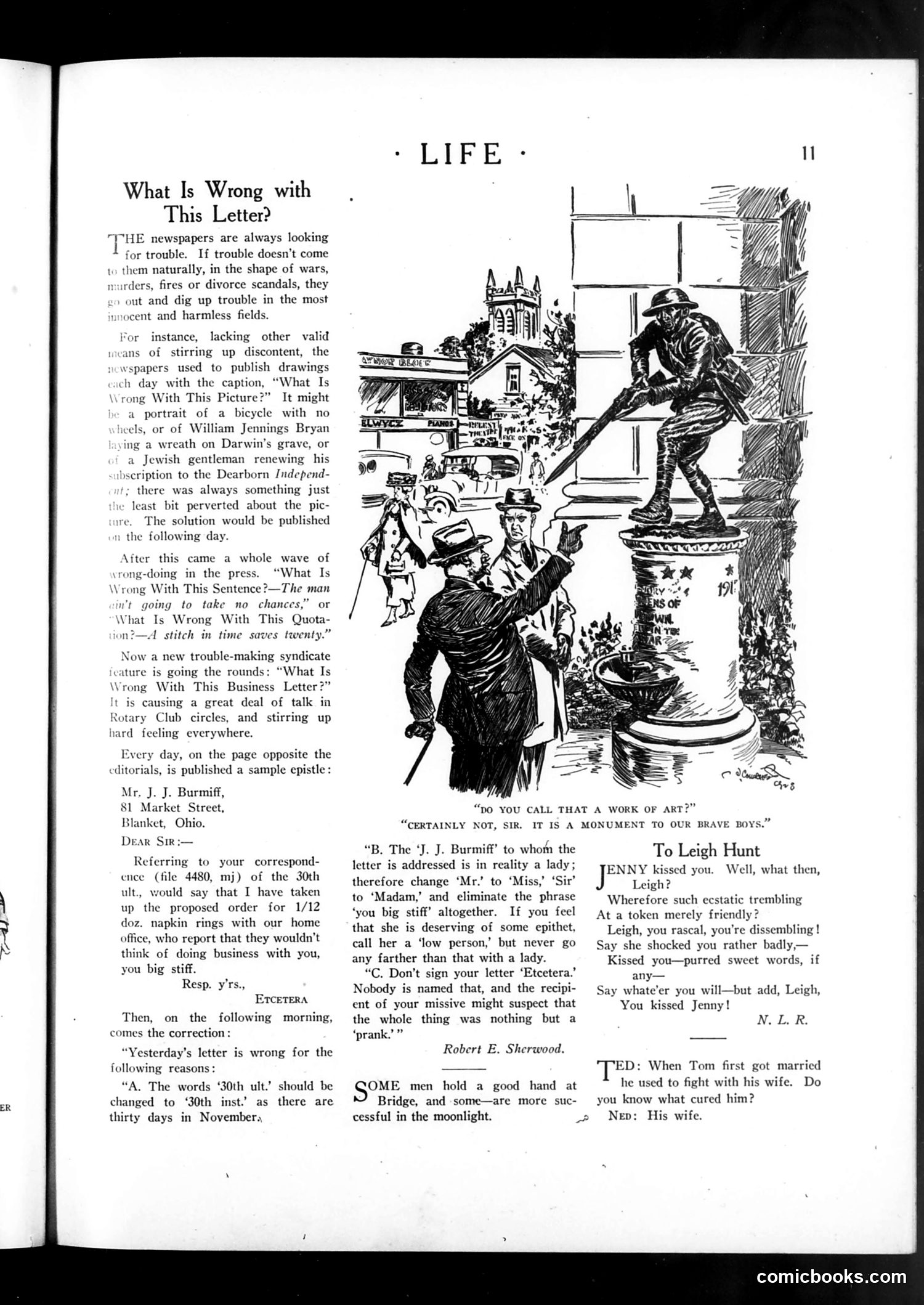
This page satirizes newspapers' practice of publishing reader letters with intentional errors, then asking audiences "what's wrong?" The main illustration shows a chaotic urban scene with various figures and monuments, meant to contain hidden absurdities for readers to spot. The article mocks this trend as artificial trouble-making by newspapers lacking genuine news. It references a specific letter-writing format that sparked multiple "what's wrong" variations in the press, including quotations and sentences. The satire criticizes how this creates unnecessary controversy, particularly in Rotary Club circles. The page also includes unrelated humorous verses ("To Leigh Hunt") and a brief joke about married couples fighting. This represents Life's typical satirical approach: poking fun at media sensationalism and popular fads.
📄 Transcribed text from this page (OCR, searchable)
Machine-transcribed from the original scan — historical spelling and the odd misread are preserved.
What Is Wrong with This Letter? "THE newspapers are always looking for trouble. If trouble doesn’t come to them naturally, in the shape of wars, yurders, fires or divorce scandals, they out and dig up trouble in the most ocent and harmless fields. For instance, lacking other valid ans of stirring up discontent, the wspapers used to publish drawings ch day with the caption, “What Is rong With This Picture?” It might a portrait of a bicycle with no cels, or of William Jennings Bryan ing a wreath on Darwin's grave, or a Jewish gentleman renewing his scription to the Dearborn Independ- ; there was always something just least bit perverted about the pic- re. The solution would be published the following day. After this came a whole wave of rong-doing in the pr “What Is \rong With This Sentence ?—The man n't going to take no chances,” or What Is Wrong With This Quota- m?—Al stitch in time saves twenty.” Now a new trouble-making syndicate cature is going the rounds: “What Is Wrong With This Business Letter?” It is causing a great deal of talk in Rotary Club circles, and stirring up hard feeling everywhere. Every day, on the page opposite the editorials, is published a sample epistle : Mr. J. J. Burmiff, 81 Market Street, Blanket, Ohio. Dear Sir:— Referring to your correspond- ence (file 4480, mj) of the 30th ult, would say that I have taken up the proposed order for 1/12 doz. napkin rings with our home office, who report that they wouldn't think of doing business with you, you big stiff. Resp. y’rs., ETCETERA Then, on the following morning, s the correction : “Yesterday's letter is wrong for the following reasons: “A. The words ‘30th ult.’ should be changed to ‘30th inst.’ as there are thirty days in November, LFWOT BLOT “po YOU CALL THAT A WORK OF ART?” “CERTAINLY NOT, SIR. “B. The ‘J. J. Burmiff’ to whom the letter is addressed is in reality a lady; therefore change ‘Mr.’ to ‘Miss,’ ‘Sir’ to ‘Madam,’ and eliminate the phrase ‘you big stiff’ altogether. If you feel that she is deserving of some epithet, call her a ‘low person,’ but never go any farther than that with a lady. “C. Don’t sign your letter ‘Etcetera.’ Nobody is named that, and the recipi- ent of your missive might suspect that the whole thing was nothing but a ‘prank.’” Robert E. Sherwood. hand at OME men hold a good Bridge, and some—are more suc- cessful in the moonlight. es) IT IS A MONUMENT TO OUR BRAVE BOYS.” To Leigh Hunt ENNY kissed you. Well, what then, Leigh? Wherefore such ecstatic trembling At a token merely friendly? Leigh, you rascal, you're dissembling ! Say she shocked you rather badly,— Kissed you—purred sweet words, if any— Say whate’er you will—but add, Leigh, You kissed Jenny! N.L.R. ED: When Tom first got married he used to fight with his wife. Do you know what cured him? Nev: His wife. comicbooks.com