
Life, 1923-11-08 · page 7 of 36
Life — November 8, 1923 — page 7: what you’re looking at
What you’re looking at
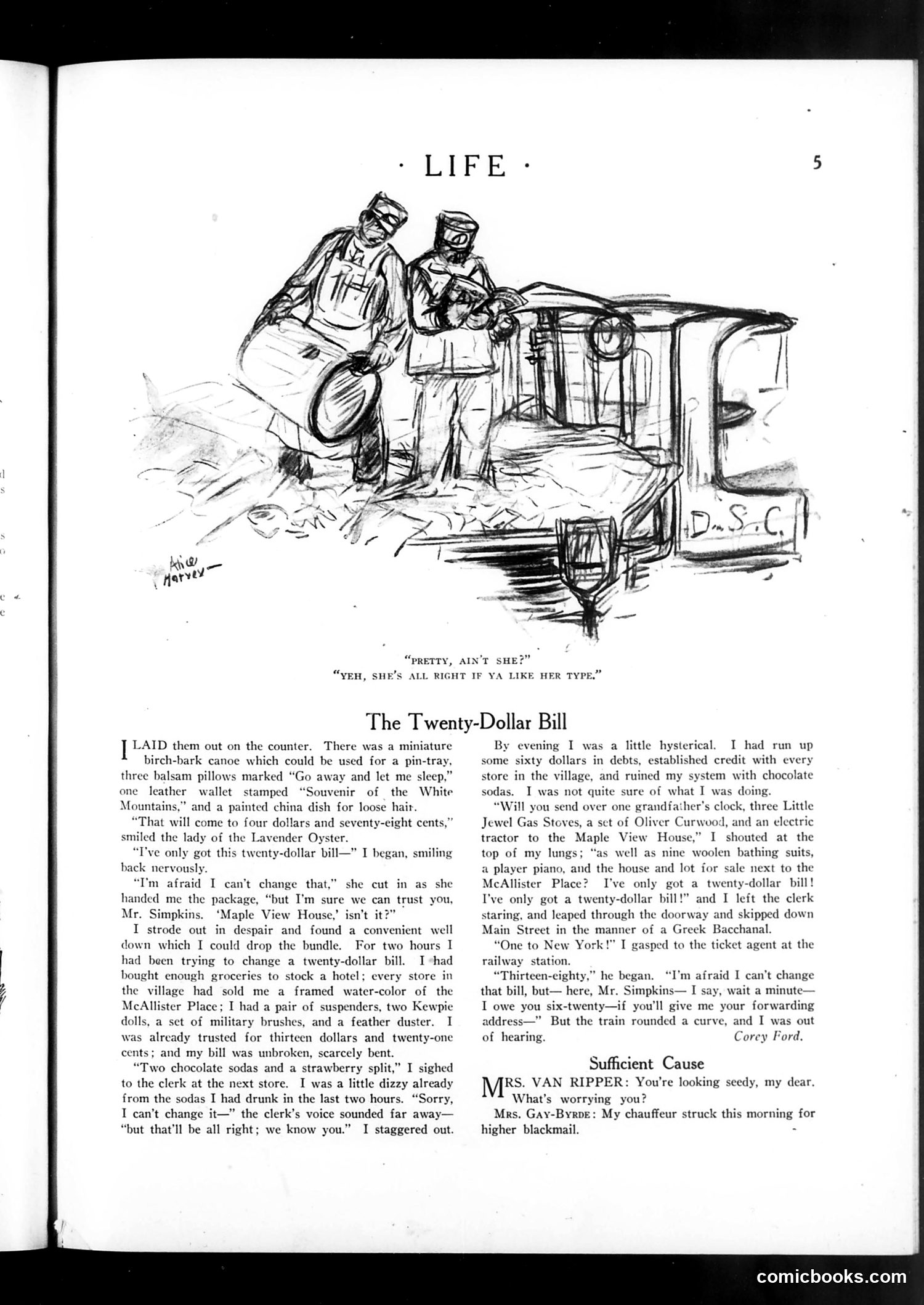
The cartoon at top depicts two figures examining an automobile, with caption dialogue about a woman's appearance ("Pretty, ain't she?" / "Yeh, she's all right if ya like her type"). This is a visual pun comparing a woman to a car—a satire on how men objectify women by treating them as interchangeable commodities, like automobiles. Below are two prose stories: "The Twenty-Dollar Bill" (by Corey Ford) concerns financial desperation and inability to change a bill, and "Sufficient Cause" features characters Mrs. Van Ripper and Mrs. Gay-Byrne discussing a chauffeur and blackmail. The page reflects early-20th-century satirical humor targeting consumer culture, gender relations, and middle-class anxieties about money and social standing.
📄 Transcribed text from this page (OCR, searchable)
Machine-transcribed from the original scan — historical spelling and the odd misread are preserved.
“PRETTY, AIN'T SHE? E'S ALL RIGHT IF YA LIKE HER TYPE.” The Twenty-Dollar Bill | LAID them out on the counter. There was a miniature birch-bark canoe which could be used for a pin-tray, three balsam pillows marked “Go away and let me sleep,” one leather wallet stamped “Souvenir of the White Mountair and a painted china dish for loose hair. “That will come to four dollars and seventy-eight cents,” smiled the lady of the Lavender Oyster. “T've only got this twenty-dollar bill—” I began, smiling I can’t change that,” she cut in as she handed me the package, “but I’m sure we can trust you, Mr. Simpkins. ‘Maple View House,’ isn’t it I strode out in despair and found a convenient well down which I could drop the bundle. For two hours I had been trying to change a twenty-dollar bill. I shad bought enough groceries to stock a hotel; every store in the village had sold me a framed water-color of the McAllister Place; I had a pair of suspenders, two Kewpie dolls, a set of military brushes, and a feather duster. I was already trusted for thirteen dollars and twenty-one cents; and my bill was unbroken, scarcely bent. “Two chocolate sodas and a strawberry split,” I sighed to the clerk at the next store. I was a little dizzy already from the sodas I had drunk in the last two hours. “Sorry, I can’t change it—” the clerk’s voice sounded far away— “but that'll be all right; we know you.” I staggered out. By evening I was a little hysterical. I had run up some sixty dollars in debts, established credit with every store in the village, and ruined my system with chocolate s. I was not quite sure of what I was doing. “Will you send over one grandfather's clock, three Little Jewel Gas Stoves, a set of Oliver Curwood, and an electric tractor to the Maple View House,” I shouted at the top of my lungs; “as well as nine woolen bathing suits, a player piano, and the house and lot for sale next to the McAllister Place? I've only got a twenty-dollar bill! I've only got a twenty-dollar bill!” and I left the clerk staring, and leaped through the doorway and skipped down Main Street in the manner of a Greek Bacchanal. “One to New York!" I gasped to the ticket agent at the rail i “Thirteen-eighty,” he began. “I'm afraid I can't change that bill, but— here, Mr. Simpkins— I say, wait a minute— I owe you six-twenty—if you'll give me your forwarding address—” But the train rounded a curve, and I was out of hearing. Corey Ford. Sufficient Cause RS. VAN RIPPER: You're looking seedy, my dear. What's worrying you? Mrs. Gay-Byrve: My chauffeur struck this morning for higher blackmail. : comicbooks.com