
A complete issue · 36 pages · 1923
Life — September 20, 1923
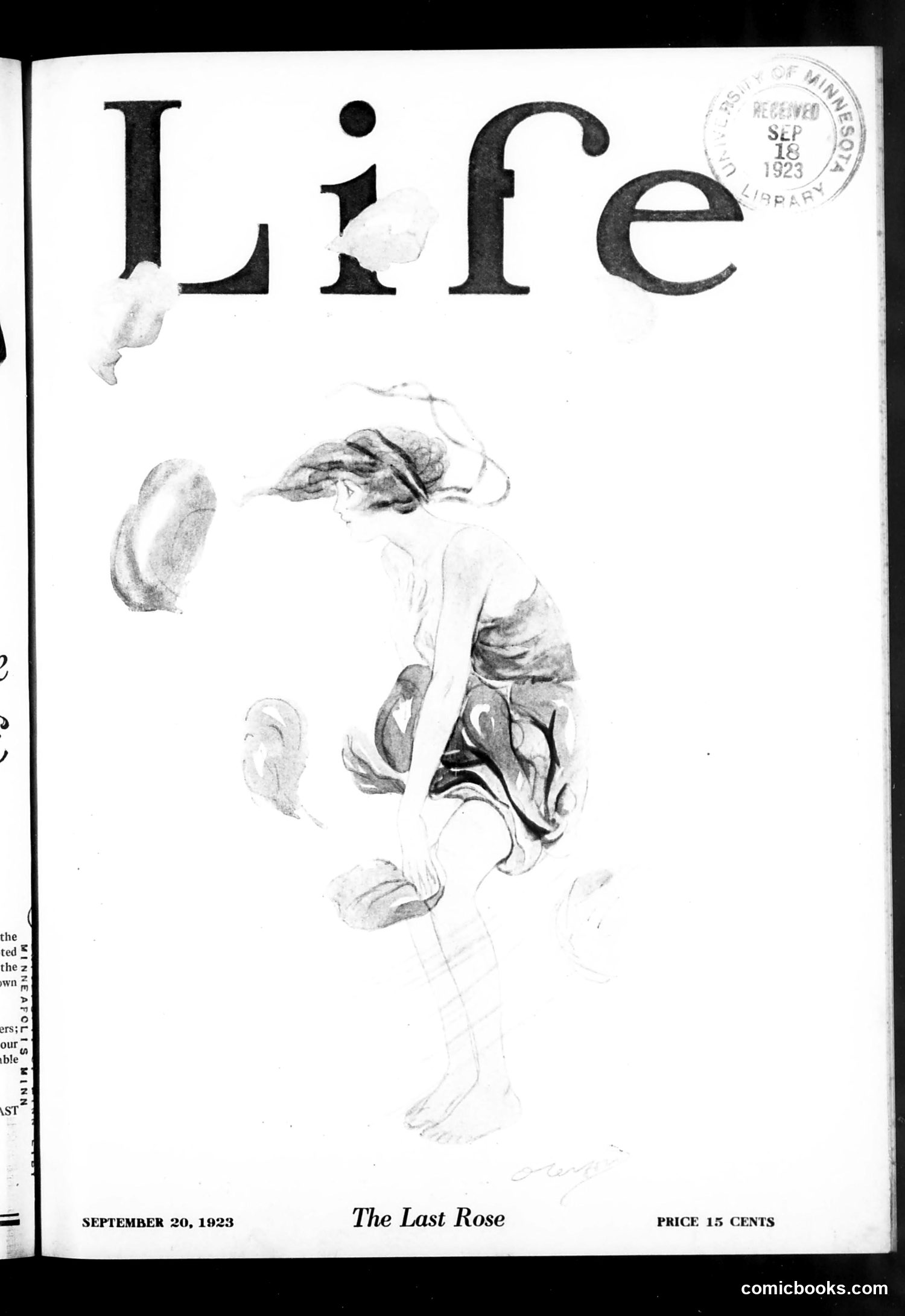
This is a cover illustration titled "The Last Rose" depicting a figure in classical or allegorical style—appearing to be a woman in flowing garments, rendered in sketch form. The figure seems to embody a feminine concept, likely representing beauty, romance, or innocence given the title's reference to a "last rose." Without additional context from the magazine's interior, the specific satirical target is unclear. However, the melancholic tone and "last" framing suggest commentary on something fading or ending in 1923 American culture—possibly romantic ideals, social innocence, or artistic sensibility in the post-WWI era. The price of 15 cents indicates this was a popular weekly satirical publication aimed at middle-class readers.
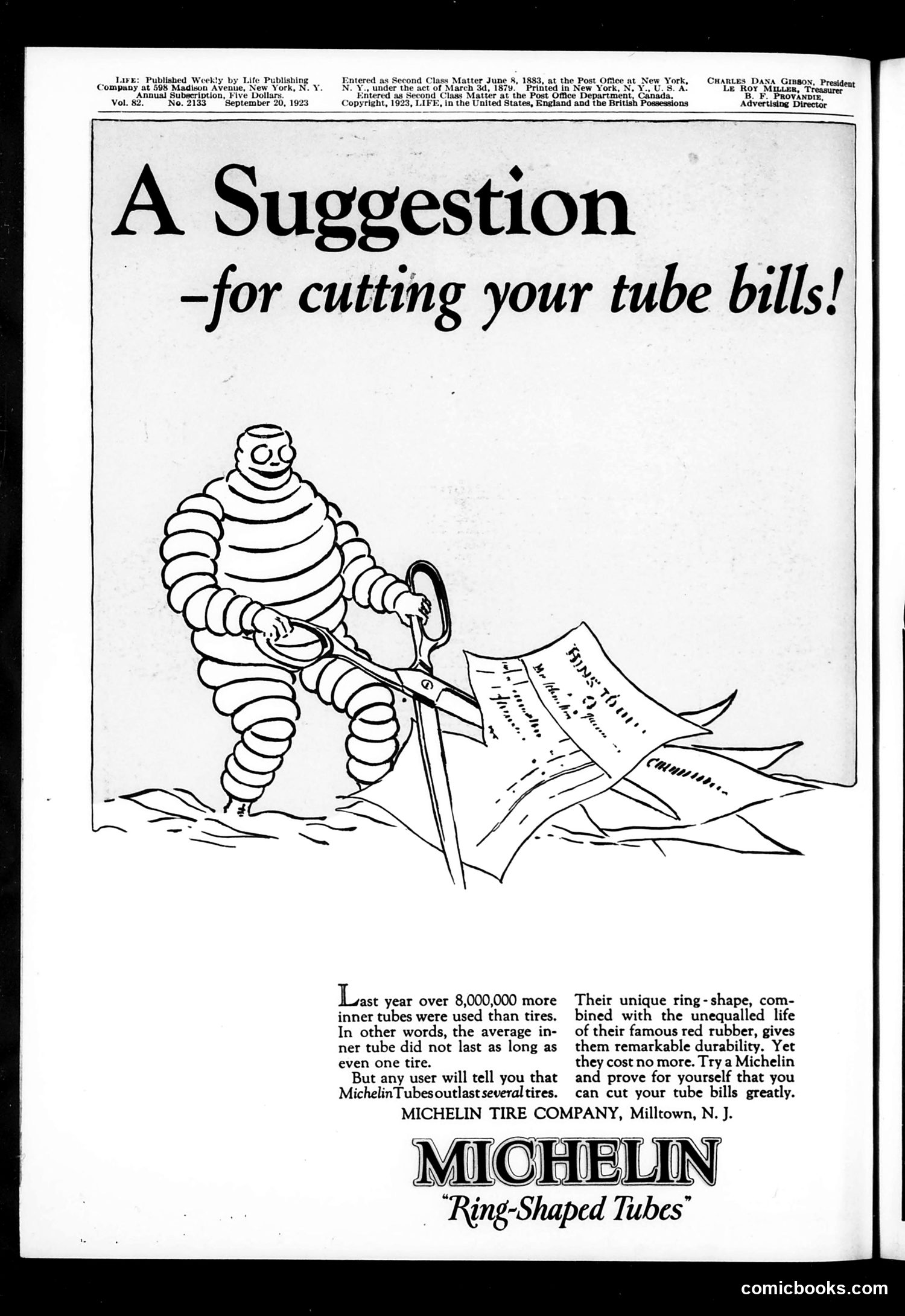
This is a **Michelin Tire advertisement**, not political satire. The page features a cartoon of the Michelin Man (Bibendum)—the company's mascot made of stacked tire tubes—wielding giant scissors to cut through bills or invoices. The ad's humor is straightforward commercial messaging: Michelin's ring-shaped inner tubes supposedly last longer than competitors' tires, thereby reducing owners' replacement costs and "cutting" their expenses. The text claims Michelin tubes "outlast several tires" and cost no more than alternatives. The "suggestion" in the headline is simply a sales pitch—buy Michelin tubes to reduce your vehicle maintenance bills. This represents typical early-20th-century advertising humor: personifying the brand mascot performing an action related to the product's benefit.
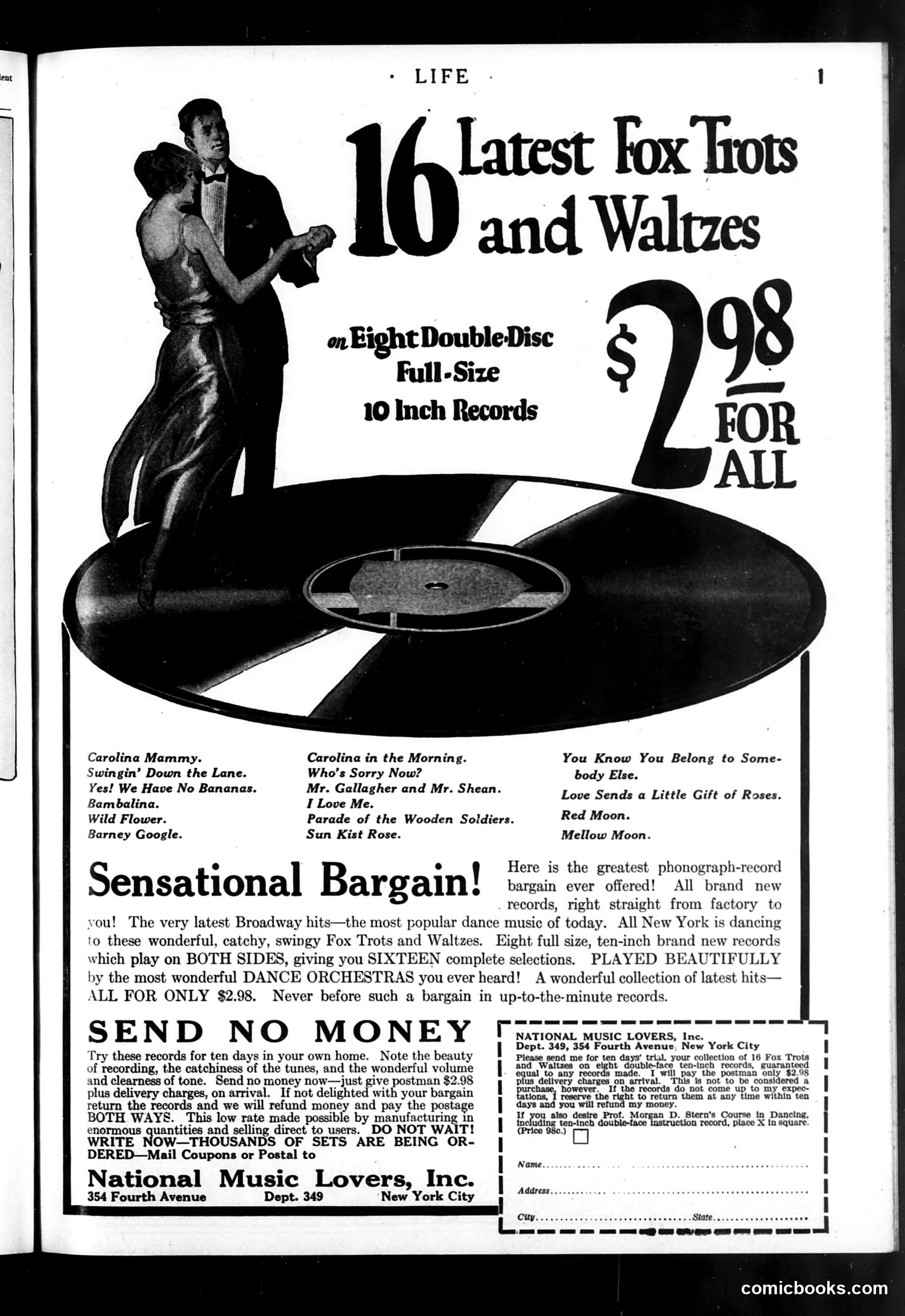
This page is **primarily an advertisement**, not political satire. National Music Lovers, Inc. is selling a "sensational bargain" record set: 16 fox trots and waltzes on eight double-disc, 10-inch records for $2.98. The illustration shows a dancing couple in formal wear, positioned decoratively atop a phonograph record. This imagery reflects 1920s popular culture—the "wonderful, catchy, swangy Fox Trots and Waltzes" advertised were contemporary dance music. The pitch emphasizes affordability and mail-order convenience ("Send No Money"), typical of direct-marketing tactics of the era. Song titles listed (like "Carolina Mammy" and "Mellow Moon") represent popular hits of the period. There is no discernible political commentary—this is straightforward consumer advertising.
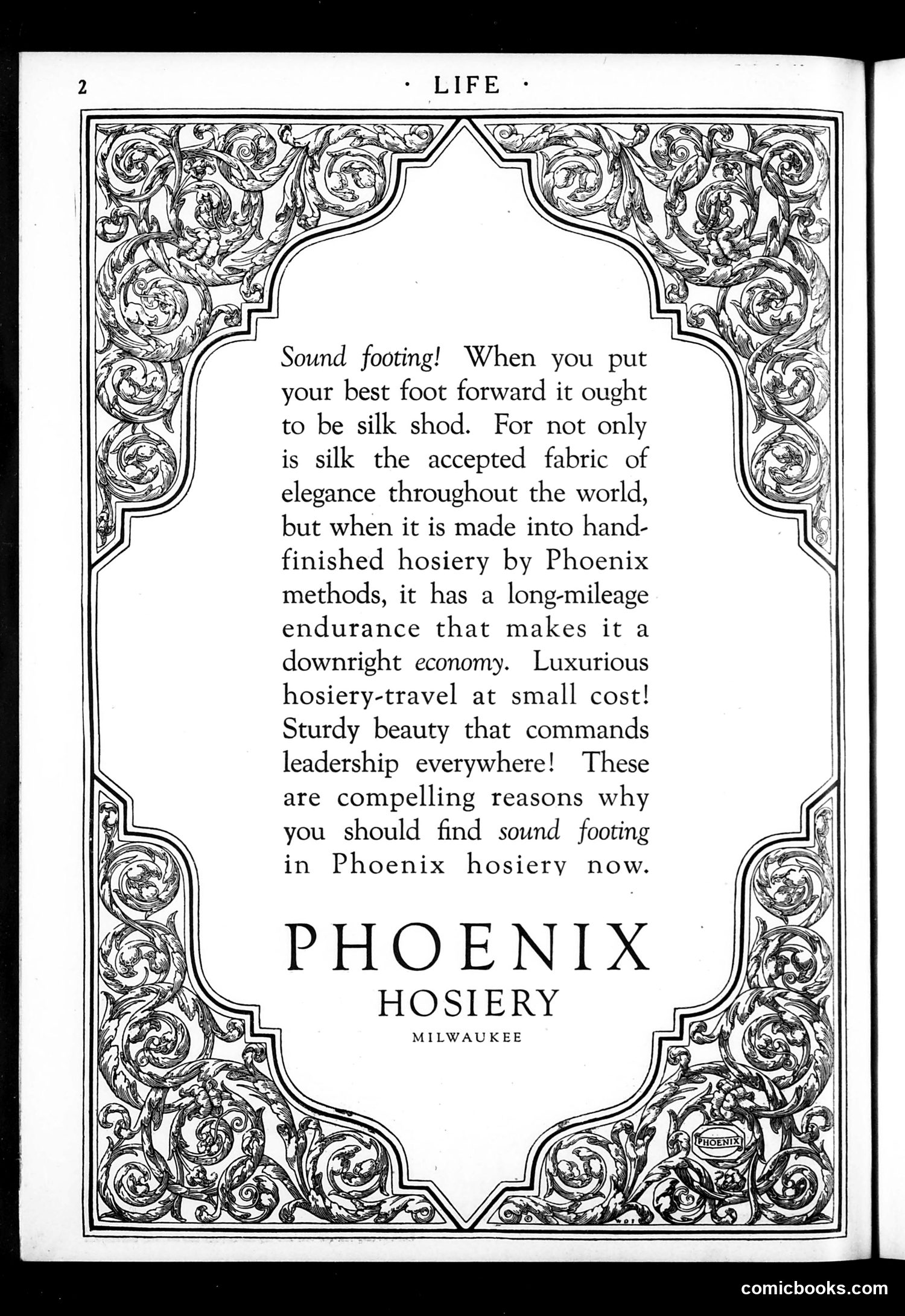
This is not a cartoon or satirical content—it's a **straightforward advertisement** for Phoenix Hosiery, a Milwaukee manufacturer of silk stockings. The ad uses the phrase "Sound footing!" as a pun (footing = feet, and sound = solid/dependable) to pitch silk stockings as both luxurious and economical. It emphasizes that Phoenix's "hand-finished" hosiery offers durability and long wear despite the high cost of silk, making it a smart investment rather than mere luxury. The ornate border is purely decorative, typical of early 20th-century magazine design. There is no political satire, caricature, or social commentary—simply period advertising rhetoric highlighting product quality and value to affluent consumers, likely women.
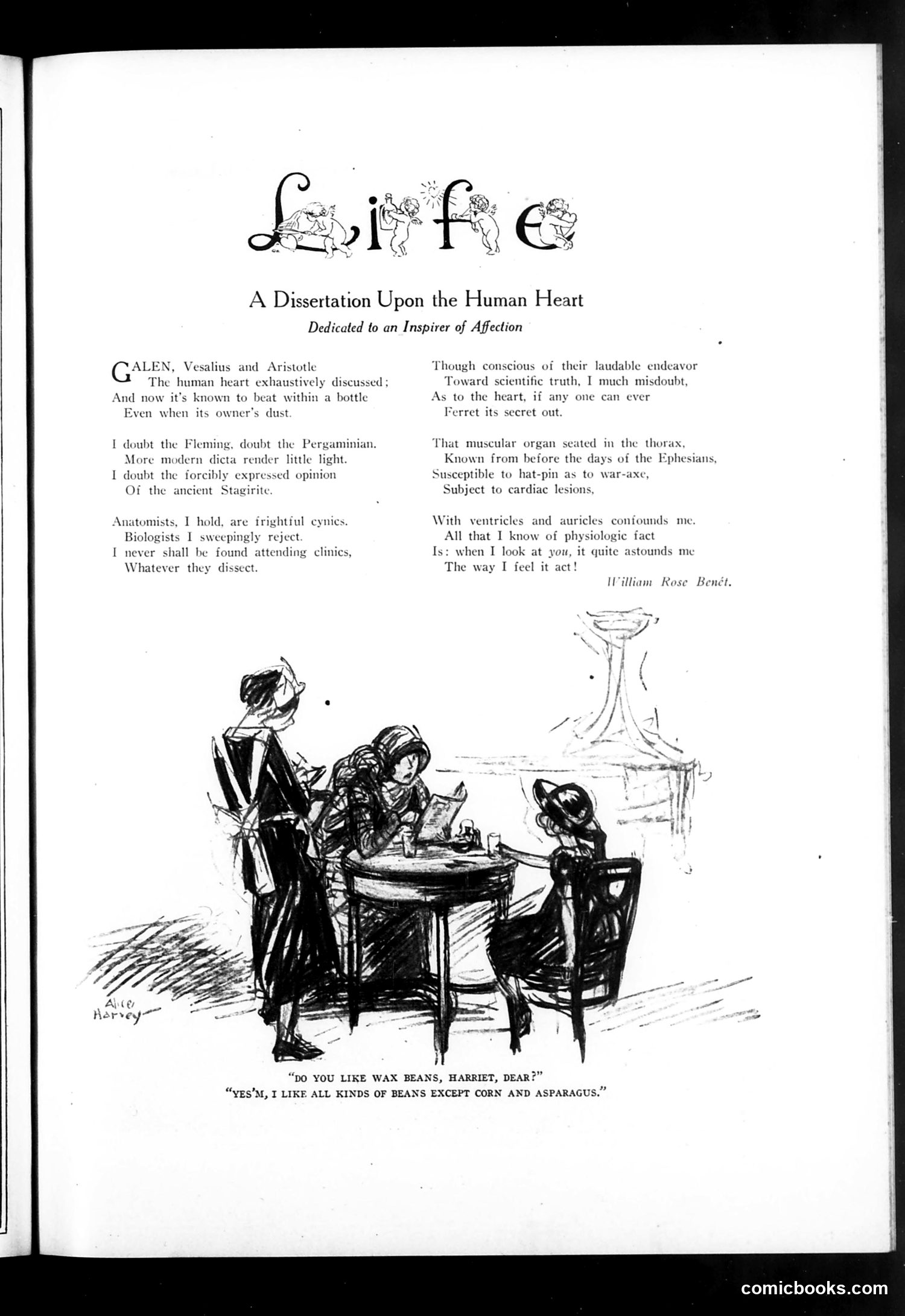
This page from *Life* magazine presents a satirical essay titled "Life: A Dissertation Upon the Human Heart," mocking pseudo-scientific anatomical discussions of the heart's nature. The poem dismisses historical authorities (Galen, Vesalius, Aristotle) and modern scientific clinics as missing the point—the heart's true nature is emotional rather than physiological. The accompanying illustration shows a domestic dinner scene with a woman, man, and child. The caption presents mundane dialogue about food preferences ("Do you like wax beans, Harriet, dear?"), contrasting sharply with the romantic, poetic language above. The satire's point: while scholars debate the heart's physical mechanics, everyday married life reveals the heart's true domain—domestic routine and affection. The gap between elevated rhetoric and prosaic reality creates the humor.
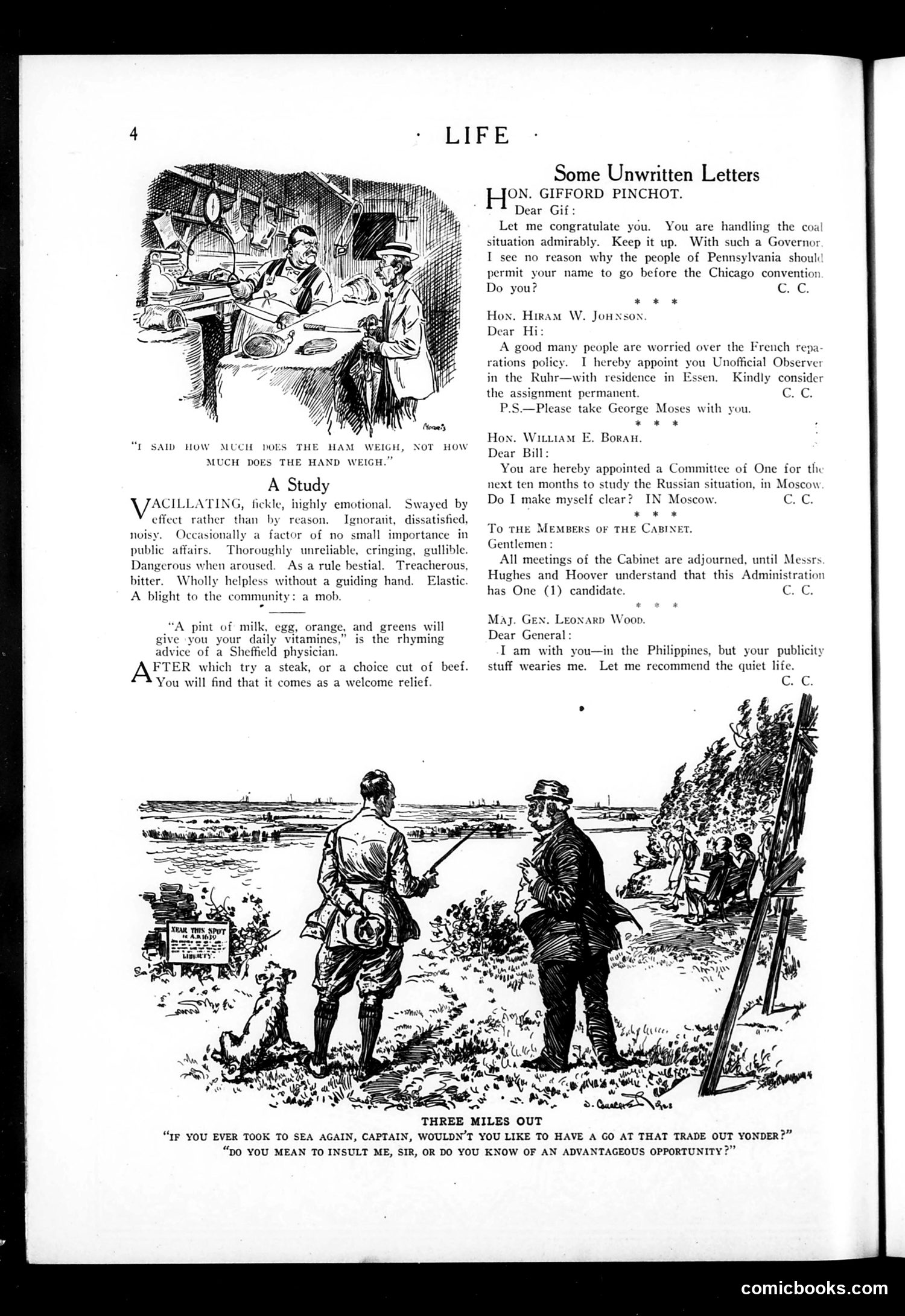
This page contains satirical letters to government officials and two illustrated jokes. **Top cartoon** depicts men at a table, captioned about ham weight versus hand weight—likely satirizing political figures' deceptive claims or misrepresentation of facts. **"A Study" section** uses medical vocabulary (vacillating, treacherous, bestial) to mock public figures' character flaws, concluding with health advice about milk, eggs, and steak—suggesting these politicians need basic care. **Bottom cartoon** shows a military officer and civilian at a beach, with dialogue about taking "to sea again" and "advantageous opportunity"—appears to mock either military recruitment, war profiteering, or political favor-seeking during WWI era. The accompanying letters reference Pennsylvania coal disputes, French reparations policy, and Russian situations, indicating this satirizes early 20th-century political controversies and government incompetence.
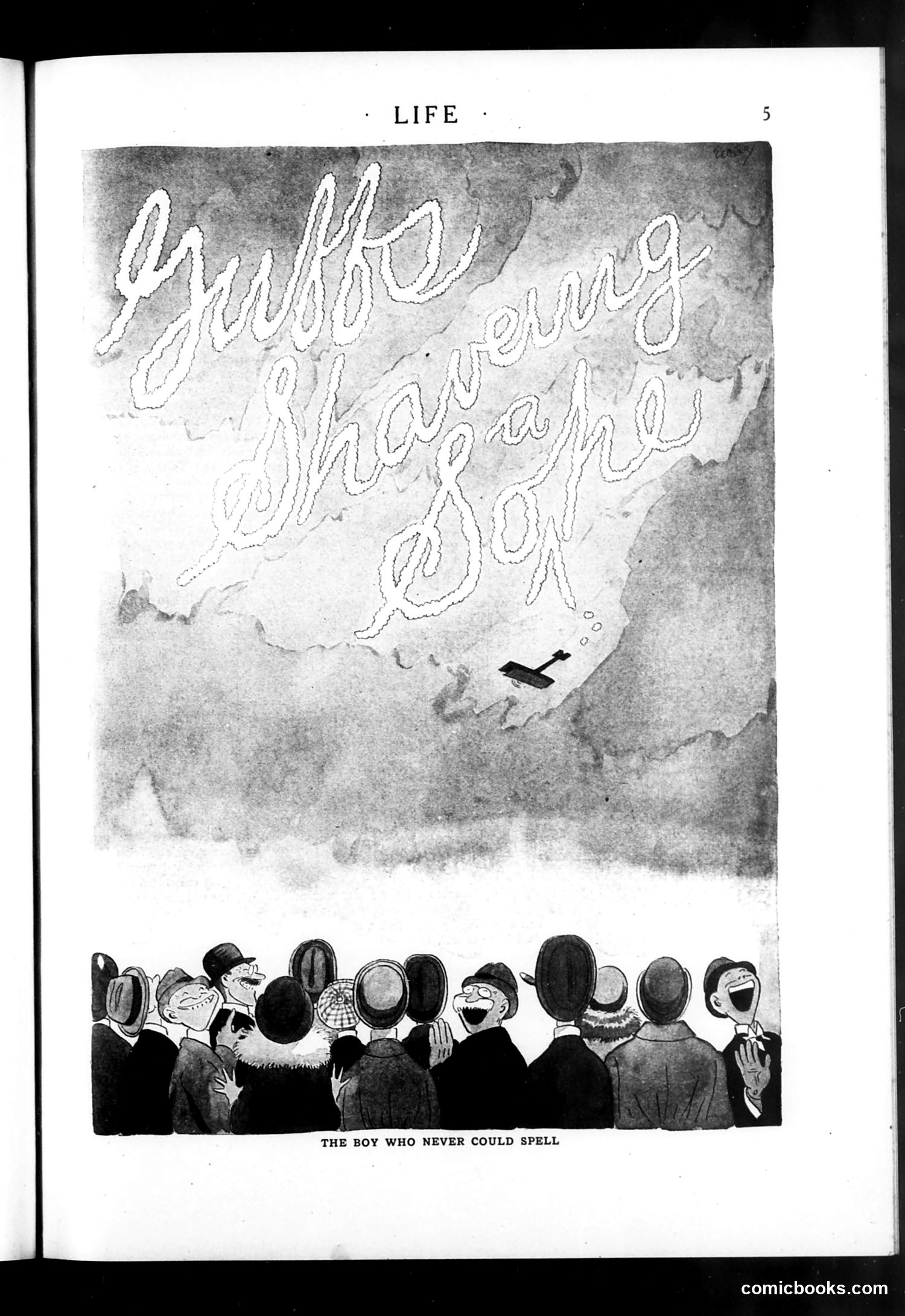
This cartoon satirizes a common schoolchild experience through visual humor. A crowd of onlookers gazes upward at skywriting that reads "Spelling a Warning Boy" (or similar—the text is deliberately illegible/misspelled). The caption "The Boy Who Never Could Spell" suggests the skywriting itself is the joke: the supposedly remedial student has now scaled up his spelling failures to dramatic, public proportions. The humor derives from the contrast between aspiration and incompetence—the boy's poor spelling skills are now literally writ large across the sky for all to witness. This appears to be gentle social satire about education and failure, typical of Life magazine's humor targeting relatable American experiences of the early-to-mid 20th century.
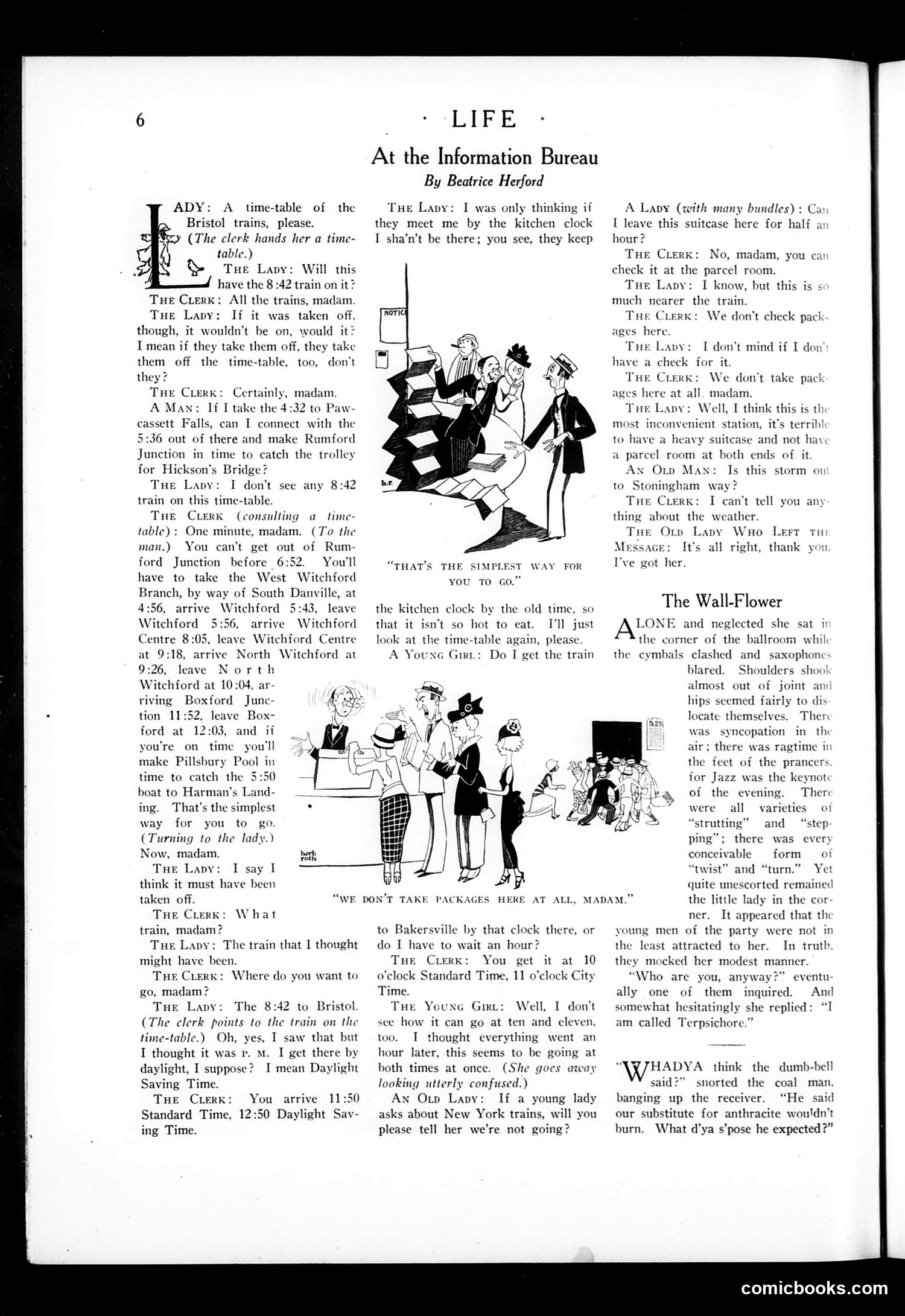
This two-panel satirical piece mocks the confusion and inefficiency of a British railway information bureau. In the first panel, a lady seeks train schedules; the clerk repeatedly struggles with time calculations and conflicting information, consulting timetables while admitting uncertainty about connections and arrivals. The second panel shows a crowded scene where the clerk definitively states "WE DON'T TAKE PACKAGES HERE AT ALL, MADAM"—suggesting that despite failing to answer legitimate questions, the staff firmly enforces the one rule they actually understand. The satire targets bureaucratic incompetence: workers who cannot perform their primary function but rigidly enforce minor regulations. The humor derives from this inverted logic and the exasperation it creates for ordinary travelers seeking basic information.
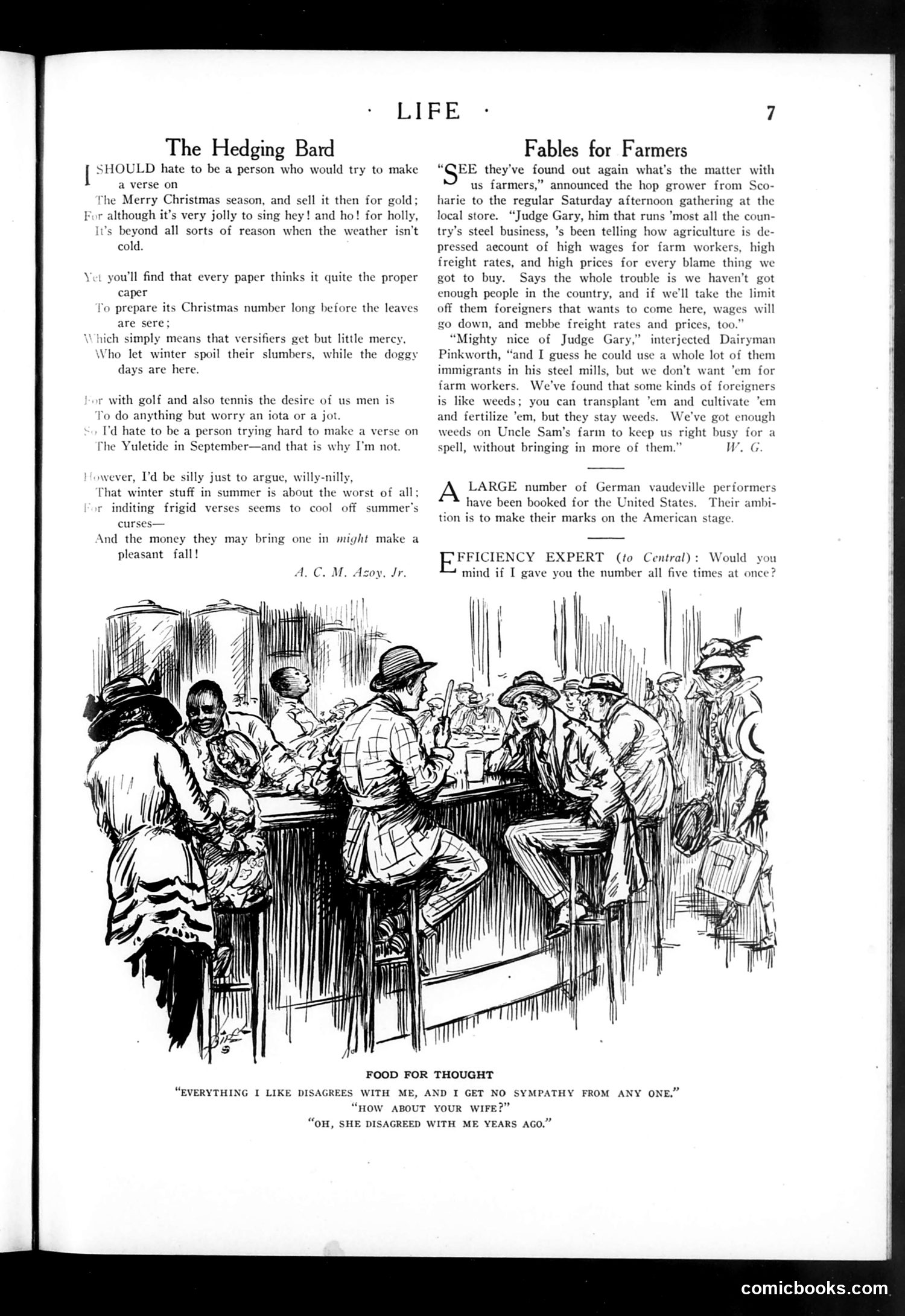
This page contains three distinct pieces of social commentary: 1. **"The Hedging Bard"** (left column): A poem by A.C.M. Asay, Jr. mocking versifiers who write about Christmas and summer topics. It satirizes the impracticality of forcing seasonal poetry when weather doesn't cooperate. 2. **"Fables for Farmers"** (top right): A brief anecdote featuring "Judge Gary" and "Pinkworthy," discussing agricultural problems—high wages, freight rates, and prices. The satire suggests that foreign immigrants are blamed for farm troubles, though the real issue is systemic. 3. **"Food for Thought"** (bottom): A cartoon depicting men at a bar. The caption records a domestic dispute: one man complains everything disagrees with him and gets no sympathy, then reveals his wife disagreed with him years ago. This is dark humor about marital discord and male grievance.
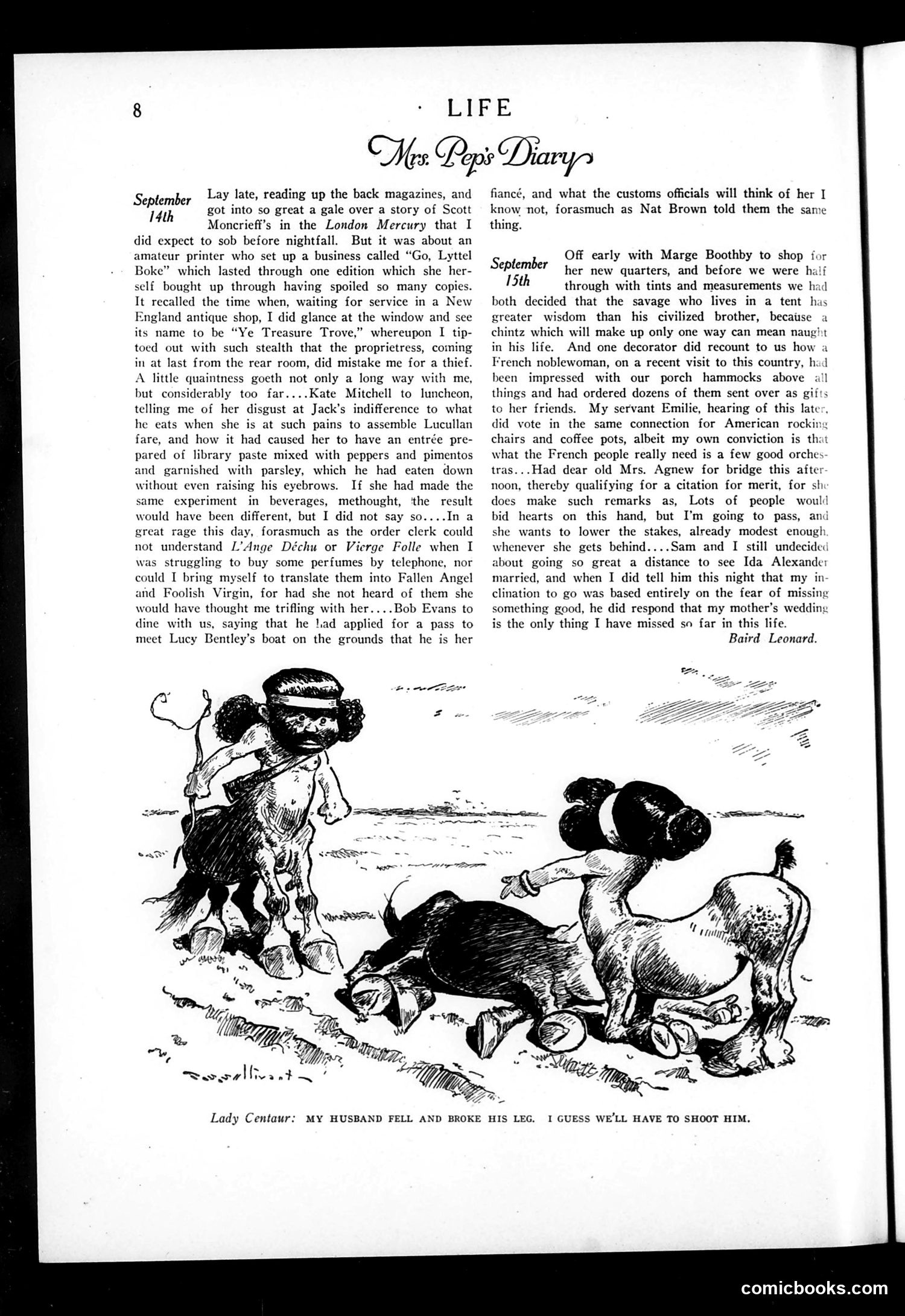
This page presents a satirical diary entry from "Mrs. Pep" documenting upper-class social pretensions. The September 15th entry mocks wealthy Americans' obsession with European culture—specifically French fashion and décor—treating imported French taste as a status symbol. The accompanying cartoon depicts a Lady Centaur (half-woman, half-horse) whose husband has broken his leg, with the grim suggestion "I guess we'll have to shoot him"—a dark joke about how wealthy people might dispose of injured horses, satirizing both the callousness of the wealthy and the absurdity of aristocratic concerns. Together, the content ridicules American nouveaux riches who uncritically adopt European sophistication while remaining morally shallow or ridiculous.
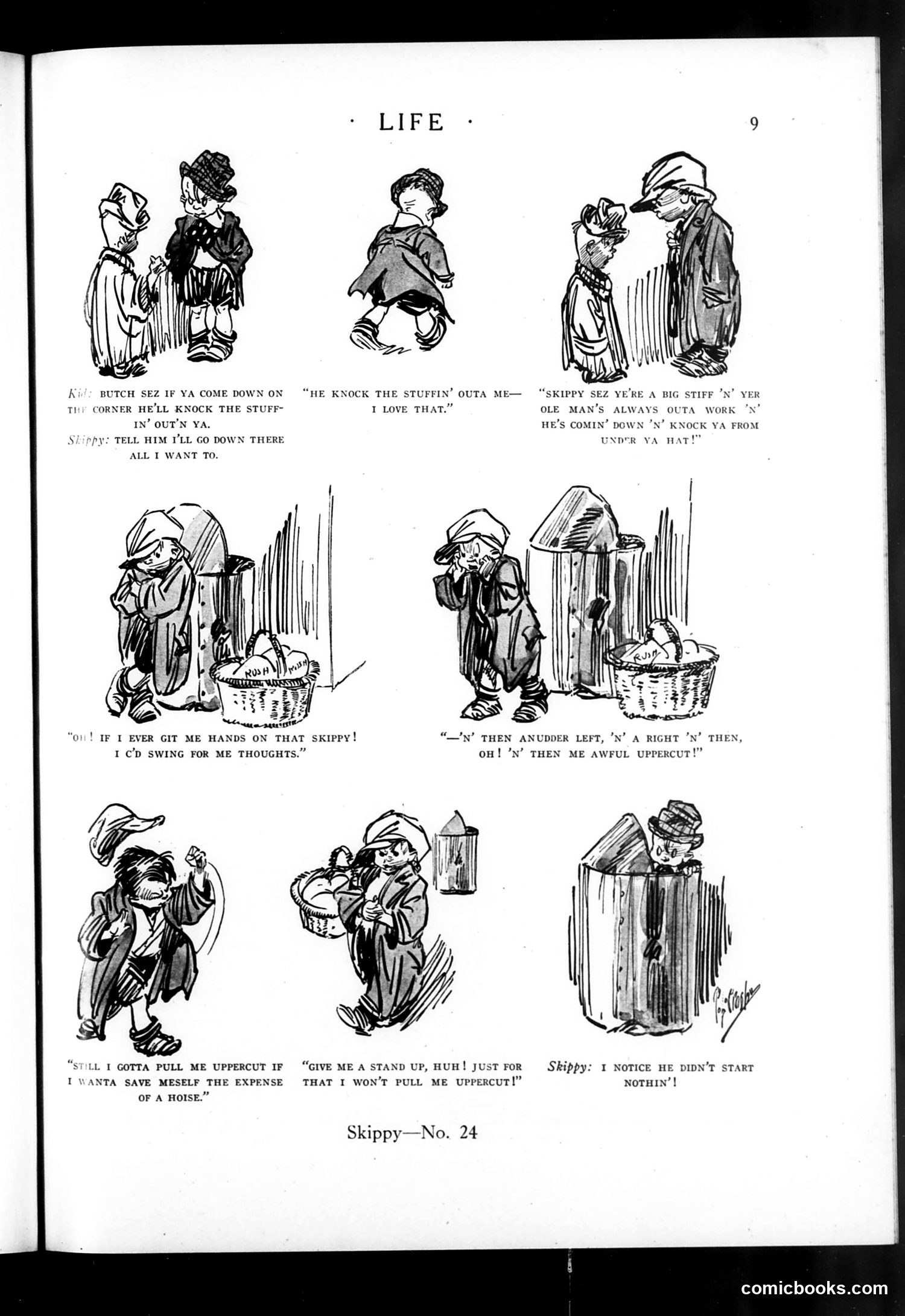
This is a comic strip titled "Skippy—No. 24" featuring a mischievous young boy character named Skippy. The strip depicts his interaction with an older man (likely meant to represent an authority figure or adult). The humor centers on Skippy's streetwise language and behavior—he uses slang expressions like "stiff," "knock ya from undr ya hat," and "uppercut." The running joke involves Skippy's threats of physical violence (knocking someone out, swinging "for me thoughts") contrasted with his small, weak appearance, which undercuts the menace. The final panel reveals the punchline: despite all his aggressive talk, Skippy "didn't start nothin'"—suggesting his bluster masks cowardice or that the threat was empty all along. This reflects 1920s-30s urban youth culture and humor about street-smart children.
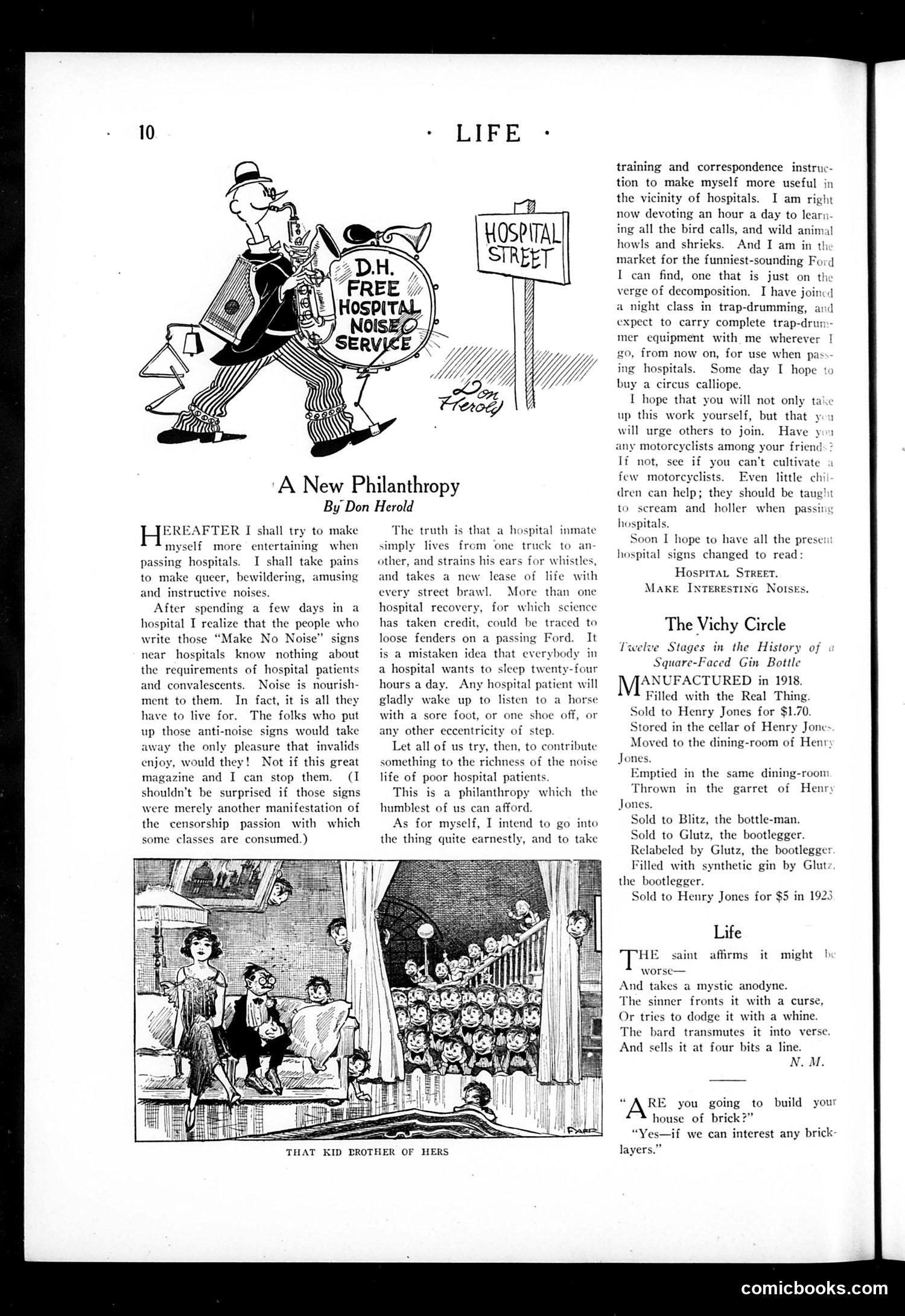
This page contains **"A New Philanthropy" by Don Herold**, a satirical article about hospital noise pollution. The cartoon depicts a man on a Ford vehicle labeled "D.H. FREE HOSPITAL NOISE SERVICE," riding past a "Hospital Street" sign. Herold's satire targets the assumption that hospital patients should endure constant disruption. He ironically proposes creating entertaining street noise—bird calls, animal howls, motorcycles, even a circus calliope—to prove that hospitals are unnecessarily quiet, contradicting the popular "Make Interesting Noises" campaign mentioned in the article. The humor lies in **mocking hospital culture's obsession with silence** and suggesting absurd alternatives. The accompanying illustration shows crowded hospital visitors, reinforcing how hospitals were already far from peaceful places despite their supposed quiet requirements.
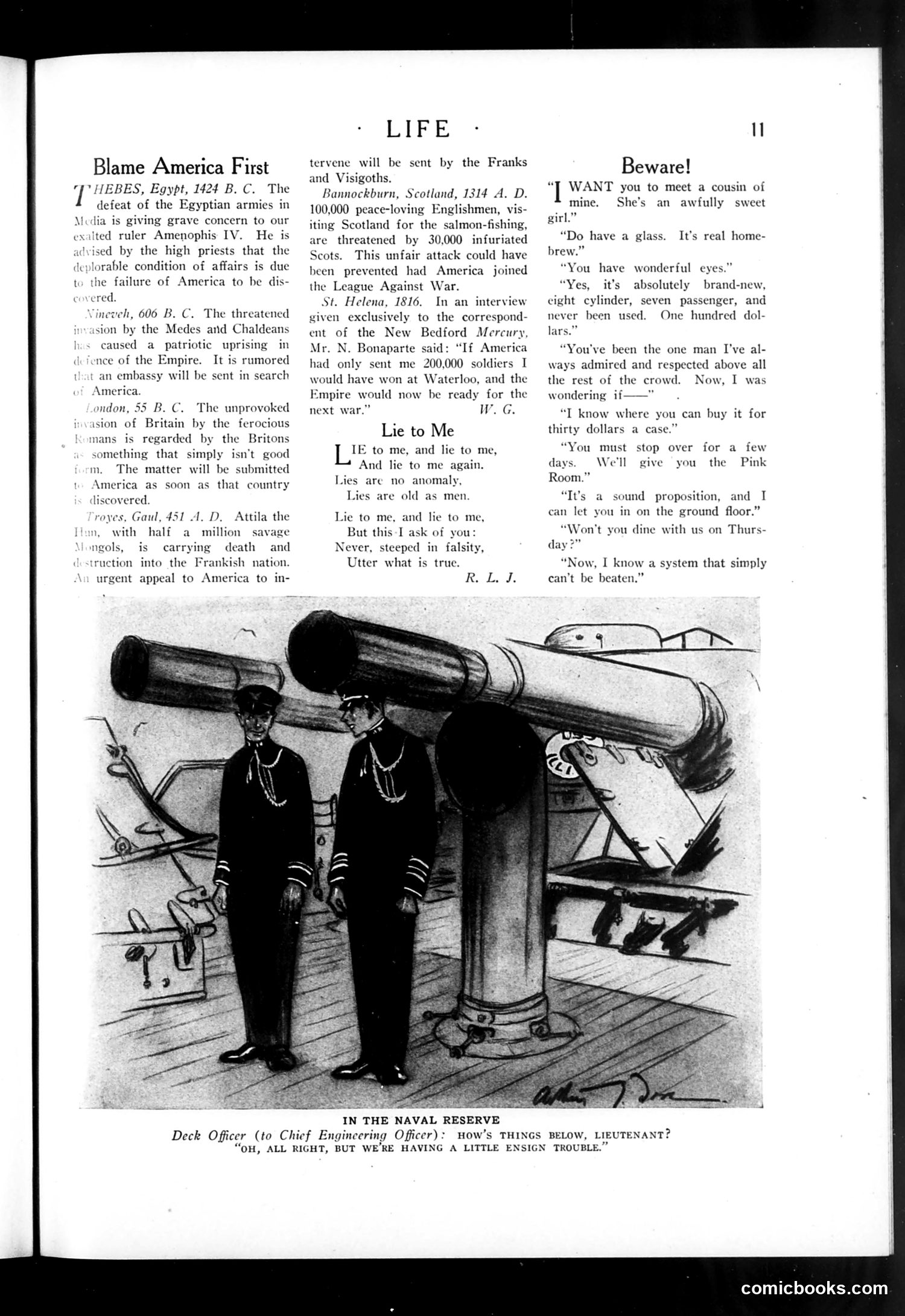
This cartoon satirizes **engine trouble in naval vessels**. Two naval officers in dress uniforms stand before a large naval gun or engine component in what appears to be a ship's interior. The humor relies on **understatement and bureaucratic absurdity**: when asked "how's things below, Lieutenant?" the junior officer responds casually—"Oh, all right, but we're having a little ensign trouble"—when he clearly means serious mechanical problems (likely a malfunctioning engine). The joke plays on the double meaning: "ensign trouble" sounds minor (ensigns are low-ranking officers), but the context of visible ship machinery suggests genuine equipment failure being minimized through military language and tone. This reflects early-20th-century satirical humor about naval incompetence or maintenance problems.
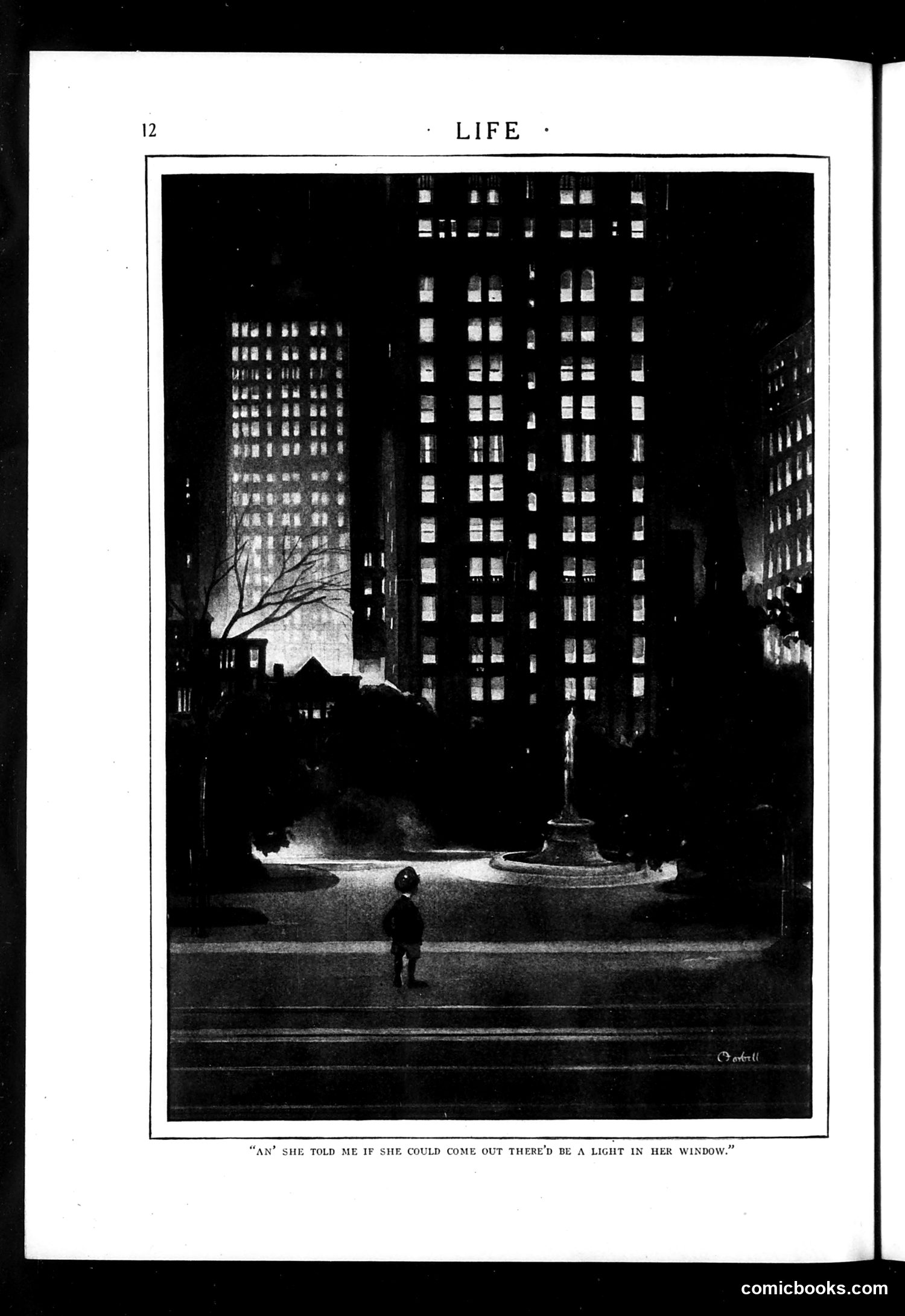
This is a black-and-white photograph rather than a cartoon, showing a solitary figure standing in an urban plaza at night, surrounded by tall illuminated office buildings. The caption reads: "An' she told me if she could come out there'd be a light in her window." The image appears to be social commentary on urban isolation and romance during the early-to-mid 20th century. It depicts a lonely person waiting in a city square, presumably hoping for a signal from someone in one of the distant apartment windows above—a poignant reference to the famous "light in the window" as a symbol of connection and hope across physical distance. The photograph captures the emotional disconnection of modern urban life, where despite surrounding crowds and buildings, individuals can feel profoundly alone. It's likely meant as sentimental or melancholic commentary on city living.
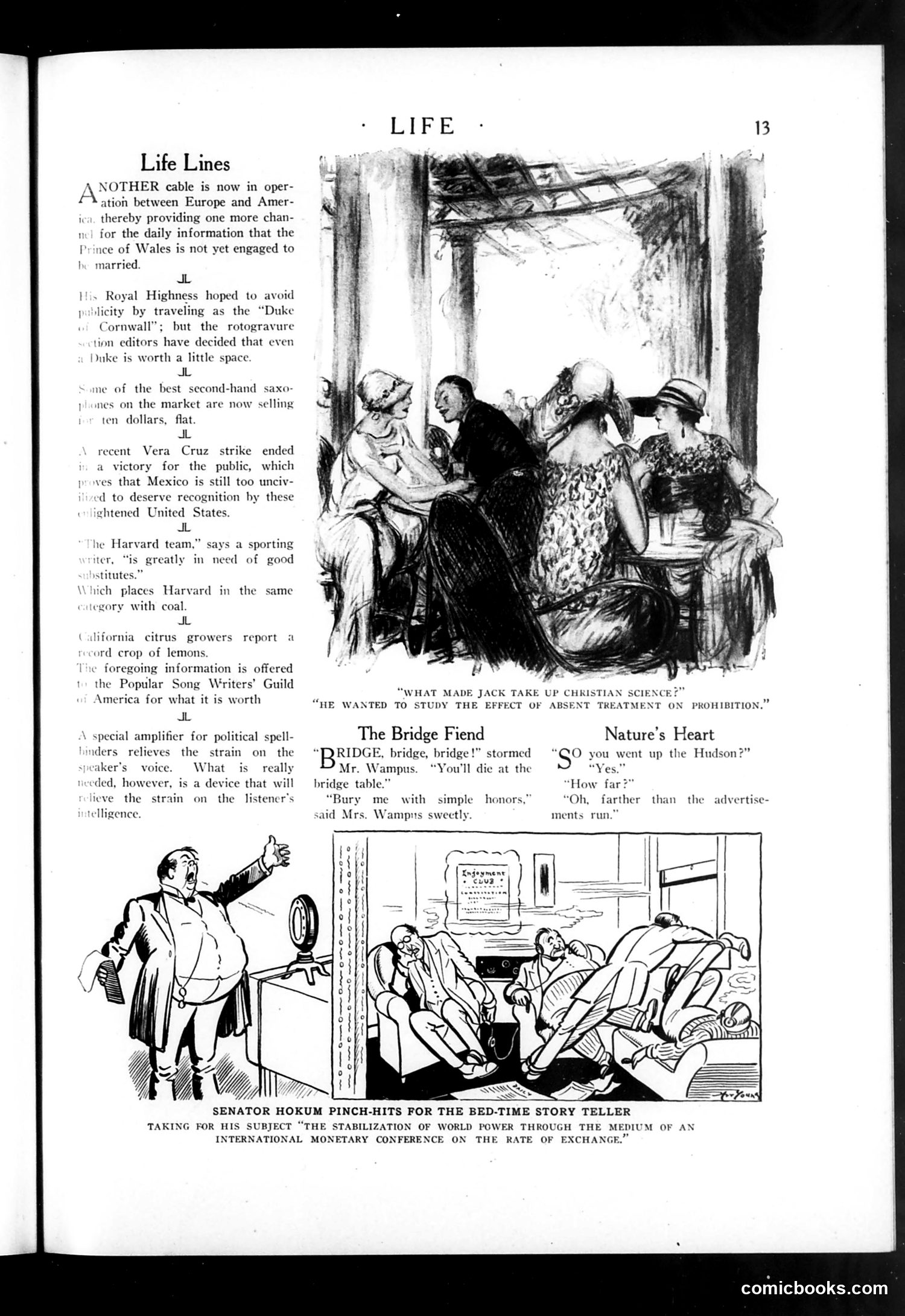
This page contains several satirical pieces. The main cartoon at bottom depicts "Senator Hokum" using exaggerated gestures while telling bedtime stories to children, with the caption mocking his subject: "the stabilization of world power through the medium of an international monetary conference on the rate of exchange." The satire ridicules long-winded political speeches on complex economic topics being presented as children's entertainment—suggesting the senator's rhetoric is both incomprehensible and tediously boring to ordinary people. The upper cartoon titled "The Bridge Fiend" depicts domestic discord, while "Nature's Heart" presents a brief dialogue. The page also includes "Life Lines"—brief news commentary on topics like the Prince of Wales, Vera Cruz, and Harvard athletics, typical of the magazine's satirical news section.
This page contains editorial commentary rather than political cartoons. The main text discusses the death of Princess Anastasia of Russia and the decline of European royalty post-WWI. The author notes that even British dukes no longer wield significant power in human affairs, and suggests "royalty itself is getting to think so." The piece also covers Italian-Greek tensions over boundaries, Irish parliamentary elections, and automobiles' effect on road travel. The small decorative illustrations (classical cherubs/figures) are ornamental rather than satirical. The overall message reflects 1920s concerns about monarchy's diminishing influence in the modern world and ongoing European political instability following World War I.
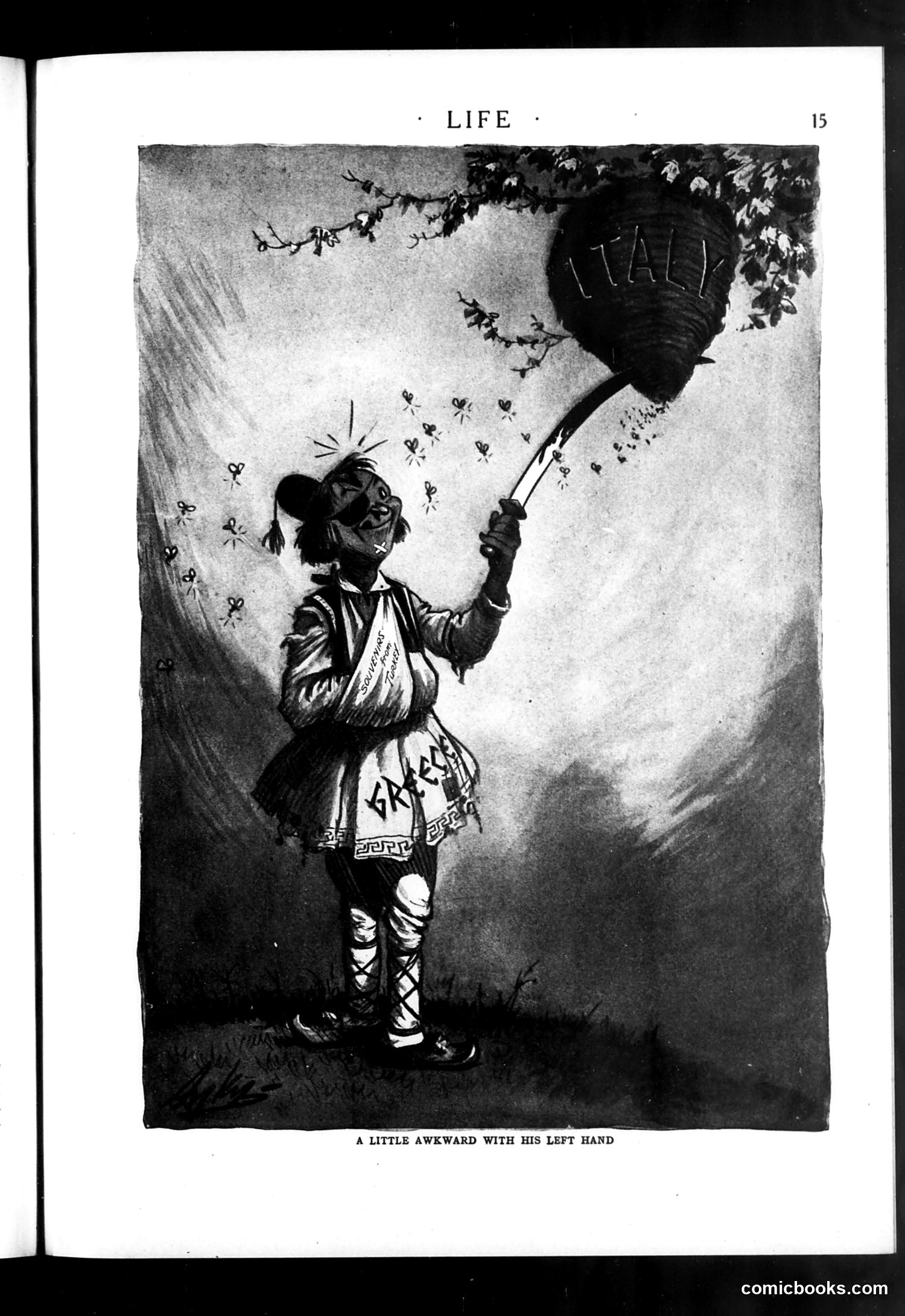
This satirical cartoon depicts a caricatured figure (appears to be representing Italy, based on the "ITALI" text visible on the balloon) attempting to use a left hand while holding what resembles a military or political device—a balloon labeled with Italian text. The figure is surrounded by small scattered elements suggesting chaos or failure. The satire likely comments on Italy's military incompetence or diplomatic clumsiness during a specific historical conflict, possibly WWI or WWII era given *Life* magazine's satirical style. The "awkward with his left hand" caption suggests Italy was fumbling or inexperienced in military operations or political maneuvering. Without the specific publication date visible, the exact historical reference remains unclear, though the imagery suggests commentary on Italian military or political ineffectiveness during a major historical period.
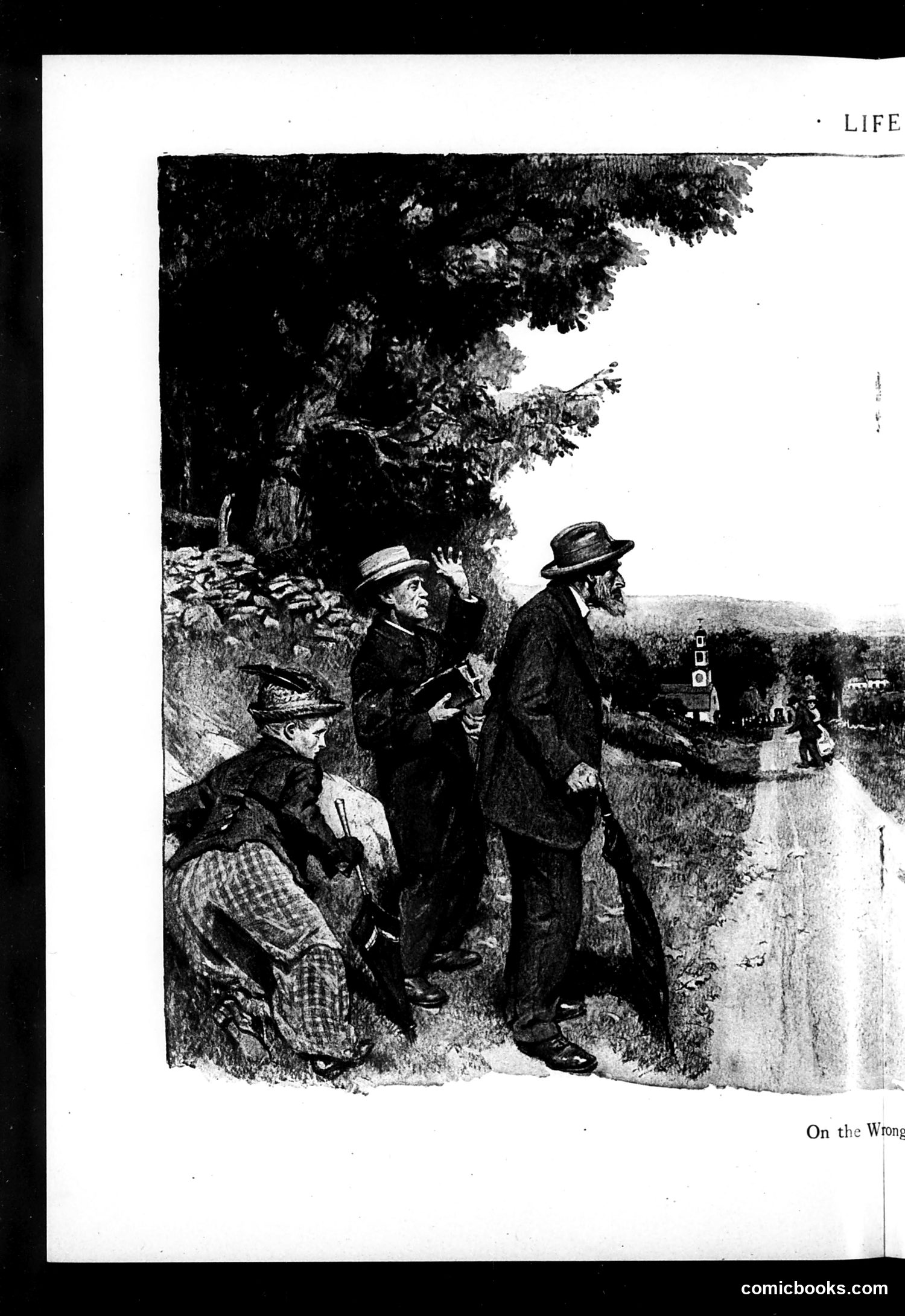
This appears to be a satirical illustration from *Life* magazine showing three men in period clothing (hats, coats) standing on a rural path near a church or building. The caption "On the Wrong" (likely incomplete) suggests the cartoon comments on people being mistaken or misguided. The figures appear to be depicted as working-class or rural characters, possibly representing common folk who are lost or heading in an incorrect direction—a frequent satirical theme mocking human folly or poor judgment. The detailed engraving style and setting suggest late 19th or early 20th-century American social commentary, though without the full caption or additional context, the specific political or social reference remains unclear.
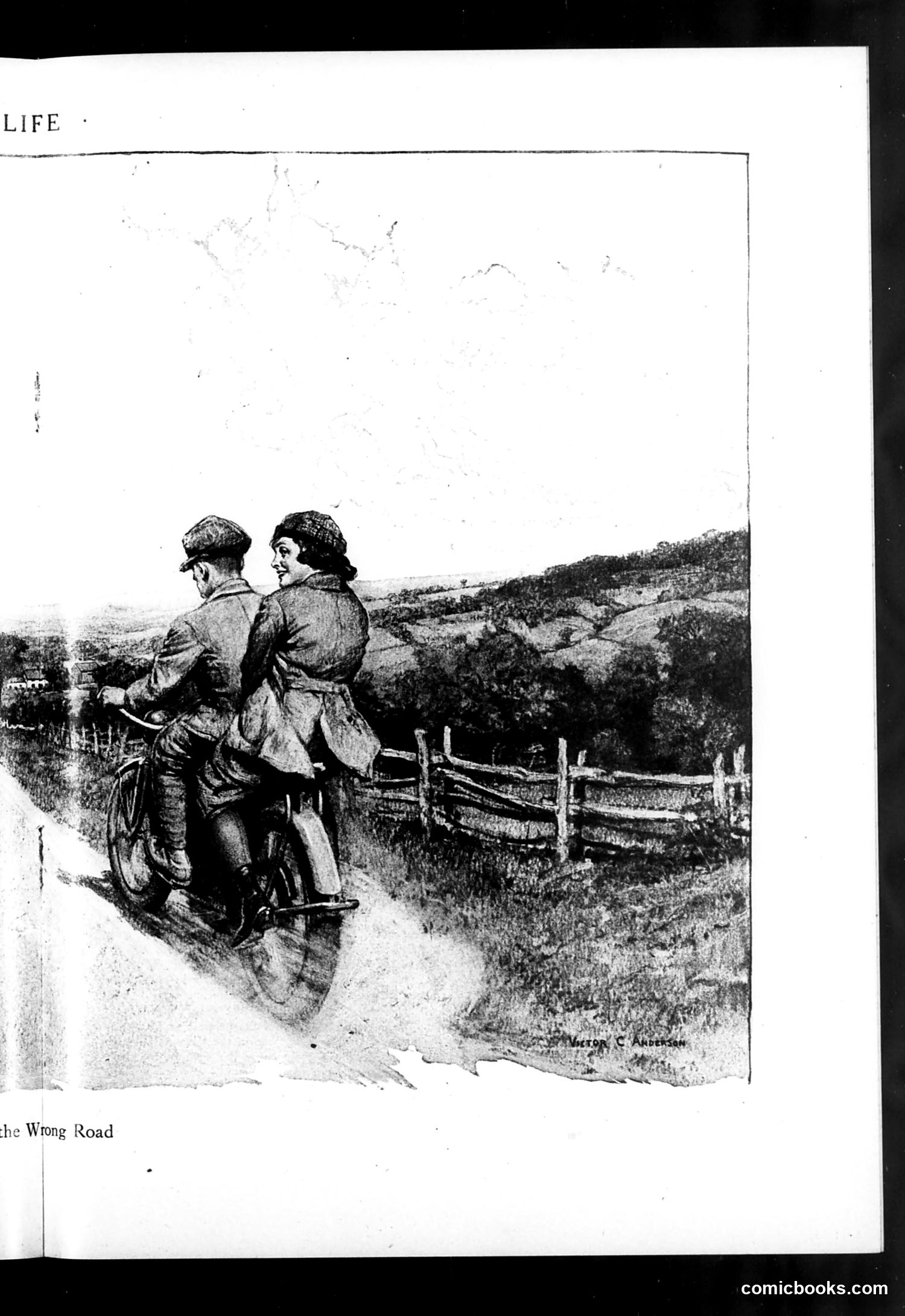
This illustration from *Life* magazine shows two figures on a bicycle heading toward a rural landscape with fencing. The title "The Wrong Road" suggests a cautionary narrative about misguided direction or poor decision-making. The image appears to be a social or moral commentary, likely depicting characters who have made a wrong choice or are heading toward undesirable consequences. The rural setting with its fence and hills may symbolize departure from civilization or proper society. Without additional context or a visible date, the specific social commentary remains unclear—it could reference relationship missteps, poor life choices, or contemporary social issues. The artist signature appears to read "Watson C. Anderson." The satirical intent seems to warn against following the "wrong road" in life.
This page reviews two Broadway musicals: "Poppy" and "Little Miss Bluebeard." **"Poppy"** stars Madge Kennedy (praised for her singing and dancing debut) and W.C. Fields, transitioning from pantomime into speaking roles. The reviewer enthusiastically endorses both performers, declaring Fields worthy of "honors" in musical comedy. The score by Stephen Jones and Arthur Samuels is praised for its orchestration—the reviewer notes that theater orchestration transforms what audiences hear versus thin "one-finger" versions attempted on home pianos. **"Little Miss Bluebeard"** features French performer Irene Bordoni and British character actor Eric Blore. The plot is dismissed as generic ("Good Lord, it's my wife!" type comedy), barely distinguishable from fourteen other similar shows. However, Bordoni's stage presence and a cute gondola song merit mention, along with Blore's theatrical appearance. The satire is gentle: both reviews celebrate star performers while acknowledging that the plots are formulaic theatrical conventions of the era.
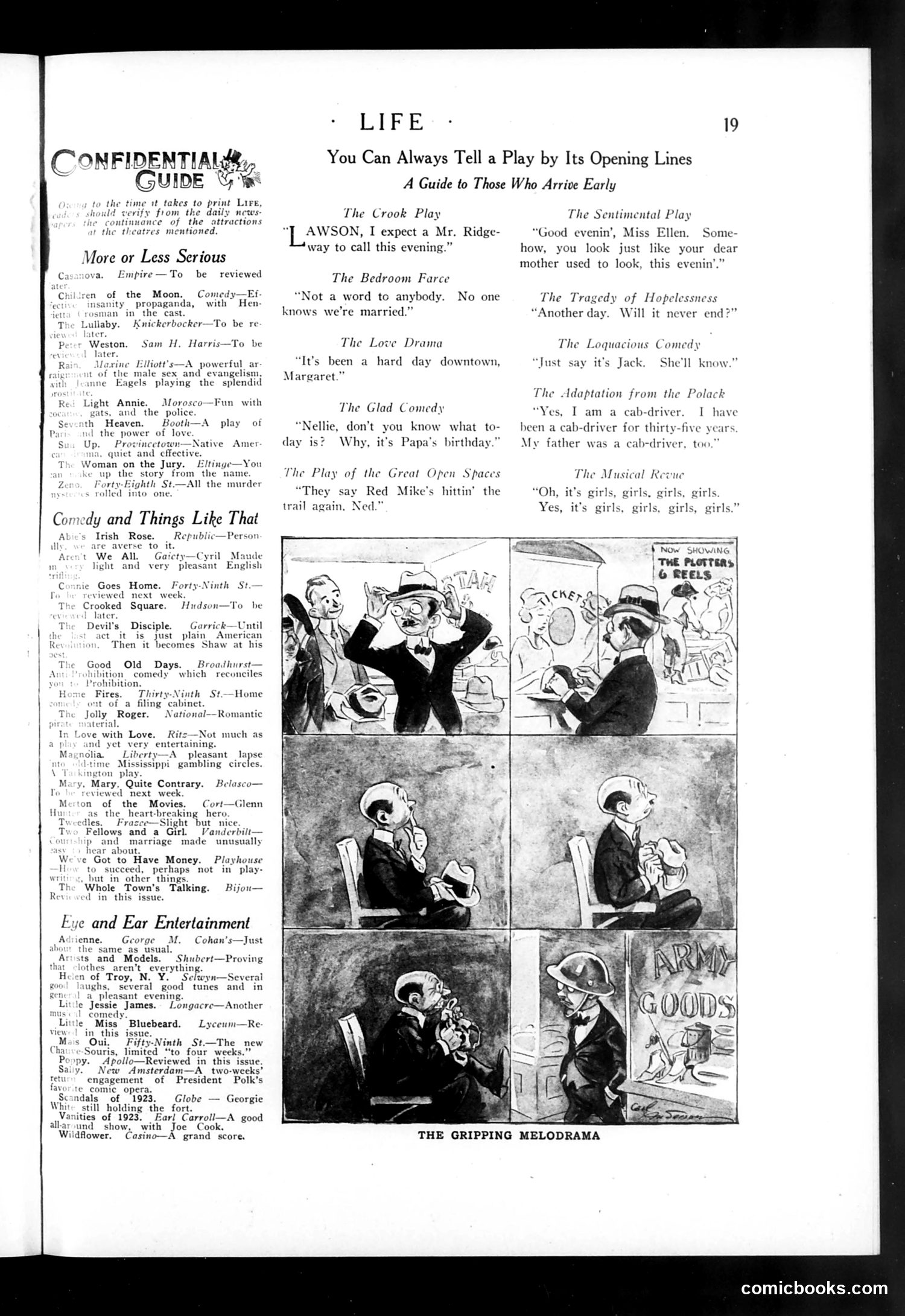
This satirical feature mocks the predictability of 1920s theater by cataloging hackneyed opening lines that immediately signal a play's genre. Each example—"Not a word to anybody. No one knows we're married" (bedroom farce), "It's been a hard day downtown, Margaret" (love drama), "Good evenin', Miss Ellen. Somehow, you look just like your dear mother" (sentimental play)—represents tired theatrical clichés audiences would recognize instantly. The accompanying cartoons (titled "The Gripping Melodrama") appear to depict an exaggerated, overwrought performance style typical of period melodramas, reinforcing the satire's point: theater-goers could predict entire plots from opening dialogue alone. The humor targets both playwrights relying on formulaic writing and audiences who accepted such predictable entertainment as normal. It's gentle mockery of commercial theater's standardized formulas.
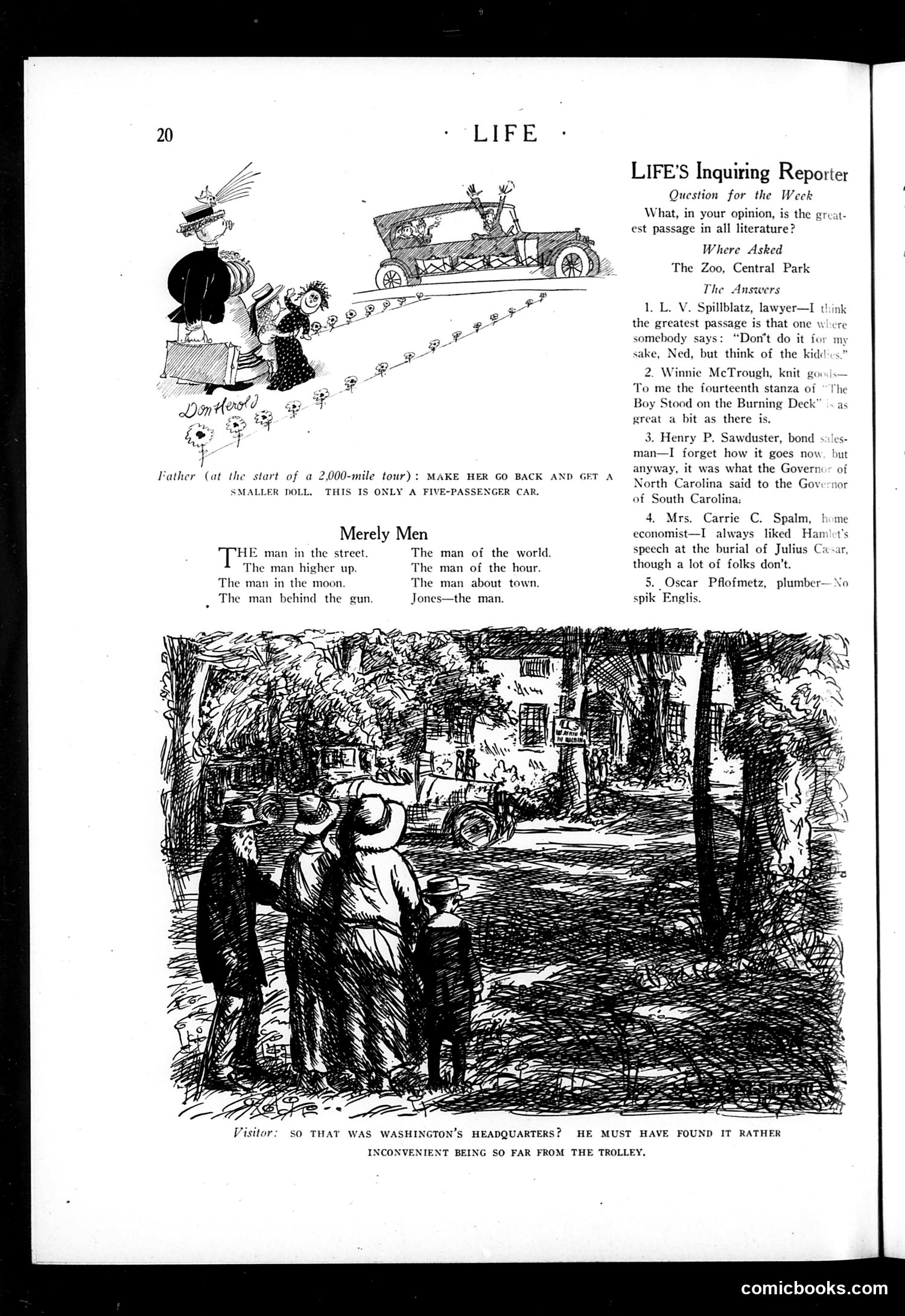
This page contains three satirical pieces from Life magazine's humor section: **"Merely Men"** is a short poem listing different archetypal male figures (the street man, higher-up, man of the hour, etc.), playing on common social types of the era. **The top cartoon** mocks over-parenting: a father beginning a 2,000-mile road trip insists his wife return home to swap their daughter's large doll for a smaller one—a five-passenger car joke about how much luggage children's belongings require. **"Life's Inquiring Reporter"** interviews zoo visitors about literature's greatest passages. The responses satirize both public taste and pretension: people cite sentimental melodramas ("think of the kiddies"), famous schoolroom poems like "Casabianca," half-remembered historical speeches, and Shakespeare. One respondent admits forgetting what he's quoting. **The bottom cartoon** shows a visitor commenting that Washington's headquarters seems inconveniently far from the trolley—mocking modern tourists' inability to appreciate historical sites without modern conveniences nearby. Overall, the page humorously critiques American materialism, poor cultural literacy, and dependency on modern comfort.
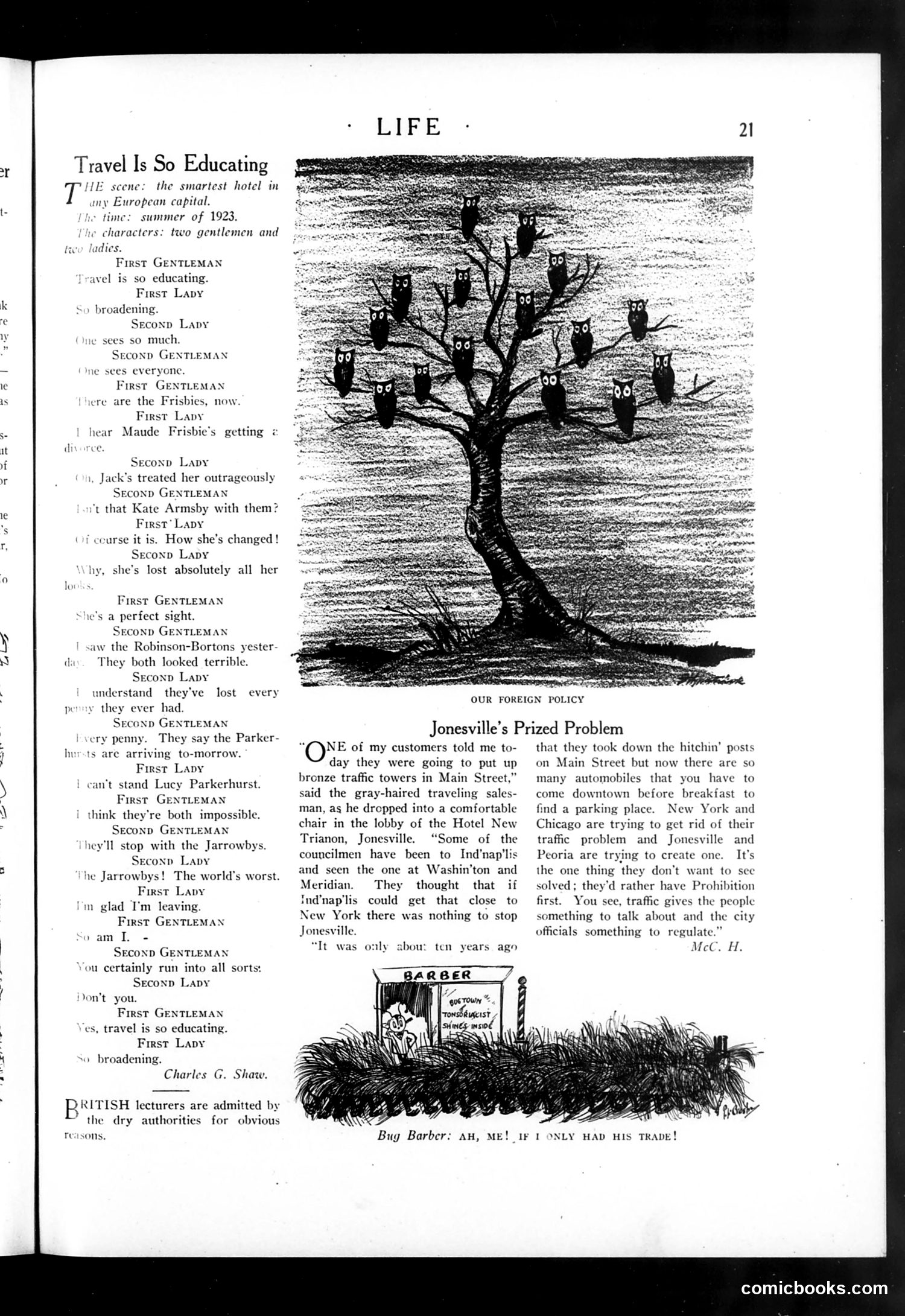
This page contains two distinct satirical pieces: **"Travel Is So Educating"** (by Charles G. Shaw) is a dialogue among wealthy American tourists at a European hotel in summer 1923. The satire mocks how travel supposedly "broadens" people—in reality, these characters spend their time gossiping about acquaintances back home, cataloging who's lost their fortune (likely referencing post-WWI economic upheaval), and judging others' appearances and marriages. The joke: travel exposes them to nothing except other Americans doing the same shallow gossip. **"Jonesville's Prized Problem"** satirizes small-town aspirations and municipal pride. A salesman describes how Jonesville wants to install traffic towers like Indianapolis, Washington, and Meridian have—not to solve problems, but to *create* them. The humor lies in the town's backwards priorities: they'd rather have visible urban problems (traffic congestion) than solve actual needs, since traffic "gives the people something to talk about." It's a jab at small-town provincialism and the desire to imitate big-city status symbols. Both pieces use dialogue to expose middle-class American vanity and poor judgment through understated irony.
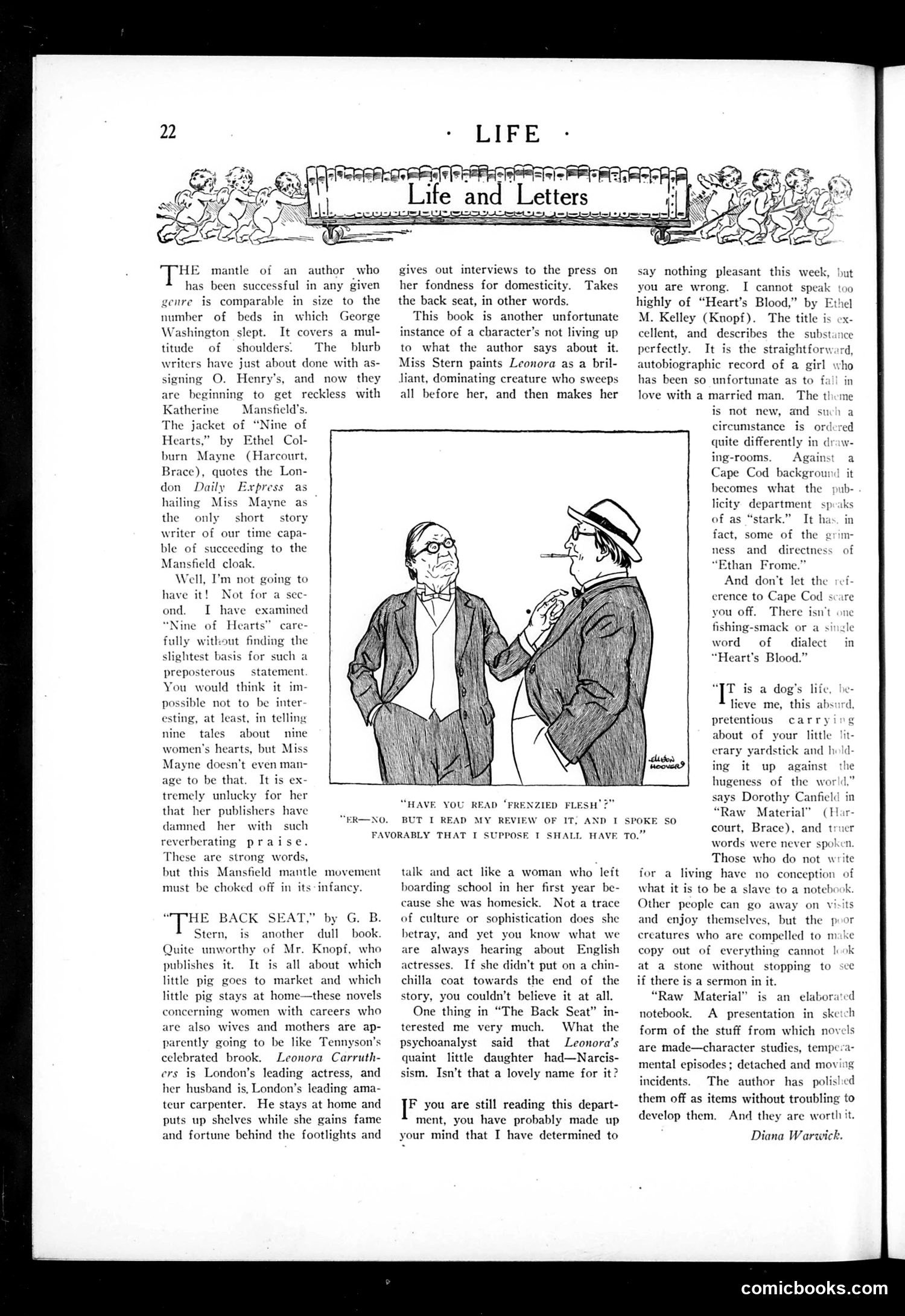
This page contains literary criticism disguised as satire. The cartoon depicts two men discussing books—likely a publisher and critic debating literary merit. The satire targets the publishing industry's practice of "blurbing": slapping famous authors' names on jacket covers to boost sales. The critic attacks this deception, noting that Katherine Mansfield's reputation is being carelessly borrowed to promote mediocre works like Ethel Colburn Mayne's "Nine of Hearts" and G.B. Stern's "The Back Seat." The author expresses exasperation that publishers attribute Mansfield-like genius to writers who don't deserve it. The reviews themselves are scathing—characters lack sophistication, plots recycle tired themes about women balancing careers and marriage, and dialogue feels false. The cartoon's dialogue ("Have you read 'Frenzied Flesh'?") reinforces the column's point: even critics haven't actually engaged with these books—they're just recycling promotional language.
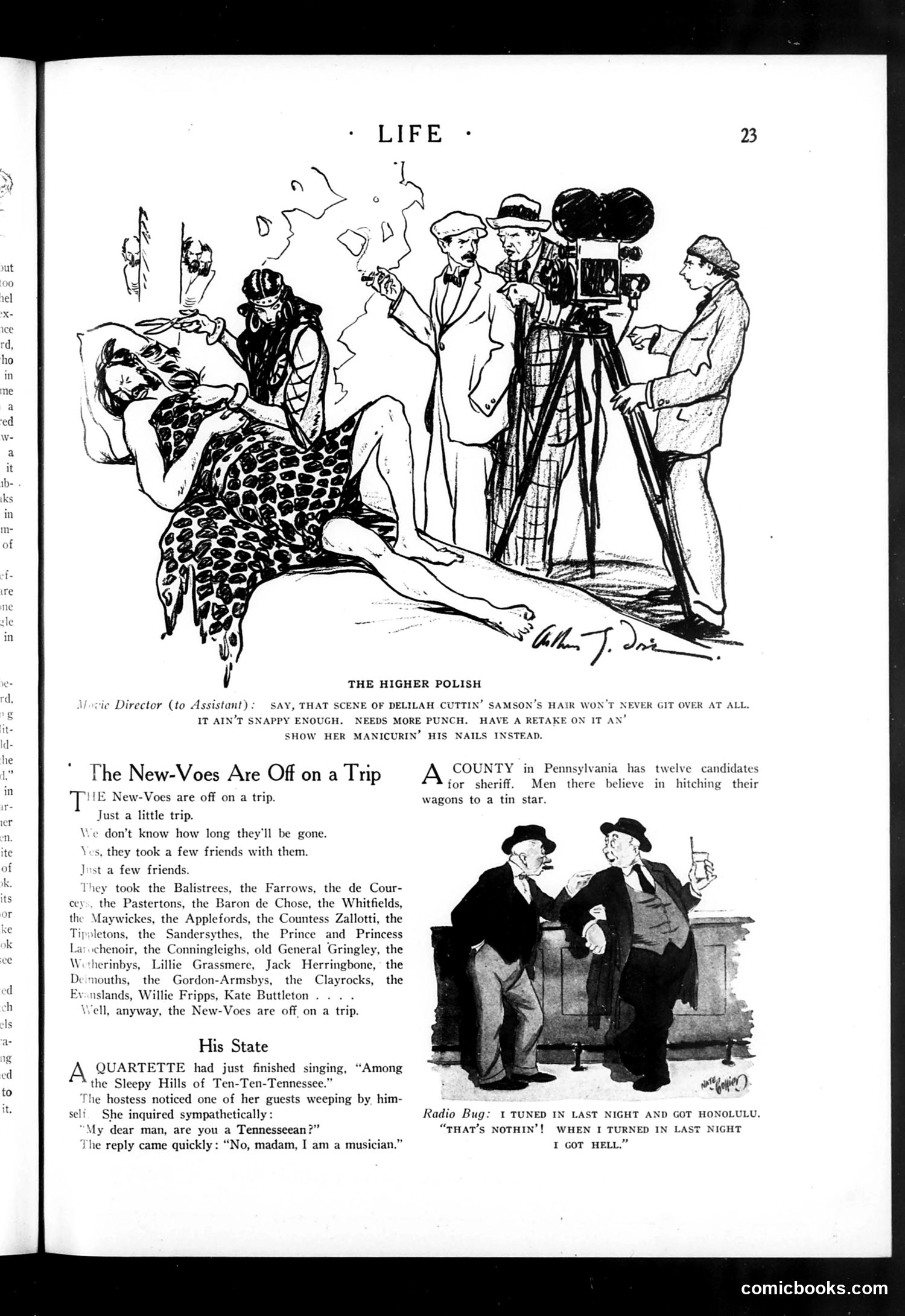
**"The Higher Polish"** (top cartoon): A film director instructs his assistant to reshoot a scene depicting Delilah cutting Samson's hair, complaining it lacks "punch." He suggests instead showing her giving Samson a manicure—feminizing the biblical strongman by having her polish his nails rather than betray him through hair-cutting. The satire mocks both overly cautious filmmaking and changing gender dynamics, suggesting modern emasculation. **"The New-Voes Are Off on a Trip"**: A humorous piece listing the New-Voes (wealthy socialites) traveling with numerous high-society friends—aristocratic names listed in ridiculous profusion. The joke satirizes the idle wealthy and their frivolous constant travel. **"His State"**: A quartette sings about Tennessee; a weeping guest admits he's not a Tennessean but a musician—implying the music was so bad it made him cry. Simple joke about poor performance. **"Radio Bug"**: Two men compare radio reception; one tuned in Honolulu; the other claims he got "hell"—likely referencing radio interference or poor signal quality as hellish.
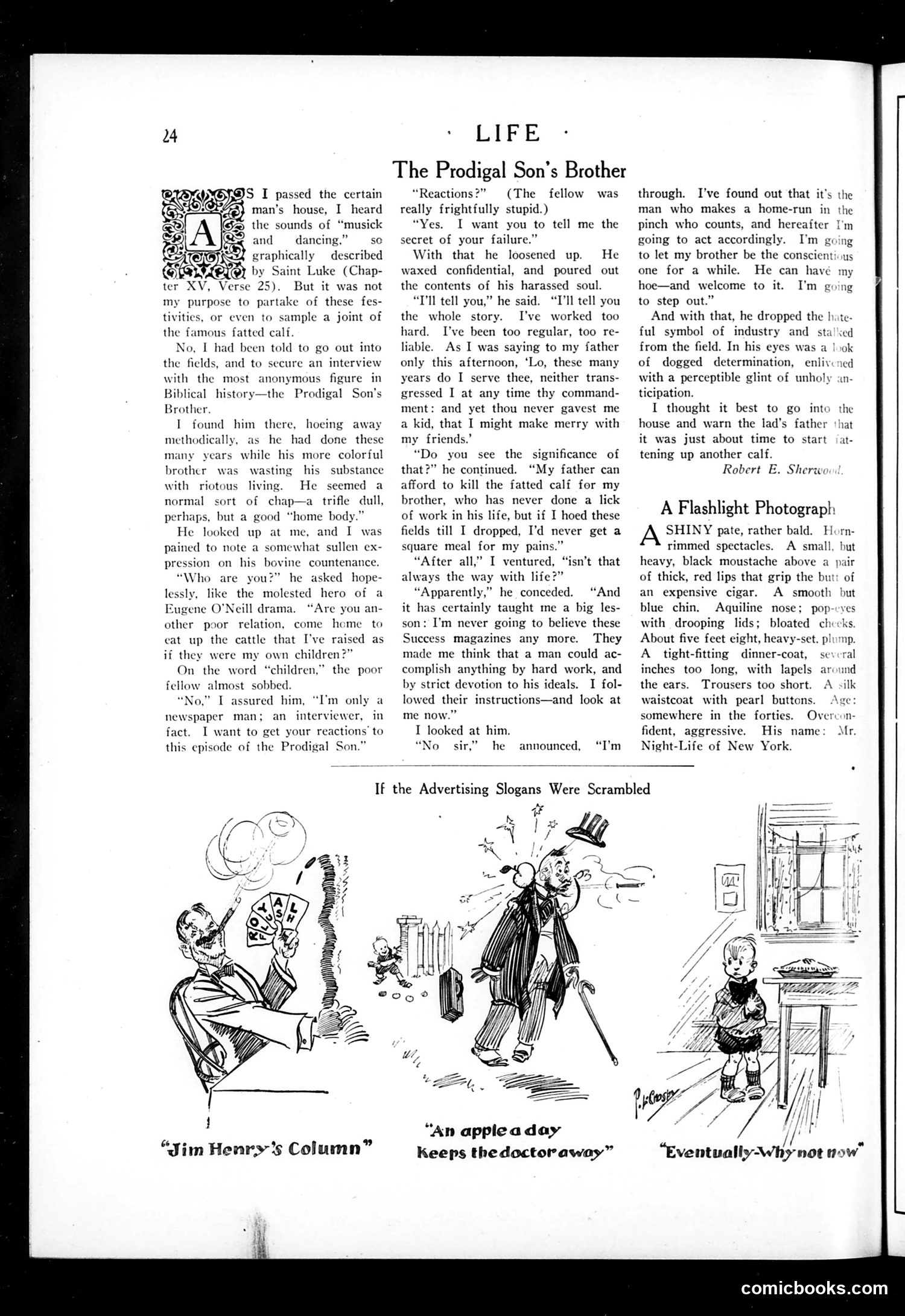
This page contains two separate pieces from Life magazine: **"The Prodigal Son's Brother"** is a satirical short story that inverts the famous biblical parable. The narrator interviews the overlooked elder brother—who faithfully worked the fields while his wastrel sibling partied—and finds him bitter and disillusioned. The brother complains that hard work and virtue went unrewarded while his irresponsible sibling received celebration and feasting. The satire targets popular "Success magazines" that preached that discipline and hard work guarantee prosperity. The story suggests this promise is hollow; the story ends with the fed-up elder brother abandoning his duties, implying the moral system itself has failed. **"If the Advertising Slogans Were Scrambled"** are three cartoons humorously mixing up familiar advertising catchphrases with absurd illustrations. The three scrambled slogans—"Jim Henry's Column," "An apple a day keeps the doctor away," and "Eventually—Why not now"—are paired with unrelated comical drawings, creating nonsensical humor through mismatch between text and image.
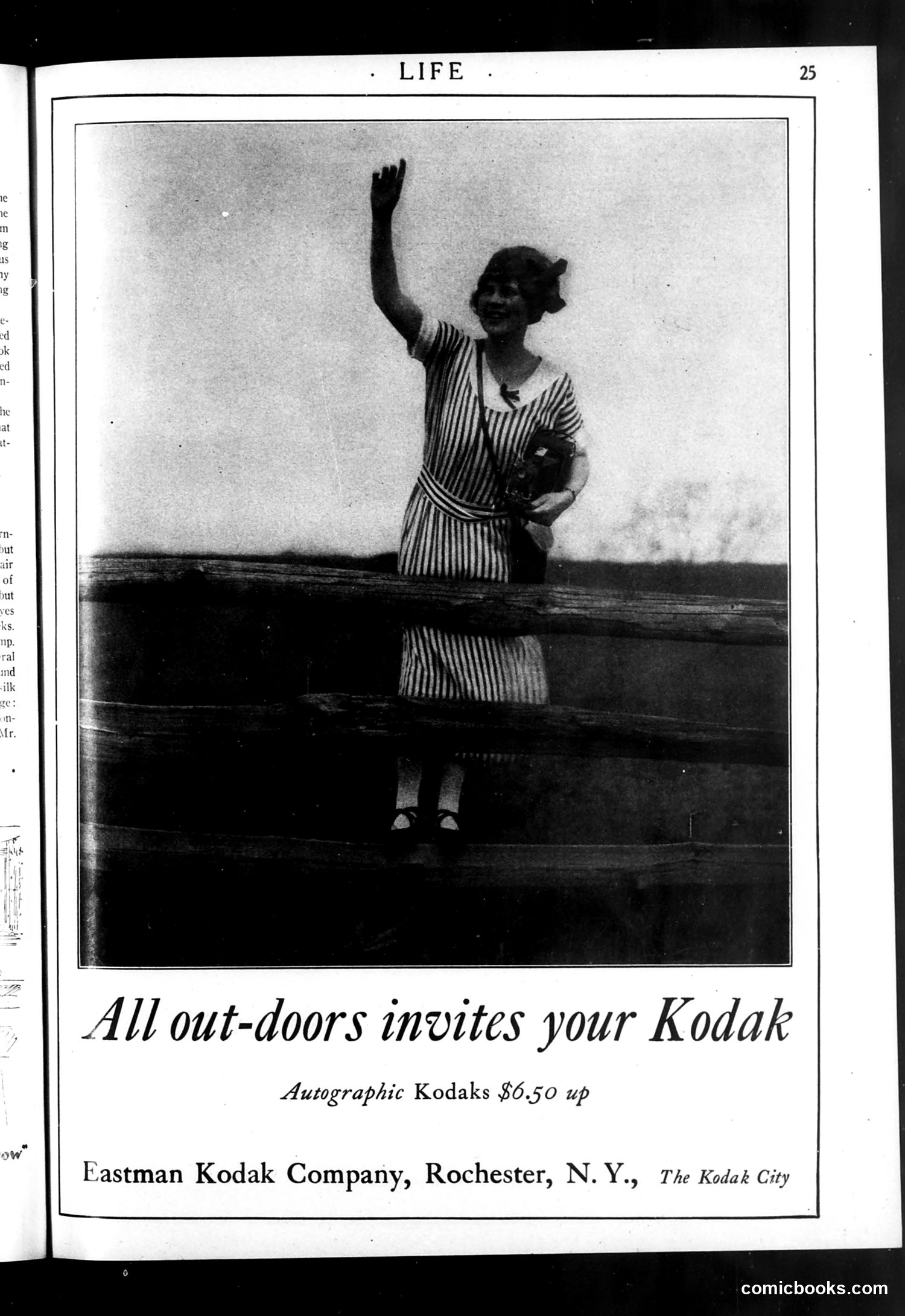
This is a Kodak advertisement rather than political satire. The page shows a woman in a striped dress standing on a wooden fence, arm raised enthusiastically, holding what appears to be a camera or small object. She's photographed against an outdoor sky and landscape. The ad's message—"All out-doors invites your Kodak"—promotes portable cameras for outdoor recreation and amateur photography. The "Autographic Kodaks $6.50 up" pricing suggests these were consumer-accessible cameras. The image exemplifies early 20th-century advertising that connected photography equipment with leisure, outdoor activity, and modern consumer culture. The woman's pose conveys freedom and joy in nature, positioning the camera as essential for capturing and documenting outdoor experiences—a key marketing strategy for Eastman Kodak's mass-market photography products.
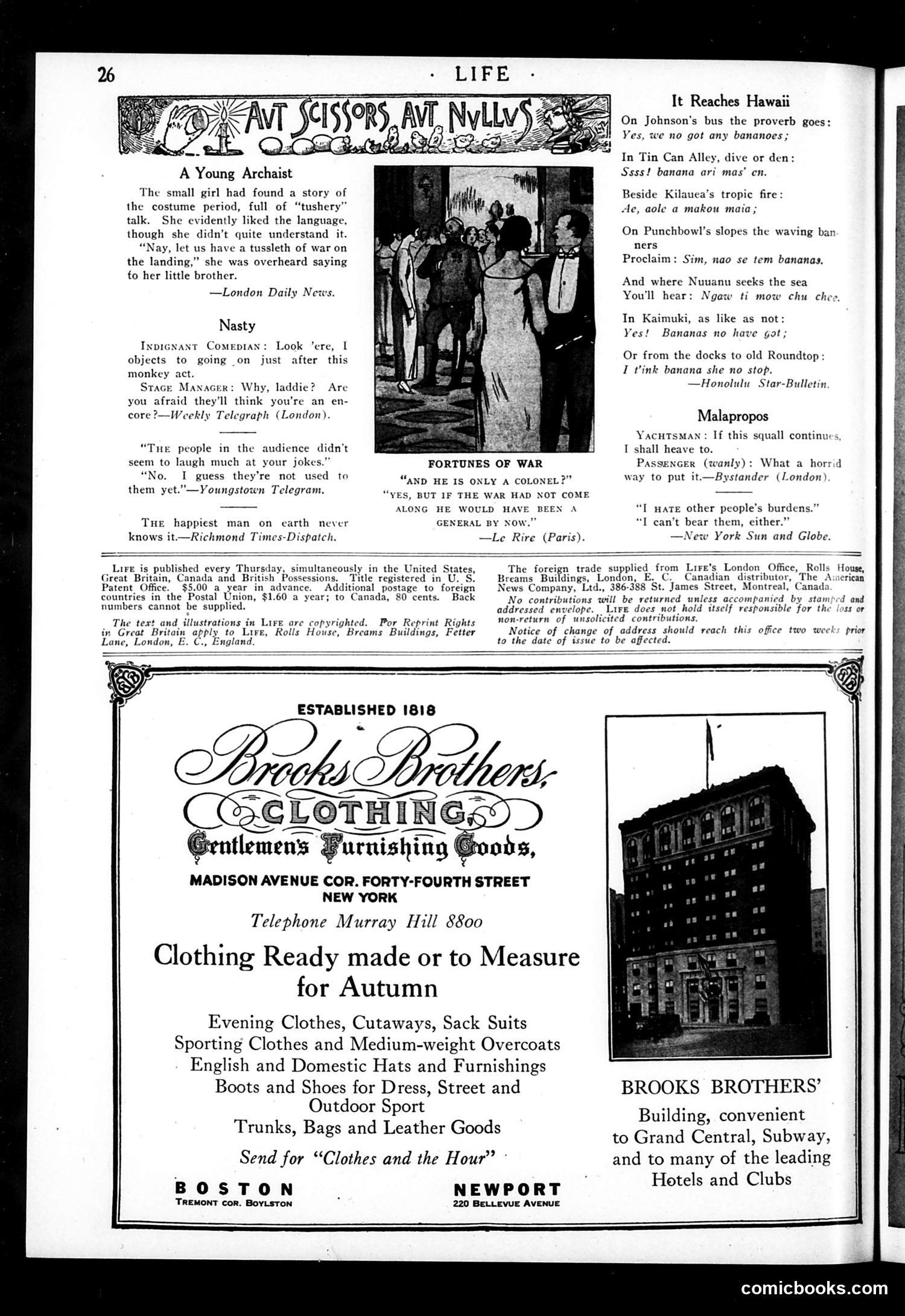
This page contains several brief humorous items typical of Life's satirical style: **"A Young Archaist"** mocks a child who enjoyed costume-period theatrical language ("tushery talk"), using the phrase "tussleth of war" to show her attempting archaic speech without understanding it. **"Nasty"** is a brief exchange between a comedian and stage manager, joking that audience members aren't accustomed to the comedian's act—implying it's so bad they don't recognize when to laugh. **"Fortunes of War"** references a wartime officer who would have remained a colonel had the war not occurred, suggesting wartime promotions elevated mediocre men to general rank. **"It Reaches Hawaii"** and **"Malapropos"** are collected jokes in various languages/dialects about bananas and shipping terminology, playing on Hawaiian Pidgin English and accents. The page is primarily **advertising** for Brooks Brothers clothing, dominating the lower half.
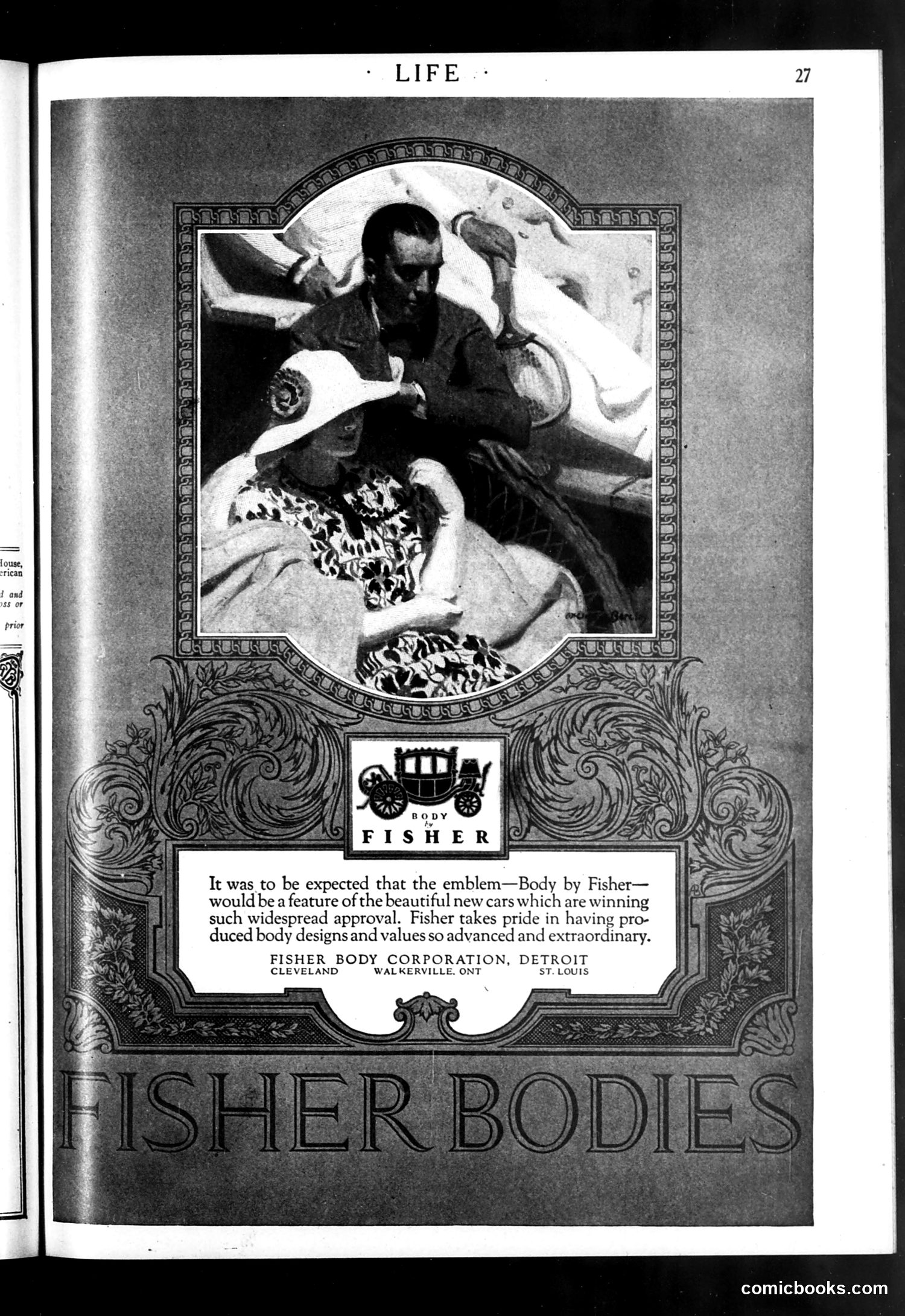
This is an advertisement, not political satire. It promotes Fisher Body Corporation, a major automobile body manufacturer of the era. The image shows a man and woman in an intimate scene with stylized figures in the background, using glamour and sensuality to market car bodies as desirable products. The "Body by Fisher" slogan emphasizes that Fisher manufactures the vehicle's exterior body rather than the mechanical components. The ornate art deco framing and the text claiming "advanced and extraordinary" designs reflect early automotive advertising's strategy of associating car bodies with luxury, sophistication, and aspirational lifestyle. Fisher Body was a prestigious supplier that became part of General Motors; this ad demonstrates how companies leveraged lifestyle imagery to sell automotive components to consumers.
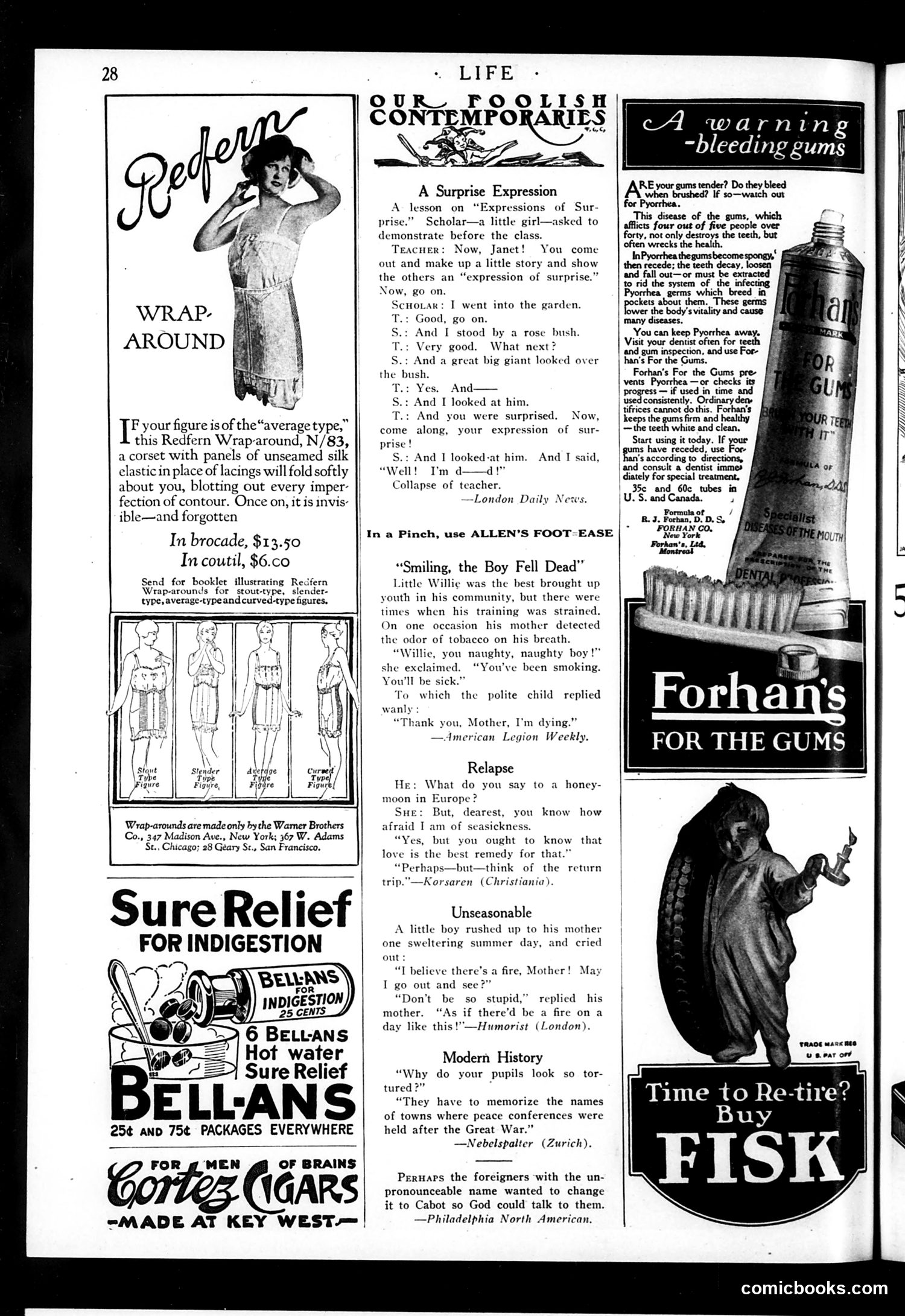
This page is primarily **advertising and humor columns**, not political cartoons. The main content includes: **Advertisements:** Redfern corsets, Bellans indigestion remedy, Cortez cigars, Forhan's toothpaste (for gum disease/pyorrhea), Allen's Foot-Ease, and Fisk tires dominate the layout. **Humor sections** feature short anecdotes with social commentary: - "A Surprise Expression" mocks overly proper upbringing when a schoolgirl shocks her teacher with crude language - "Little Willie" jokes about a well-behaved boy's politeness despite smoking - Several brief jokes about honeymoons, seasickness, and a child's illogical observation about summer fires The page reflects **early 20th-century middle-class concerns**: women's appearance (corsets), digestive health, dental hygiene, and proper deportment. The humor gently satirizes rigid Victorian propriety by showing it comically break down in everyday situations. No specific political figures or events are referenced.
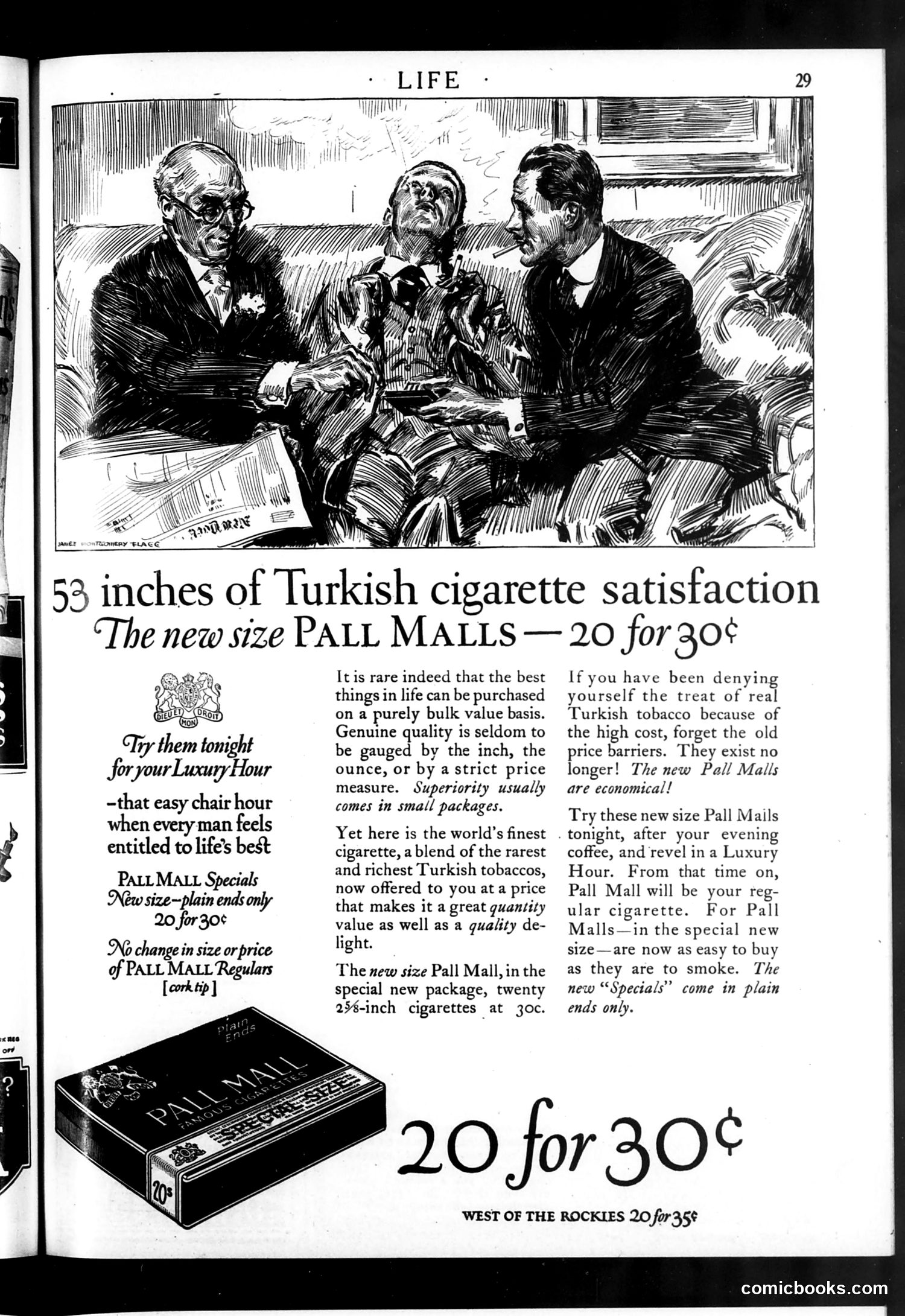
This is a **cigarette advertisement**, not political satire. The page features a Pall Mall cigarette ad for a new, longer "economy" size (20 cigarettes for 30¢). The illustration shows three well-dressed men in conversation, likely representing affluent consumers or businessmen—the target audience for "luxury" tobacco products. The image reinforces the ad's pitch: that genuine quality Turkish cigarettes, previously affordable only to the wealthy, are now accessible to ordinary men through this new bulk-value packaging. The copy emphasizes a paradox: that quality need not mean small, expensive packages. By offering 53-inch cigarettes (longer than regulars) at a lower per-unit cost, Pall Mall positioned itself as democratizing luxury. The phrase "Luxury Hour"—an aspirational moment of leisure—appeals to post-work relaxation. This is straightforward commercial messaging from the interwar/Depression era, when price-point marketing and pseudo-democratic appeals were standard advertising strategy.
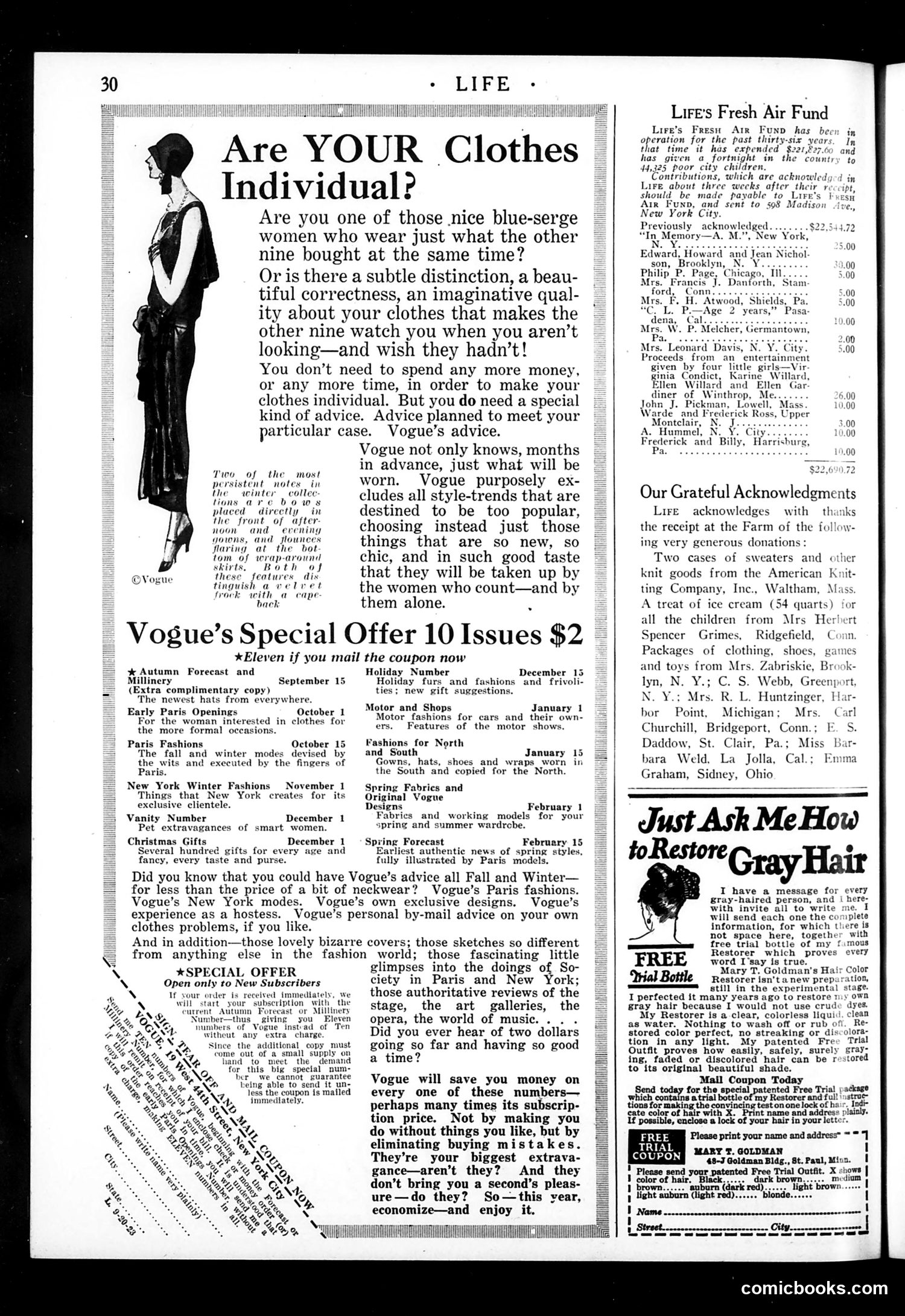
This page is primarily **advertising** for Vogue magazine, not political satire. The main article, "Are YOUR Clothes Individual?," is a pitch targeting affluent women in the 1920s. **The Social Context:** The advertisement mocks a specific anxiety: wealthy women's fear of looking identical to their peers despite wearing expensive clothes. It promises that Vogue magazine (which cost $2 for 10 issues) will help them achieve subtle distinction and "good taste" through fashion advice—positioning Vogue as arbiter of what "the women who count" wear. **The Satire's Point:** There's gentle irony in the premise: Vogue claims to help women be "individual" by following its prescribed trends, while simultaneously admitting it "purposely excludes all style-trends that are destined to be too popular." In other words, Vogue sells conformity to exclusivity—making ordinary wealthy women feel special by teaching them what fashionable people supposedly already know. The accompanying fashion illustration shows a woman in elegant attire exemplifying the "individual" look Vogue prescribes.
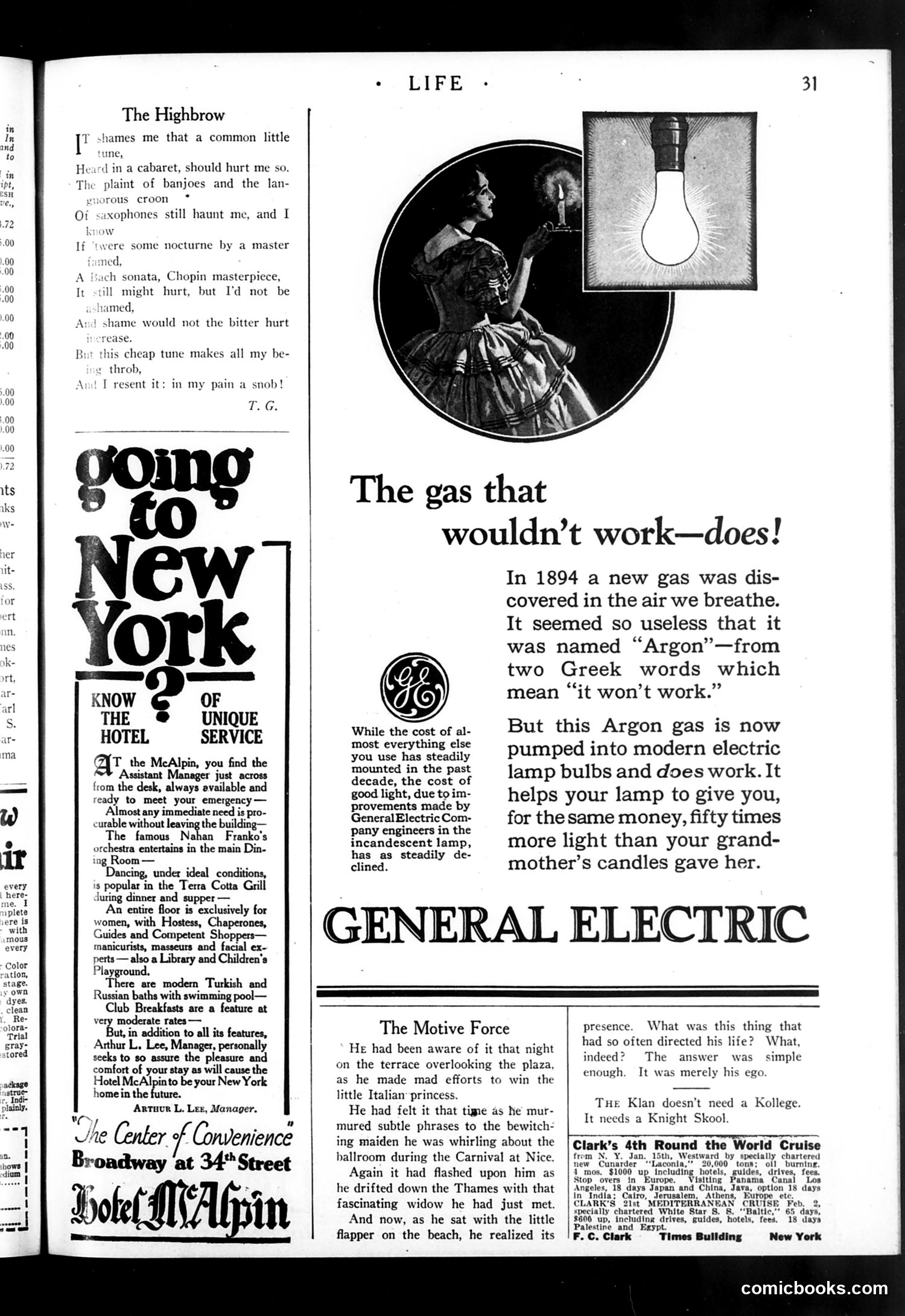
This page contains several distinct elements: **"The Highbrow" Poem**: A satirical piece about cultural snobbery—a self-aware snob admits that cheap popular music (banjos, saxophones, cabaret tunes) emotionally moves him more than "serious" classical music (Chopin), which embarrasses him. The joke targets pretentious people who deny genuine emotional responses to "lowbrow" entertainment. **General Electric Advertisement**: Promotes argon gas light bulbs with tongue-in-cheek humor. The ad plays on argon's 1894 naming meaning "won't work"—ironically, it now makes bulbs work better, providing fifty times more light than candles at declining cost. This celebrates technological progress. **"The Motive Force" Short Story**: A brief narrative about a man's romantic pursuits (Italian princess, maiden, widow, flapper) driven by his ego—a lighthearted critique of male vanity. **Hotel and Cruise Advertisements**: Standard luxury service promotions. The page's tone is typical early 20th-century satirical humor—gently mocking social pretension while celebrating modern technology and consumer conveniences.
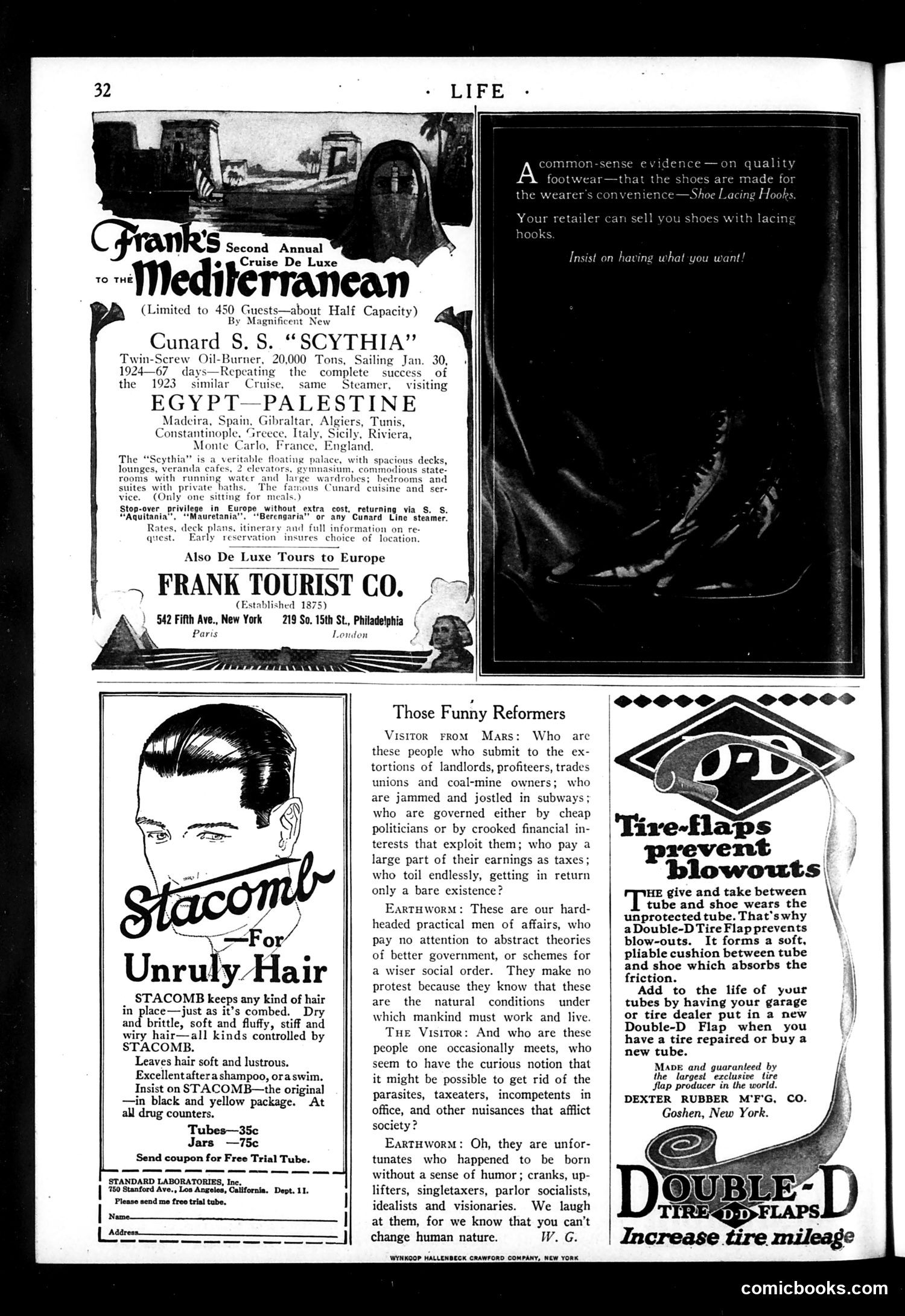
This page features a satirical dialogue between a visiting Martian and "Earthworm," a cynical human character. The cartoon mocks complacent citizens who tolerate exploitation by landlords, unions, coal owners, and corrupt politicians—accepting these as inevitable conditions of life. The satire's target is clear: ordinary people who dismiss social reformers as naive cranks, idealists, and "parlor socialists" for believing conditions *could* improve. Earthworm represents the defeatist attitude that "you can't change human nature," while the Visitor—an outsider perspective—highlights the absurdity of accepting such obvious injustices passively. The cartoon is vintage 1920s progressive critique, attacking both the wealthy exploiters *and* the working people who enable them through resigned acceptance rather than demanding reform. The humor lies in the Martian's bewildered observation of this illogical passivity. The remainder of the page consists of period advertisements (luxury cruises, hair products, tire flaps).
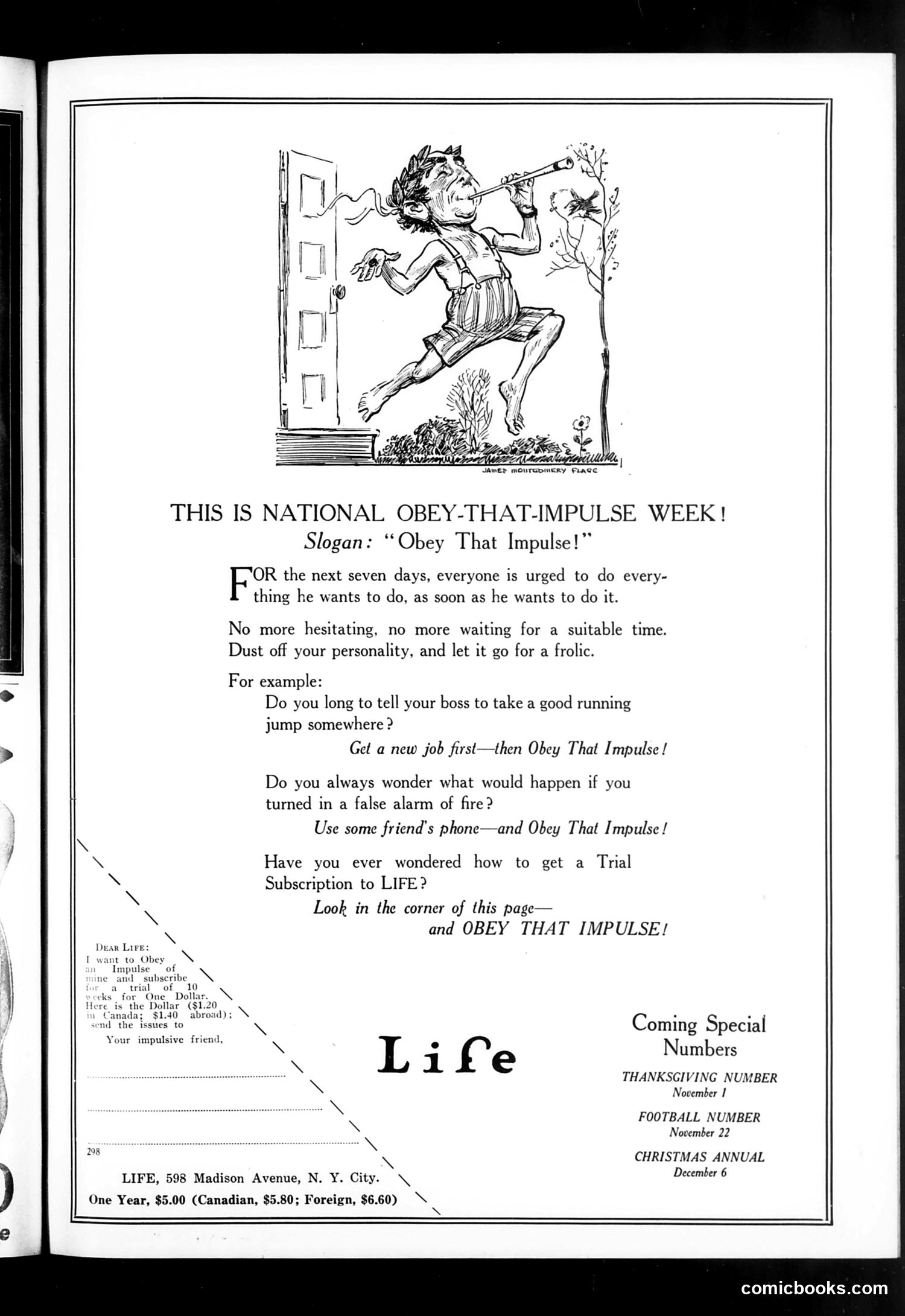
This is a humorous satirical advertisement promoting a fictional "National Obey-That-Impulse Week." The page mocks the era's growing cultural anxieties about impulsivity and social restraint by inverting them—encouraging readers to abandon caution and act on every whim immediately. The cartoon depicts a wild, energetic figure bursting through a door, embodying unbridled impulse. The text offers tongue-in-cheek examples: quitting your job, pulling false fire alarms, or calling using someone else's phone without permission. The satire works on two levels: it gently ridicules both reckless behavior *and* the self-help/advice culture that might earnestly promote such ideas. The final "impulse"—subscribing to *Life* magazine itself—reveals the entire piece as a clever advertisement disguised as social commentary, typical of *Life*'s witty, self-aware marketing style from this era (likely early-to-mid 20th century).
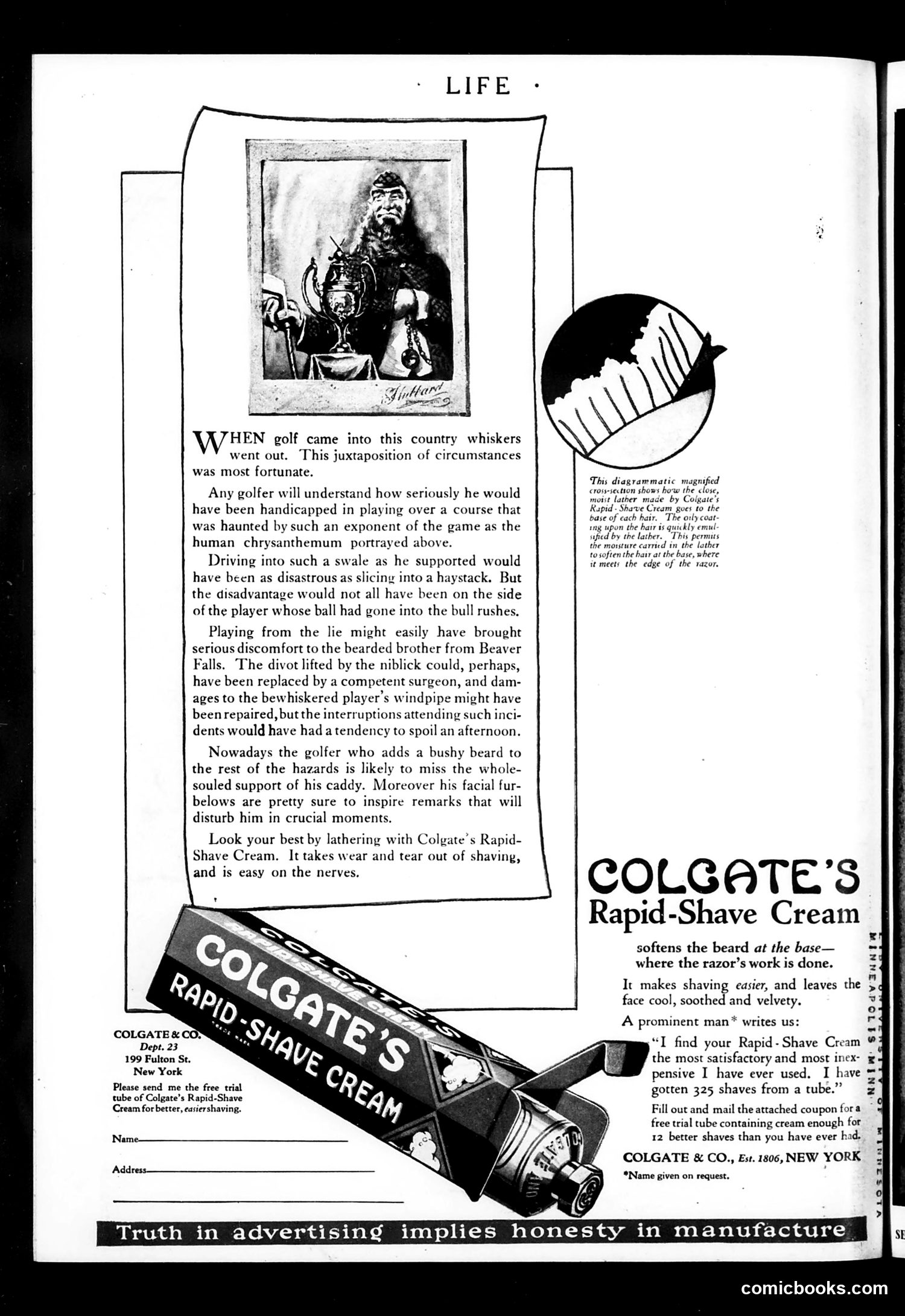
This is primarily a **Colgate's Rapid-Shave Cream advertisement** rather than political satire. The page uses a humorous premise to promote shaving products. The joke contrasts two American fashion trends: the arrival of golf (a gentlemanly sport) coinciding with the decline of beards. The satirical point is that beards would be dangerously incompatible with golf—a mustachioed prospector or frontiersman (the "human chrysanthemum" and "bearded brother from Beaver Falls") playing golf would be absurd and hazardous. The illustration shows an old, bearded man in frontier attire—representing an outdated American masculine ideal that golf supposedly displaced. The advertisement's message: modern gentlemen who play golf need clean-shaven faces. Colgate's cream makes shaving easier and keeps faces "cool, soothed and velvety"—appealing to golf-playing men as the new standard of American masculinity. The tagline at bottom emphasizes trustworthiness: "Truth in advertising implies honesty in manufacture."