
Life, 1923-09-20 · page 26 of 36
Life — September 20, 1923 — page 26: what you’re looking at
What you’re looking at
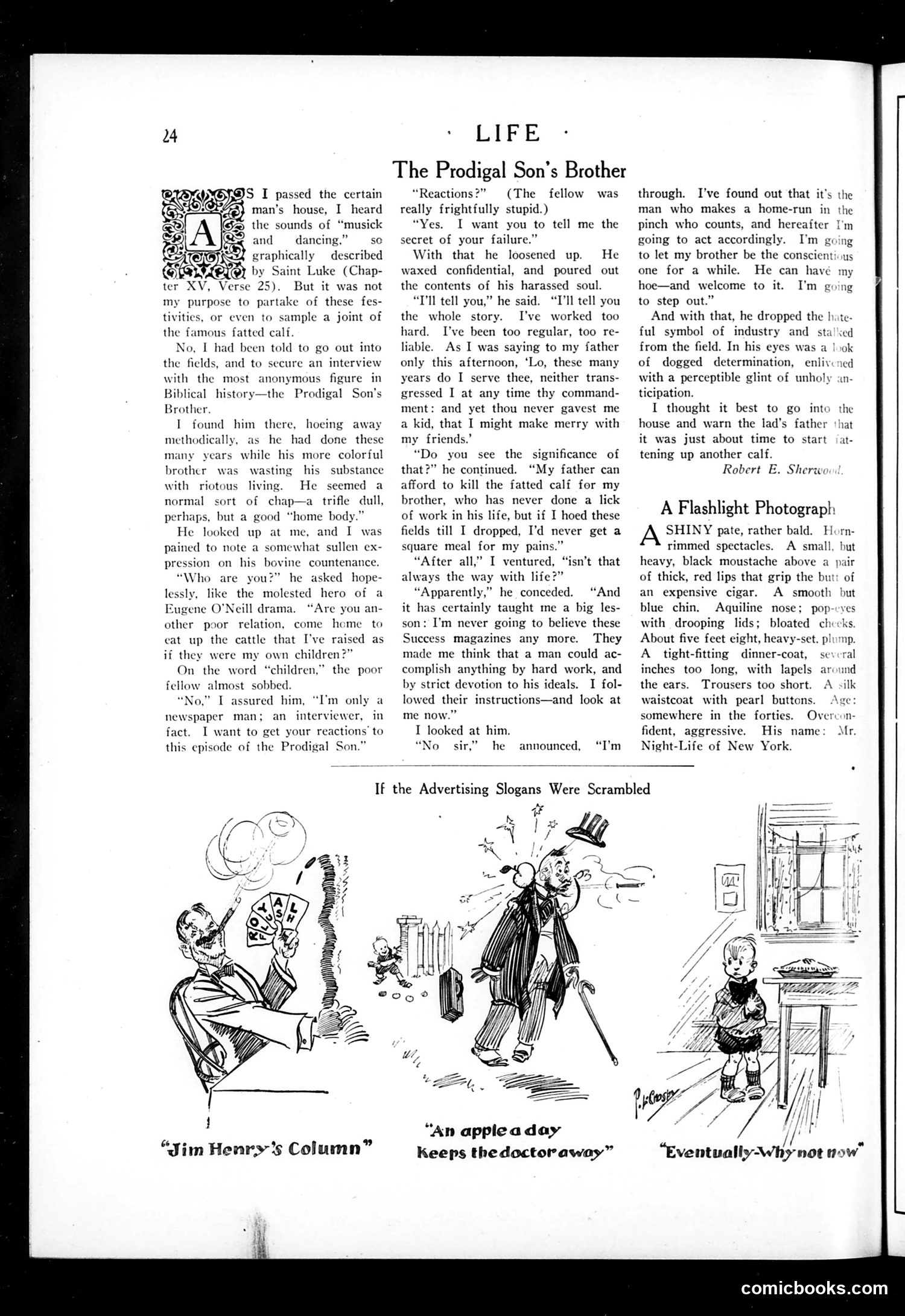
This page contains two separate pieces from Life magazine: **"The Prodigal Son's Brother"** is a satirical short story that inverts the famous biblical parable. The narrator interviews the overlooked elder brother—who faithfully worked the fields while his wastrel sibling partied—and finds him bitter and disillusioned. The brother complains that hard work and virtue went unrewarded while his irresponsible sibling received celebration and feasting. The satire targets popular "Success magazines" that preached that discipline and hard work guarantee prosperity. The story suggests this promise is hollow; the story ends with the fed-up elder brother abandoning his duties, implying the moral system itself has failed. **"If the Advertising Slogans Were Scrambled"** are three cartoons humorously mixing up familiar advertising catchphrases with absurd illustrations. The three scrambled slogans—"Jim Henry's Column," "An apple a day keeps the doctor away," and "Eventually—Why not now"—are paired with unrelated comical drawings, creating nonsensical humor through mismatch between text and image.
📄 Transcribed text from this page (OCR, searchable)
Machine-transcribed from the original scan — historical spelling and the odd misread are preserved.
S I passed the certain man’s house, I heard the sounds of “musick and — dancing,” — so graphically described by Saint Luke (Chap- ter XV, Verse 25 But it was not my purpose to partake of these fes- tivities, or even to sample a joint of the famous fatted calf. I had been told to go out into the fields, and to secure an interview with the most anonymous figure in Biblical history—the Prodigal Son's Brother. I found him there, hoeing away methodically, as he had done these many years while his more colorful wasting his substance riotous living. He seemed a normal sort of chap—a trifle dull, perhaps, but a good “home body.” He looked up at me, and I was pained to note a somewhat sullen ex- pression on his bovine countenance. “Who are you?” he asked hope- lessly, like the molested hero of a Eugene O'Neill drama. “Are you an- other poor relation, come home to eat up the cattle that I've raised as if they were my own children On the word “children,” the poor fellow almost sobbed. “No,” I assured him, “I'm only a an interviewer, in I want to get your reactions’ to brother was with newspaper man; fact. this episode of the Prodigal Son.” LIFE The Prodigal Son’s Brother “Reactions?” (The really frightfully stupid.) “Yes. I want you to tell me the secret of your failure.” With that he loosened up. He waxed confidential, and poured out the contents of his harassed soul. “T'll tell you,” he said. “T’ll tell you the whole story. I've worked too hard. I’ve been too regular, too re- liable. As I was saying to my father only this afternoon, ‘Lo, these many years do I serve thee, neither trans- gressed I at any time thy command- ment: and yet thou never gavest me a kid, that I might make merry with my friends.’ “Do you see the significance of that?” he continued. “My father can afford to kill the fatted calf for my brother, who has never done a lick of work in his life, but if I hoed these fields till I dropped, I’d never get a square meal for my pains.” “After all,” I ventured, “isn’t that always the way with life?” “Apparently,” he conceded. “And it has certainly taught me a big les- son: I'm never going to believe these Success magazines any more. They made me think that a man could ac- complish anything by hard work, and by strict devotion to his ideals. I fol- lowed their instructions—and look at me now.” I looked at him. “No. sir,” fellow was he announced, “I'm through. I’ve found out that it’s the man who makes a home-run in the pinch who counts, and hereafter I'm going to act accordingly. I'm going to let my brother be the conscienti us one for a while. He can havé my hoe—and welcome to it. I'm goin to step out.” And with that, he dropped the hate- ful symbol of industry and _ sta!\ed from the field. In his eyes was a |ook of dogged determination, enlivened with a perceptible glint of unholy an- ticipation. I thought it best to go into the house and warn the lad’s father ‘hat it was just about time to start /at- tening up another calf. Robert E. Sherwo A Flashlight Photograph SHINY pate, rather bald. Horn- rimmed spectacles. A small, but heavy, black moustache above a pair of thick, red lips that grip the but: of an expensive cigar. A smooth but blue chin. Aquiline nose; pop-vyes with drooping lids; bloated chccks. About five feet eight, heavy-set. plump. A tight-fitting dinner-coat, several inches too long, with lapels around the ears. Trousers too short. A silk waistcoat with pearl buttons. es somewhere in the forties. Overcon- fident, aggressive. His name: Mr. Night-Life of New York. If the Advertising Slogans Were Scrambled “Ap appleaday Keeps thedoctoraway” 6 * “Eventually: Why not now comicbooks.com