
Life, 1923-09-20 · page 24 of 36
Life — September 20, 1923 — page 24: what you’re looking at
What you’re looking at
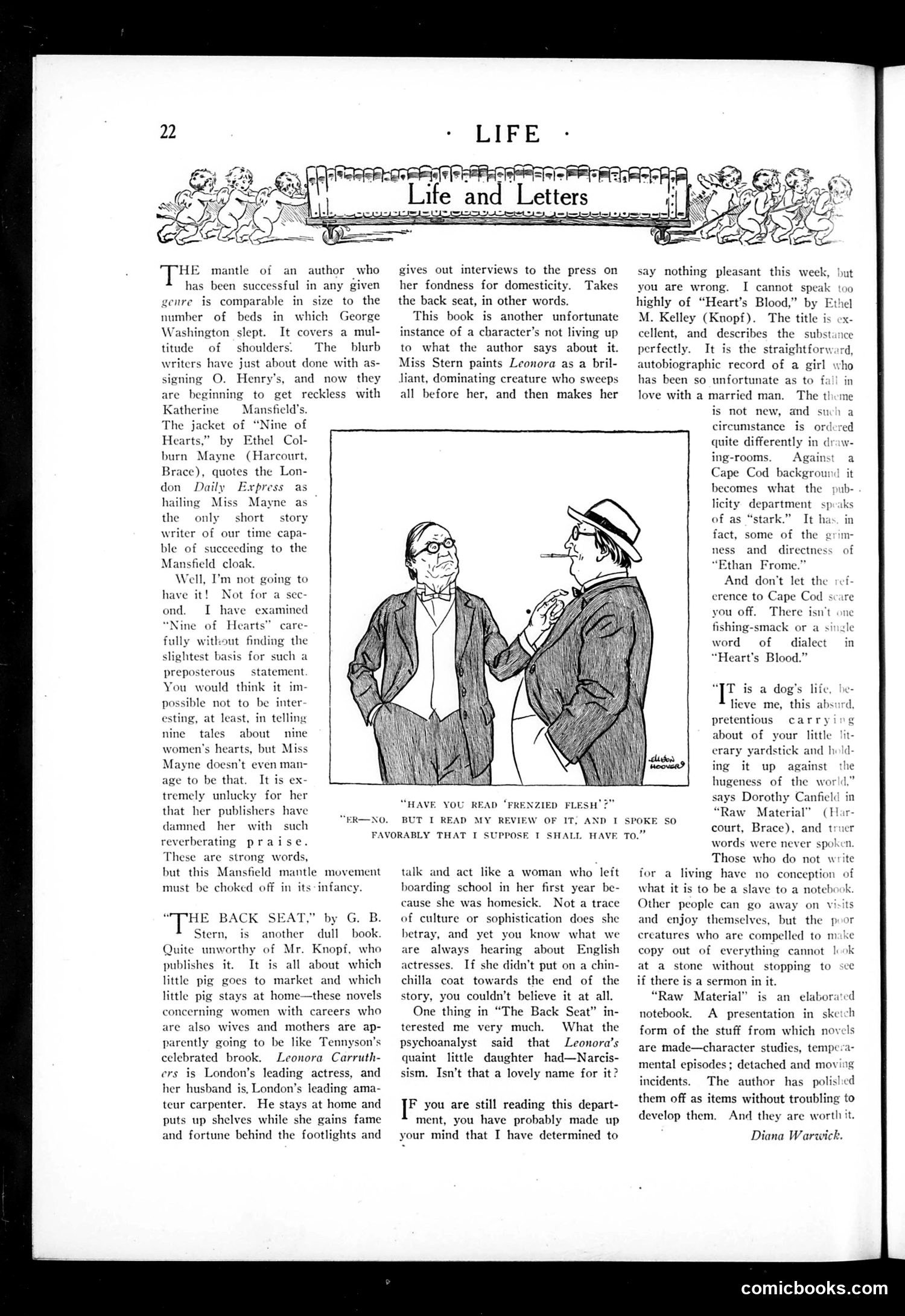
This page contains literary criticism disguised as satire. The cartoon depicts two men discussing books—likely a publisher and critic debating literary merit. The satire targets the publishing industry's practice of "blurbing": slapping famous authors' names on jacket covers to boost sales. The critic attacks this deception, noting that Katherine Mansfield's reputation is being carelessly borrowed to promote mediocre works like Ethel Colburn Mayne's "Nine of Hearts" and G.B. Stern's "The Back Seat." The author expresses exasperation that publishers attribute Mansfield-like genius to writers who don't deserve it. The reviews themselves are scathing—characters lack sophistication, plots recycle tired themes about women balancing careers and marriage, and dialogue feels false. The cartoon's dialogue ("Have you read 'Frenzied Flesh'?") reinforces the column's point: even critics haven't actually engaged with these books—they're just recycling promotional language.
📄 Transcribed text from this page (OCR, searchable)
Machine-transcribed from the original scan — historical spelling and the odd misread are preserved.
Li HE mantle of an author who has been successful in any given genre is comparable in size to the number of beds in Washington slept. It covers a mul- titude of shoulders. The blurb writers have just about done with as- signing O. Henry's, and now they are beginning to get reckless with Katherine Mansfield’s. The jacket of “Nine of Hearts,” by Ethel Col- burn (Harcourt, Brace), quotes the Lon- Daily Express as Miss Mayne as only — short which George Mayne don hailing the writer of our time capa- story ble of succeeding to the Mansfield cloak. Well, I’m not going to have it! Not fo ond. I have examined “Nine of Heart fully without finding the slightest basis for such a preposterous statement You would think it possible not to be inter esting, at least, in telling nine tales nine women’s hearts, but Miss Mayne doesn’t even man- age to be that. sec- care- im- about It is ex- =Is]¢ Letters Se gives out interviews to the press on her fondness for domesticity. Takes the back seat, in other words. This book is another unfortunate instance of a character’s not living up to what the author says about it. Miss Stern paints Leonora as a bril- liant, dominating creature who sweeps all before her, and then makes her say nothing pleasant this week, you are wrong. I cannot speak highly of “Heart’s Blood,” by Et M. Kelley (Knopf). The title is cellent, and describes the subst perfectly. It is the straightfory autobiographic record of a girl has been so unfortunate as to f. love with a married man. The t is not new, and su circumstance is quite different ord ing-rooms. t Cape Cod background i becomes what the licity department of as “stark.” It I fact, some of the ness and “Ethan Frome.” And don’t let the erence to Cape Cod s you off. There isn't fishing-smack or a s word of — dialect “Heart's Blood.” directness “TT is a dog's life, lieve me, this absur¢ pretentious carry about of your little ardstick and h it up against of the wor y for her ishers have with reverberating praise. tremely unluc that her publ “ER—NO. damned her such These are strong words, but this Mansfield mantle movement must be choked off in its-infancy. “THE Stern, is BACK SEAT,” by G. B. dull book. Quite unworthy of Mr. Knopf, who publishes it. It about which little pig goes to market and which little pig stays at home—these novels concerning women with careers who are also wives and mothers are ap- parently going to be like Tennyson’s celebrated brook. Leonora Carruth- ers is London’s leading actress, and her husband is, London’s leading ama- teur carpenter. He stays at home and puts up shelves while she gains fame and fortune behind the footlights and another is all FAVORABLY THAT I SUPPOSE IT SHALL “HAVE YOU READ ‘FRENZIED FLESH’ ?” BUT I READ MY REVIEW OF IT, AND I HAVE talk and act like a woman who left boarding school in her first year be- cause she was homesick. Not a trace of culture or sophistication does she betray, and yet you know what we are hearing about English If she didn’t put on a chin- chilla coat towards the end of the story, you couldn’t believe it at all. One thing in “The Back Seat” in- terested me very much. What the psychoanalyst said that Leonora’s quaint little daughter had—Narcis- sism. Isn't that a lovely name for it? always actresses. IF you are still reading this depart- ment, you have probably made up your mind that I have determined to says Dorothy Canfiek “Raw Material” (Har- court, Brace), and t words were never spol Those who do not write for a living have no conception what it is to be a slave to a noteh« Other people can go away on vi and enjoy themselves, but the poor creatures who are compelled to m copy out of everything cannot | at a stone without stopping to sce if there is a sermon in it. “Raw Material” is an notebook. A presentation in sketch elaborated form of the stuff from which novels are made—character studies, tempe:a- mental episodes; detached and moving incidents. them off as items without troubling to develop them. The author has polished And they are worth it. Diana Warwick. comicbooks.com