
Life, 1923-09-20 · page 16 of 36
Life — September 20, 1923 — page 16: what you’re looking at
What you’re looking at
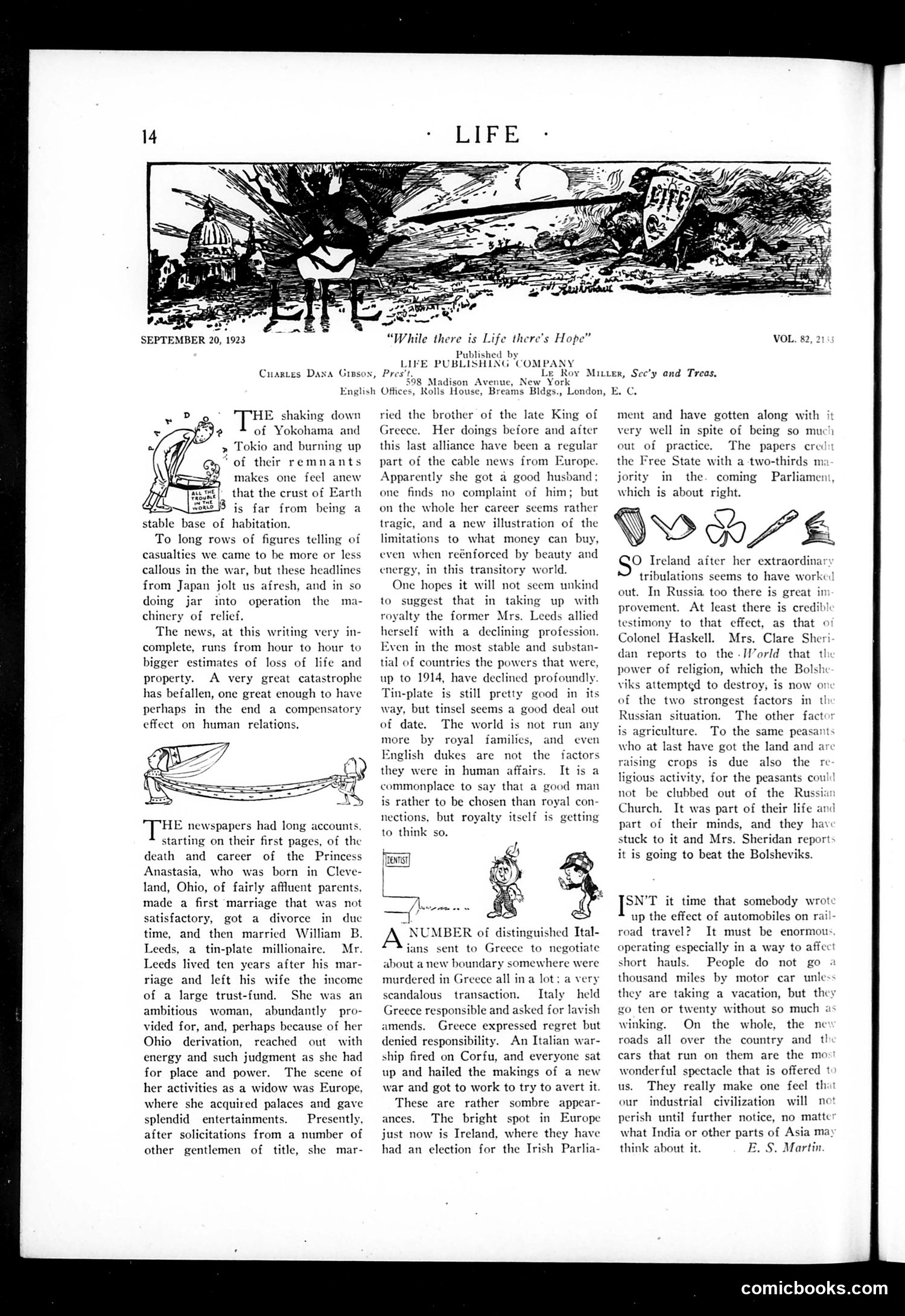
This page contains editorial commentary rather than political cartoons. The main text discusses the death of Princess Anastasia of Russia and the decline of European royalty post-WWI. The author notes that even British dukes no longer wield significant power in human affairs, and suggests "royalty itself is getting to think so." The piece also covers Italian-Greek tensions over boundaries, Irish parliamentary elections, and automobiles' effect on road travel. The small decorative illustrations (classical cherubs/figures) are ornamental rather than satirical. The overall message reflects 1920s concerns about monarchy's diminishing influence in the modern world and ongoing European political instability following World War I.
📄 Transcribed text from this page (OCR, searchable)
Machine-transcribed from the original scan — historical spelling and the odd misread are preserved.
SEPTEMBER 20, 1923 Cuartes Daxa Grsox, Pres’t. English Offices, Kolls House, HE shaking down 2 of Yokohama and » Tokio and burning up “of their remnants makes one feel anew that the crust of Earth is far from being a stable base of habitation. To long rows of figures telling of casualties we came to be more or less callous in the war, but these headlines from Japan jolt us afresh, and in so doing jar into operation the chinery of relief. The news, at this writing very in- complete, runs from hour to hour to bigger estimates of loss of life and property. A very great catastrophe has befallen, one great enough to have perhaps in the end a compensatory effect on human relations. ma- THE newspapers had long accounts. starting on their first pages, of the death and career of the Princess Anastasia, who was born in Cleve- land, Ohio, of fairly affluent parents, made a first marriage that was not satisfactory, got a divorce in due time, and then married William B. Leeds, a tin-plate millionaire. Mr. Leeds lived ten years after his mar- riage and left his wife the income of a large trust-fund. She was an ambitious abundantly — pro- vided for, and, perhaps because of her Ohio derivation, reached with energy and such judgment as she had for place and power. The scene of her activities as a widow was Europe, where she acquired palaces and gave splendid entertainments. Presently, after solicitations from a number of other gentlemen of title, she mar- woman, out “While there is Life there's Hope” Published by LIFE PUBLISHING COMP. g i New York s Bldgs., London, E 398 Madison Av. ried the brother of the late King of Greece. Her doings before and aiter this last alliance have been a regular part of the cable news from Europe. Apparently she got a good husband; one finds no complaint of him; but on the whole her career seems rather tragic, and a new illustration of the limitations to what money can buy, even when reénforced by beauty and energy, in this transitory world. One hopes it will not seem unkind to suggest that in taking up with ty the former Mrs. Leeds allied elf with a declining profession. Even in the most stable and substan- tial of countries the powers that were, up to 1914, have declined profoundly Tin-plate is still pretty good in its way, but tinsel seems a good deal out of date. The world is not run any more by royal families, and English dukes are not the iactors they were in human affairs. It is a commonplace to say that a good man is rather to be chosen than royal con- nections, but royalty itself is getting to think so. even j[textst] NUMBER of distinguished Ital- ians sent to Greece to negotiate about a new boundary somewhere were murdered in Greece all ina lot: a very scandalous Italy held Greece responsible and asked for lavish amends. Greece expressed regret but denied responsibility. An Italian war- ship fired on Corfu, and everyone sat up and hailed the makings of a new war and got to work to try to avert it These are rather sombre appear- ances. The bright spot in Europe just now is Ireland, where they have had an election for the Irish Parlia- transaction. VOL. 82, 21 ny Mutter, Sec'y and Treas, ment and have gotten along with very well in spite of being so muci The papers credit the Free State with a two-thirds m jority in the. coming Parliament, which is about right. out of practice. O Ireland after her extraordinar tribulations seems to have workcil out. In Russia too there is great in provement. At least there is credib! testimony to that effect, as that « Colonel Haskell. Mrs. Clare Sheri dan the World that tl power of religion, which the Bolsh« viks attempted to destroy of the two strongest factors in tl Russian situation. The other factor is agriculture. To the same peasants who at last have got the land and are crops is due also the r ligious activity, for the peasants coul:! not be clubbed out of the Russi Church. It was part of their life and part of their minds, and they hav« stuck to it and Mrs. Sheridan report it is going to beat the Bolsheviks. reports to is now or raising SN’T it time that somebody wrot up the effect of automobiles on rail- road travel? It must be enormou operating especially in a way to affect short hauls. People do not go thousand miles by motor car unle they are taking a vacation, but they go ten or twenty without so much as winking. On the whole, the ne roads all over the country and t! cars that run on them are the mo: wonderful spectacle that is offered t They really make one feel that our industrial civilization will not perish until further notice, no matte what India or other parts of Asia ma) think about it. E, S. Martin us. comicbooks.com