
Life, 1923-09-20 · page 20 of 36
Life — September 20, 1923 — page 20: what you’re looking at
What you’re looking at
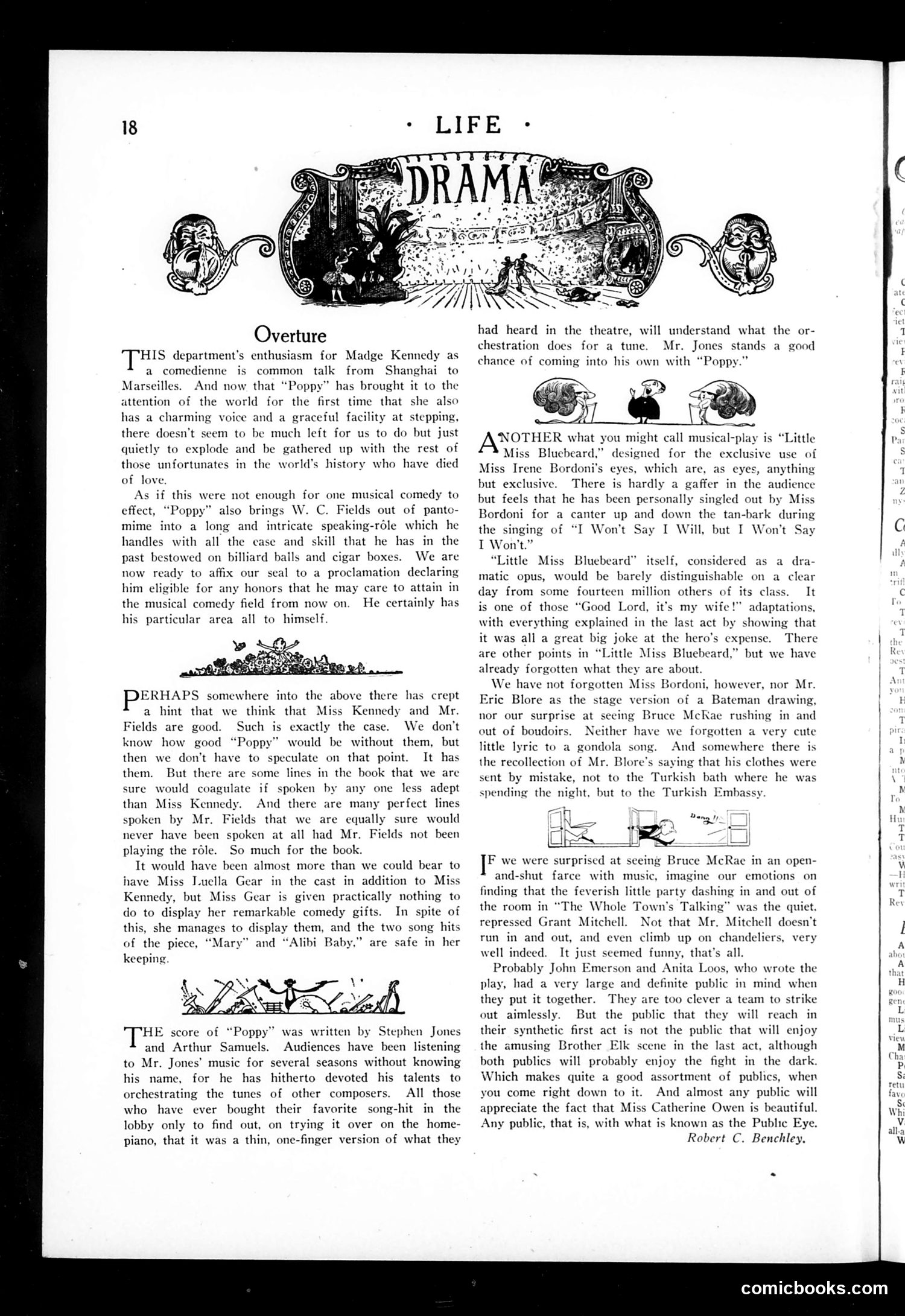
This page reviews two Broadway musicals: "Poppy" and "Little Miss Bluebeard." **"Poppy"** stars Madge Kennedy (praised for her singing and dancing debut) and W.C. Fields, transitioning from pantomime into speaking roles. The reviewer enthusiastically endorses both performers, declaring Fields worthy of "honors" in musical comedy. The score by Stephen Jones and Arthur Samuels is praised for its orchestration—the reviewer notes that theater orchestration transforms what audiences hear versus thin "one-finger" versions attempted on home pianos. **"Little Miss Bluebeard"** features French performer Irene Bordoni and British character actor Eric Blore. The plot is dismissed as generic ("Good Lord, it's my wife!" type comedy), barely distinguishable from fourteen other similar shows. However, Bordoni's stage presence and a cute gondola song merit mention, along with Blore's theatrical appearance. The satire is gentle: both reviews celebrate star performers while acknowledging that the plots are formulaic theatrical conventions of the era.
📄 Transcribed text from this page (OCR, searchable)
Machine-transcribed from the original scan — historical spelling and the odd misread are preserved.
Overture HIS department's enthusiasm for Madge Kennedy as a comedienne is common talk from Shanghai to Marseilles. And now that “Poppy” has brought it to the attention of the world for the first time that she also has a charming voice and a graceful facility at stepping, there doesn't seem to be much left for us to do but just quietly to explode and be gathered up with the rest of those unfortunates in the world’s history who have died of lov As if this were not enough for one musical comedy to effect, “Poppy” also brings W. C. Fields out of panto- mime into a long and intricate speaking-réle which he handles with all the ease and skill that he has in the past bestowed on billiard balls and cigar box We are now ready to affix our seal to a proclamation declaring him eligible for any honors that he may care to attain in the musical comedy field from now on. He certainly has his particular area all to himself. ERHAPS somewhere into the above there has crept a hint that we think that Miss Kennedy and Mr. Fields are good. Such is exactly the case. We don't know how good “Poppy” would be without them, but then we don’t have to speculate on that point. It has them. But there are some lines in the book that we are sure would coagulate if spoken by any one less adept than Miss Kennedy. And there are many perfect lines spoken by Mr. Fields that we are equally sure would never have been spoken at all had Mr. Fields not been playing the rdle. So much for the book. It would have been almost more than we could bear to have Miss Iuella Gear in the cast in addition to Miss Kennedy, but Miss Gear is given practically nothing to do to display her remarkable comedy gifts. In spite of this, she manages to display them, and the two song hits of the piece, “Mary” and “Alibi Baby,” are safe in her keeping. HE score of “Poppy” was written by Stephen Jones and Arthur Samuels. Audiences have been listening to Mr. Jones’ music for several seasons without knowing his name, for he has hitherto devoted his talents to orchestrating the tunes of other composers. All those who have ever bought their favorite song-hit in the lobby only to find out, on trying it over on the home- piano, that it was a thin, one-finger version of what they had heard in the theatre, will understand what the or- chestration does for a tune. Mr. Jones nds a good a ) I \ na NOTHER what you might call musical-play is “Little Miss Bluebeard. Irene Bordoni > use of Mi eyes, anything but exclusive. There is hardly a gaffer in the audien but feels that he has been personally singled out by Miss Bordoni for a canter up and down the tan-bark during the singing of “I Won't Say I Will, but I Won't y I Won't.” “Little Miss Bluebeard” itsel matic opus, would be barely distinguishable on a clear day from some fourteen million others of its class. It is one of those “Good Lord, it's my wife!” adaptations, with everything explained in the last act by showing that it was all a great big joke at the hero's are other points in “Little Miss Bluebeard,” but we have already forgotten what they are about. We have not forgotten Miss Bordoni, however, nor Mr. Eric Blore as the stage version of a Bateman drawing, nor our surprise at seeing Bruce McKae rushing in and designed for the » Which are, considered as a dra- <pense. There out of boudoirs. Neither have we forgotten a very cute little lyric to a gondola sor And somewhere there is the recollection of Mr. Blore’s saying that his clothes were sent by mistake, not to the Turkish bath where he was spending the night, but to the Turkish Embassy. 4am + io a F we were surprised at seeing Bruce McRae in an open- and-shut farce with music, imagine our emotions on finding that the feverish little party dashing in and out of the room in “The Whole Town's Talking” was the quiet. repressed Grant Mitchell. Not that Mr. Mitchell doesn't run in and out, and even climb up on chandeliers, very well indeed. It just seemed funny, that’s all. Probably John E who wrote the play, had a very large and definite public in mind when they put it together. They are too clever a team to strike out aimless! But the public that they will reach in their synthetic first act is not the public that will enjoy the amusing Brother Elk scene in the last act, although both publics will probably enjoy the fight in the dark. Which makes quite a good assortment of publics, when you come right down to it. And almost any public will appreciate the fact that Miss Catherine Owen is beautiful. Any public, that is, with what is known as the Public Eye. Robert C. Benchley. nerson and Anita Loc comicbooks.com