
A complete issue · 36 pages · 1923
Life — June 21, 1923
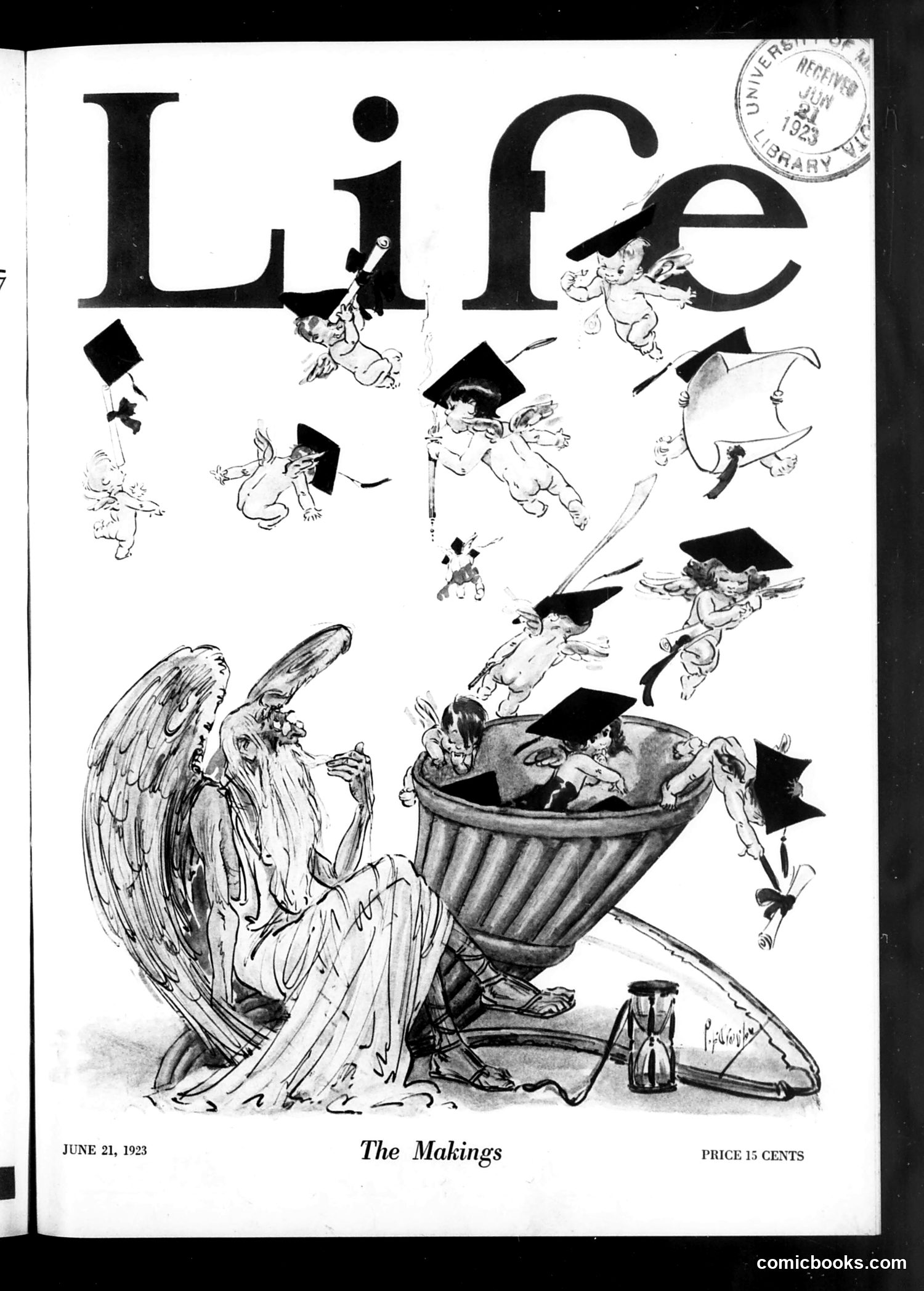
This cover illustration titled "The Makings" depicts babies and cherubs being manufactured in an industrial funnel or chute system, with an angel overseeing the process. The title appears to be a visual pun on "the makings" (as in "the makings of a baby"). The satire likely comments on 1920s anxieties about modernity, industrialization, and mass production encroaching on traditionally sacred or natural processes. By depicting human birth through factory machinery, the artist satirizes concerns that modern society was becoming mechanized and dehumanized. The cherubs flying upward suggest whimsy alongside critique—the illustration balances gentle humor with social commentary about how industrial-age thinking was reshaping cultural values around family and reproduction.
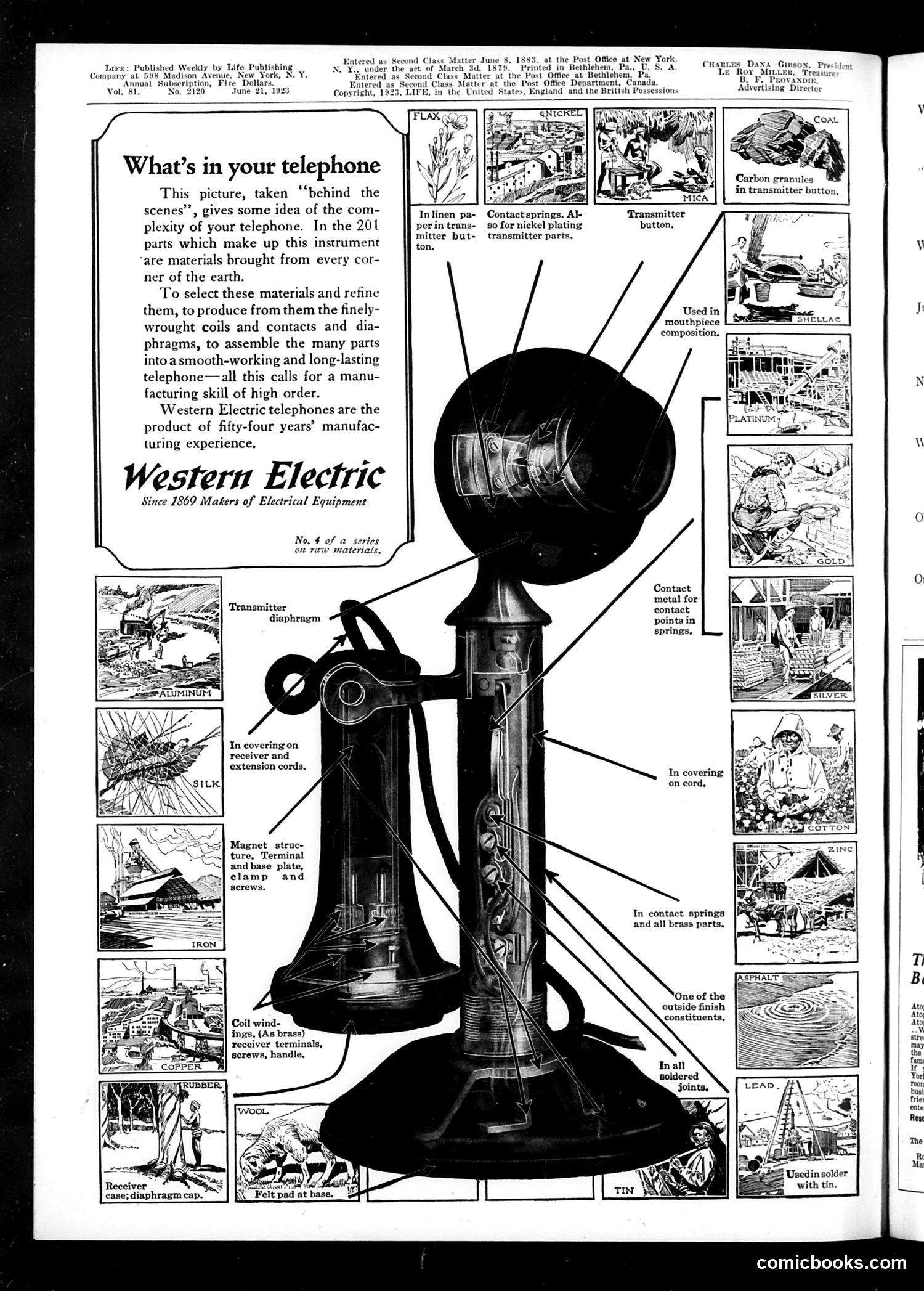
This page is **not a political cartoon or satirical content**—it's a **Western Electric advertisement** (No. 4 in a series on "raw materials"). The large central illustration shows a candlestick telephone with labeled components and callouts identifying materials used in its manufacture: aluminum, nickel, silk, iron, copper, rubber, wool, lead, tin, platinum, and zinc. Small surrounding illustrations depict the natural sources of these materials (mining operations, forests, etc.). The advertisement's message emphasizes Western Electric's manufacturing expertise, claiming 54 years of experience in telephone production. The phrase "What's in your telephone?" frames this as an educational demonstration of industrial sourcing and precision manufacturing rather than satire or social commentary.
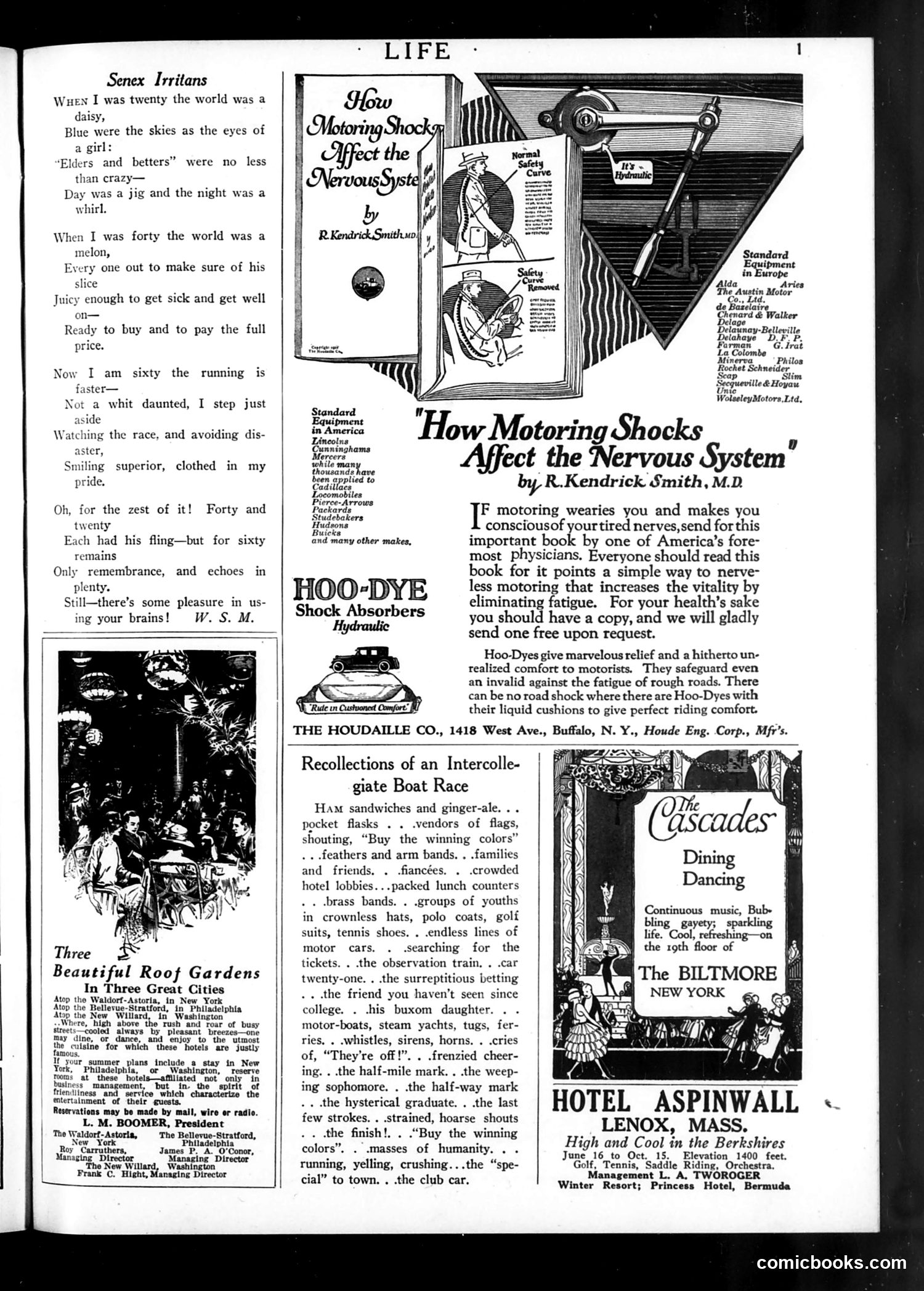
This page is primarily **advertising and miscellaneous content** rather than political satire. The main elements include: 1. **"Senex Irritans" poem** (left): A reflective personal essay about aging, contrasting youthful energy with present-day fatigue—not satirical. 2. **"How Motoring Shocks Affect the Nervous System"** (center): A medical article by R. Kendrick Smith, M.D., advocating Hoo-Dye shock absorbers to reduce driving fatigue. This is a **product advertisement** disguised as health advice—common early 20th-century marketing. 3. **"Roof Gardens in Three Great Cities"** (lower left): Travel/leisure content listing rooftop venues. 4. **"Intercollegiate Boat Race"** (center-bottom): Nostalgic recollection of a sporting event. 5. **Hotel and dining advertisements** (right): The Cascades, Biltmore, Aspinwall Lenox. The page reflects 1920s consumer culture and leisure advertising rather than political commentary.
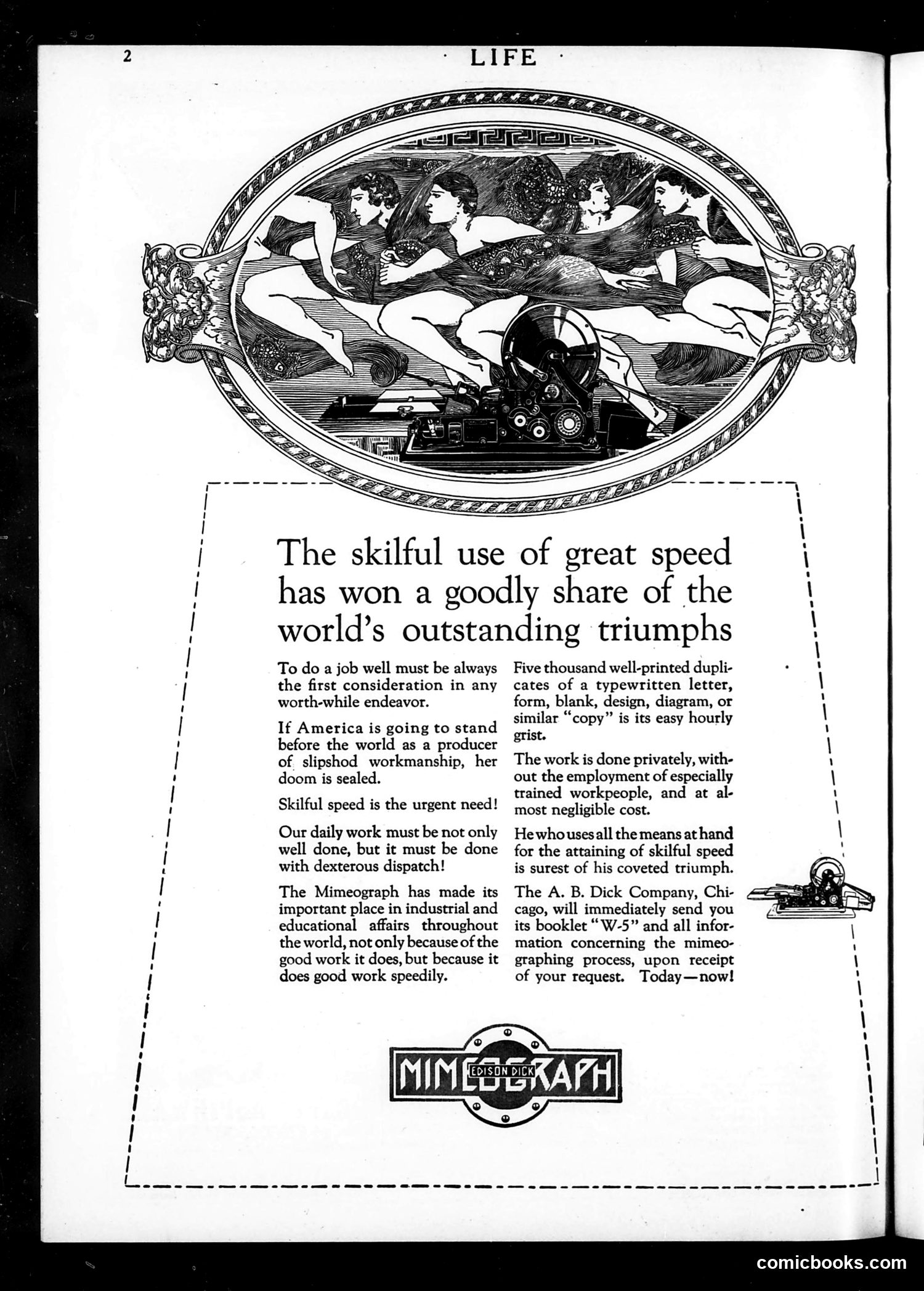
This is primarily an **advertisement for the Mimeograph machine** by the A.B. Dick Company, not political satire. The decorative header illustration shows classical female figures (likely representing speed, industry, or progress) alongside mechanical gears and equipment. The ad's text argues that "skilful use of great speed has won a goodly share of the world's outstanding triumphs." It positions the mimeograph as essential to American industrial competitiveness, claiming the machine enables "slipshed workmanship" prevention and efficient document duplication. The ad appeals to early-20th-century industrial anxieties about American productivity and workforce quality. It promises that mimeographs produce "five thousand well-printed duplicates" quickly and cheaply without "specially trained workpeople." This reflects the era's obsession with efficiency and mechanization as solutions to economic and social problems.
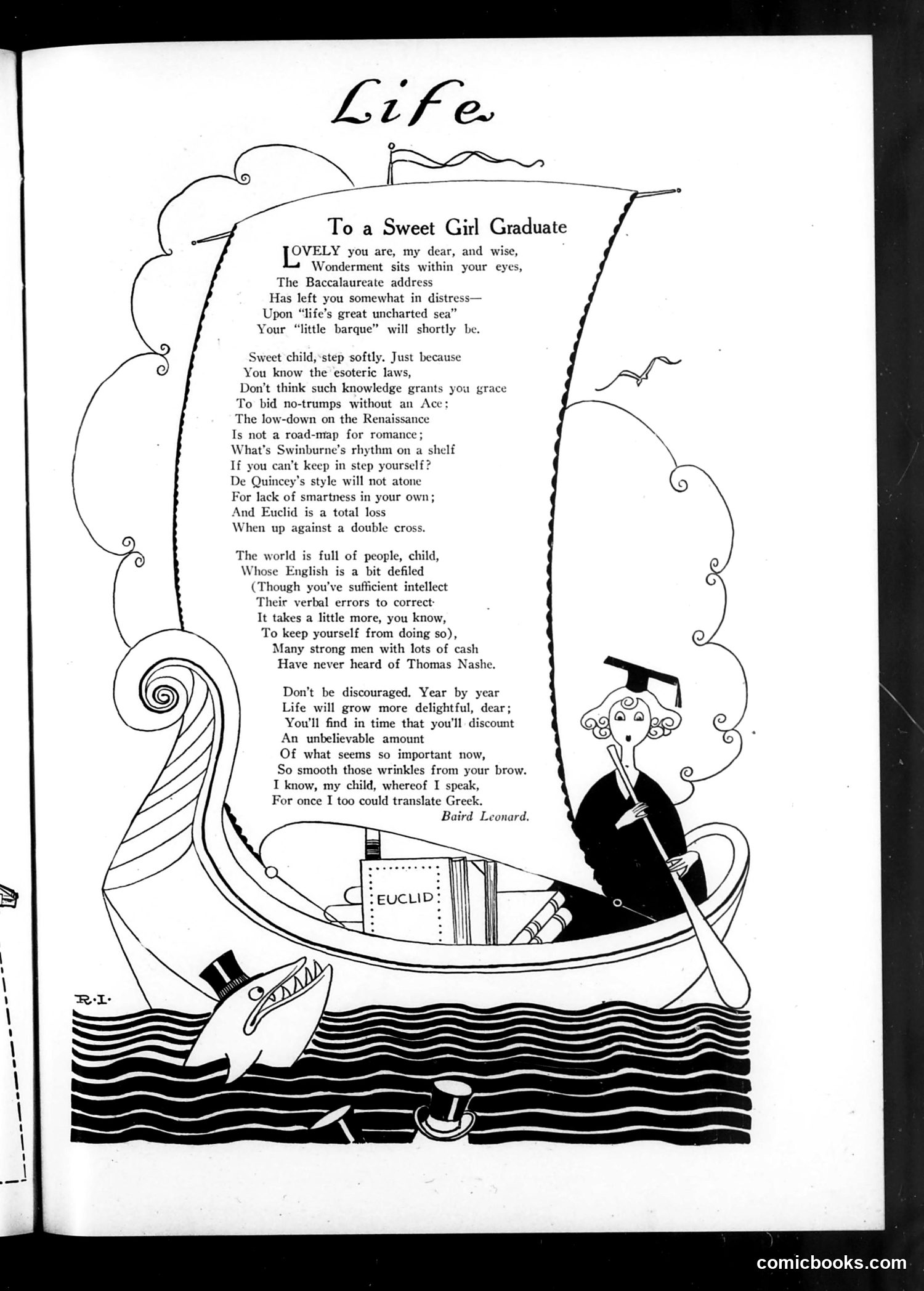
This is a graduation poem titled "To a Sweet Girl Graduate" by Baird Leonard, published in *Life* magazine's "Life" section. The illustration depicts a Venetian gondola carrying a graduate (shown with mortarboard) and a book labeled "Euclid," floating on stylized waves. The poem humorously advises a female graduate not to be intimidated by her classical education. It mocks pretentious intellectualism by referencing figures like Swinburne, De Quincey, and Euclid—suggesting these shouldn't paralyze her with self-doubt. The satire targets the anxiety women faced entering intellectual spaces, while also poking fun at over-educated pomposity. The gondola metaphor frames her post-graduation life as a romantic journey on "life's great uncharted sea." The tone is gently patronizing yet encouraging—typical of early 20th-century attitudes toward educated women.
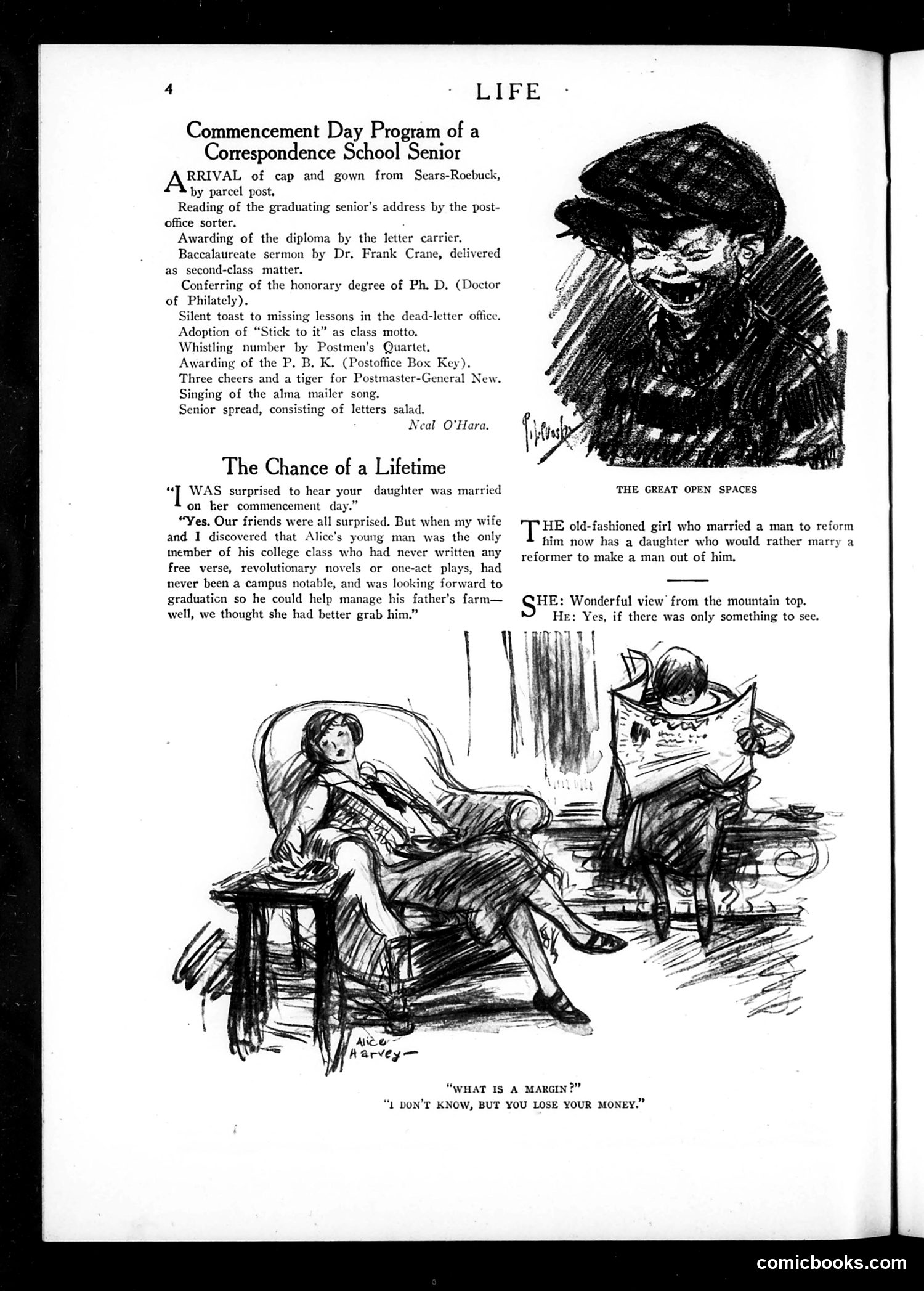
This page contains satirical commentary on early 20th-century social attitudes about education and marriage. **"The Chance of a Lifetime"** mocks a father's surprise that his daughter married a man on her commencement day—specifically, a college classmate who had never been academically notable. The father initially approved, calculating the match would help the young man manage a farm, rather than valuing the daughter's own educational achievement. **"The Great Open Spaces"** extends this satire: an old-fashioned woman who married a "reformer" now has a daughter preferring to marry another reformer. The joke undercuts romantic idealism about changing men through marriage. The cartoon's final joke about "margins" plays on financial/business terminology, suggesting naive newlyweds don't understand monetary concepts—typical period humor about women's supposed financial ignorance.
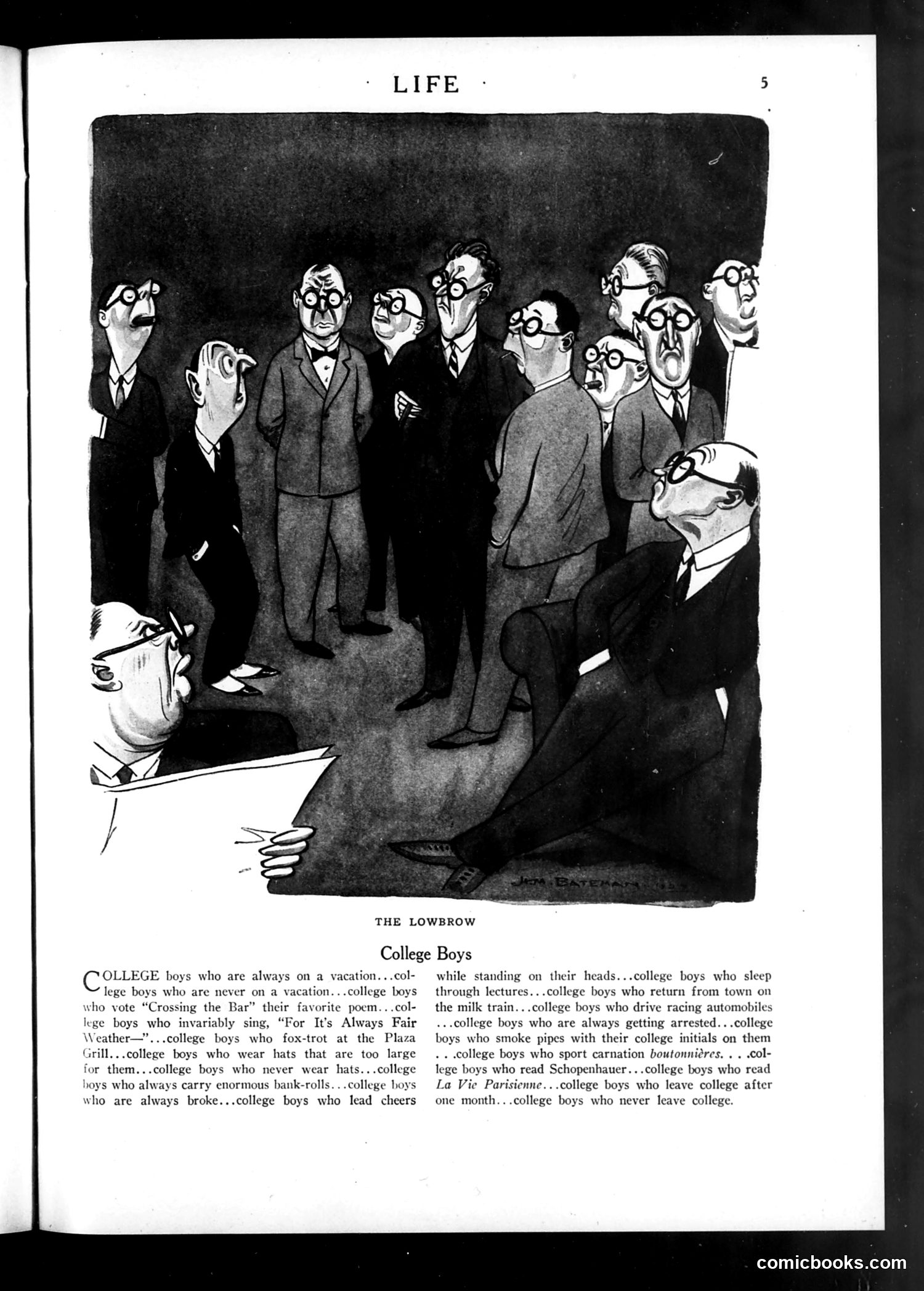
This satirical cartoon and accompanying text mock stereotypical "college boys" of the era. The image shows a group of young men wearing glasses, depicted with exaggerated, somewhat buffoonish facial features gathered together. The text humorously catalogs contradictory college boy stereotypes: those "always on vacation" yet never vacationing, who read Schopenhauer but also *La Vie Parisienne*, who drive racing cars and get arrested, who smoke pipes with college initials. The satire suggests college boys are simultaneously pretentious intellectuals and reckless troublemakers—vacuous poseurs trying to appear sophisticated while behaving foolishly. The "lowbrow" title indicates the piece criticizes superficial, affected student culture, portraying college boys as ridiculous social climbers beneath the dignity of true intellectuals.
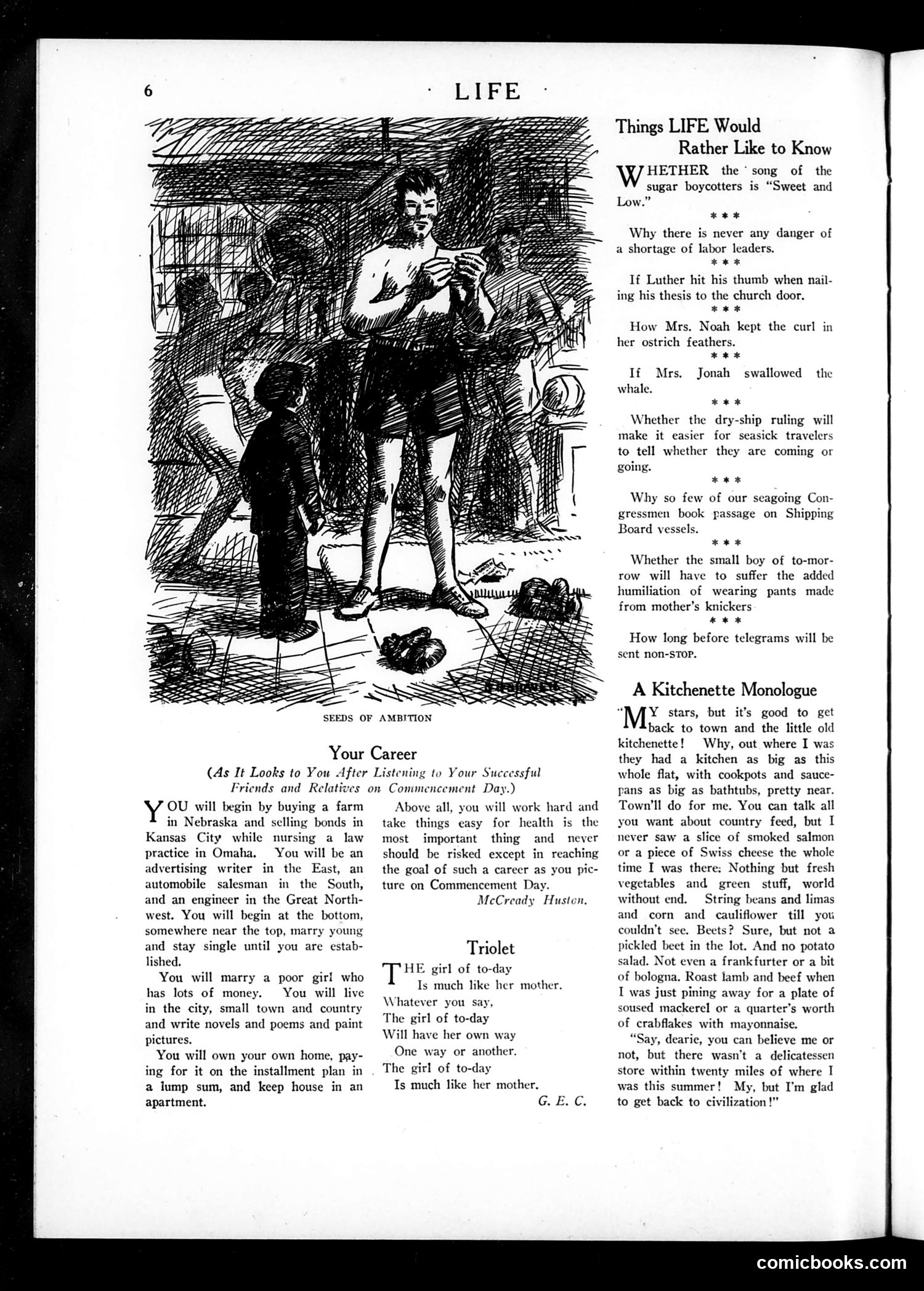
This page contains satirical commentary and poetry rather than traditional political cartoons. The main illustration titled "Seeds of Ambition" depicts a shirtless young man in an urban setting, likely representing youthful ambition and social aspiration. The text column "Things Life Would Rather Like to Know" presents humorous rhetorical questions about contemporary absurdities—including references to sugar boycotts, Luther (likely Martin Luther's 95 Theses), Mrs. Noah, and shipping regulations. These mock serious social and religious debates by juxtaposing them with trivial concerns. The pieces "Your Career" and the poem "Triolet" offer gentle satire of social expectations regarding careers, marriage, and settling down. The "Kitchenette Monologue" humorously contrasts idealized domestic life with harsh reality, suggesting satirical commentary on working-class urban living conditions.
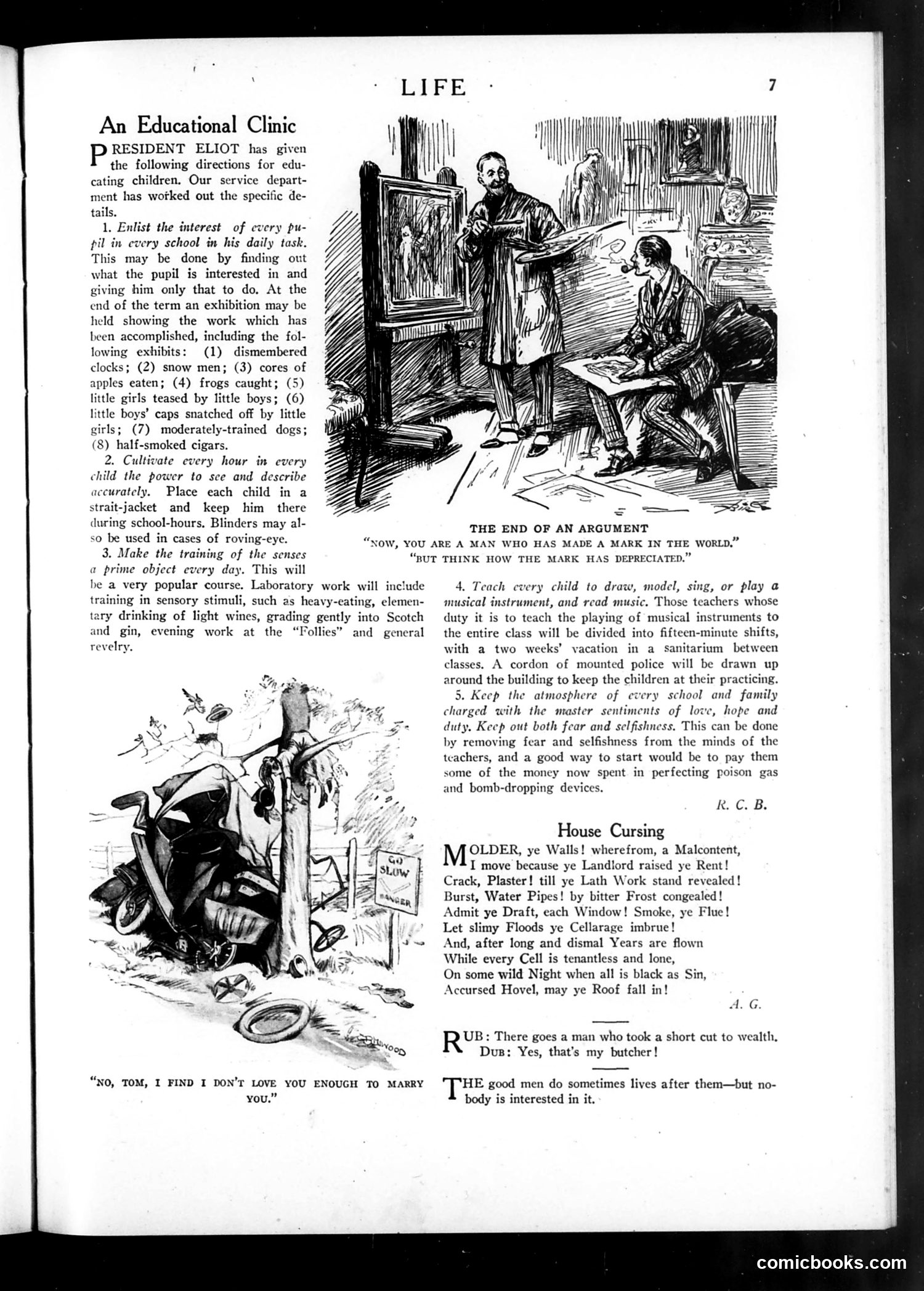
**Top Illustration - "The End of an Argument":** Shows a man (appearing to be a teacher or authority figure) confronting a younger man who has knocked over furniture and made a mess. The caption reads: "Now, you are a man who has made a mark in the world, but think how the mark has depreciated." This satirizes someone whose youthful accomplishments or "mark" have been undermined by poor recent behavior or conduct—the visual destruction emphasizing the deterioration. **"An Educational Clinic":** Text describes President Eliot's proposed directions for educating children, including practical training in trades and sensory development. **Bottom Illustrations:** Include domestic/social commentary cartoons about house conditions and relationships, with satirical verse about rental disputes and romantic indifference. The page combines educational reform discussion with satirical commentary on social manners and relationships.
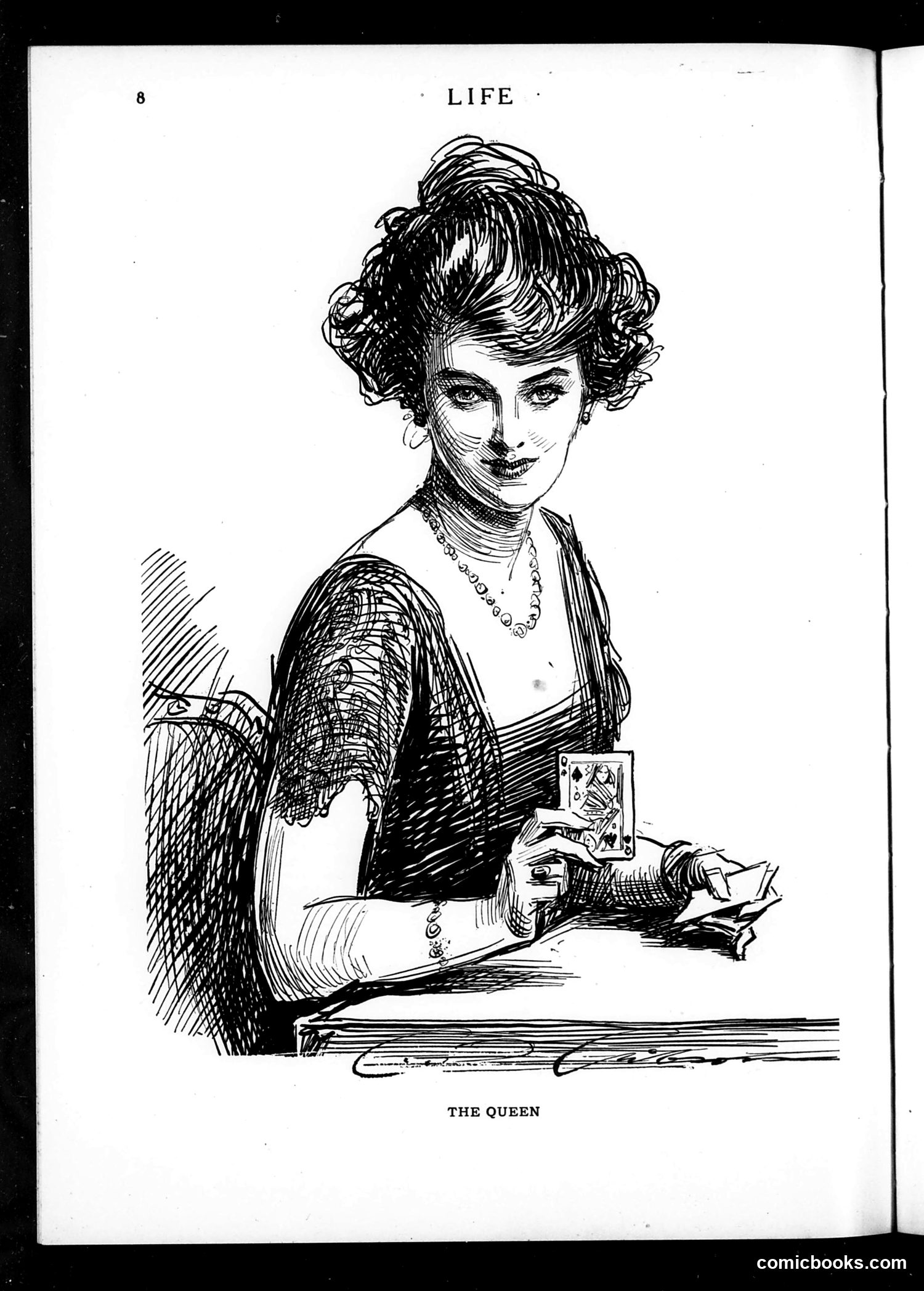
This ink sketch depicts a woman in elegant Edwardian-era dress holding playing cards, wearing jewelry and a shawl with detailed cross-hatching. The caption identifies her simply as "THE QUEEN." Without additional context from the magazine issue, the specific identity and satirical point remain unclear. The title could reference: - An actual queen or royal figure - A society woman of high status - A metaphorical "queen" of cards, gambling, or social circles The playing card visible in her hand suggests themes of chance, gambling, or perhaps social games. The refined artistic technique and prominent placement indicate this was a notable figure, but the precise satirical target—whether political, social, or personal—cannot be determined from the image and caption alone.
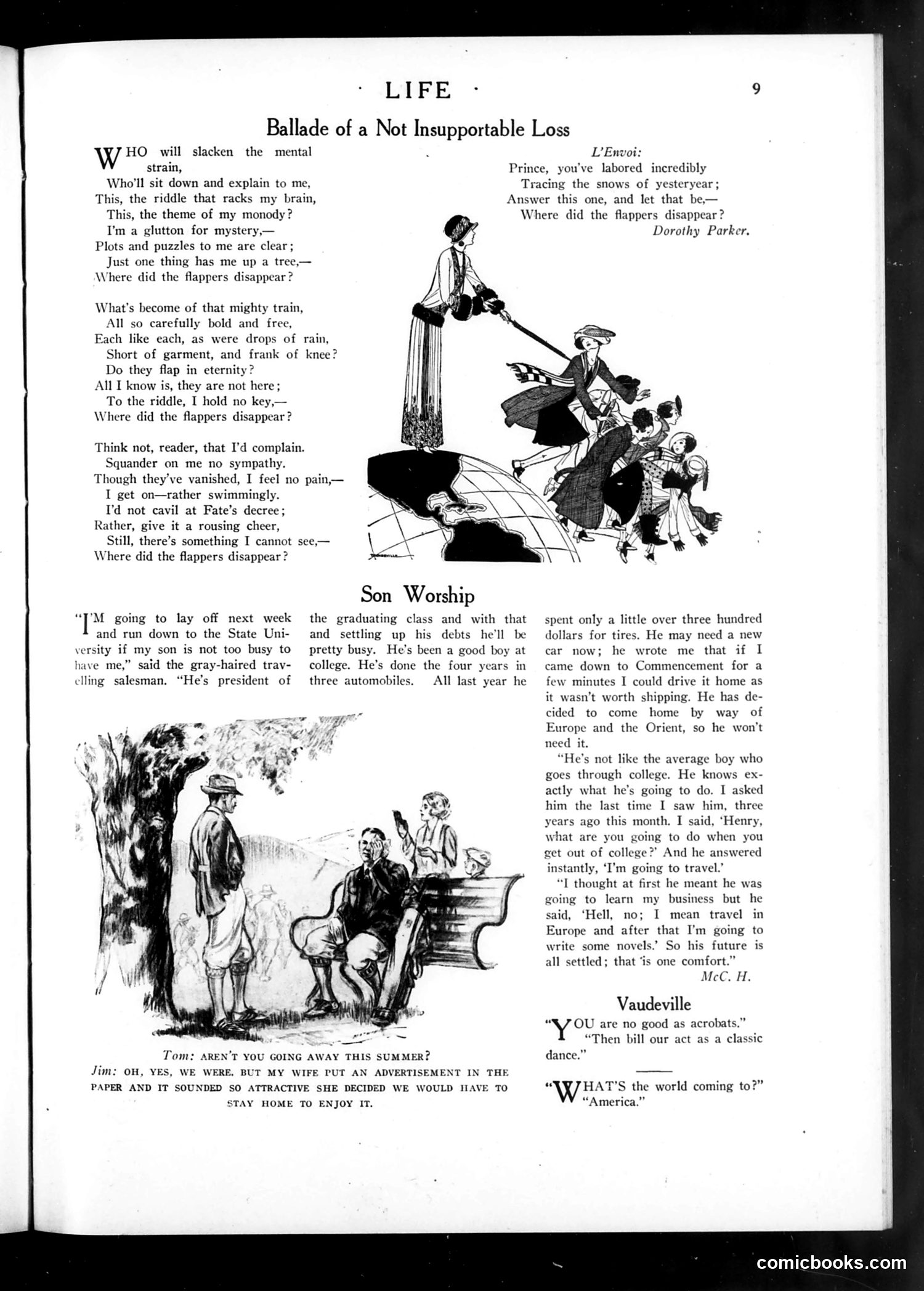
This page contains three separate pieces of satirical humor typical of Life magazine's social commentary: 1. **"Ballade of a Not Insupportable Loss"** (top): A poem illustrated with an elegant woman and children, humorously lamenting the disappearance of "flappers"—the 1920s term for young women who defied social convention through bobbed hair, short skirts, and modern behavior. The satire gently mocks both the flappers' trendiness and the speaker's bemused attitude toward their cultural moment. 2. **"Son Worship"** (middle): A father's dialogue about his college-graduated son's plans. The satire targets paternal pride mixed with financial anxiety—the son needs a new car despite his father's hesitation, exemplifying post-WWI generational expectations and consumer culture tensions. 3. **"Vaudeville"** (bottom): Brief theatrical references mocking the decline of vaudeville entertainment. The illustrations use sketch-style drawings characteristic of 1920s magazine humor.
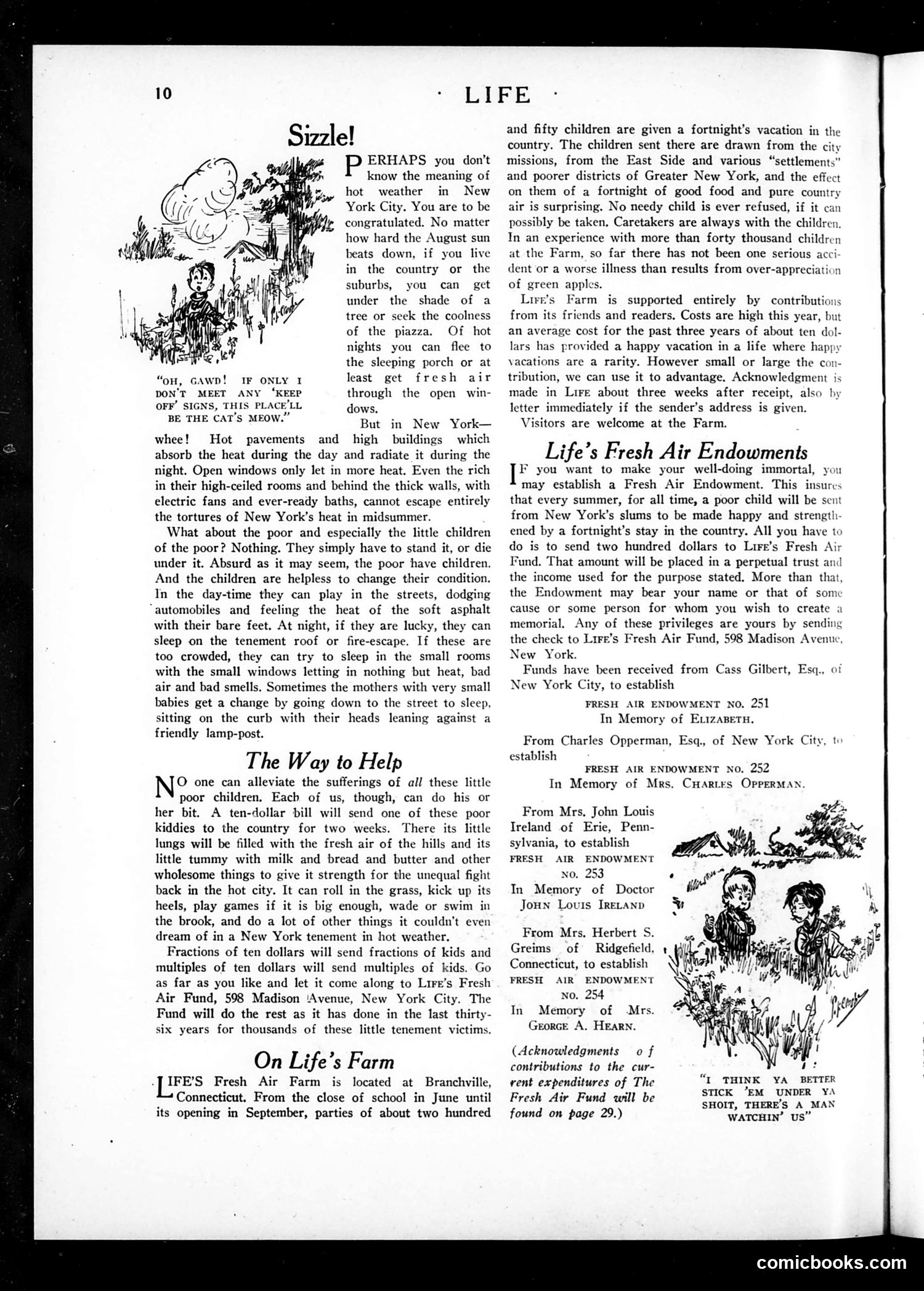
This page combines satirical commentary with charitable appeals. The cartoon shows a child sleeping outdoors on a city curb, illustrating urban poverty in New York City. The accompanying article "Sizzle!" sarcastically contrasts wealthy New Yorkers' heat complaints with poor children's actual suffering—they lack air conditioning, sleep on rooftops or fire escapes, and endure dangerous tenement conditions. The page then pivots to "Life's Fresh Air Endowments," promoting the magazine's charitable program sending poor urban children to a Connecticut farm for summer vacations. Multiple memorial endowments are listed, allowing donors to create named charitable funds. The satire targets indifference to urban poverty while promoting the magazine's solution: seasonal relief for tenement children through country exposure.
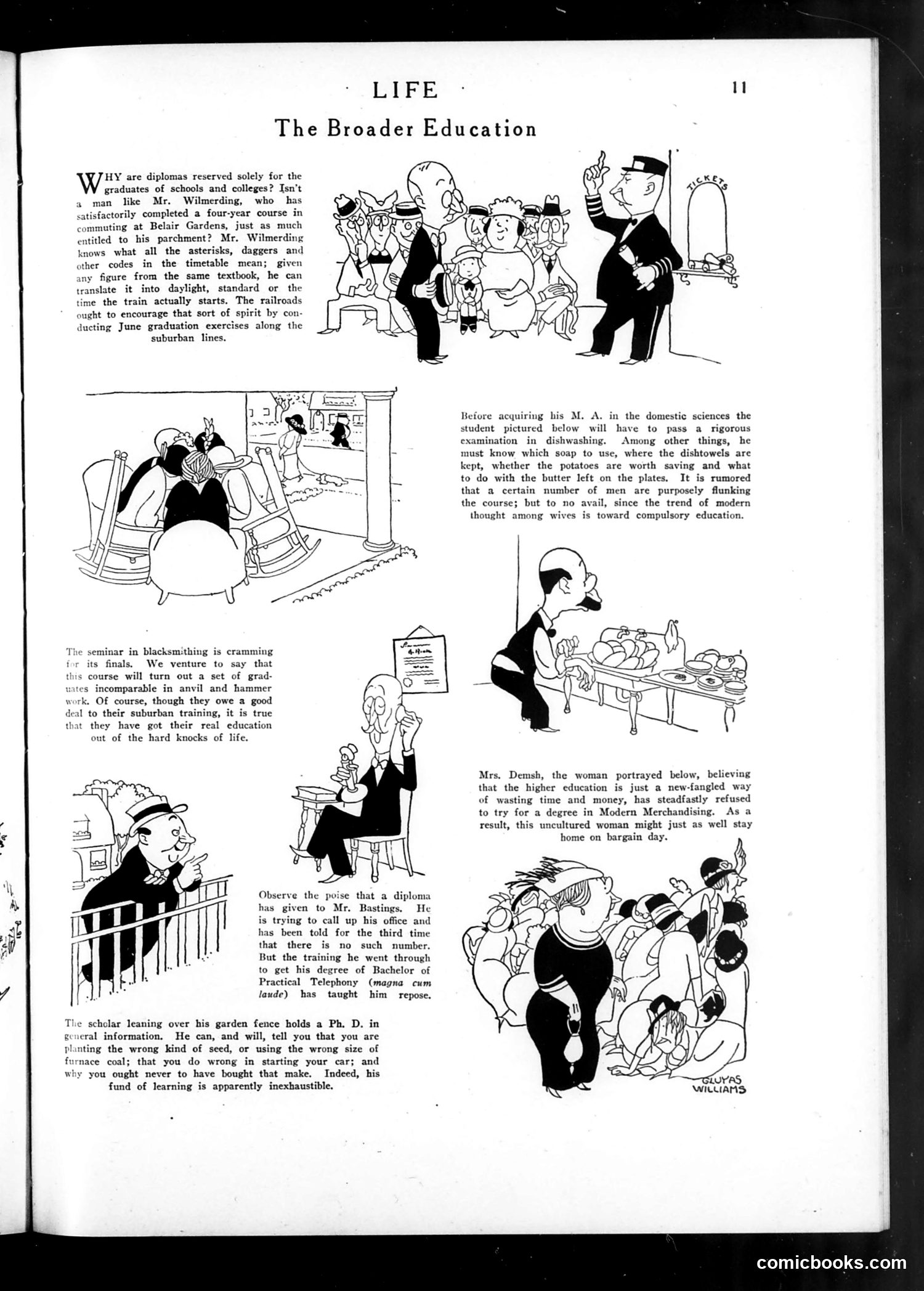
This page satirizes the over-expansion of college curricula into impractical domestic skills. The headline questions why diplomas are reserved for academic study when practical knowledge matters more. The cartoons mock specific examples: a man with a blacksmith degree finding the training useless; another earning a degree in "Practical Telephony" yet remaining clueless; a PhD in "general information" who can't garden properly despite his credentials. The central joke targets Mrs. Densh, who refuses a degree in "Modern Merchandising" (housekeeping), believing higher education wastes time and money—and sarcastically suggesting she'd do better on "bargain day" (shopping). The satire critiques both the inflation of academic credentials for mundane tasks and the disconnect between formal education and practical life skills.
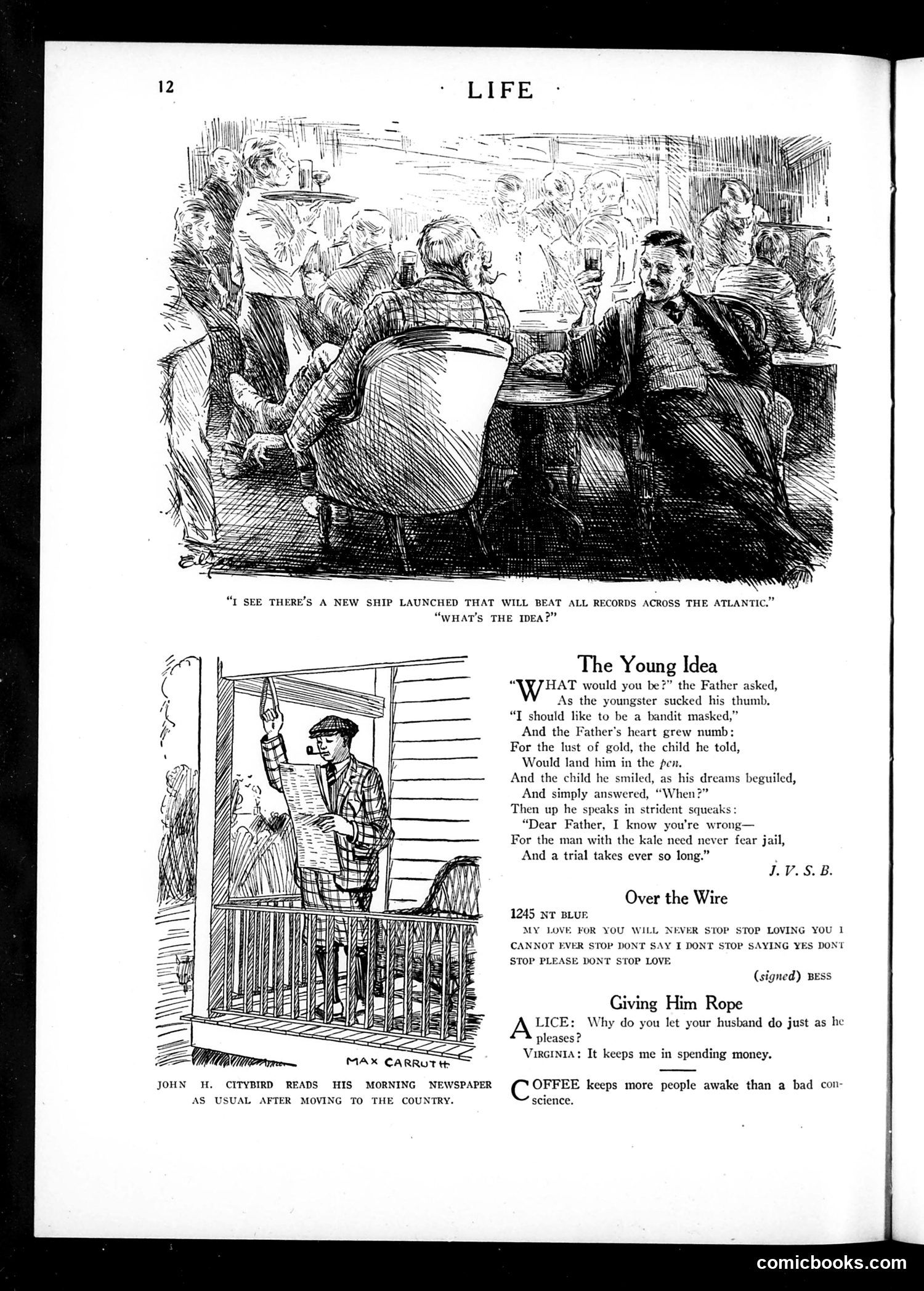
**Top Cartoon:** Depicts a group of men in what appears to be a bar or social setting discussing a new ship. One man announces a vessel that "will beat all records across the Atlantic," and another responds "What's the idea?" This satirizes the era's competitive transatlantic shipping races and the obsession with maritime speed records—a major status symbol for nations and shipping companies in the late 19th/early 20th century. **"The Young Idea" Poem:** A father asks his son what he'd like to be. The child aspires to be a "bandit masked," prompting the father's concern. The son's confident reply—that a man with "kale" (money) needn't fear jail—satirizes youth's cynical, materialistic values and the perception that wealth enables criminals to escape justice. **Other items** include brief humorous dialogues about domestic life and coffee consumption.
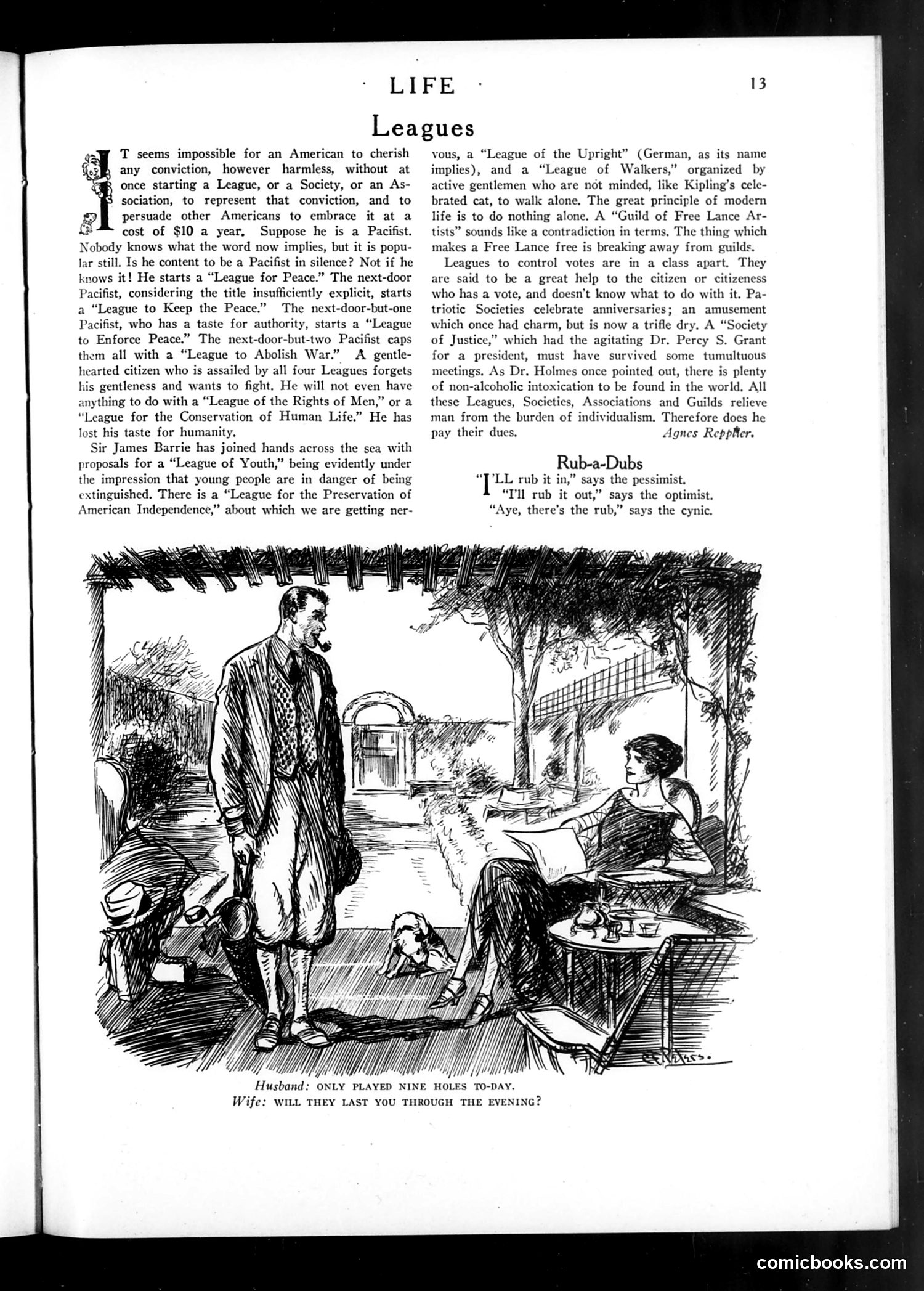
This page satirizes the proliferation of reform "leagues" in early 20th-century America. The text mocks a Pacifist who starts multiple organizations—each with an earnest but redundant mission (League for Peace, League to Keep the Peace, League to Enforce Peace, etc.)—illustrating how well-intentioned reformers create overlapping bureaucracies rather than actual change. The cartoon below shows a husband who's played only nine golf holes, telling his wife they won't last him through the evening—a domestic joke about his addiction to the sport. The cartoon's irony connects to the essay's theme: just as the husband foolishly underestimates his leisure time, reformers naively multiply organizations expecting better results from more leagues.
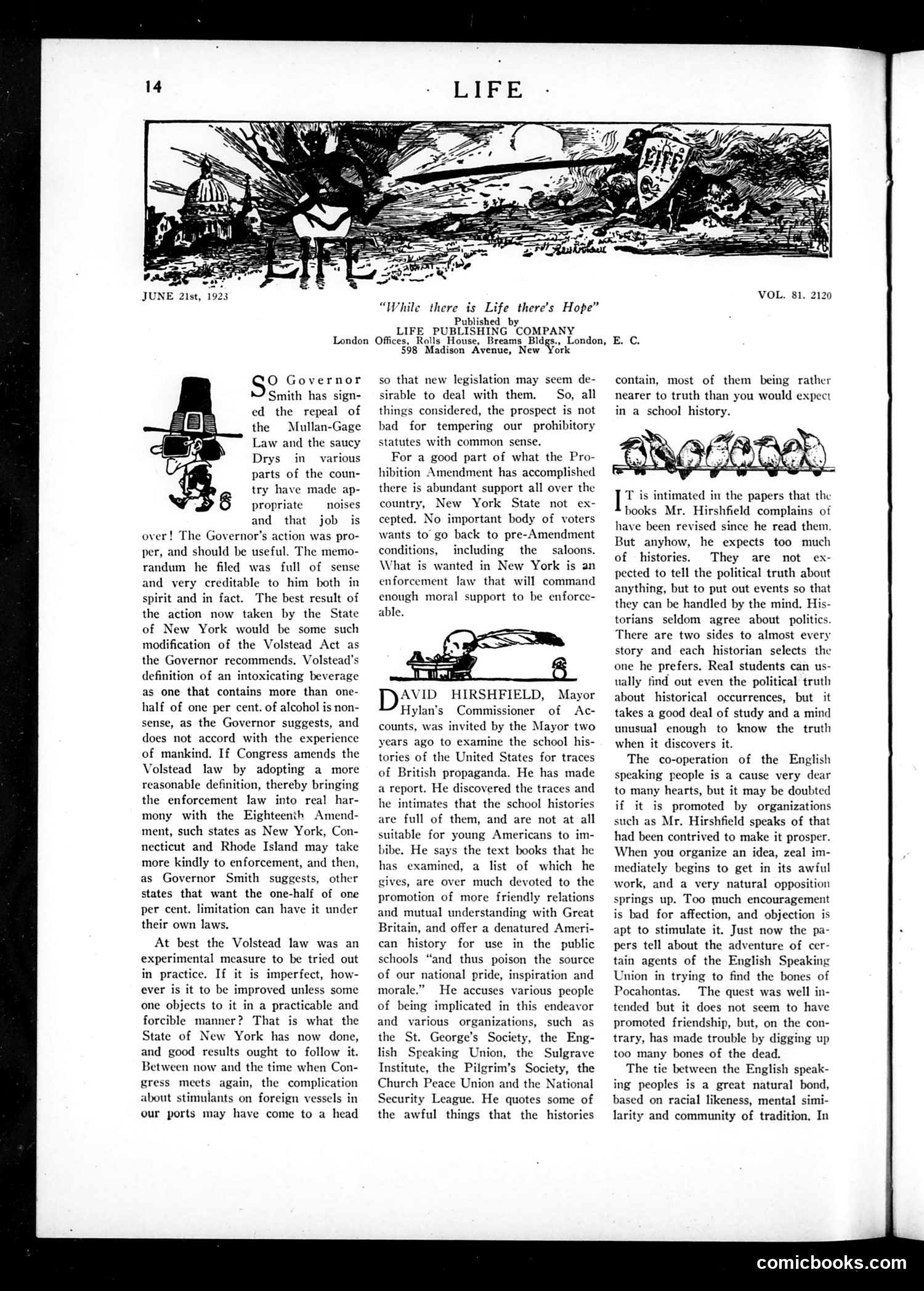
This page discusses Governor Smith's repeal of the Mullan-Gage Law and the Volstead Act (Prohibition enforcement). The small cartoon at top left shows a Pilgrim figure—likely representing American Puritan heritage—toppling over drunk, satirizing the contradiction between America's moral foundations and the current debate over alcohol prohibition. The main text criticizes both sides: those promoting Prohibition as moralistic "poison" to American pride, and those opposing stricter enforcement. The page mocks Mayor Hirshfield's examination of school histories, which he claims contain British propaganda designed to undermine American patriotism and foster friendly relations with Britain. The satire targets government overreach, historical revisionism, and the cultural anxieties of 1920s America regarding alcohol, foreign influence, and national identity.
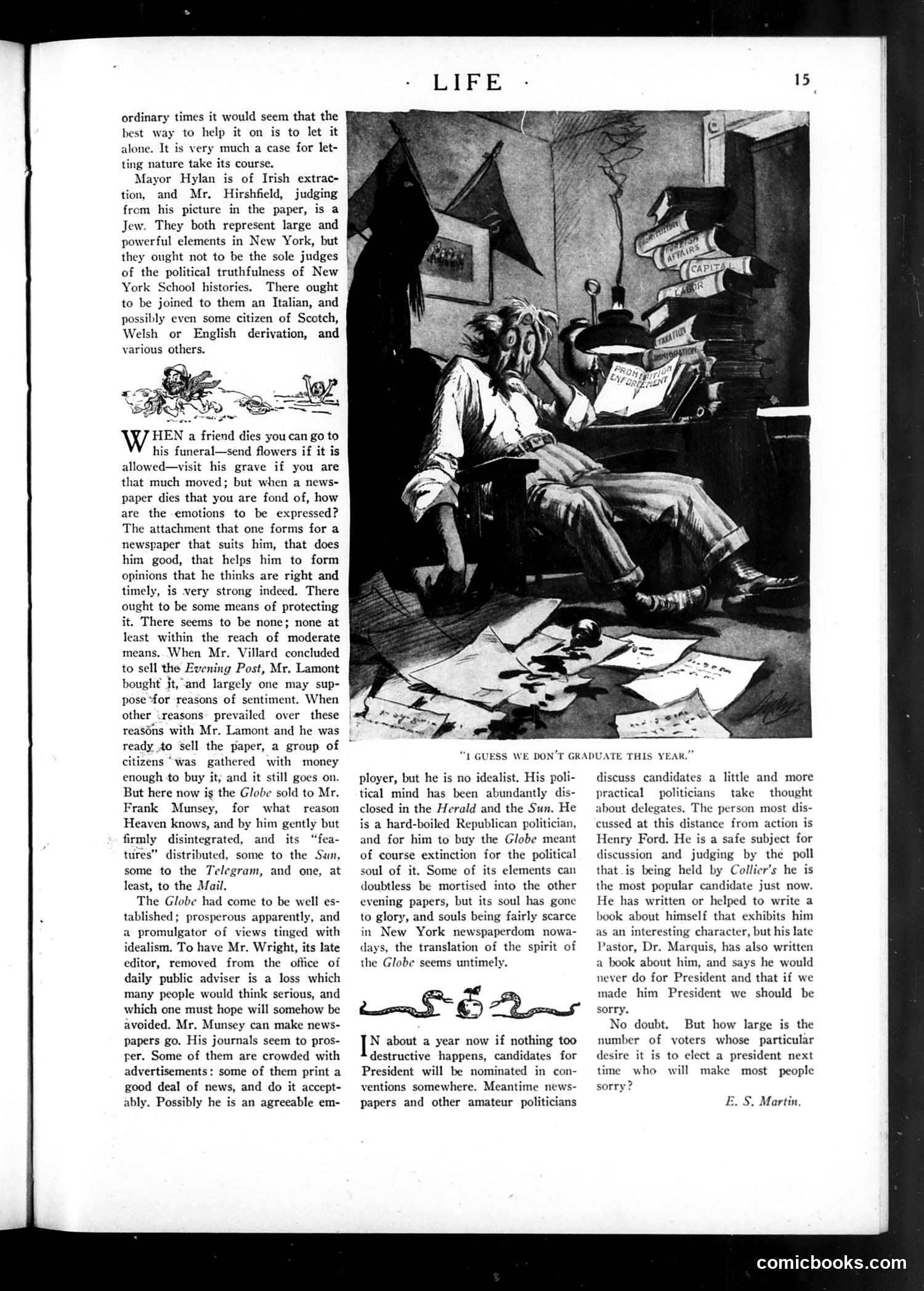
This page critiques the decline of idealistic journalism in New York through the sale of the *Evening Globe* to publisher Frank Munsey. The accompanying cartoon (caption: "I Guess We Don't Graduate This Year") depicts a disheveled figure amid scattered papers labeled with newspaper mastheads (*Sun*, *Telegraph*, *Mail*), visualizing the Globe's dismantling—its content parceled out to competing papers. The text argues that while Munsey is commercially competent, he is a "hard-boiled Republican politician" without idealism. His acquisition meant the Globe's "political soul" died, its progressive viewpoint absorbed into less principled publications. The author laments the loss of newspapers shaped by conviction rather than profit. The piece also discusses Henry Ford's presidential candidacy—popular in polls but criticized by his own pastor as unsuitable for office, illustrating tension between public opinion and expert judgment.
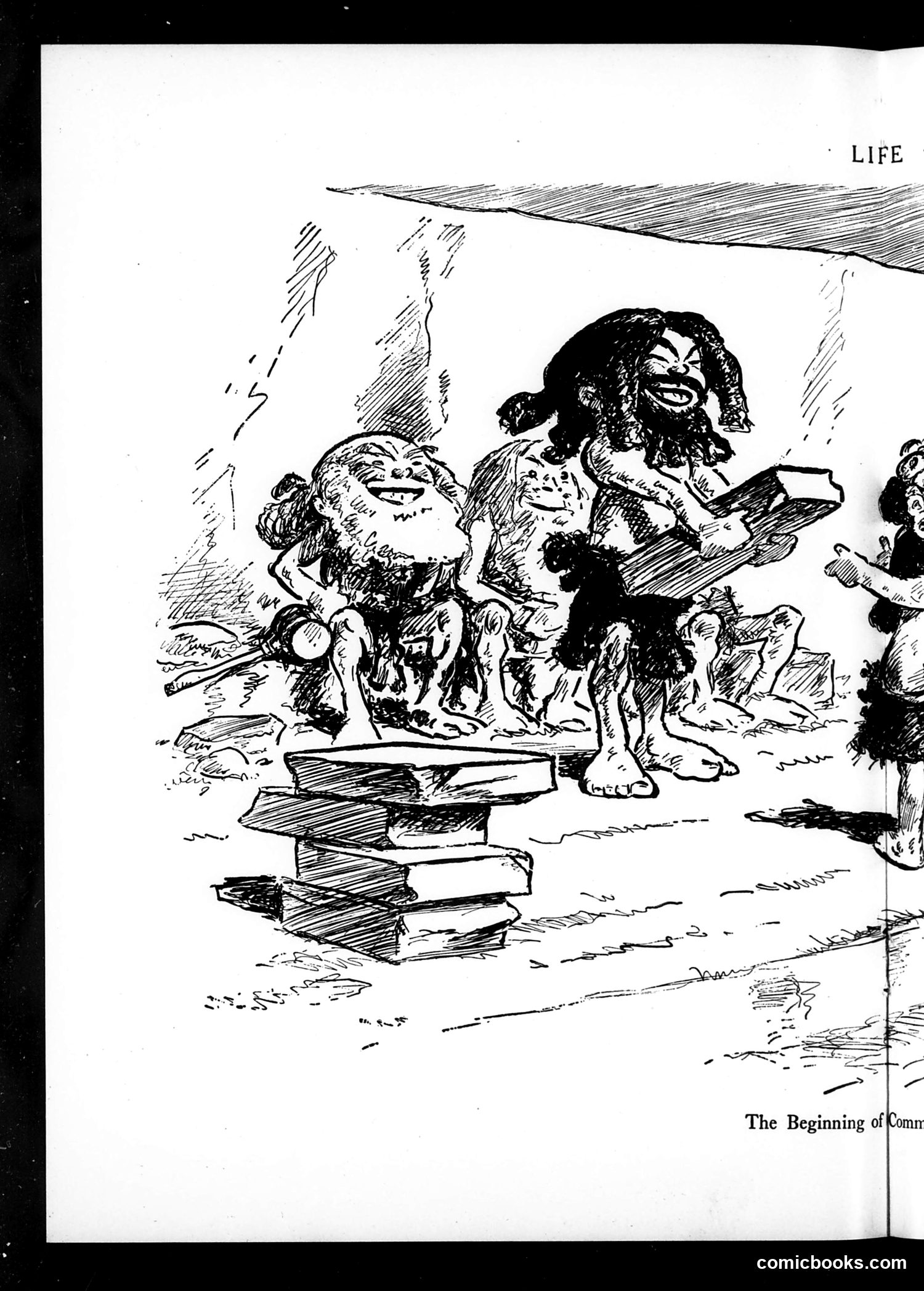
This satirical cartoon depicts primitive figures gathered around stacked books or tablets, apparently illustrating the origins of communication or civilization. The exaggerated, crude caricatures of early humans examining written materials suggests Life magazine is mocking the pretensions of human "progress" through literacy and scholarship. The caption "The Beginning of Comm[unication]" (text cut off) indicates this is commentary on how humans view their intellectual development. The cartoon likely satirizes either: - Overly romanticized notions of humanity's civilizational advances - Academic or intellectual pretension - The gap between our self-image and our actual nature The crude drawing style reinforces the mockery—reducing humanity to barely-civilized figures gawping at books—a common Life approach to deflating pomposity about human achievement and culture.
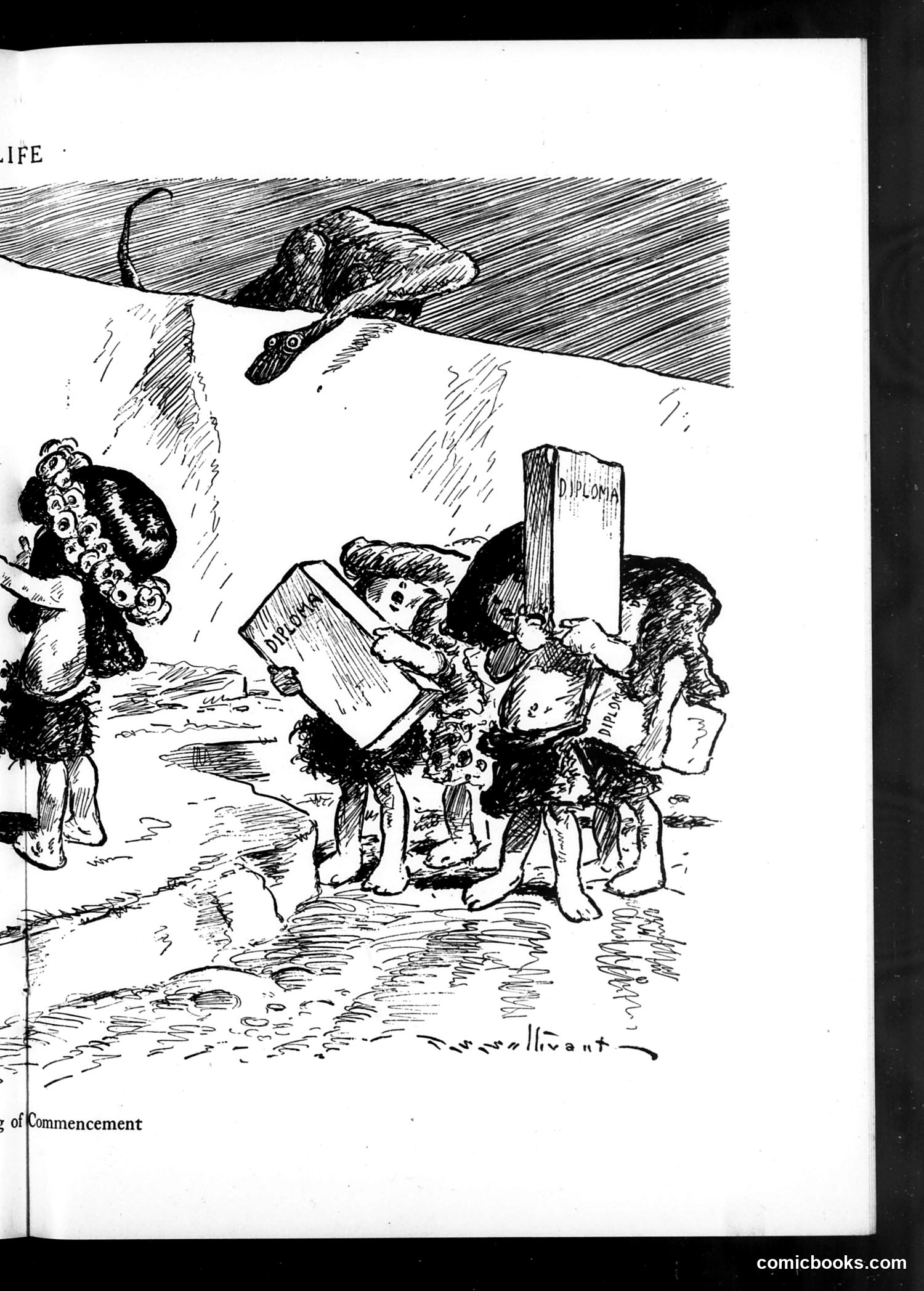
This cartoon, signed by the artist Illivant, depicts a commencement ceremony scene. Several figures in academic dress hold diplomas while standing beneath what appears to be a large diploma or academic credential. A bird (possibly an eagle or similar creature) hovers above, seemingly descending or swooping down toward the graduates. The satire appears to critique the value or authority of academic diplomas and commencement ceremonies themselves—suggesting that formal education credentials may be under threat or scrutiny, or that the conferring of degrees is being mocked as hollow or ineffectual. The predatory bird likely represents some external force threatening to diminish or undermine the significance of academic achievement, though the specific historical context remains unclear without additional dating or publication information.
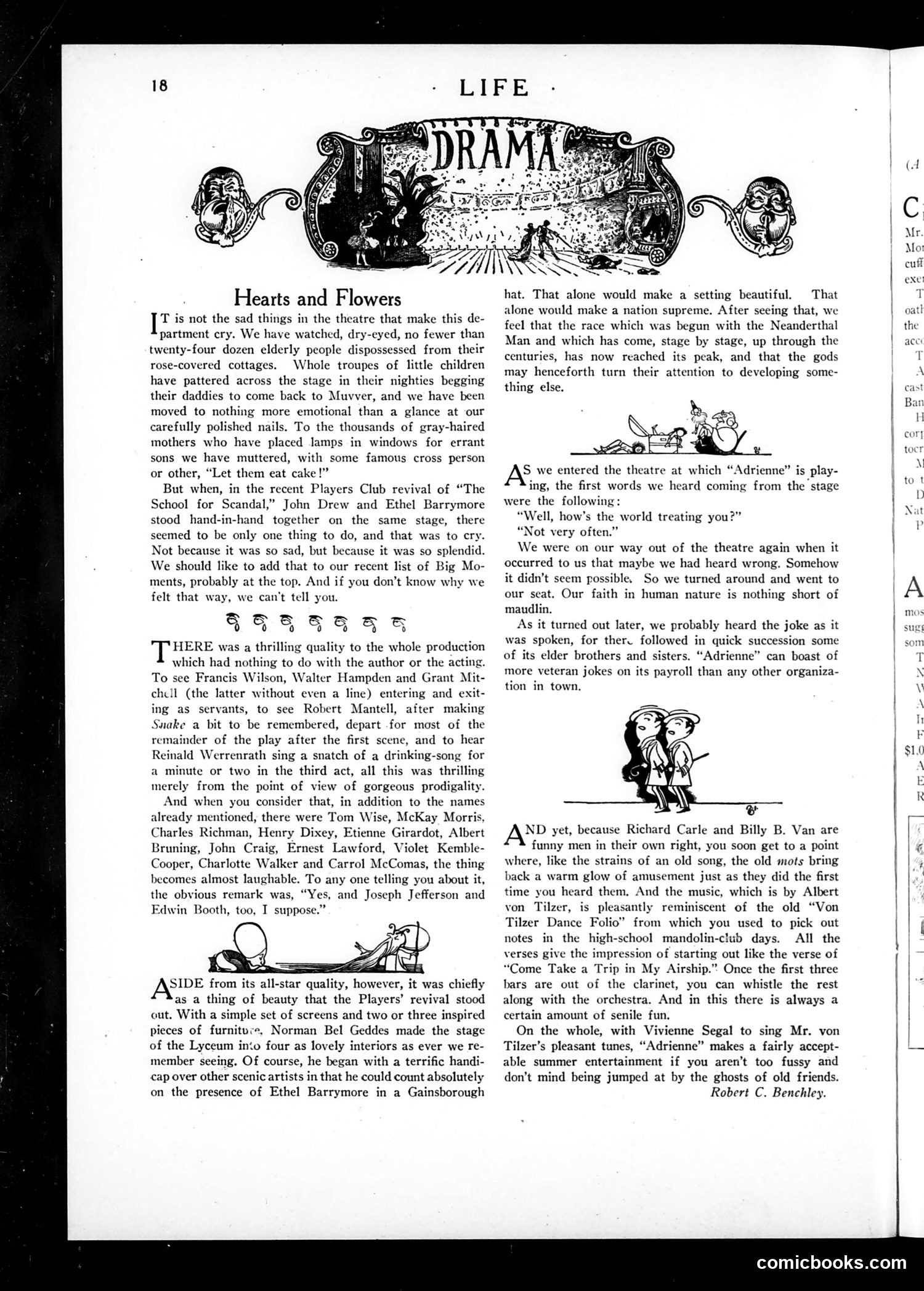
This is a theater review column celebrating two productions. The author playfully admits to emotional detachment toward stock theatrical melodrama (dispossessed families, pleading children)—the sentimental tropes that supposedly move audiences to tears. However, the author genuinely cried seeing **John Drew and Ethel Barrymore** together in a Players Club revival of "The School for Scandal"—not from sadness but from the sheer splendor of witnessing legendary performers. The piece mocks the extravagant casting of that same production, listing numerous famous actors (Francis Wilson, Walter Hampden, Robert Mantell, etc.) in minor roles, joking it's "almost laughable" and sarcastically evoking deceased greats like Joseph Jefferson and Edwin Booth. The author also reviews "Adrienne," criticizing its reliance on tired, recycled jokes—suggesting it's staffed by veteran comics trading in old material rather than fresh wit. The humor lies in the contrast between genuine theatrical artistry and commercial mediocrity.
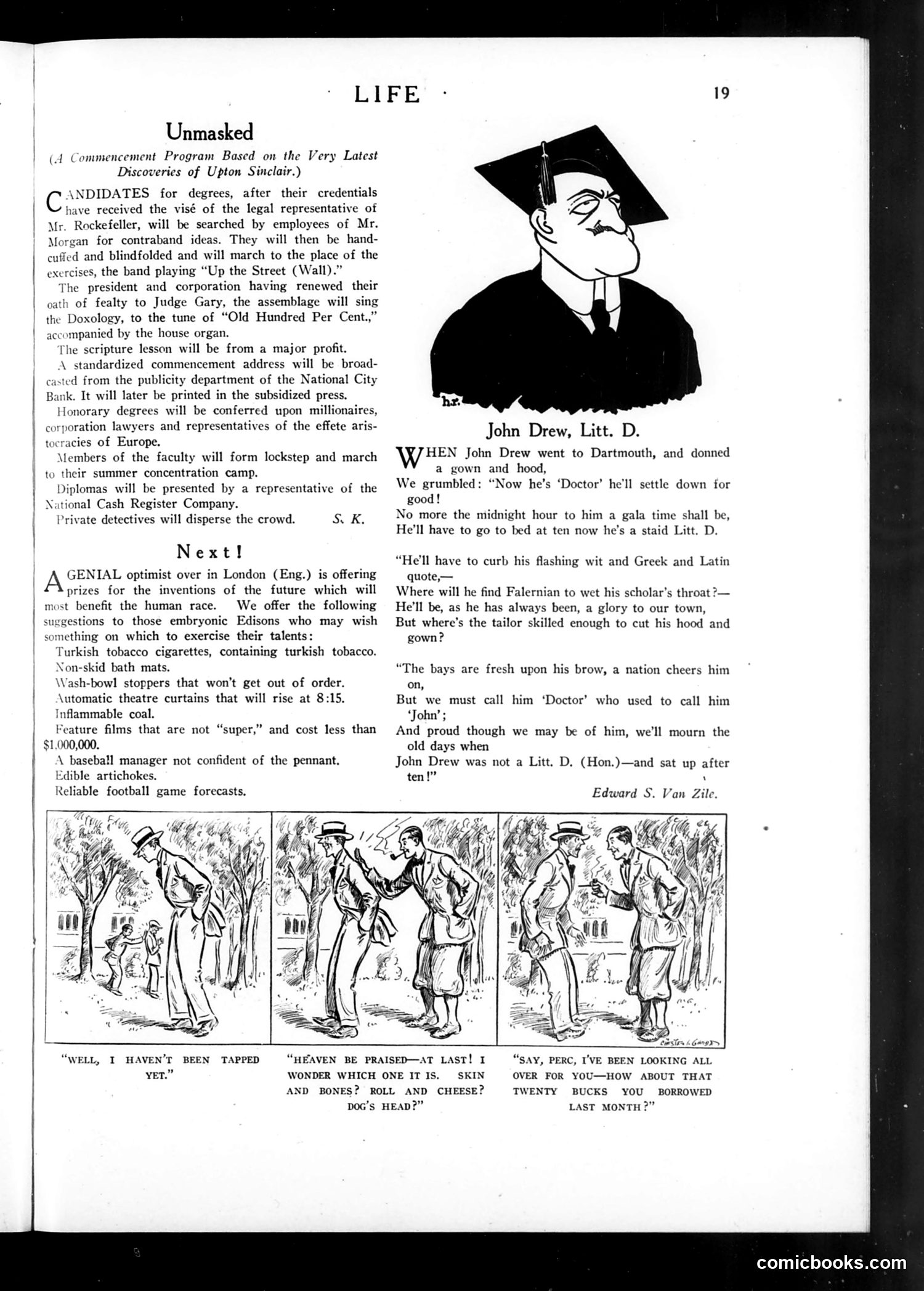
This page satirizes early 20th-century American institutional corruption, referencing muckraker Upton Sinclair's exposés of corporate malfeasance. **"Unmasked"** mocks university commencement ceremonies as tools of wealthy industrialists. The text names **Rockefeller** and **Morgan**—robber barons who allegedly controlled institutions—searching graduates for "contraband ideas." Students are "handcuffed and blindfolded," marching down "Wall Street." Faculty sing hymns reworded as "Old Hundred Per Cent." The satire suggests universities serve corporate interests, not education: honorary degrees go to millionaires and corporation lawyers, not scholars. **"John Drew, Litt. D."** humorously laments that actor John Drew receiving an honorary doctorate will "settle down" and stop his witty late-night socializing—an ironic poem doubting a title changes character. **The cartoon strip** depicts wealthy men encountering street children: references to elite "Skull and Bones" societies and exclusive club rituals highlight class division, with the final panel sardonically showing a poor boy's actual concern—repaying borrowed money.
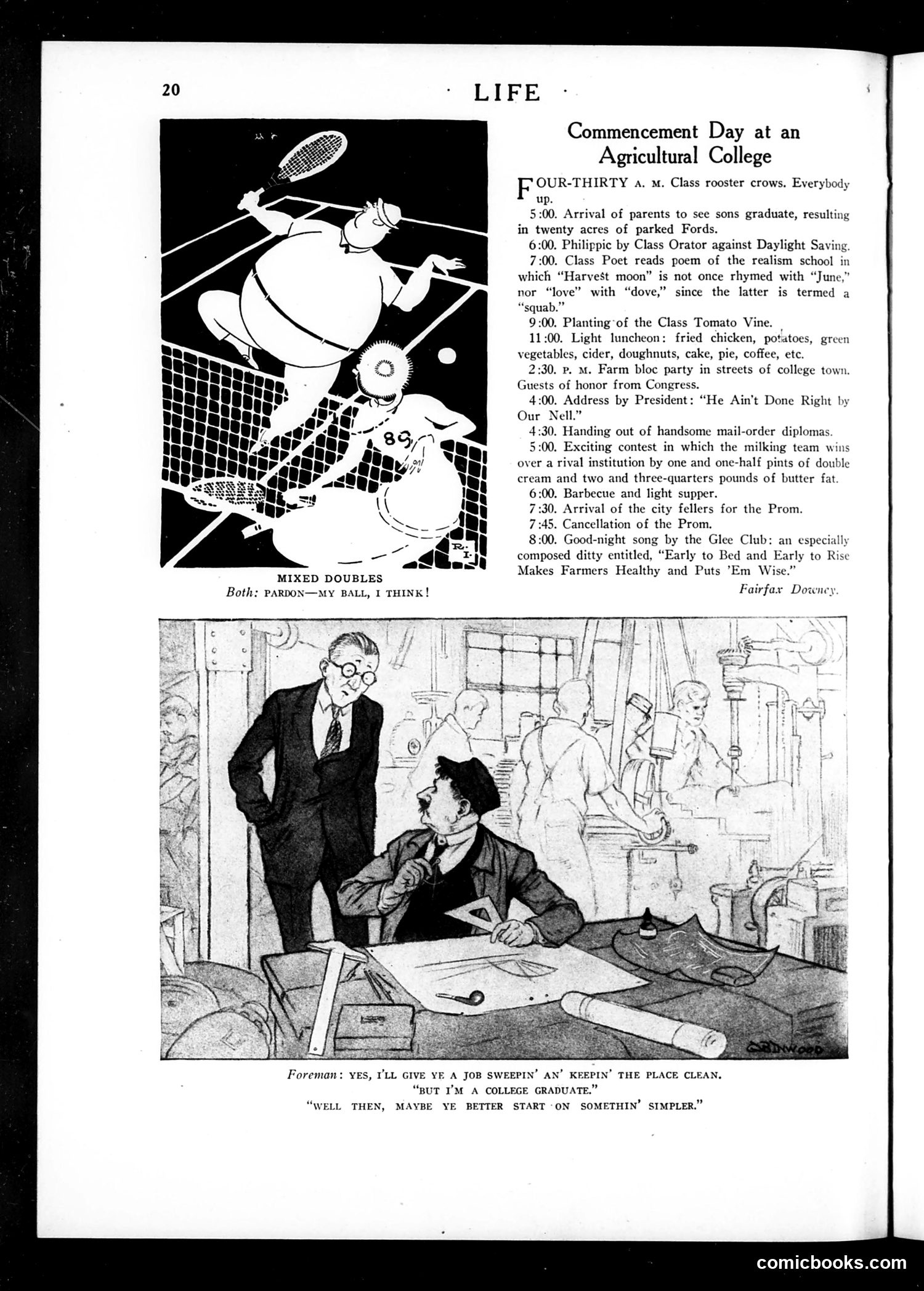
This satirical piece mocks agricultural college graduates and rural life circa the 1920s. The schedule parodies the pretentiousness of a farm college commencement—featuring absurd elements like a "Class Poet" avoiding traditional rhymes and "mail-order diplomas." The bottom cartoon delivers the central joke: a college-educated graduate seeks work, but the foreman dismisses him as overqualified for even basic janitorial tasks, suggesting he "start on somethin' simpler." This critiques the disconnect between agricultural education and practical farm labor—implying college graduates lack practical skills despite their credentials. The humor targets both the inflated self-importance of educational institutions and the gap between academic training and real-world utility, a common concern during the agricultural crisis of that era.
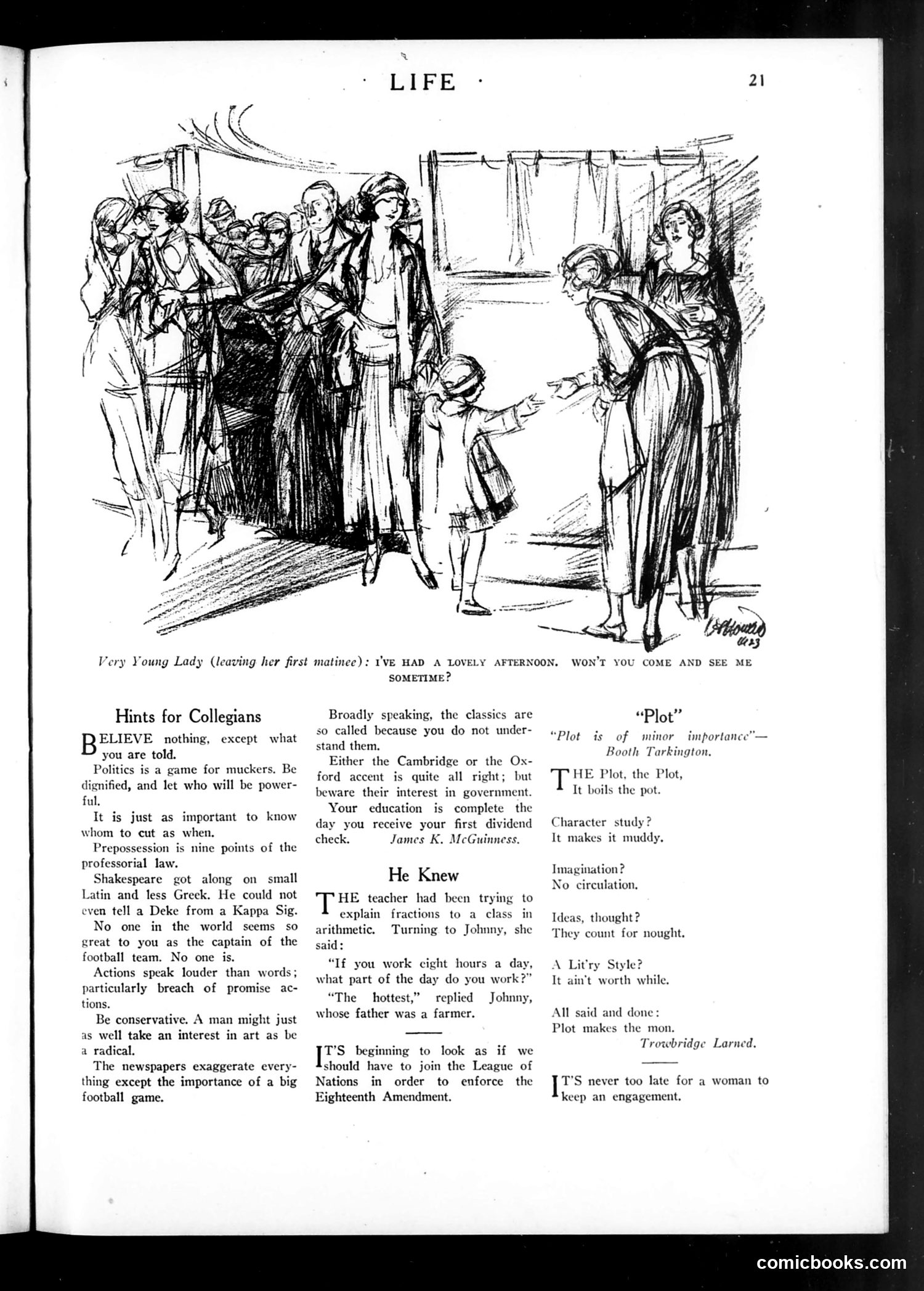
This page from *Life* magazine contains multiple satirical pieces targeting early 20th-century American social attitudes. **Main Cartoon:** A young woman leaving her first matinee performance invites a male acquaintance to visit her, playing on the social convention that women shouldn't appear too eager—a commentary on courtship etiquette and gender performance. **"Hints for Collegians":** Cynical advice mocking privileged college life, dismissing classics education, elevating football captains and fraternity status (Dekes, Kappa Sig), and suggesting financial success matters more than genuine learning. The jabs at "Cambridge or Oxford accents" reference affectations of wealthy American students. **"He Knew":** A farmer's son's witty response about working "the hottest" hours satirizes both economic hardship and classroom disconnect from rural reality. **"Plot" section:** Literary criticism mocking the overvaluation of plot in fiction—suggesting character, imagination, and style matter little, only narrative mechanics "make the mon[ey]." Overall, the page satirizes American class pretensions, educational hypocrisy, and commercial values.
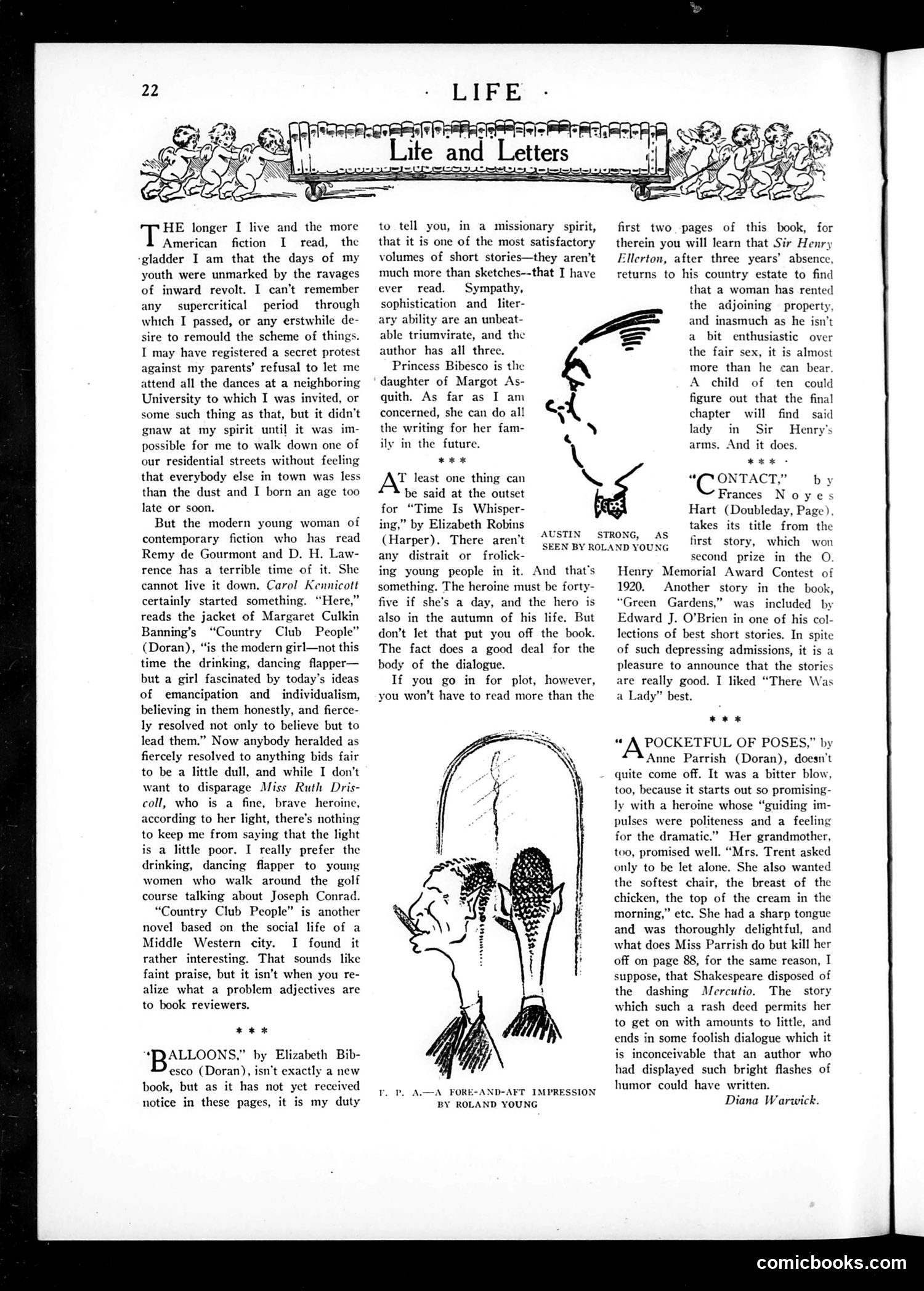
This is a literary review column from *Life* magazine discussing several contemporary novels. The page includes two cartoon illustrations by Roland Young, a noted cartoonist of the era. The main text reviews four books, critiquing modern fiction's obsession with tortured, intellectually conflicted heroines. The reviewer contrasts the "modern girl" fascinated by emancipation (citing Carol Kennicott from *Main Street*) with the older generation, and praises works by Princess Bibesco and Elizabeth Robins that feature more mature characters. The two cartoons—one a profile sketch and one labeled "A Fore-and-Aft Impression"—appear to be humorous illustrations of characters or types discussed in the reviews, typical of Young's satirical style. Without clearer captions, their specific subjects aren't definitively identifiable from the image alone, though they likely caricature the literary archetypes being discussed.
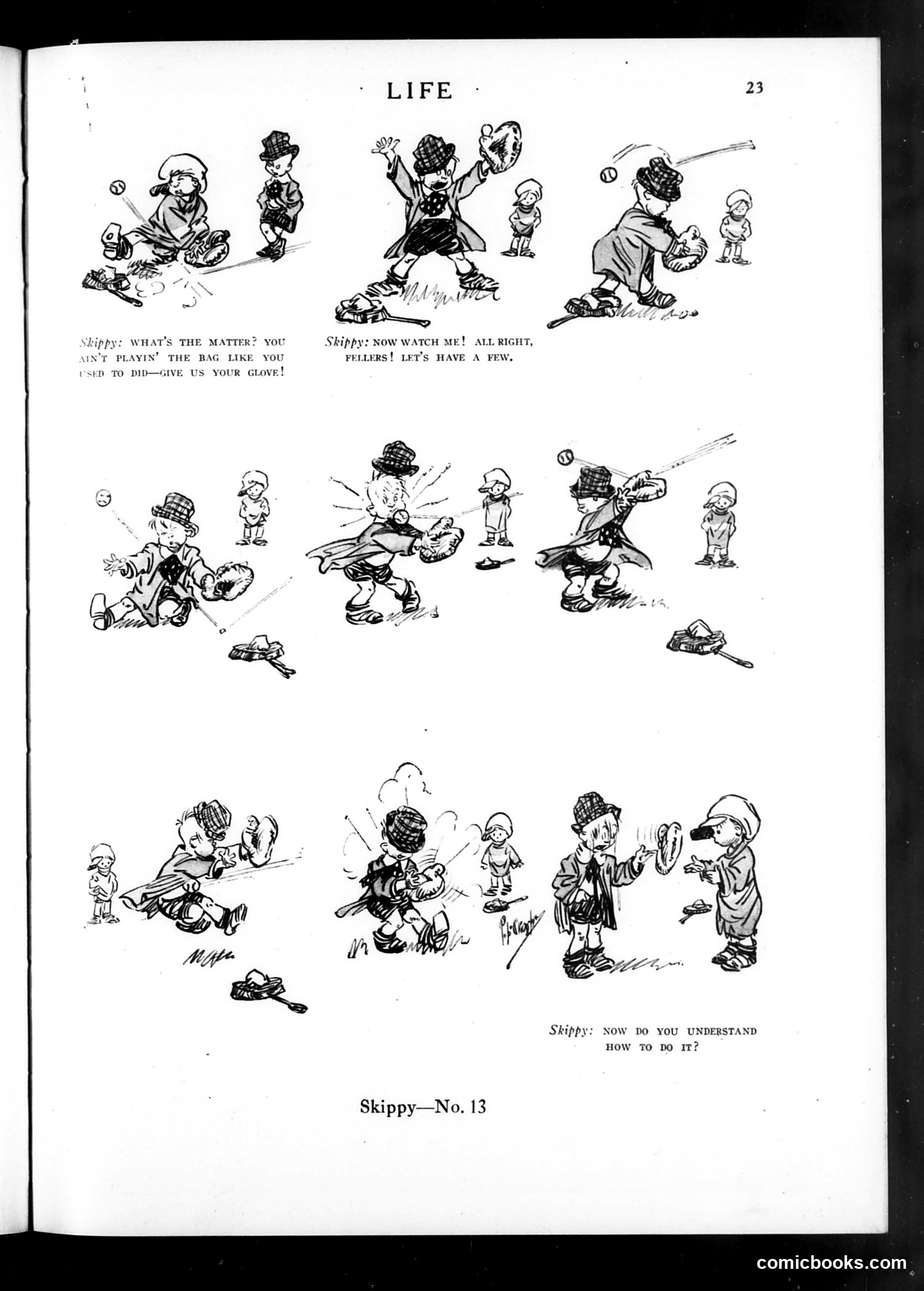
This is a sequential comic strip titled "Skippy—No. 13" showing a child character named Skippy teaching other children how to play baseball, specifically how to bat. The strip depicts Skippy demonstrating proper batting technique after the other children complain he's not playing the bag (base) like he used to and ask him to show them how. Through wordless action panels, Skippy demonstrates the swing and follow-through. The final panel has Skippy asking if they now understand how to do it, suggesting the children have learned the proper technique. This appears to be an instructional/educational comic strip about sports skills aimed at young readers.
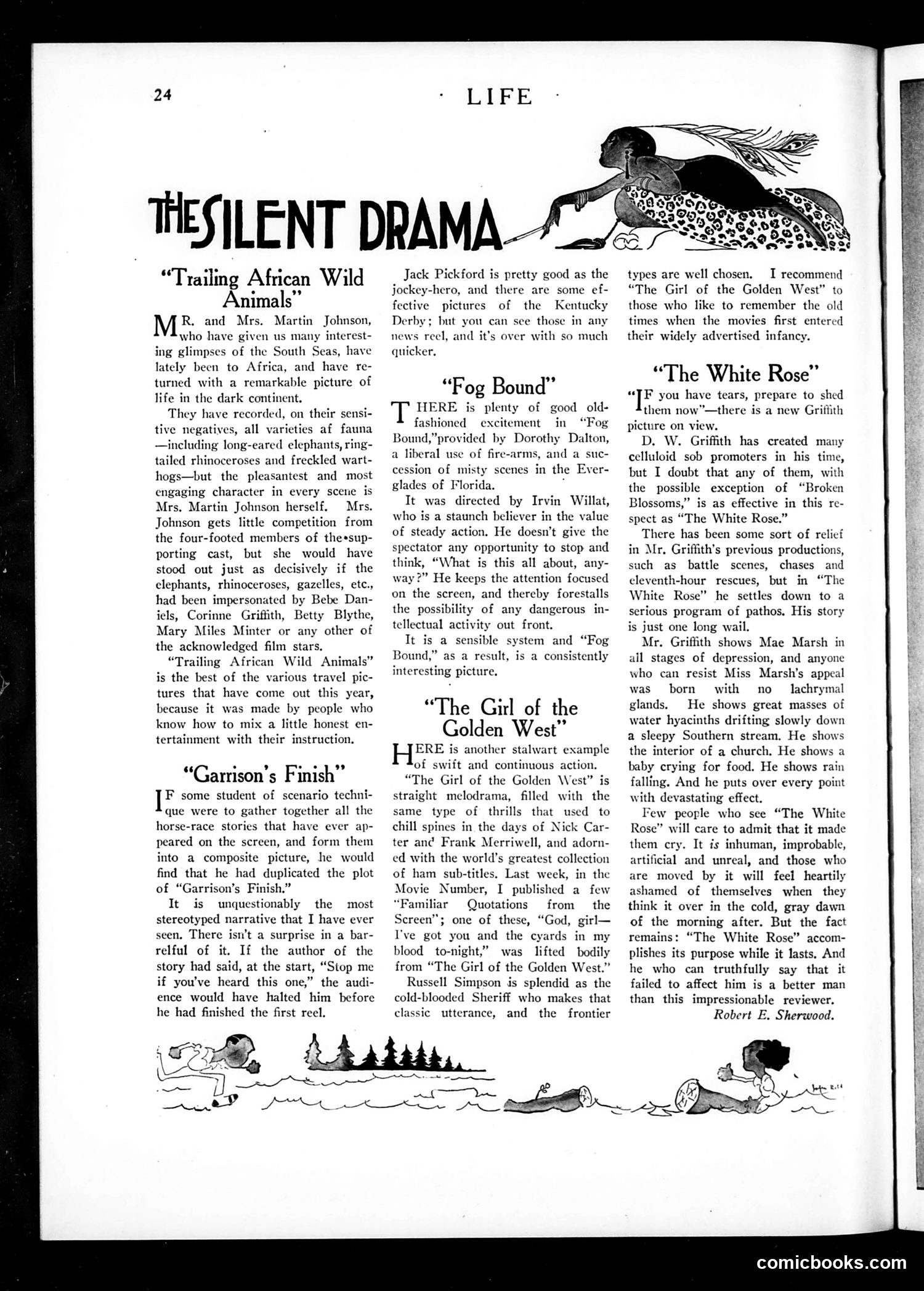
This page contains film reviews from Life's "Silent Drama" column, critiquing contemporary motion pictures. The reviews discuss five films: **"Trailing African Wild Animals"** praises the Martins Johnsons' African documentary, noting Mrs. Johnson herself is the most engaging "character." **"Garrison's Finish"** dismisses a horse-racing film as utterly formulaic and predictable, starring Jack Pickford. **"Fog Bound"** with Dorothy Dalton receives backhanded praise—the reviewer notes its relentless action deliberately prevents audiences from thinking critically. **"The Girl of the Golden West"** is melodramatic hokum filled with overwrought titles and hammy acting, though competently made. **"The White Rose"** references D.W. Griffith's latest tearjerker. The tone is sophisticated mockery of formulaic, low-brow entertainment designed for mass audiences. The reviewer values honest filmmaking over emotional manipulation. These appear to be 1919-1920 era films.
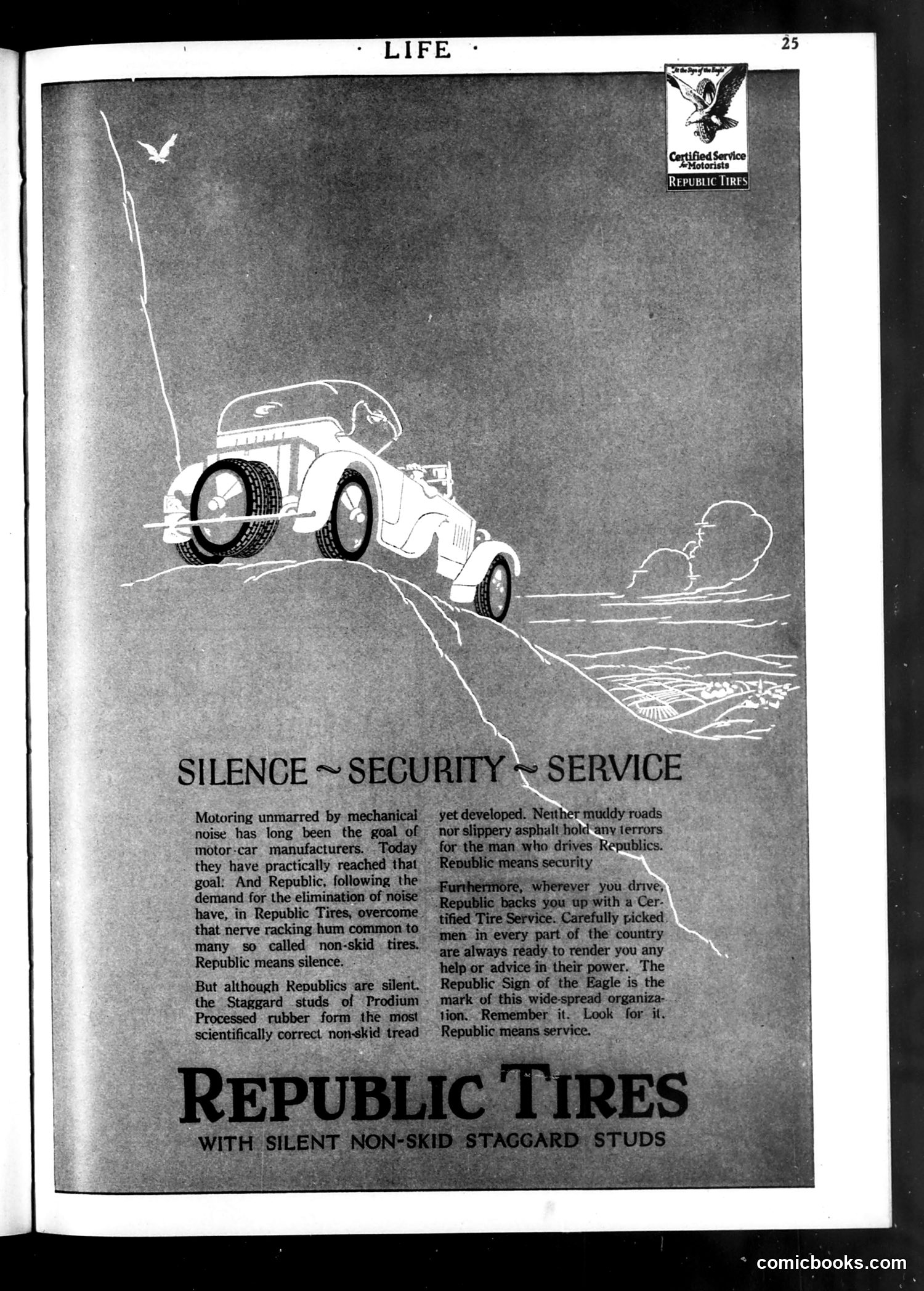
This is a vintage advertisement for Republic Tires, not political satire. The ad uses the tagline "Silence—Security—Service" to market tires with "silent non-skid staggoard studs." The illustration shows a car precariously perched on a cliff edge, emphasizing tire safety and traction. The accompanying text claims Republic tires overcome "nerve racking hum common to many so called non-skid tires" by providing silent operation while maintaining safety grip. The "Republic Sign of the Eagle" mentioned refers to the company's logo and nationwide service network. This is straightforward product advertising emphasizing mechanical innovation—reducing noise while improving road grip—rather than political commentary.
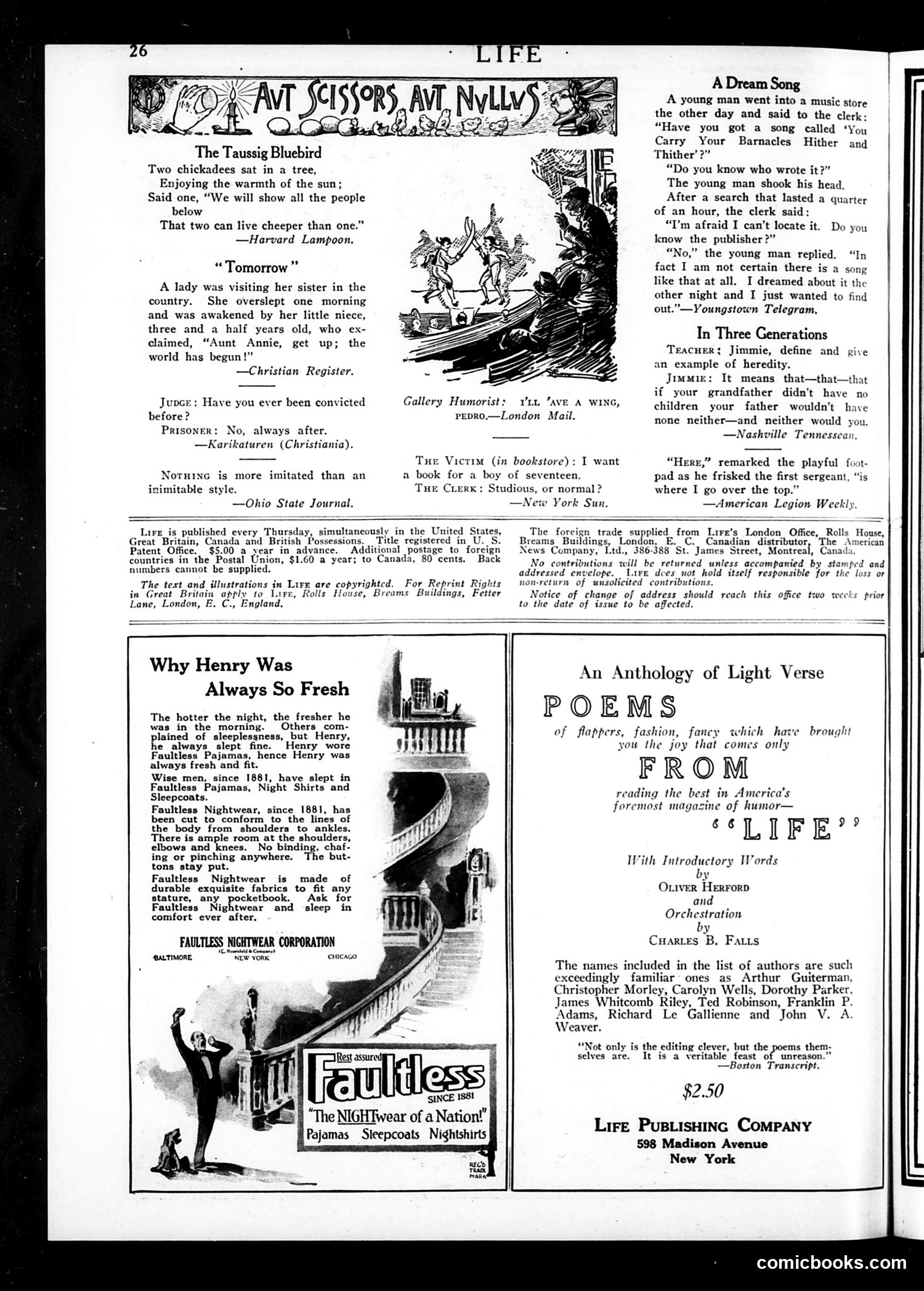
This page from *Life* magazine contains several brief humorous items typical of early 20th-century satirical publications: **The humor pieces** are light, punchy jokes about everyday situations—a couple of chickadees claiming to live cheaply, a child waking her aunt saying "the world has begun," and a young man searching for a song he only dreamed about. These reflect the magazine's style of gentle domestic and absurdist comedy. **"In Three Generations"** satirizes how people explain heredity through a child's circular logic: if your grandfather had no children, your father wouldn't exist, and therefore neither would you—a tautological but amusing definition. **The military humor** references WWI (the phrase "go over the top" refers to trench warfare), with a soldier joking about his sergeant while under fire. The page also advertises *Faultless* pajamas and promotes an anthology of light verse from *Life* itself, edited by Oliver Hereford and Charles B. Falls. The content reflects *Life*'s identity as a magazine of "humor" and "satire" aimed at educated middle-class readers.

This is a **product advertisement**, not a political cartoon or satire. It's a full-page ad for U.S. Royal Cords tires from United States Rubber Company, circa 1923 (note the copyright date). The page announces three manufacturing innovations: sprayed rubber, web cord technology, and a flat band process for tire construction. The large tire image in the center showcases the product visually. The appeal is to **competitive advantage and public confidence**—the ad emphasizes that these new discoveries prove U.S. Royal Cords are superior and that the company is meeting "leadership obligations" through innovation and "larger public service." There is **no satirical content or political commentary**. This is straightforward early 20th-century advertising that positions technological advancement as evidence of corporate responsibility and product quality. The quote "One million new users will say this year: 'Royal Cords!'" projects optimistic market growth. For modern readers: this reflects an era when tire technology was genuinely advancing and companies marketed these innovations as major achievements.
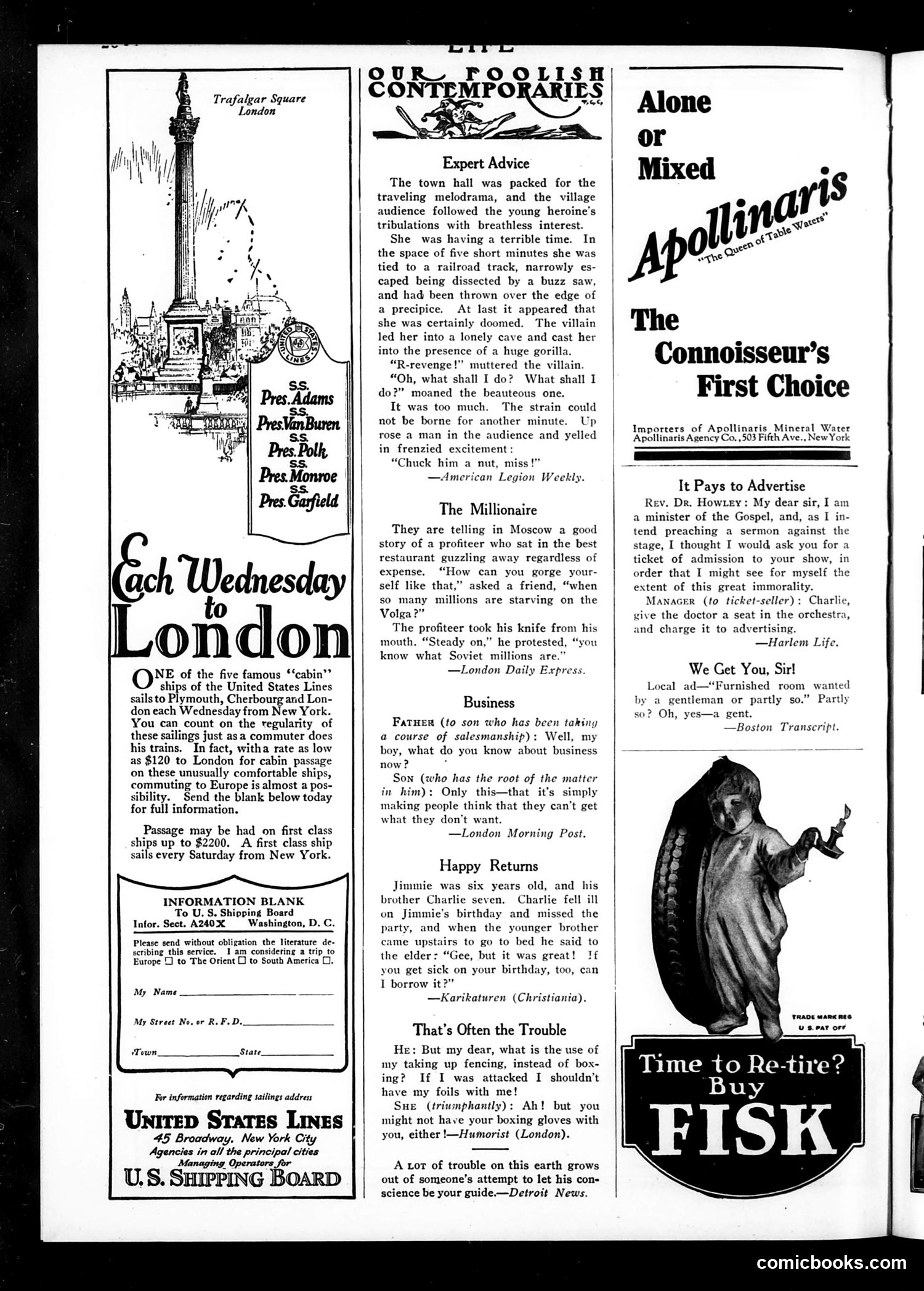
This page from *Life* magazine consists primarily of **advertisements and short humorous anecdotes** rather than political cartoons. The left side advertises transatlantic shipping—the U.S. Lines offering regular "cabin" service to London for as little as $120, targeting business commuters to Europe. The center and right contain brief comic stories sourced from international publications (*American Legion Weekly*, *London Daily Express*, *London Morning Post*). These satirize human foibles: an audience member advising an actress during a melodrama to "chuck him a nut" when she faces a gorilla; a Soviet profiteer's indifference to starving millions; a con artist defining business as making people want what they don't need; and a clergyman requesting theater tickets to condemn theatrical "immorality." The right side includes advertisements for Apollinaris mineral water and Fisk tires. **Overall**: This is a typical *Life* page mixing commercial promotion with reprinted international humor—no specific political figures or campaigns are identifiable.
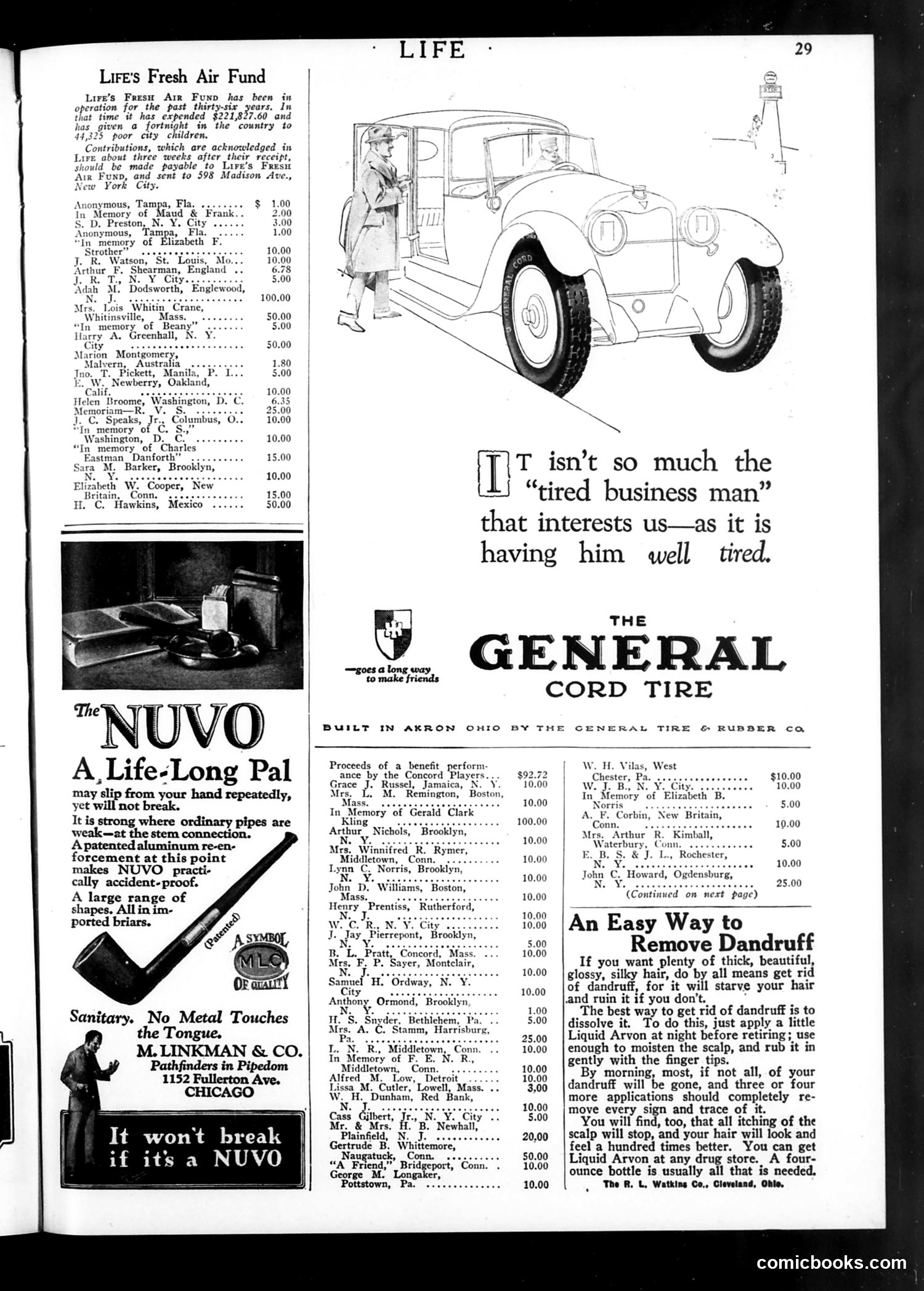
This page is primarily **advertising and charitable notices**, not satirical content. The main elements are: 1. **Life's Fresh Air Fund donation list** — acknowledging contributions to a real charitable program that sent poor city children to the countryside for two weeks. This was genuine philanthropic work, not satire. 2. **Three advertisements:** - **NUVO pipes** — humorously claiming their aluminum reinforcement makes them "practically accident-proof" - **General Cord Tire** — with a joke about the "tired business man" (a stock figure of the era), playing on the double meaning of "tired" (exhausted vs. equipped with tires) - **Liquid Arvon dandruff treatment** — a straightforward product ad The General Tire ad is the closest to humor here, using a pun rather than satire. There are no political cartoons or caricatures on this page. It's a typical early-20th-century magazine layout mixing charitable appeals with commercial advertising.
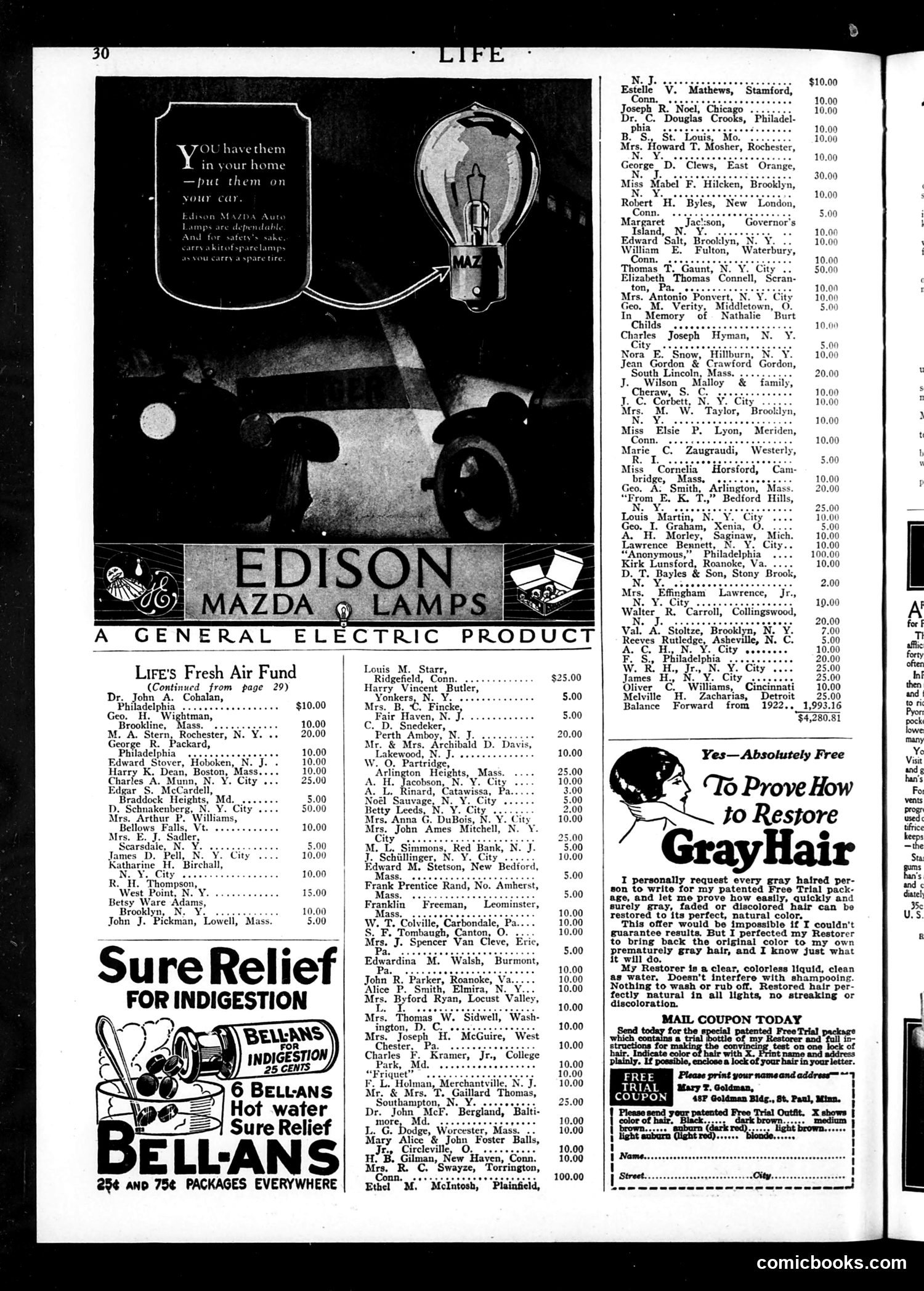
This page is primarily **advertising and fundraising content**, not political satire. **Main Content:** 1. **Edison Mazda Lamps advertisement** (top): A General Electric product ad showing a car with headlights, promoting spare auto lamps for home and vehicle use. 2. **Life's Fresh Air Fund** (center): A charitable fundraising list displaying donations from readers—ranging from $2 to $100—supporting what appears to be a public health initiative (likely providing outdoor recreation for urban children during the Progressive Era). 3. **Bellans indigestion remedy ad** (lower left): A commercial advertisement for a stomach relief product. 4. **Gray Hair restoration ad** (right): A mail-order product promising to restore natural hair color. **Historical Context:** This reflects 1920s American consumer culture and philanthropic practices, with magazines serving as platforms for both commercial advertising and charitable fundraising appeals to their affluent readership.
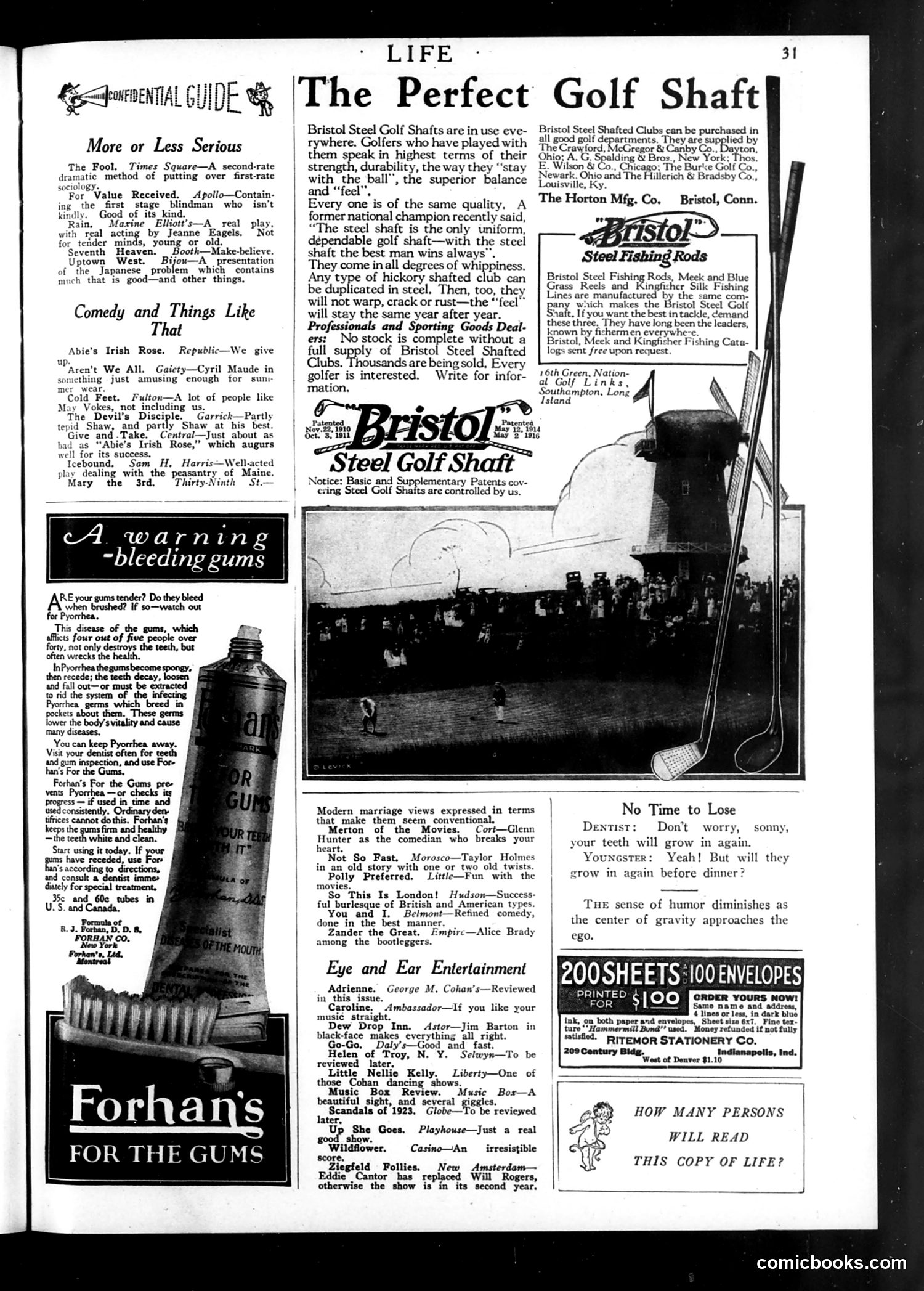
This page is primarily **commercial advertising** rather than editorial content. The dominant feature is a large advertisement for Bristol Steel Golf Shafts, showing a golfer mid-swing at what appears to be a prestigious golf course. The page includes a brief **theater review section** ("Experimental Guide") critiquing Broadway plays with casual, short dismissals—notably "Abie's Irish Rose" receives only "We give up," suggesting the reviewer found it unworthy of serious comment. A **health advertisement** for Forhan's toothpaste addresses pyorrhea (gum disease), using fear-based messaging typical of 1920s advertising: describing how the disease affects "four out of five people over forty" and can cause tooth loss and systemic illness. The golf shaft advertisement emphasizes steel's superiority over traditional hickory, promoting uniformity and durability—a sales pitch for this newer manufacturing innovation. The page reflects 1920s consumer culture: entertainment criticism, health anxieties, and technological product promotion.
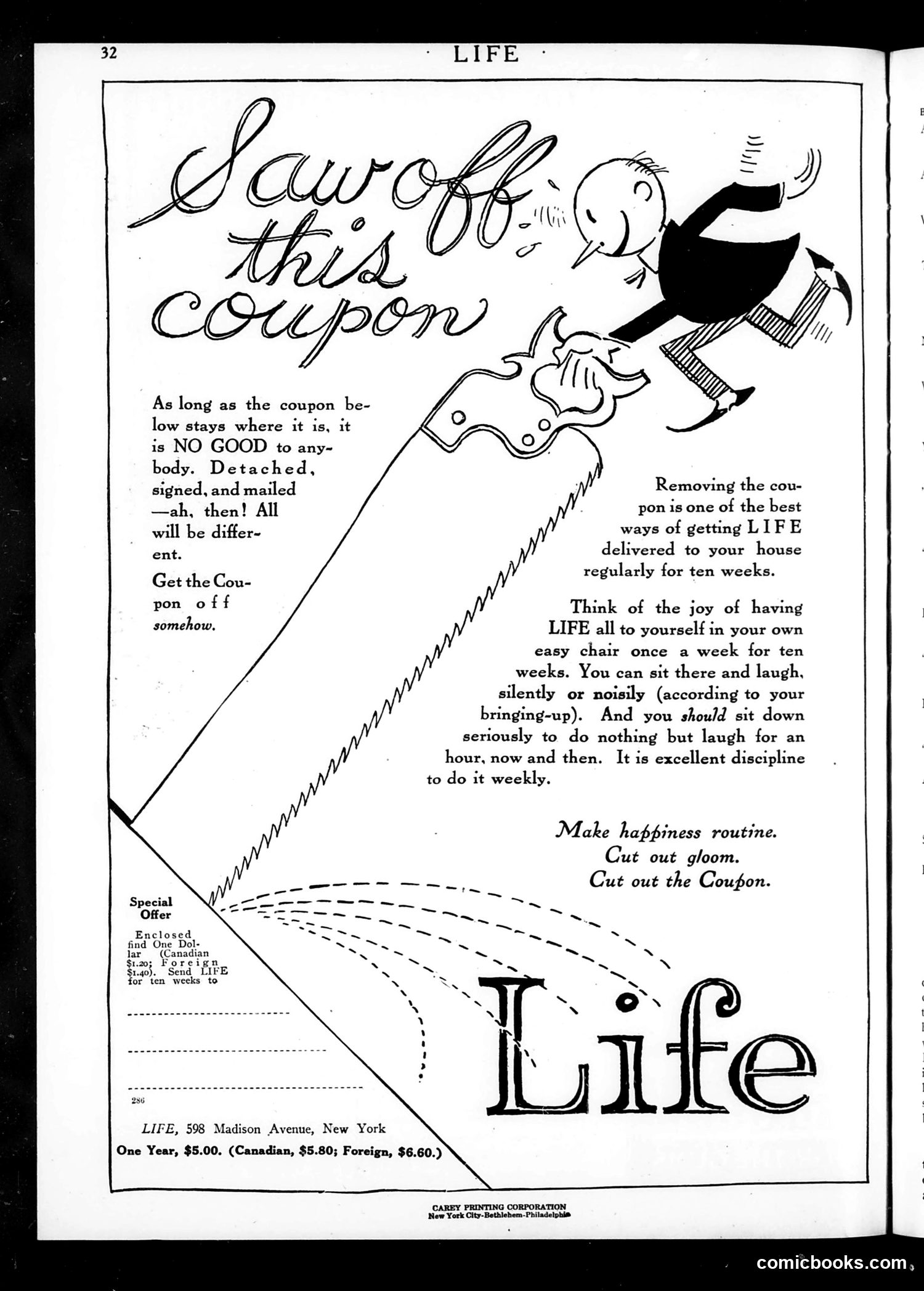
This is primarily a **subscription advertisement** for *Life* magazine, a satirical weekly publication. The cartoon depicts a man energetically removing a coupon from the page—the visual joke being that the coupon is physically "useless" while attached but becomes valuable once detached and mailed. The ad promotes subscribing to *Life* as a form of self-care, humorously positioning weekly reading as a disciplinary practice for happiness and laughter. It encourages readers to treat leisure time seriously: sitting in an easy chair, laughing deliberately for an hour weekly, and cutting out "gloom" alongside cutting out the coupon. The pricing ($5.00 annually, with Canadian and foreign rates noted) and address (598 Madison Avenue, New York) confirm this is a genuine subscription solicitation. The tone is characteristic of early-to-mid 20th century advertising that blended practical sales pitches with whimsical appeals to readers' wellbeing.
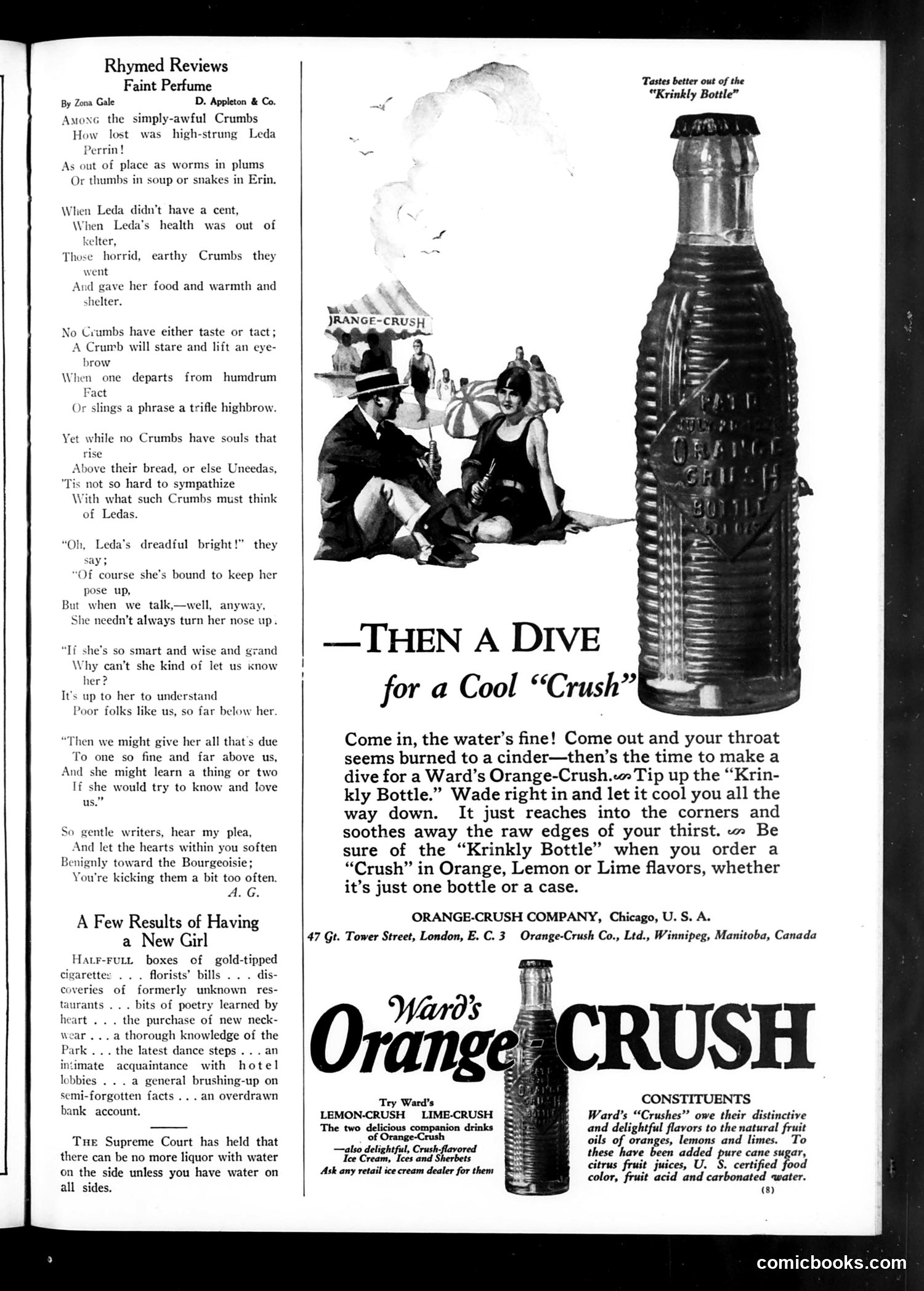
This page contains two distinct elements: **Left side - Literary review:** A satirical poem by A.G. reviewing Zona Gale's novel "Faint Perfume." The poem critiques class attitudes, depicting the "Crumbs" (working-class characters) as resentful that the protagonist Leda, a refined woman of higher social standing, won't condescend to them. The satire mocks both the Crumbs' jealousy and their expectation that Leda should lower herself to "know and love" them. The reviewer subtly suggests readers show more sympathy toward the working classes. **Right side - Advertisement:** A full-page Orange-Crush beverage ad featuring the product's distinctive "Krinkly Bottle." The ad uses a beach/swimming scenario to pitch the drink as refreshing relief from thirst, employing casual, colloquial language ("Wade right in") typical of 1920s marketing. The page mixes literary criticism with consumer advertising—both common in *Life* magazine's format.
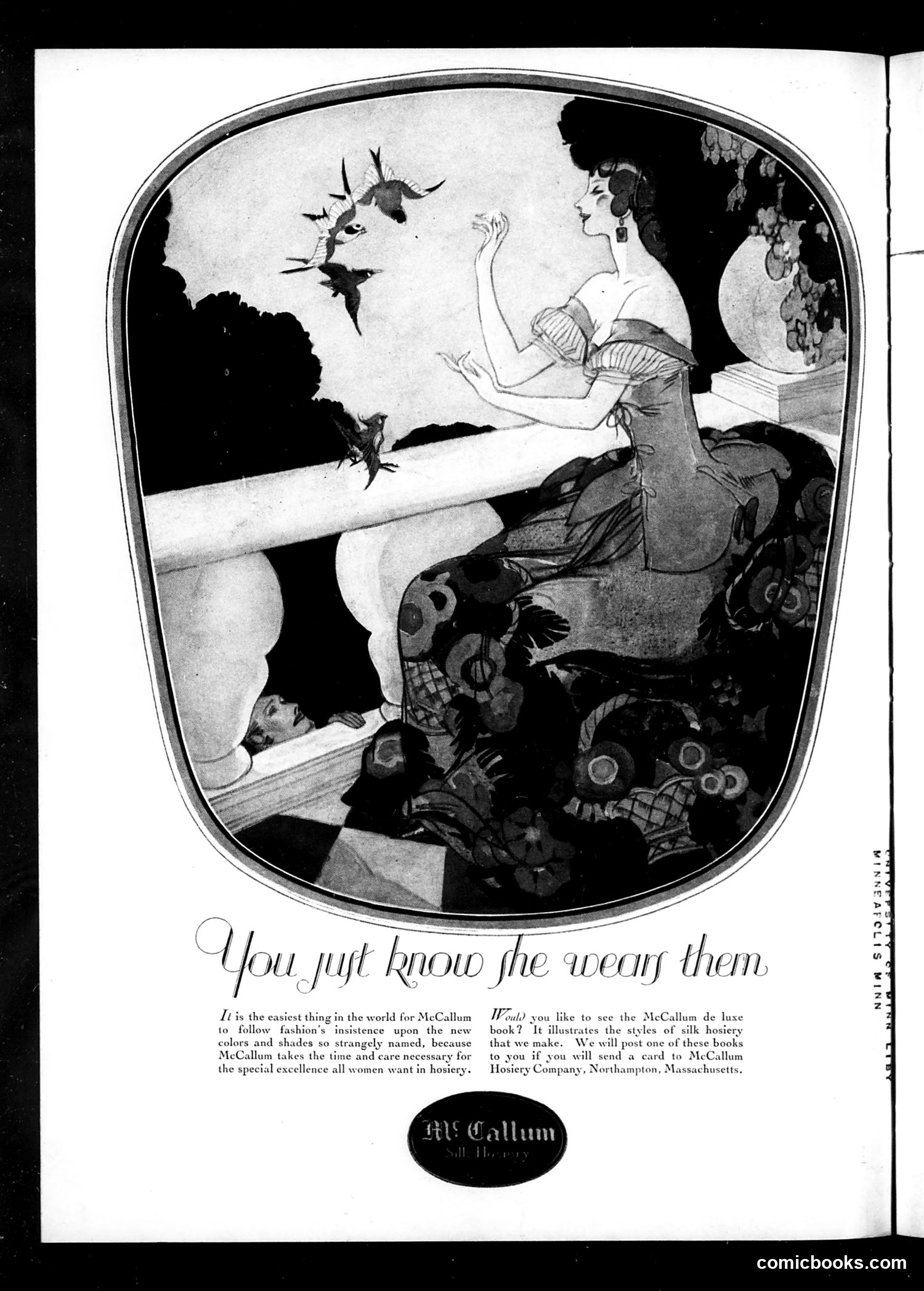
This is a **product advertisement**, not political satire. It promotes McCallum brand silk hosiery to women. The illustration shows a fashionable woman in 1920s-style dress examining silk stockings, with decorative elements (flowers, musical notes, toys) suggesting luxury and elegance. The tagline "You just know they wear them" implies that fashionable women naturally choose McCallum brand. The ad emphasizes that McCallum makes following fashion's "new colors and shades" easy because they offer "special excellence all women want in hosiery." It invites readers to request a deluxe catalog showcasing their silk stocking styles. This reflects early 20th-century consumer advertising's appeal to women's fashion aspirations and the cultural status of silk hosiery as a luxury good.