
Life, 1923-06-21 · page 17 of 36
Life — June 21, 1923 — page 17: what you’re looking at
What you’re looking at
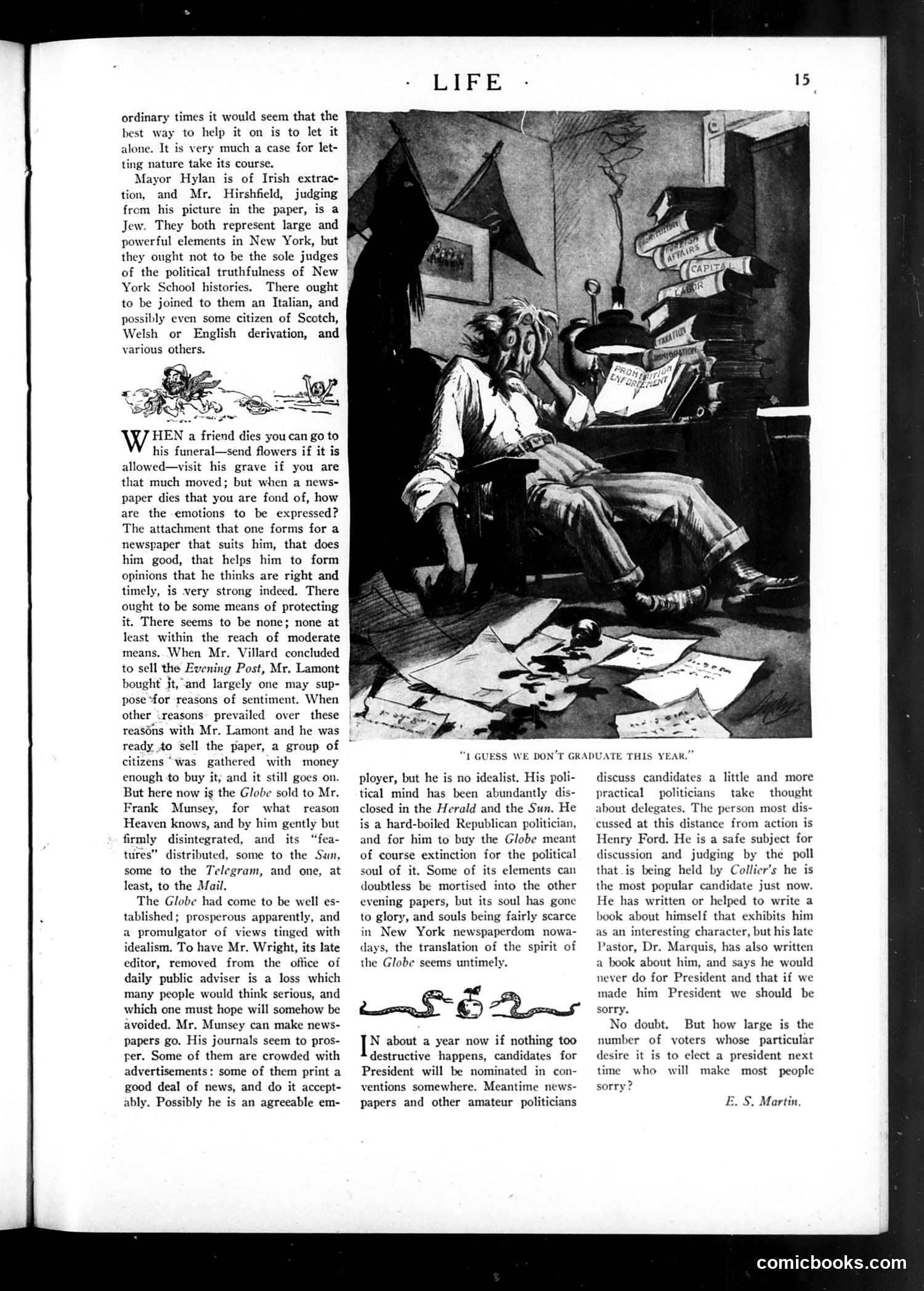
This page critiques the decline of idealistic journalism in New York through the sale of the *Evening Globe* to publisher Frank Munsey. The accompanying cartoon (caption: "I Guess We Don't Graduate This Year") depicts a disheveled figure amid scattered papers labeled with newspaper mastheads (*Sun*, *Telegraph*, *Mail*), visualizing the Globe's dismantling—its content parceled out to competing papers. The text argues that while Munsey is commercially competent, he is a "hard-boiled Republican politician" without idealism. His acquisition meant the Globe's "political soul" died, its progressive viewpoint absorbed into less principled publications. The author laments the loss of newspapers shaped by conviction rather than profit. The piece also discusses Henry Ford's presidential candidacy—popular in polls but criticized by his own pastor as unsuitable for office, illustrating tension between public opinion and expert judgment.
📄 Transcribed text from this page (OCR, searchable)
Machine-transcribed from the original scan — historical spelling and the odd misread are preserved.
ordinary times it would seem that the best way to help it on is to let it alone. It is very much a case for let- ting nature take its course. Mayor Hylan is of Irish extrac- tion, and Mr, Hirshfield, judging from his picture in the paper, is a Jew. They both represent large and powerful elements in New York, but | they ought not to be the sole judges of the political truthfulness of New © York School histories. There ought to be joined to them an Italian, and possibly even some citizen of Scotch, Welsh or English derivation, and various others. HEN a friend dies you can go to his funeral—send flowers if it is allowed—visit his grave if you are that much moved; but when a news- paper dies that you are fond of, how are the emotions to be expressed? The attachment that one forms for a newspaper that suits him, that does him good, that helps him to form opinions that he thinks are right and timely, is very strong indeed. There ought to be some means of protecting it. There seems to be none; none at least within the reach of moderate means. When Mr. Villard concluded to sell the Evening Post, Mr. Lamont bought it, and largely one may sup- pose for reasons of sentiment. When other (reasons prevailed over these reasons with Mr. Lamont and he was ready to sell the paper, a group of citizens “was gathered with money enough to buy it, and it still goes on. But here now is the Globe sold to Mr. Frank Munsey, for what reason Heaven knows, and by him gently but firmly disintegrated, and its “fea- tures” distributed, some to the Swr, some to the Telegram, and one, at least, to the Mail. The Globe had come to be well es- tablished; prosperous apparently, and a promulgator of views tinged with idealism. To have Mr. Wright, its late editor, removed from the office of daily public adviser is a loss which many people would think serious, and which one must hope will somehow be avoided. Mr. Munsey can make news- papers go. His journals seem to pros- per. Some of them are crowded with advertisements: some of them print a good deal of news, and do it accept- ably. Possibly he is an agreeable em- “1 GUESS WE DON’T GRADUATE THIS YE. ployer, but he is no idealist. His poli- tical mind has been abundantly dis- closed in the Herald and the Sun. He is a hard-boiled Republican politician, and for him to buy the Globe meant of course extinction for the political soul of it. Some of its elements can doubtless be mortised into the other evening papers, but its soul has gone to glory, and souls being fairly scarce in New York newspaperdom nowa- days, the translation of the spirit of the Globe seems untimely. CS 5 ADs N about a year now if nothing too destructive happens, candidates for President will be nominated in con- ventions somewhere. Meantime news- papers and other amateur politicians discuss candidates a little and more practical politicians take thought about delegates. The person most dis- cussed at this distance from action is Henry Ford. He is a safe subject for discussion and judging by the poll that.is being held by Collier’s he is the most popular candidate just now. He has written or helped to write a book about himself that exhibits him as an interesting character, but his late Pastor, Dr. Marquis, has also written a book about him, and says he would never do for President and that if we made him President we should be sorry. No doubt. But how large is the number of voters whose particular desire it is to elect a president next time who will make most people sorry? E, S. Martin, comicbooks.com