
Life, 1923-06-21 · page 20 of 36
Life — June 21, 1923 — page 20: what you’re looking at
What you’re looking at
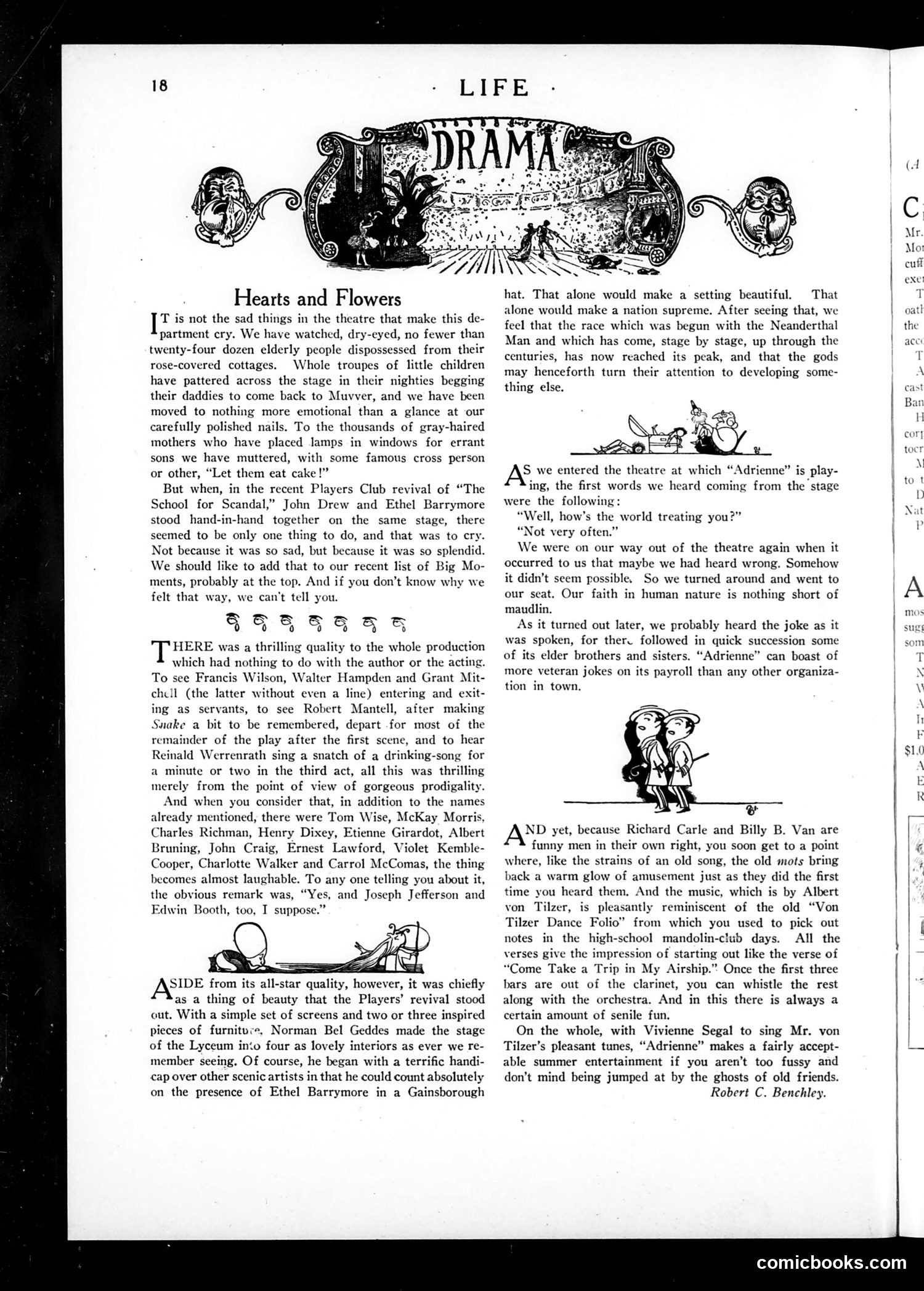
This is a theater review column celebrating two productions. The author playfully admits to emotional detachment toward stock theatrical melodrama (dispossessed families, pleading children)—the sentimental tropes that supposedly move audiences to tears. However, the author genuinely cried seeing **John Drew and Ethel Barrymore** together in a Players Club revival of "The School for Scandal"—not from sadness but from the sheer splendor of witnessing legendary performers. The piece mocks the extravagant casting of that same production, listing numerous famous actors (Francis Wilson, Walter Hampden, Robert Mantell, etc.) in minor roles, joking it's "almost laughable" and sarcastically evoking deceased greats like Joseph Jefferson and Edwin Booth. The author also reviews "Adrienne," criticizing its reliance on tired, recycled jokes—suggesting it's staffed by veteran comics trading in old material rather than fresh wit. The humor lies in the contrast between genuine theatrical artistry and commercial mediocrity.
📄 Transcribed text from this page (OCR, searchable)
Machine-transcribed from the original scan — historical spelling and the odd misread are preserved.
Hearts and Flowers T is not the sad things in the theatre that make this de- partment cry. We have watched, dry-eyed, no fewer than twenty-four dozen elderly people dispossessed from their rose-covered cottages. Whole troupes of little children have pattered across the stage in their nighties begging their daddies to come back to Muvver, and we have been moved to nothing more emotional than a glance at our carefully polished nails. To the thousands of gray-haired mothers who have placed Jamps in windows for errant sons we have muttered, with some famous cross person or other, “Let them eat cake!” But when, in the recent Players Club revival of “The School for Scandal,” John Drew and Ethel Barrymore stood hand-in-hand together on the same stage, there seemed to be only one thing to do, and that was to cry. Not because it was so sad, but because it was so splendid. We should like to add that to our recent list of Big Mo- ments, probably at the top. And if you don’t know why we felt that way, we can't tell you. SSRSSERR HERE was a thrilling quality to the whole production which had nothing to do with the author or the acting. To see Francis Wilson, Walter Hampden and Grant Mit- chcll (the latter without even a line) entering and exit- ing as servants, to see Robert Mantell, after making Snake a bit to be remembered, depart -for most of the remainder of the play after the first scene, and to hear Reinald Werrenrath sing a snatch of a drinking-song for a minute or two in the third act, all this was thrilling merely from the point of view of gorgeous prodigality. And when you consider that, in addition to the names already mentioned, there were Tom Wise, McKay Morris, Charles Richman, Henry Dixey, Etienne Girardot, Albert Bruning, John Craig, Ernest Lawford, Violet Kemble- Cooper, Charlotte Walker and Carrol McComas, the thing becomes almost laughable. To any one telling you about it, the obvious remark was, “Yes, and Joseph Jefferson and Edwin Booth, too, I suppose.” ASIDE from its all-star quality, however, it was chiefly as a thing of beauty that the Players’ revival stood out. With a simple set of screens and two or three inspired pieces of furnituce, Norman Bel Geddes made the stage of the Lyceum into four as lovely interiors as ever we re- member seeing. Of course, he began with a terrific handi- cap over other scenic artists in that he could count absolutely on the presence of Ethel Barrymore in a Gainsborough hat. That alone would make a setting beautiful. That alone would make a nation supreme. After seeing that, we feel that the race which was begun with the Neanderthal Man and which has come, stage by stage, up through the centuries, has now reached its peak, and that the gods may henceforth turn their attention to developing some- thing else. S we entered the theatre at which “Adrienne” is play- ing, the first words we heard coming from the stage were the following: Well, how's the world treating you?” “Not very often.” We were on our way out of the theatre again when it occurred to us that maybe we had heard wrong. Somehow it didn’t seem possible. So we turned around and went to our seat. Our faith in human nature is nothing short of maudlin. As it turned out later, we probably heard the joke as it was spoken, for there followed in quick succession some of its elder brothers and sisters. “Adrienne” can boast of more veteran jokes on its payroll than any other organiza- tion in town. ND yet, because Richard Carle and Billy B. Van are funny men in their own right, you soon get to a point where, like the strains of an old song, the old mots bring back a warm glow of amusement just as they did the first time you heard them. And the music, which is by Albert von Tilzer, is pleasantly reminiscent of the old “Von Tilzer Dance Folio” from which you used to pick out notes in the high-school mandolin-club days. All the verses give the impression of starting out like the verse of “Come Take a Trip in My Airship.” Once the first three bars are out of the clarinet, you can whistle the rest along with the orchestra. And in this there is always a certain amount of senile fun. On the whole, with Vivienne Segal to sing Mr. von Tilzer’s pleasant tunes, “Adrienne” makes a fairly accept- able summer entertainment if you aren’t too fussy and don’t mind being jumped at by the ghosts of old friends. Robert C. Benchley. > comicbooks.com