
Life, 1923-06-21 · page 16 of 36
Life — June 21, 1923 — page 16: what you’re looking at
What you’re looking at
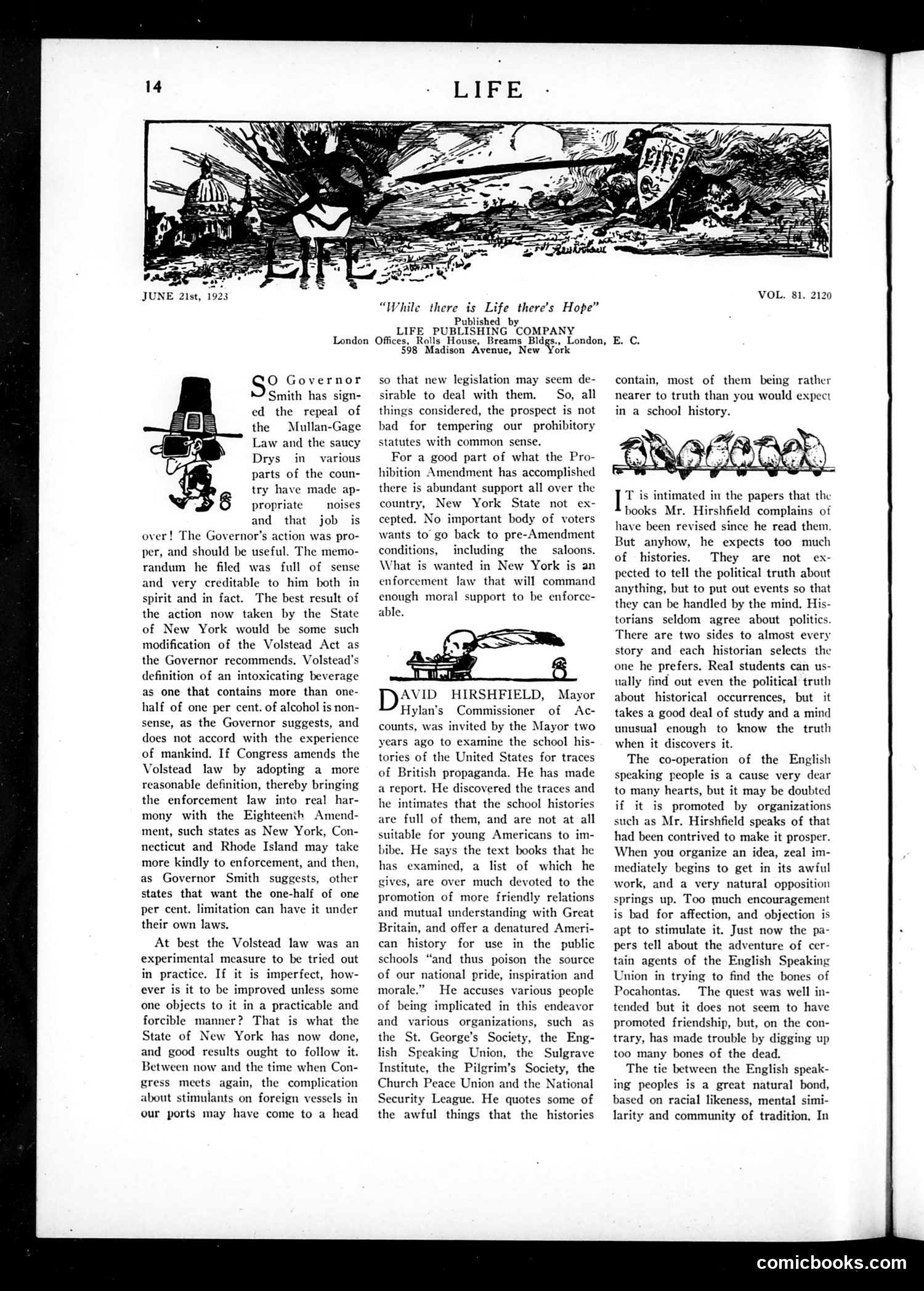
This page discusses Governor Smith's repeal of the Mullan-Gage Law and the Volstead Act (Prohibition enforcement). The small cartoon at top left shows a Pilgrim figure—likely representing American Puritan heritage—toppling over drunk, satirizing the contradiction between America's moral foundations and the current debate over alcohol prohibition. The main text criticizes both sides: those promoting Prohibition as moralistic "poison" to American pride, and those opposing stricter enforcement. The page mocks Mayor Hirshfield's examination of school histories, which he claims contain British propaganda designed to undermine American patriotism and foster friendly relations with Britain. The satire targets government overreach, historical revisionism, and the cultural anxieties of 1920s America regarding alcohol, foreign influence, and national identity.
📄 Transcribed text from this page (OCR, searchable)
Machine-transcribed from the original scan — historical spelling and the odd misread are preserved.
JUNE 2ist, 1923 London Offices, Rolls House, Breams Bldgs., O Governor Smith has sign- ed the repeal of the Mullan-Gage Law and the saucy Drys in various parts of the coun- try have made ap- propriate noises and that job is over! The Governor's action was pro- per, and should be useful. The memo- randum he filed was full of sense and very creditable to him both in spirit and in fact. The best result of the action now taken by the State of New York would be some such modification of the Volstead Act as the Governor recommends. Volstead’s definition of an intoxicating beverage as one that contains more than one- half of one per cent. of alcohol is non- sense, as the Governor suggests, and does not accord with the experience of mankind. If Congress amends the Volstead law by adopting a more reasonable definition, thereby bringing the enforcement law into real har- mony with the Eighteenth Amend- ment, such states as New York, Con- necticut and Rhode Island may take more kindly to enforcement, and then, as Governor Smith suggests, other states that want the one-half of one per cent. limitation can have it under their own laws. At best the Volstead law was an experimental measure to be tried out in practice. If it is imperfect, how- ever is it to be improved unless some one objects to it in a practicable and forcible manner? That is what the State of New York has now done, and good results ought to follow it. Between now and the time when Con- gress meets again, the complication about stimulants on foreign vessels in our ports may have come to a head “While there is Life there’s Hope” Published by LIFE PUBLISHING COMPANY poe, EC. 598 Madison Avenue, New Yor! so that new legislation may seem de- sirable to deal with them. So, all things considered, the prospect is not bad for tempering our prohibitory statutes with common sense. For a good part of what the Pro- hibition Amendment has accomplished there is abundant support all over the country, New York State not ex- cepted. No important body of voters wants to’ go back to pre-Amendment conditions, including the — saloons. What is wanted in New York is an enforcement law that will command enough moral support to be enforce- able. AVID HIRSHFIELD, Mayor Hylan’s Commissioner of <Ac- counts, was invited by the Mayor two years ago to examine the school his- tories of the United States for traces of British propaganda. He has made a report. He discovered the traces and he intimates that the school histories are full of them, and are not at all suitable for young Americans to im- bibe. He says the text books that he examined, a list of which he gives, are over much devoted to the promotion of more friendly relations and mutual understanding with Great Britain, and offer a denatured Ameri- can history for use in the public schools “and thus poison the source of our national pride, inspiration and morale.” He accuses various people of being implicated in this endeavor and various organizations, such as the St. George’s Society, the Eng- lish Speaking Union, the Sulgrave Institute, the Pilgrim’s Society, the Church Peace Union and the National Security League. He quotes some of the awful things that the histories has VOL. 81. 2120 contain, most of them being rather nearer to truth than you would expect in a school history. T is intimated in the papers that the books Mr. Hirshfield complains of have been revised since he read them. But anyhow, he expects too much of histories. They are not ex- pected to tell the political truth about anything, but to put out events so that they can be handled by the mind. His- torians seldom agree about politics. There are two sides to almost every story and each historian selects the one he prefers. Real students can us- ually find out even the political truth about historical occurrences, but it takes a good deal of study and a mind unusual enough to know the truth when it discovers it. The co-operation of the English speaking people is a cause very dear to many hearts, but it may be doubted if it is promoted by organizations such as Mr. Hirshfield speaks of that had been contrived to make it prosper. When you organize an idea, zeal im- mediately begins to get in its awful work, and a very natural opposition springs up. Too much encouragement is bad for affection, and objection is apt to stimulate it. Just now the pa- pers tell about the adventure of cer- tain agents of the English Speaking Union in trying to find the bones of Pocahontas. The quest was well in- tended but it does not seem to have promoted friendship, but, on the con- trary, has made trouble by digging up too many bones of the dead. The tie between the English speak- ing peoples is a great natural bond, based on racial likeness, mental simi- larity and community of tradition. In comicbooks.com