
Life, 1923-06-21 · page 11 of 36
Life — June 21, 1923 — page 11: what you’re looking at
What you’re looking at
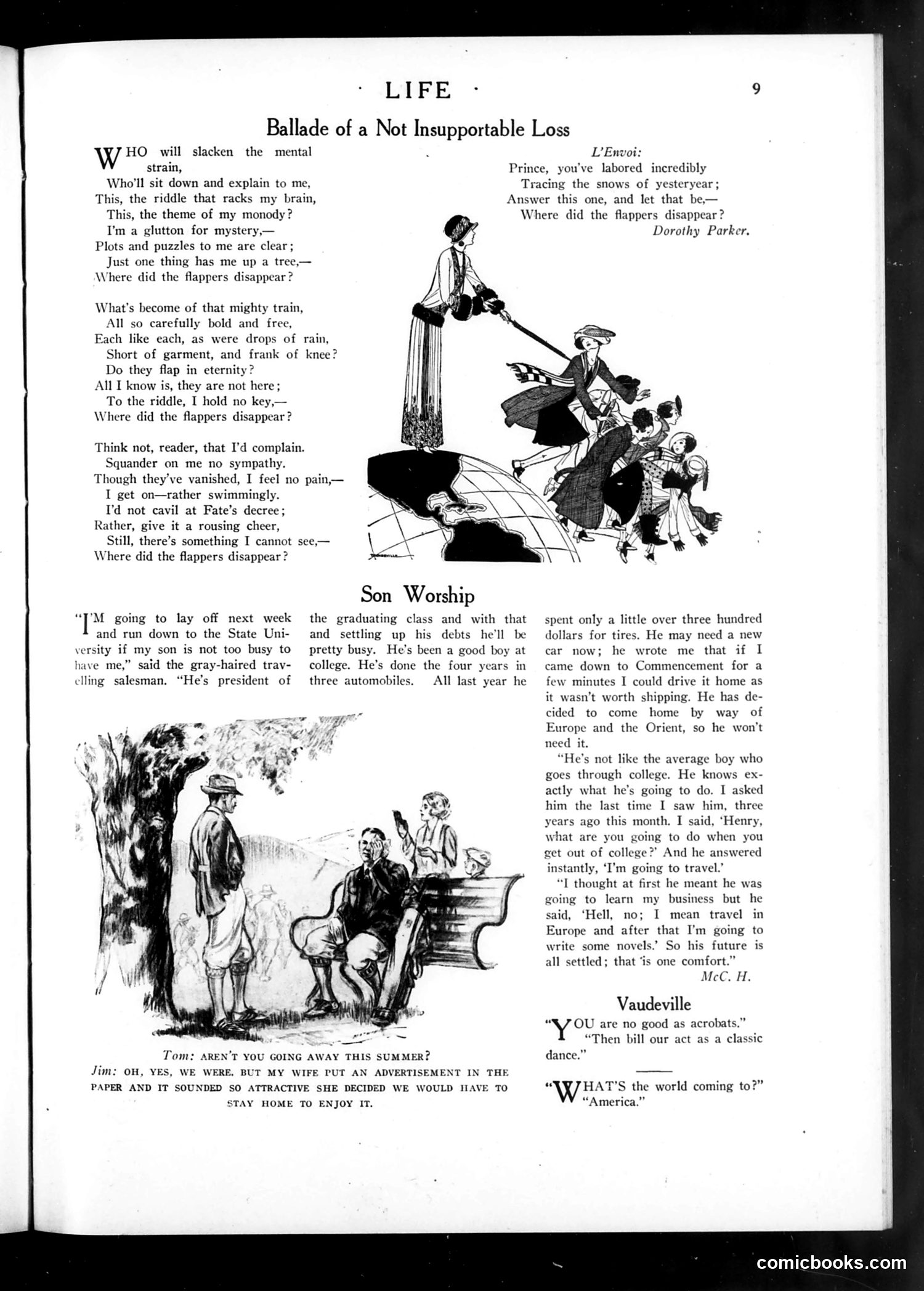
This page contains three separate pieces of satirical humor typical of Life magazine's social commentary: 1. **"Ballade of a Not Insupportable Loss"** (top): A poem illustrated with an elegant woman and children, humorously lamenting the disappearance of "flappers"—the 1920s term for young women who defied social convention through bobbed hair, short skirts, and modern behavior. The satire gently mocks both the flappers' trendiness and the speaker's bemused attitude toward their cultural moment. 2. **"Son Worship"** (middle): A father's dialogue about his college-graduated son's plans. The satire targets paternal pride mixed with financial anxiety—the son needs a new car despite his father's hesitation, exemplifying post-WWI generational expectations and consumer culture tensions. 3. **"Vaudeville"** (bottom): Brief theatrical references mocking the decline of vaudeville entertainment. The illustrations use sketch-style drawings characteristic of 1920s magazine humor.
📄 Transcribed text from this page (OCR, searchable)
Machine-transcribed from the original scan — historical spelling and the odd misread are preserved.
LIFE Ballade of a Not Insupportable Loss HO will slacken strain, Who'll sit down and explain to me, This, the riddle that racks my brain, This, the theme of my monody? the mental LEnvoi: Prince, you've labored incredibly Tracing the snows of yesteryear; Answer this one, and let that be,— Where did the flappers disappear? I’m a glutton for mystery,— Plots and puzzles to me are clear; Just one thing has me up a tree,— Where did the flappers disappear? Dorothy Parker. What's become of that mighty train, All so carefully bold and free, Each like each, as were drops of rain, Short of garment, and frank of knee? Do they flap in eternity? All I know is, they are not here; To the riddle, I hold no key,— Where did the flappers disappear? Think not, reader, that I'd complain. Squander on me no sympathy. Though they’ve vanished, I feel no pain— I get on—rather swimmingly. I'd not cavil at Fate’s decree; Rather, give it a rousing cheer, Still, there’s something I cannot Where did the flappers disappear ? Son Worship the graduating class and with that and settling up his debts he'll be pretty busy. He's been a good boy at college. He’s done the four years in three automobiles. All last year he “I'M going to lay off next week and run down to the State Uni- versity if my son is not too busy to have me,” said the gray-haired trav- clling salesman. “He's president of spent only a little over three hundred dollars for tires. He may need a new now; he me that if I came down to Commencement for a few minutes I could drive it home as it wasn’t worth shipping. He has de- cided to come home by way of Europe and the Orient, so he won't need it. “He's not like the average boy who goes through college. He knows ex- actly what he’s going to do. I asked him the last time I saw him, three years ago this month. I said, ‘Henry, what are you going to do when you get out of college?’ And he answered instantly, ‘I'm going to travel.’ “I thought at first he meant he was going to learn my business but he said, ‘Hell, no; I travel in Europe and after that I'm going to write some novels.’ So his future is all settled; that ‘is one comfort.” McC. H. car wrote mean Vaudeville “4&7 OU are no good as acrobats.” “Then bill our act as a classic dance.” Jim: oH, ¥ ERE, BUT MY WIFE PUT AN ADVERTISEMENT IN THE PAPER AND IT SOUNDED SO ATTRACTIVE SHE DECIDED WE WOULD HAVE TO STAY HOME TO ENJOY IT. a HAT’S the world coming to?” “America.” comicbooks.com