
Life, 1923-06-21 · page 24 of 36
Life — June 21, 1923 — page 24: what you’re looking at
What you’re looking at
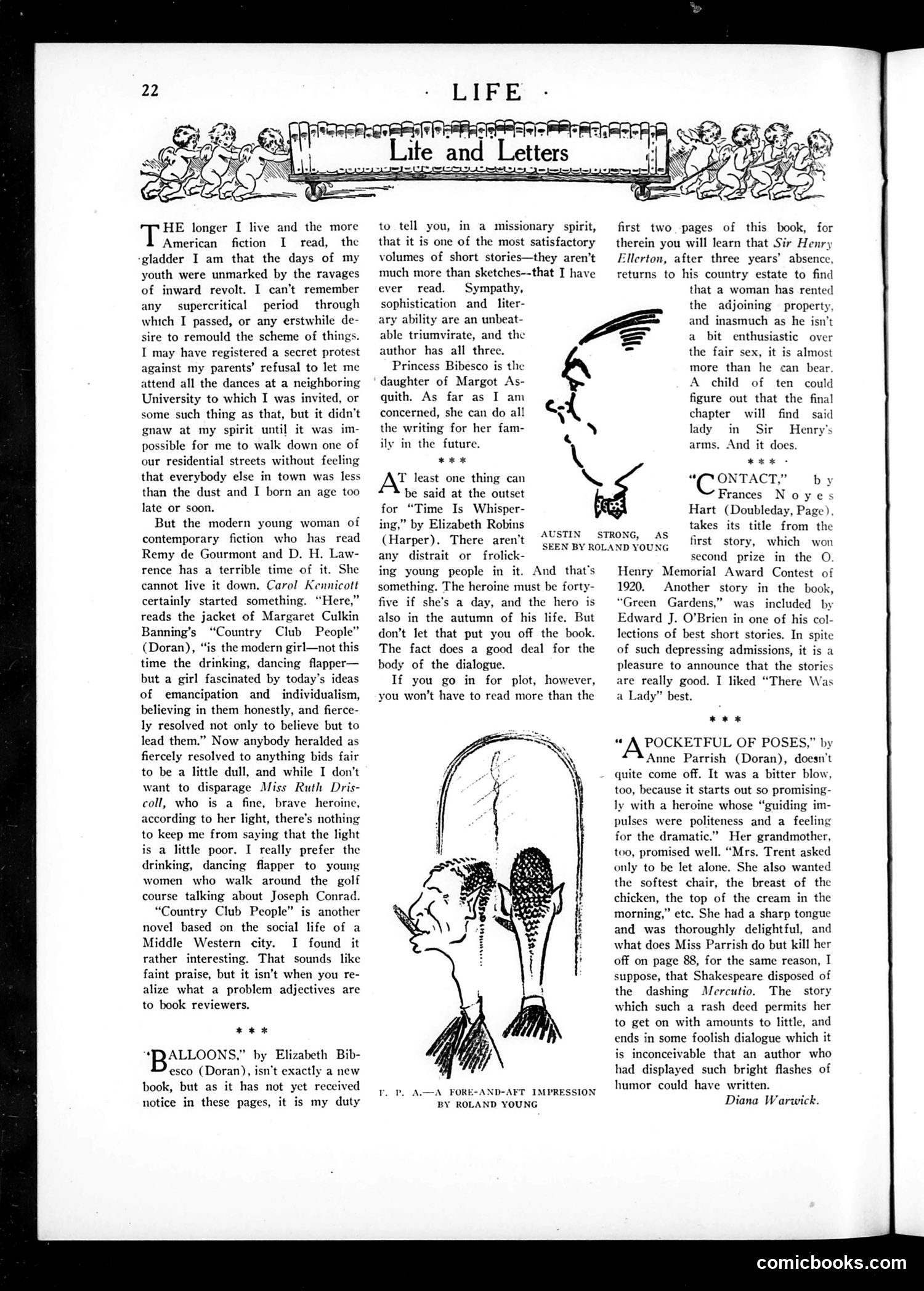
This is a literary review column from *Life* magazine discussing several contemporary novels. The page includes two cartoon illustrations by Roland Young, a noted cartoonist of the era. The main text reviews four books, critiquing modern fiction's obsession with tortured, intellectually conflicted heroines. The reviewer contrasts the "modern girl" fascinated by emancipation (citing Carol Kennicott from *Main Street*) with the older generation, and praises works by Princess Bibesco and Elizabeth Robins that feature more mature characters. The two cartoons—one a profile sketch and one labeled "A Fore-and-Aft Impression"—appear to be humorous illustrations of characters or types discussed in the reviews, typical of Young's satirical style. Without clearer captions, their specific subjects aren't definitively identifiable from the image alone, though they likely caricature the literary archetypes being discussed.
📄 Transcribed text from this page (OCR, searchable)
Machine-transcribed from the original scan — historical spelling and the odd misread are preserved.
SS Tee longer I live and the more American fiction I read, the -gladder I am that the days of my youth were unmarked by the ravages of inward revolt. I can’t remember any supercritical period through which I passed, or any erstwhile de- sire to remould the scheme of things. I may have registered a secret protest against my parents’ refusal to let me attend all the dances at a neighboring University to which I was invited, or some such thing as that, but it didn’t gnaw at my spirit until it was im- possible for me to walk down one of our residential streets without feeling that everybody else in town was less than the dust and I born an age too late or soon, But the modern young woman of contemporary fiction who has read Remy de Gourmont and D. H. Law- rence has a terrible time of it. She cannot live it down. Carol Kennicott certainly started something. “Here,” reads the jacket of Margaret Culkin Banning’s “Country Club People” (Doran), “is the modern girl—not this time the drinking, dancing flapper— but a girl fascinated by today’s ideas of emancipation and individualism, believing in them honestly, and fierce- ly resolved not only to believe but to lead them.” Now anybody heralded as fiercely resolved to anything bids fair to be a little dull, and while I don’t want to disparage Miss Ruth Dris- coll, who is a fine, brave heroine, according to her light, there’s nothing to keep me from saying that the light is a little poor. I really prefer the drinking, dancing flapper to young women who walk around the golf course talking about Joseph Conrad. “Country Club People” is another novel based on the social life of a Middle Western city. I found it rather interesting. That sounds like faint praise, but it isn’t when you re- alize what a problem adjectives are to book reviewers. eek BALLOONS: by Elizabeth Bib- esco (Doran), isn’t exactly a new book, but as it has not yet received notice in these pages, it is my duty to tell you, in a missionary spirit, that it is one of the most satisfactory volumes of short stories—they aren’t much more than sketches--that I have ever read. Sympathy, sophistication and liter- ary ability are an unbeat- able triumvirate, and the author has all three. Princess Bibesco is the daughter of Margot As- quith. As far as I am concerned, she can do all the writing for her fam- ily in the future. eee T least one thing can be said at the outset for “Time Is Whisper- ing,” by Elizabeth Robins (Harper). There aren't any distrait or frolick- ing young people in it. And that’s something. The heroine must be forty- five if she’s a day, and the hero is also in the autumn of his life. But don’t let that put you off the book. The fact does a good deal for the body of the dialogue. If you go in for plot, however, you won't have to read more than the . PD. AA FORE-AND-AFT IMPRESSION BY ROLAND YOUNG SEEN BY ROLAND YOUNG first two pages of this book, for therein you will learn that Sir Henry Ellerton, after three years’ absence, returns to his country estate to find that a woman has rented the adjoining property, and inasmuch as he isn’t a bit enthusiastic over the fair sex, it is almost more than he can bear. A child of ten could figure out that the final chapter will find said lady in Sir Henry's arms. And it does. eee “CONTACT,” by Frances Noyes Hart (Doubleday, Page) takes its title from the first story, which won second prize in the O. Henry Memorial Award Contest of 1920. Another story in the book, “Green Gardens,” was included by Edward J. O’Brien in one of his col- lections of best short stories. In spite of such depressing admissions, it is a pleasure to announce that the stories are really good. I liked “There Was a Lady” best. eK “ A POCKETFUL OF POSES,” by Anne Parrish (Doran), doesn’t quite come off. It was a bitter blow, too, because it starts out so promising- ly with a heroine whose “guiding im- pulses were politeness and a feeling for the dramatic.” Her grandmother, too, promised well. “Mrs. Trent asked only to be let alone. She also wanted the softest chair, the breast of the chicken, the top of the cream in the morning,” etc. She had a sharp tongue and was thoroughly delightful, and what does Miss Parrish do but kill her off on page 88, for the same reason, I suppose, that Shakespeare disposed of the dashing Mercutio. The story which such a rash deed permits her to get on with amounts to little, and ends in some foolish dialogue which it is inconceivable that an author who had displayed such bright flashes of humor could have written. Diana Warwick. comicbooks.com