
Life, 1923-06-21 · page 26 of 36
Life — June 21, 1923 — page 26: what you’re looking at
What you’re looking at
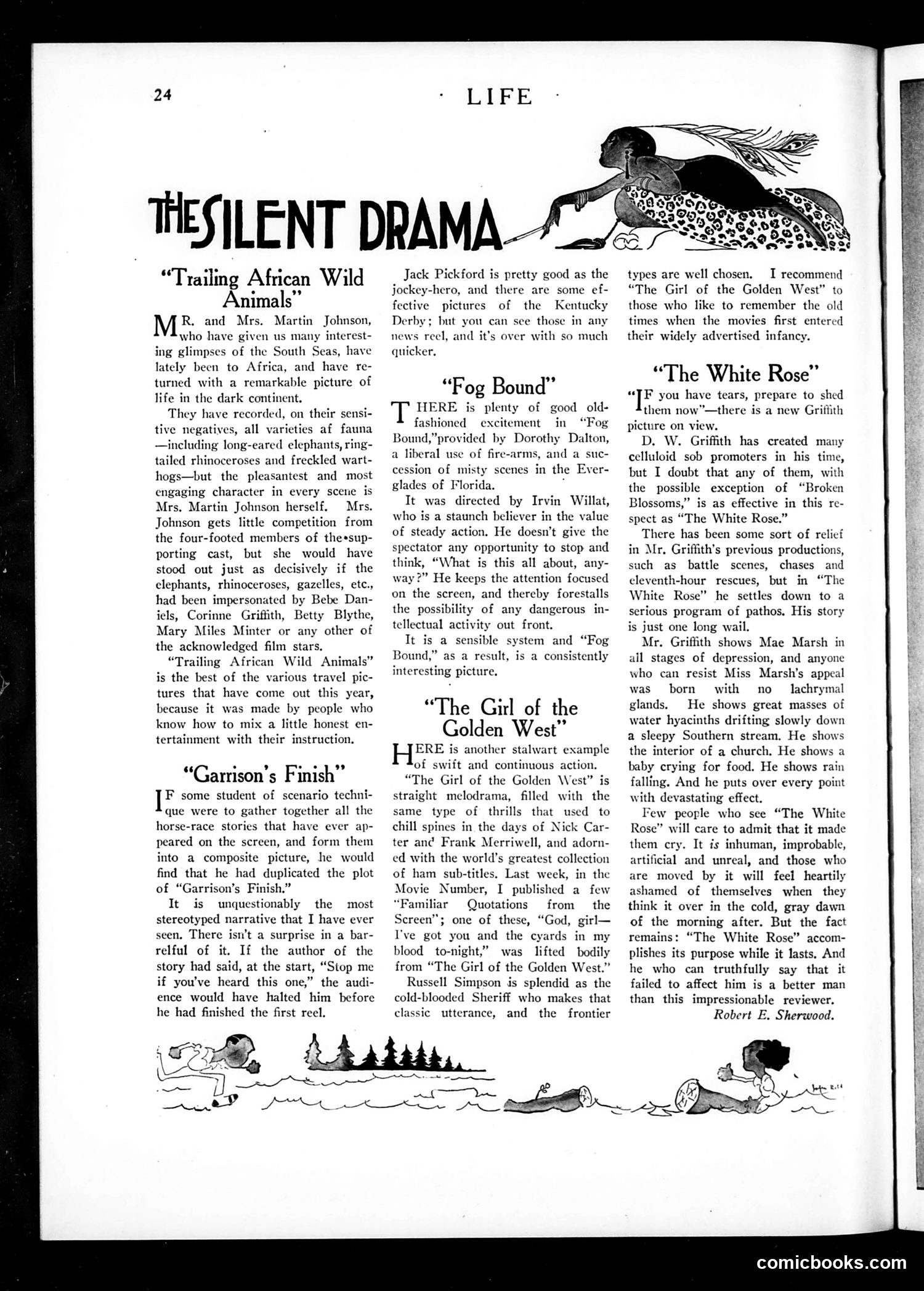
This page contains film reviews from Life's "Silent Drama" column, critiquing contemporary motion pictures. The reviews discuss five films: **"Trailing African Wild Animals"** praises the Martins Johnsons' African documentary, noting Mrs. Johnson herself is the most engaging "character." **"Garrison's Finish"** dismisses a horse-racing film as utterly formulaic and predictable, starring Jack Pickford. **"Fog Bound"** with Dorothy Dalton receives backhanded praise—the reviewer notes its relentless action deliberately prevents audiences from thinking critically. **"The Girl of the Golden West"** is melodramatic hokum filled with overwrought titles and hammy acting, though competently made. **"The White Rose"** references D.W. Griffith's latest tearjerker. The tone is sophisticated mockery of formulaic, low-brow entertainment designed for mass audiences. The reviewer values honest filmmaking over emotional manipulation. These appear to be 1919-1920 era films.
📄 Transcribed text from this page (OCR, searchable)
Machine-transcribed from the original scan — historical spelling and the odd misread are preserved.
THESILENT DRAMA. “Trailing African Wild : ” Animals R. and Mrs. Martin Johnson, who have given us many interest- ing glimpses of the South Seas, have lately been to Africa, and have re- turned with a remarkable picture of life in the dark continent, They have recorded, on their sensi- tive negatives, all varieties af fauna —including long-eared elephants, ring- tailed rhinoceroses and freckled wart- hogs—but the pleasantest and most engaging character in every scene is Mrs. Martin Johnson herself. Mrs. Johnson gets little competition from the four-footed members of thesup- porting cast, but she would have stood out just as decisively if the elephants, rhinoceroses, gazelles, etc., had been impersonated by Bebe Dan- iels, Corinne Griffith, Betty Blythe, Mary Miles Minter or any other of the acknowledged film stars. “Trailing African Wild Animals” is the best of the various travel pic- tures that have come out this year, because it was made by people who know how to mix a little honest en- tertainment with their instruction. . ’ ae “Garrison's Finish F some student of scenario techni- que were to gather together all the horse-race stories that have ever ap- peared on the screen, and form them into a composite picture, he would find that he had duplicated the plot of “Garrison’s Finish.” It is unquestionably the most stereotyped narrative that I have ever seen. There isn’t a surprise in a bar- relful of it. If the author of the story had said, at the start, “Stop me if you've heard this one,” the audi- ence would have halted him before he had finished the first reel. AI j Jack Pickford is pretty good as the jockey-hero, and there are some ef- fective pictures of the Kentucky Derby; but you can see those in any news reel, and it's over with so much quicker, “Fog Bound” HERE is plenty of good old- fashioned excitement in “Fog Bound,”provided by Dorothy Dalton, a liberal use of fire-arms, and a suc- cession of misty scenes in the Ever- glades of Florida. . It was directed by Irvin Willat, who is a staunch believer in the value of steady action. He doesn’t give the spectator any opportunity to stop and think, “What is this all about, any- way?” He keeps the attention focused on the screen, and thereby forestalls the possibility of any dangerous in- tellectual activity out front. It is a sensible system and “Fog Bound,” as a result, is a consistently interesting picture, “The Girl of the Golden West” ERE is another stalwart example of swift and continuous action. “The Girl of the Golden West” is straight melodrama, filled with the same type of thrills that used to chill spines in the days of Nick Car- ter and Frank Merriwell, and adorn- ed with the world’s greatest collection of ham sub-titles. Last week, in the Movie Number, I published a few “Familiar Quotations from the Screen”; one of these, “God, girl— I've got you and the cyards in my blood to-night,” was lifted bodily from “The Girl of the Golden West.” Russell Simpson is splendid as the cold-blooded Sheriff who makes that classic utterance, and the frontier types are well chosen. I recommend “The Girl of the Golden West” to those who like to remember the old times when the movies first entered their widely advertised infancy. “The White Rose” “TF you have tears, prepare to shed them now"”—there is a new Griffith picture on view. D. W. Griffith has created many celluloid sob promoters in his time, but I doubt that any of them, with the possible exception of “Broken Blossoms,” is as effective in this re- spect as “The White Rose.” There has been some sort of relief in Mr, Griffith’s previous productions, such as battle scenes, chases and cleventh-hour rescues, but in “The White Rose” he settles down to a serious program of pathos. His story is just one long wail. Mr. Griffith shows Mae Marsh in all stages of depression, and anyone who can resist Miss Marsh’s appeal was born with no _— lachrymal glands. He shows great masses of water hyacinths drifting slowly down a sleepy Southern stream. He shows the interior of a church, He shows a baby crying for food. He shows rain falling. And he puts over every point with devastating effect. Few people who see “The White Rose” will care to admit that it made them cry. It is inhuman, improbable, artificial and unreal, and those who are moved by it will feel heartily shamed of themselves when they think it over in the cold, gray dawn of the morning after. But the fact remains: “The White Rose” accom- plishes its purpose while it lasts, And he who can truthfully say that it failed to affect him is a better man than this impressionable reviewer. Robert E. Sherwood. comicbooks.com