
A complete issue · 42 pages · 1923
Life — May 24, 1923
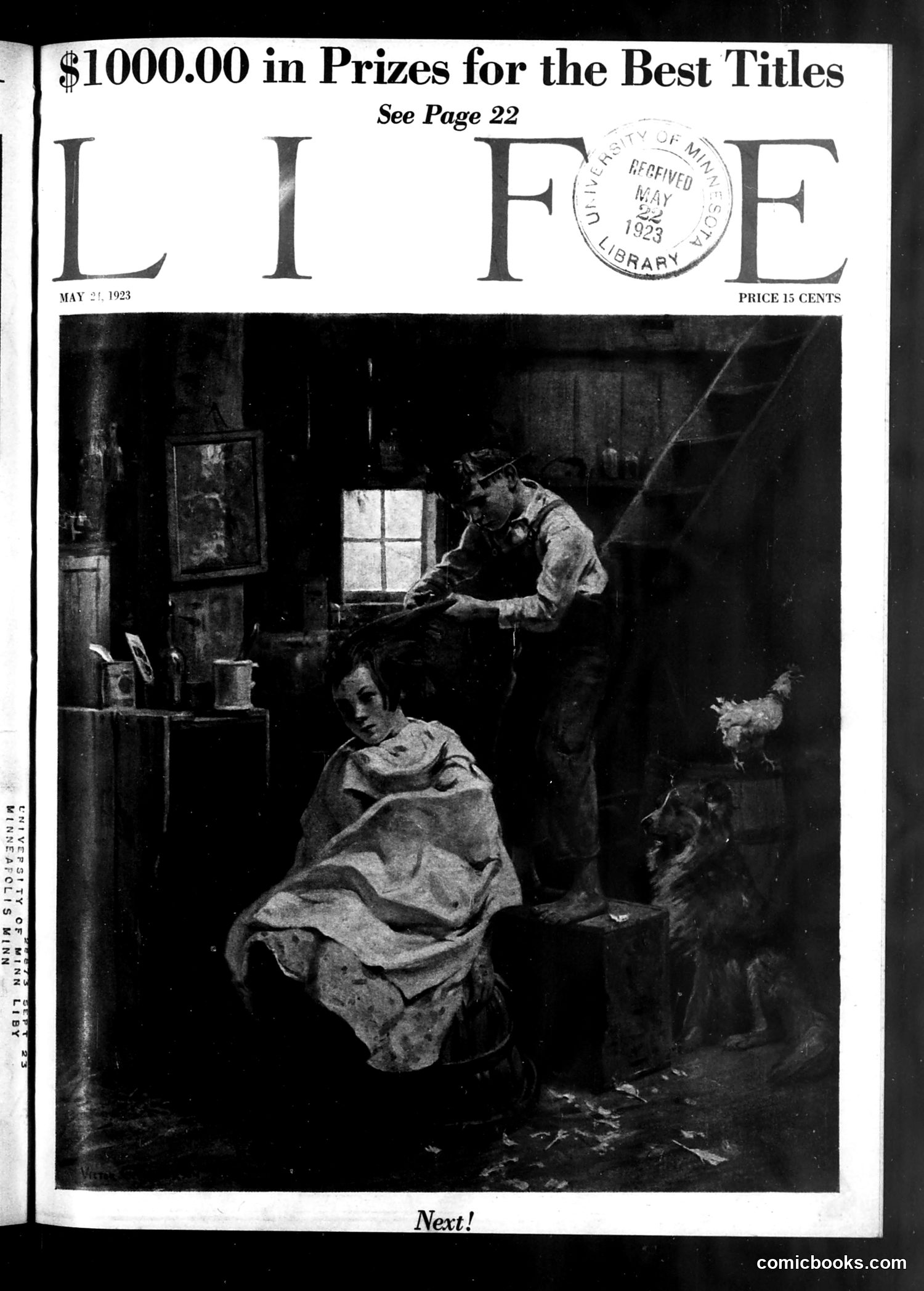
This appears to be a dramatic scene rather than political satire. The black-and-white photograph shows an interior setting with three figures: a seated woman wrapped in blankets or cloth, a man standing behind her, and what appears to be a child or small figure on the right. A dog is also present. The setting looks sparse and dimly lit, suggesting poverty or distress. The single word caption "Next!" is ambiguous—it could imply a sequence of events or waiting. Without additional context or article text visible, the specific narrative or social commentary remains unclear. The image quality and theatrical staging suggest this may relate to a contemporaneous social issue or human-interest story rather than explicit political commentary.
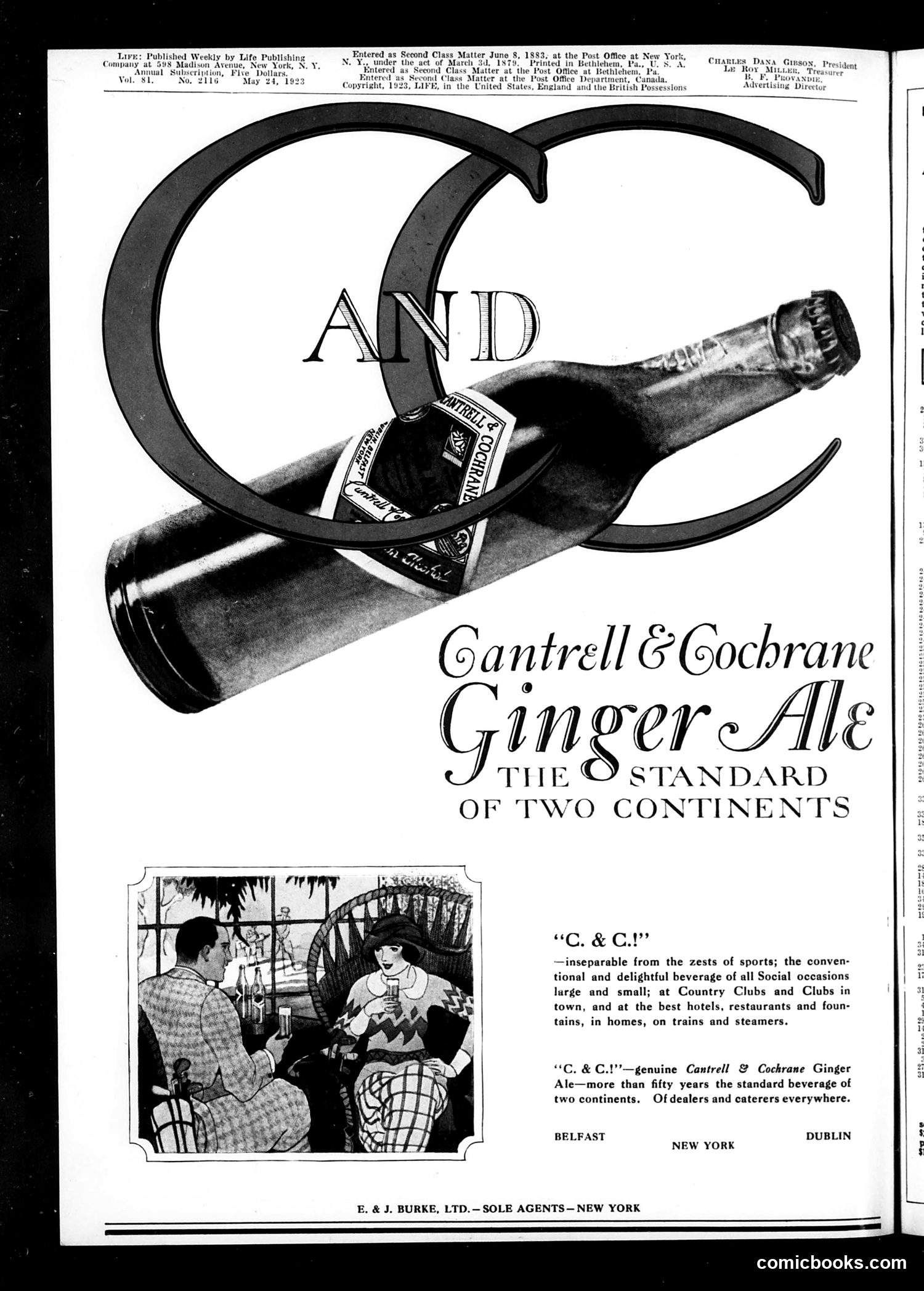
This page is primarily **advertising**, not political satire. It promotes Cantrell & Cochrane Ginger Ale, a beverage brand from Belfast, Dublin, and New York. The large illustration shows a bottle of ginger ale held by a stylized hand emerging from what appears to be a large "C" (for Cantrell & Cochrane). The tagline calls it "THE STANDARD OF TWO CONTINENTS," claiming widespread popularity on both sides of the Atlantic. The smaller photograph depicts two well-dressed people in a social setting, presumably enjoying the product. The copy emphasizes the drink's association with sports clubs, hotels, restaurants, and trains—positioning it as a sophisticated beverage for upscale social occasions. There is no political cartoon or satirical commentary present on this page.
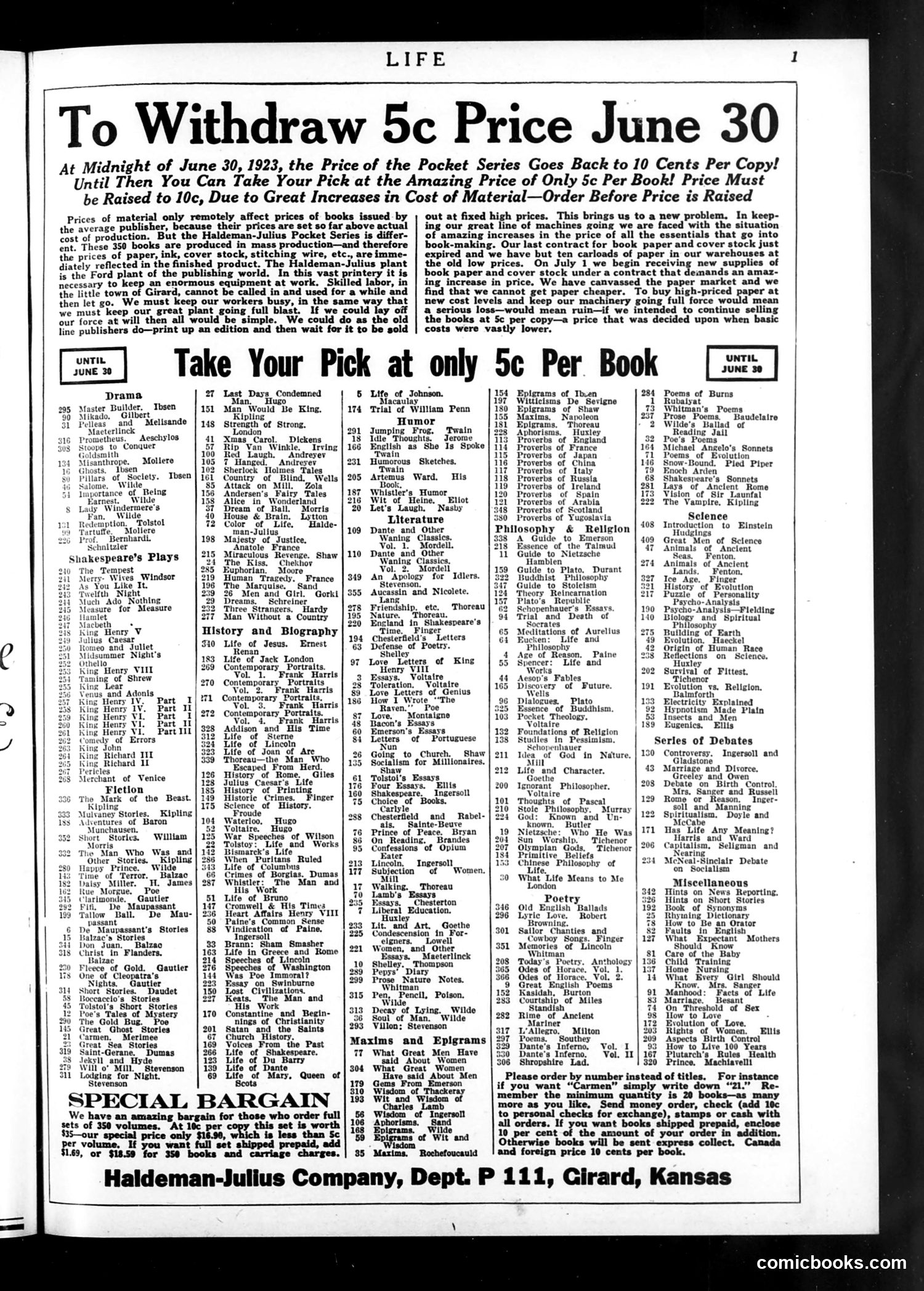
This page is **primarily advertising**, not editorial content or cartoons. It's a book catalog from Haldeman-Julius Company offering their "Pocket Series" books at 5 cents each. The top section explains a price increase announcement: due to rising material costs (paper, ink, stitching wire), the company must raise prices from 5 cents to 10 cents effective July 1, 1923. This is a straightforward business notice detailing production challenges post-World War I. The bulk of the page lists available titles across genres: drama (Shakespeare plays), fiction, humor, literature, philosophy, science, poetry, and debates. The final section promotes a special bargain: 350-volume sets at discounted rates. There are no political cartoons or satirical illustrations visible—just commercial content announcing price changes and cataloging an affordable book subscription service.
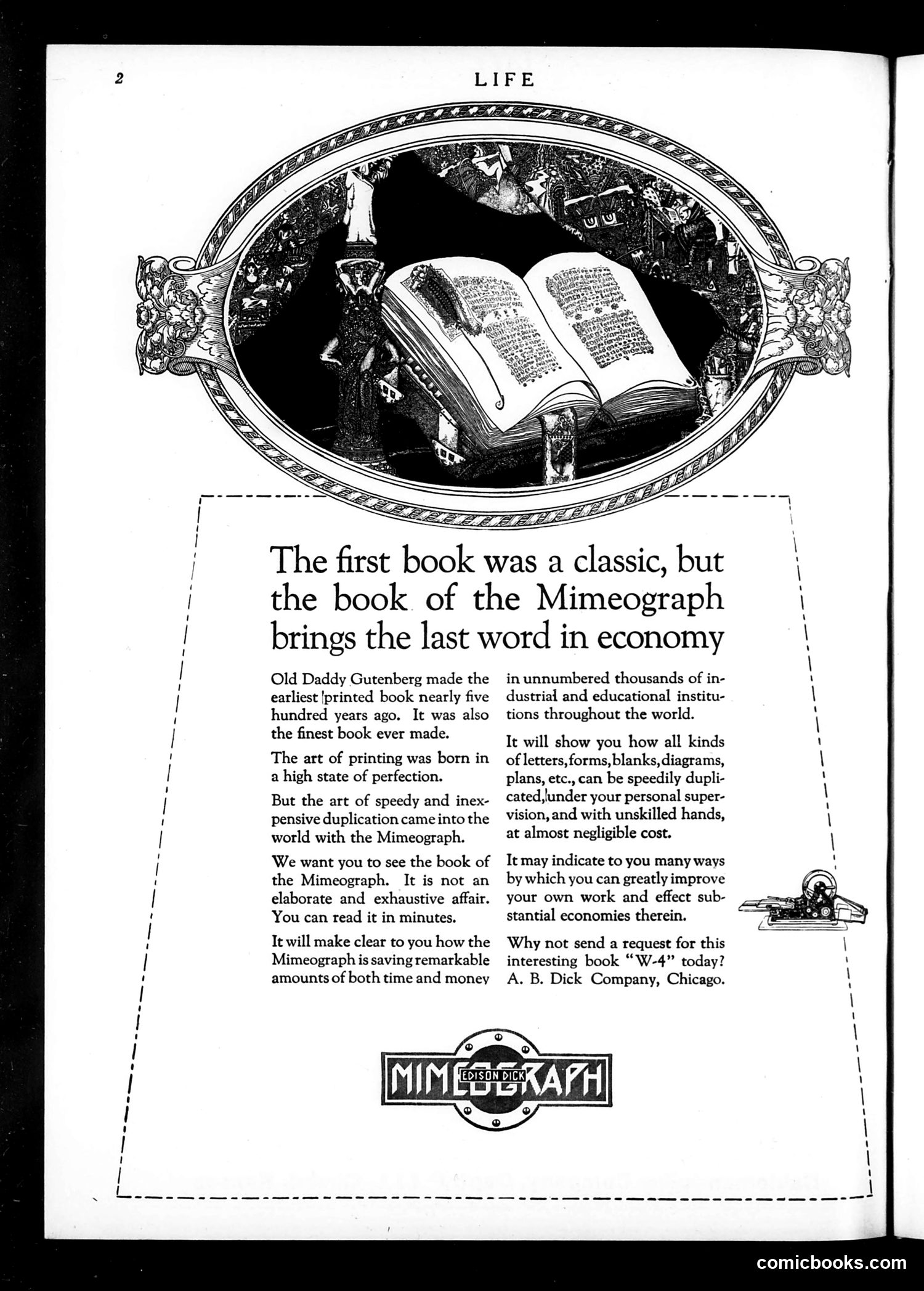
This is primarily **advertising, not satire or political commentary**. The page promotes the Mimeograph machine by A.B. Dick Company of Chicago. The ad compares book printing history to modern copying technology. It contrasts Gutenberg's printed book (shown in the ornamental oval illustration at top) as "a classic" with the mimeograph as bringing "the last word in economy." The pitch emphasizes the mimeograph's practical advantages: it duplicates letters, forms, diagrams, and plans cheaply and quickly without requiring skilled operators. The ad targets institutional buyers—"industrial and educational institutions throughout the world"—suggesting this was marketed to offices, schools, and organizations seeking affordable document reproduction before photocopiers existed.
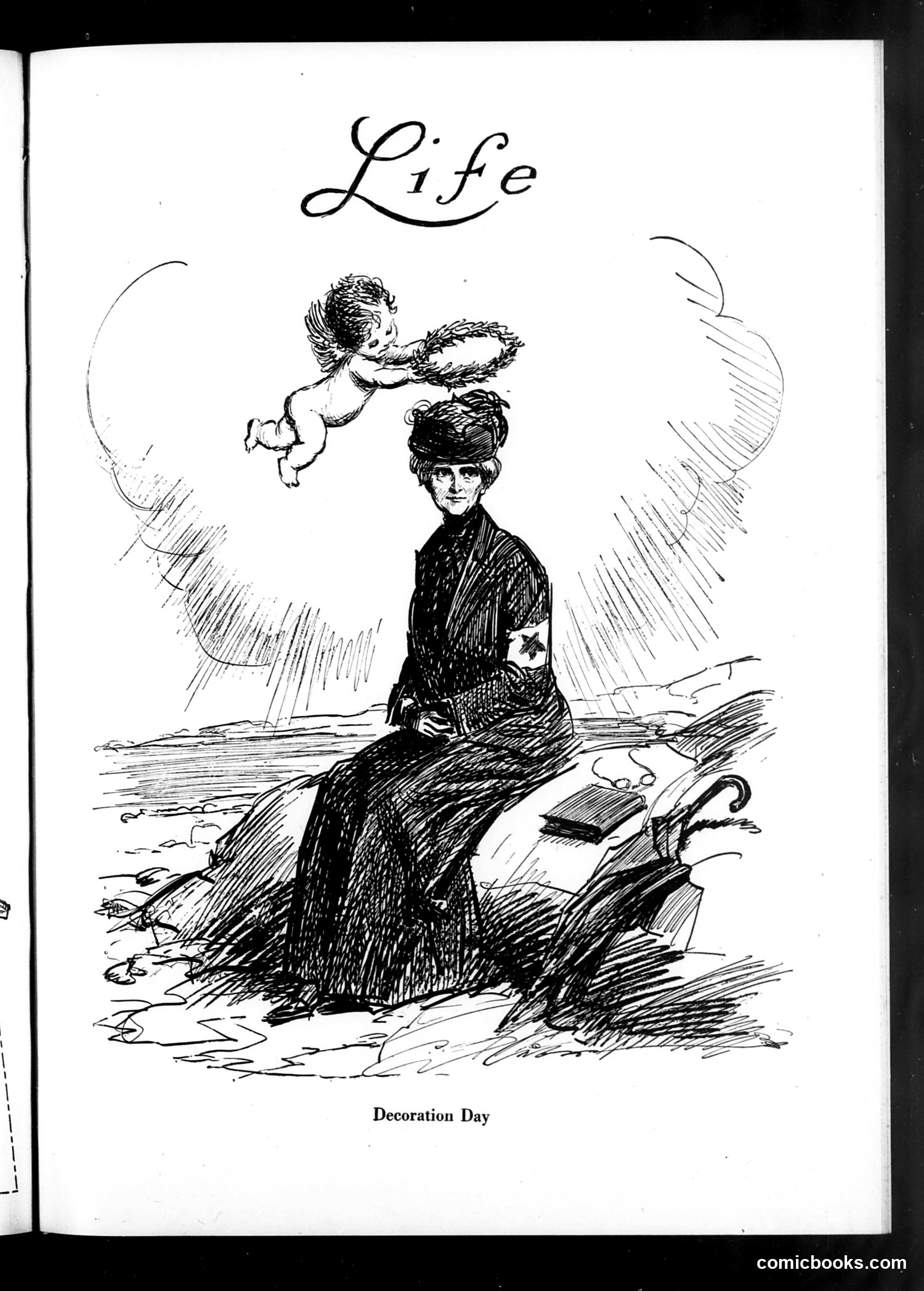
This page from *Life* magazine depicts a woman in mourning attire sitting on graves, with an angel figure above her holding a wreath. The caption reads "Decoration Day," referring to the American holiday (now Memorial Day) when citizens traditionally visit cemeteries to honor the dead, particularly fallen soldiers. The illustration appears to be sentimental rather than satirical—it celebrates the solemn duty of remembrance. The woman's dark clothing and posture convey grief, while the angelic figure suggests spiritual comfort or the sanctity of those memorialized. The sketch style emphasizes emotional weight rather than humor or political critique. This represents *Life*'s more earnest editorial content alongside its typically satirical material.
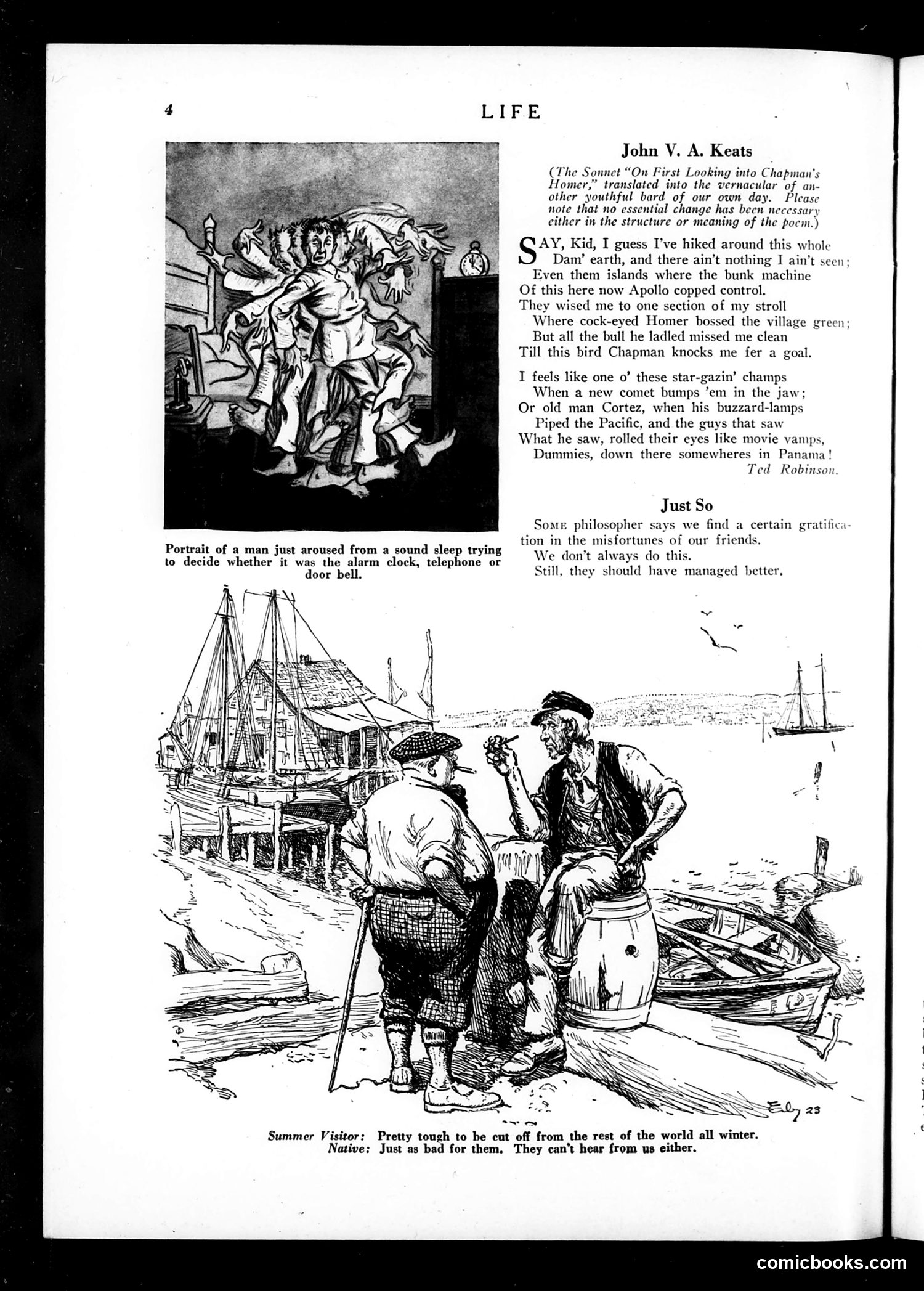
This page features two distinct pieces: **Top:** A poem by John V.A. Keats titled "Say, Kid" uses colloquial language to describe someone's confused awakening—unable to determine whether an alarm clock, telephone, or door bell woke them. The accompanying chaotic illustration depicts a man jolted awake amid swirling, energetic figures. **Bottom:** An illustration captioned "Summer Visitor" depicts two fishermen discussing a seasonal visitor who is "pretty tough to be cut off from the rest of the world all winter" but equally problematic year-round because "They can't hear from us either." This satirizes the social awkwardness and isolation of summer visitors—people who arrive seasonally but remain disconnected from their host community. Both pieces employ humorous exaggeration to mock modern inconveniences and social tensions of the era.
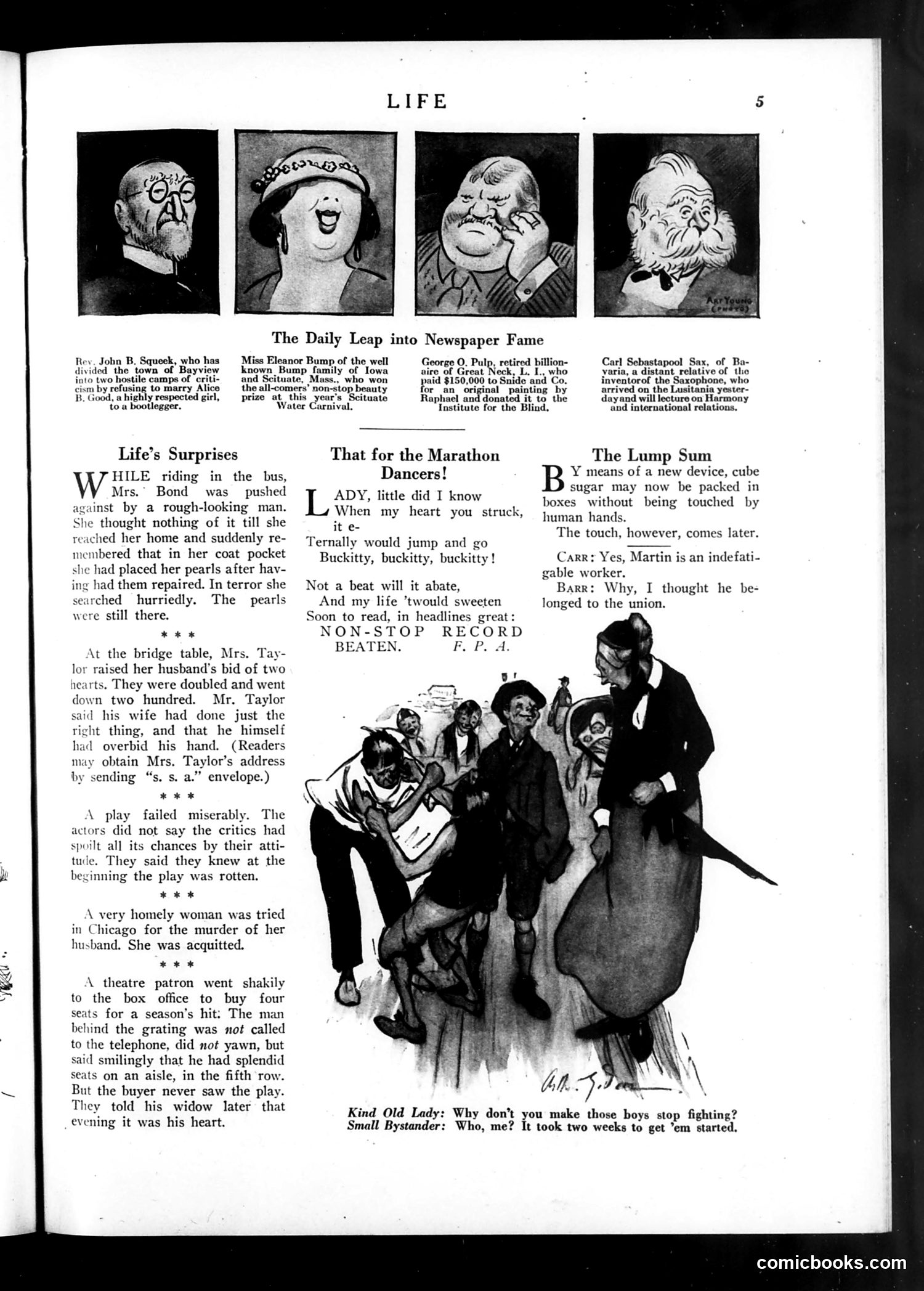
This page contains satirical humor pieces and a cartoon. The top shows "The Daily Leap into Newspaper Fame"—four caricatured portraits of people who reportedly gained sudden newspaper attention, including Rev. John B. Snueck (a town divider), Miss Jessie "Bump" of Iowa (a Scituate Water Carnival prize winner), and Carl Schastopol (a Great Neck resident who donated $150,000). Below are three humorous anecdotes: a woman who retrieved pearl earrings from a coat pocket after falsely suspecting theft; a bridge table card game where the Taylors doubled and exceeded expectations; and commentary on a failed theatrical production. The main illustration depicts a "kind old lady" attempting to stop fighting boys, while a "small bystander" claims credit for starting the conflict—satirizing misplaced responsibility and adults' ineffective interventions in street disputes.
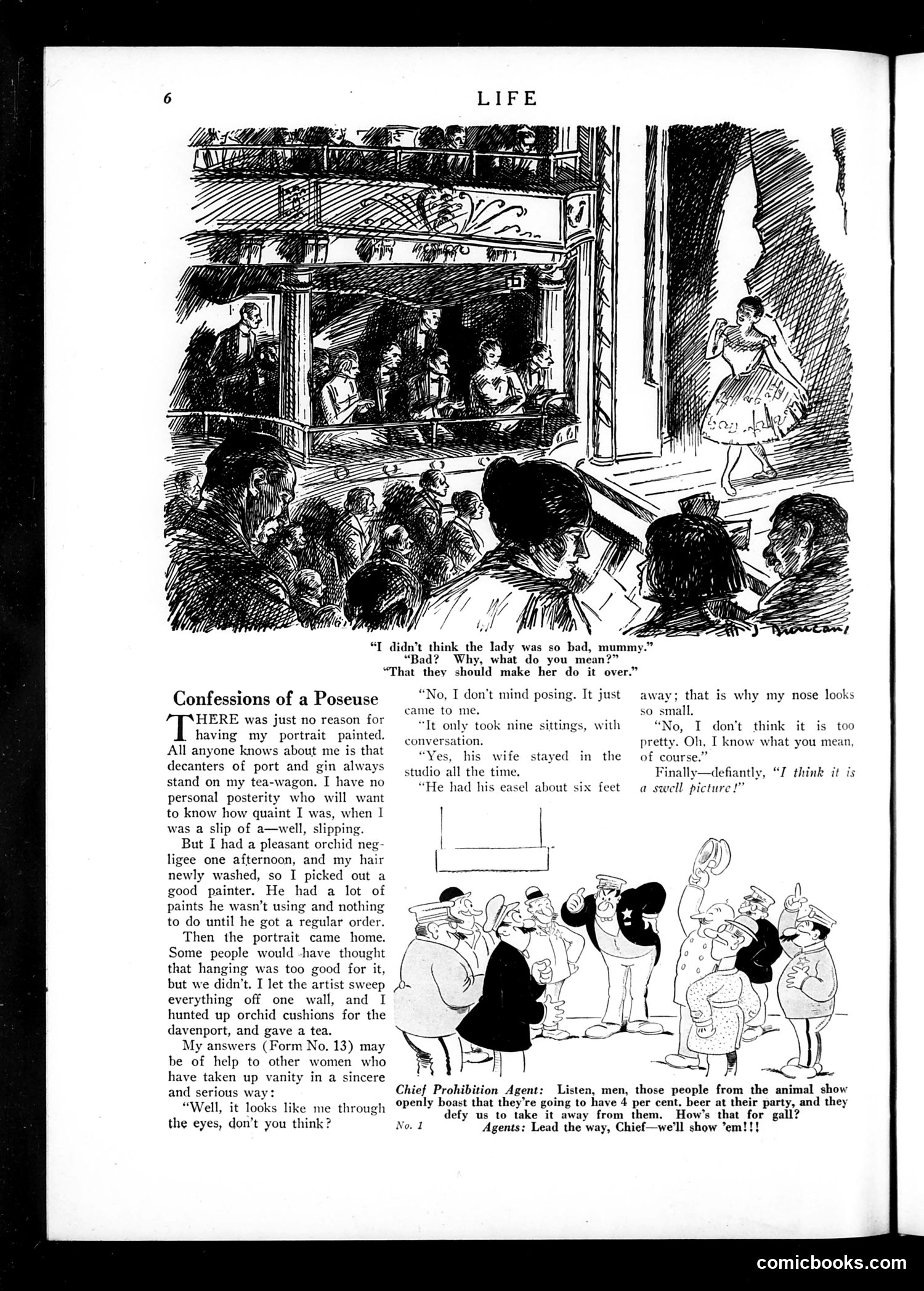
This page contains two satirical pieces from *Life* magazine: **"Confessions of a Poseuse"** (top left): A woman describes having her portrait painted. She complains about vanity and the artist's demands—he needed a regular commission to work, scattered her belongings for his "daveuport" (davenport), and insisted she pose. The joke mocks both the sitter's pretension and artists' temperamental behavior. **"Chief Prentiss and the Animal Show"** (bottom): A cartoon shows a Native American figure ("Chief") boasting to agents about providing 4% beer at their party and stealing it from "them." The humor appears to reference Prohibition-era alcohol smuggling, with the "Chief" portrayed as both foolish and criminal—a period-typical ethnic stereotype used for comedic effect.
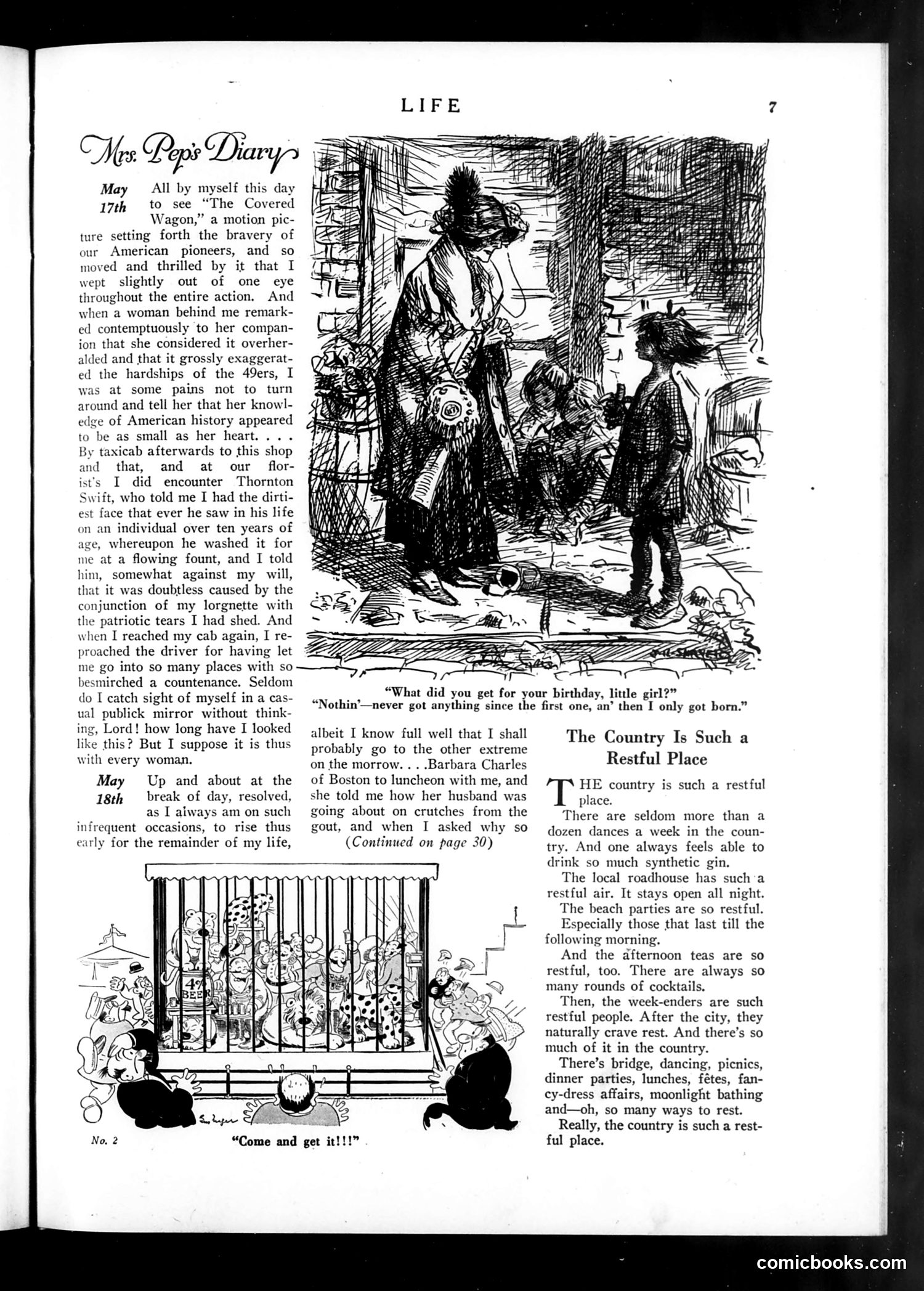
This page contains two satirical cartoons and a diary entry from "Mrs. Pop's Diary." **Top cartoon**: Shows a woman speaking to a child, with the caption: "What did you get for your birthday, little girl?" / "Nothin'—never got anything since the first one, an' then I only got born." This satirizes parental neglect and economic hardship, likely reflecting Depression-era struggles where families couldn't afford birthday gifts. **Bottom cartoon**: Depicts people looking through prison/jail cell bars with the caption "Come and get it!!!" This appears to satirize overcrowded prison conditions or a social commentary on incarceration. **Mrs. Pop's Diary entry** (May 17th-18th) describes attendance at a film ("The Covered Wagon") about American pioneers, touching on themes of hardship and patriotism. The overall tone reflects early 20th-century social commentary on poverty and institutional conditions.
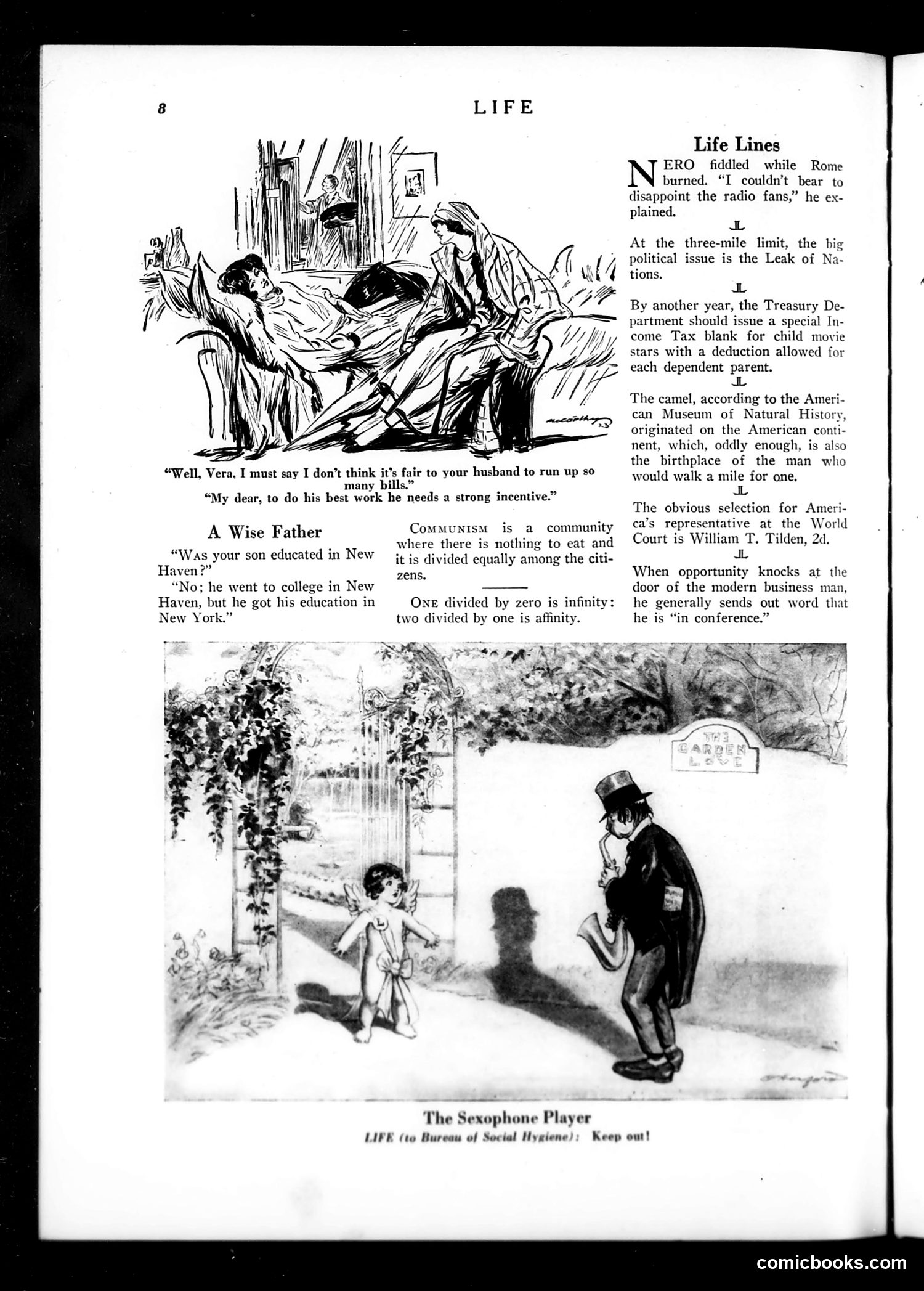
This page contains three separate humor pieces: 1. **"A Wise Father"** (top cartoon): A domestic scene where a husband complains about bills while his wife suggests he needs "a strong incentive" to work harder. The satire targets marital dynamics and financial pressure. 2. **Life Lines** (right column): Brief social commentary on contemporary issues—Nero fiddling while Rome burned (likely referencing current political inaction), Treasury Department tax proposals for child movie stars, camel origins, and William T. Tilden (a famous tennis player) as America's World Court representative. 3. **"The Saxophone Player"** (bottom): A man playing saxophone near a child, with a sign reading "Keep out!" The caption suggests saxophones were considered socially objectionable—likely reflecting 1920s moral concerns about jazz music and its perceived corrupting influence on youth.
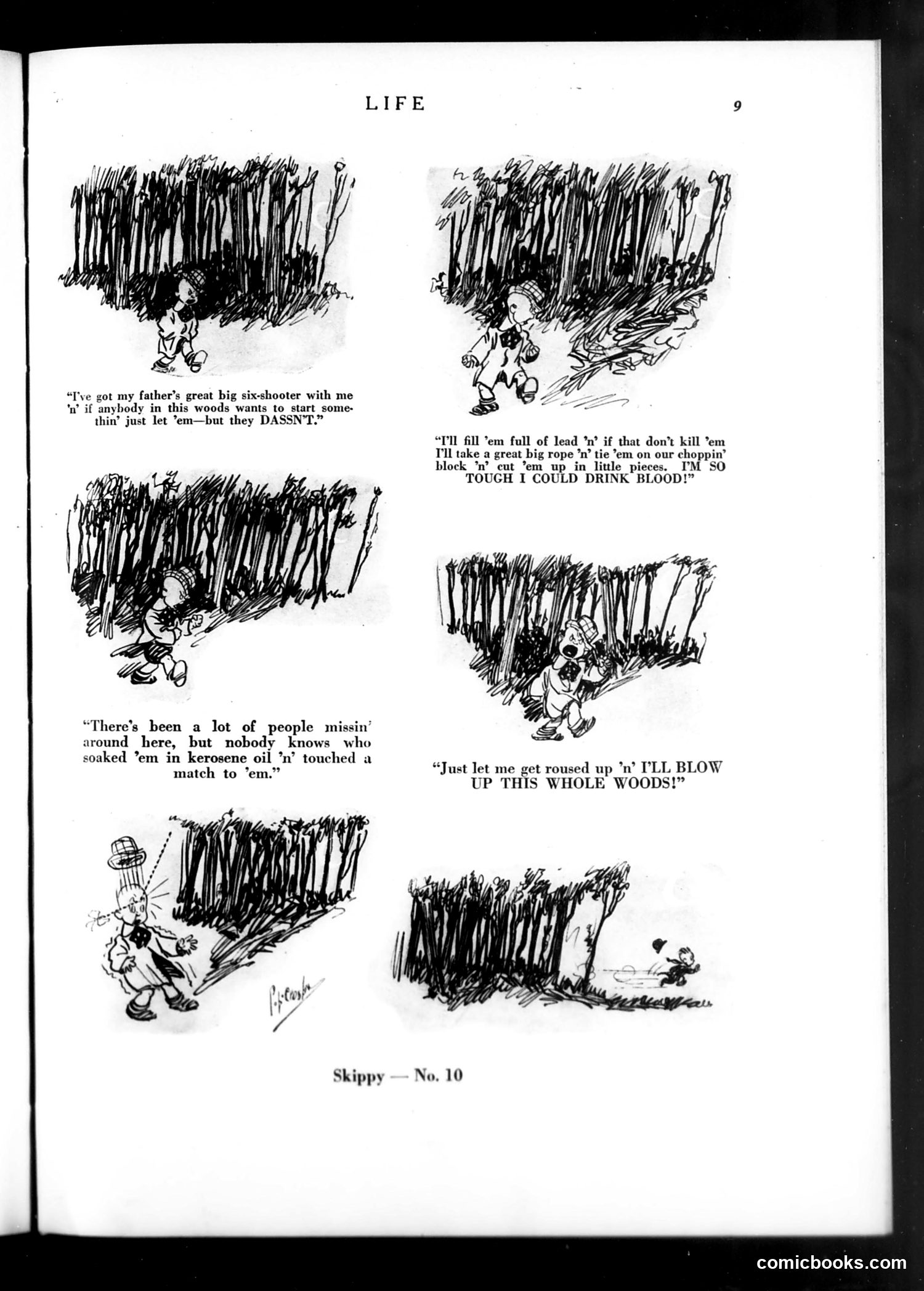
This is a comic strip featuring a young character named Skippy in a woods setting. The humor centers on boys' adventurous fantasies and their bravado about violence and danger. The strip progresses through six panels showing Skippy with a six-shooter, imagining increasingly dramatic scenarios: starting a fight, filling enemies with lead, using kerosene and matches, and finally threatening to blow up the entire woods while drunk on imagined power. The satire targets childhood male aggression and the violent fantasies boys indulge in through popular Western and adventure media. The contrast between Skippy's small, harmless appearance and his bloodthirsty rhetoric creates comedic irony, while subtly critiquing how entertainment encouraged violent thinking in children. The exaggerated declarations mock both boyish braggadocio and the glorification of violence in popular culture.
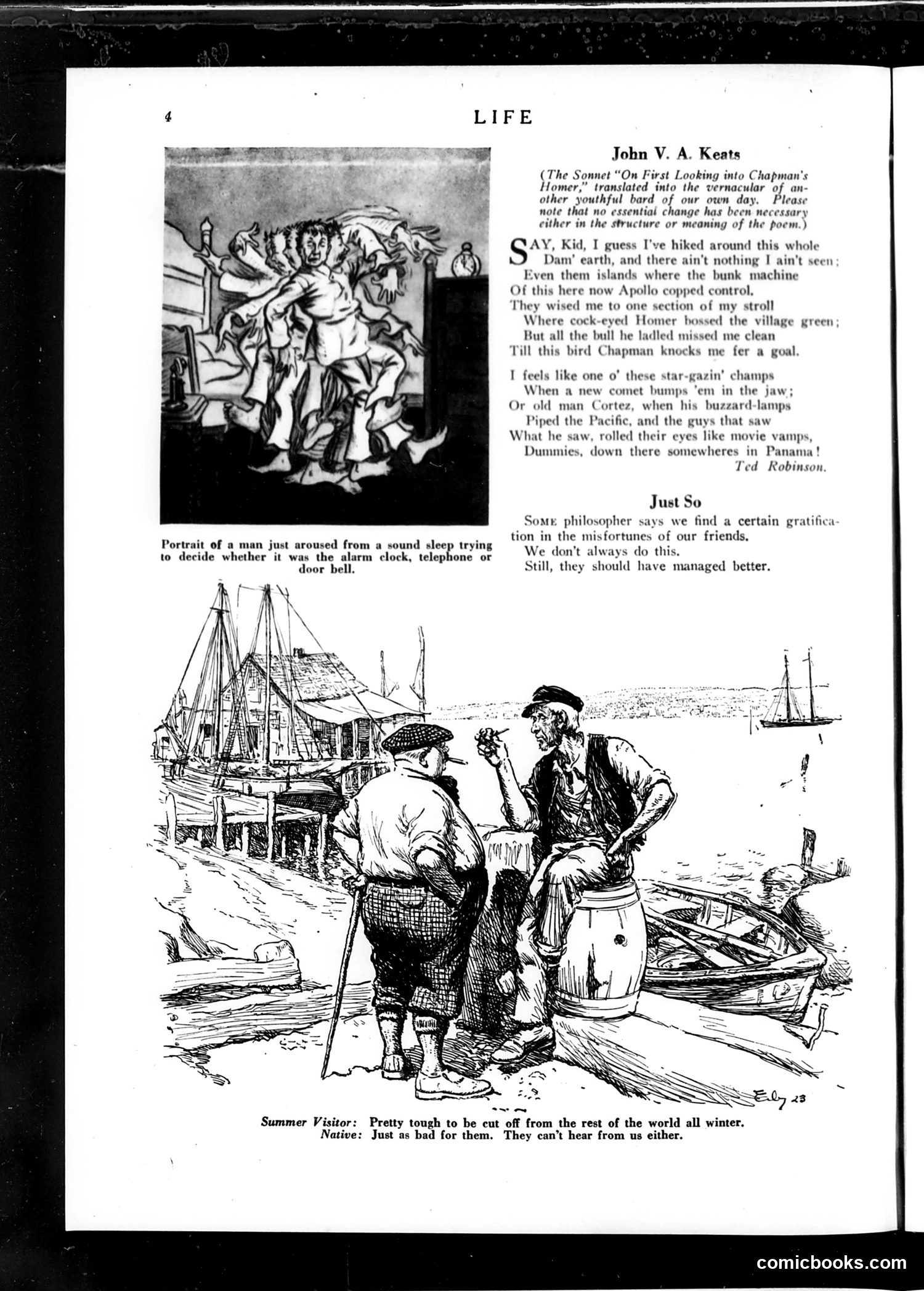
This page from *Life* magazine contains two separate pieces: **Top:** A poem by John V. A. Keats titled "Sayin' Kid" (with a modern vernacular spelling) that references Apollo spacecraft and Chapman, suggesting this dates to the Space Race era. The accompanying chaotic illustration shows a man confused upon waking, uncertain whether an alarm clock, telephone, or door bell disturbed him—a relatable domestic comedy about modern life's competing noises and interruptions. **Bottom:** A sketch captioned "Summer Visitor" depicts isolated coastal fishermen meeting a visitor. The joke mocks the visitor's social isolation during winter: being "cut off from the rest of the world all winter" makes communication with outsiders difficult. It satirizes the loneliness and disconnection of remote seaside living. Both pieces use humor to comment on modern life's disruptions and isolation.
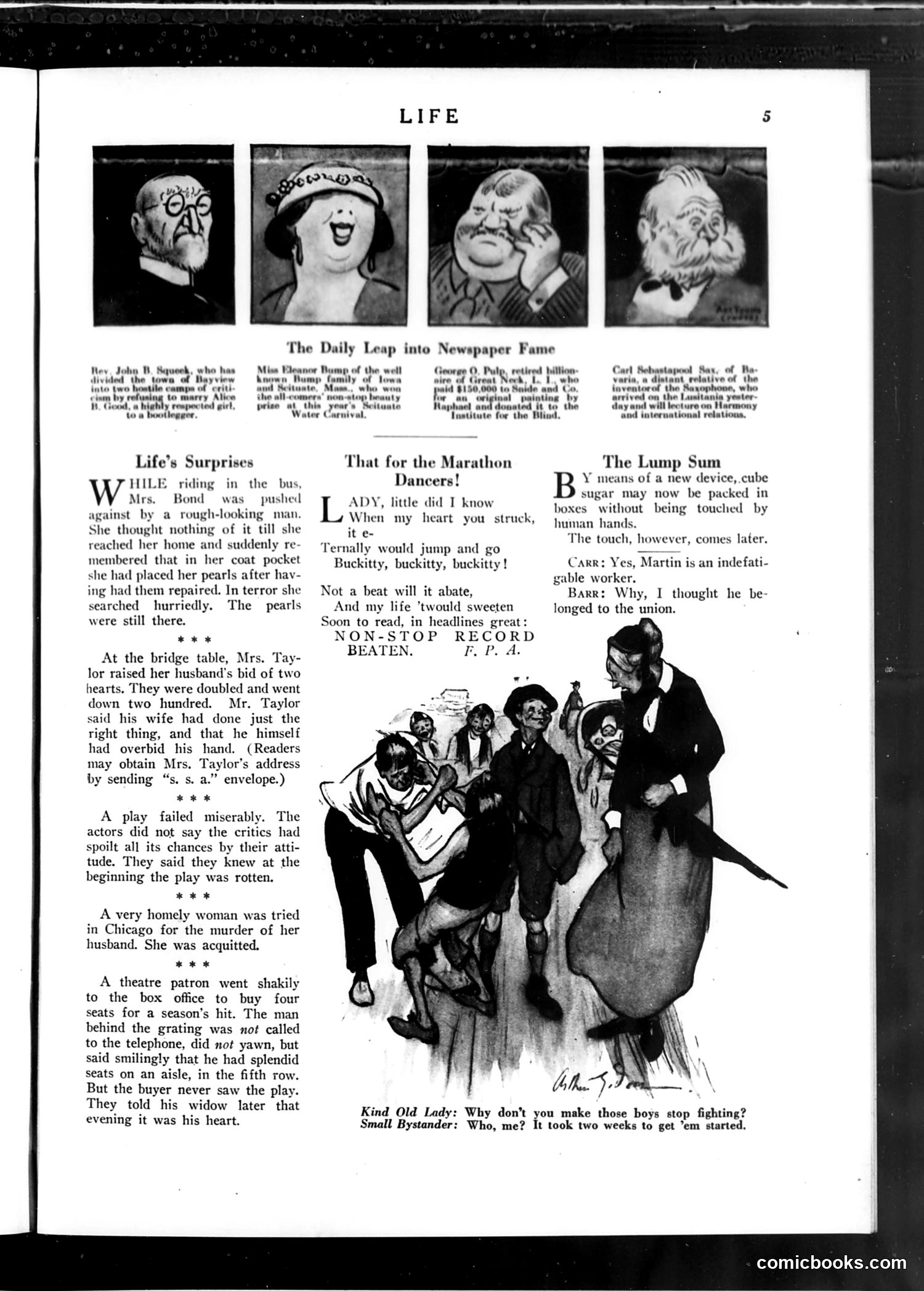
This page from *Life* magazine features humorous anecdotes and a cartoon about everyday social situations. **"The Daily Leap into Newspaper Fame"** shows four caricatured faces of people who achieved minor celebrity through newspapers—including Rev. John B. Spiegel (refusing to marry), Miss Eleanor Bump (beauty pageant winner), George O. Pule (retired billionaire donating art), and Carl Sebastapod Sax (arriving for a lecture). **The cartoon** depicts a chaotic street scene where a "Kind Old Lady" asks a "Small Bystander" to stop fighting boys. His reply—"Who, me? It took two weeks to get 'em started"—suggests the humor comes from the child's pride in organizing the brawl, satirizing youthful troublemaking and adult naïveté about children's mischief. The other anecdotes mock bridge-playing mistakes, failed theater productions, and box office incompetence—typical early 20th-century American humor.
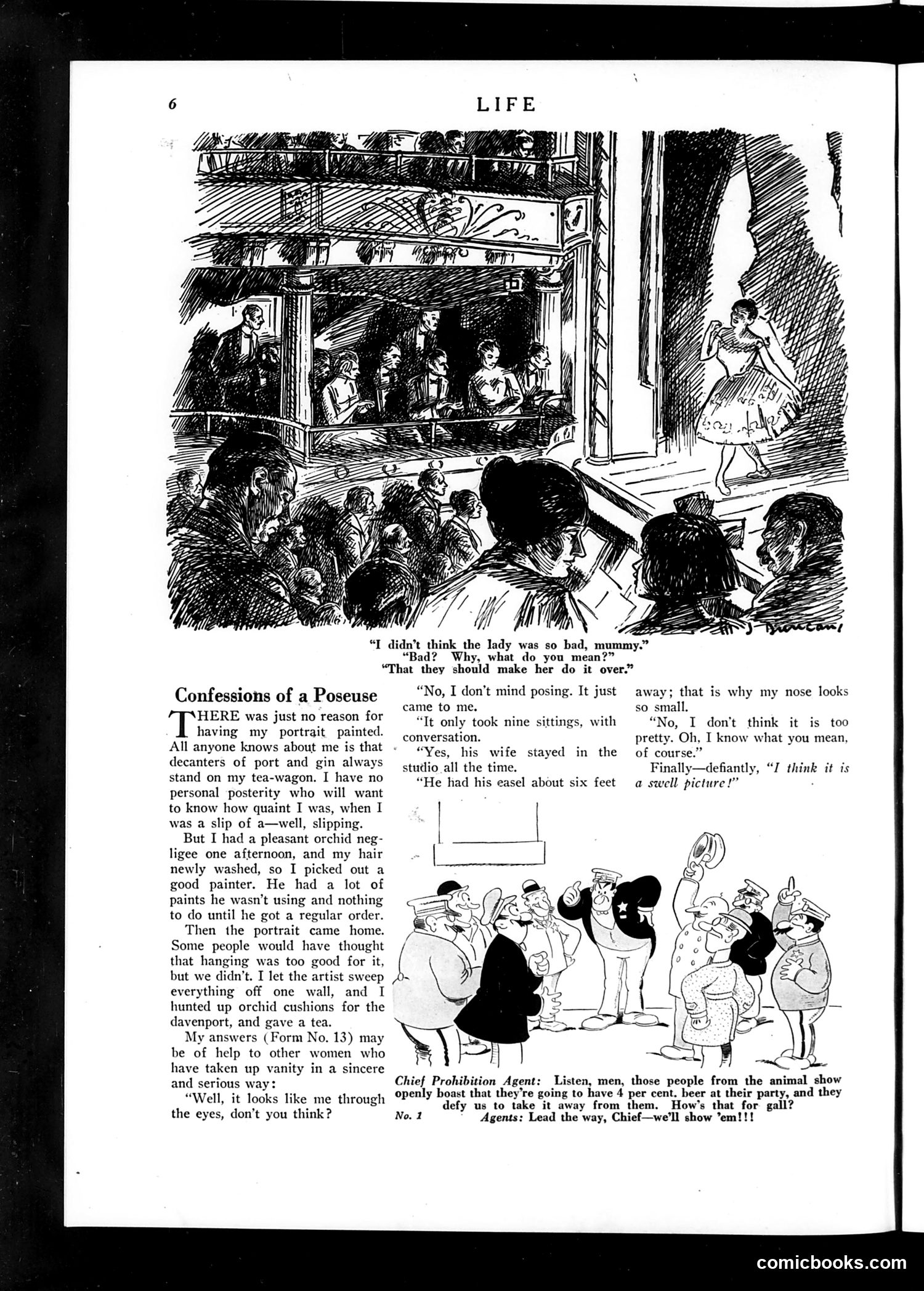
This page contains two unrelated pieces of satirical content from an early 20th-century Life Magazine: **Upper Section - "Confessions of a Poseuse":** A woman explains she hired a portrait painter, then deliberately arranged her home to obstruct his work (sweeping, moving furniture) so he'd paint quickly. Her goal was a flattering portrait without proper sitting time. The joke mocks vanity and the shortcuts people take to appear well-presented. **Lower Section - "Chief Prohibition Agent":** A cartoon mocking Prohibition enforcement. A police chief boasts to agents about seizing beer from an "animal show," claiming they'll prevent illegal 4% beer distribution. The humor targets the absurdity and ineffectiveness of Prohibition-era law enforcement—agents celebrating minor seizures while real illegal alcohol operations flourish. Both pieces satirize contemporary American vanity and failed governance policies.
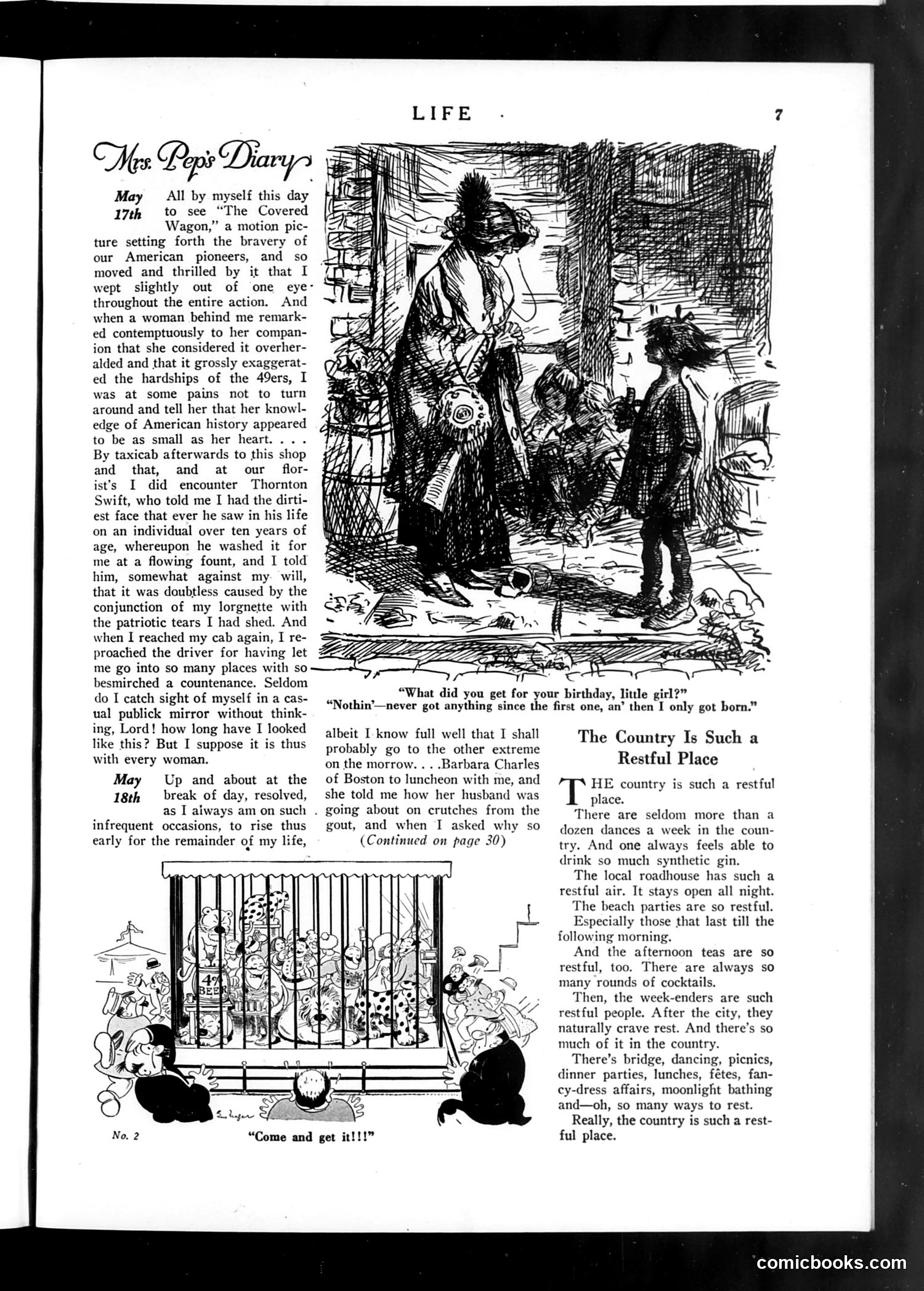
This page contains two satirical cartoons: **Top cartoon:** Shows a woman encountering a shabby, unkempt man on the street. The caption reads: "What did you get for your birthday, little girl?" / "Nothin'—never got anything since the first one, an' then I only got born." This appears to be social commentary on poverty and neglect of children in poor communities. **Bottom cartoon (No. 2):** Depicts people looking through prison/jail bars with the caption "Come and get it!!" This likely satirizes overcrowded prison conditions or critiques incarceration practices of the era. **"Mrs. Pep's Diary" section:** Reflects on viewing "The Covered Wagon" (a 1923 film about pioneers), noting how it moved her emotionally regarding American history and manifest destiny. **Right column essay:** "The Country Is Such a Restful Place" sarcastically describes leisure activities and social gatherings in rural/country settings.
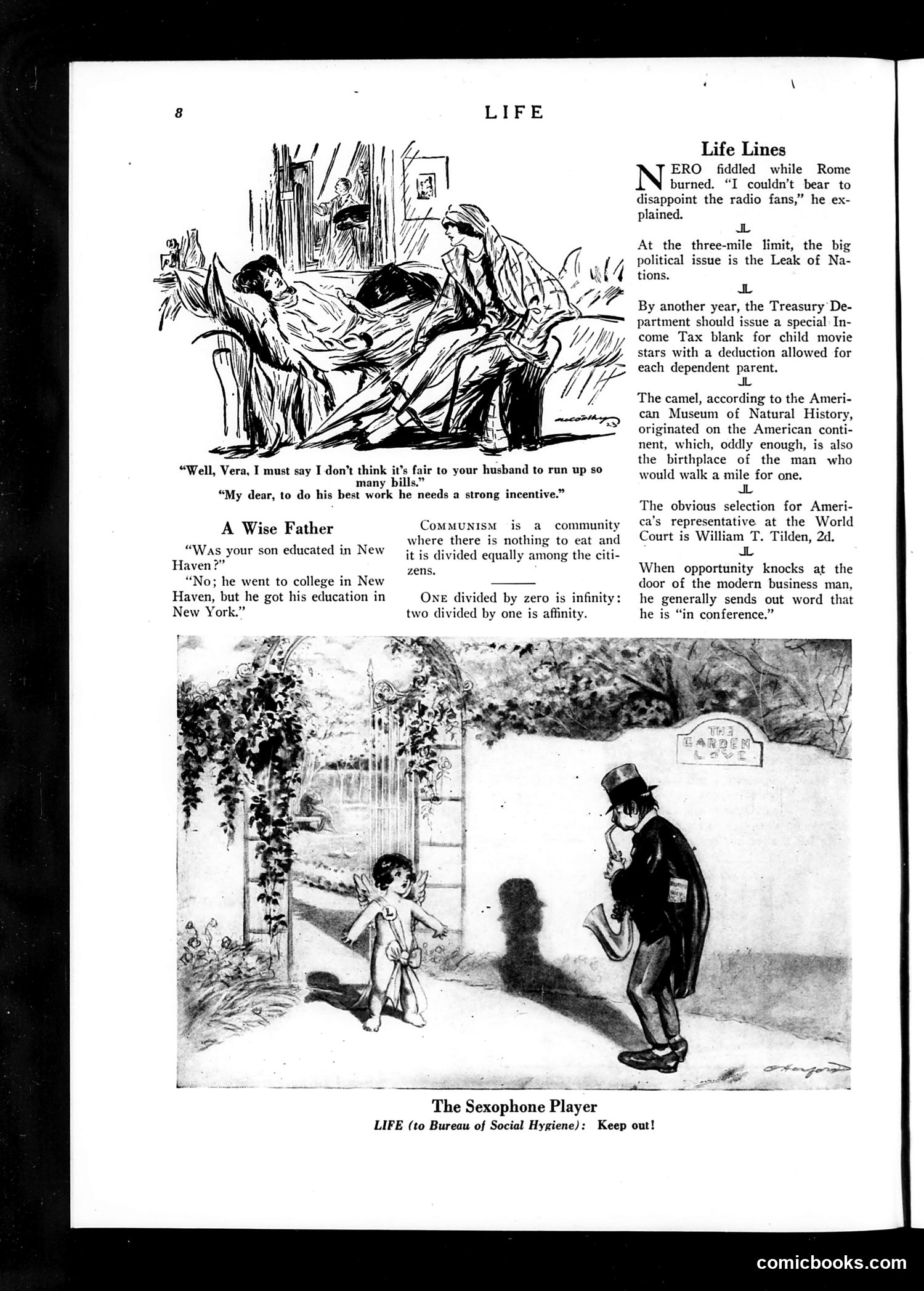
This page from *Life* magazine contains several satirical elements: **Top cartoon**: A domestic scene where a wife complains to her husband about unpaid bills, with the caption suggesting he needs "a strong incentive" to work harder—satirizing middle-class financial struggles. **"A Wise Father" joke**: Contrasts New Haven education with practical New York business experience, mocking academic pretension. **"The Sexophone Player" cartoon**: Shows a uniformed man (likely a park official or police officer) telling a child to stop playing saxophone outdoors, with the caption crediting "Life (to Bureau of Social Hygiene): Keep out!" This satirizes public health campaigns and noise ordinances—mocking overly intrusive government regulation of everyday activities in the name of social welfare. The page blends domestic humor with social commentary on regulation and public decorum.
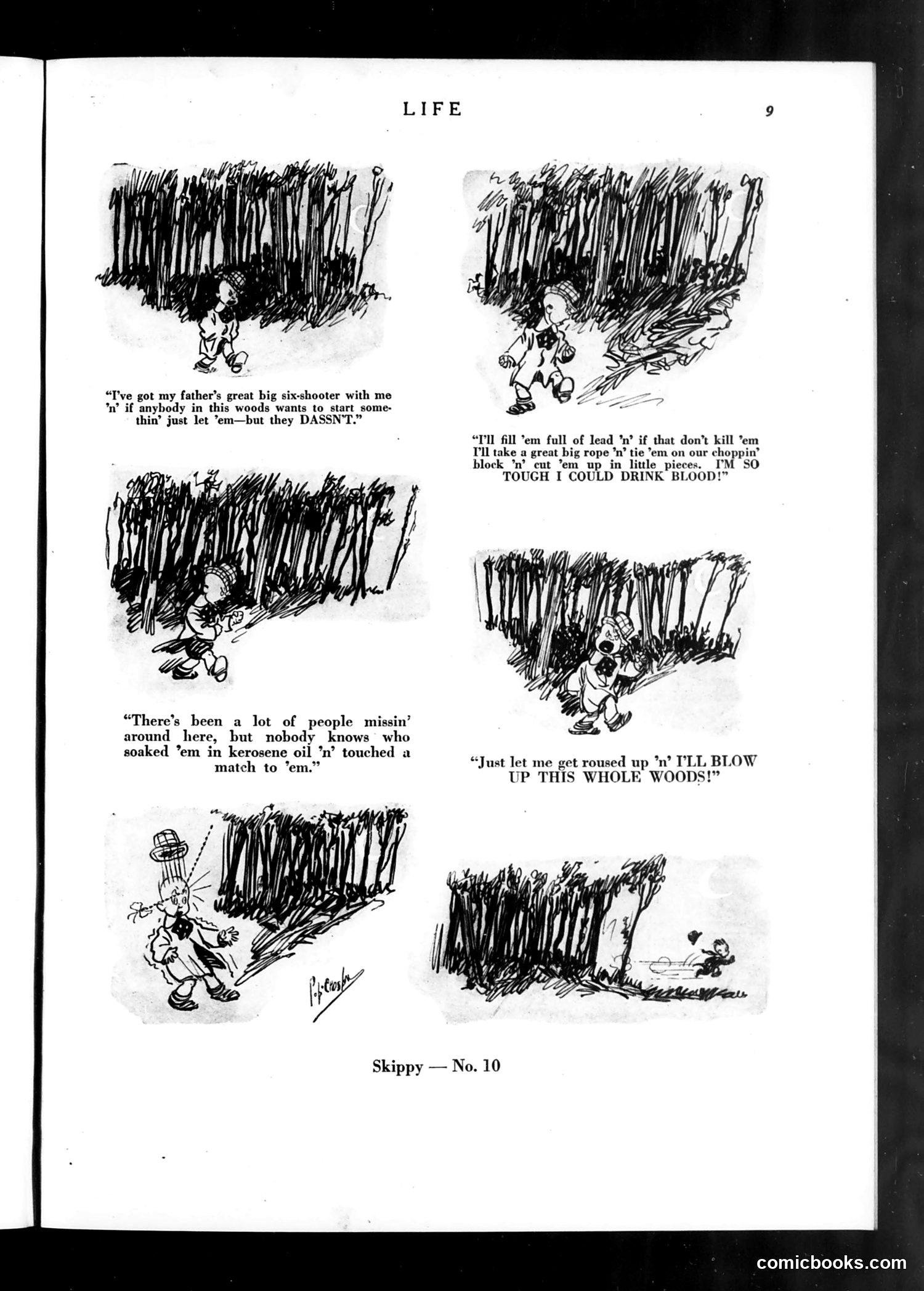
This is a humorous children's comic strip where a small boy named Skippy makes increasingly absurd and violent boasts while alone in the woods. The joke relies on the contrast between his tiny size (visible in the drawings) and his grandiose threats about shooting, dismembering, and burning people. The satire targets childhood bravado and masculine posturing—how children, especially boys, often make exaggerated claims about toughness when unsupervised. The dark humor comes from Skippy's casual references to actual crimes (disappearances, arson) while remaining oblivious to how his bragging makes him sound like a criminal. The comic gently mocks both childish overconfidence and the frontier/tough-guy mythology popular in early 20th-century American culture that children absorbed and imitated. His father's gun represents this masculine tradition passed down to the next generation.
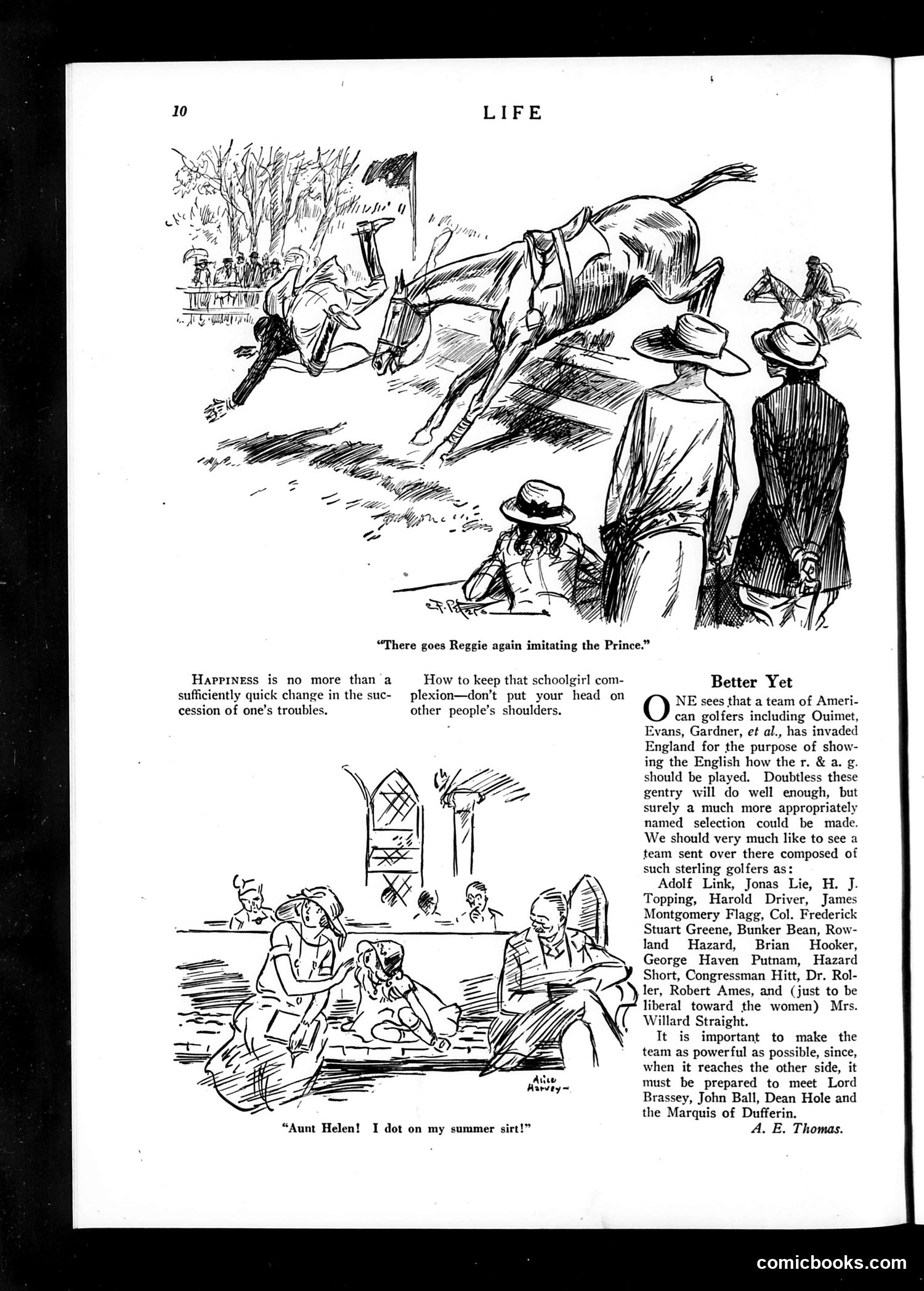
**Top Cartoon:** "There goes Reggie again imitating the Prince" depicts a horse-riding accident where a rider has been thrown. The joke satirizes someone named Reggie for mimicking "the Prince"—likely Prince of Wales or similar aristocratic figure—by adopting affected mannerisms or riding style that prove disastrous. The humor targets social pretension and class mimicry. **Bottom Cartoon:** Shows a domestic scene with the caption "Aunt Helen! I dot on my summer sirt!"—appears to be wordplay or dialect humor about summer clothing and an aunt's reaction. **Main Article ("Better Yet"):** Satirizes American golfers (Ouimet, Evans, Gardner) visiting England to demonstrate superior American golf technique. The author humorously proposes an alternative American team using names that are obviously satirical or pun-based ("Bunker Bean," "Harold Driver," "Hazard Short")—suggesting ridiculous name-matching rather than actual golfing talent. The satire mocks both American boastfulness about superiority and the competitive golf rivalry between nations.
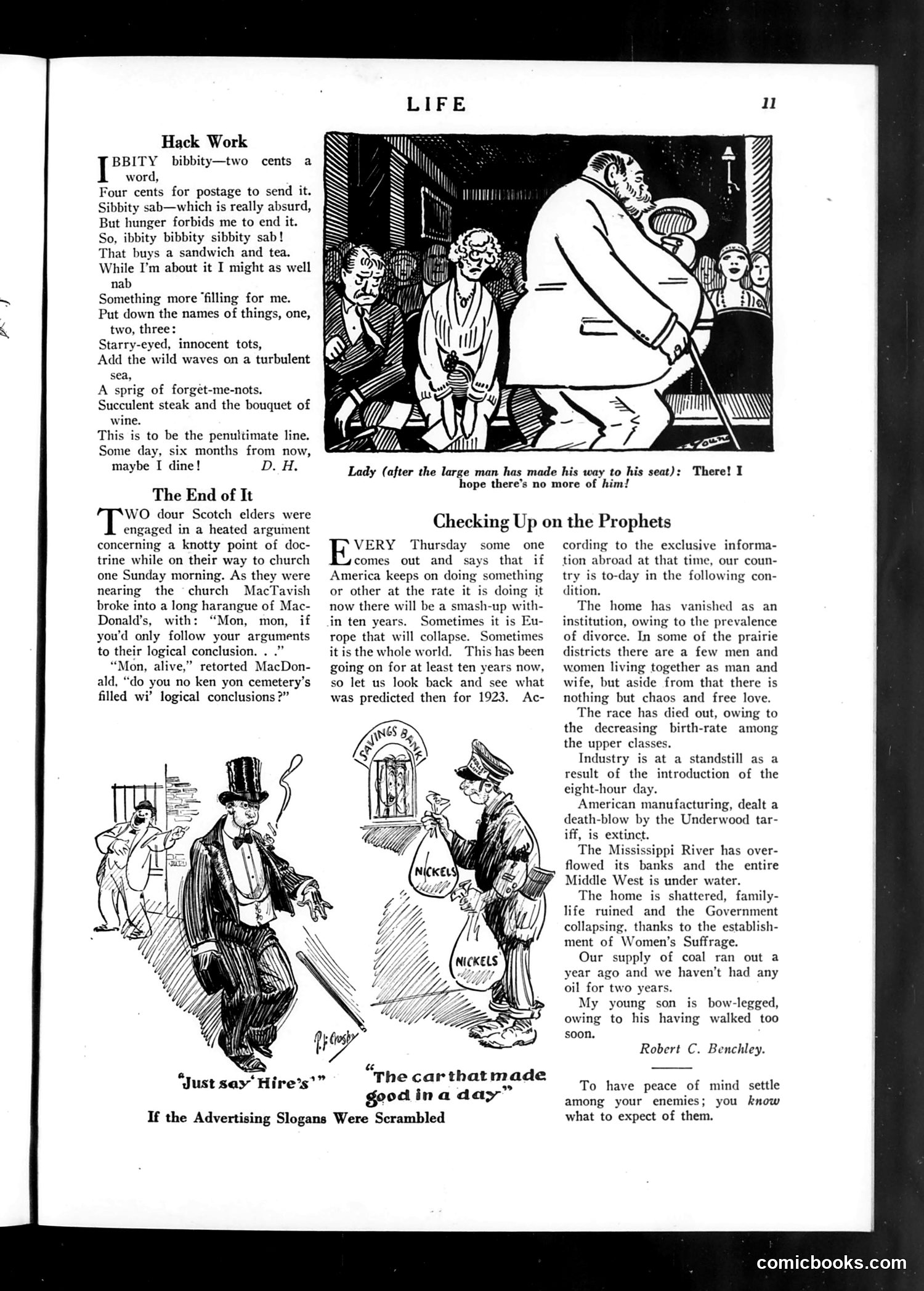
This page satirizes hackwork writing, doom-mongering predictions, and advertising culture circa early 1920s. **"Hack Work"** mocks formulaic commercial writing—a poet admits to churning out sentimental verse (starry-eyed tots, forget-me-nots, steak) purely for meager payment (two cents per word), despising the work but needing money for food. **"The End of It"** is a brief Scottish dialect joke about logical argumentation leading nowhere—a cemetery full of people who followed logic to its conclusion. **"Checking Up on the Prophets"** is the page's main satire. It mocks apocalyptic predictions that circulated ten years prior (around 1913). The author (Robert C. Benchley, a famous humorist) catalogs absurd 1913 predictions for 1923: home/family destroyed by divorce and suffrage, industry collapsed by eight-hour workdays, the Mississippi flooding the Midwest, coal/oil exhaustion, and generational physical degeneration. The joke: **none of this happened**, exposing prophets of doom as perennially wrong. The scrambled advertising slogans cartoon plays with recognizable corporate claims rendered meaningless.
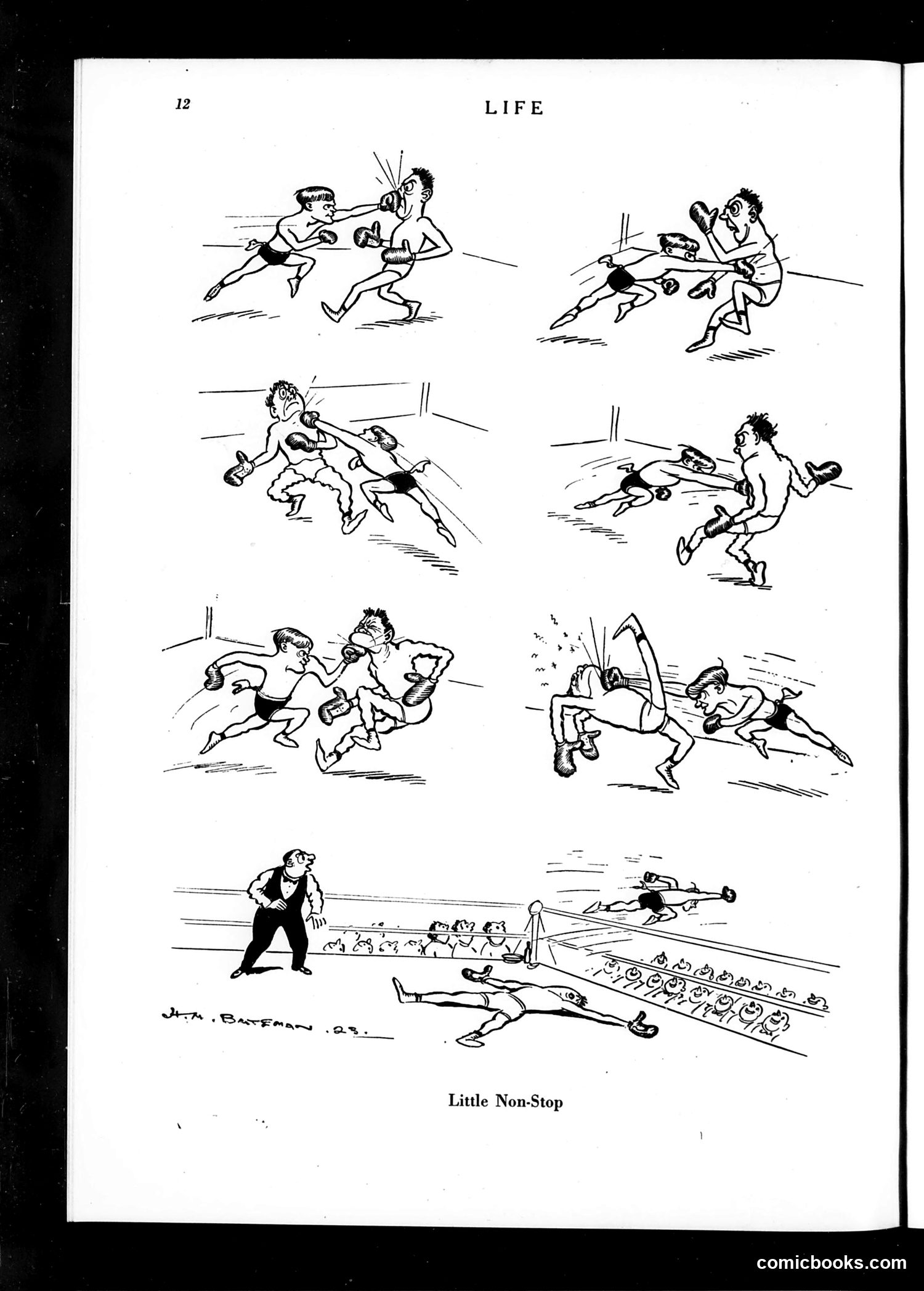
This page presents a humorous sequence showing increasingly chaotic boxing or fighting matches. The title "Little Non-Stop" appears to mock continuous, relentless activity—likely satirizing someone or something that won't stop. The panels progress from simple one-on-one fights to increasingly frenzied multi-person brawls, culminating in what appears to be an organized match or event with spectators and a referee. The escalation suggests the satire is about how situations spiral out of control or how small conflicts grow into large-scale chaos. Without additional context about the publication date or specific events referenced, the exact political or social target remains unclear, though the cartoon likely mocks either a person known for constant activity, a persistent social trend, or an ongoing conflict of its era.
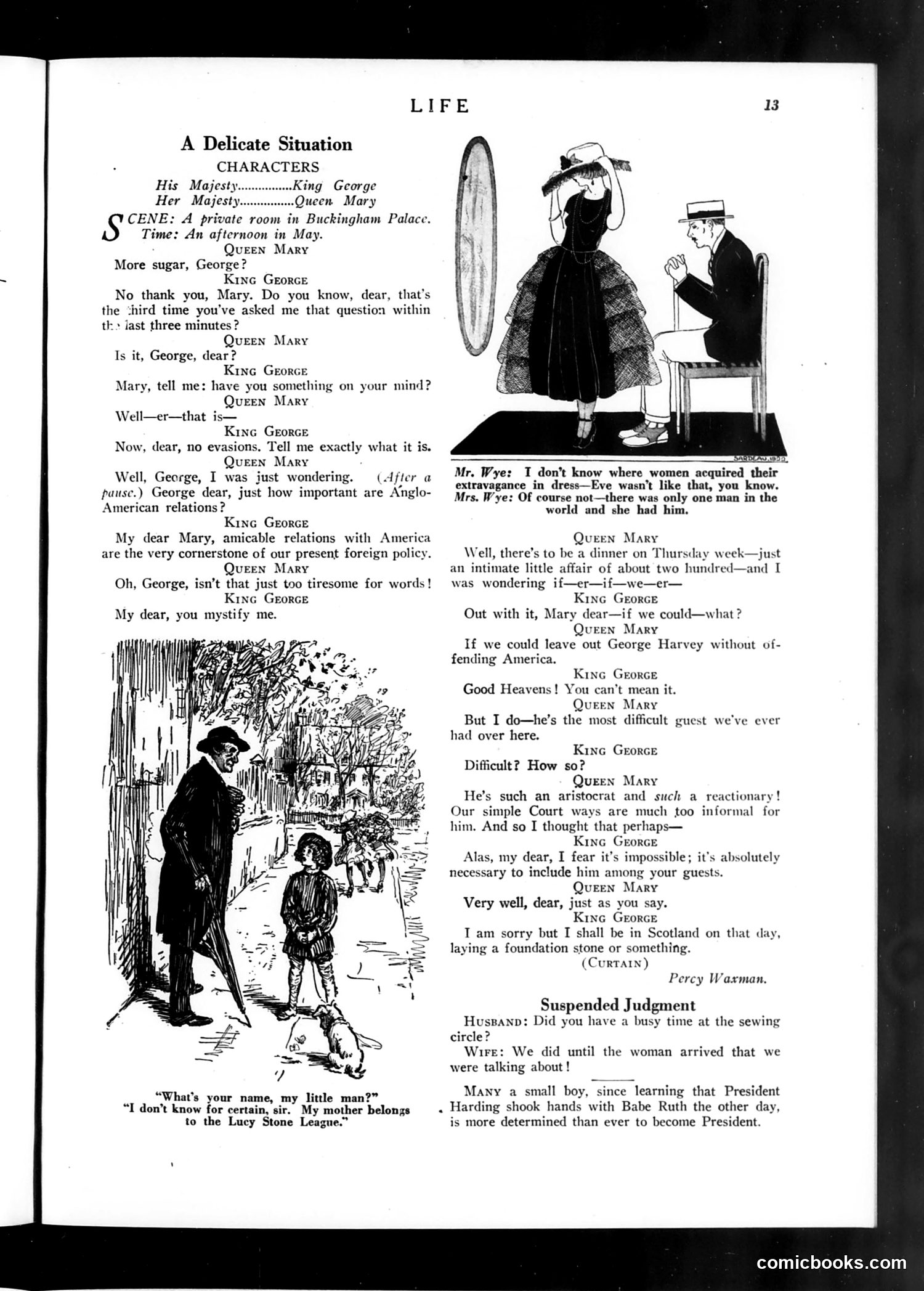
This satirical sketch features King George V and Queen Mary discussing a diplomatic dilemma. Queen Mary hopes to exclude **George Harvey** (U.S. diplomat and publisher) from an upcoming court dinner, finding him an insufferable snob. However, King George explains Harvey's presence is diplomatically essential to Anglo-American relations—a cornerstone of British foreign policy. The satire mocks the tension between authentic hospitality and diplomatic necessity: the royals must endure an objectionable guest for political reasons. Harvey's reputation as an arrogant, reactionary aristocrat makes him socially intolerable yet politically indispensable. The page's secondary jokes target women's fashion extravagance, the Lucy Stone League (women's suffrage activists), and President Harding's celebrity. The humor depends on readers recognizing Harvey's actual notoriety in 1920s Anglo-American relations.
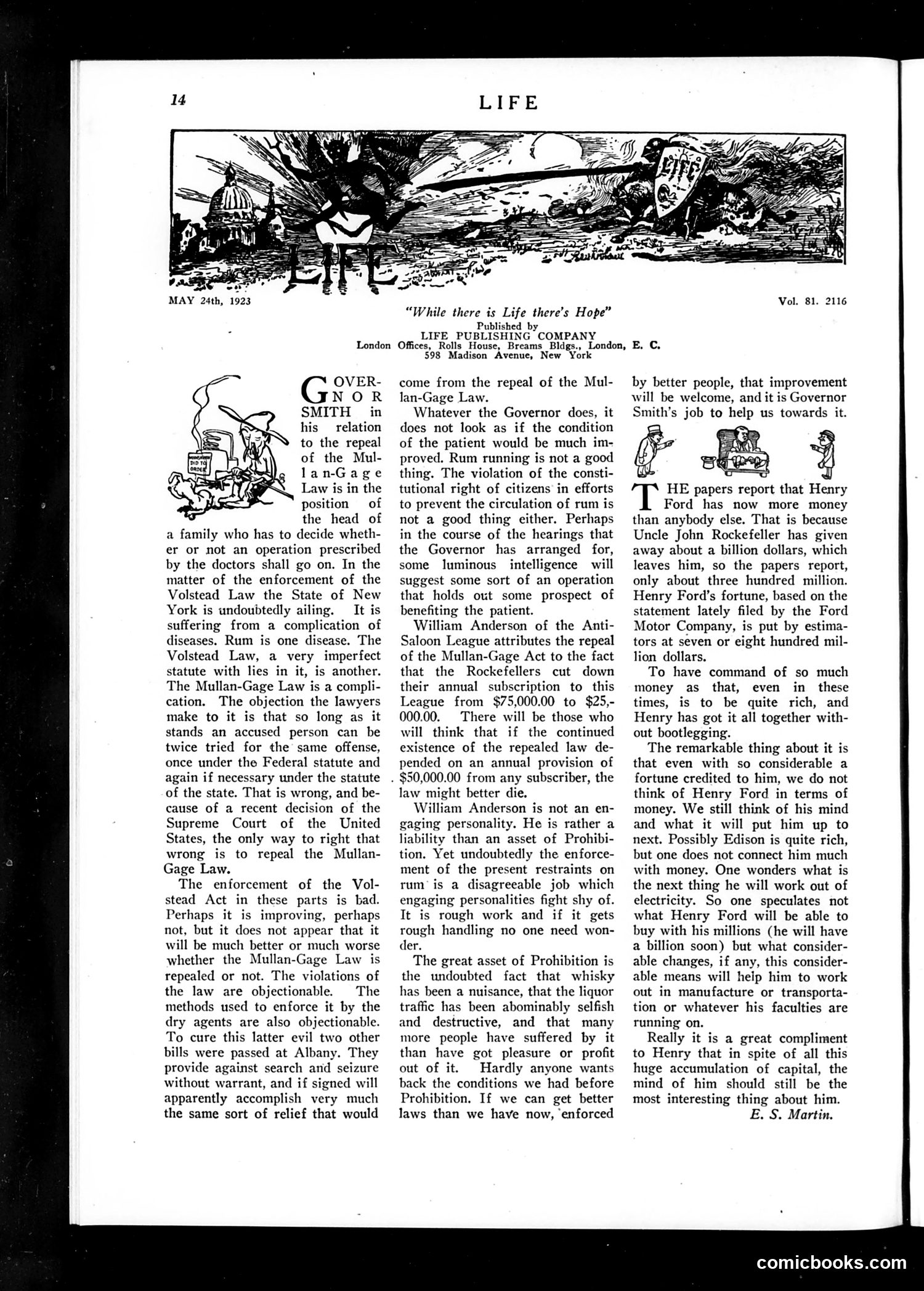
The page contains two distinct editorial pieces addressing Prohibition-era issues in New York. The first article, illustrated with a medical metaphor cartoon, discusses Governor Smith's position on repealing the Mullan-Gage Law. It frames New York's enforcement problems as a "patient" suffering multiple "diseases"—rum-running, the imperfect Volstead Act, and constitutional violations in enforcement. The piece argues repeal won't significantly improve matters, but suggests better enforcement methods and laws might help. The second piece comments on Henry Ford's wealth relative to John D. Rockefeller's. It notes that Ford now has more money than Rockefeller because Rockefeller has donated approximately one billion dollars to charity, leaving him with only three hundred million. The tone is somewhat sardonic about measuring wealth and philanthropy. Both articles reflect 1920s concerns: Prohibition's enforcement complications and the cultural fascination with American industrial titans' vast fortunes.
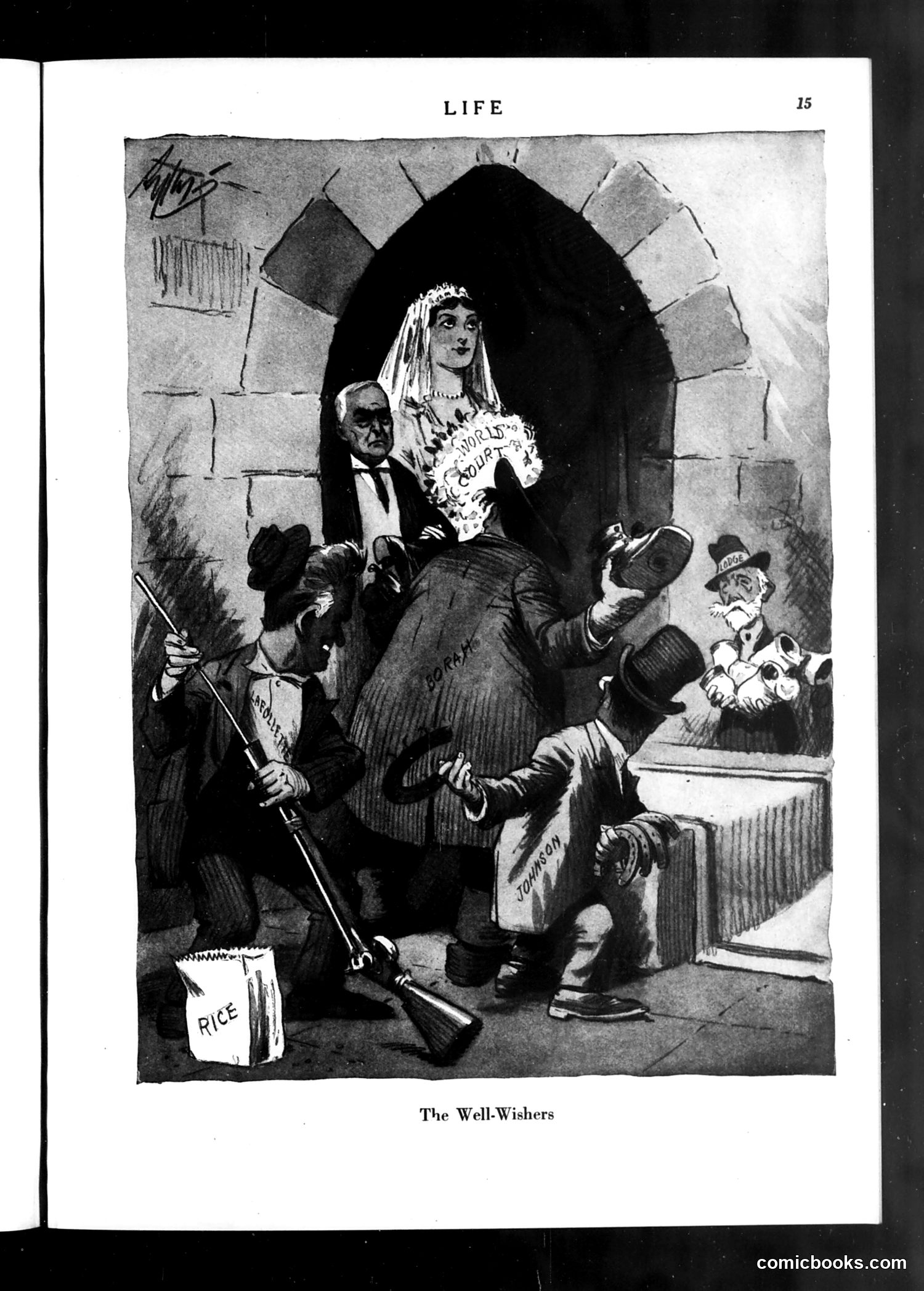
This satirical cartoon depicts a bride and groom at what appears to be a church doorway, surrounded by figures labeled "RICE" and "TOMATO" throwing projectiles at the newlyweds. The "well-wishers" are caricatured as rough or working-class men in hats, engaged in the traditional practice of throwing rice and tomatoes at newly married couples. The satire likely mocks either the rowdiness of this custom or comments on class dynamics—suggesting that enthusiastic but uncouth "well-wishers" might be more of a nuisance than a blessing. The exaggerated, almost violent energy of the figures throwing projectiles transforms what should be a joyful tradition into something chaotic and potentially harmful. The cartoon critiques the behavior of wedding guests or perhaps social customs themselves.
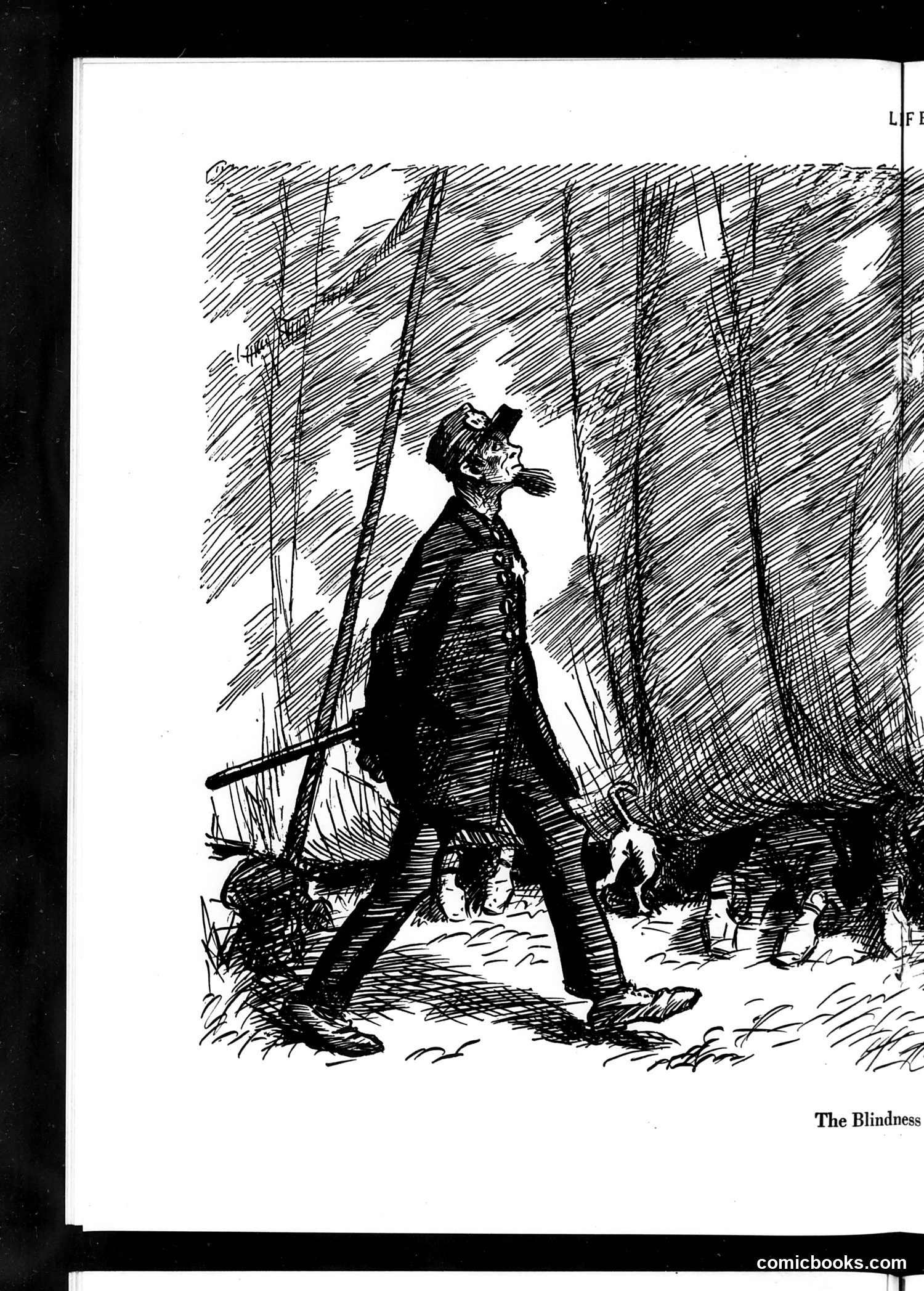
This ink sketch depicts a solitary figure in formal 19th-century dress (top hat, coat) standing in a forest, looking upward with an expression suggesting confusion or bewilderment. The figure carries an axe and appears lost among tall trees. The title "The Blindness" suggests the satire concerns someone's inability to see or understand something obvious. The forest setting and the man's formal attire—incongruous for logging work—implies this is a metaphorical commentary rather than literal woodcutting. Without additional context from *Life* magazine's publication date or surrounding articles, the specific political or social target remains unclear. The cartoon likely critiques some contemporary figure or policy perceived as foolishly oblivious to evident truths or circumstances, though the precise reference cannot be determined from the image alone.
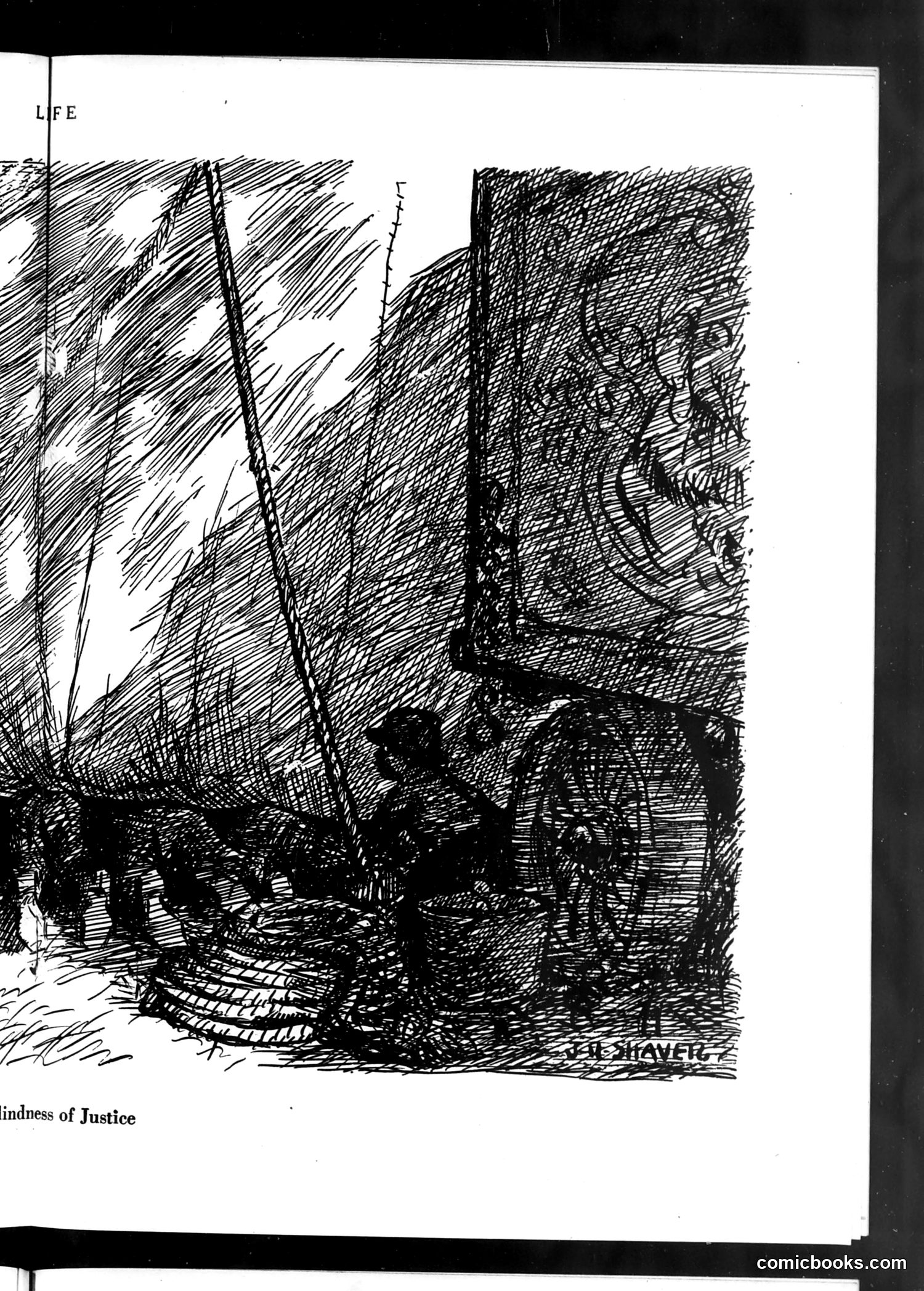
This political cartoon appears to depict Lady Justice—traditionally represented as blindfolded—rendered literally blind and unable to see injustice occurring beneath her. The image shows deteriorating conditions at the base of what appears to be a monument or statue, with figures in squalor or distress below while Justice remains elevated and oblivious above. The satire critiques the legal system's failure to address social problems or inequality; despite Justice's symbolic role in protecting citizens, the cartoon suggests the actual justice system ignores real suffering happening in plain sight. This likely references early 20th-century concerns about poverty, corruption, or legal system failures that Life magazine frequently satirized. The work appears signed by an artist (signature partially visible).
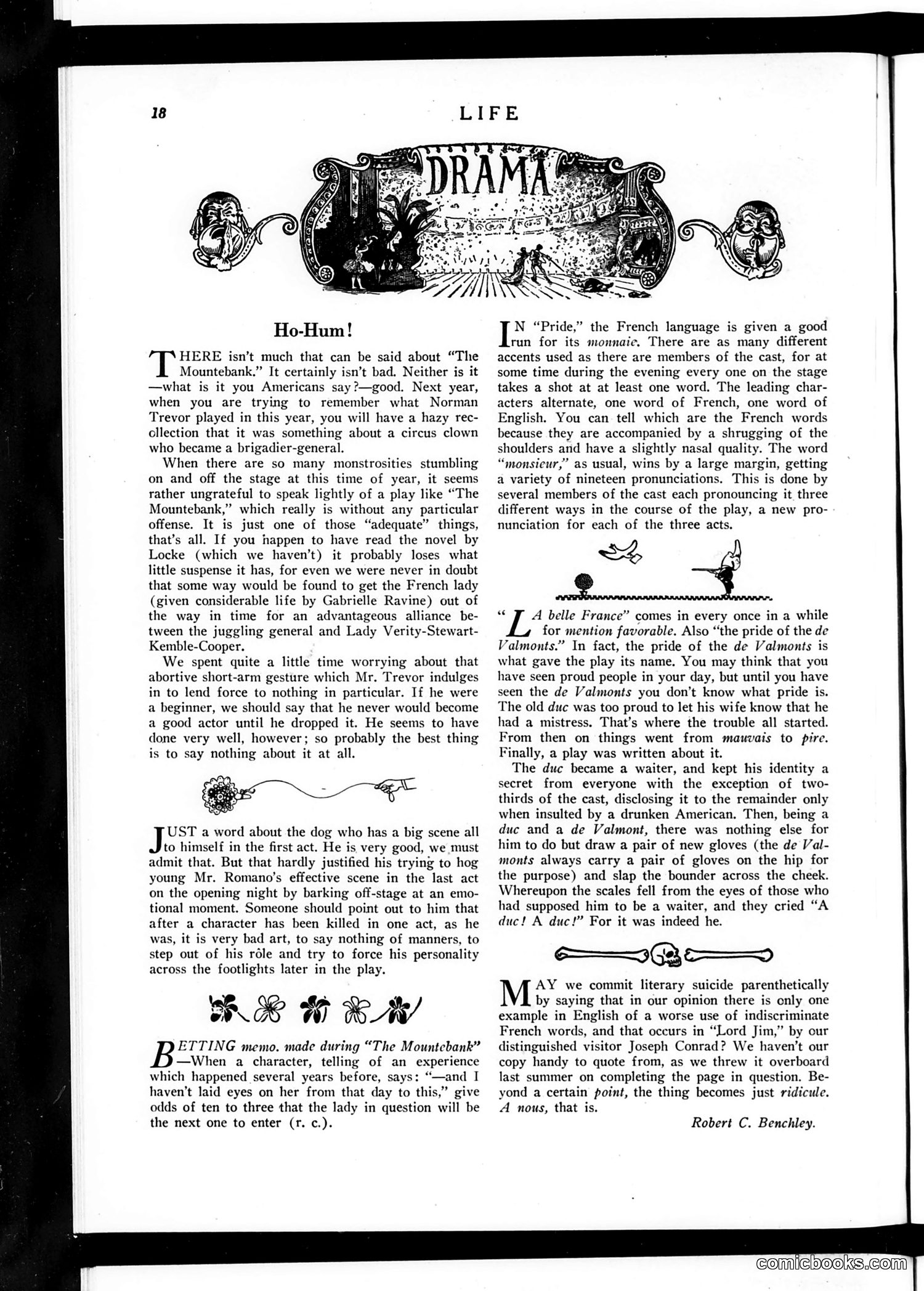
This page reviews two Broadway plays from Life magazine's drama section. The main critique of "The Mountebank" is dismissive—it's neither good nor bad, merely "adequate." The plot involves actor Norman Trevor as a circus clown–turned–general, with actress Gabrielle Ravine as a French lady. The reviewer mocks the predictable plot and Trevor's theatrical gesture-work, while praising a dog's performance—then sarcastically critiques the dog for barking off-stage during a later scene, violating theatrical propriety. The second review of "Pride" ridicules the cast's inconsistent French pronunciation, particularly the word "monsieur," which receives nineteen different readings throughout the play. The plot concerns French aristocratic pride: a duke, too proud to let his wife know of his mistress, becomes a waiter while maintaining his secret identity. The satire targets theatrical mediocrity and overwrought European drama conventions popular in early 20th-century American theater.
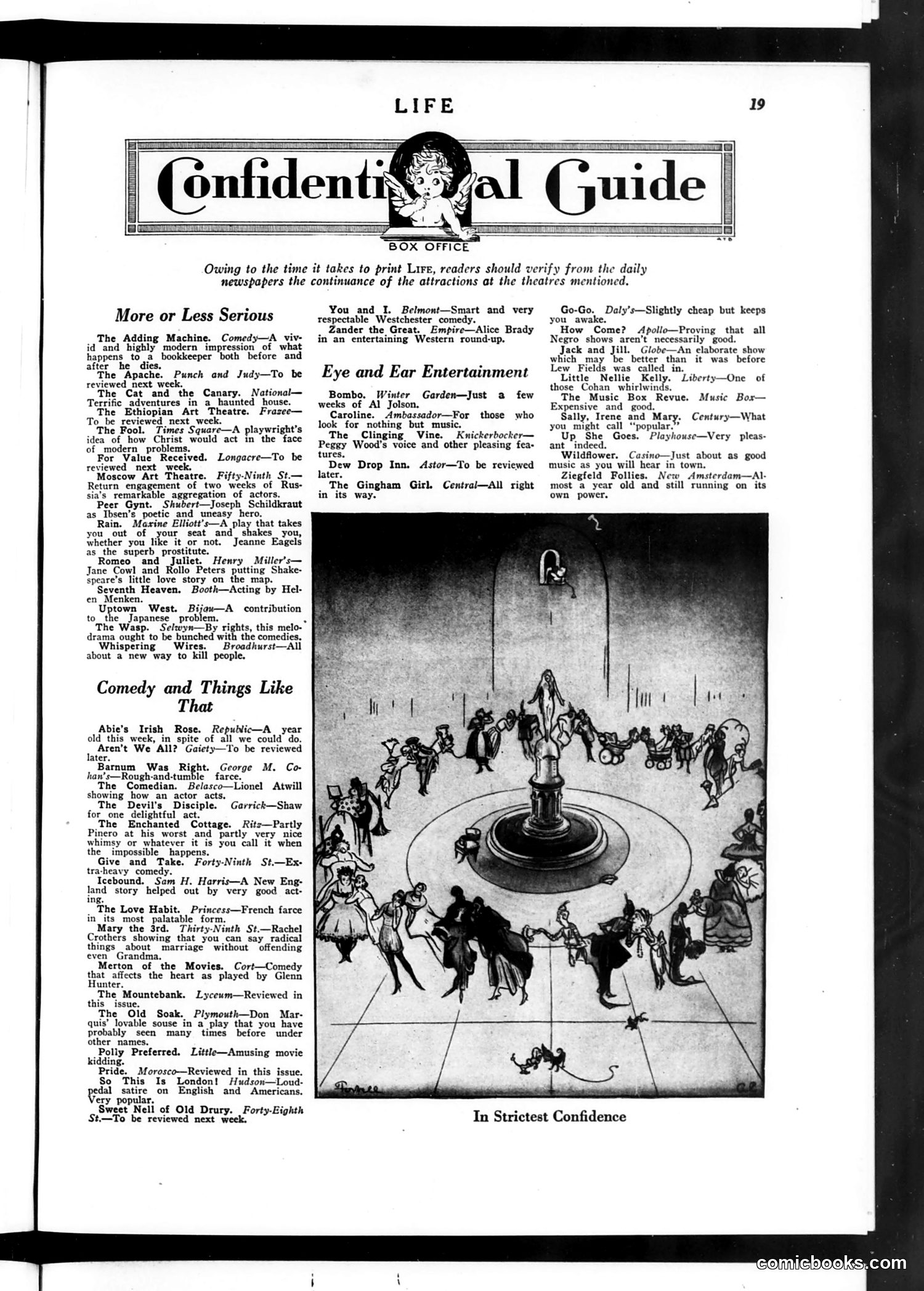
This is a **theater review guide**, not a political cartoon. It's a practical listing of Broadway shows currently running, organized by genre ("More or Less Serious," "Comedy," "Eye and Ear Entertainment"). The right side features an illustration labeled "In Strictest Confidence" showing a crowded theater interior with patrons and what appears to be a stage or performance space—likely a humorous depiction of theater-going culture. The reviews are brief, often witty critiques: "Rain" is called a play "that takes you out of your seat and shakes you"; "Abie's Irish Rose" is noted as "a year old this week, in spite of all we could do" (suggesting the reviewer's disapproval of its continued popularity); "How Come?" is criticized as proving "not all Negro shows are necessarily good." The header note warns readers to verify theater information in daily newspapers since *Life* magazine's printing delays. This is essentially entertainment journalism for 1920s theatergoers, not satire of political events.
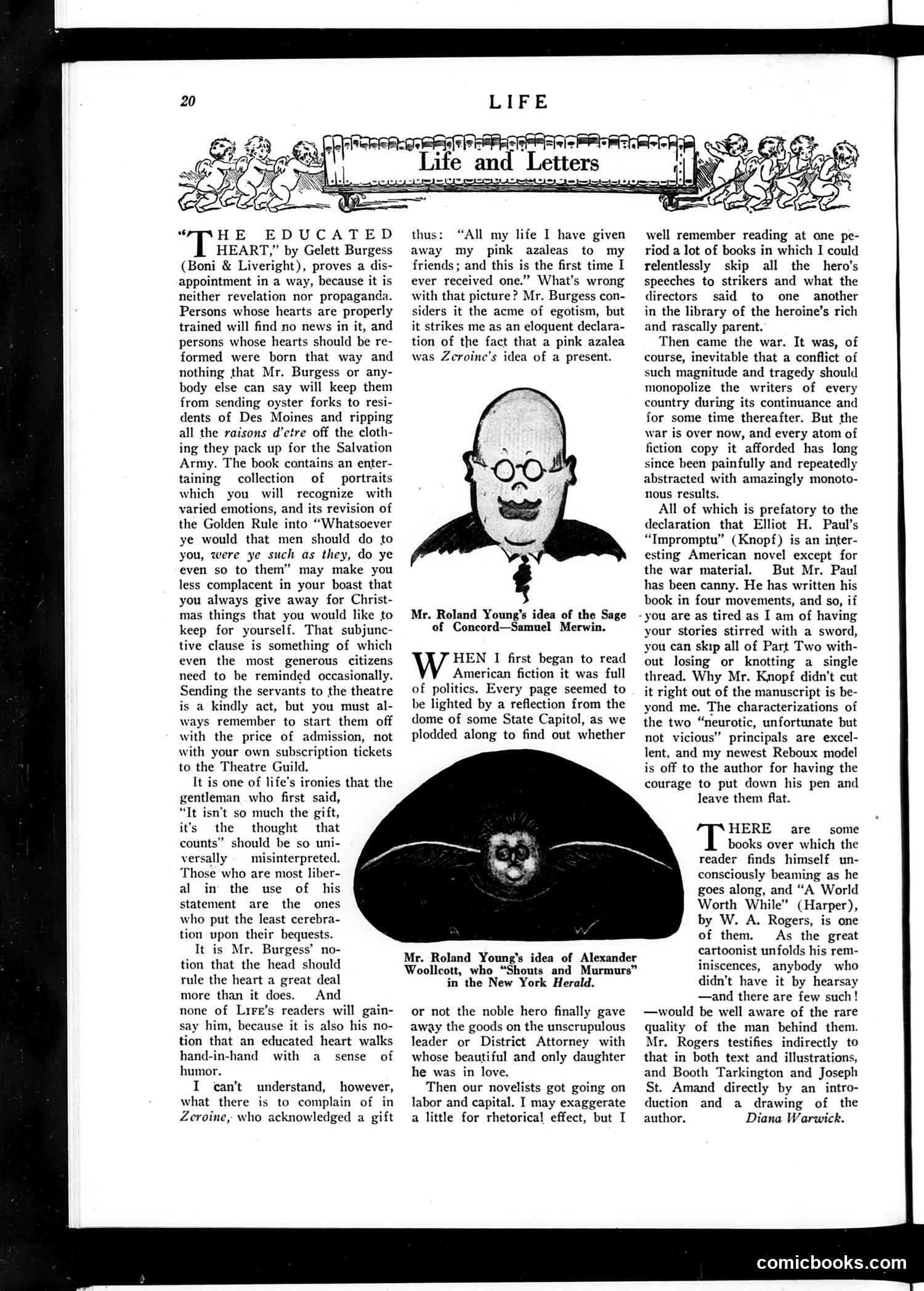
This page contains **two cartoon caricatures** by Roland Young satirizing American literary figures: 1. **"The Sage of Concord"** (top): A bald man with glasses representing Samuel Merwin, apparently mocking his pretensions to intellectual authority. 2. **Alexander Woollcott** (bottom): Depicted as a rotund, theatrical figure who "Shouts and Murmurs" in the New York Herald—a reference to his actual newspaper column. The text reviews Gelett Burgess's book *"The Educated Heart,"* critiquing how American fiction cycles through trendy subjects: first politics, then labor disputes, then World War I material. The reviewer complains these topics have been exhausted in contemporary novels. The caricatures mock prominent cultural figures of the 1920s, using exaggerated features for satirical effect—typical of *Life* magazine's approach to literary criticism and cultural commentary.
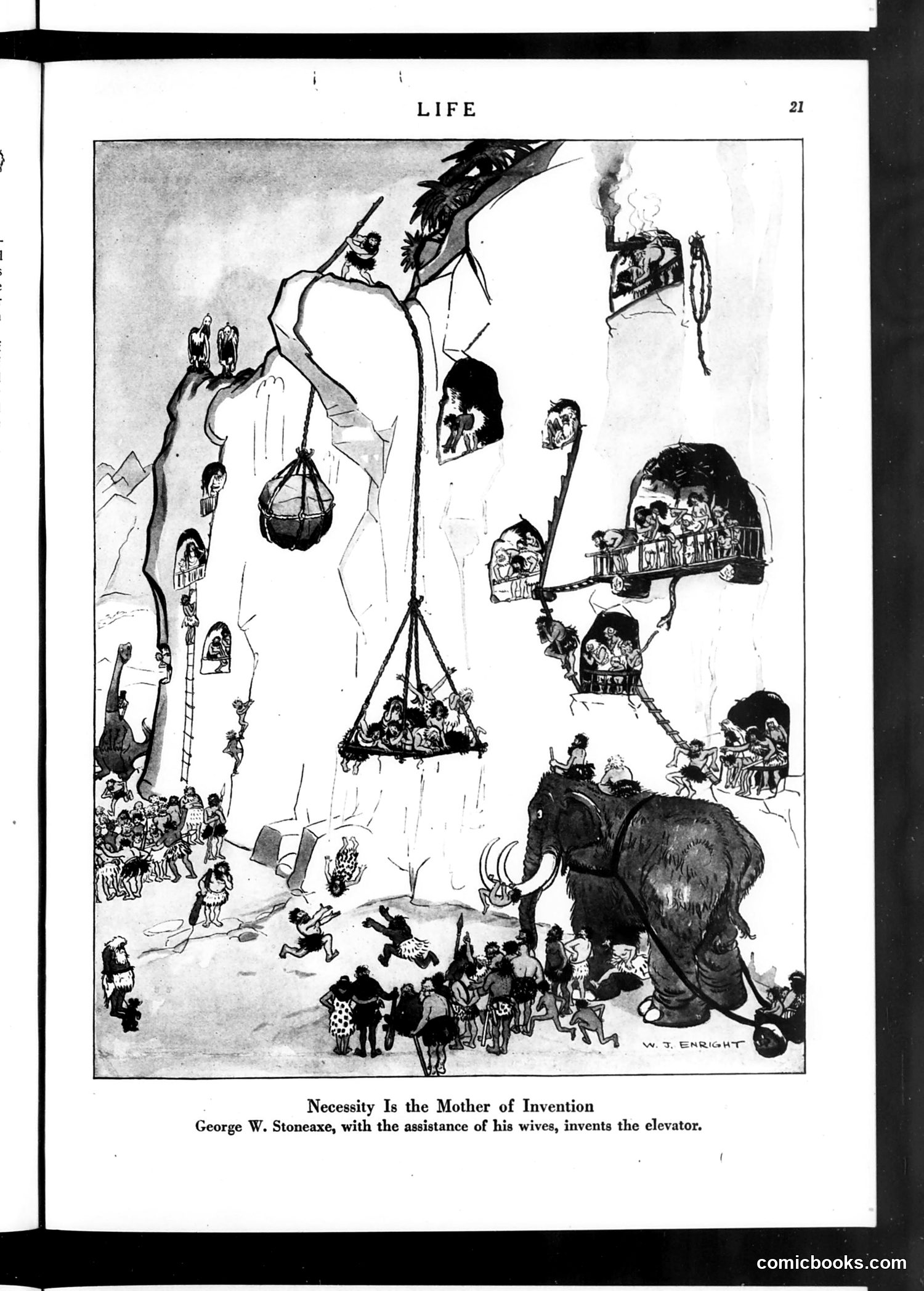
This is a satirical cartoon by W.T. Erright depicting the invention of the elevator. The caption presents a character named "George W. Stoneaxe" (likely a pun on a prehistoric or caveman name) inventing the elevator "with the assistance of his wives." The cartoon shows a fantastical contraption featuring a massive elephant, pulley systems, and baskets of people being hoisted up a tall structure. Multiple wives appear throughout the scene operating various mechanical parts. The satire operates on several levels: it humorously attributes a major modern invention to a primitive figure, and jokes about relying on wives' labor for technological progress—a commentary on both gender roles and the underrecognized contributions of women to innovation. The absurd, chaotic design emphasizes how impractical and ridiculous such a setup would be, enhancing the comedic effect.
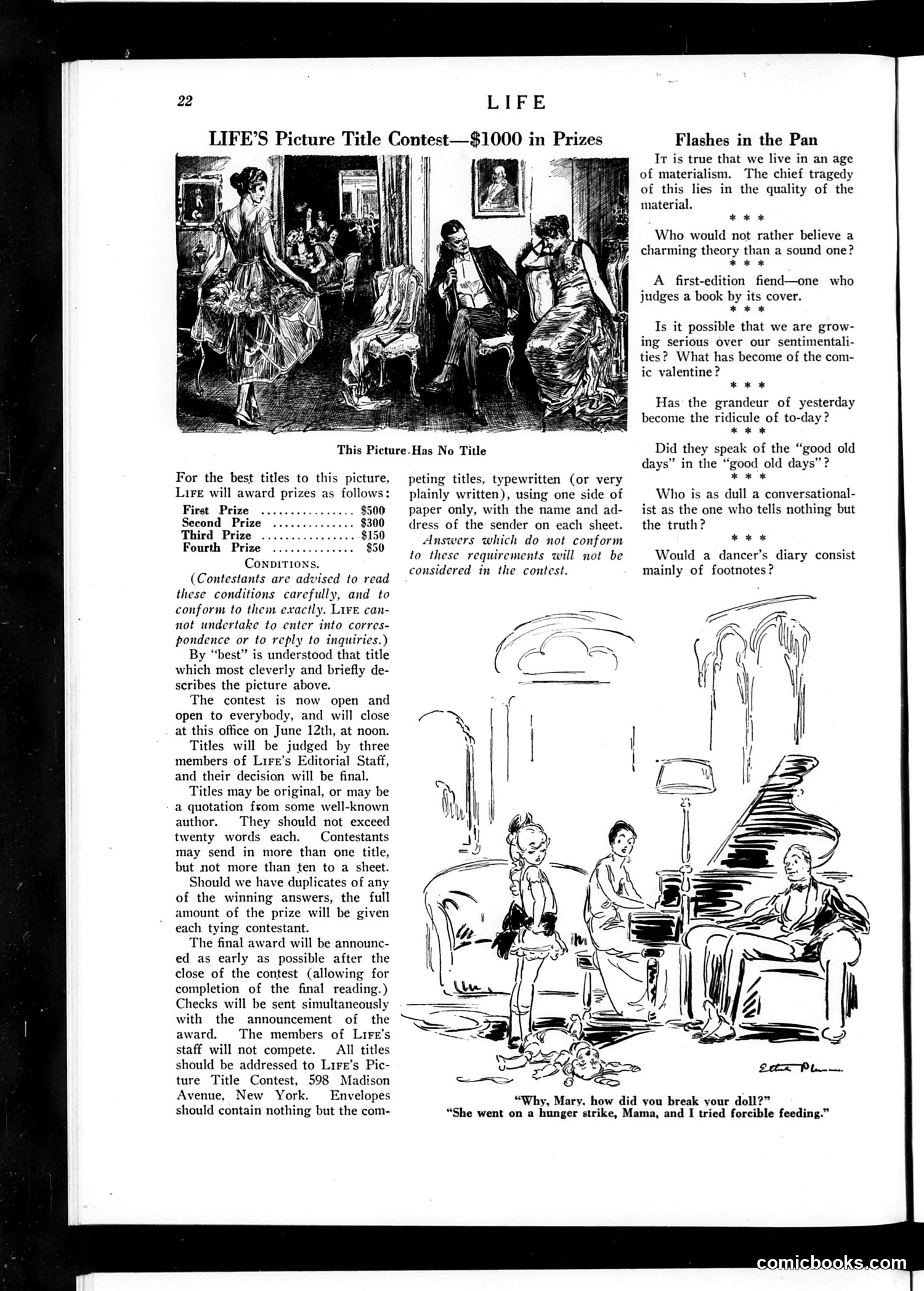
This page contains two distinct elements: **The Picture Title Contest** (top): Life magazine invites readers to submit titles for an untitled illustration showing an elegant social gathering—a woman entertaining men in what appears to be a parlor. The contest offers $500 for the best title, with strict submission rules (typewritten, under 20 words, by June 12th). **The Cartoon** (bottom): A child has broken a doll and explains to her mother that the doll "went on a hunger strike" and she "tried forcible feeding." This references the **suffragist movement**, where women activists used hunger strikes as protest tactics while imprisoned. The joke satirizes how contemporary political struggles have filtered into children's play—a child uses adult political vocabulary to describe ordinary mischief, mocking both the seriousness of suffragists and the pervasiveness of protest discourse in 1910s culture. The "Flashes in the Pan" column consists of brief, cynical social observations typical of satirical magazines of the era.
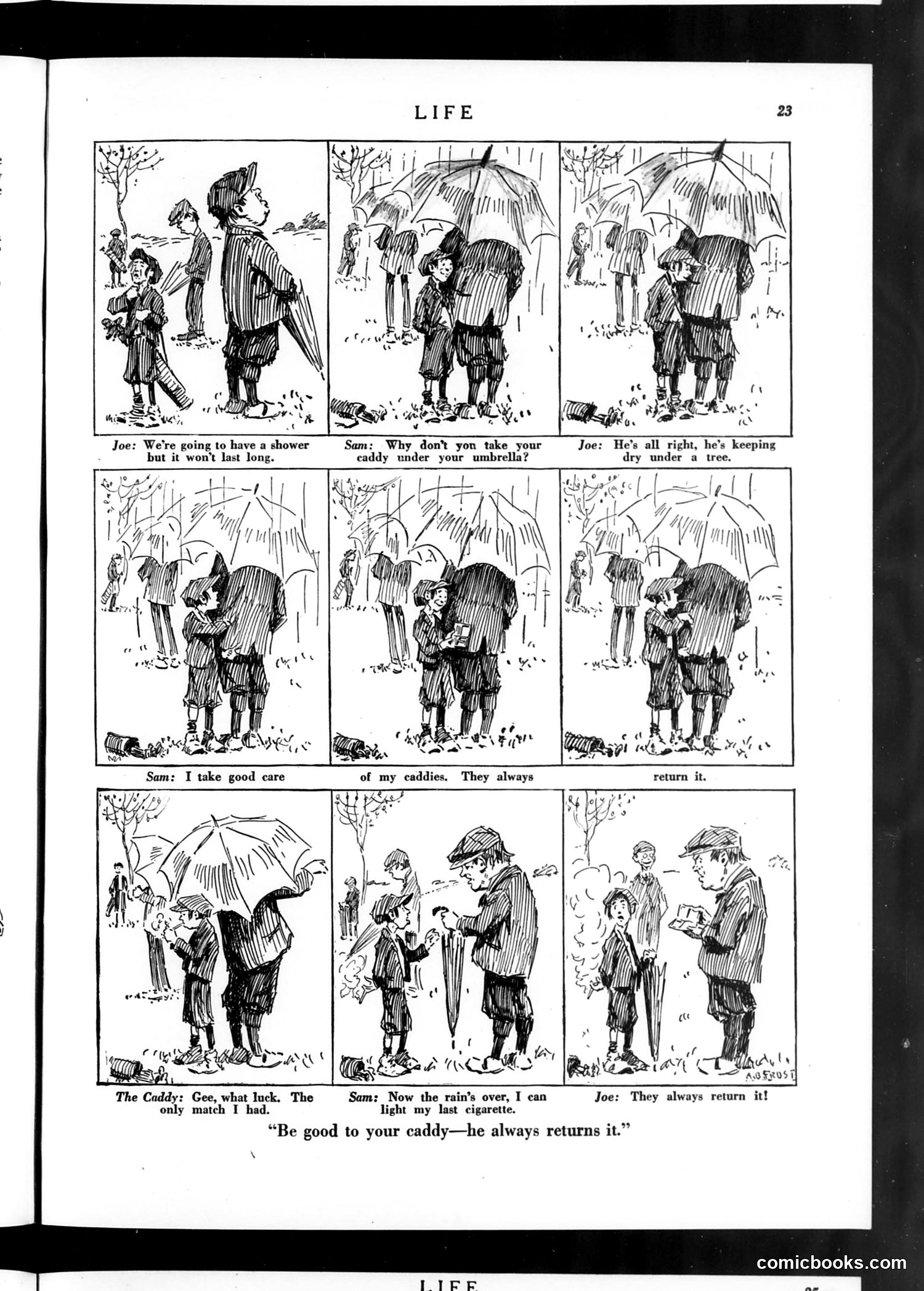
This comic strip depicts a humorous lesson about treating service workers fairly. The narrative follows Joe and Sam, wealthy golfers, during a rainstorm with their young caddy (a boy who carries their golf clubs). The joke's point: When Joe suggests sheltering the caddy under an umbrella, Sam dismissively refuses. Later, when the caddy borrows Sam's only match to light a cigarette after the rain clears, Joe quips that "they always return it"—implying the caddy will give the match back, just as he would have returned an umbrella had Sam lent him one. The satire critiques upper-class hypocrisy and selfishness toward working-class youth. The "moral" headline suggests that treating service workers with basic kindness produces loyalty and reciprocal good behavior—a pointed commentary on class relations in early-to-mid 20th century America.
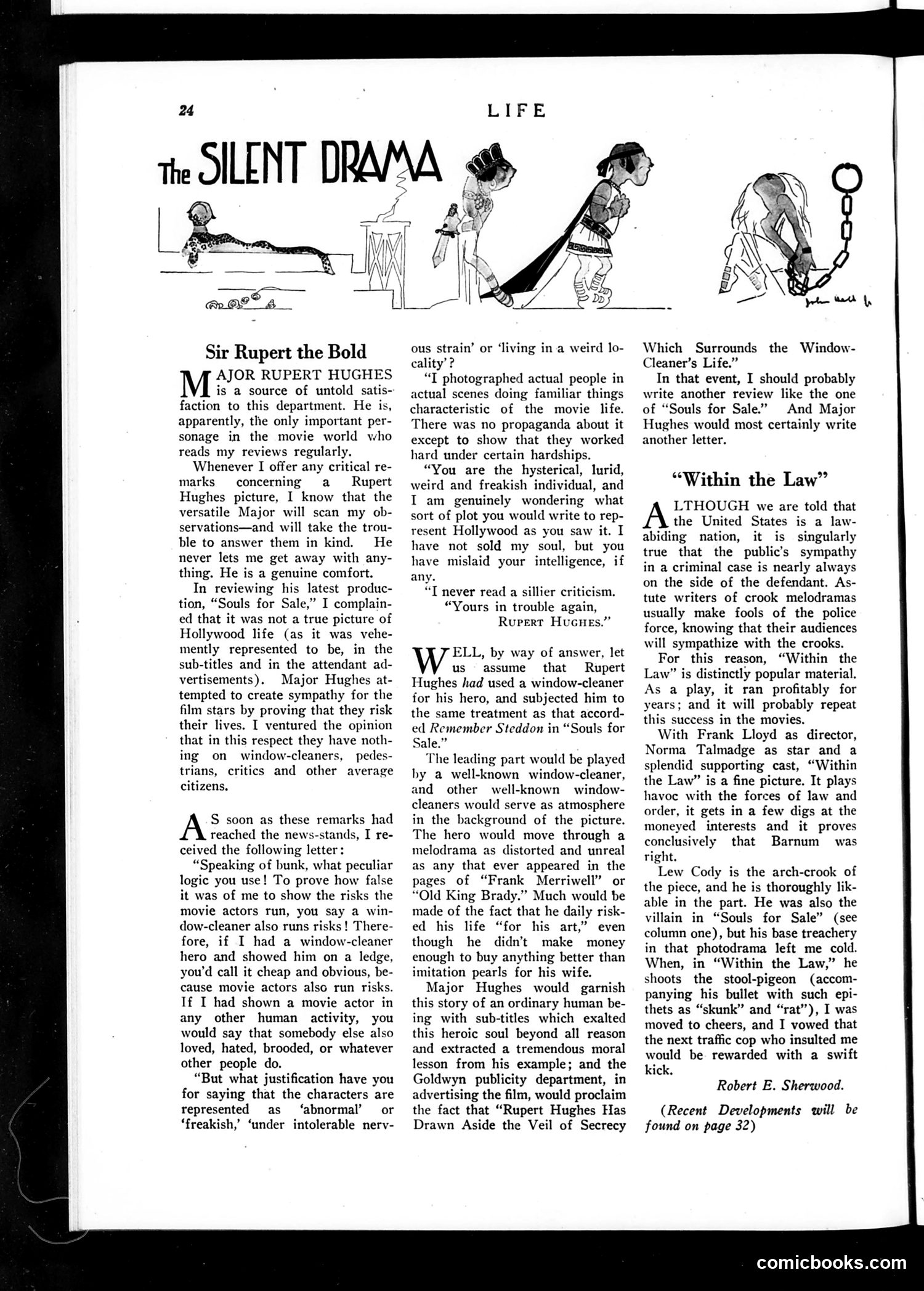
This page features a humorous exchange between **Robert E. Sherwood** (the critic) and **Major Rupert Hughes** (a Hollywood filmmaker) about Hughes's film "Souls for Sale." **The Joke:** Sherwood criticized the film for unrealistically portraying movie actors as uniquely heroic and risk-taking. Hughes responded defensively, claiming he simply showed actors doing ordinary work. Sherwood's witty rebuttal: if Hughes had instead made a melodrama about a window-cleaner—treating him with the same exaggerated "heroic" subtitles and promotional hype—it would be equally ridiculous. **The Satire:** Targets both Hughes's pretentious filmmaking (dressing up ordinary lives as profound drama) and Hollywood's self-aggrandizing publicity machine. The cartoon's accompanying illustrations satirize silent-film melodrama conventions through physical comedy and exaggeration. The piece exemplifies *Life* magazine's specialty: skewering cultural figures through clever argumentation wrapped in humor. Hughes apparently engaged with such criticism regularly, which Sherwood found refreshing in Hollywood circles.

This is **a straightforward advertisement, not satire or political commentary**. It promotes Republic Tires and Tubes, featuring a 1920s-era automobile with servicemen and a mechanic attending to it. The ad emphasizes "The World's Finest Service with The World's Finest Tires," positioning Republic as a premium brand. The "Sign of the Eagle" logo (visible in the upper right) serves as the company's certified-dealer mark, meant to assure customers of reliability and quality workmanship. The ad targets motorists by promising to eliminate "tire trouble" through superior products and dealer service. The illustration's style—depicting modern automotive service—reflects early 20th-century advertising conventions celebrating technological progress and professional service. This is **commercial messaging, not editorial or satirical content**.
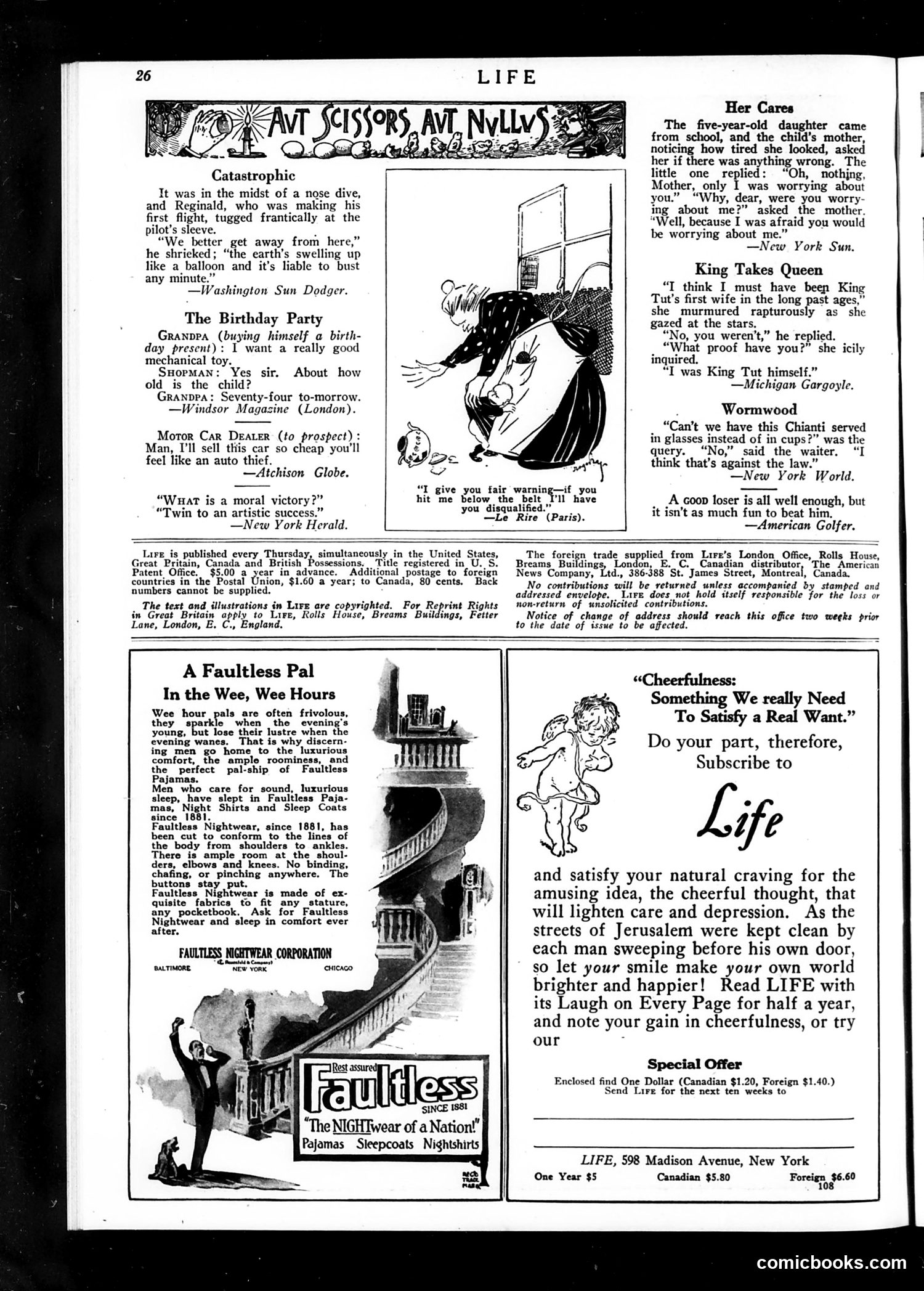
This page from *Life* magazine contains several brief humorous anecdotes typical of early 20th-century satirical humor, plus period advertisements. **The jokes** are gentle social commentary: "Catastrophic" mocks nervous airplane passengers; "The Birthday Party" jokes about an elderly man buying toys for himself; "Her Cares" presents ironic role-reversal where a child worries about her mother. "King Takes Queen" plays on reincarnation romanticism, while "Wormwood" satirizes pretentious diners' complaints about wine service. **The imagery** shows a woman reclining by a window in the main cartoon—illustrating romantic daydreaming or leisure. **The advertisements** for Faultless Nightwear and a subscription pitch for *Life* itself represent typical magazine monetization. The humor is gentle, domestic, and relies on wordplay rather than political satire—reflecting *Life's* role as a family-oriented humor magazine rather than hard-hitting political commentary. The jokes target universal human foibles: nervousness, vanity, pretension, and romantic fancy.

This is **not a cartoon or satire**, but rather a **straightforward product advertisement** for Royal Cords tires, manufactured by United States Rubber Company. The page appears in *Life* magazine (circa 1923, based on the date reference) and promotes tires through reasoned persuasion rather than extravagant claims. The ad's central argument is that Royal Cords succeed through reputation built on quality and "personal responsibility"—not through advertised mileage claims or impulse buying. The image shows a large tire with text promising that "one million new users will say this year: 'Royal Cords!'" **For modern readers**: This reflects 1920s consumer marketing strategy emphasizing trust, word-of-mouth reputation, and understated product claims—a stark contrast to today's aggressive advertising with quantified performance metrics. The appeal to "growing understanding among men" assumes a male car-owning audience typical of that era.
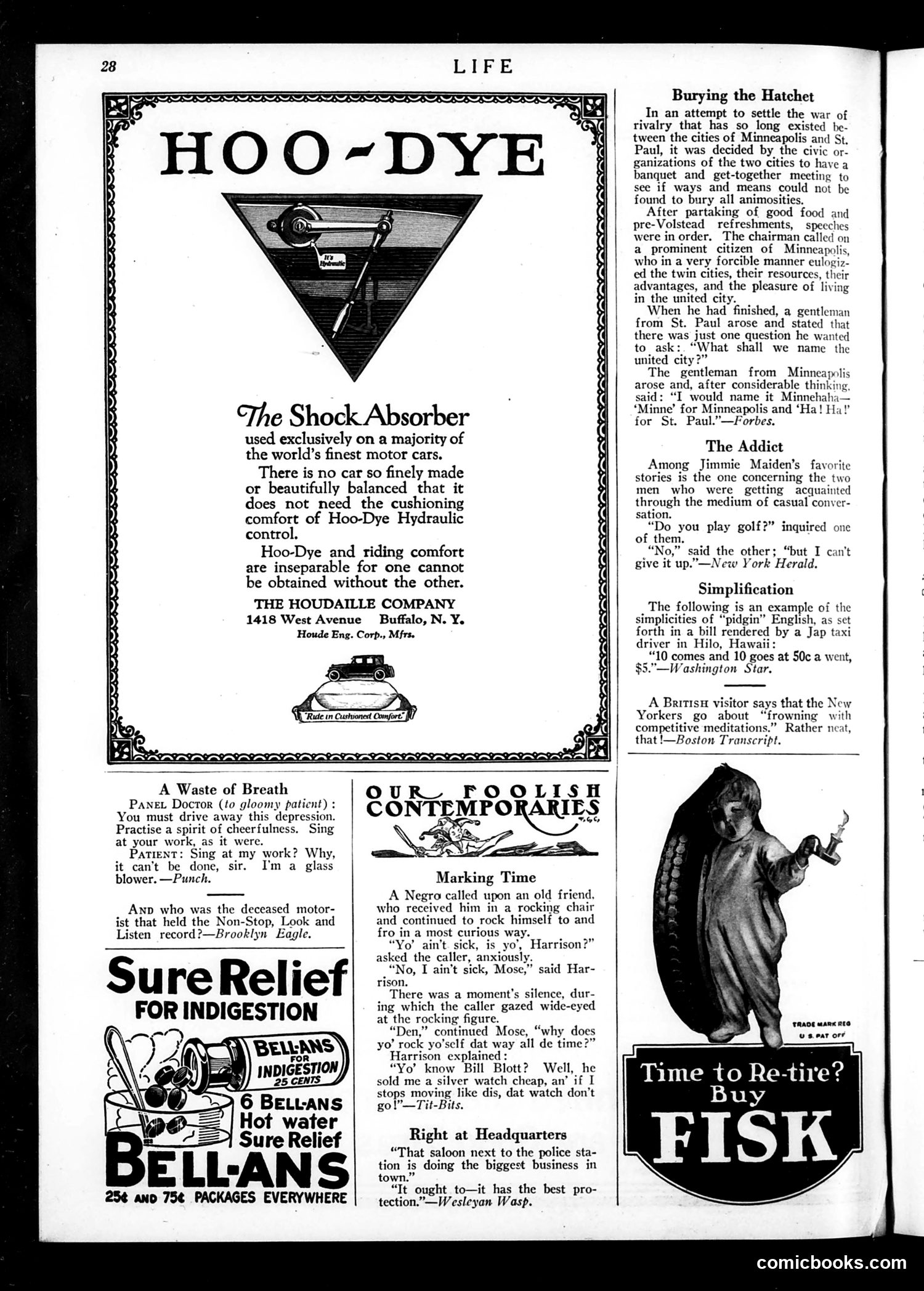
This page contains multiple short humor pieces typical of Life's satirical format, plus advertising: **"Burying the Hatchet"** jokes about Minneapolis-St. Paul rivalry. A speaker from Minneapolis, asked what to name a united city, suggests "Minnehaha"—combining "Minne" (Minneapolis) with "Ha! Ha!" (mocking St. Paul). The humor lies in the backhanded insult disguised as compromise. **"Marking Time"** presents a racial stereotype dialogue between two Black men. Harrison rocks constantly because he bought a cheap watch from Bill Blott that won't work unless he keeps moving—a joke playing on period minstrel-show dialect and humor conventions. **"The Addict"** and **"Simplification"** are brief one-liners about golf addiction and pidgin English respectively. **Other content** includes advertising for Hoo-Dye shock absorbers, Bellans indigestion remedy, and Fisk tires, plus a glass-blower complaint joke. The page reflects 1920s popular humor: casual ethnic stereotyping, regional rivalry humor, and advertising integrated throughout the magazine format.
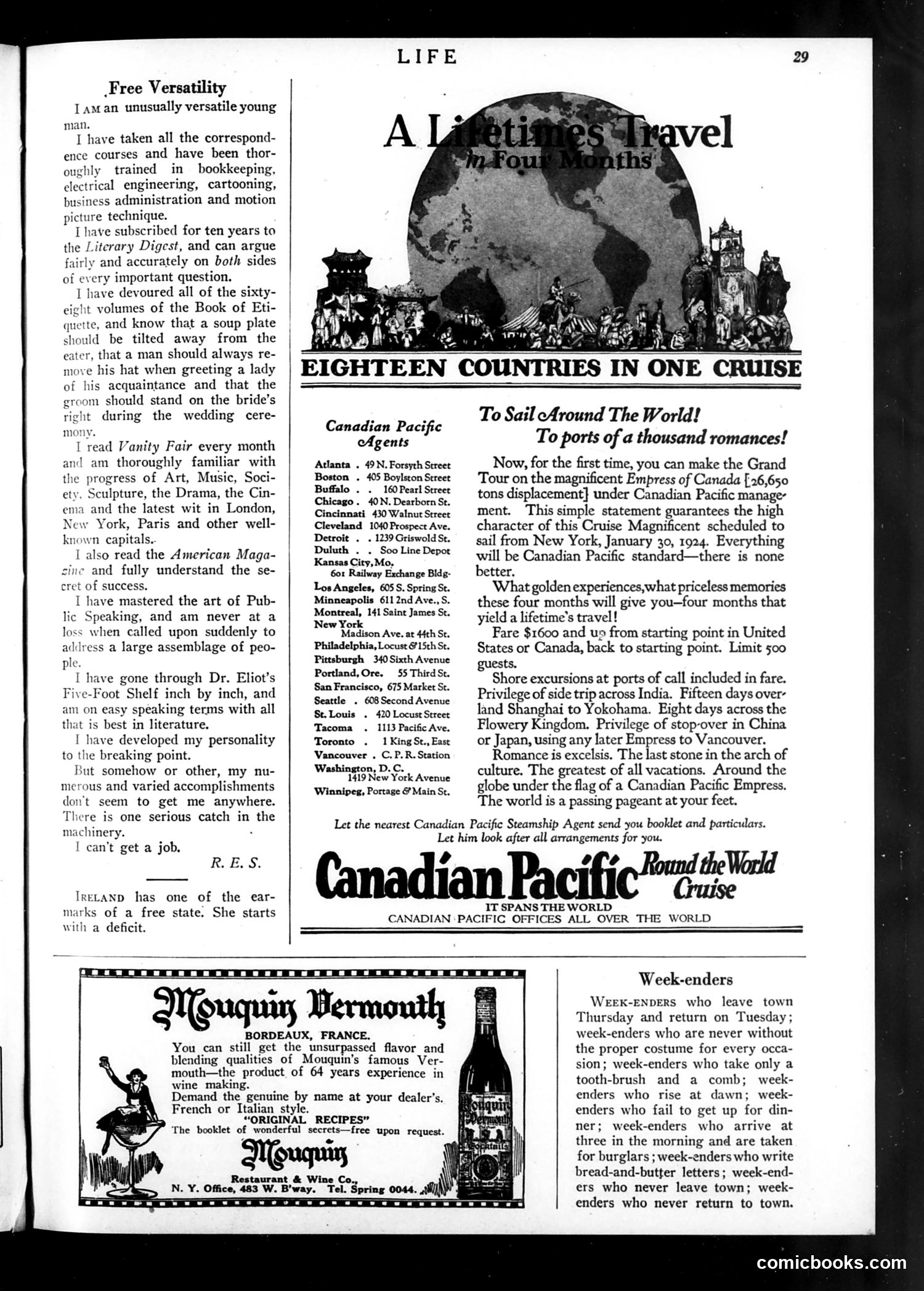
This page contains two distinct pieces: **"Free Versatility" (left column):** A satirical monologue by someone claiming extensive self-improvement credentials—correspondence courses in multiple trades, ten years of *Literary Digest* subscription, mastery of etiquette manuals, familiarity with high culture, public speaking skills, and completion of Harvard's "Five-Foot Shelf." The joke: despite all this conspicuous self-cultivation, he *cannot find employment*. This mocks 1920s self-help culture and the gap between credential accumulation and actual job market success—a timely concern in the post-WWI economy. **Advertisements:** The page is dominated by cruise and alcohol advertising, including Canadian Pacific's "Round the World" luxury cruise (promoting 18-country travel for $1,600+) and Moquin Vermouth wine. The satire targets how Americans invested in self-improvement schemes that promised success but delivered little practical benefit—a commentary on consumer culture and American optimism meeting economic reality.
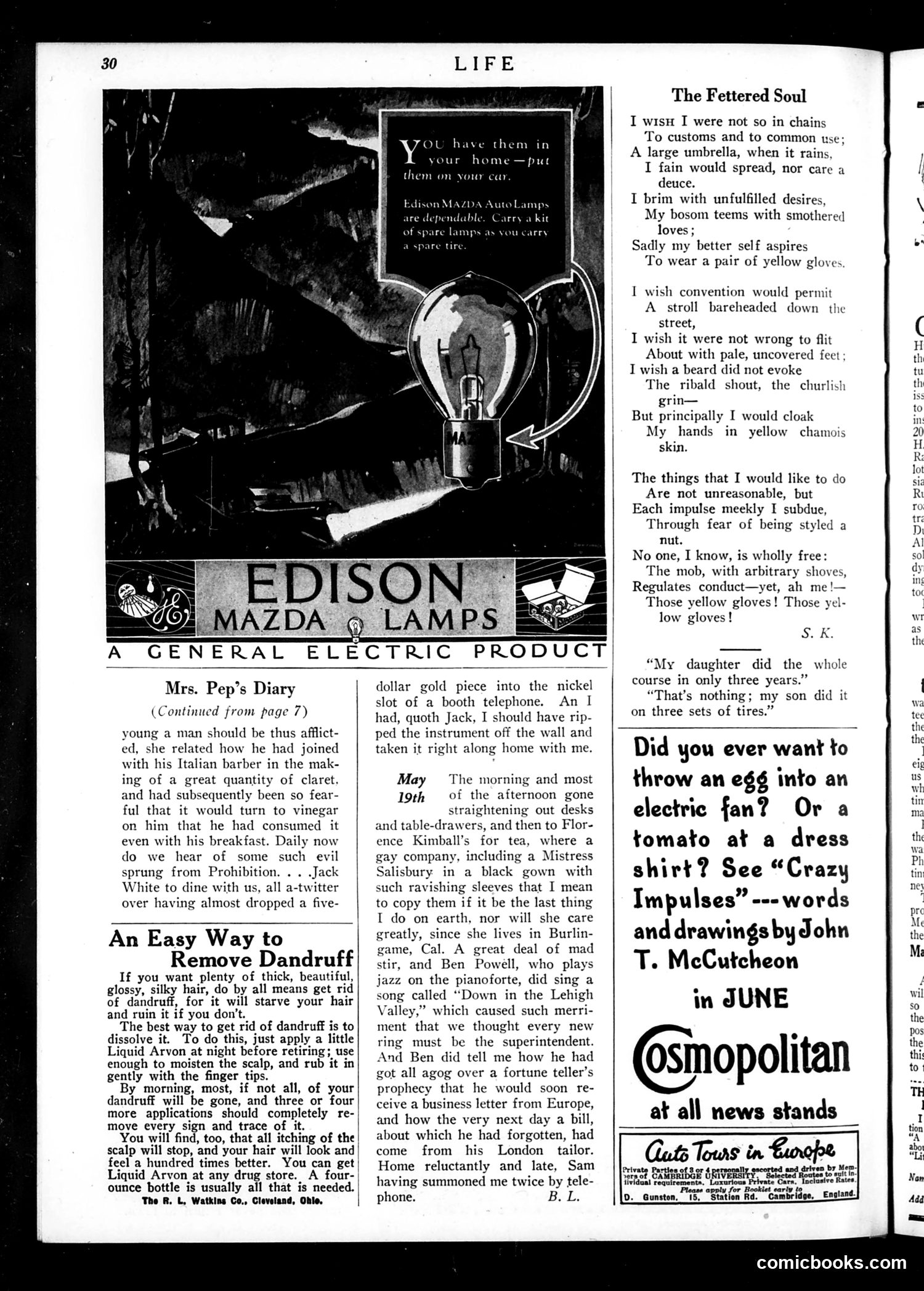
This page from *Life* magazine is primarily **advertising and light satirical content** rather than political commentary. The dominant feature is an **Edison Mazda Auto Lamps advertisement** (a General Electric product), showing a car headlight with the slogan encouraging readers to keep spare bulbs handy. The text content includes: - **"Mrs. Pep's Diary"**: A humorous social column satirizing Prohibition-era America, where a guest nervously dropped a five-dollar gold piece, and another character obsesses over a fortune teller's prediction and a tailor's bill. - **"The Fettered Soul"**: A poem by S.K. ironically lamenting social conformity—the speaker wishes to wear yellow gloves, walk bareheaded, and break conventions, but fears being called "a nut." The repetition of "yellow gloves" mocks how arbitrary social restrictions feel. The page also contains practical advertorials (dandruff removal tips) and a teaser for "Crazy Impulses" content in *Cosmopolitan* magazine. Overall, it reflects 1920s concerns with propriety, consumer products, and gentle social satire about conformist anxieties.
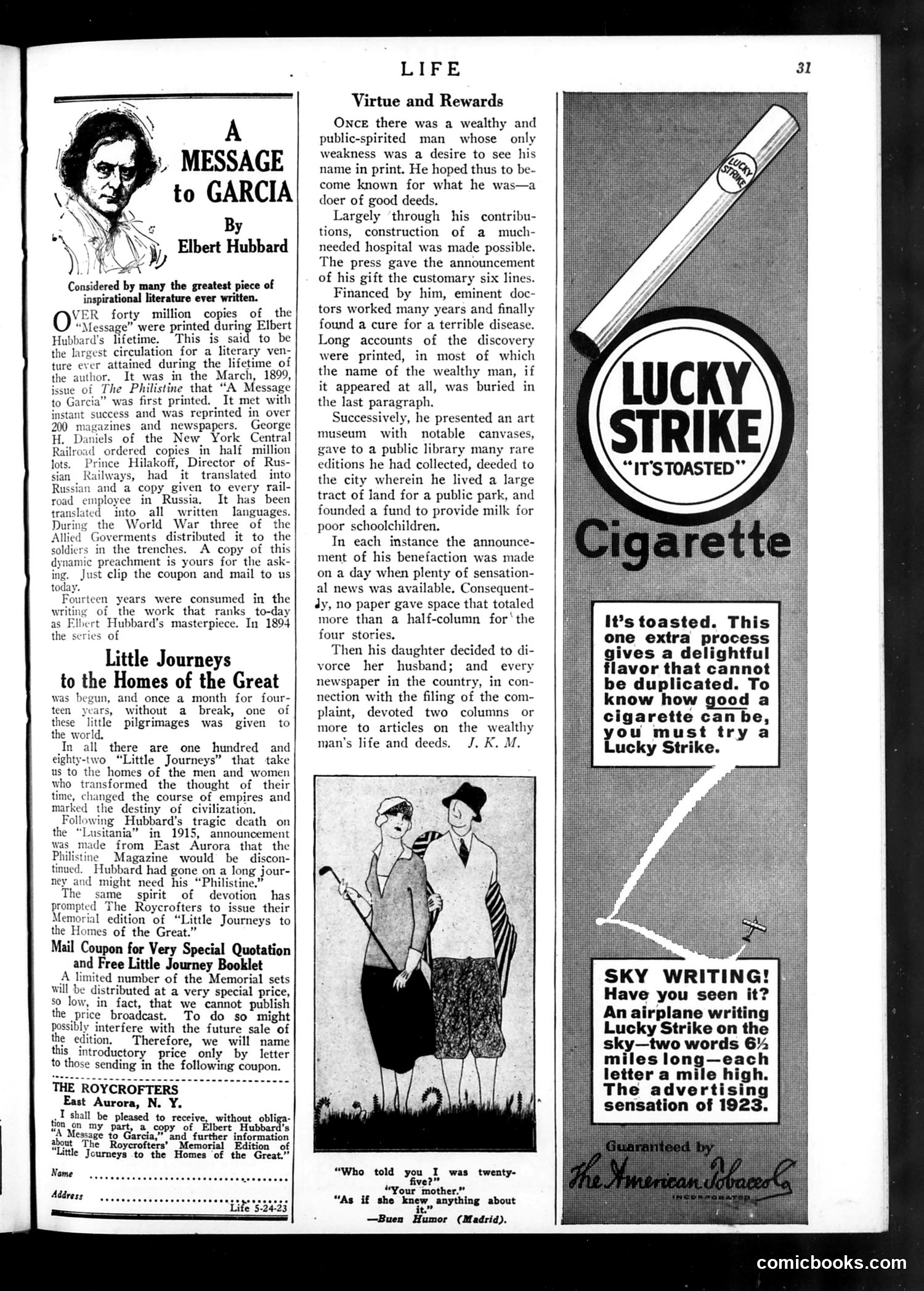
This page contains **two distinct sections**: promotional material for Elbert Hubbard's works on the left, and a satirical story titled "Virtue and Rewards" on the right. **The satire "Virtue and Rewards"** mocks wealthy philanthropists who donate to society primarily seeking public recognition and fame. The wealthy man in the story funds a hospital, supports medical research, establishes a museum and library, and creates a public park—yet receives minimal press coverage because his announcements coincidentally occur during days with competing major news stories. **The joke's point**: The man's genuine good deeds go largely unrecognized despite his desire for visibility. This satirizes both the vanity of wealthy donors who seek glory and the arbitrary nature of newspaper coverage. It suggests that virtue motivated by ego-seeking rarely receives the public acknowledgment its practitioners crave. The left side promoting Hubbard's "A Message to Garcia" is straightforward advertising, unrelated to the satire, promoting Hubbard's famous motivational essay and his biographical "Little Journeys" series.
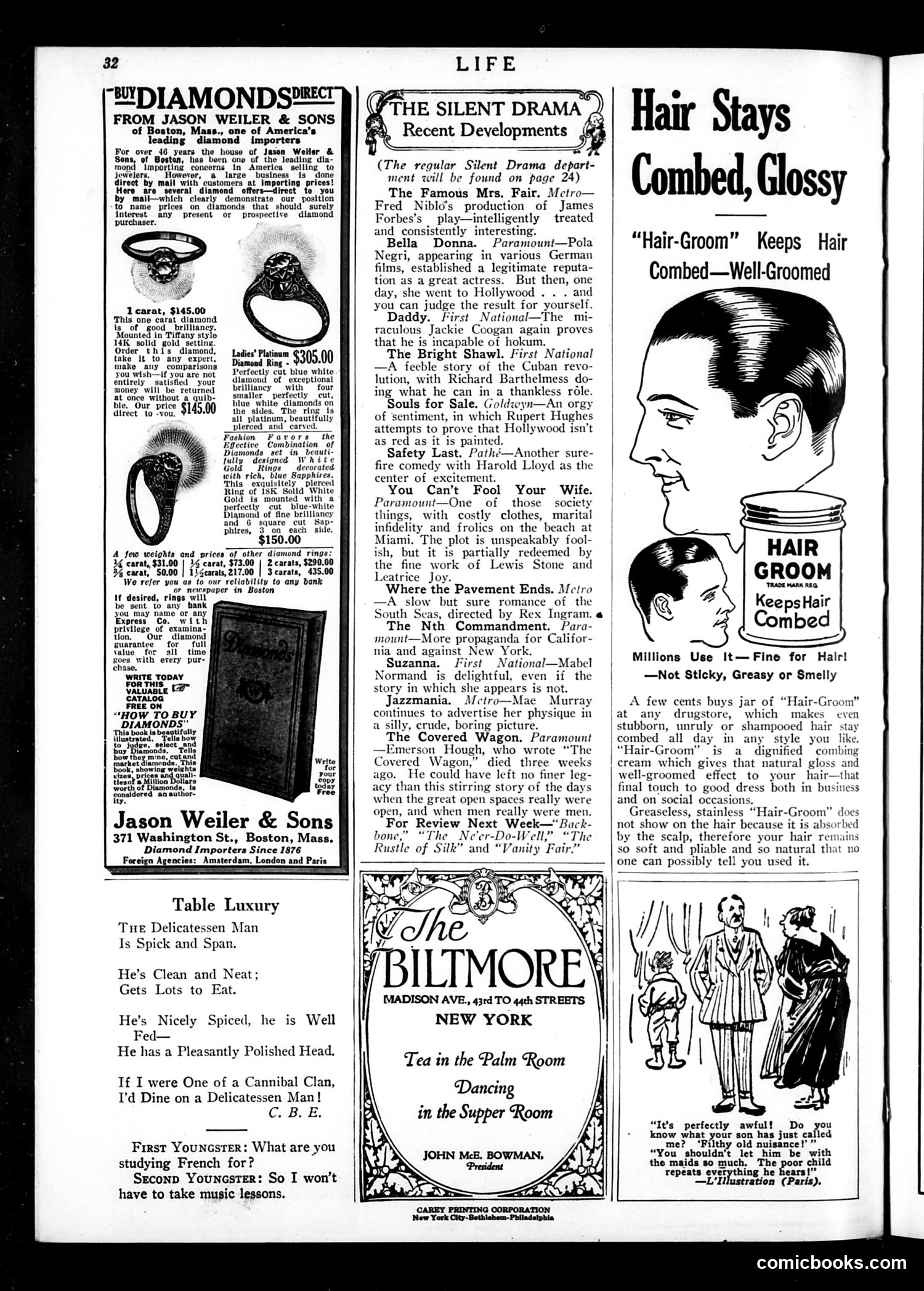
This page is primarily **advertising and entertainment reviews**, not political satire. The main content includes: **Advertisements:** Jason Weiler & Sons (diamond importer) dominates the left side with product images and pricing for engagement rings and jewelry, emphasizing mail-order purchasing and guarantees. **"Table Luxury" section:** A lighthearted four-stanza poem by C.B.E. celebrating the delicatessen man—praising his cleanliness, good food, and polished appearance with a humorous cannibal-themed punchline. **"The Silent Drama" section:** Film reviews of contemporary movies (Paramount, Metro, First National productions), critiquing recent silent films with brief, sardonic commentary. Notable: negative review of Pola Negri's transition to Hollywood. **Small cartoon:** Two boys discussing French lessons as an alternative to music practice—a simple joke with no political content. The page reflects 1920s consumer culture and entertainment interests rather than political commentary.
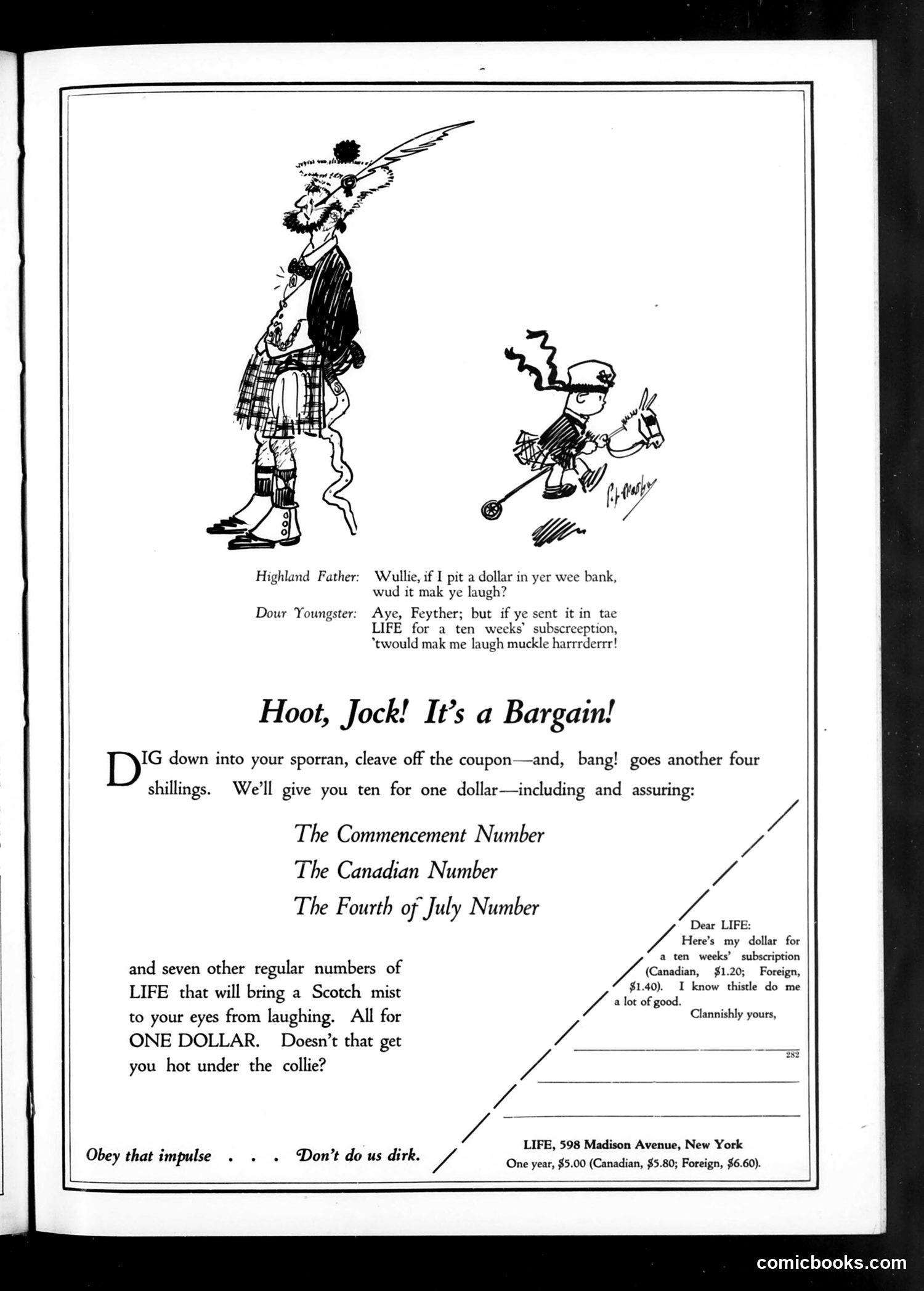
This is a **subscription advertisement** for *Life* magazine, using Scottish humor and cultural stereotypes to appeal to readers. ## The Setup A cartoon depicts a Scottish father and son (identified by dialect and tartan clothing). The father offers his son a dollar for savings; the son responds that he'd laugh more if the father subscribed to *Life* magazine instead—suggesting the publication is so funny it's worth more than money. ## The Sales Pitch The ad leverages Scottish cultural identity ("Scotch mist," "sporran," "Clannishly yours") to create familiarity and humor. It offers **ten issues for one dollar**—an extraordinary value proposition, including special numbered editions (Commencement, Canadian, Fourth of July issues). ## The Joke The appeal to Scottish frugality is the core humor: the ad essentially says "You Scots are so cheap this deal will make you laugh despite your tightfisted nature." A sample letter from a satisfied subscriber reinforces this, claiming the purchase does "a lot of good." The closing phrase "Don't do us dirk" is a pun (Scottish dagger) warning readers not to reject this bargain.
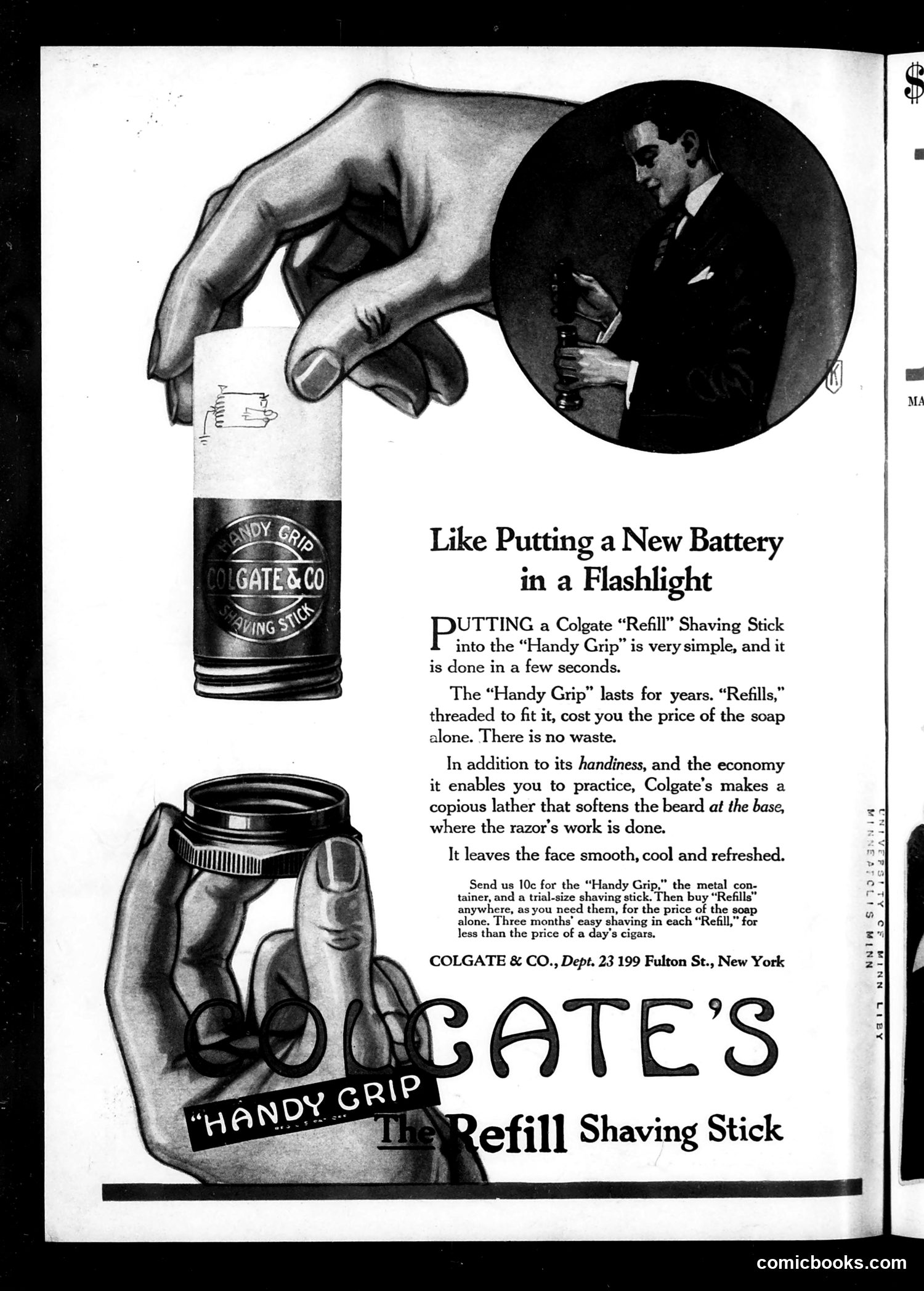
This is a **Colgate shaving products advertisement**, not political satire. The page promotes Colgate's "Handy Grip" refillable shaving stick system. The advertisement uses a modern convenience analogy—comparing inserting a new shaving stick refill to "putting a new battery in a flashlight"—to appeal to early 20th-century consumers familiar with flashlight technology. This was an innovative selling point: the reusable metal grip holder lasted years while users purchased cheap refill sticks, reducing waste and cost. The visual shows hands demonstrating the insertion process (top and bottom illustrations) and includes a circular portrait of a well-dressed man (the product's intended consumer), emphasizing the product's appeal to gentlemen concerned with grooming. The pitch emphasizes economy ("price of the soap alone"), convenience ("very simple"), and product quality (superior lather, smooth results). This represents typical early advertising strategy: positioning new consumer goods as both modern and thrifty.