
Life, 1923-05-24 · page 22 of 42
Life — May 24, 1923 — page 22: what you’re looking at
What you’re looking at
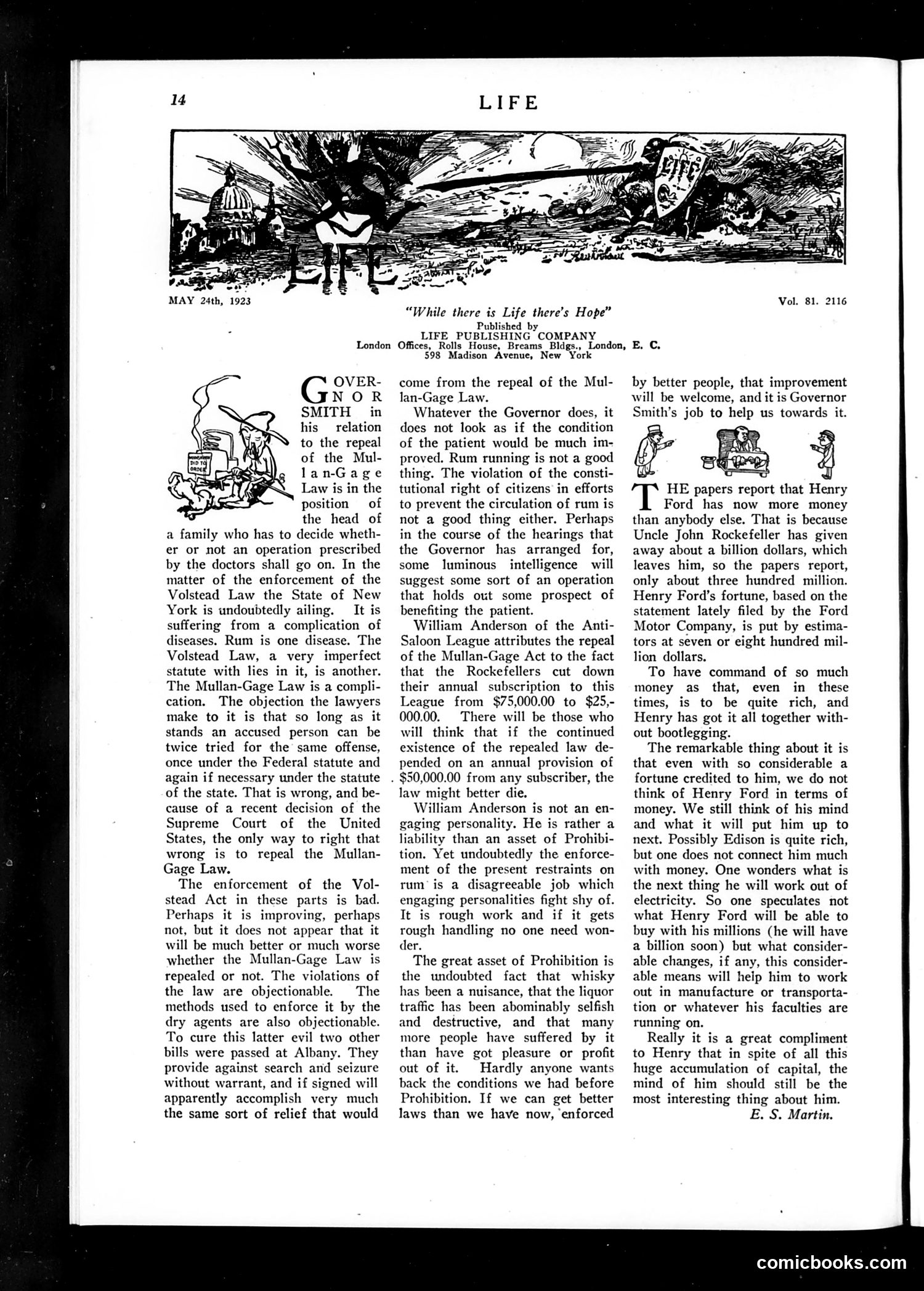
The page contains two distinct editorial pieces addressing Prohibition-era issues in New York. The first article, illustrated with a medical metaphor cartoon, discusses Governor Smith's position on repealing the Mullan-Gage Law. It frames New York's enforcement problems as a "patient" suffering multiple "diseases"—rum-running, the imperfect Volstead Act, and constitutional violations in enforcement. The piece argues repeal won't significantly improve matters, but suggests better enforcement methods and laws might help. The second piece comments on Henry Ford's wealth relative to John D. Rockefeller's. It notes that Ford now has more money than Rockefeller because Rockefeller has donated approximately one billion dollars to charity, leaving him with only three hundred million. The tone is somewhat sardonic about measuring wealth and philanthropy. Both articles reflect 1920s concerns: Prohibition's enforcement complications and the cultural fascination with American industrial titans' vast fortunes.
📄 Transcribed text from this page (OCR, searchable)
Machine-transcribed from the original scan — historical spelling and the odd misread are preserved.
MAY 24th, 1923 “While there is Life there’s Hope” Published by LIFE PUBLISHING COMPANY Vol. 81. 2116 London Offices, Rolls House, Breams Bldgs., London, E. C, OVER- NOR SMITH in his _ relation to the repeal of the Mul- lanGage Law is in the position of the head of a family who has to decide wheth- er or not an operation prescribed by the doctors shall go on. In the matter of the enforcement of the Volstead Law the State of New York is undoubtedly ailing. It is suffering from a complication of diseases. Rum is one disease. The Volstead Law, a very imperfect statute with lies in it, is another. The Mullan-Gage Law is a compli- cation. The objection the lawyers make to it is that so long as it stands an accused person can be twice tried for the same offense, once under the Federal statute and again if necessary under the statute of the state. That is wrong, and be- cause of a recent decision of the Supreme Court of the United States, the only way to right that wrong is to repeal the Mullan- Gage Law. The enforcement of the Vol- stead Act in these parts is bad. Perhaps it is improving, perhaps not, but it does not appear that it will be much better or much worse whether the Mullan-Gage Law is repealed or not. The violations of the law are objectionable. The methods used to enforce it by the dry agents are also objectionable. To cure this latter evil two other bills were passed at Albany. They provide against search and seizure without warrant, and if signed will apparently accomplish very much the same sort of relief that would 598 Madison Avenue, New York come from the repeal of the Mul- lan-Gage Law. Whatever the Governor does, it does not look as if the condition of the patient would be much im- proved. Rum running is not a good thing. The violation of the consti- tutional right of citizens’ in efforts to prevent the circulation of rum is not a good thing either. Perhaps in the course of the hearings that the Governor has arranged for, some luminous intelligence will suggest some sort of an operation that holds out some prospect of benefiting the patient. William Anderson of the Anti- Saloon League attributes the repeal of the Mullan-Gage Act to the fact that the Rockefellers cut down their annual subscription to this League from $75,000.00 to $25,- 000.00. There will be those who will think that if the continued existence of the repealed law de- pended on an annual provision of . $50,000.00 from any subscriber, the law might better die. William Anderson is not an en- gaging personality. He is rather a liability than an asset of Prohibi- tion. Yet undoubtedly the enforce- ment of the present restraints on rum is a disagreeable job which engaging personalities fight shy of. It is rough work and if it gets rough handling no one need won- der. The great asset of Prohibition is the undoubted fact that whisky has been a nuisance, that the liquor traffic has been abominably selfish and destructive, and that many more people have suffered by it than have got pleasure or profit out of it. Hardly anyone wants back the conditions we had before Prohibition. If we can get better laws than we have now, ‘enforced by better people, that improvement will be welcome, and it is Governor Smith’s job to help us towards it. HE papers report that Henry Ford has now more money than anybody else. That is because Uncle John Rockefeller has given away about a billion dollars, which leaves him, so the papers report, only about three hundred million. Henry Ford’s fortune, based on the statement lately filed by the Ford Motor Company, is put by estima- tors at seven or eight hundred mil- lion dollars. To have command of so much money as that, even in these times, is to be quite rich, and Henry has got it all together with- out bootlegging. The remarkable thing about it is that even with so considerable a fortune credited to him, we do not think of Henry Ford in terms of money. We still think of his mind and what it will put him up to next. Possibly Edison is quite rich, but one does not connect him much with money. One wonders what is the next thing he will work out of electricity. So one speculates not what Henry Ford will be able to buy with his millions (he will have a billion soon) but what consider- able changes, if any, this consider- able means will help him to work out in manufacture or transporta- tion or whatever his faculties are running on. Really it is a great compliment to Henry that in spite of all this huge accumulation of capital, the mind of him should still be the most interesting thing about him. E. S. Martin. comicbooks.com