
Life, 1923-05-24 · page 26 of 42
Life — May 24, 1923 — page 26: what you’re looking at
What you’re looking at
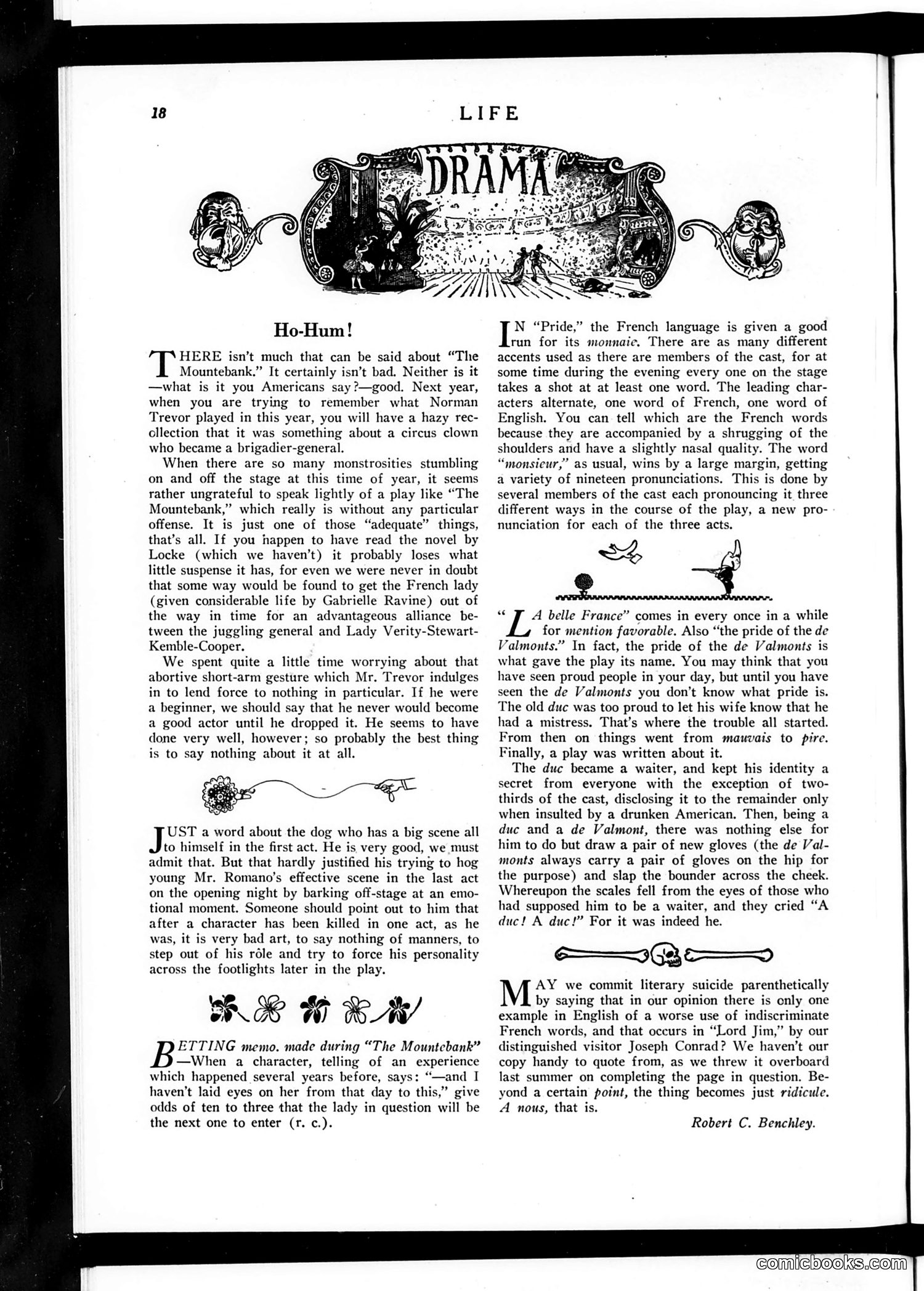
This page reviews two Broadway plays from Life magazine's drama section. The main critique of "The Mountebank" is dismissive—it's neither good nor bad, merely "adequate." The plot involves actor Norman Trevor as a circus clown–turned–general, with actress Gabrielle Ravine as a French lady. The reviewer mocks the predictable plot and Trevor's theatrical gesture-work, while praising a dog's performance—then sarcastically critiques the dog for barking off-stage during a later scene, violating theatrical propriety. The second review of "Pride" ridicules the cast's inconsistent French pronunciation, particularly the word "monsieur," which receives nineteen different readings throughout the play. The plot concerns French aristocratic pride: a duke, too proud to let his wife know of his mistress, becomes a waiter while maintaining his secret identity. The satire targets theatrical mediocrity and overwrought European drama conventions popular in early 20th-century American theater.
📄 Transcribed text from this page (OCR, searchable)
Machine-transcribed from the original scan — historical spelling and the odd misread are preserved.
HERE isn’t much that can be said about “The Mountebank.” It certainly isn’t bad. Neither is it —what is it you Americans say?—good. Next year, when you are trying to remember what Norman Trevor played in this year, you will have a hazy rec- collection that it was something about a circus clown who became a brigadier-general. When there are so many monstrosities stumbling on and off the stage at this time of year, it seems rather ungrateful to speak lightly of a play like “The Mountebank,” which really is without any particular offense. It is just one of those “adequate” things, that’s all. If you nappen to have read the novel by Locke (which we haven’t) it probably loses what little suspense it has, for even we were never in doubt that some way would be found to get the French lady (given considerable life by Gabrielle Ravine) out of the way in time for an advantageous alliance be- tween the juggling general and Lady Verity-Stewart- Kemble-Cooper. We spent quite a little time worrying about that abortive short-arm gesture which Mr. Trevor indulges in to lend force to nothing in particular. If he were a beginner, we should say that he never would become a good actor until he dropped it. He seems to have done very well, however; so probably the best thing is to say nothing about it at all. UST a word about the dog who has a big scene all Ji himself in the first act. He is very good, we must admit that. But that hardly justified his trying to hog young Mr. Romano's effective scene in the last act on the opening night by barking off-stage at an emo- tional moment. Someone should point out to him that after a character has been killed in one act, as he was, it is very bad art, to say nothing of manners, to step out of his rdle and try to force his personality across the footlights later in the play. BE ETTING memo. made during “The Mountebank” —When a character, telling of an experience which happened several years before, says: “—and I haven't laid eyes on her from that day to this,” give odds of ten to three that the lady in question will be the next one to enter (r. c.). N “Pride,” the French language is given a good run for its monnaie, There are as many different accents used as there are members of the cast, for at some time during the evening every one on the stage takes a shot at at least one word. The leading char- acters alternate, one word of French, one word of English. You can tell which are the French words because they are accompanied by a shrugging of the shoulders and have a slightly nasal quality. The word “monsieur,” as usual, wins by a large margin, getting a variety of nineteen pronunciations. This is done by several members of the cast each pronouncing it three different ways in the course of the play, a new pro- nunciation for each of the three acts. =% A belle France” comes in every once in a while for mention favorable. Also “the pride of the de Valmonts.” In fact, the pride of the de Valmonts is what gave the play its name. You may think that you have seen proud people in your day, but until you have seen the de Valmonts you don’t know what pride is. The old duc was too proud to let his wife know that he had a mistress. That’s where the trouble all started. From then on things went from mauvais to pire. Finally, a play was written about it. The duc became a waiter, and kept his identity a secret from everyone with the exception of two- thirds of the cast, disclosing it to the remainder only when insulted by a drunken American. Then, being a duc and a de Valmont, there was nothing else for him to do but draw a pair of new gloves (the de Val- monts always carry a pair of gloves on the hip for the purpose) and slap the bounder across the cheek. Whereupon the scales fell from the eyes of those who had supposed him to be a waiter, and they cried “A duc! A duc!” For it was indeed he. 33> AY we commit literary suicide parenthetically by saying that in our opinion there is only one example in English of a worse use of indiscriminate French words, and that occurs in “Lord Jim,” by our distinguished visitor Joseph Conrad? We haven’t our copy handy to quote from, as we threw it overboard last summer on completing the page in question. Be- yond a certain point, the thing becomes just ridicule. A nous, that is. Robert C. Benchley. cComiclnooks.com