
Life, 1923-05-24 · page 28 of 42
Life — May 24, 1923 — page 28: what you’re looking at
What you’re looking at
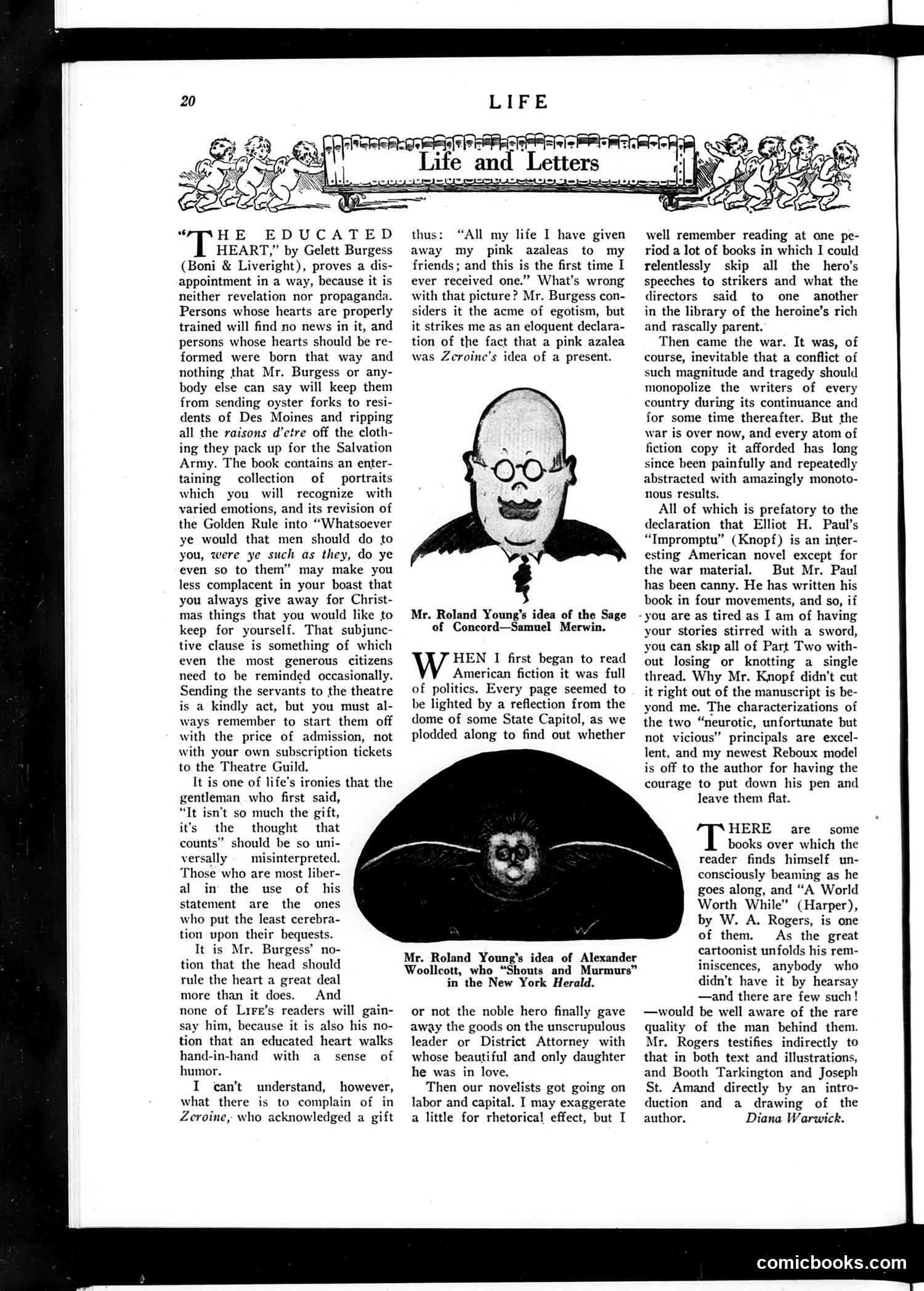
This page contains **two cartoon caricatures** by Roland Young satirizing American literary figures: 1. **"The Sage of Concord"** (top): A bald man with glasses representing Samuel Merwin, apparently mocking his pretensions to intellectual authority. 2. **Alexander Woollcott** (bottom): Depicted as a rotund, theatrical figure who "Shouts and Murmurs" in the New York Herald—a reference to his actual newspaper column. The text reviews Gelett Burgess's book *"The Educated Heart,"* critiquing how American fiction cycles through trendy subjects: first politics, then labor disputes, then World War I material. The reviewer complains these topics have been exhausted in contemporary novels. The caricatures mock prominent cultural figures of the 1920s, using exaggerated features for satirical effect—typical of *Life* magazine's approach to literary criticism and cultural commentary.
📄 Transcribed text from this page (OCR, searchable)
Machine-transcribed from the original scan — historical spelling and the odd misread are preserved.
* HE EDUCATED HEART,” by Gelett Burgess (Boni & Liveright), proves a dis- appointment in a way, because it is neither revelation nor propaganda. Persons whose hearts are properly trained will find no news in it, and persons whose hearts should be re- formed were born that way and nothing that Mr. Burgess or any- body else can say will keep them from sending oyster forks to resi- dents of Des Moines and ripping all the raisons d'etre off the cloth- ing they pack up for the Salvation Army. The book contains an enter- taining collection of portraits which you will recognize with varied emotions, and its revision of the Golden Rule into “Whatsoever ye would that men should do to you, were ye such as they, do ye even so to them” may make you less complacent in your boast that you always give away for Christ- mas things that you would like to keep for yourself. That subjunc- tive clause is something of which even the most generous citizens need to be reminded occasionally. Sending the servants to the theatre is a kindly act, but you must al- ways remember to start them off with the price of admission, not with your own subscription tickets to the Theatre Guild. It is one of life's ironies that the gentleman who first said, “It isn’t so much the gift, it’s the thought that counts” should be so uni- versally misinterpreted. Those who are most liber- al in the use of his statement are the ones who put the least cerebra- tion upon their bequests. It is Mr. Burgess’ no- tion that the head should tule the heart a great deal more than it does. And none of Lire’s readers will gain- say him, because it is also his no- tion that an educated heart walks hand-in-hand with a sense of humor. I can’t understand, however, what there is to complain of in Zeroine, who acknowledged a gift LIFE mo Od daeace Life and ‘Letters thus: “All my life I have given away my pink azaleas to my friends; and this is the first time I ever received one.” What’s wrong with that picture? Mr. Burgess con- siders it the acme of egotism, but it strikes me as an eloquent declara- tion of the fact that a pink azalea was Zeroinc’s idea of a present. Mr. Roland Young’s idea of the Sage of Concord—Samuel Merwin. HEN I first began to read American fiction it was full of politics. Every page seemed to be lighted by a reflection from the dome of some State Capitol, as we plodded along to find out whether Mr. Roland Young’s idea of Alexander Woollcott, who “Shouts and Murmurs” in the New York Herald. or not the noble hero finally gave away the goods on the unscrupulous leader or District Attorney with whose beautiful and only daughter he was in love. Then our novelists got going on labor and capital. I may exaggerate a little for rhetorical effect, but I well remember reading at one pe- riod a lot of books in which I could relentlessly skip all the hero’s speeches to strikers and what the directors said to one another in the library of the heroine’s rich and rascally parent. Then came the war. It was, of course, inevitable that a conflict of such magnitude and tragedy should monopolize the writers of every country during its continuance and for some time thereafter. But the war is over now, and every atom of fiction copy it afforded has long since been painfully and repeatedly abstracted with amazingly monoto- nous results. All of which is prefatory to the declaration that Elliot H. Paul’s “Impromptu” (Knopf) is an inter- esting American novel except for the war material. But Mr. Paul has been canny. He has written his book in four movements, and so, if you are as tired as I am of having your stories stirred with a sword, you can skip all of Part Two with- out losing or knotting a single thread. Why Mr. Knopf didn’t cut it right out of the manuscript is be- yond me. The characterizations of the two “neurotic, unfortunate but not vicious” principals are excel- lent, and my newest Reboux model is off to the author for having the courage to put down his pen and leave them flat. HERE are some books over which the reader finds himself un- consciously beaming as he goes along, and “A World Worth While” (Harper), by W. A. Rogers, is one of them. As the great cartoonist unfolds his rem- iniscences, anybody who didn’t have it by hearsay —and there are few such! —would be well aware of the rare quality of the man behind them. Mr. Rogers testifies indirectly to that in both text and illustrations, and Booth Tarkington and Joseph St. Amand directly by an intro- duction and a drawing of the author. Diana Warwick. comicbooks.com