
A complete issue · 36 pages · 1923
Life — February 22, 1923
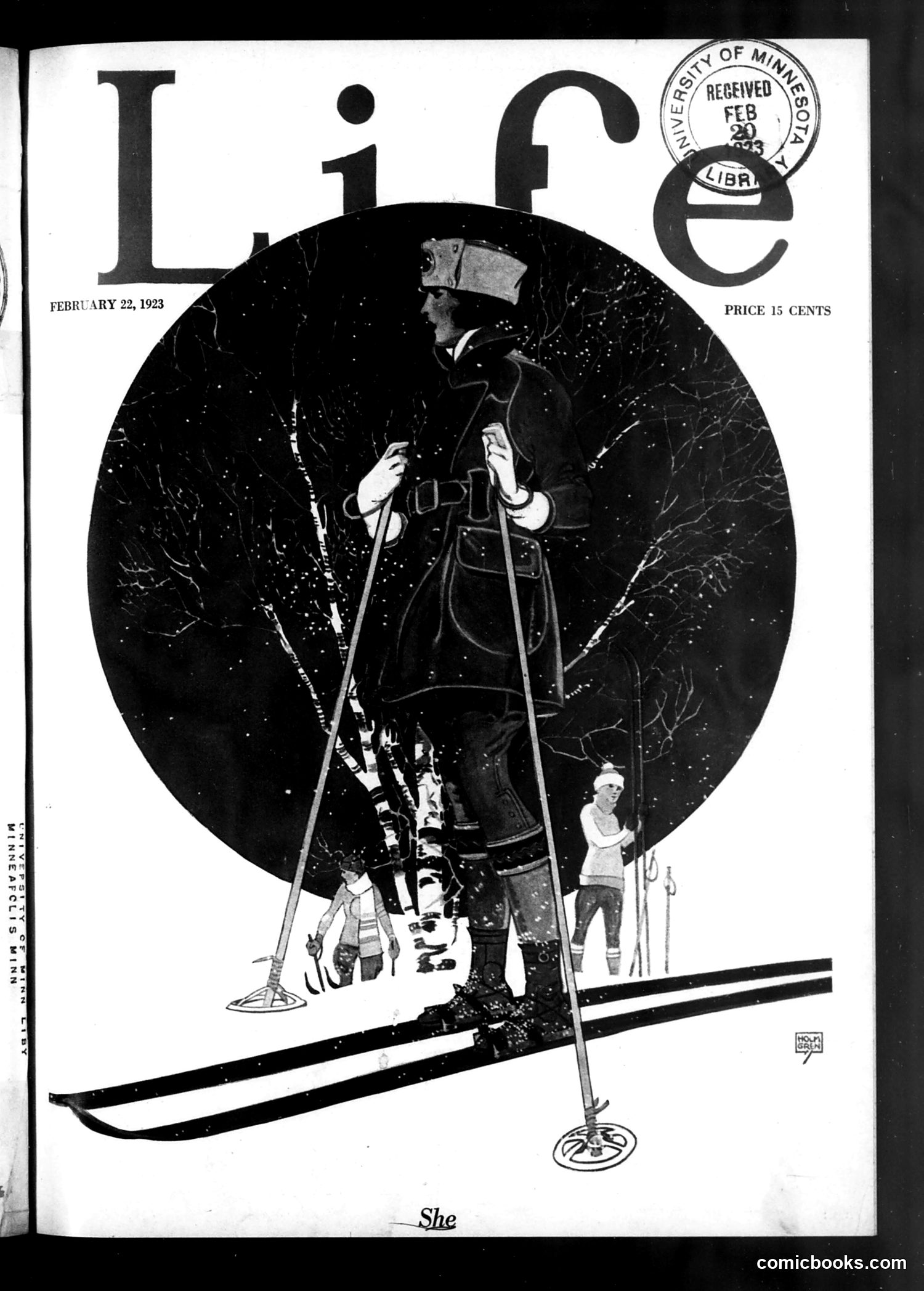
This cover depicts a winter sports scene titled "She," showing a fashionably dressed woman skiing. She wears a decorative headband and holds ski poles while descending a snowy slope, with two smaller figures (possibly children or other skiers) visible below her. The satire likely comments on **women's changing social roles in the 1920s**—the era of "flappers" and increased female independence. The woman's confident, dominant pose (towering over the smaller figures) and stylish winter gear suggest the "New Woman" of the Jazz Age, engaging in recreational activities previously considered primarily male pursuits. The title "She" emphasizes this focus on female agency and modernity. At 15 cents, this reflects Life's satirical take on contemporary gender dynamics during a period of significant social transformation.
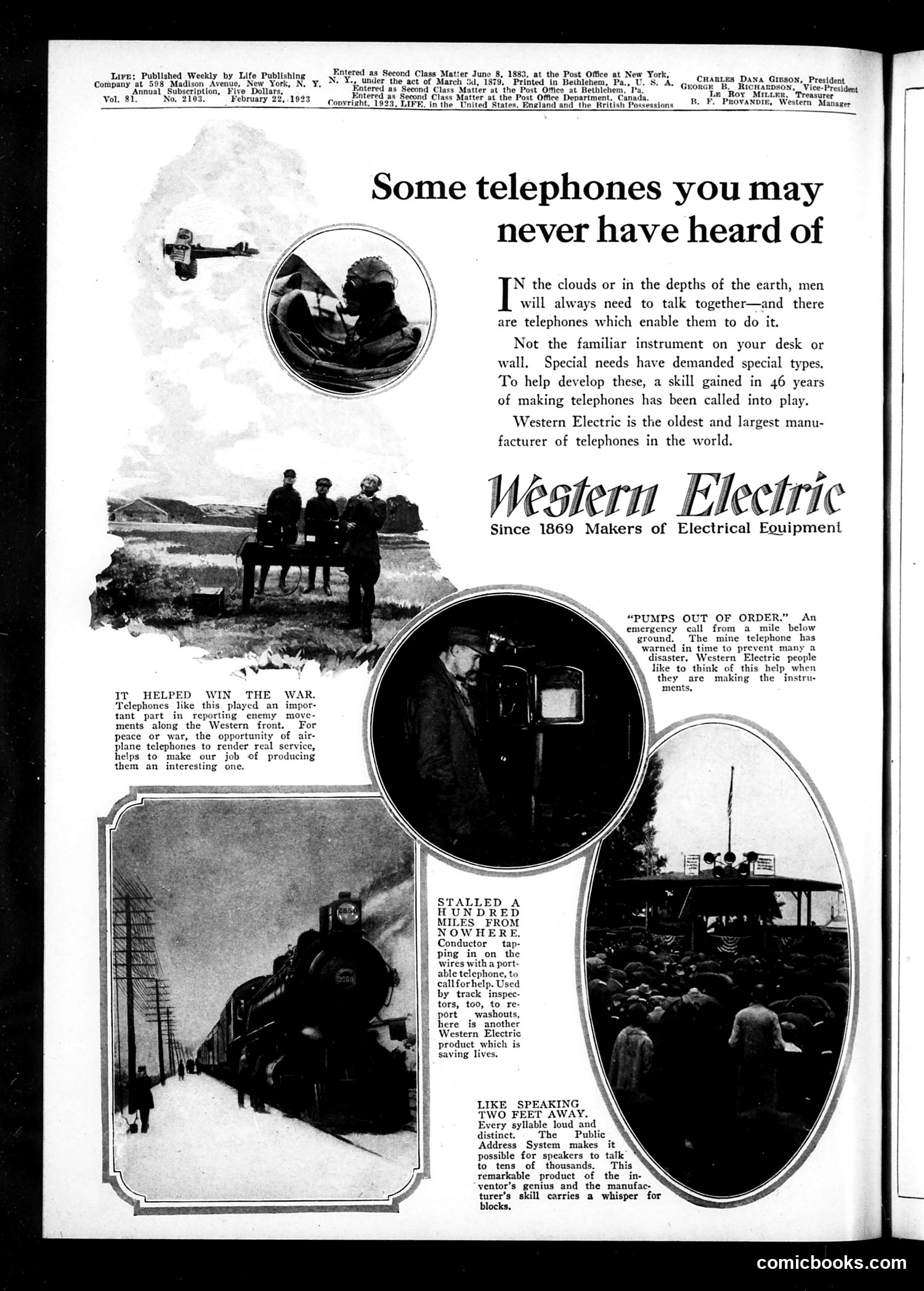
This page is primarily **advertising, not satire or editorial cartoon**. It's a Western Electric company advertisement promoting specialized telephones for unusual applications. The headline "Some telephones you may never have heard of" introduces various niche telephone uses. The page showcases: - **Airplane telephones** (top image) - **Field communication** during wartime (referenced as helping "win the war") - **Railroad telephones** for trains - **Emergency outdoor telephones** for remote locations - **Public address systems** ("like speaking two feet away") The advertisement emphasizes Western Electric's 46-year expertise manufacturing specialized electrical equipment beyond standard desk phones. Each photograph demonstrates a practical application—war reporting, train operations, rural emergency services—positioning the company as an innovative industrial supplier rather than just a consumer telephone provider.
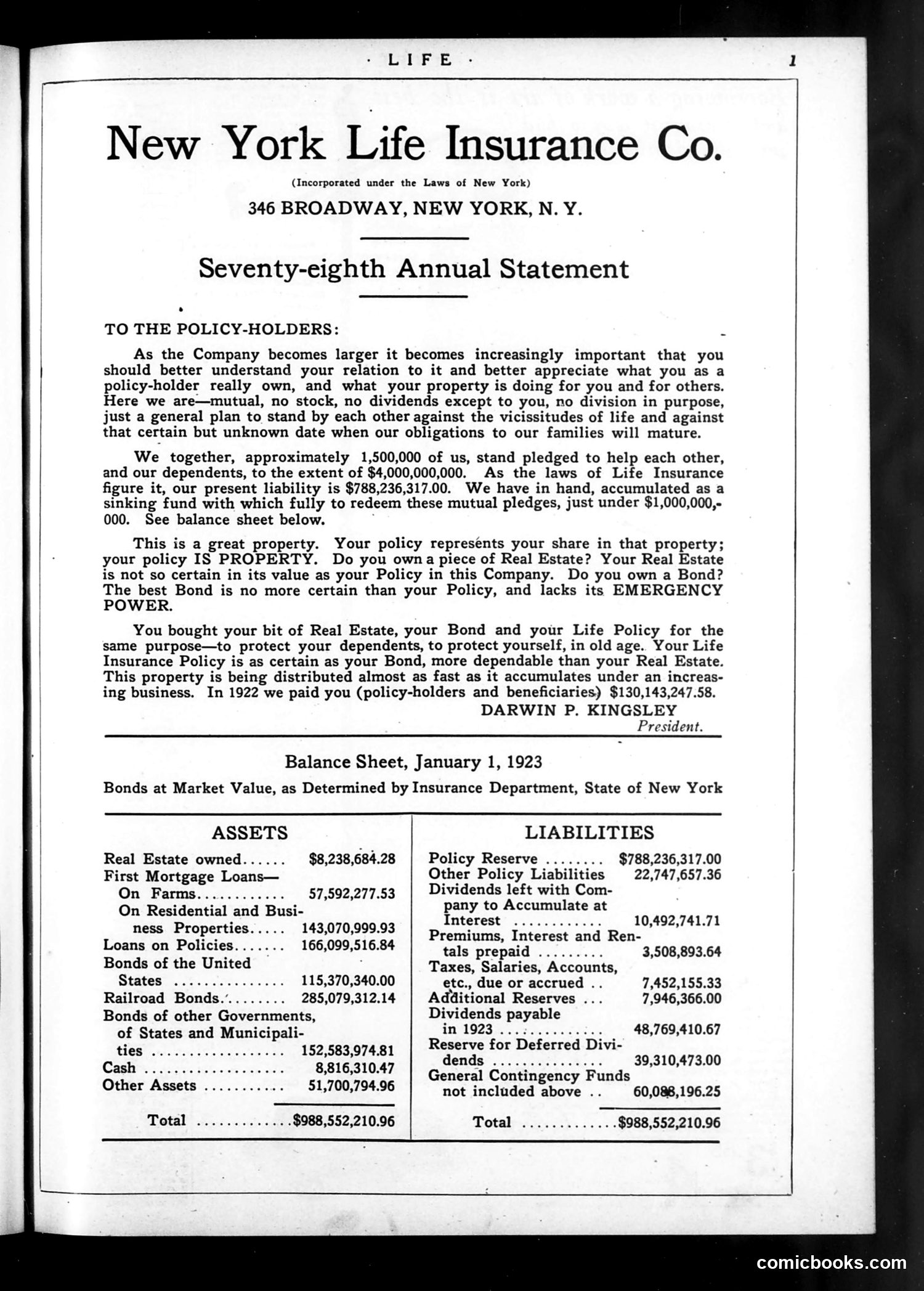
This page contains **no cartoon or satirical content**. It is a formal financial document: the "Seventy-eighth Annual Statement" of the New York Life Insurance Company, dated January 1, 1923, addressed to policyholders. The text is a message from President Darwin P. Kingsley explaining the company's mutual structure and financial position. It emphasizes that policyholders own the company as property, comparing life insurance policies to real estate bonds for reliability. The bulk of the page presents a balance sheet showing assets of approximately $988.5 million against liabilities of the same amount. This is **corporate advertising/financial disclosure**, not editorial satire or cartooning—a standard format Life magazine used for paid statements from major institutions.
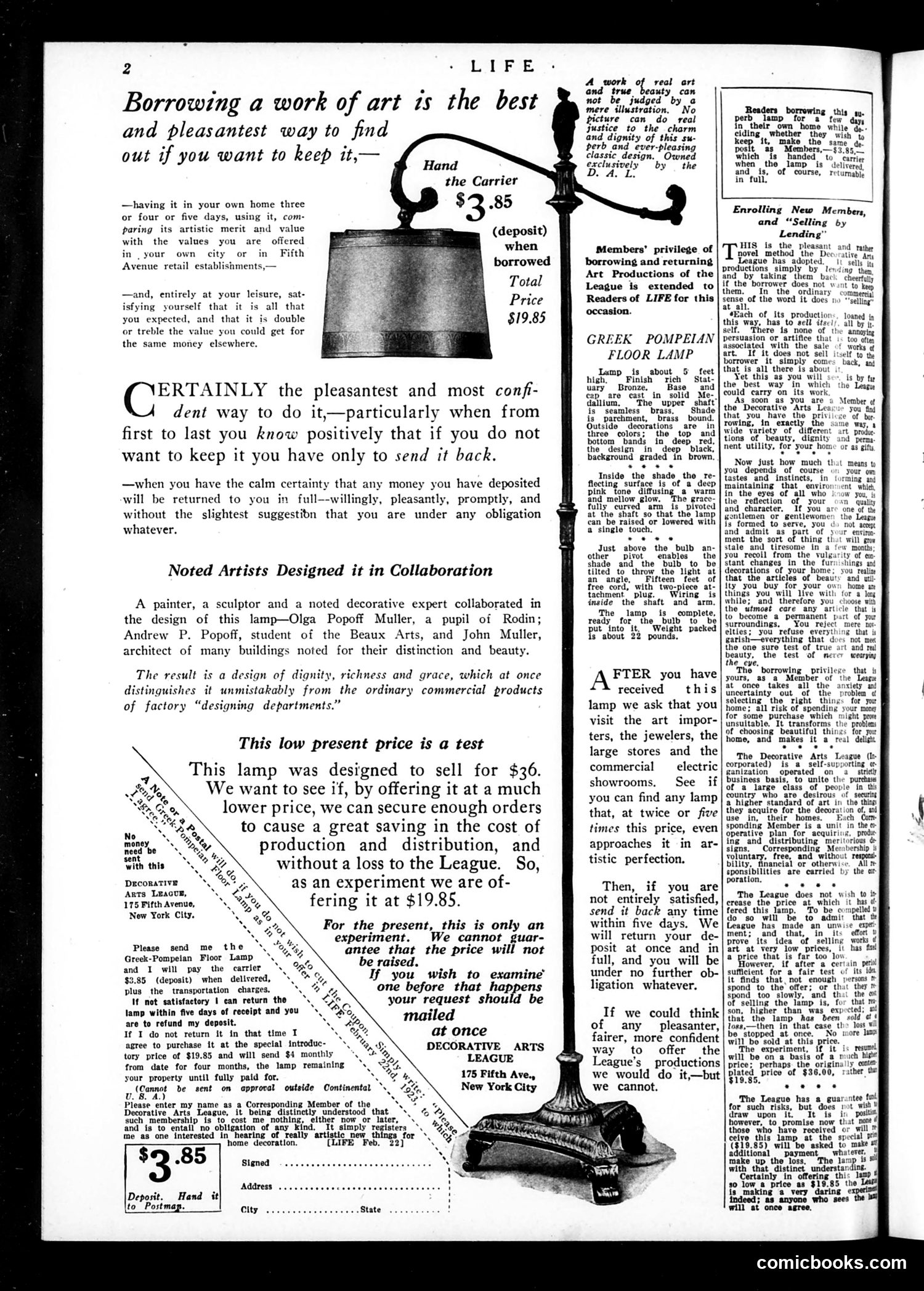
This page is **primarily advertising**, not satire or political commentary. It promotes a Greek Pompeiian Floor Lamp through the Decorative Arts League, priced at $19.85. The "cartoon" elements are minimal—just decorative illustrations of the lamp itself. The text emphasizes that borrowing artwork through the League allows people to test-drive pieces before purchasing, framing it as a consumer service rather than satire. The only potentially humorous angle is the implicit social commentary: the League positions art appreciation as accessible to ordinary people ("Readers borrowing on this path"), challenging the idea that fine art belongs only in wealthy homes or museums. However, this is earnest marketing rather than satirical critique. The page reflects 1920s-30s consumer culture and design democratization more than political satire.
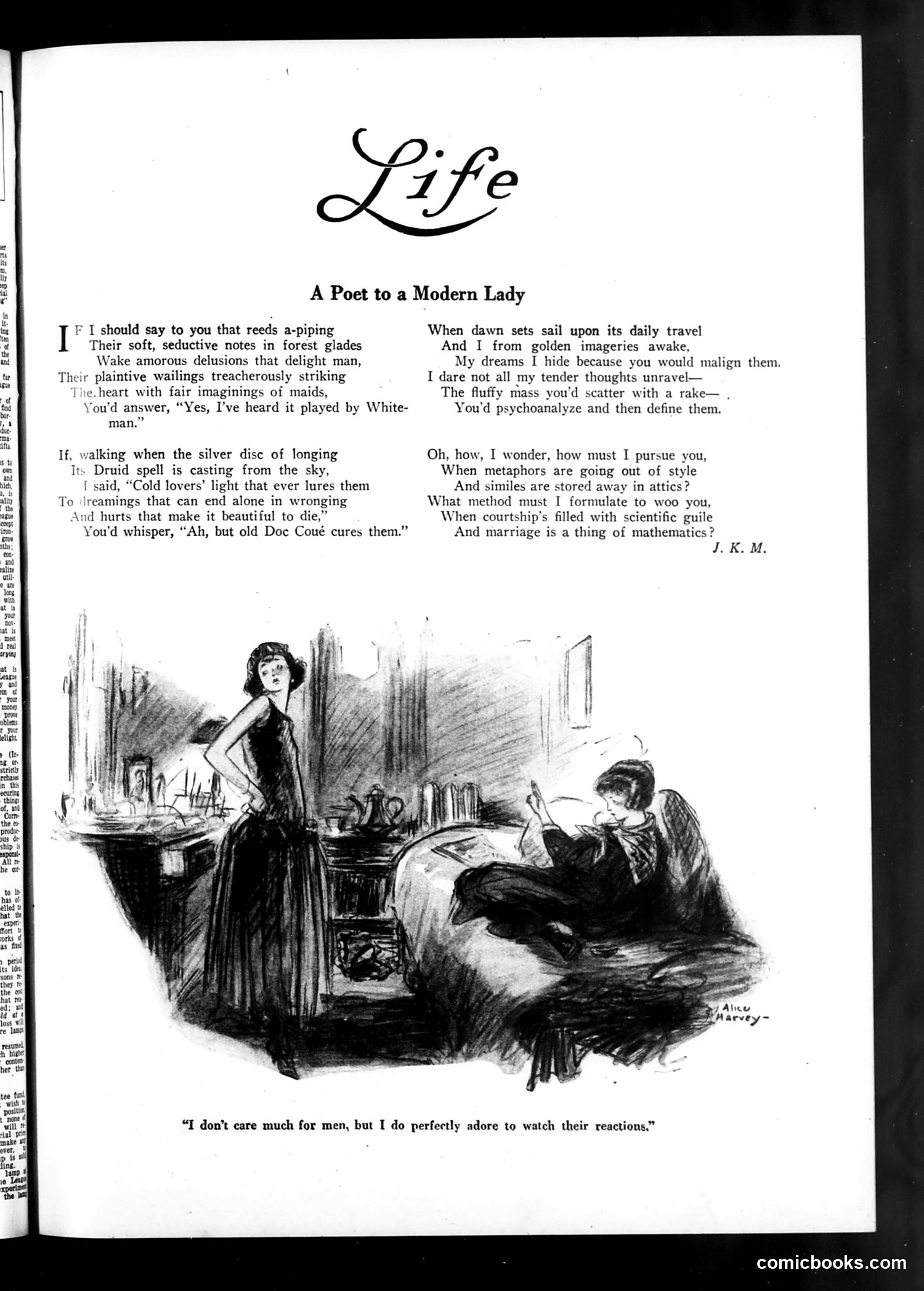
This page presents a poem by J.K.M. mocking romantic courtship in the modern era. The poet sarcastically addresses a "modern lady," suggesting that traditional romantic gestures—reading poetry, moonlit walks, literary allusions—have become obsolete. He questions how one can court a woman when "metaphors are going out of style" and "marriage is a thing of mathematics." The accompanying sketch shows a woman standing confidently while a man reclines on a bed, seemingly indifferent. The caption—"I don't care much for men, but I do perfectly adore to watch their reactions"—reinforces the satire: the modern woman is emotionally detached and amused by male behavior rather than moved by romance. The piece satirizes both changing gender dynamics and the perceived decline of romantic sentiment in contemporary society.
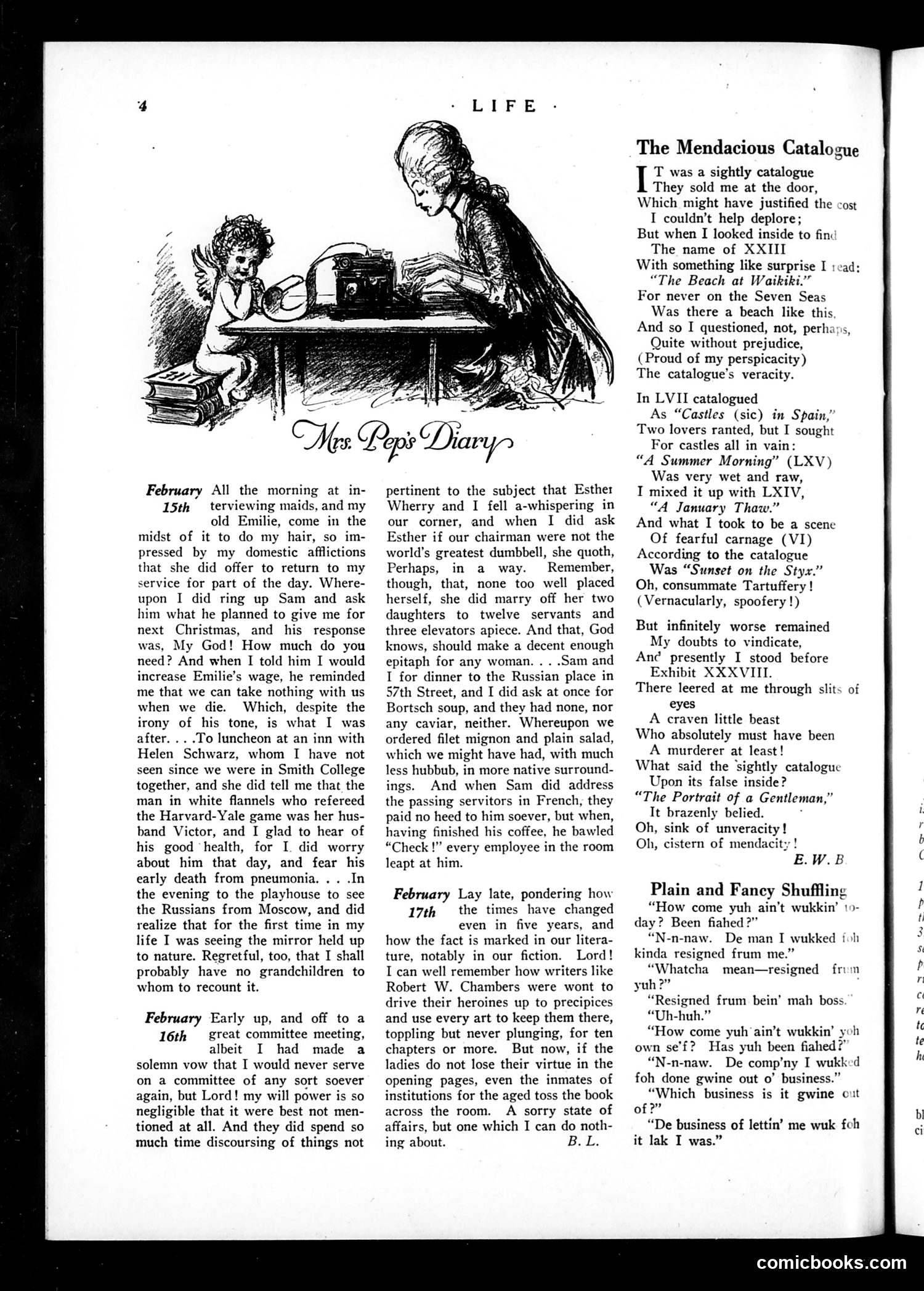
The main illustration shows "Mrs. Pepis Diary," depicting a woman at a typewriter being observed by a skeletal figure—likely Death or a grim reaper—peering over her shoulder. This appears to be satirizing the diary/confession genre popular in magazines of the era. The text contains diary entries from February discussing social observations: difficulties hiring servants, dinner conversation at a Russian restaurant, and complaints about changing times. The satire seems directed at upper-class society concerns and the triviality of wealthy women's preoccupations. A separate piece titled "Plain and Fancy Shuffling" uses dialect humor in a dialogue about employment and business, likely satirizing working-class speech patterns—a common comedic device in period publications. The overall tone is gentle social satire targeting both aristocratic pretension and class-based stereotypes.
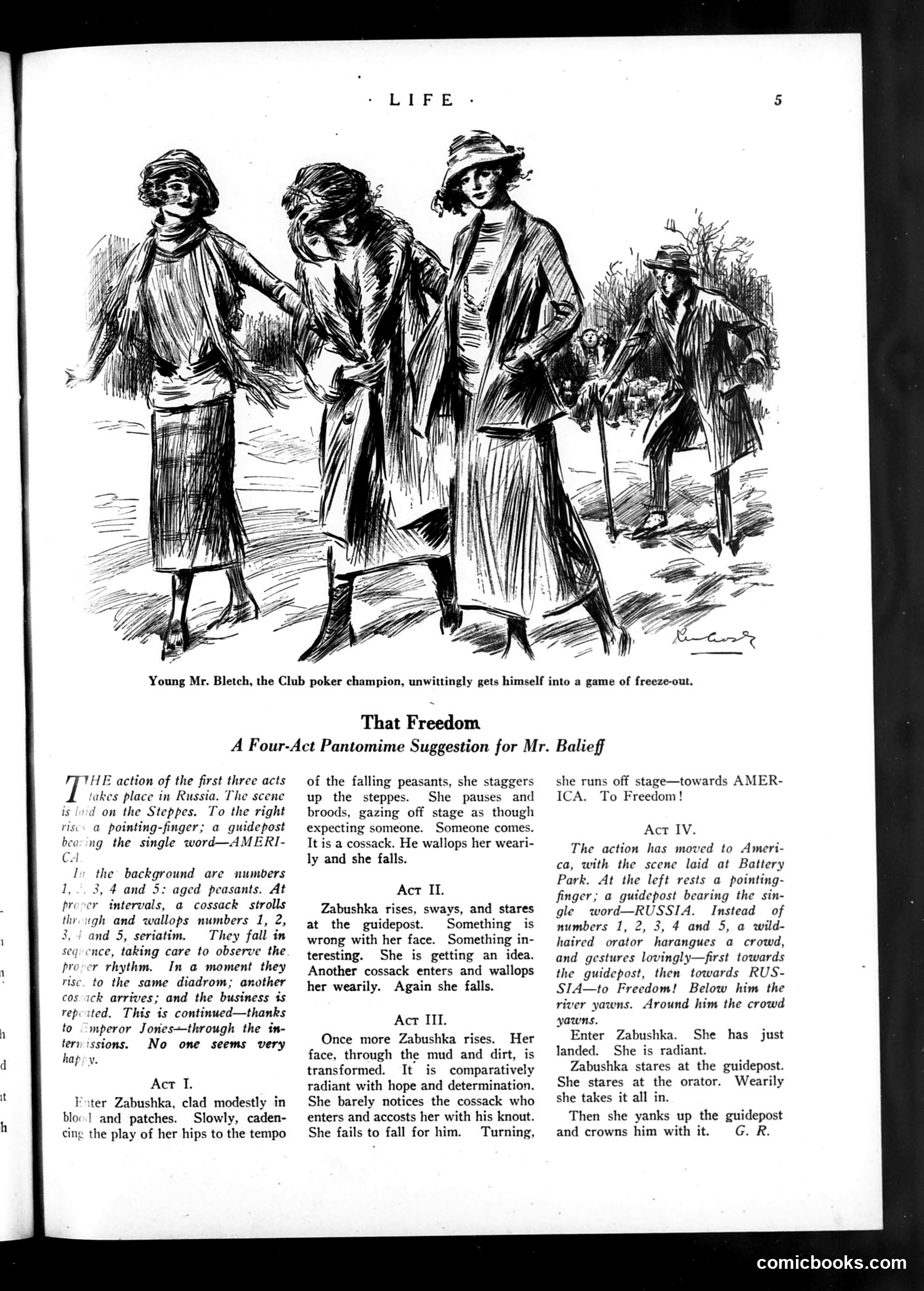
This page contains a sketch and a theatrical synopsis for "That Freedom," described as "A Four-Act Pantomime Suggestion for Mr. Balieff." The illustration depicts women in early 20th-century dress, with the caption referencing "Young Mr. Bletch, the Club poker champion, unwittingly gets himself into a game of freeze-out." The pantomime appears to satirize Russian peasant life on "the Steppes." The synopsis follows a character named Zabushka through four acts involving a cossack, a guidepost, and ultimately freedom ("SIA—to Freedom!"). The satire likely mocks Russian themes popular in contemporary theater while playing on the contrast between the sophisticated club setting of the cartoon caption and the dramatic Russian peasant scenario of the pantomime. The humor appears rooted in incongruity and theatrical absurdity rather than specific political commentary.
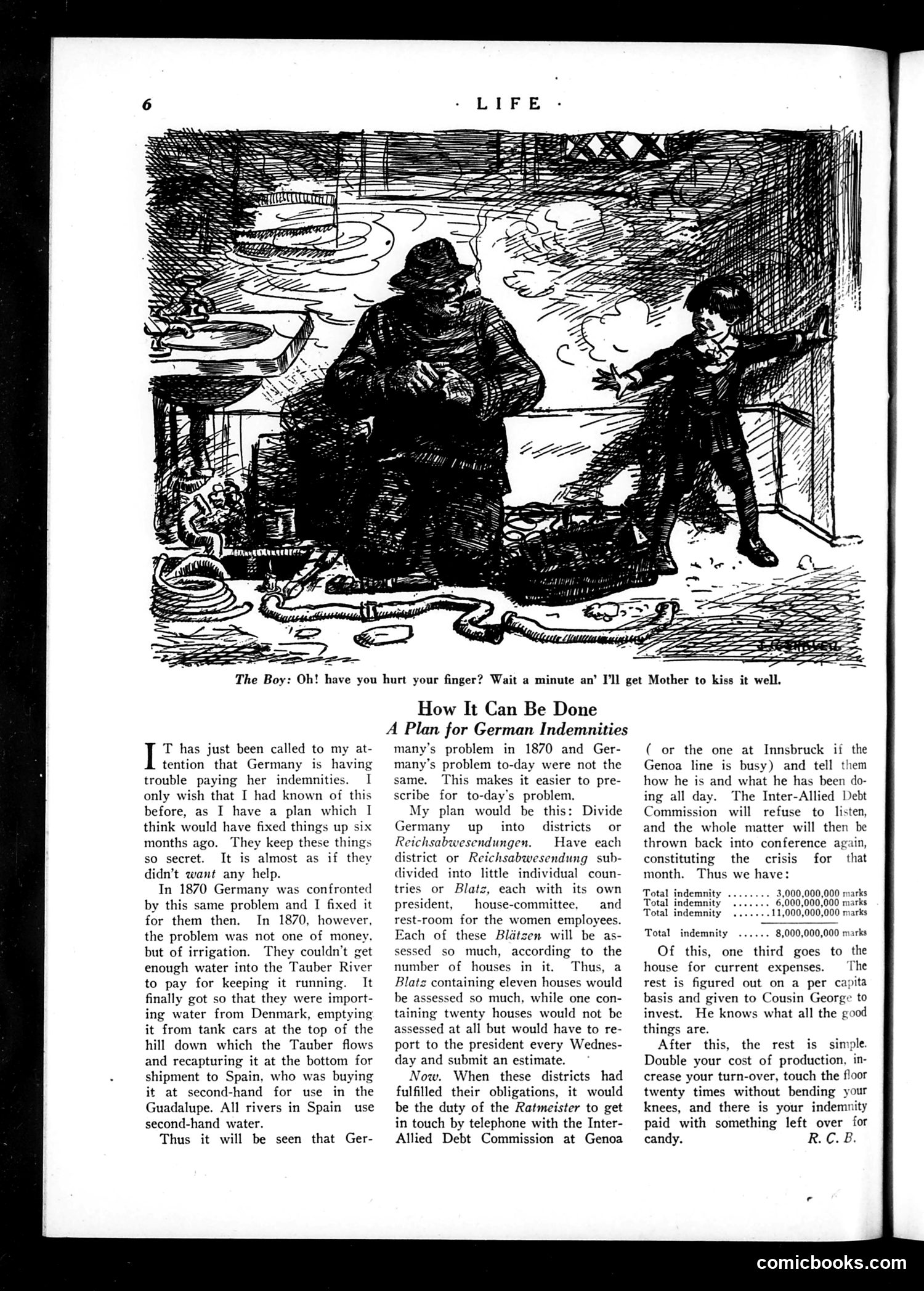
The cartoon depicts a domestic scene where a child has hurt their finger, and seeks comfort from their mother rather than the adult present (likely the father). The caption reads: "The Boy: Oh! have you hurt your finger? Wait a minute an' I'll get Mother to kiss it well." The accompanying article, "How It Can Be Done: A Plan for German Indemnities," addresses post-WWI reparations. The author proposes dividing Germany into administrative districts (Reichsbezirkssendungen) and Blätze (neighborhoods), each reporting financial assessments to an Inter-Allied Debt Commission in Genoa. Revenue would fund Allied war debts through systematic collection. The cartoon appears to mock ineffectual responses to complex problems—suggesting that Germany's indemnity crisis requires practical solutions, not sentimental gestures, much like a child's injury needs actual treatment.
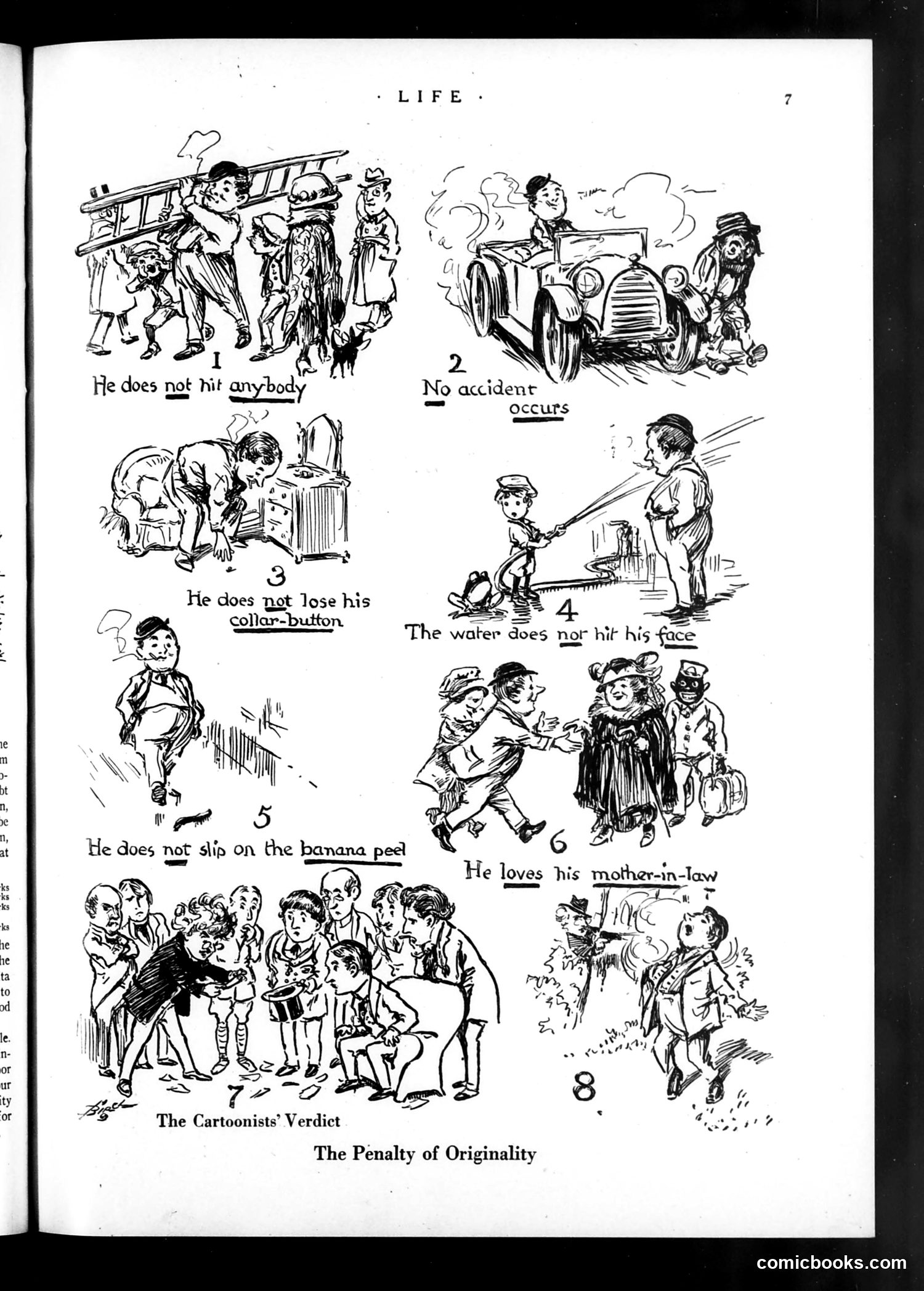
This satirical cartoon series mocks the concept of an "original man"—someone who defies social conventions and expectations. Each panel depicts increasingly absurd scenarios where this hypothetical nonconformist avoids common mishaps or social interactions: - He doesn't hit anybody (avoiding violence) - No accident occurs (safe driving) - He doesn't lose his collar-button (maintains propriety) - The waiter doesn't hit his face (no confrontation) - He doesn't slip on banana peels (avoids slapstick) - He loves his mother-in-law (defies stereotypical family tensions) Panel 7 shows "The Cartoonists' Verdict"—multiple figures examining this oddity with bewilderment, suggesting such originality is so rare and unnatural that it requires investigation. The satire implies early 20th-century society found true individuality bizarre and suspicious rather than admirable.
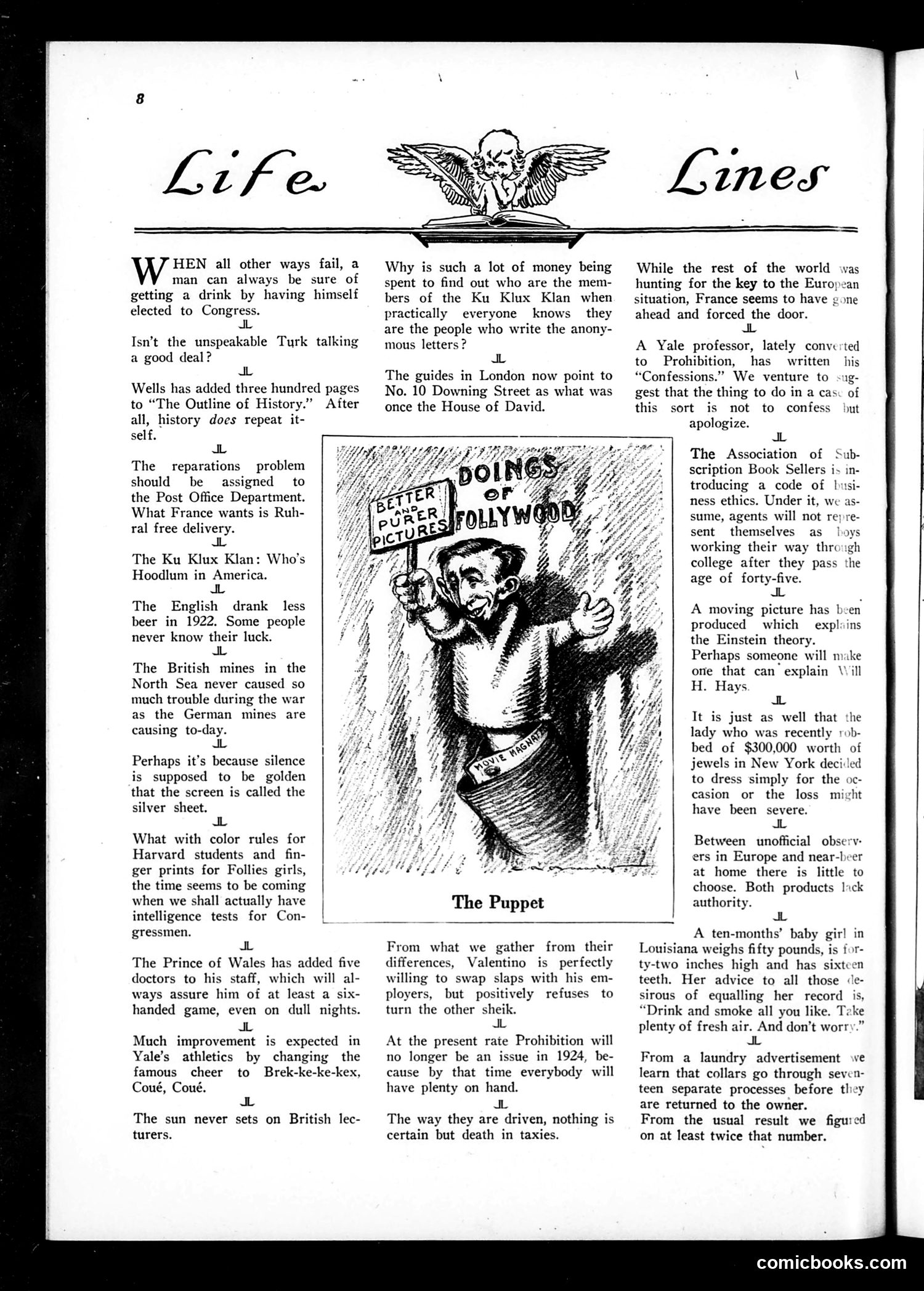
This cartoon depicts a chimpanzee or ape figure manipulating a smaller human puppet labeled "BETTER PICTURES FOLLYWOOD" (satirizing Hollywood). The image satirizes the film industry's control over its stars and content during the silent film era. The accompanying text references "Valentino" (likely Rudolph Valentino, the famous silent film star) and discusses his conflicts with studio management—specifically that he "positively refuses to turn the other sheek [sic]." This suggests disputes between Valentino and his studio bosses over roles and working conditions. The cartoon's point: major studios operated as puppet masters, controlling actors' careers and creative choices with little regard for the performers' own preferences or dignity.
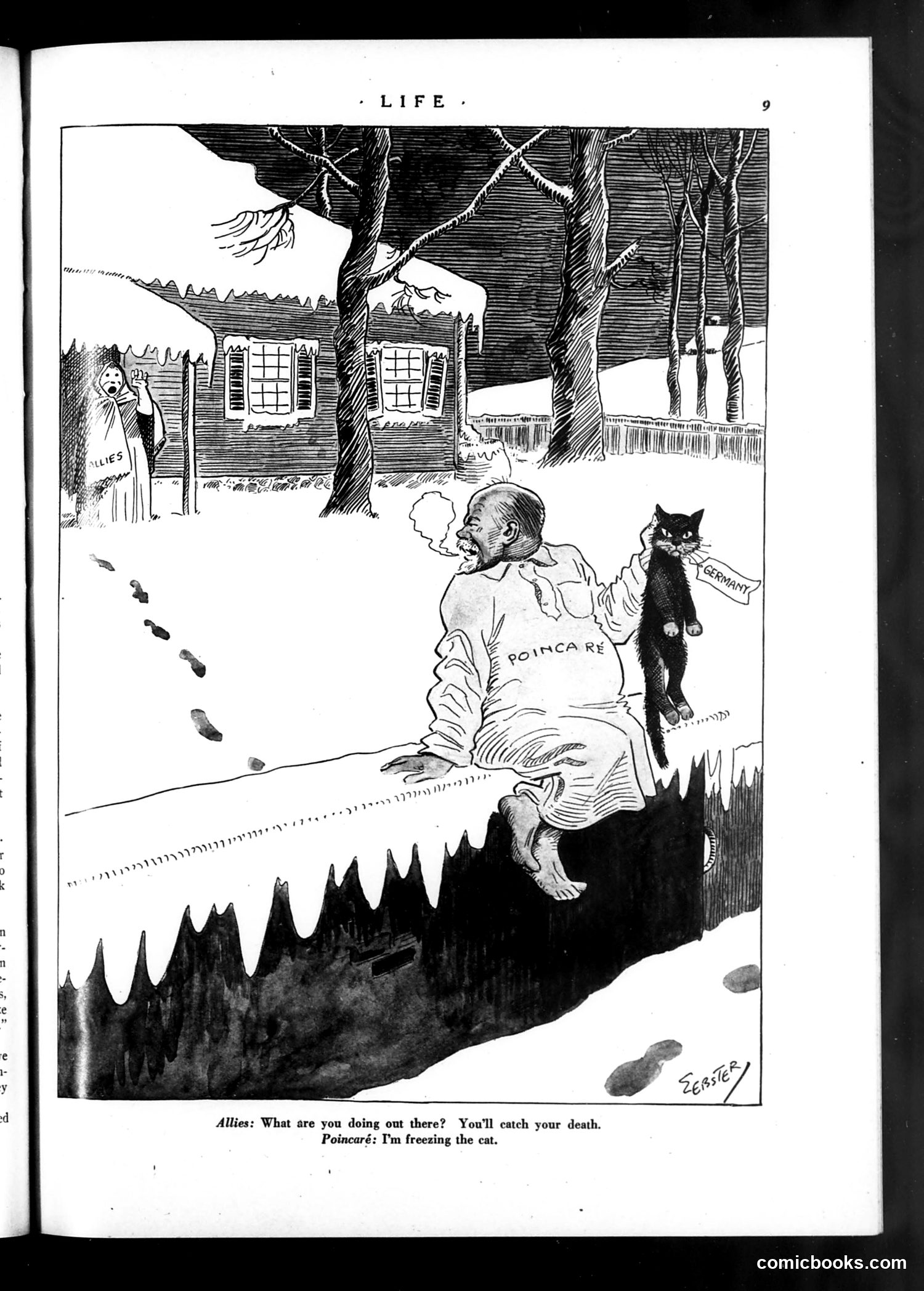
This cartoon depicts a man labeled "Poincaré" (French Premier Raymond Poincaré) sitting in snow, freezing a black cat while holding a document labeled "Germany." A figure in the background warns him he'll "catch his death." The satire comments on French-German relations, likely during the post-WWI period or Ruhr crisis. Poincaré is portrayed as literally freezing—suffering himself—in pursuit of harsh treatment toward Germany ("freezing the cat"). The cartoon suggests his aggressive stance against Germany is self-destructive, backfiring on France itself. The black cat may symbolize bad luck or misfortune resulting from his policy. The warning adds ironic commentary: his pursuit of punitive measures against Germany will harm France more than help it.
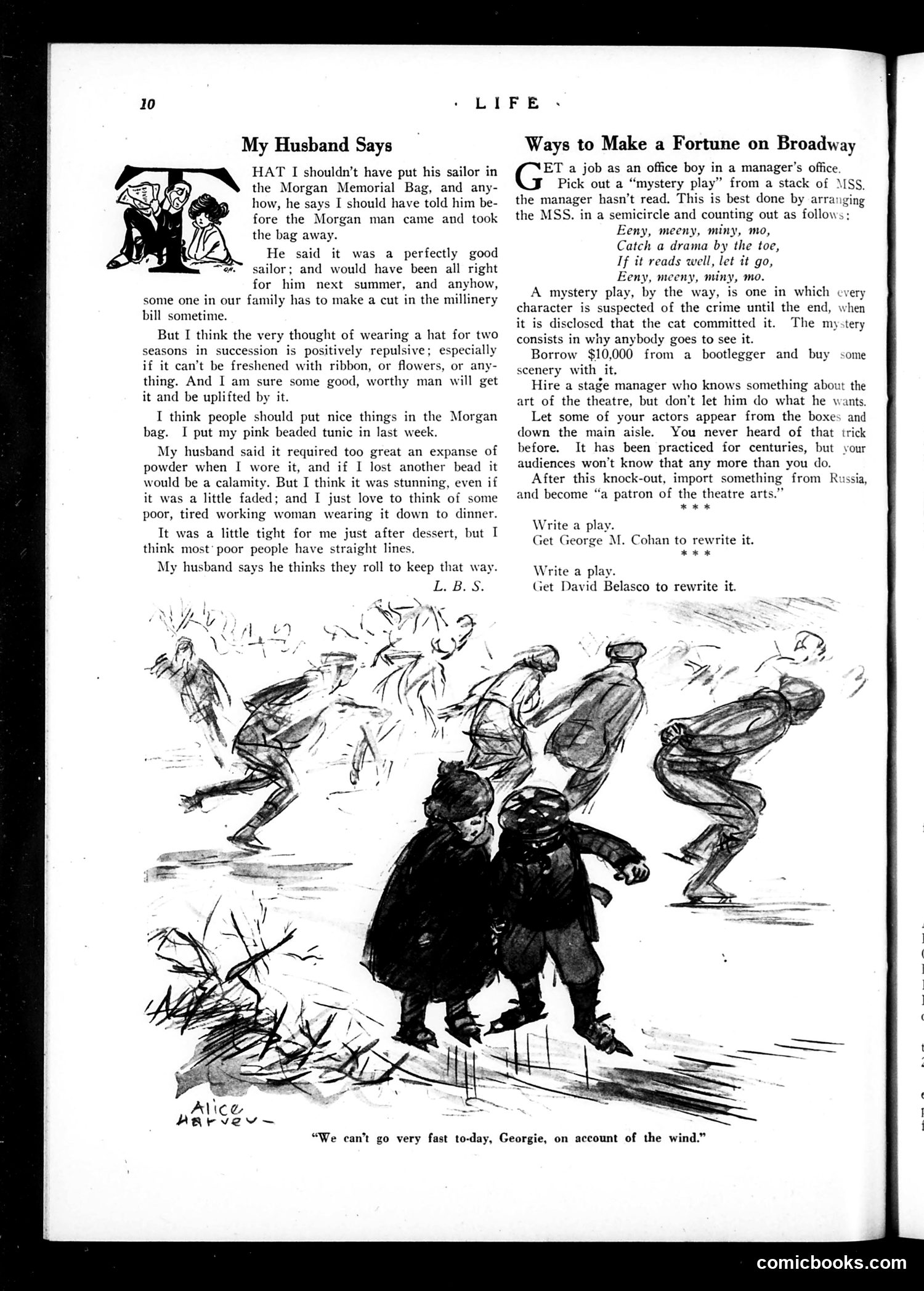
This page contains two distinct pieces: **"My Husband Says"** (left): A domestic humor column where a wife recounts her husband's complaint about her wearing a hat twice in succession—apparently wasteful extravagance. His suggestion that she wear it more frequently to justify the expense is presented as absurdly penny-pinching. The satire targets frugal husbands and Depression-era economic anxieties about household spending. **"Ways to Make a Fortune on Broadway"** (right): Tongue-in-cheek advice for aspiring theatrical producers, including hiring inexperienced office boys and mounting predictable mystery plays. It mocks Broadway's commercialism and low artistic standards. **Bottom cartoon** (by Alice Harvey): Shows two children struggling against wind, with the caption "We can't go very fast to-day, Georgie, on account of the wind"—gentle humor about childhood experiences.
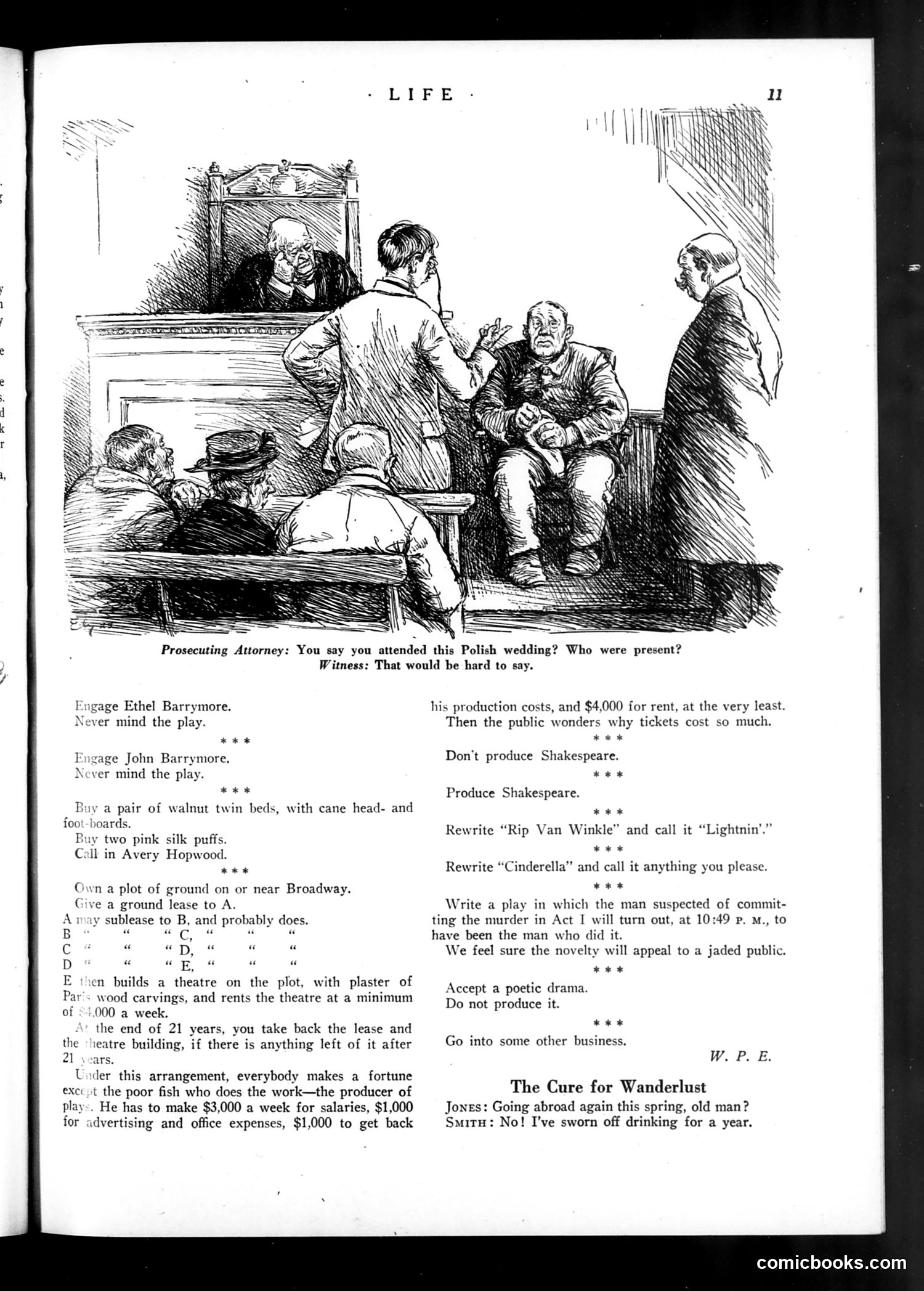
The main cartoon shows a courtroom scene where a prosecuting attorney questions a witness about a Polish wedding. The witness claims it would be "hard to say" who attended—a humorous evasion suggesting the wedding was either chaotic or the witness was intoxicated. Below are satirical advice columns mocking Broadway theater producers. The jokes suggest that theatrical producers become wealthy through exploitative schemes: buying cheap real estate near Broadway, subletting plots to investors, and renting the resulting theater at inflated prices. The advice columns sardonically recommend either producing Shakespeare plays or abandoning theater entirely for other business ventures—implying Broadway production is less about art than financial manipulation. The page reflects early 20th-century American attitudes toward both ethnic communities (Polish immigrants) and entertainment industry practices.
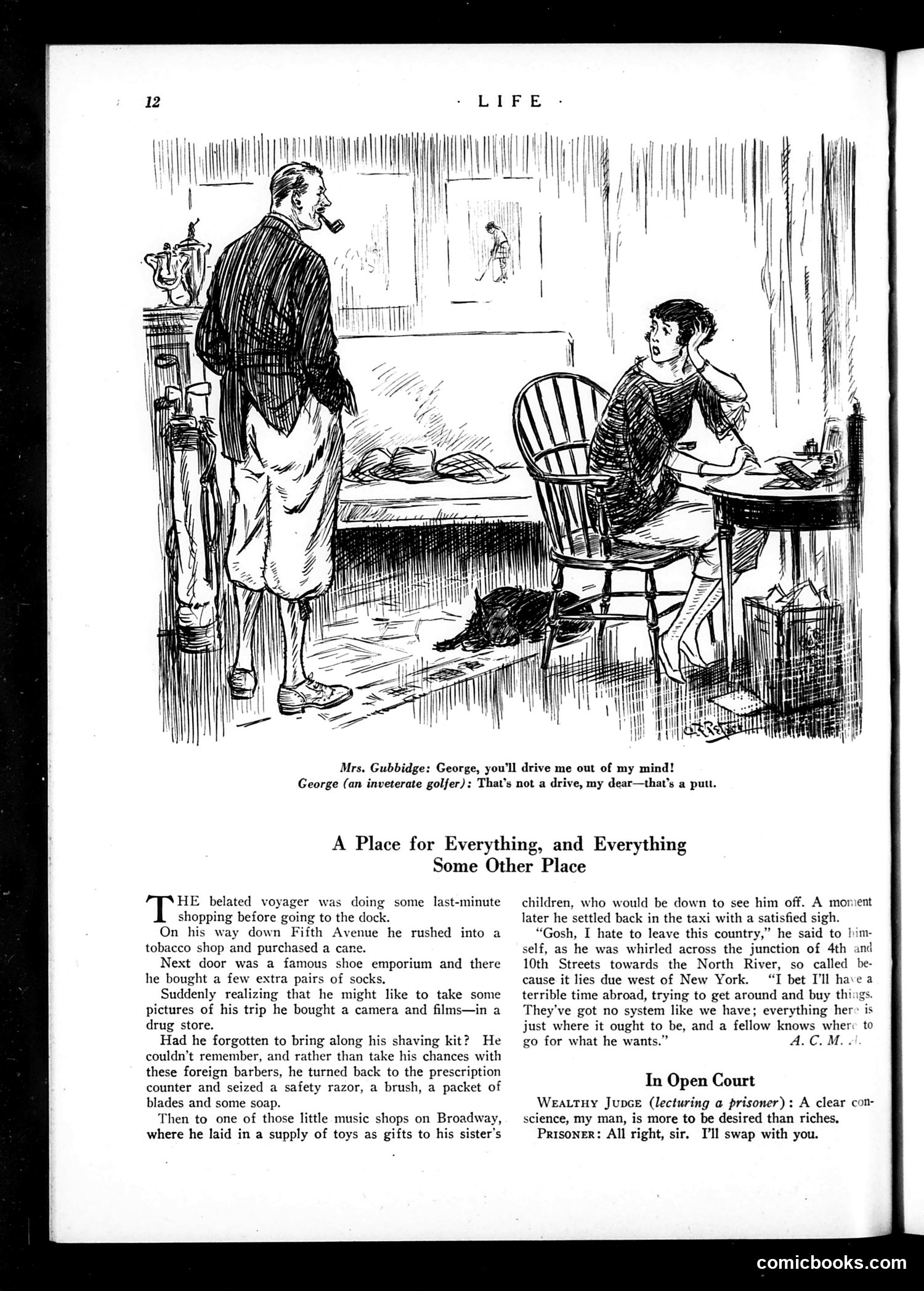
The top cartoon depicts a domestic argument between a husband and wife. The husband (George) is an "inveterate golfer" who has apparently made a poor golf shot. His wife Mrs. Gubbidge complains he'll "drive me out of my mind," but George defensively insists it was "a putt, not a drive"—a technical golf distinction meant as a joke about his obsession with the sport. The story below, "A Place for Everything, and Everything Some Other Place," humorously describes a traveler's last-minute shopping habits before a trip—buying items at various New York shops in haphazard fashion. It satirizes disorganized travel preparation and the American consumer's impulse to shop for "everything" needed for a journey.
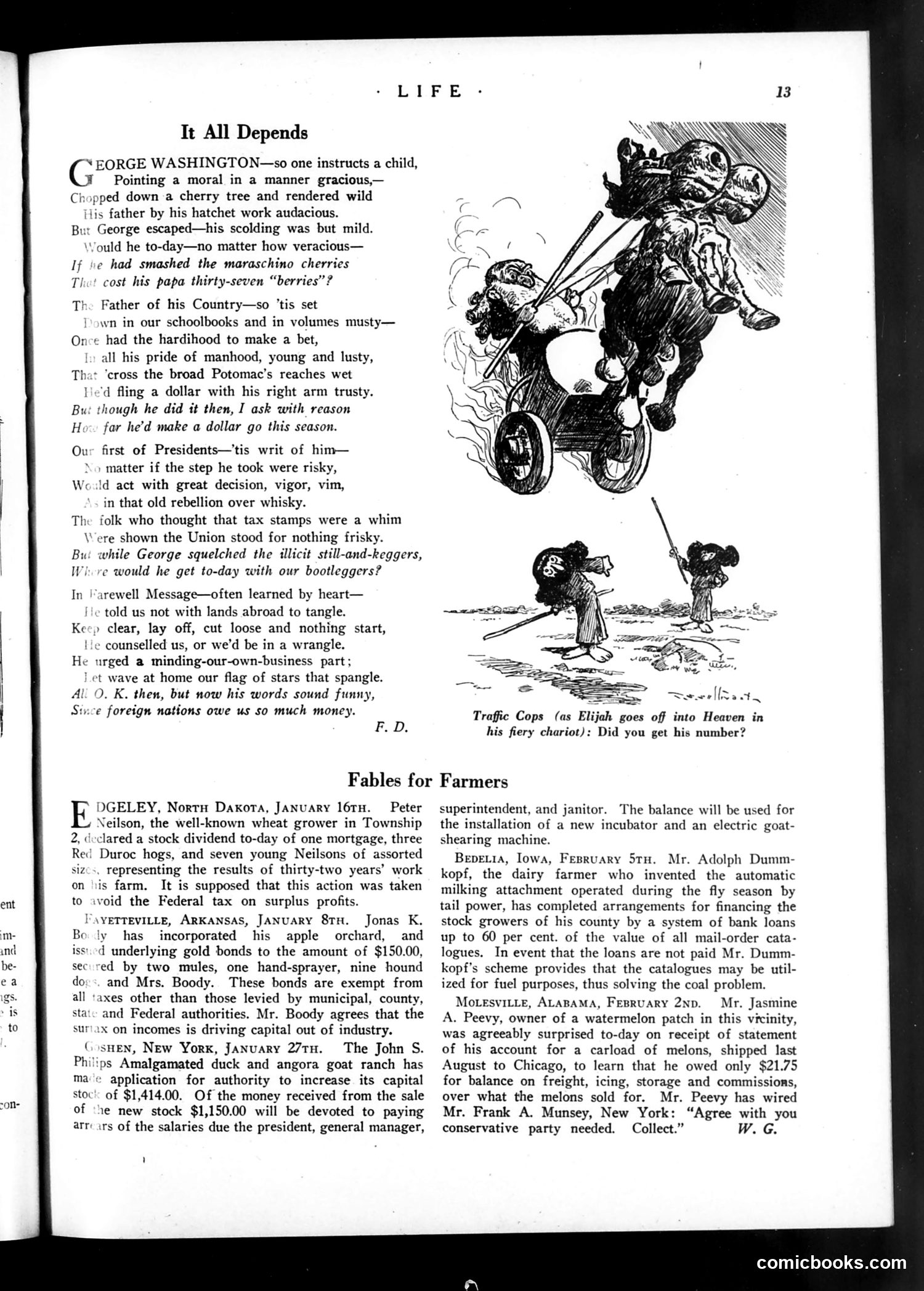
**"It All Depends" Poem:** This is a satirical poem about George Washington, playing on the famous (and likely apocryphal) cherry tree legend. The joke inverts the moral lesson: while Washington's father mildly scolded him for chopping down the tree, the poem asks what would happen if young George had *smashed* the expensive maraschino cherries instead—suggesting the punishment would have been far worse for destroying valuable goods than for destroying nature. **"Traffic Cops" Cartoon:** The lower illustration appears to show figures using poles or implements near water, with a caption making a crude joke about someone "going off into Heaven in his fiery chariot" and asking if you "got his number"—likely a dark humor reference to a traffic accident or death. The page primarily contains political/social satire typical of Life magazine's early 20th-century commentary.
This Life magazine page (February 22, 1923) contains editorial commentary on European politics rather than a traditional cartoon. The text discusses Congress's reluctance to ratify the British debt agreement, French military intervention in Germany's Ruhr region, and diplomatic tensions surrounding Turkey. The article critiques the apparent apathy of the United States toward European settlement while noting that real power in Germany rests with industrial leaders rather than politicians. It references negotiations with Turkey and suggests that diplomatic efforts remain deadlocked. The small illustrations appear decorative rather than satirical. The commentary suggests American isolationism and skepticism toward European political solutions were key concerns for Life's editors in the early post-war period.
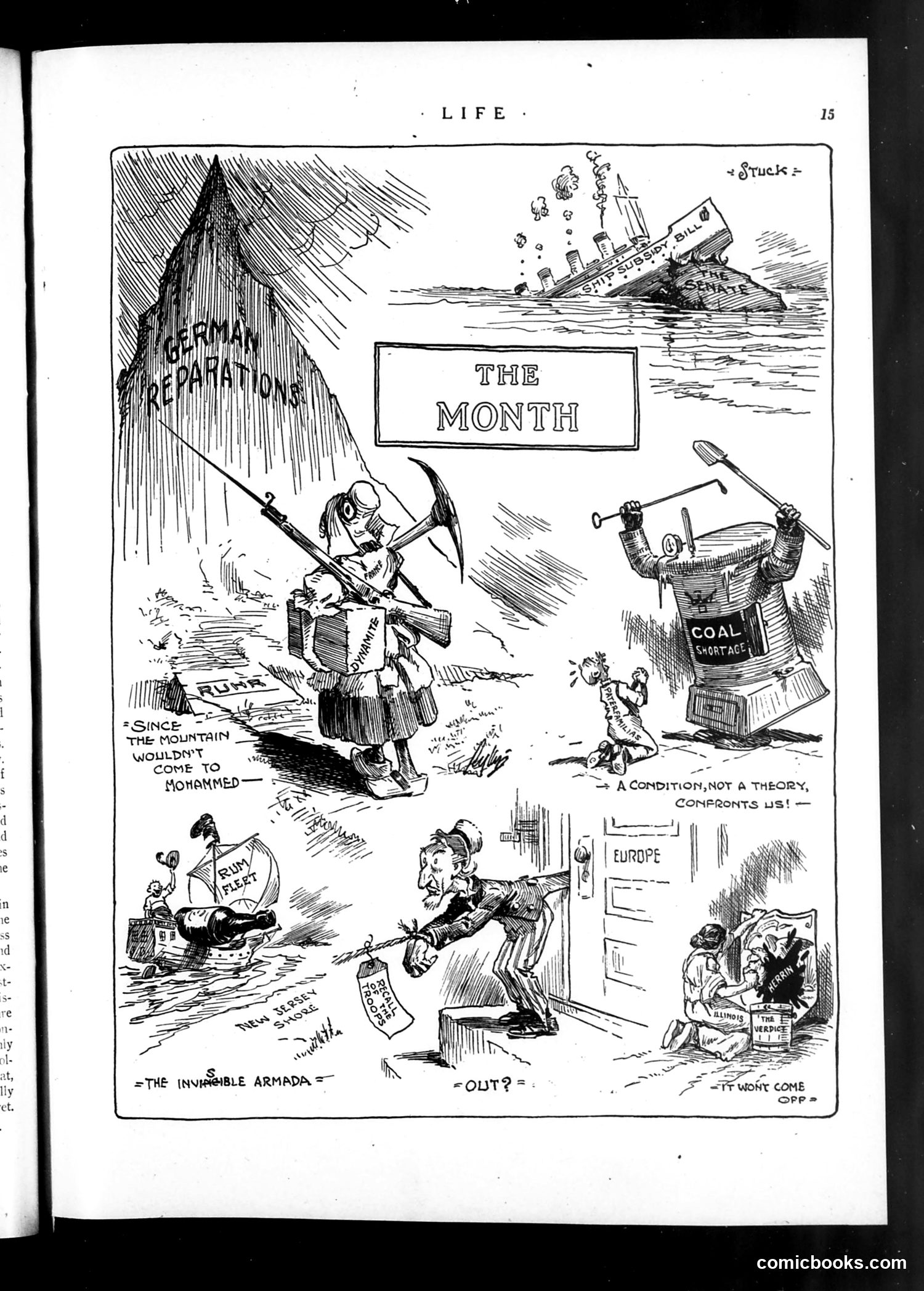
This satirical page from *Life* magazine presents multiple vignettes commenting on contemporary crises. The central metaphor references the proverb "If the mountain won't come to Mohammed" to suggest problems demanding action rather than theoretical debate. The cartoons depict: a sinking warship labeled "Senate" and "Bills" (legislative gridlock); a figure buried under "German Reparations"; a coal shortage crisis; and what appears to be European instability. One panel references "The Invincible Armada," invoking Spain's historical naval defeat. The overall message criticizes government and international inaction during multiple simultaneous crises—likely post-WWI economic chaos, reparations disputes, and resource shortages. The satire suggests that discussing conditions theoretically is insufficient; urgent, concrete solutions are needed to prevent disaster.
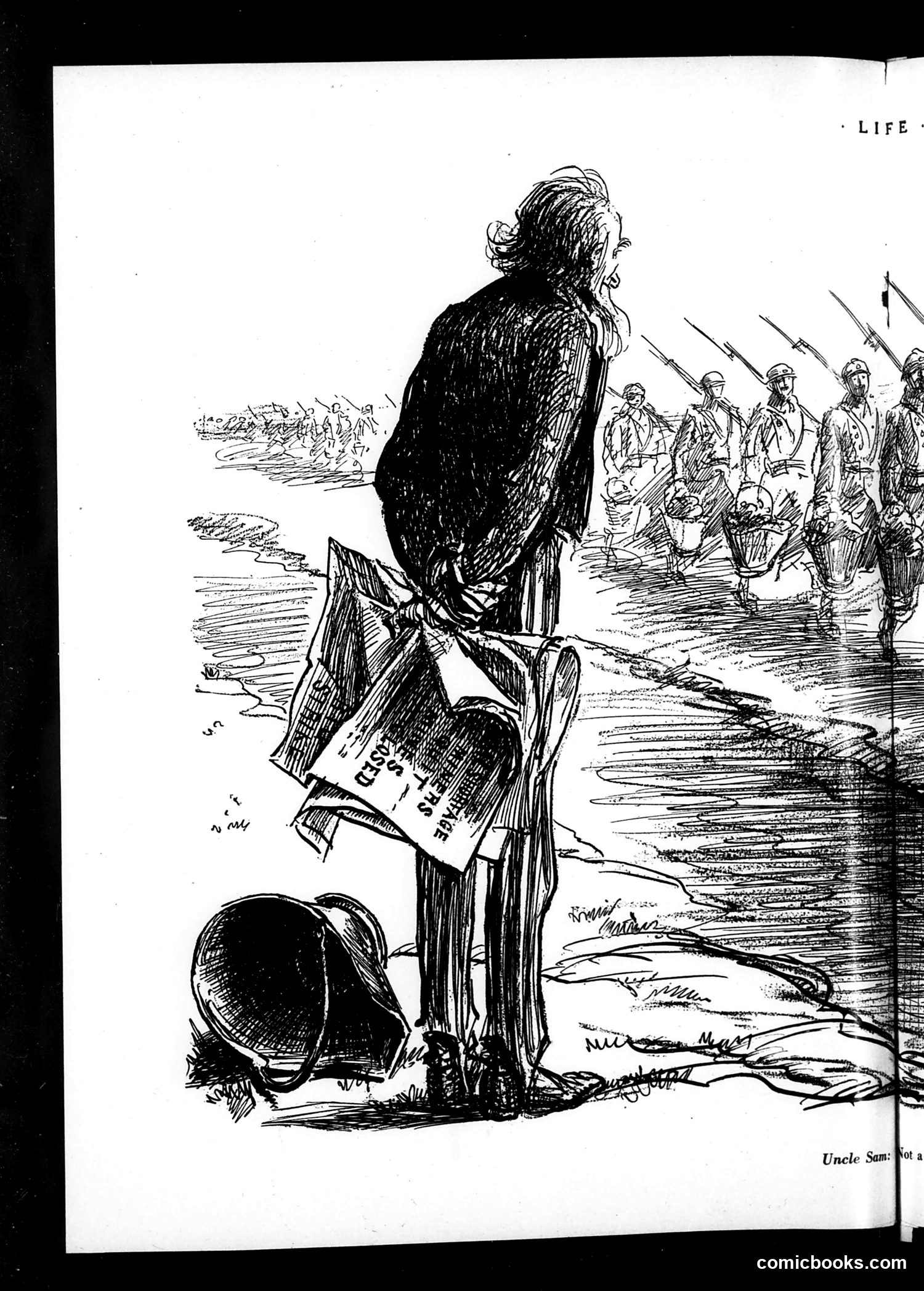
This is a political cartoon titled "Uncle Sam" (visible at bottom right). It depicts an elderly Uncle Sam figure standing on a beach, wearing tattered clothing and carrying a bag labeled "COST OF WAR." He observes armed soldiers wading ashore in the distance, carrying supplies and weapons. The cartoon critiques the economic burden of military conflict on America. Uncle Sam—the personification of the United States government—is impoverished and worn down by war expenses, while young soldiers continue to be sent into combat. The satire suggests that while individual soldiers carry out military operations, the nation itself is being financially drained and exhausted by the cost of warfare. The image likely comments on American military involvement, possibly during World War I or another major conflict.
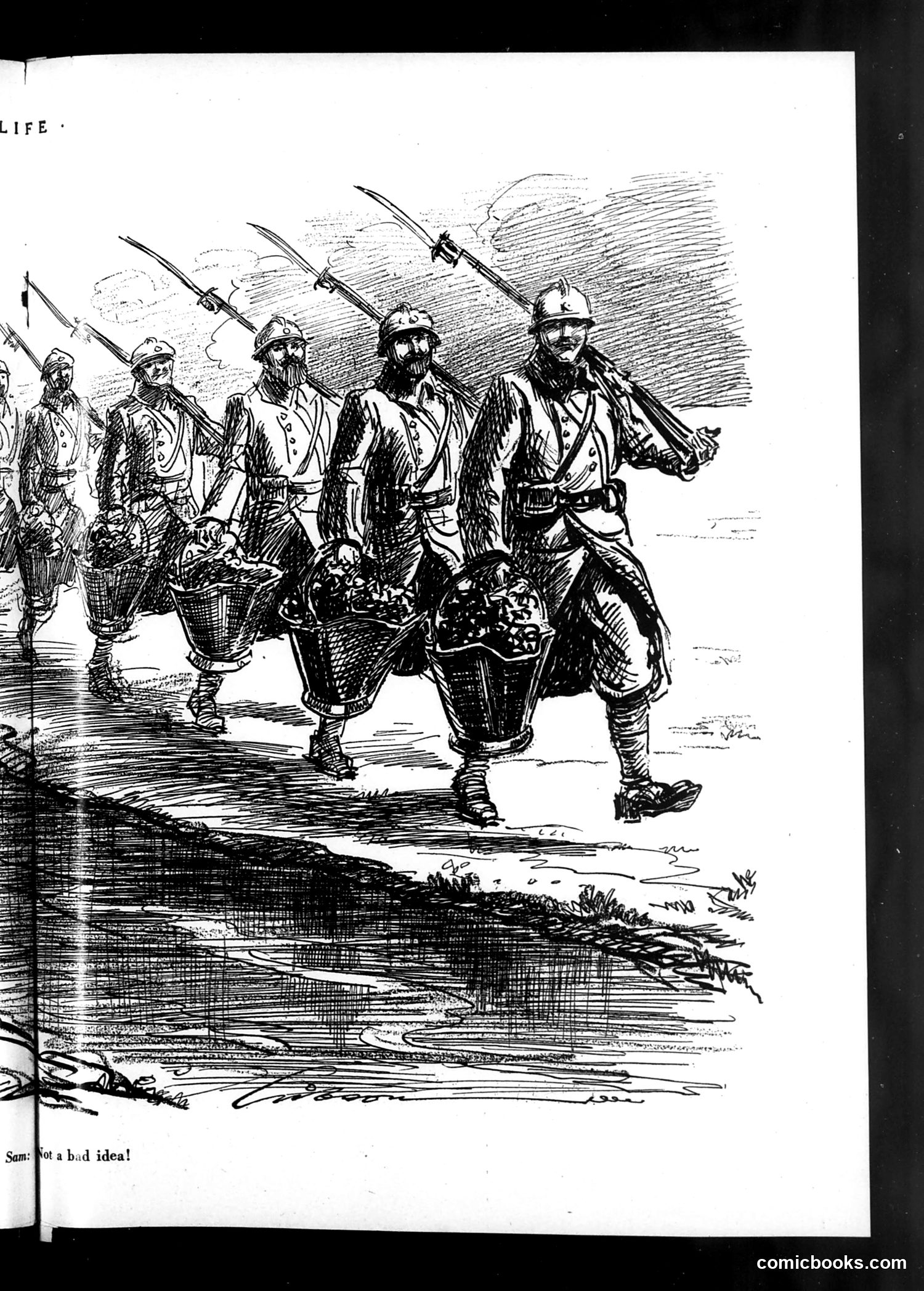
This appears to be a satirical military cartoon from Life magazine. It depicts a line of soldiers wearing distinctive spiked helmets (Pickelhaube) and military uniforms, carrying long spears or pikes. Based on the helmet style, these likely represent German or Prussian soldiers, probably from World War I era. The caption "Not a bad idea!" suggests ironic commentary—though the exact reference is unclear without fuller context. It may be satirizing a proposed military tactic, strategy, or equipment choice. The soldiers' somewhat antiquated weaponry (spears alongside modern uniforms) might mock the mixing of old and new military approaches, or comment on perceived strategic absurdity in contemporary warfare. The illustration's style and subject matter are consistent with American satirical commentary on European military conflicts during the early 20th century.
This theater criticism column satirizes Broadway's musical comedy conventions while praising the Shubert theatrical company. The main targets are: - **"Commercial managers"** who rely on cheap spectacle (red spotlights on women in black dresses) rather than musical quality - **The Shuberts' competitors**, implicitly those offering inferior productions - **Generic operetta tropes**: tedious plots featuring women in hoop skirts using masks to "fool her lover"—dismissed as unfunny and contrived The author praises the **Shuberts** for producing "Blossom Time" and "Caroline" with actual talented singers (Tessa Kosta, Eleanor Painter, Peggy Wood) and serious musical scores, even while mocking "Caroline" as dull and German-imported. The **Theatre Guild** receives backhanded praise for ambition ("glutton for hard work") while staging Shaw and Ibsen, though the critic insists "Peer Gynt" "just isn't much of a play." The comparison to T.S. Eliot's "The Waste Land" suggests both are respected but dramatically inert. The satire ultimately celebrates **highbrow entertainment** while mockingly documenting Broadway's persistent mediocrity.
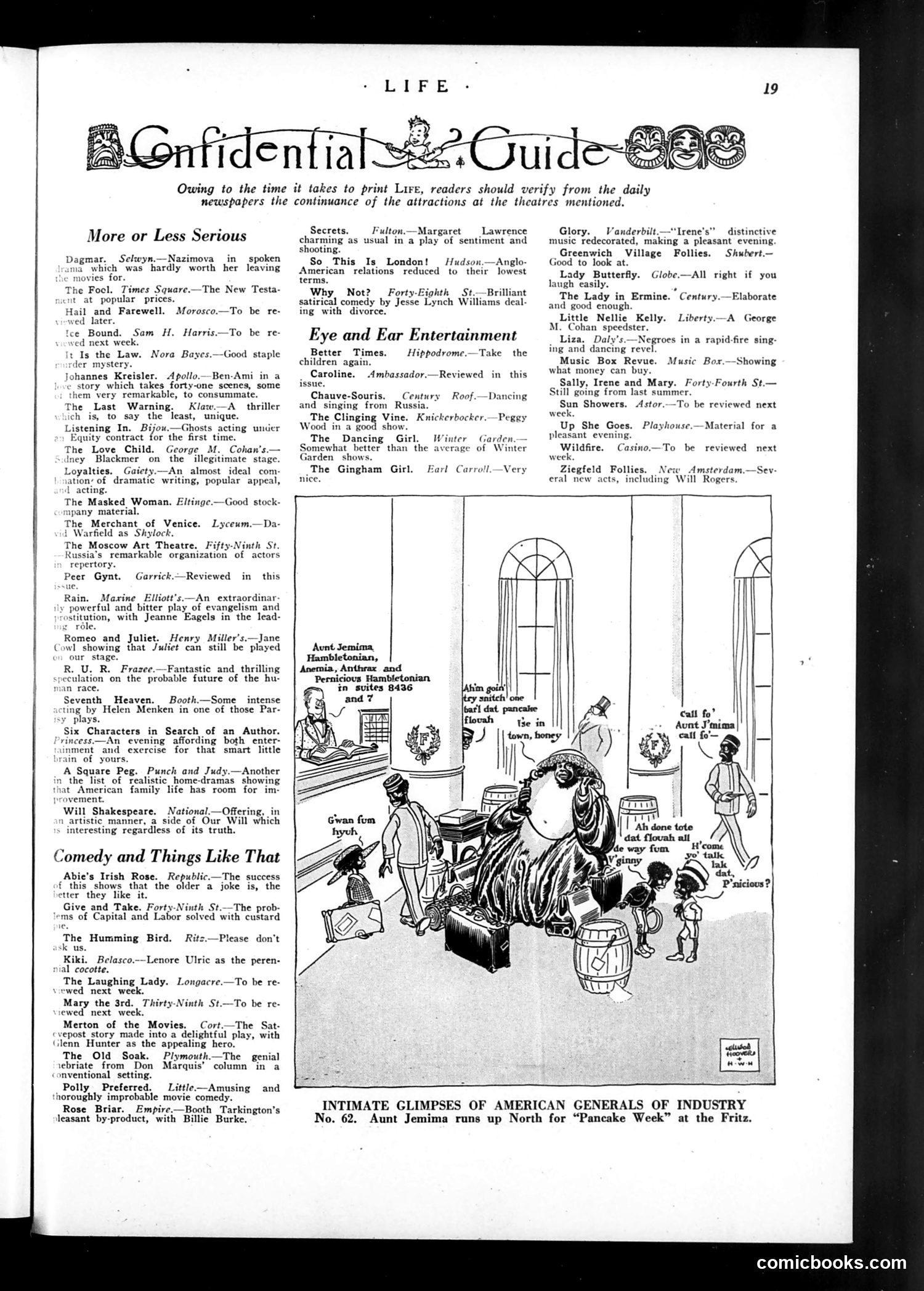
This is a theater guide page listing Broadway shows with brief reviews, typical of Life magazine's entertainment coverage. The main cartoon illustrates "Aunt Jemima runs up North for 'Pancake Week' at the Fritz"—a satirical reference to a popular advertising character of the era. The cartoon depicts Aunt Jemima (a racist minstrel-derived advertising mascot promoting pancake mix) arriving at what appears to be a fancy restaurant or hotel, creating comedic discord between her stereotyped Southern Black identity and the upscale urban setting. The "Intimate Glimpses of American Generals of Industry" subtitle suggests satire about corporate commercialism. The humor relies on period-typical racial stereotyping and the incongruity of a product mascot appearing in high society. Modern readers would recognize this as reflecting both the casual racism embedded in early 20th-century advertising and Life's satirical use of popular commercial imagery for social commentary.
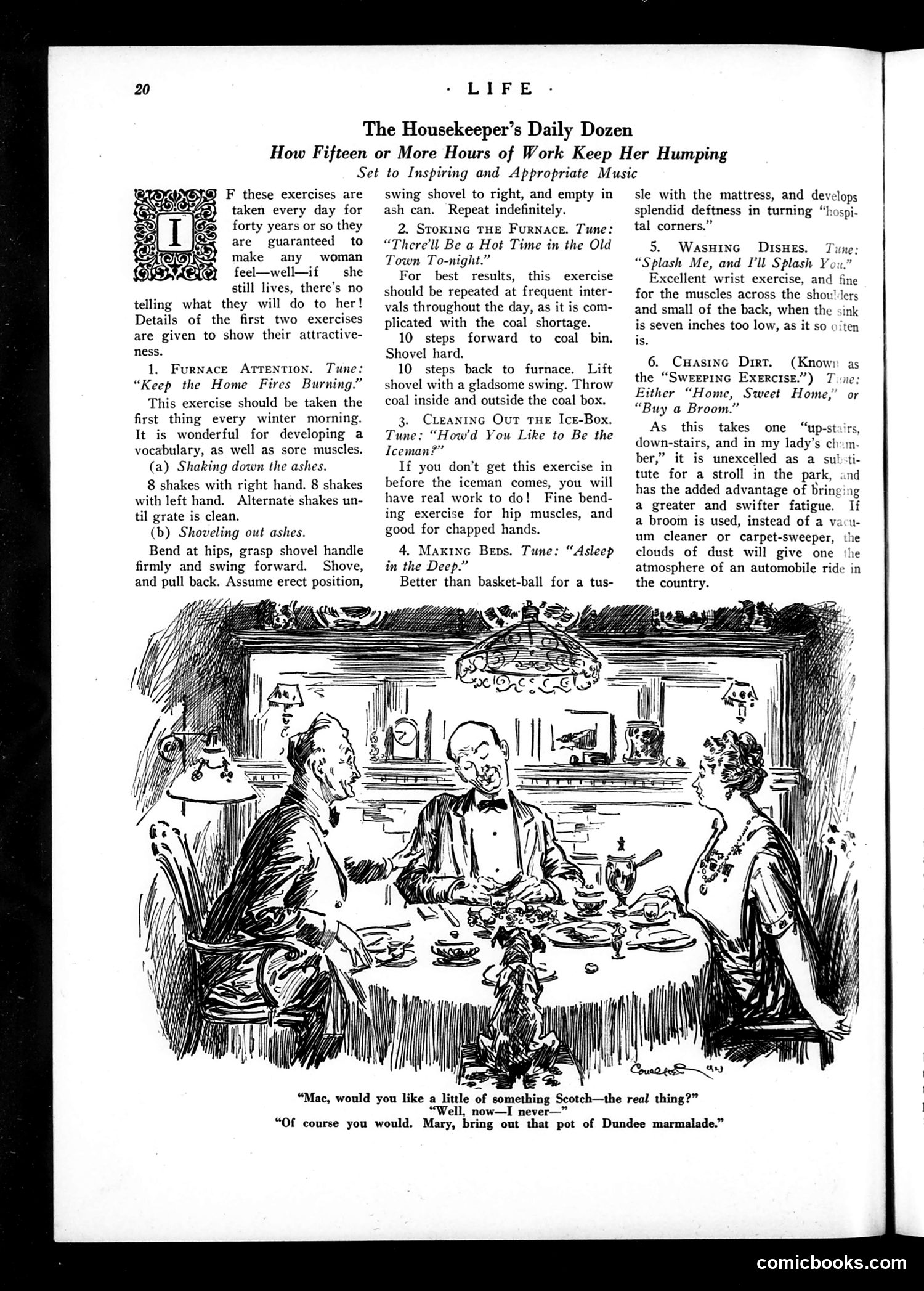
This is a satirical piece mocking the era's "Daily Dozen" exercise craze (a popular 1920s fitness program) by reframing grueling housework as athletic training. The satire operates on multiple levels: **The Core Joke:** Women's unpaid domestic labor—furnace maintenance, dishwashing, cleaning—is presented as if it were legitimate exercise, complete with sheet music cues. The deadpan tone ("guaranteed to make any woman feel—well—if she still lives") undercuts the relentless physical demands. **Social Critique:** The piece highlights the absurdity of women working 15+ hours daily at physically taxing tasks while being denied recognition of this as "real" work. By comparing housework to fashionable exercise, it exposes how society trivializes women's labor. **The Cartoon:** The lower illustration shows a dinner party where a man asks for "something Scotch—the real thing," only to be served Dundee marmalade instead—a simple joke about Scottish imports and domestic substitution. The satire targets both unrealistic fitness trends and women's exhausting, undervalued domestic roles in this period.
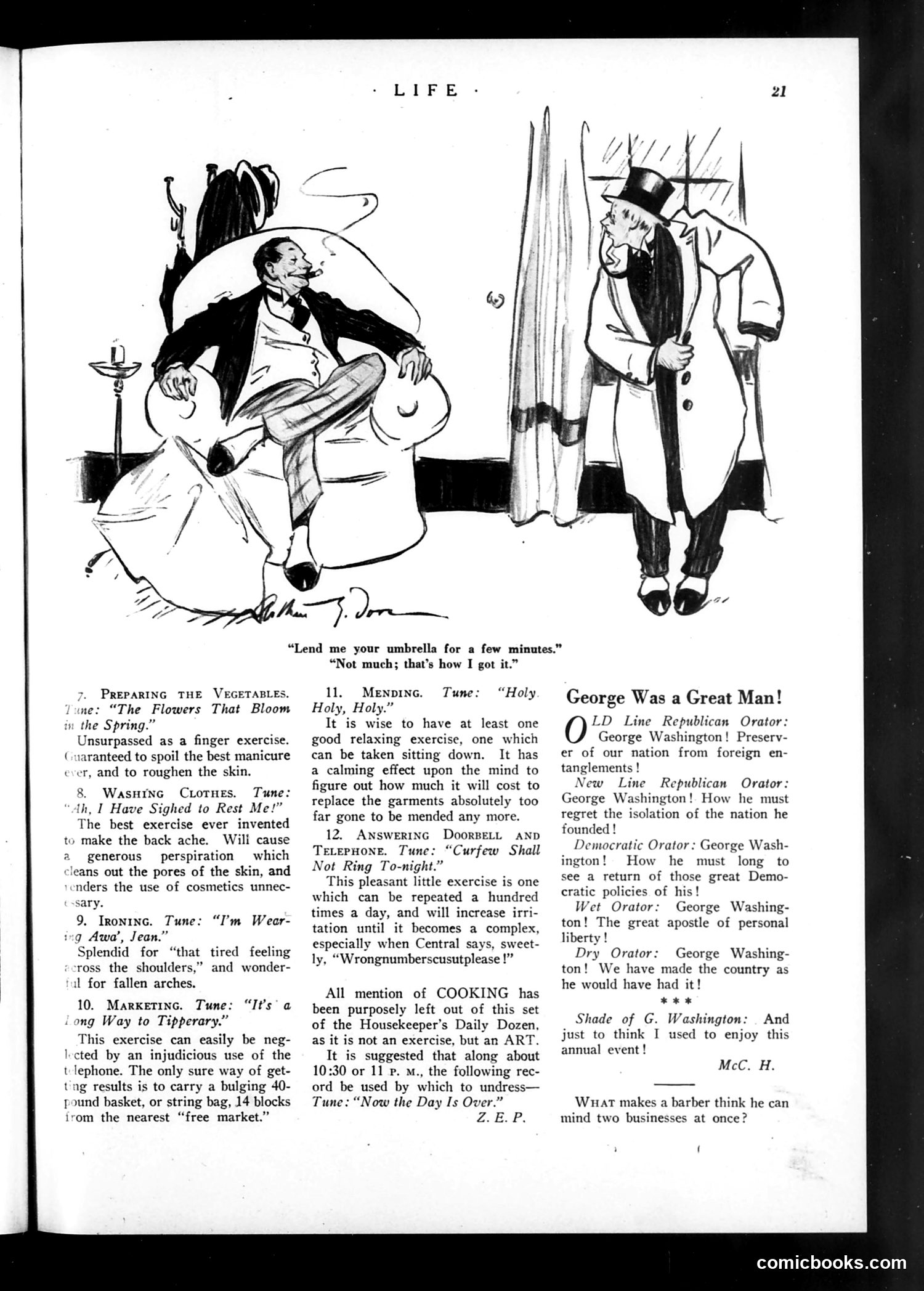
This page presents household humor targeting women's domestic labor. The left cartoon mocks a man borrowing an umbrella while his companion holds one—the caption "Not much; that's how I got it" suggests he obtained his through similar manipulation rather than purchase. The numbered items (7-12) comprise a "Housekeeper's Daily Dozen"—exercises disguised as household chores. Each task (vegetable prep, laundry, ironing, marketing, mending, answering phones) is presented ironically as beneficial exercise, with matching tune titles. The satire critiques how housework was simultaneously devalued as "not real work" while being physically exhausting. The right section mocks political rhetoric about George Washington. Different orators—Old Republican, New Republican, Democrat, Wet (anti-Prohibition), and Dry (pro-Prohibition)—each claim Washington supports their contradictory positions. Washington's "shade" observes this annual politicization with weary resignation, satirizing how historical figures are manipulated to justify contemporary partisan agendas.
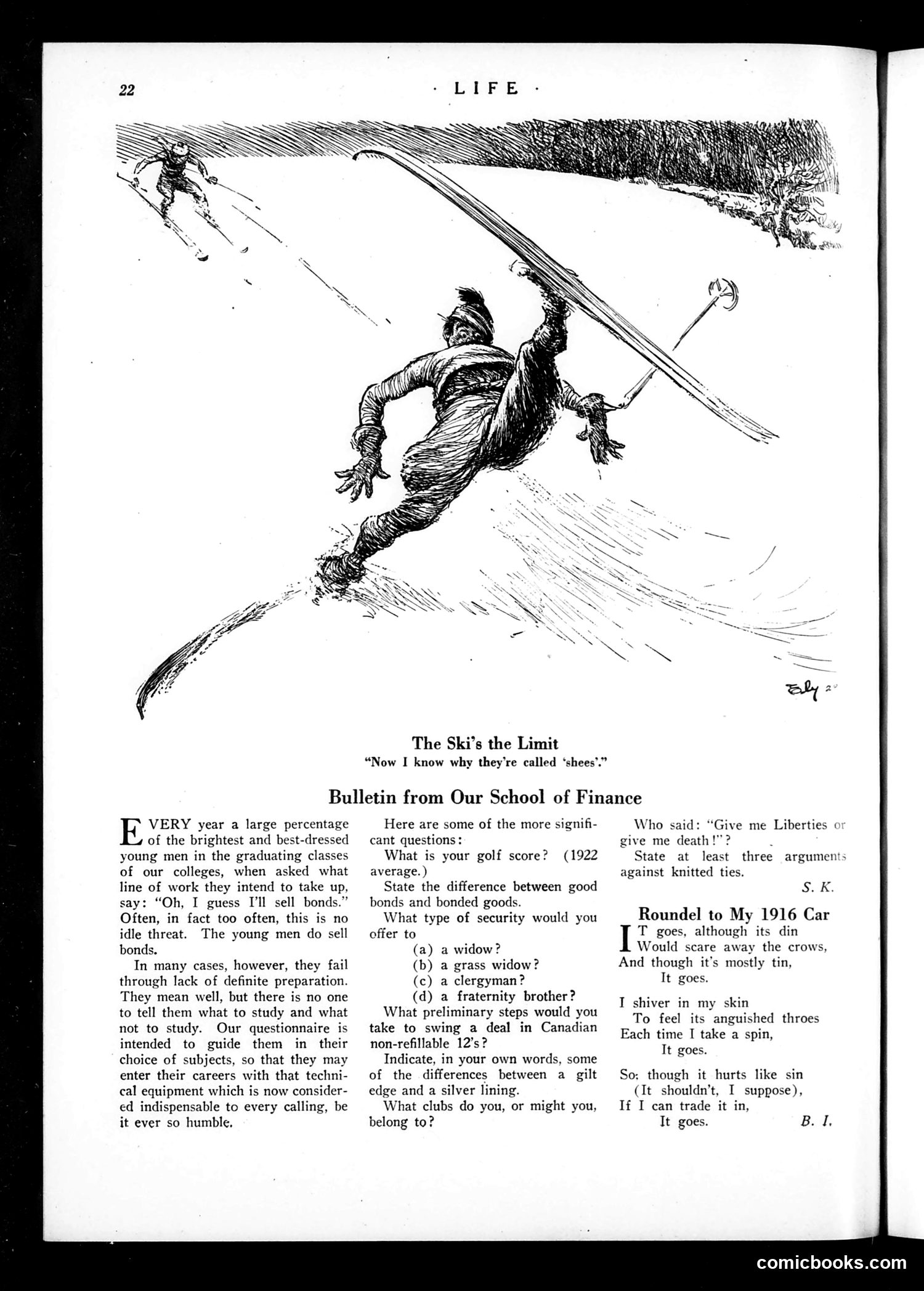
The top cartoon mocks skiing as a dangerous sport—a skier tumbles uncontrollably down a slope while another skier watches. The caption "Now I know why they're called 'shees'" is a pun: skis sound like "she's" (as in "she is"), suggesting the sport makes one exclaim feminine expressions of distress. The "Bulletin" section satirizes the 1920s trend of college graduates entering bond sales with minimal preparation. Life ridicules this by presenting absurd "interview questions" for aspiring bond salesmen: golf scores matter more than finance knowledge; candidates should know the difference between "gilt edge" and "silver lining" (wordplay on investment terms); selling to widows and clergymen are presented as equivalent challenges. The satire targets both the young men's shallow ambitions and the financial industry's apparent lack of rigorous standards—anyone could apparently sell bonds if they golfed well and belonged to the right clubs.
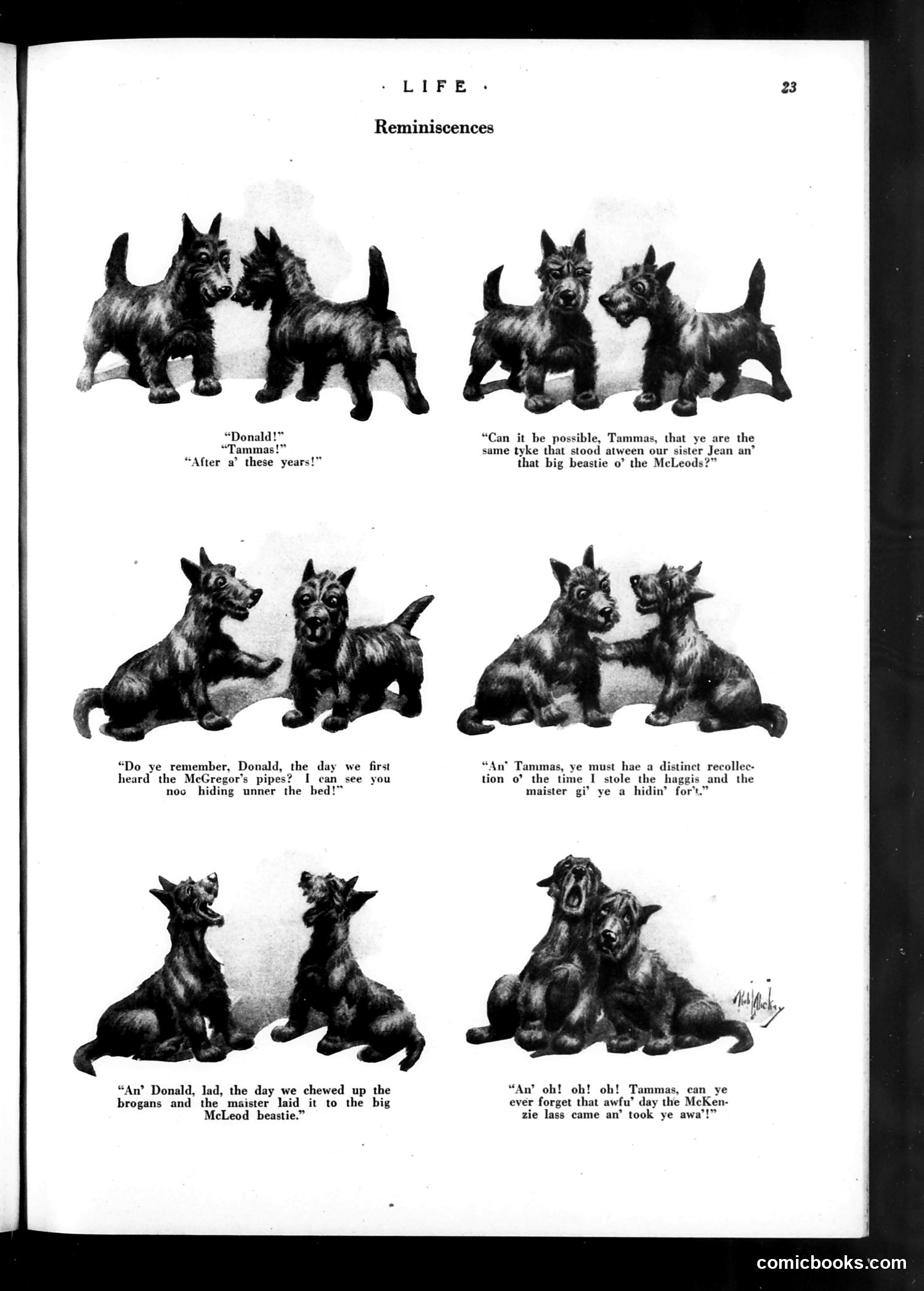
This is a humorous comic strip featuring two Scottish terrier dogs named Donald and Tammas reminiscing about shared childhood memories. The dialogue uses Scottish dialect ("tyke," "hae," "awa'") to establish the dogs as Scottish characters. The satire works through anthropomorphization—the dogs recall typical mischievous dog behaviors (hiding from bagpipes, stealing food, chewing shoes) but narrate them as if recounting human life experiences. The jokes reference Scottish cultural elements: McGregor's bagpipes, haggis (traditional Scottish dish), and the McKenzie family. The humor lies in the contrast between the dogs' dignified, nostalgic tone and the silly incidents they're describing. It's gentle, sentimental comedy playing on Scottish identity and the universality of childhood pranks—whether experienced by humans or pets. The strip appears designed for light entertainment rather than sharp political satire.
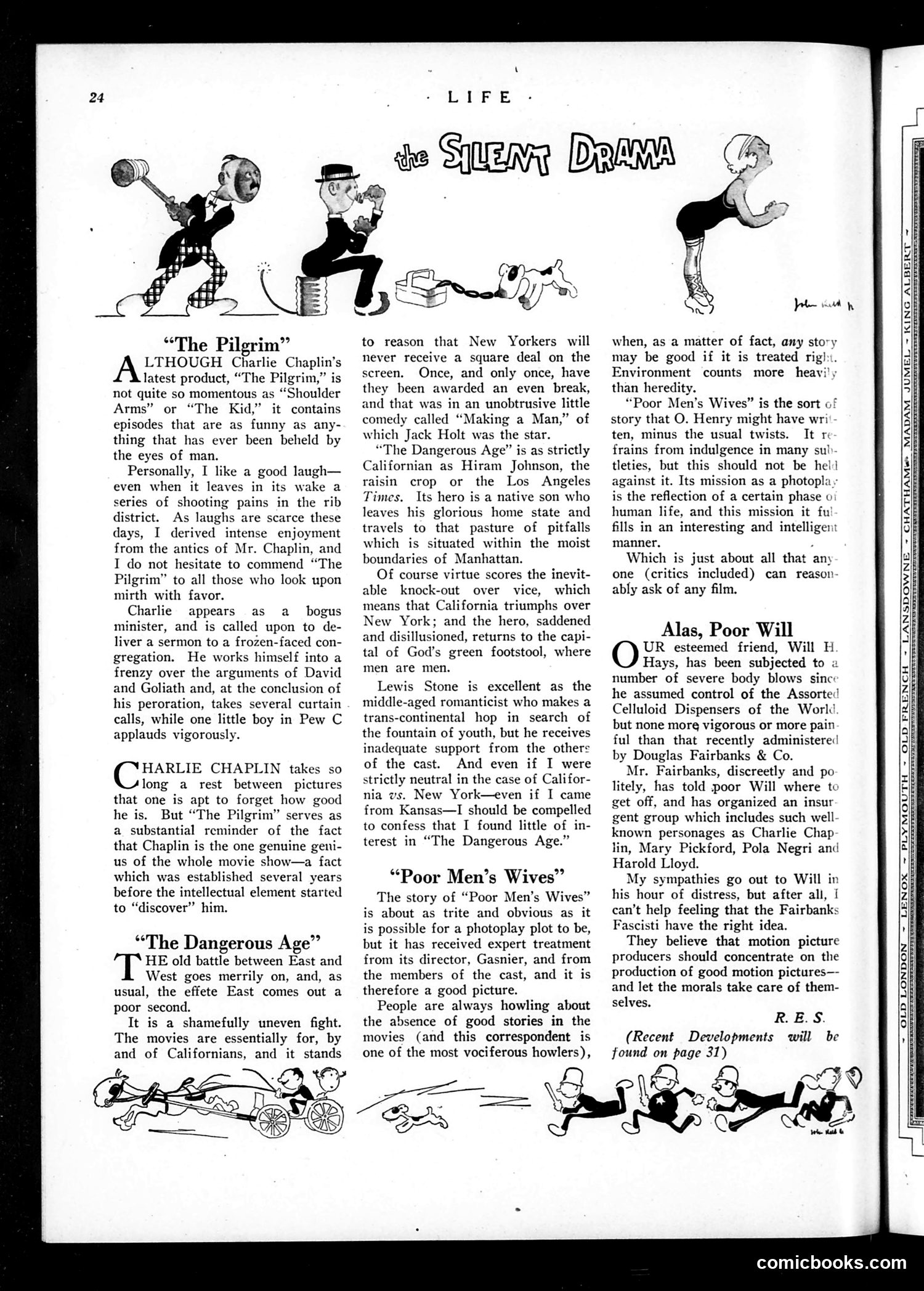
This page reviews three silent films, with satirical cartoons illustrating each. The cartoons show physical comedy and slapstick—Charlie Chaplin performing exaggerated poses, characters tumbling—reflecting the era's silent film humor. **The reviews discuss:** 1. **"The Pilgrim"** - Chaplin plays a fraudulent minister delivering a sermon. The critic praises Chaplin as genuine cinema "genius," noting his comedic talent despite long gaps between films. 2. **"The Dangerous Age"** - The critic satirizes Hollywood's East Coast bias, complaining that California-made films always depict New York negatively while California triumphs. The plot follows a California man searching for youth in Manhattan, predictably returning home disillusioned. 3. **"Poor Men's Wives"** - Despite a "trite" plot, the critic acknowledges expert direction and casting redeem it. The satirical point: good filmmaking matters more than original storytelling—any tale can work if executed well. The tone is wryly humorous about 1920s cinema conventions and Hollywood's geographic prejudices.
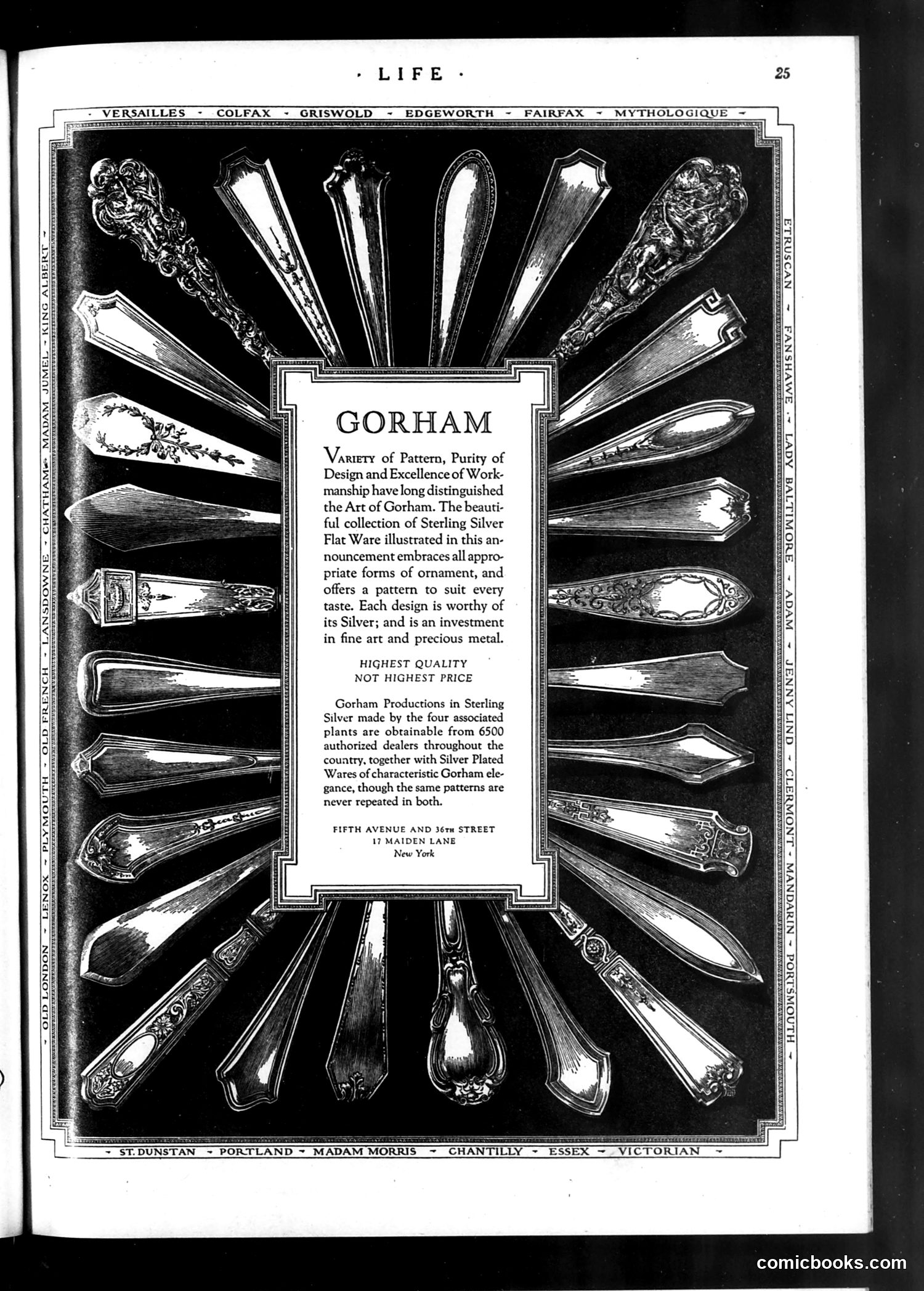
This page is **not a cartoon or satire**—it's a **straightforward advertisement** for Gorham silverware, a luxury brand. The image displays various sterling silver flatware pieces (forks, spoons, knives) arranged in a radial pattern around a central text block. The ad emphasizes Gorham's craftsmanship, design variety, and availability through 6,500 authorized dealers nationwide. The only notable messaging is the tagline **"HIGHEST QUALITY NOT HIGHEST PRICE,"** which suggests Gorham positioned itself as offering premium goods at reasonable cost—a marketing strategy common during this era. The decorative border lists pattern names (Versailles, Colfax, Fairfax, Victorian, etc.), typical of period silverware marketing. There is no political commentary, satire, or caricature present. This is simply a full-page luxury goods advertisement from *Life* magazine's advertising pages.
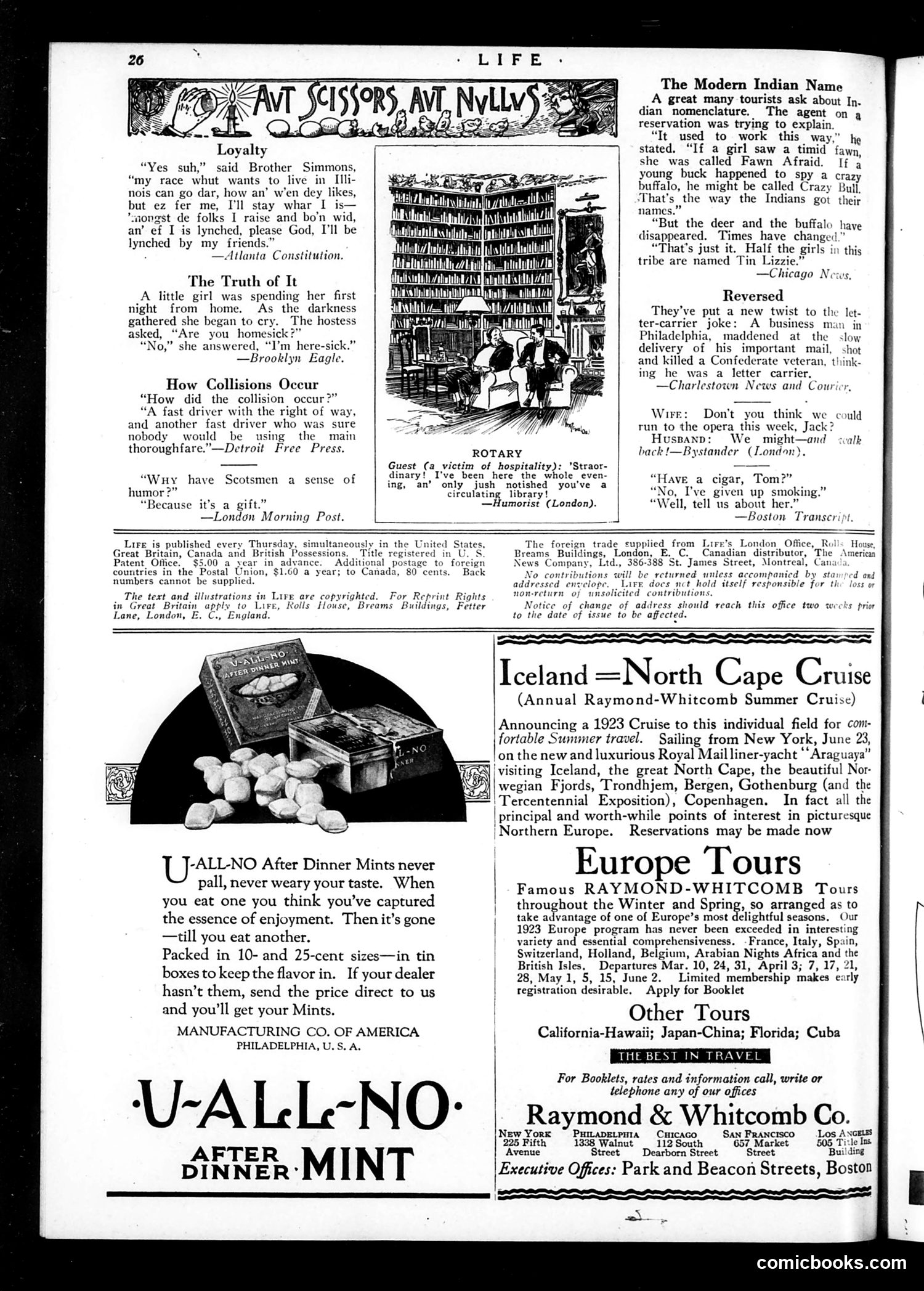
This page contains mostly **short humorous anecdotes** and **advertisements** rather than political cartoons. The jokes reflect early-1920s American social attitudes: **Key content:** - "The Modern Indian Name" satirizes Native American naming conventions, using the premise that tribes named people after animals they encountered. The joke's punchline—"Half the girls in this tribe are named Tin Lizzie" (slang for Model T Ford)—suggests modern displacement of traditional culture. - "Loyalty" presents a Black character (dialect-heavy) expressing resignation to lynching, framed as humor by the *Atlanta Constitution*. This reflects the era's casual treatment of racial violence. - "Reversed" jokes about a Philadelphia businessman killing a "Confederate veteran" mistaking him for a letter carrier—likely referencing post-Civil War tensions and slow mail delivery complaints. - Other brief jokes cover domestic life and miscellaneous observations. The page is primarily **filler content** between advertisements for U-All-No mints, Raymond & Whitcomb tours, and other products. The humor reflects period prejudices and social anxieties now recognized as deeply offensive.
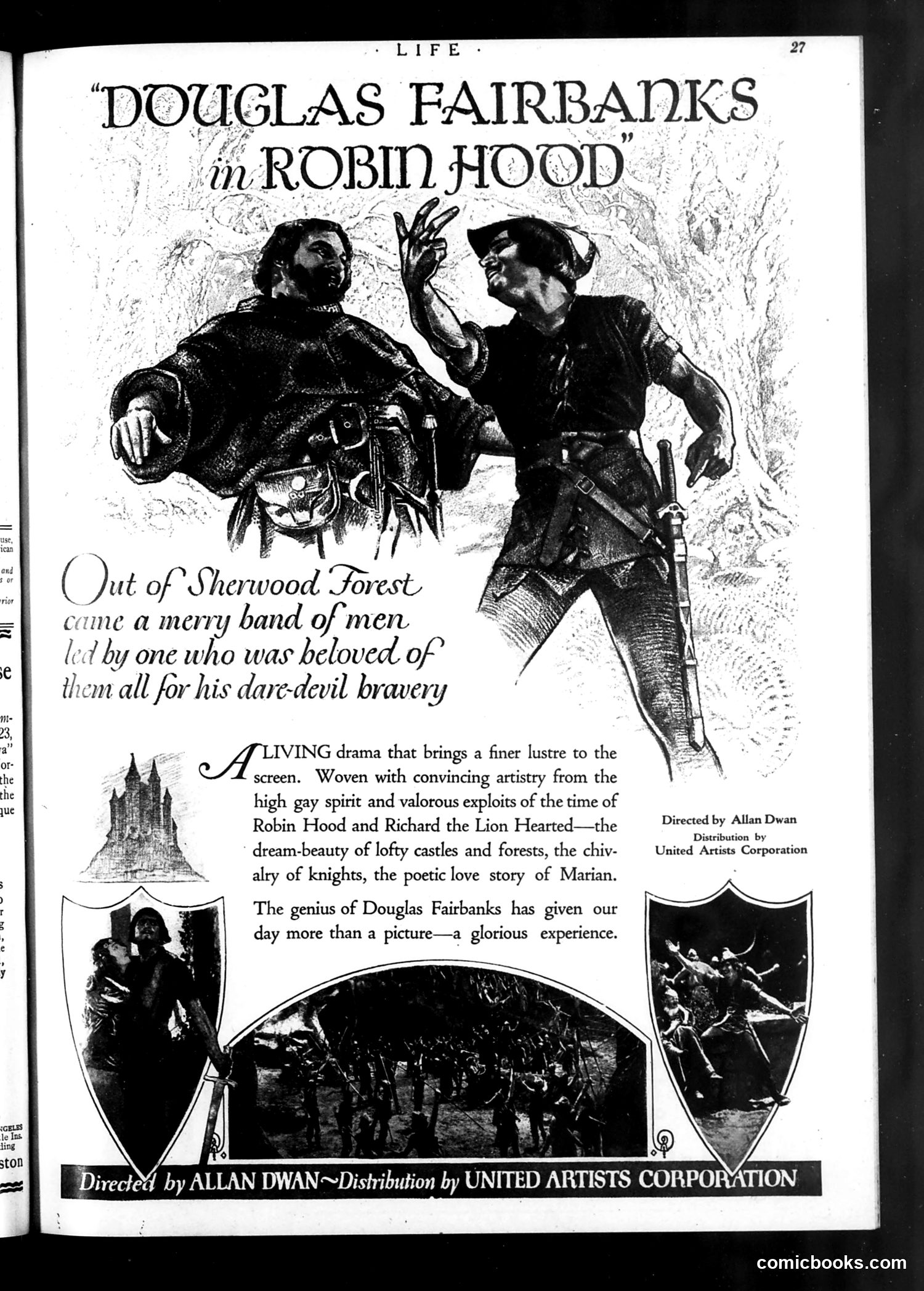
This is a **movie advertisement**, not political satire. It promotes Douglas Fairbanks's film version of *Robin Hood*, directed by Allan Dwan and distributed by United Artists Corporation. The page showcases the film's romantic and adventurous appeal: it promises "dream-beauty of lofty castles and forests, the chivalry of knights, the poetic love story of Marian," alongside "valorous exploits" and "dare-devil bravery." The illustrations depict period costumes and action scenes typical of the swashbuckling adventure genre Fairbanks pioneered. The text praises Fairbanks's "genius," framing cinema as providing "more than a picture—a glorious experience." This reflects 1920s Hollywood's effort to elevate film from cheap entertainment to prestigious art, and Fairbanks's status as a major star who could command such prominent magazine placement.
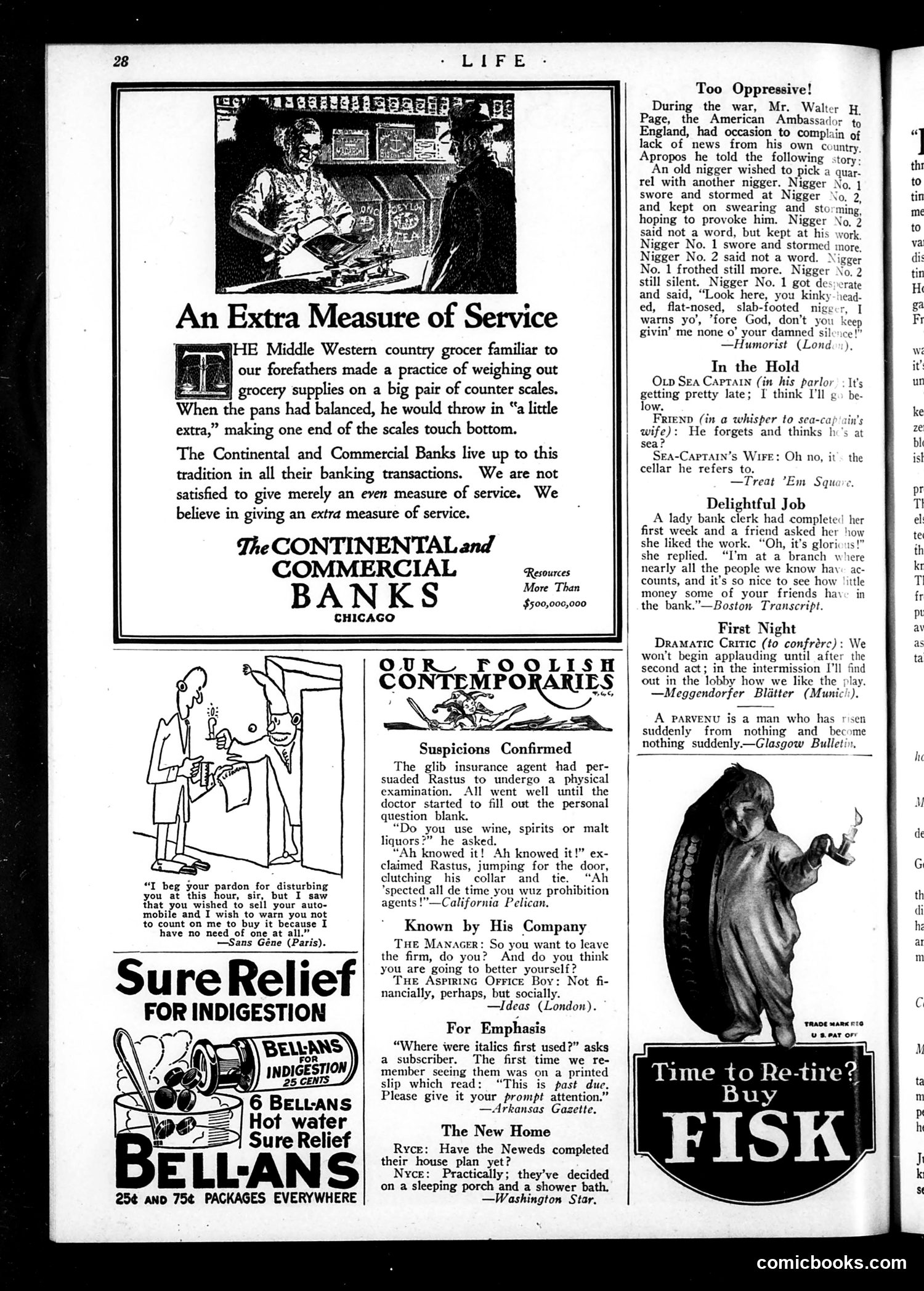
This page from *Life* magazine contains several satirical jokes and advertisements typical of early 20th-century American humor: **Main Cartoons/Humor:** 1. **"Too Oppressive!"** — A story attributed to Ambassador Walter Page about an African American man unable to provoke a silent rival. The humor relies on racist dialect and stereotypes common to the era. 2. **"Our Foolish Contemporaries"** section includes various brief jokes: an insurance agent asking about alcohol consumption (likely referencing Prohibition-era anxieties), office humor about social climbing, and observations about italics in printing. 3. **The cartoons** feature simple line drawings accompanying jokes about domestic life, office dynamics, and social pretension. **Advertisements** dominate the lower half, promoting Bellans indigestion relief, Fisk tires, and banking services emphasizing "extra measure of service." The page reflects period attitudes toward class, ethnicity, and gender while showcasing the magazine's satirical approach to contemporary American life and consumer culture.
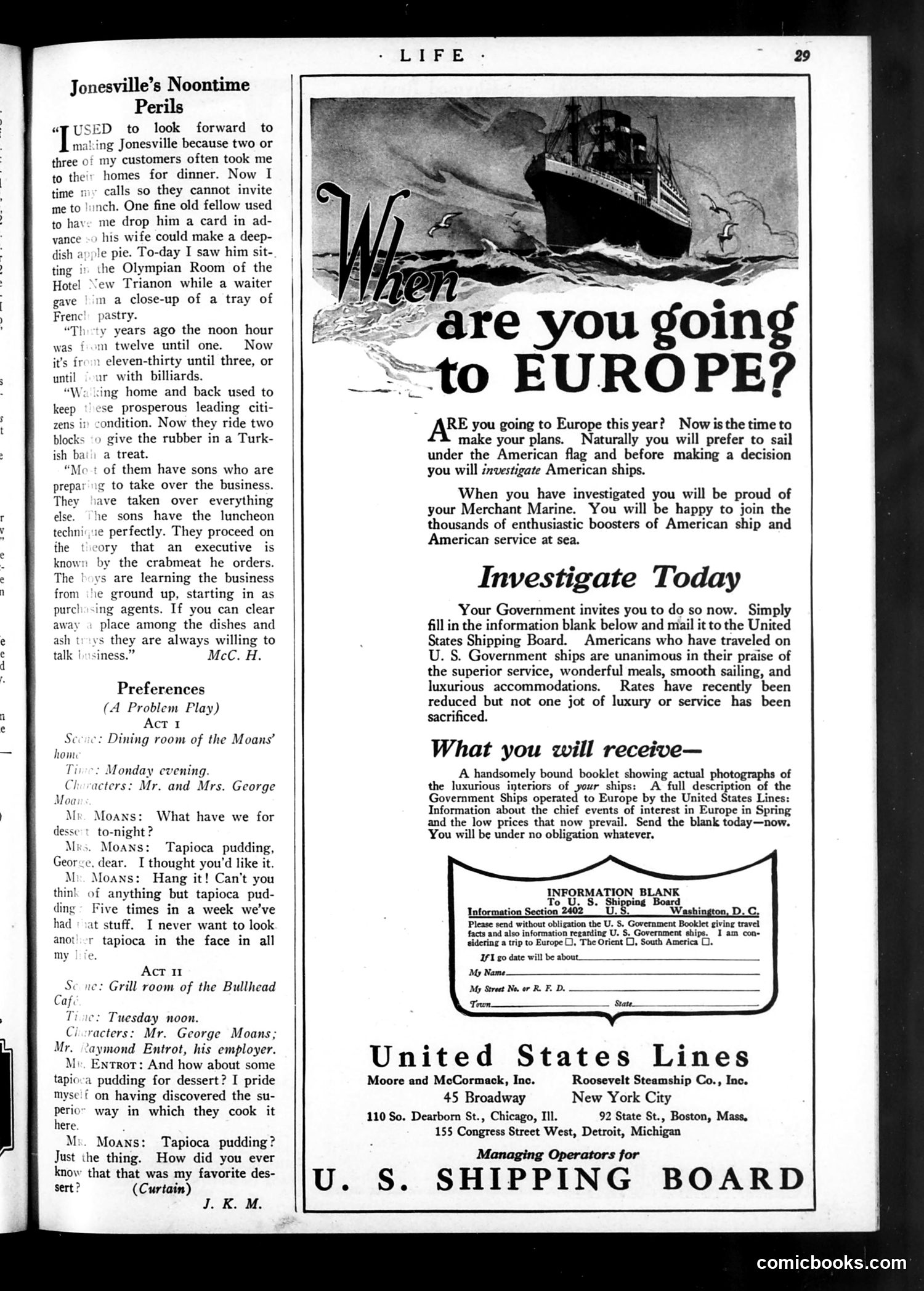
This page contains two separate pieces of satirical content: **"Jonesville's Noontime Perils"** is a humorous complaint about how American business culture has changed. The narrator laments that prosperous businessmen now spend entire afternoons (11:30 AM to 3 PM) at leisurely lunches with expensive foods like French pastry and crabmeat, rather than quick midday breaks. He criticizes the younger generation taking over businesses for prioritizing fancy restaurant meals as a status symbol of executive success. The satire targets 1920s corporate vanity and excessive leisure time. **"Preferences (A Problem Play)"** is a comedic sketch mocking a husband who complains bitterly about eating tapioca pudding at home five times weekly—then enthusiastically orders the same dish at a fancy restaurant, praising his employer's "superior" preparation. The joke: identical food tastes better in a restaurant setting, reflecting superficial attitudes about status and dining. **The advertisement** (not satirical) promotes U.S. Government steamship travel to Europe, emphasizing American ships' luxury and affordability—a straightforward promotional piece unrelated to the humorous content.
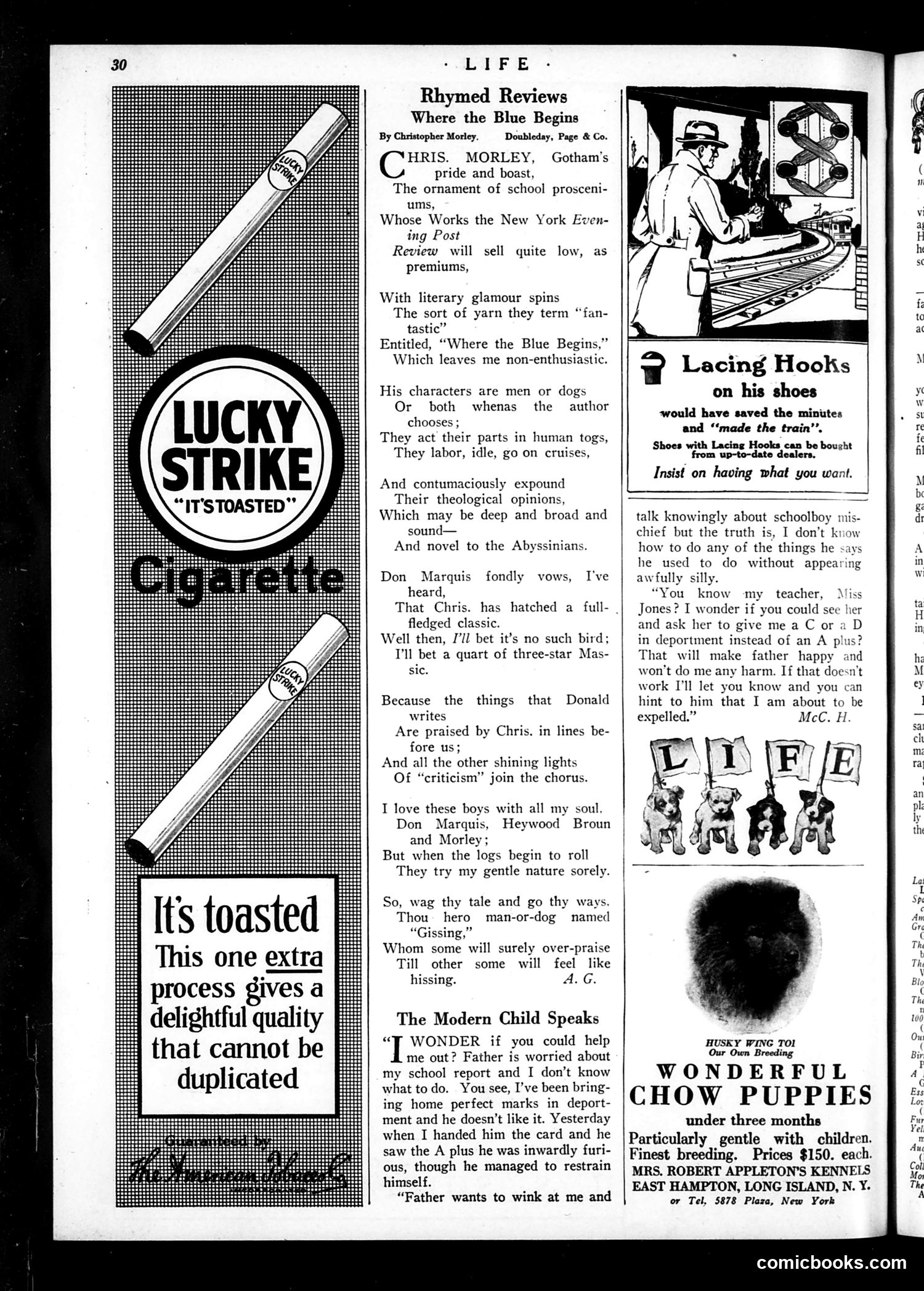
**Main Content:** This page contains book reviews, advertisements, and humor pieces rather than political cartoons. **"Rhymed Reviews" (Christopher Morley's "Where the Blue Begins"):** The anonymous reviewer (signed A.G.) satirizes a novel about anthropomorphic dogs by mocking both the book and the critical establishment. The satire targets how Morley and fellow critics (Don Marquis, Heywood Broun) praise each other's work uncritically—a "mutual admiration society" among literati. The reviewer dismisses the book as pretentious while expressing affection for these writers despite finding their work overrated. **"The Modern Child Speaks":** A humor piece satirizing generational disconnect. A child achieves perfect deportment marks but fears this upsets his father, who wants his son to be a mischievous schoolboy like he was. The child's solution—requesting a lower grade—mocks both parental nostalgia and rigid school systems. **Advertisements:** Lucky Strike cigarettes and shoe lacing hooks dominate the left and right margins, typical period product placement.
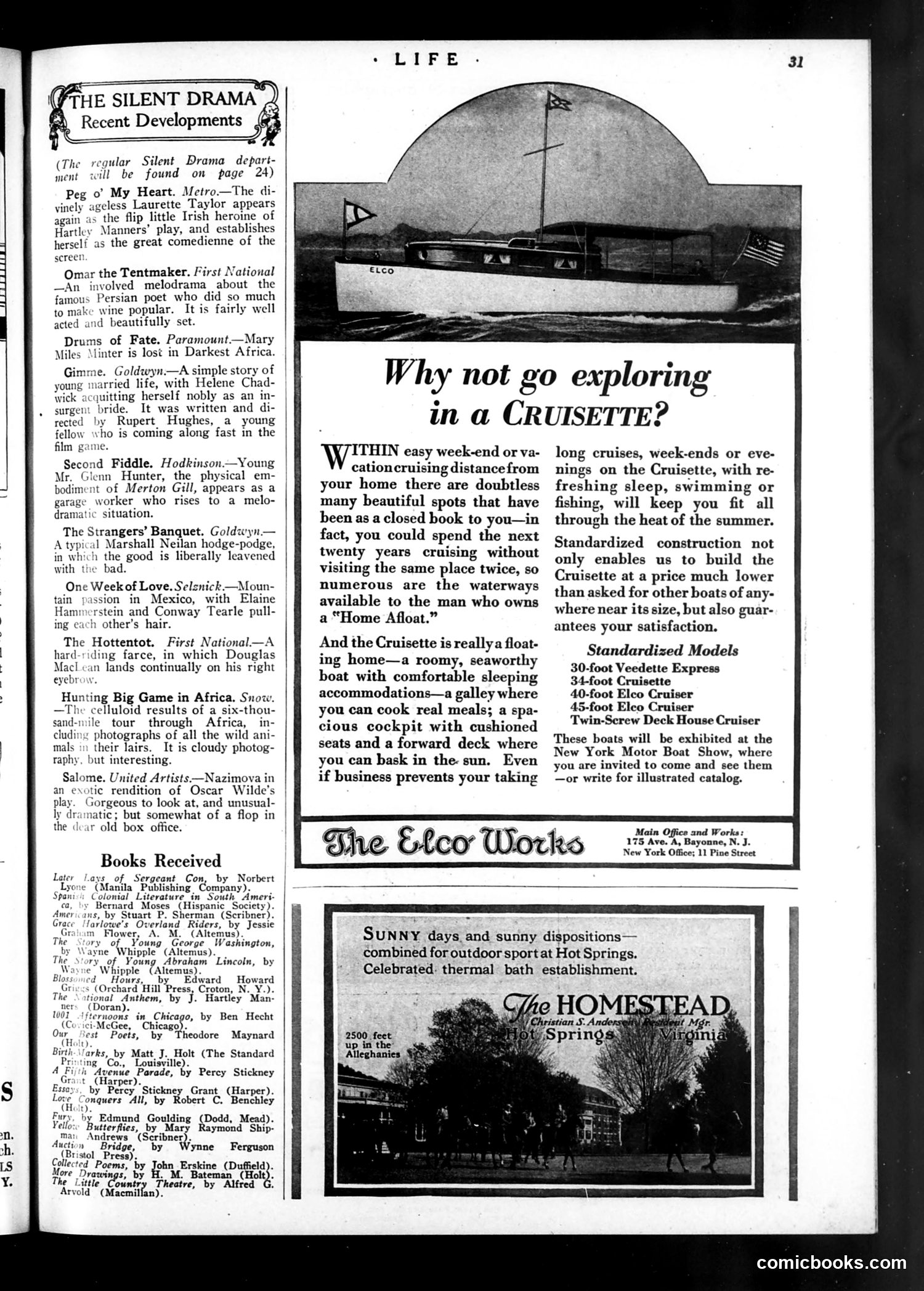
This page contains two distinct sections: a film review column and advertisements. **Film Reviews ("The Silent Drama"):** The left column reviews contemporary silent films, including titles like *Peg o' My Heart* (starring Laurette Taylor), *Omar the Tentmaker*, and *Salome* (with Nazimova). These are straightforward critical assessments of popular movies from the early 1920s—no satire or caricature present. The reviews praise or criticize acting, direction, and storytelling. **Advertisements:** The page features two major ads: one for the Elco Works' "Cruisette" (a small motorboat marketed as a "Home Afloat" for weekend recreation), and one for "The Homestead" resort in Hot Springs, Virginia. These are standard commercial pitches targeting leisure and tourism, appealing to middle-class readers with disposable income for recreation and travel. **Overall:** This is primarily a content/advertising page with no political or social satire. The reviews reflect 1920s cinema tastes; the ads reflect period consumer culture and vacation marketing.
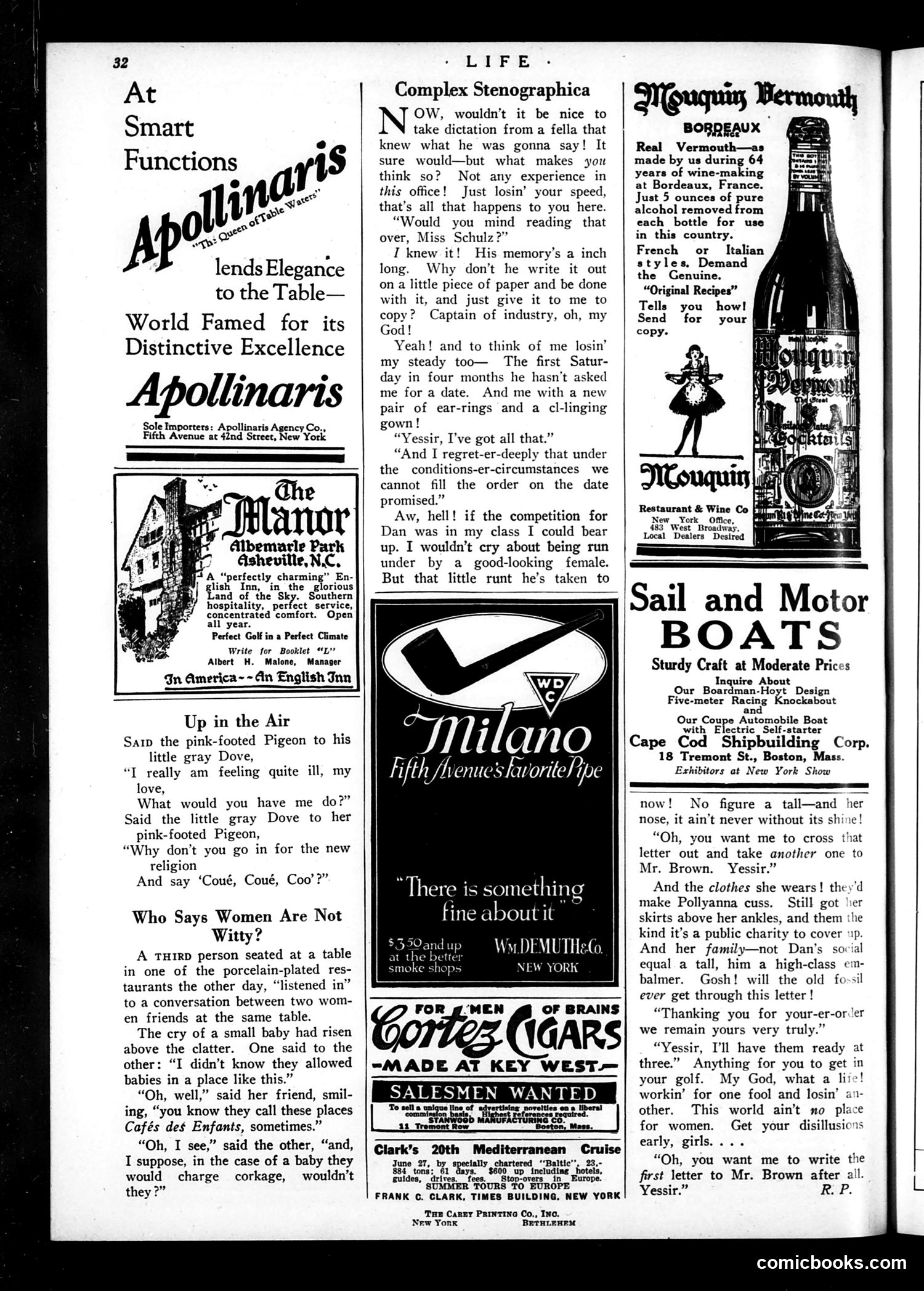
This Life magazine page consists primarily of advertisements with two humorous pieces interspersed. **"Up in the Air"** is a brief joke about pigeons discussing a "new religion" involving repeating "Coué"—a reference to Émile Coué's popular self-help movement of the 1920s based on autosuggestion and positive affirmations. **"Who Says Women Are Not Witty?"** presents a restaurant conversation where one woman quips that a restaurant allowing babies should charge "corkage" (a fee for outside drinks)—a clever wordplay suggesting babies are as disruptive as alcohol. **"Complex Stenographica"** is the page's main satirical piece, depicting a female office stenographer's internal frustration as her boss dictates unclear correspondence. She resents re-doing work, losing personal time (a boyfriend hasn't asked her out), and judges her rival's appearance and wardrobe. The satire targets both incompetent male management and the stenographer's cattiness. The remainder consists of advertisements for liqueurs, hotels, boats, cigars, and cruises—typical 1920s luxury goods marketing.
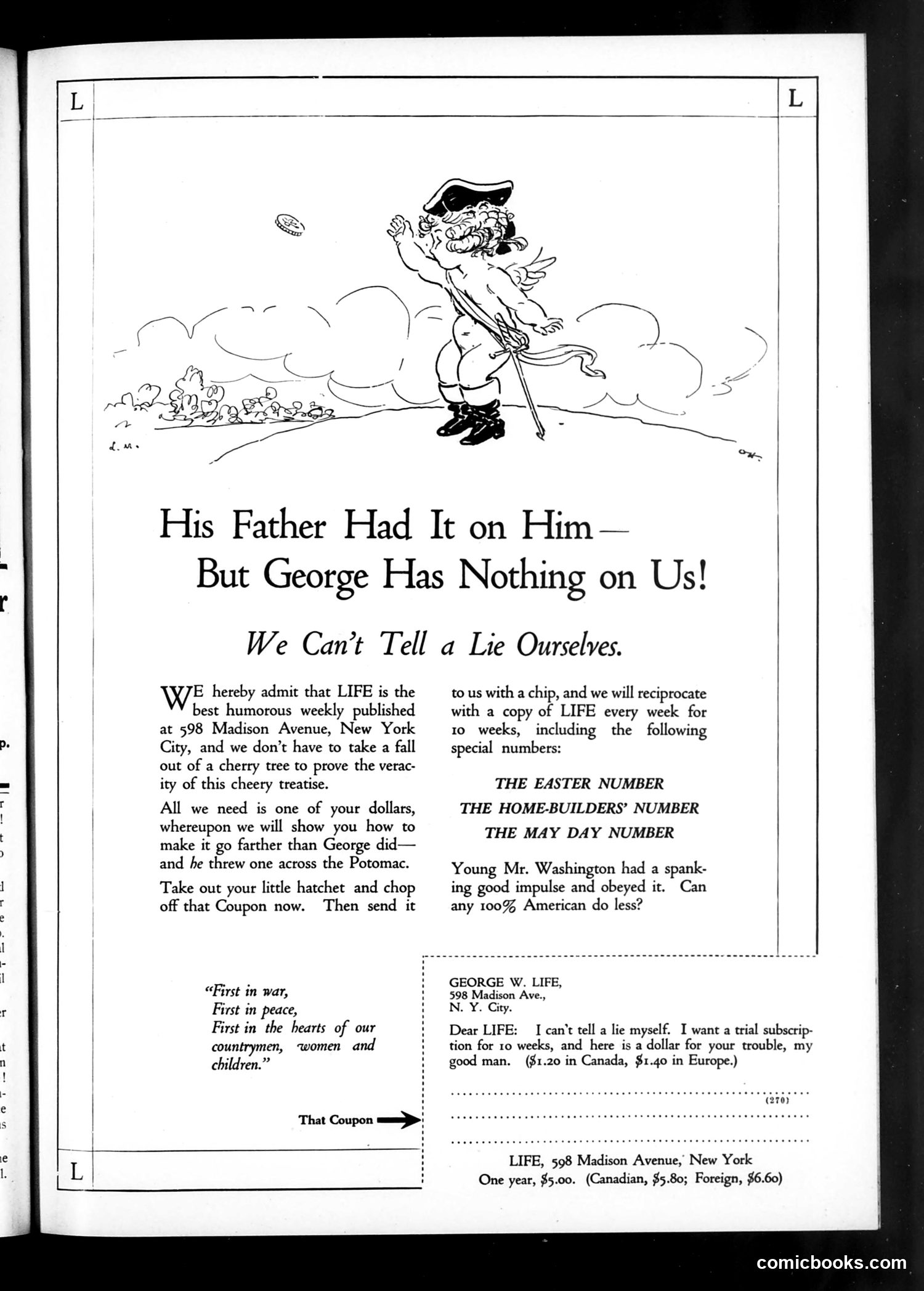
This is a **subscription advertisement for *Life* magazine** built around the famous George Washington cherry-tree legend—the apocryphal story that young Washington confessed to chopping down his father's cherry tree rather than lying about it. The satire works on multiple levels: 1. **The Setup**: The headline jokes that Washington's father punished him, but *Life* magazine claims to have "nothing on" readers—meaning they won't judge harshly either. 2. **The Pitch**: *Life* offers to teach readers how to make a dollar "go farther than George did"—mocking Washington's legendary act of throwing a coin across the Potomac River as wasteful. 3. **The Irony**: The magazine calls itself honest ("We Can't Tell a Lie Ourselves") while simultaneously running a subscription drive—a self-aware joke about their own commercial self-promotion. 4. **The Appeal**: It references Washington's patriotism and asks if any "100% American" would refuse such a wholesome impulse, using nationalism as a persuasion tactic. It's essentially *Life* poking fun at itself while pitching subscriptions.
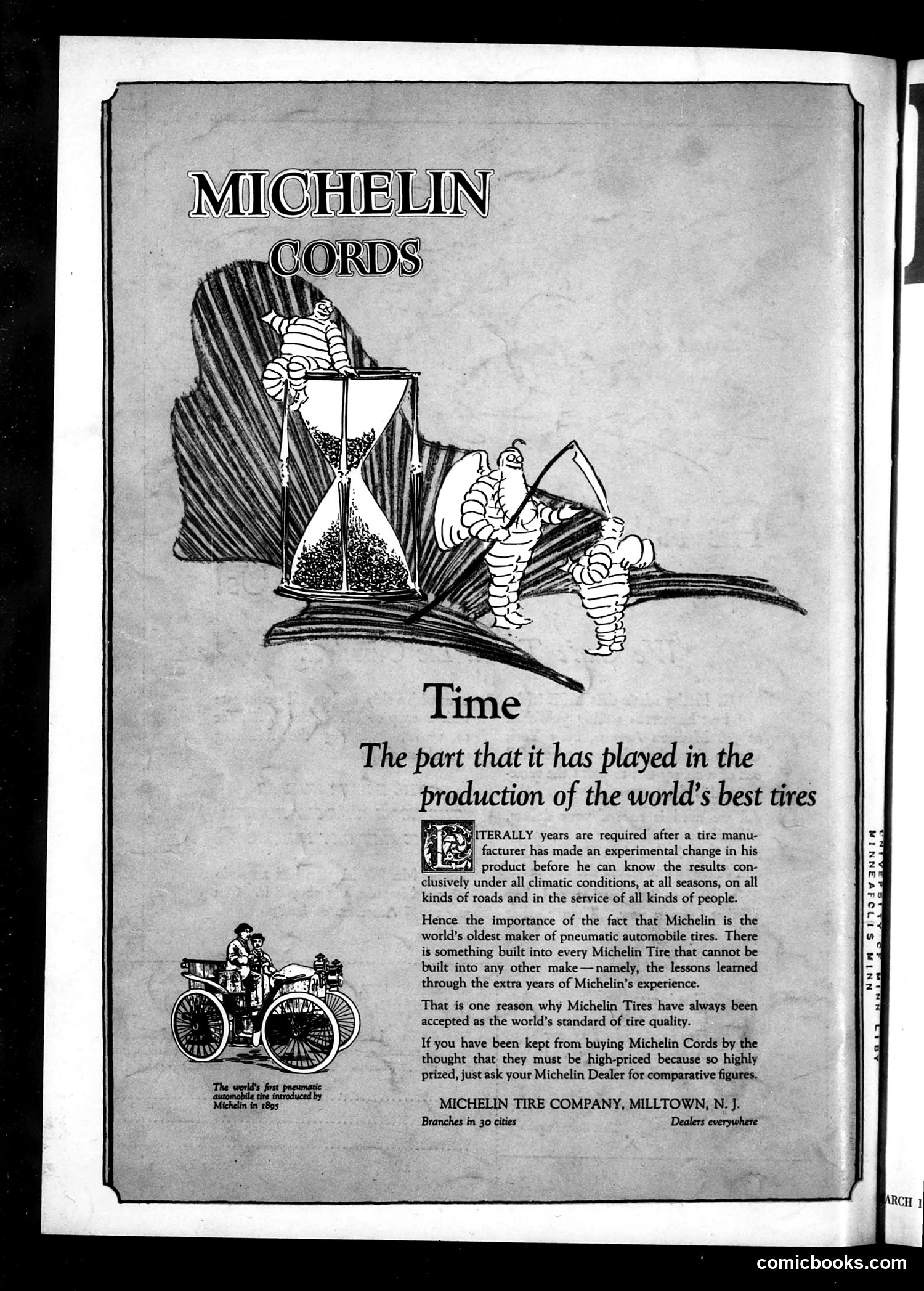
This is a **Michelin tire company advertisement**, not political satire. The page features the Michelin Man (the iconic mascot made of tire stacks) with an hourglass, symbolizing "Time." The ad's central argument: Michelin claims superiority because it has the longest history as a pneumatic tire manufacturer, allowing decades of real-world testing across climates and road conditions. This accumulated "experience" allegedly produces better tires than competitors can offer. The advertisement addresses a likely customer concern—that Michelin Cords cost more—by suggesting the higher price reflects quality earned through years of research, not arbitrary premium pricing. The copy urges readers to compare prices directly with dealers. The early automobile imagery (vintage car illustration) dates this to the early-to-mid 20th century when tire quality was a legitimate selling point and Michelin's heritage held genuine market advantage.