
Life, 1923-02-22 · page 10 of 36
Life — February 22, 1923 — page 10: what you’re looking at
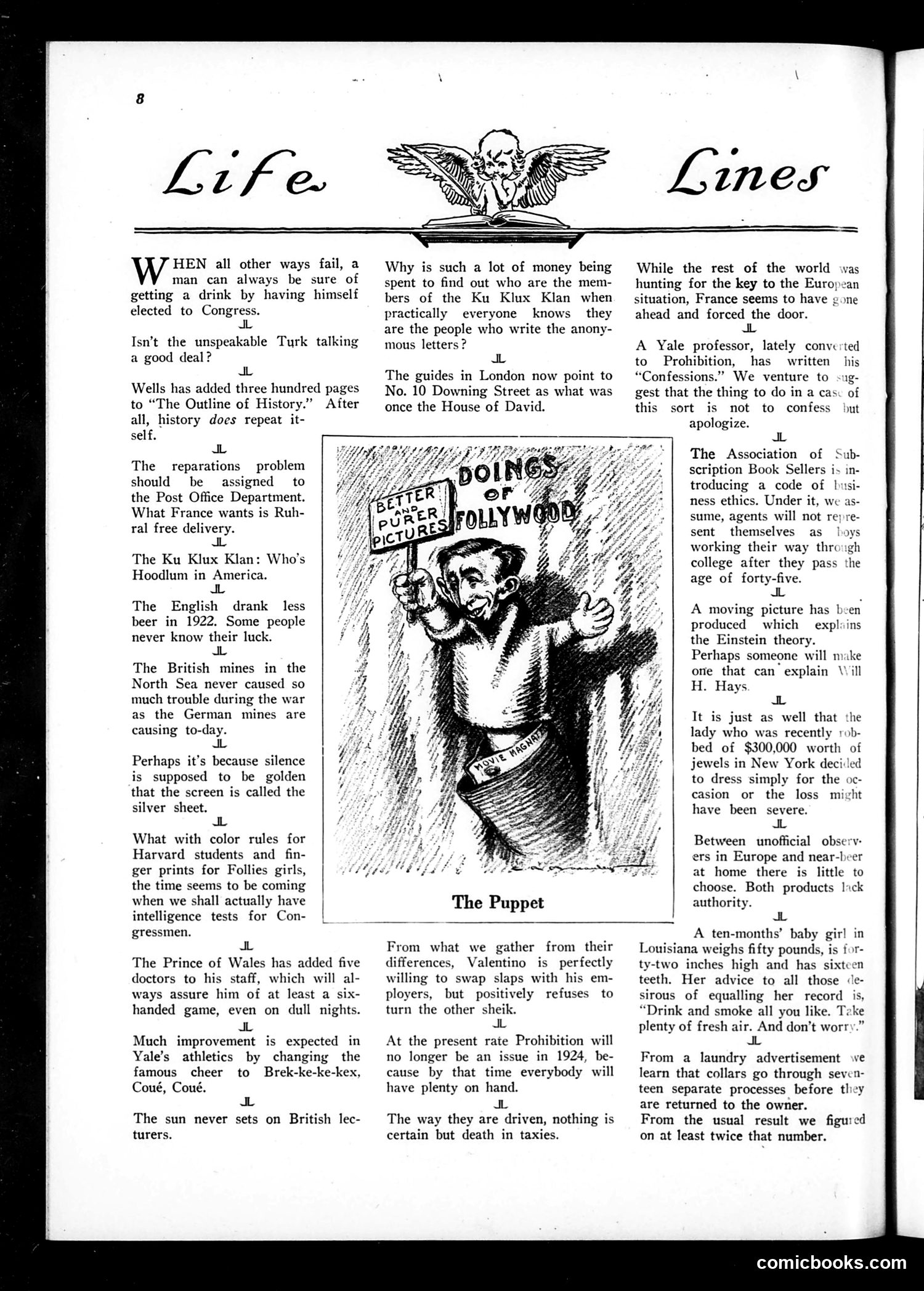
What you’re looking at
This cartoon depicts a chimpanzee or ape figure manipulating a smaller human puppet labeled "BETTER PICTURES FOLLYWOOD" (satirizing Hollywood). The image satirizes the film industry's control over its stars and content during the silent film era. The accompanying text references "Valentino" (likely Rudolph Valentino, the famous silent film star) and discusses his conflicts with studio management—specifically that he "positively refuses to turn the other sheek [sic]." This suggests disputes between Valentino and his studio bosses over roles and working conditions. The cartoon's point: major studios operated as puppet masters, controlling actors' careers and creative choices with little regard for the performers' own preferences or dignity.
📄 Transcribed text from this page (OCR, searchable)
Machine-transcribed from the original scan — historical spelling and the odd misread are preserved.
HEN all other ways fail, a man can always be sure of getting a drink by having himself elected to Congress. JL Isn’t the unspeakable Turk talking a good deal? Wells has added three hundred pages to “The Outline of History.” After all, history does repeat it- self. Why is such a lot of money being spent to find out who are the mem- bers of the Ku Klux Klan when practically everyone knows they are the people who write the anony- mous letters? aL The guides in London now point to No. 10 Downing Street as what was once the House of David. While the rest of the world was hunting for the key to the European situation, France seems to have gone ahead and forced the door. A Yale professor, lately converted to Prohibition, has written his “Confessions.” We venture to -ug- gest that the thing to do in a cas: of this sort is not to confess )ut apologize. LL The reparations problem should be assigned to the Post Office Department. What France wants is Ruh- ral free delivery. aL The Ku Klux Klan: Who's Hoodlum in America. aL The English drank less beer in 1922. Some people never know their luck. aL The British mines in the North Sea never caused so much trouble during the war as the German mines are causing to-day. aL Perhaps it’s because silence is supposed to be golden that the screen is called the silver sheet. aL What with color rules for Harvard students and fin- ger prints for Follies girls, the time seems to be coming when we shall actually have intelligence tests for Con- gressmen. aL The Prince of Wales has added five doctors to his staff, which will al- ways assure him of at least a six- handed game, even on dull nights. JL Much improvement is expected in Yale’s athletics by changing the famous cheer to Brek-ke-ke-kex, Coué, Coué. JL The sun never sets on British lec- turers. The Puppet The Association of Sub- scription Book Sellers is i troducing a code of busi ness ethics. Under it, we sume, agents will not re} sent themselves as boys working their way through college after they pass the age of forty-five. aL . A moving picture has been produced which explains the Einstein theory. Perhaps someone will make one that can explain Will H. Hays -L It is just as well that the lady who was recently rob- bed of $300,000 worth of jewels in New York deci:led to dress simply for the oc- casion or the loss might have been severe. JL Between unofficial observ: ers in Europe and near-beer at home there is little to choose. Both products lick authority. tL From what we gather from their differences, Valentino is perfectly willing to swap slaps with his em- ployers, but positively refuses to turn the other sheik. JL At the present rate Prohibition will no longer be an issue in 1924, be- cause by that time everybody will have plenty on hand. JL The way they are driven, nothing is certain but death in taxies. A ten-months’ baby girl in Louisiana weighs fifty pounds, ty-two inches high and has six teeth. Her advice to all those ‘le- sirous of equalling her record is, “Drink and smoke all you like. Take plenty of fresh air. And don’t worry.” JL From a laundry advertisement we learn that collars go through seven- teen separate processes before tlicy are returned to the owner. From the usual result we figured on at least twice that number. comicbooks.com