
Life, 1923-02-22 · page 20 of 36
Life — February 22, 1923 — page 20: what you’re looking at
What you’re looking at
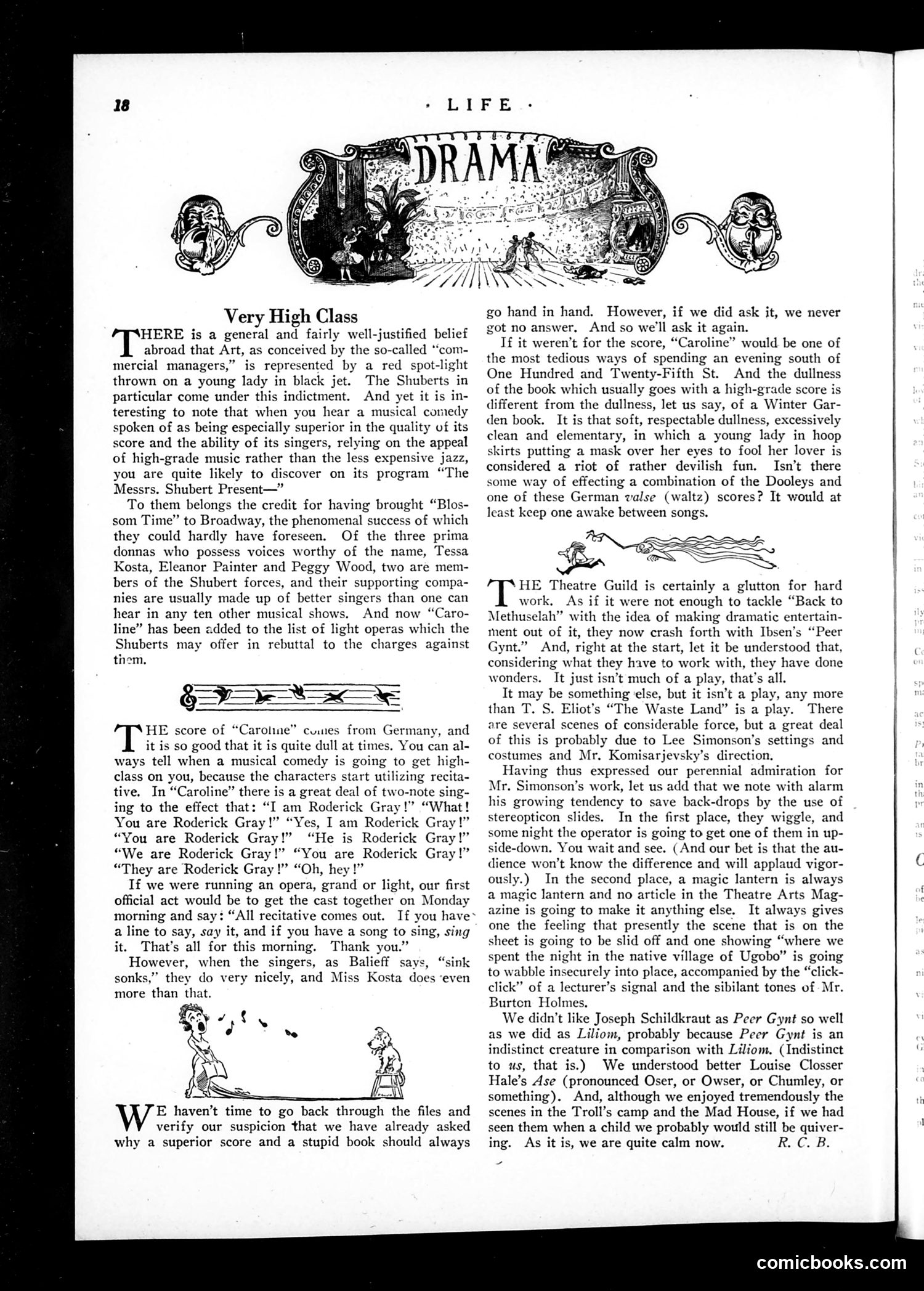
This theater criticism column satirizes Broadway's musical comedy conventions while praising the Shubert theatrical company. The main targets are: - **"Commercial managers"** who rely on cheap spectacle (red spotlights on women in black dresses) rather than musical quality - **The Shuberts' competitors**, implicitly those offering inferior productions - **Generic operetta tropes**: tedious plots featuring women in hoop skirts using masks to "fool her lover"—dismissed as unfunny and contrived The author praises the **Shuberts** for producing "Blossom Time" and "Caroline" with actual talented singers (Tessa Kosta, Eleanor Painter, Peggy Wood) and serious musical scores, even while mocking "Caroline" as dull and German-imported. The **Theatre Guild** receives backhanded praise for ambition ("glutton for hard work") while staging Shaw and Ibsen, though the critic insists "Peer Gynt" "just isn't much of a play." The comparison to T.S. Eliot's "The Waste Land" suggests both are respected but dramatically inert. The satire ultimately celebrates **highbrow entertainment** while mockingly documenting Broadway's persistent mediocrity.
📄 Transcribed text from this page (OCR, searchable)
Machine-transcribed from the original scan — historical spelling and the odd misread are preserved.
Very High Class HERE is a general and fairly well-justified belief abroad that Art, as conceived by the so-called “com- mercial managers,” is represented by a red spot-light thrown on a young lady in black jet. The Shuberts in particular come under this indictment. And yet it is in- teresting to note that when you hear a musical comedy spoken of as being especially superior in the quality of its score and the ability of its singers, relying on the appeal of high-grade music rather than the less expensive jazz, you are quite likely to discover on its program “The Messrs. Shubert Present—” To them belongs the credit for having brought “Blos- som Time” to Broadway, the phenomenal success of which they could hardly have foreseen. Of the three prima donnas who possess voices worthy of the name, Tessa Kosta, Eleanor Painter and Peggy Wood, two are mem- bers of the Shubert forces, and their supporting compa- nies are usually made up of better singers than one can hear in any ten other musical shows. And now “Caro- line” has been added to the list of light operas which the Shuberts may offer in rebuttal to the charges against a en oe HE score of “Caroline” cues from Germany, and it is so good that it is quite dull at times. You can al- ways tell when a musical comedy is going to get high- class on you, because the characters start utilizing recita- tive. In “Caroline” there is a great deal of two-note sing- ing to the effect that: “I am Roderick Gray!” “What! You are Roderick Gray!” “Yes, I am Roderick Gray!” “You are Roderick Gray!” “He is Roderick Gray!” “We are Roderick Gray!” “You are Roderick Gray!” “They are Roderick Gray!” “Oh, hey!” If we were running an opera, grand or light, our first official act would be to get the cast together on Monday morning and say: “All recitative comes out. If you have~ a line to say, say it, and if you have a song to sing, sing it. That’s all for this morning. Thank you.” However, when the singers, as Balieff says, “sink sonks,” they do very nicely, and Miss Kosta does even more than that. E haven't time to go back through the files and verify our suspicion that we have already asked why a superior score and a stupid book should always go hand in hand. However, if we did ask it, we never got no answer. And so we'll ask it again. If it weren't for the score, “Caroline” would be one of the most tedious ways of spending an evening south of One Hundred and Twenty-Fifth St. And the dullness of the book which usually goes with a high-grade score is different from the dullness, let us say, of a Winter Gar- den book. It is that soft, respectable dullness, excessively clean and elementary, in which a young lady in hoop skirts putting a mask over her eyes to fool her lover is considered a riot of rather devilish fun. Isn’t there some way of effecting a combination of the Dooleys and one of these German valse (waltz) scores? It would at least keep one awake between songs. ‘HE Theatre Guild is certainly a glutton for hard work. As if it were not enough to tackle “Back to Methuselah” with the idea of making dramatic entertain- ment out of it, they now crash forth with Ibsen’s “Peer Gynt.” And, right at the start, let it be understood that, considering what they have to work with, they have done wonders. It just isn’t much of a play, that’s all. It may be something else, but it isn’t a play, any more than T. S. Eliot’s “The Waste Land” is a play. There are several scenes of considerable force, but a great deal of this is probably due to Lee Simonson’s settings and costumes and Mr. Komisarjevsky’s direction. Having thus expressed our perennial admiration for Mr. Simonson’s work, let us add that we note with alarm his growing tendency to save back-drops by the use of stereopticon slides. In the first place, they wiggle, and some night the operator is going to get one of them in up- side-down. You wait and see. (And our bet is that the au- dience won’t know the difference and will applaud vigor- ously.) In the second place, a magic lantern is always a magic lantern and no article in the Theatre Arts Mag- azine is going to make it anything else. It always gives one the feeling that presently the scene that is on the sheet is going to be slid off and one showing “where we spent the night in the native village of Ugobo” is going to wabble insecurely into place, accompanied by the “click- click” of a lecturer’s signal and the sibilant tones of Mr. Burten Holmes. We didn’t like Joseph Schildkraut as Peer Gynt so well as we did as Liliom, probably because Peer Gynt is an indistinct creature in comparison with Liliom. (Indistinct to us, that is.) We understood better Louise Closser Hale’s Ase (pronounced Oser, or Owser, or Chumley, or something). And, although we enjoyed tremendously the scenes in the Troll’s camp and the Mad House, if we had seen them when a child we probably would still be quiver- ing. As it is, we are quite calm now. ROG. B. comicbooks.com