
Life, 1923-02-22 · page 16 of 36
Life — February 22, 1923 — page 16: what you’re looking at
What you’re looking at
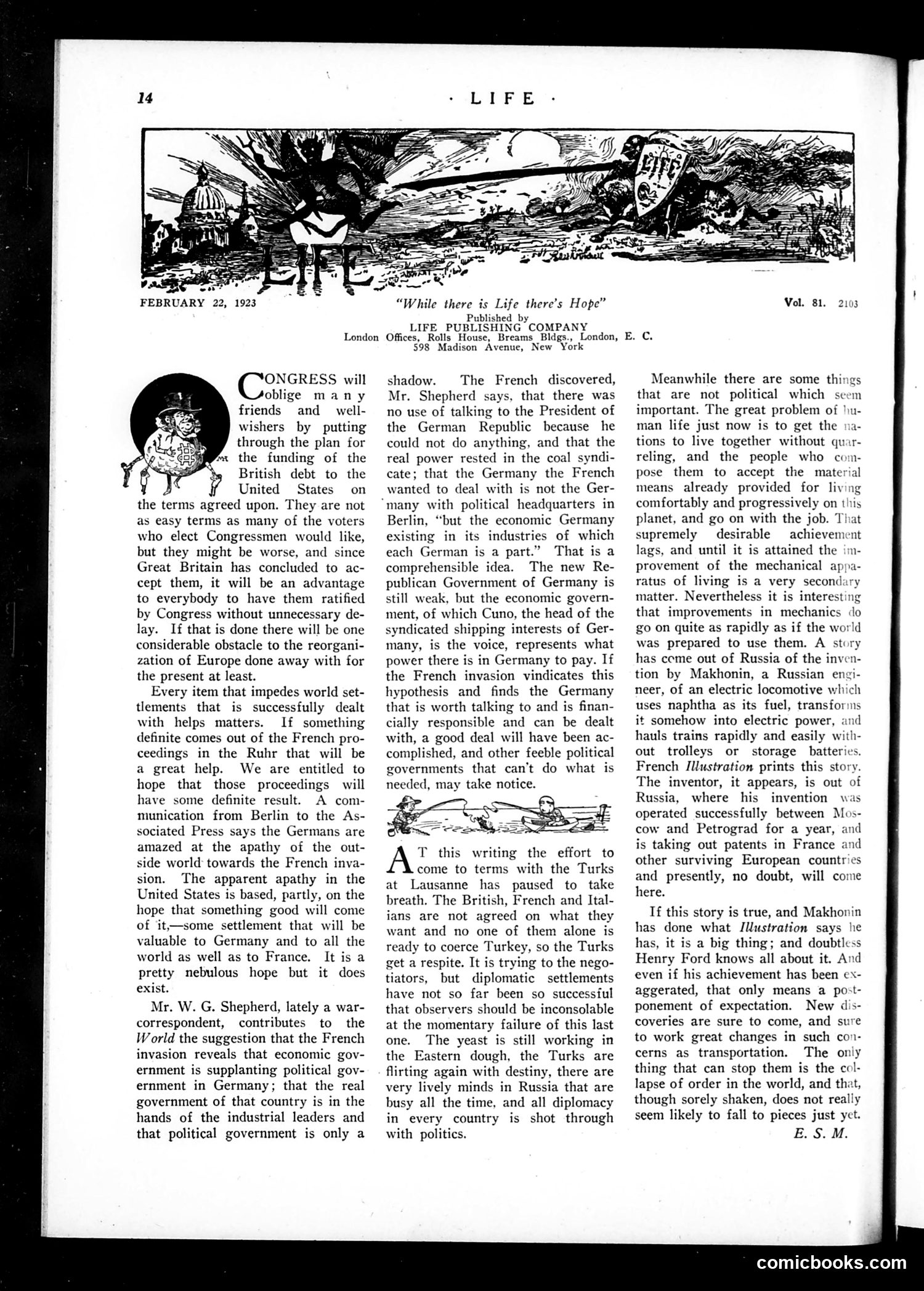
This Life magazine page (February 22, 1923) contains editorial commentary on European politics rather than a traditional cartoon. The text discusses Congress's reluctance to ratify the British debt agreement, French military intervention in Germany's Ruhr region, and diplomatic tensions surrounding Turkey. The article critiques the apparent apathy of the United States toward European settlement while noting that real power in Germany rests with industrial leaders rather than politicians. It references negotiations with Turkey and suggests that diplomatic efforts remain deadlocked. The small illustrations appear decorative rather than satirical. The commentary suggests American isolationism and skepticism toward European political solutions were key concerns for Life's editors in the early post-war period.
📄 Transcribed text from this page (OCR, searchable)
Machine-transcribed from the original scan — historical spelling and the odd misread are preserved.
FEBRUARY 22, 1923 London Offices, ONGRESS will oblige many friends and well- wishers by putting through the plan for the funding of the British debt to the United States on the terms agreed upon. They are not as easy terms as many of the voters who elect Congressmen would like, but they might be worse, and since Great Britain has concluded to ac- cept them, it will be an advantage to everybody to have them ratified by Congress without unnecessary de- lay. If that is done there will be one considerable obstacle to the reorgani- zation of Europe done away with for the present at least. Every item that impedes world set- tlements that is successfully dealt with helps matters. If something definite comes out of the French pro- ceedings in the Ruhr that will be a great help. We are entitled to hope that those proceedings will have some definite result. A com- munication from Berlin to the As- sociated Press says the Germans are amazed at the apathy of the out- side world towards the French inva- sion. The apparent apathy in the United States is based, partly, on the hope that something good will come of it—some settlement that will be valuable to Germany and to all the world as well as to France. It is a pretty nebulous hope but it does exist. Mr. W. G. Shepherd, lately a war- correspondent, contributes to the World the suggestion that the French invasion reveals that economic gov- ernment is supplanting political gov- ernment in Germany; that the real government of that country is in the hands of the industrial leaders and that political government is only a iy “While there is Life there’s Hope” Published by LIFE PUBLISHING COMPANY Rolls House, 598 Madison Avenue, New York shadow. The French discovered, Mr. Shepherd says, that there was no use of talking to the President of the German Republic because he could not do anything, and that the real power rested in the coal syndi- cate; that the Germany the French wanted to deal with is not the Ger- “many with political headquarters in Berlin, “but the economic Germany existing in its industries of which each German is a part.” That is a comprehensible idea. The new Re- publican Government of Germany is still weak, but the economic govern- ment, of which Cuno, the head of the syndicated shipping interests of Ger- many, is the voice, represents what power there is in Germany to pay. If the French invasion vindicates this hypothesis and finds the Germany that is worth talking to and is finan- cially responsible and can be dealt with, a good deal will have been ac- complished, and other feeble political governments that can’t do what is needed, may take notice. ame this writing the effort to come to terms with the Turks at Lausanne has paused to take breath. The British, French and Ital- ians are not agreed on what they want and no one of them alone is ready to coerce Turkey, so the Turks get a respite. It is trying to the nego- tiators, but diplomatic settlements have not so far been so successiul that observers should be inconsolable at the momentary failure of this last one. The yeast is still working in the Eastern dough, the Turks are flirting again with destiny, there are very lively minds in Russia that are busy all the time, and all diplomacy in every country is shot through with politics. Breams Bldgs., London, E. C. Meanwhile there are some things that are not political which se important. The great problem of !)u- man life just now is to get the tions to live together without qu reling, and the people who « pose them to accept the materis means already provided for liv comfortably and progressively on this planet, and go on with the job. 1 supremely desirable achievem: lags, and until it is attained the provement of the mechanical app: ratus of living is a very secondary matter. Nevertheless it is interesting that improvements in mechanics do go on quite as rapidly as if the world was prepared to use them. A story has come out of Russia of the inven- tion by Makhonin, a Russian engi- neer, of an electric locomotive which uses naphtha as its fuel, transforms it somehow into electric power, : hauls trains rapidly and easily with- out trolleys or storage batteries. French Illustration prints this story. The inventor, it appears, is out of Russia, where his invention was operated successfully between Mos- cow and Petrograd for a year, and is taking out patents in France and other surviving European countries and presently, no doubt, will come here. If this story is true, and Makhonin has done what Illustration says he has, it is a big thing; and doubtless Henry Ford knows all about it. And even if his achievement has been ex- aggerated, that only means a post- ponement of expectation. New dis- coveries are sure to come, and sure to work great changes in such con- cerns as transportation. The only thing that can stop them is the col- lapse of order in the world, and thet, though sorely shaken, does not really seem likely to fall to pieces just yet. E. S. M. comicbooks.com