
Life, 1923-02-22 · page 6 of 36
Life — February 22, 1923 — page 6: what you’re looking at
What you’re looking at
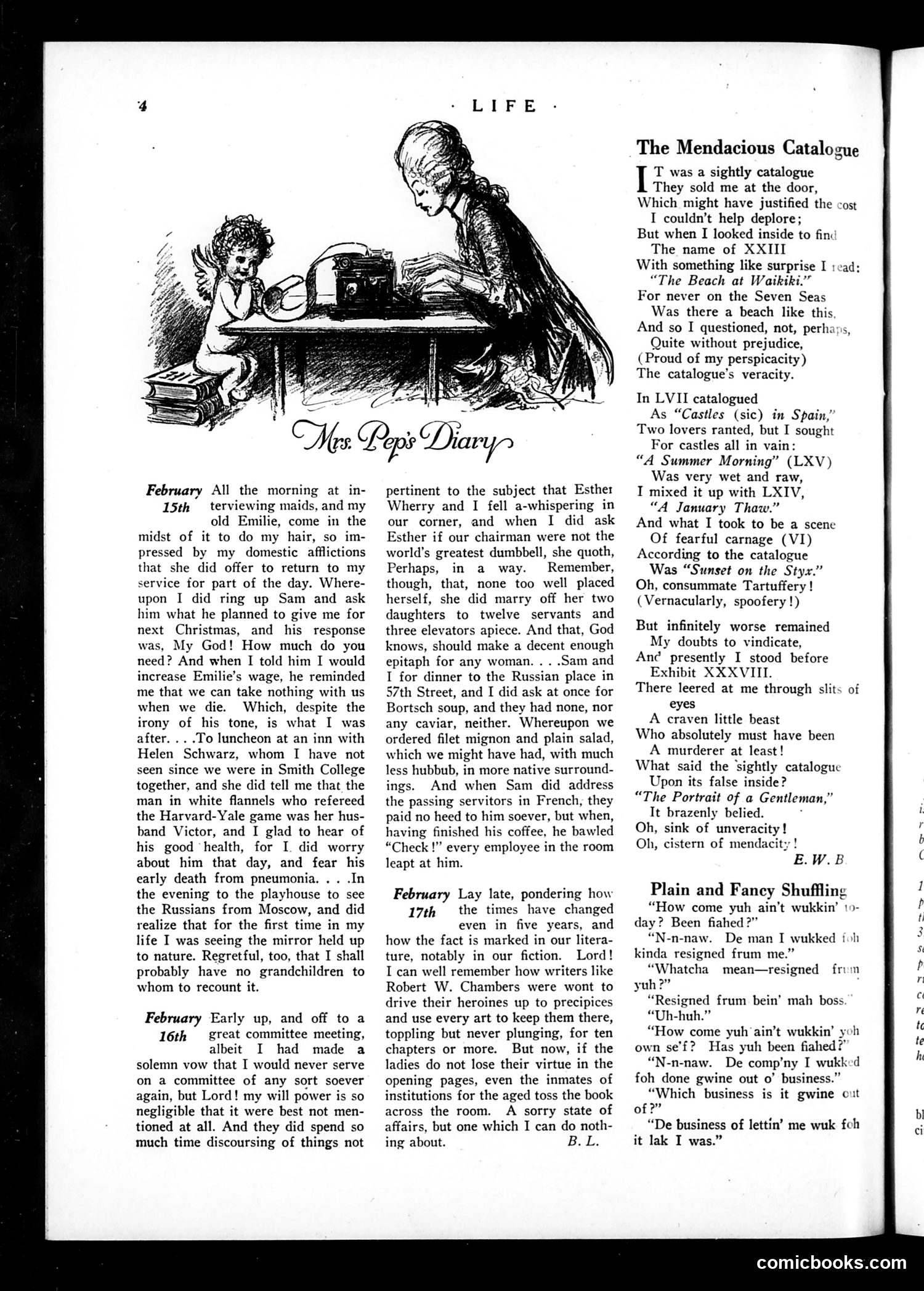
The main illustration shows "Mrs. Pepis Diary," depicting a woman at a typewriter being observed by a skeletal figure—likely Death or a grim reaper—peering over her shoulder. This appears to be satirizing the diary/confession genre popular in magazines of the era. The text contains diary entries from February discussing social observations: difficulties hiring servants, dinner conversation at a Russian restaurant, and complaints about changing times. The satire seems directed at upper-class society concerns and the triviality of wealthy women's preoccupations. A separate piece titled "Plain and Fancy Shuffling" uses dialect humor in a dialogue about employment and business, likely satirizing working-class speech patterns—a common comedic device in period publications. The overall tone is gentle social satire targeting both aristocratic pretension and class-based stereotypes.
📄 Transcribed text from this page (OCR, searchable)
Machine-transcribed from the original scan — historical spelling and the odd misread are preserved.
February All the morning at in- 15th — terviewing maids, and my old Emilie, come in the midst of it to do my hair, so im- pressed by my domestic afflictions that she did offer to return to my service for part of the day. Where- upon I did ring up Sam and ask him what he planned to give me for next Christmas, and his response was, My God! How much do you need? And when I told him I would increase Emilie’s wage, he reminded me that we can take nothing with us when we die. Which, despite the irony of his tone, is what I was after. .. .To luncheon at an inn with Helen Schwarz, whom I have not seen since we were in Smith College together, and she did tell me that the man in white flannels who refereed the Harvard-Yale game was her hus- band Victor, and I glad to hear of his good ‘health, for I. did worry about him that day, and fear his early death from pneumonia. An the evening to the playhouse to see the Russians from Moscow, and did realize that for the first time in my life I was seeing the mirror held up to nature. Regretful, too, that I shall probably have no grandchildren to whom to recount it. February Early up, and off to a 16th great committee meeting, albeit I had made a solemn vow that I would never serve on a committee of any sort soever again, but Lord! my will power is so negligible that it were best not men- tioned at all. And they did spend so much time discoursing of things not pertinent to the subject that Esther Wherry and I fell a-whispering in our corner, and when I did ask Esther if our chairman were not the world’s greatest dumbbell, she quoth, Perhaps, in a way. Remember, though, that, none too well placed herself, she did marry off her two daughters to twelve servants and three elevators apiece. And that, God knows, should make a decent enough epitaph for any woman. . . .Sam and I for dinner to the Russian place in 57th Street, and I did ask at once for Bortsch soup, and they had none, nor any caviar, neither. Whereupon we ordered filet mignon and plain salad, which we might have had, with much less hubbub, in more native surround- ings. And when Sam did address the passing servitors in French, they paid no heed to him soever, but when, having finished his coffee, he bawled “Check !” every employee in the room leapt at him. February Lay late, pondering how 17th the times have changed even in five years, and how the fact is marked in our litera- ture, notably in our fiction. Lord! I can well remember how writers like Robert W. Chambers were wont to drive their heroines up to precipices and use every art to keep them there, toppling but never plunging, for ten chapters or more. But now, if the ladies do not lose their virtue in the opening pages, even the inmates of institutions for the aged toss the book across the room. A sorry state of affairs, but one which I can do noth- ing about. B.L. The Mendacious Catalogue T was a sightly catalogue They sold me at the door, Which might have justified the cost I couldn’t help deplore; But when I looked inside to fin: The name of XXIII With something like surprise I 1: “The Beach at Waikiki.” For never on the Seven Seas Was there a beach like this, And so I questioned, not, perha Quite without prejudice, (Proud of my perspicacity) The catalogue’s veracity. In LVII catalogued As “Castles (sic) in Spain,” Two lovers ranted, but I sought For castles all in vain: “A Summer Morning” (LXV) Was very wet and raw, I mixed it up with LXIV, “A January Thaw.” And what I took to be a scene Of fearful carnage (VI) According to the catalogue Was “Sunset on the Styx.” Oh, consummate Tartuffery ! (Vernacularly, spoofery !) But infinitely worse remained My doubts to vindicate, Anc presently I stood before Exhibit XXXVIII. There leered at me through slits of eyes A craven little beast Who absolutely must have been A murderer at least! What said the ‘sightly catalogue Upon its false inside? “The Portrait of a Gentleman,” It brazenly belied. Oh, sink of unveracity! Oh, cistern of mendacity ! E.W.B Plain and Fancy Shuffling “How come yuh ain’t wukkin’ 10- day? Been fiahed?” “N-n-naw. De man I wukked fol: kinda resigned frum me.” “Whatcha mean—resigned fri yuh?” “Resigned frum bein’ mah boss. “Uh-huh.” “How come yuh’ain’t wukkin’ yoh own se’f? Has yuh been fiahed?’ “N-n-naw. De comp’ny I wukked foh done gwine out o’ business.” “Which business is it gwine out of?” “De business of lettin’ me wuk fch it lak I was.” comicbooks.com