
Life, 1923-02-22 · page 26 of 36
Life — February 22, 1923 — page 26: what you’re looking at
What you’re looking at
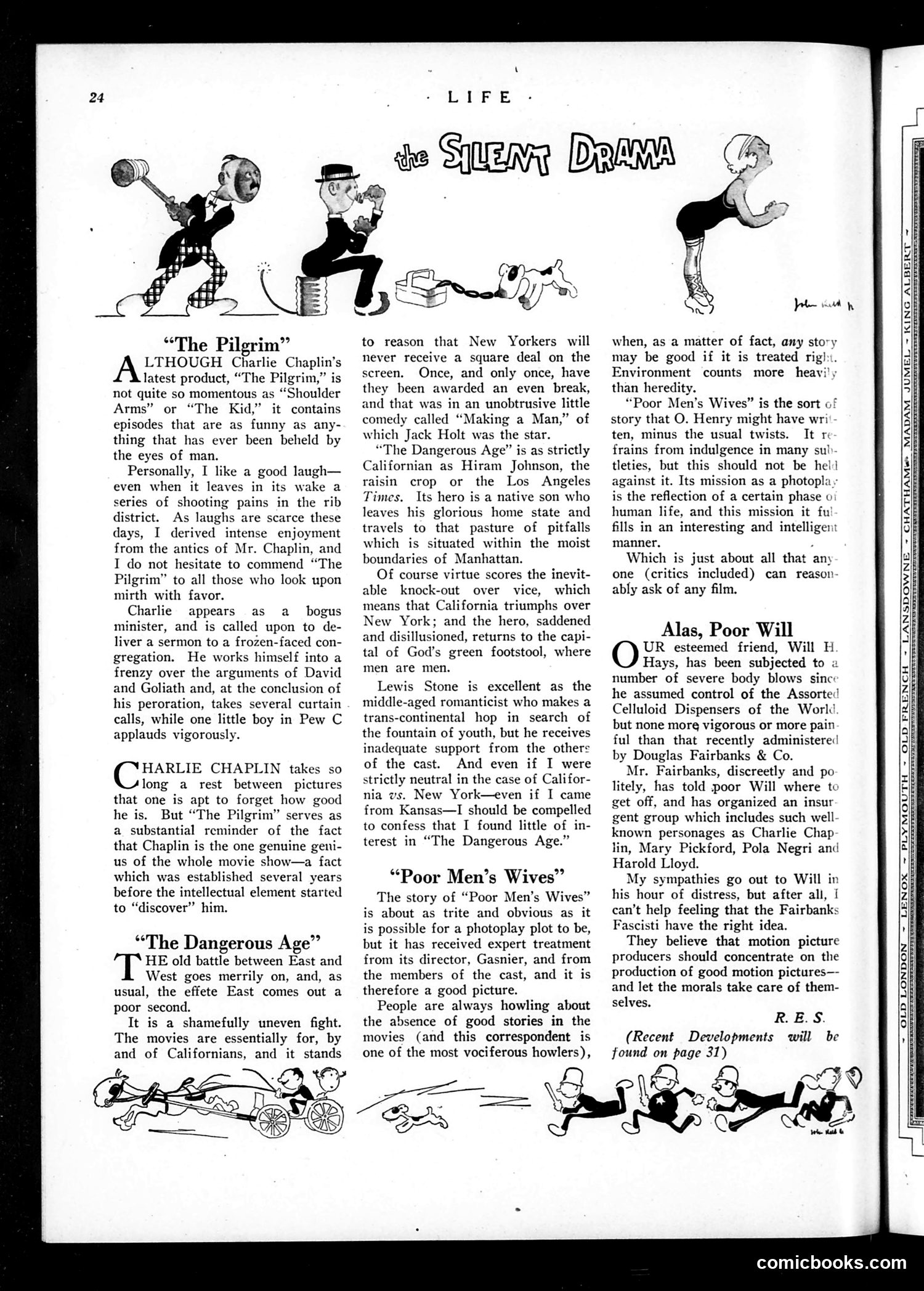
This page reviews three silent films, with satirical cartoons illustrating each. The cartoons show physical comedy and slapstick—Charlie Chaplin performing exaggerated poses, characters tumbling—reflecting the era's silent film humor. **The reviews discuss:** 1. **"The Pilgrim"** - Chaplin plays a fraudulent minister delivering a sermon. The critic praises Chaplin as genuine cinema "genius," noting his comedic talent despite long gaps between films. 2. **"The Dangerous Age"** - The critic satirizes Hollywood's East Coast bias, complaining that California-made films always depict New York negatively while California triumphs. The plot follows a California man searching for youth in Manhattan, predictably returning home disillusioned. 3. **"Poor Men's Wives"** - Despite a "trite" plot, the critic acknowledges expert direction and casting redeem it. The satirical point: good filmmaking matters more than original storytelling—any tale can work if executed well. The tone is wryly humorous about 1920s cinema conventions and Hollywood's geographic prejudices.
📄 Transcribed text from this page (OCR, searchable)
Machine-transcribed from the original scan — historical spelling and the odd misread are preserved.
“The Pilgrim” LTHOUGH Charlie Chaplin’s latest product, “The Pilgrim,” is not quite so momentous as “Shoulder Arms” or “The Kid,” it contains episodes that are as funny as any- thing that has ever been beheld by the eyes of man. Personally, I like a good laugh— even when it leaves in its wake a series of shooting pains in the rib district. As laughs are scarce these days, I derived intense enjoyment from the antics of Mr. Chaplin, and I do not hesitate to commend “The Pilgrim” to all those who look upon mirth with favor. Charlie appears as a _ bogus minister, and is called upon to de- liver a sermon to a frozen-faced con- gregation. He works himself into a frenzy over the arguments of David and Goliath and, at the conclusion of his peroration, takes several curtain calls, while one little boy in Pew C applauds vigorously. HARLIE CHAPLIN takes so long a rest between pictures that one is apt to forget how good he is. But “The Pilgrim” serves as a substantial reminder of the fact that Chaplin is the one genuine geni- us of the whole movie show—a fact which was established several years before the intellectual element started to “discover” him. “The Dangerous Age” HE old battle between East and West goes merrily on, and, as usual, the effete East comes out a poor second. It is a shamefully uneven fight. The movies are essentially for, by and of Californians, and it stands to reason that New Yorkers will never receive a square deal on the screen. Once, and only once, have they been awarded an even break, and that was in an unobtrusive little comedy called “Making a Man,” of which Jack Holt was the star. “The Dangerous Age” is as strictly Californian as Hiram Johnson, the n crop or the Los Angeles mes. Its hero is a native son who leaves his glorious home state and travels to that pasture of pitfalls which is situated within the moist boundaries of Manhattan. Of course virtue scores the inevit- able knock-out over vice, which means that California triumphs over New York; and the hero, saddened and disillusioned, returns to the capi- tal of God’s green footstool, where men are men. Lewis Stone is excellent as the middle-aged romanticist who makes a trans-continental hop in search of the fountain of youth, but he receives inadequate support from the others of the cast. And even if I were strictly neutral in the case of Califor- nia vs. New York—even if I came from Kansas—I should be compelled to confess that I found little of in- terest in “The Dangerous Age.” “Poor Men’s Wives” The story of “Poor Men’s Wives” is about as trite and obvious as it is possible for a photoplay plot to be, but it has received expert treatment from its director, Gasnier, and from the members of the cast, and it is therefore a good picture. People are always howling about the absence of good stories in the movies (and this correspondent is one of the most vociferous howlers), m® — p R C ge Ss when, as a matter of fact, any story may be good if it is treated righ. Environment counts more heavyi'y than heredity. “Poor Men’s Wives” is the sort of story that O. Henry might have wri'- ten, minus the usual twists. It ré frains from indulgence in many sul tleties, but this should not be heli against it. Its mission as a photoplay is the reflection of a certain phase o human life, and this mission it fu fills in an interesting and intelligent manner, 5 Which is just about all that any one (critics included) can reason ably ask of any film. Alas, Poor Will UR esteemed friend, Will H Hays, has been subjected to 2 number of severe body blows sinc: he assumed control of the Assorte: Celluloid Dispensers of the World but none more vigorous or more pain ful than that recently administered by Douglas Fairbanks & Co. Mr. Fairbanks, discreetly and po litely, has told poor Will where to get off, and has organized an insur gent group which includes such well- known personages as Charlie Chap lin, Mary Pickford, Pola Negri and Harold Lloyd. My sympathies go out to Will in his hour of distress, but after all, [ can’t help feeling that the Fairbanks Fascisti have the right idea. They believe that motion picture producers should concentrate on the production of good motion pictures—- and let the morals take care of them- selves. R.E.S. (Recent Developments will be found on page 31) we) NOx = PLYMOUTH ~ OLD FRENCH ~ LANSDOWNE - CHATHAM@ MADAM JUMEL ~ KING ALBERT ~ CE: [GED LONDON comicbooks.com