
A complete issue · 34 pages · 1922
Life — June 8, 1922
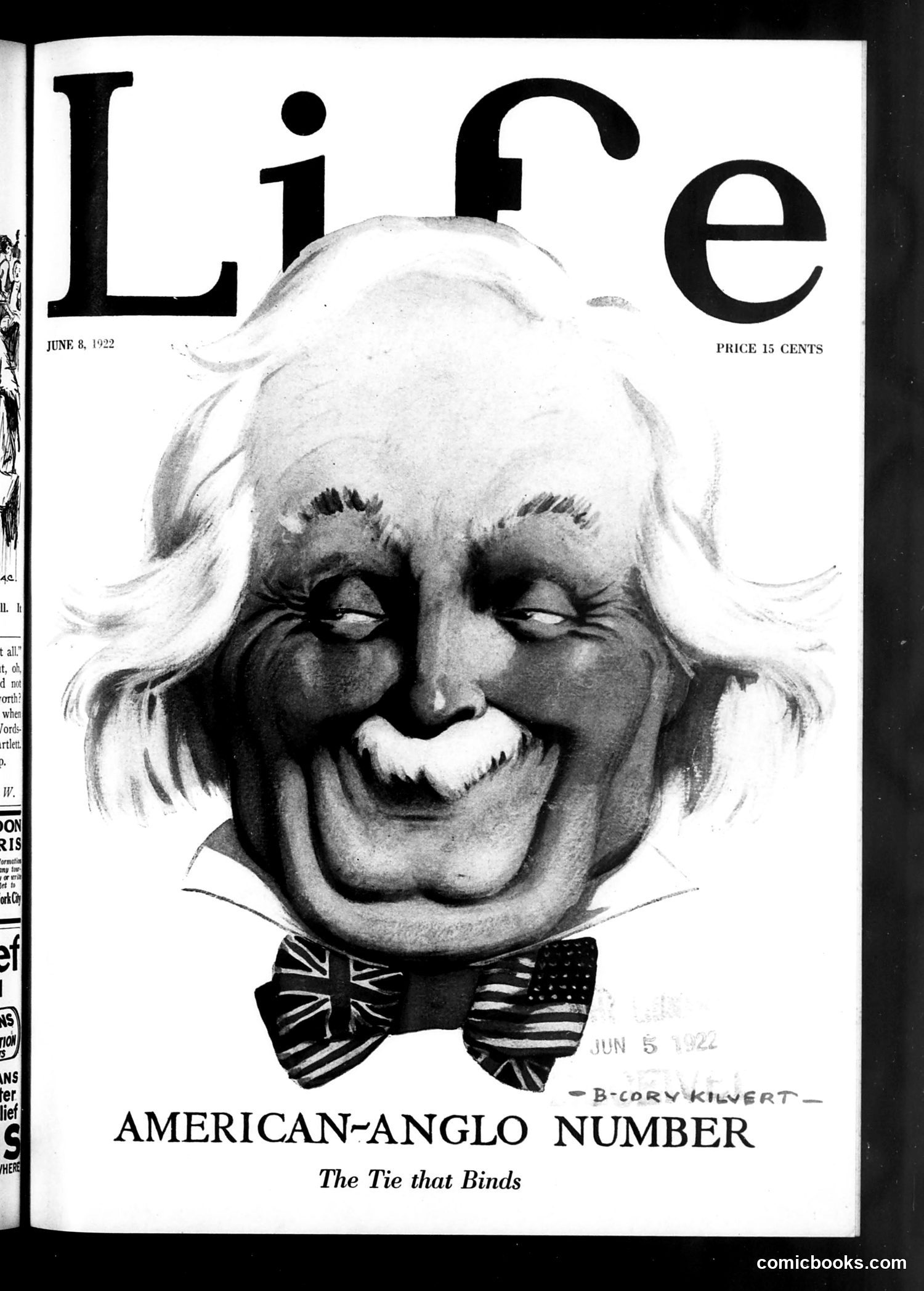
This is the cover of Life's "American-Anglo Number," themed "The Tie that Binds." The caricature depicts a cheerful, round-faced figure wearing a bow tie split between the British Union Jack and American flag—symbolizing Anglo-American alliance and friendship. The exaggerated facial features and jovial expression suggest this represents the positive relationship between Britain and America in the early 1920s, following their alliance in World War I (which ended 1918). The "tie that binds" pun refers both to the bow tie worn and the diplomatic bonds between the two nations. The price of 15 cents and artist credit "B. Corvin/Kilvert" date this to the post-WWI period when Anglo-American cooperation was a significant political theme.
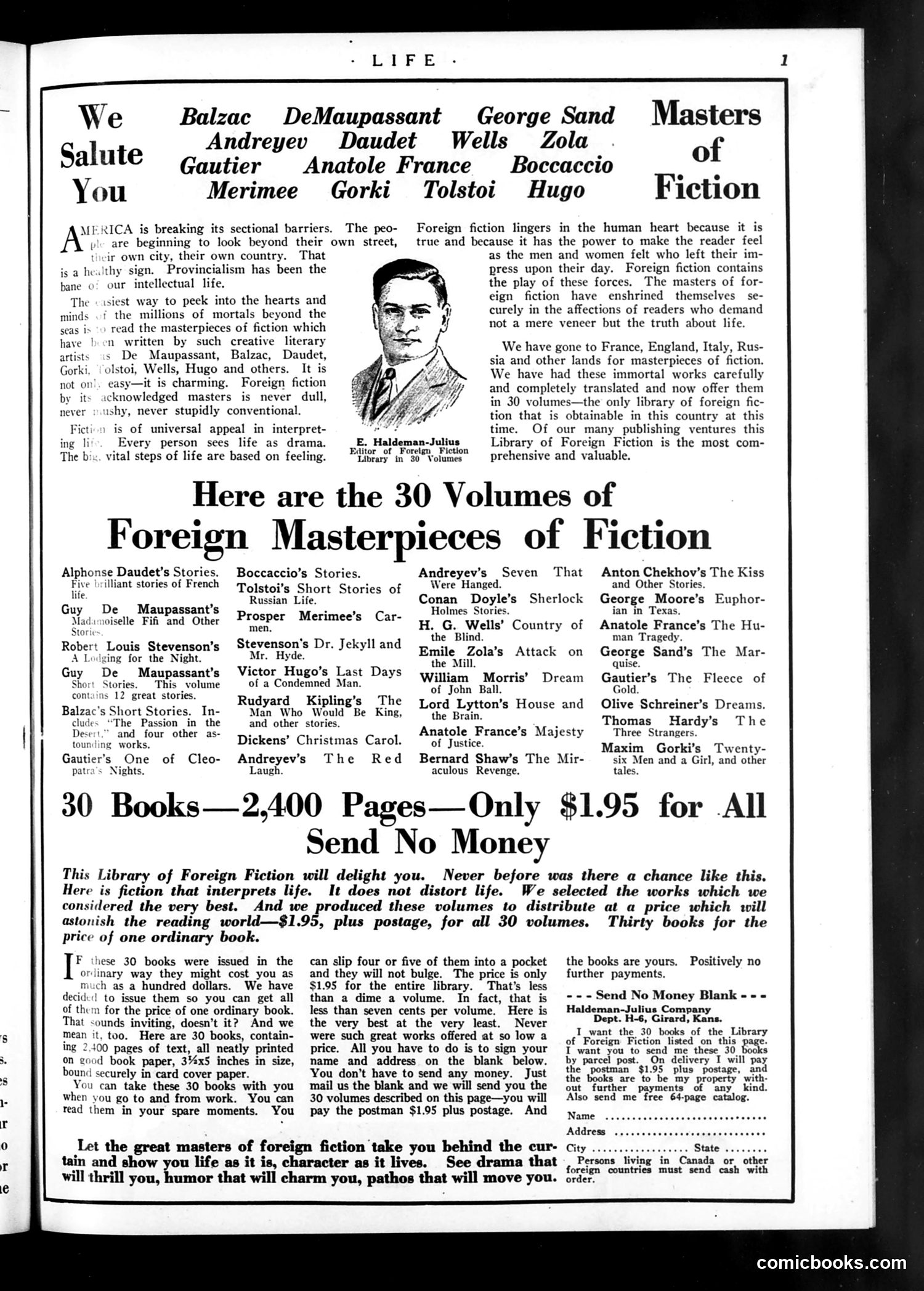
This page is primarily **advertising, not political satire or cartoons**. It promotes a "Library of Foreign Fiction" book collection—30 volumes of classic literature for $1.95. The content includes: - A portrait sketch identified as "E. Haldeman-Julius, Editor of Foreign Fiction Library" - Lists of classic authors (Balzac, Tolstoi, Hugo, Zola, etc.) - Marketing copy emphasizing America's cultural development and breaking "sectional barriers" - Details about the book set's affordability and distribution The only visual element is the editor's portrait. There is no political cartoon or satirical commentary. This is a commercial venture targeting early 20th-century American readers interested in accessing European literary classics at minimal cost.
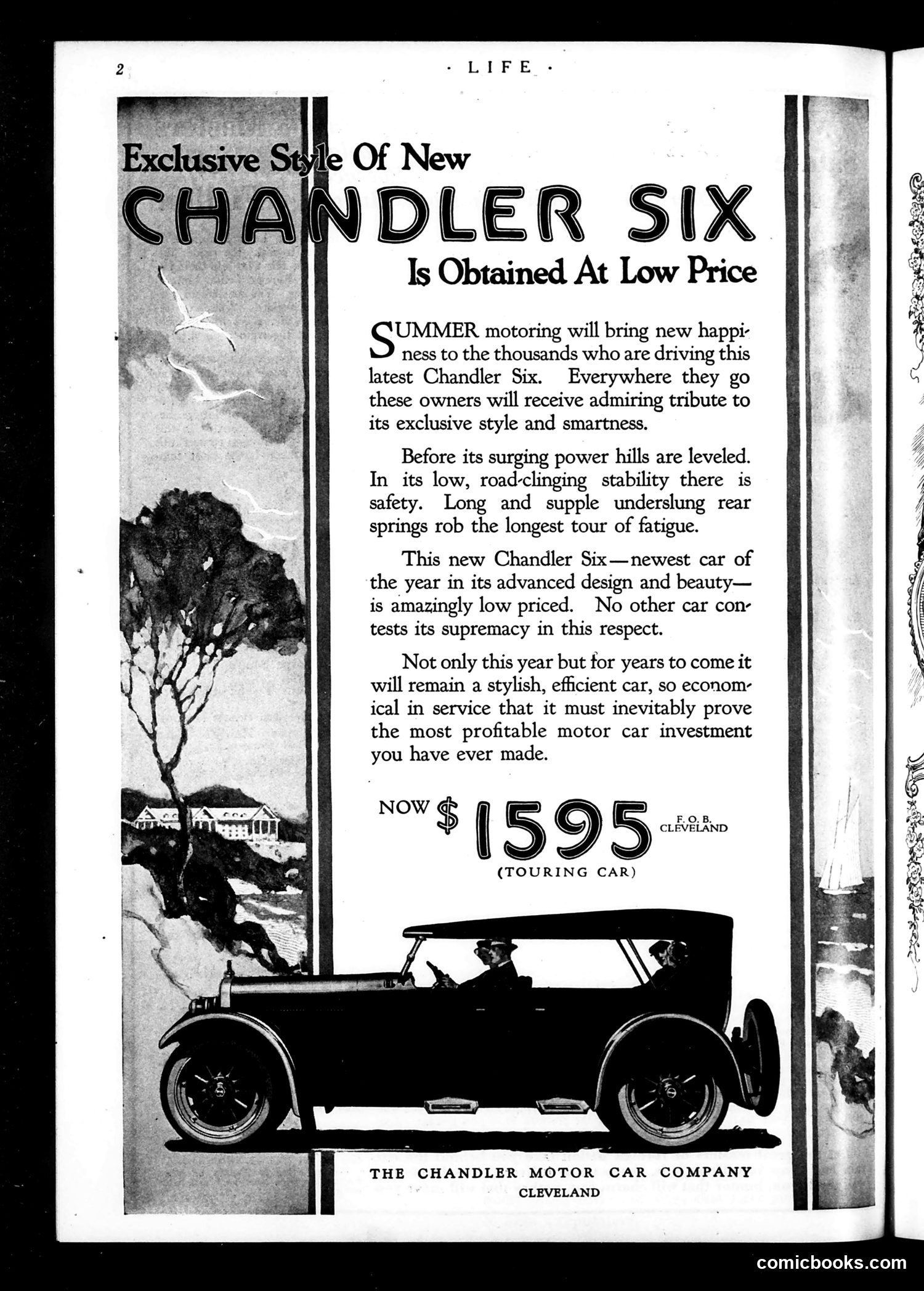
This page is **primarily an advertisement**, not political satire. It's a full-page ad for the Chandler Six automobile, placed in *Life* magazine by the Chandler Motor Car Company of Cleveland. The ad features a pastoral landscape illustration and a silhouette of the touring car, emphasizing "exclusive style" and "low price" ($1,595 for a Cleveland model). The marketing pitch highlights the car's engineering features—power, stability, and durability—while claiming it offers the best value proposition among competitors. The only non-commercial visual element is the romantic landscape sketch, which appears designed to evoke aspirational lifestyle imagery rather than convey any satirical message.
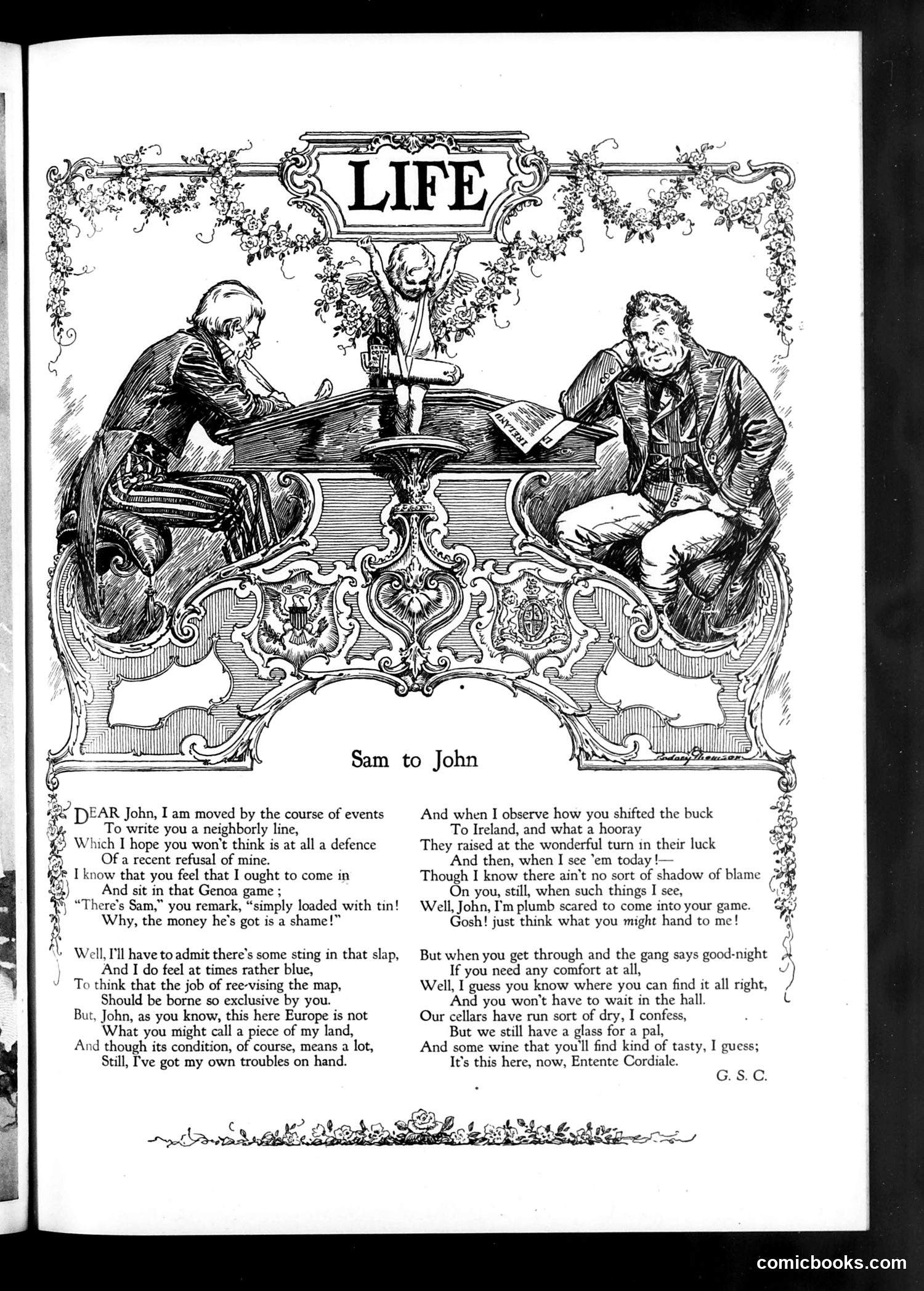
This poem-illustrated cartoon depicts two men in conversation, labeled "Sam to John." Based on the context, "Sam" appears to be addressing "John" about a neighborly dispute, likely involving money or a boundary disagreement ("shifted the buck / To Ireland"). The satire concerns two figures settling a conflict—Sam admits wrongdoing but deflects blame, while offering reconciliation through hospitality (wine, "Entente Cordiale"). The reference to Ireland and "shifting the buck" suggests this may represent Anglo-Irish relations or a diplomatic dispute of the era when Life published satirical commentary on international affairs. The ornate, classical frame underscores the contrast between civilized appearance and petty human quarreling.
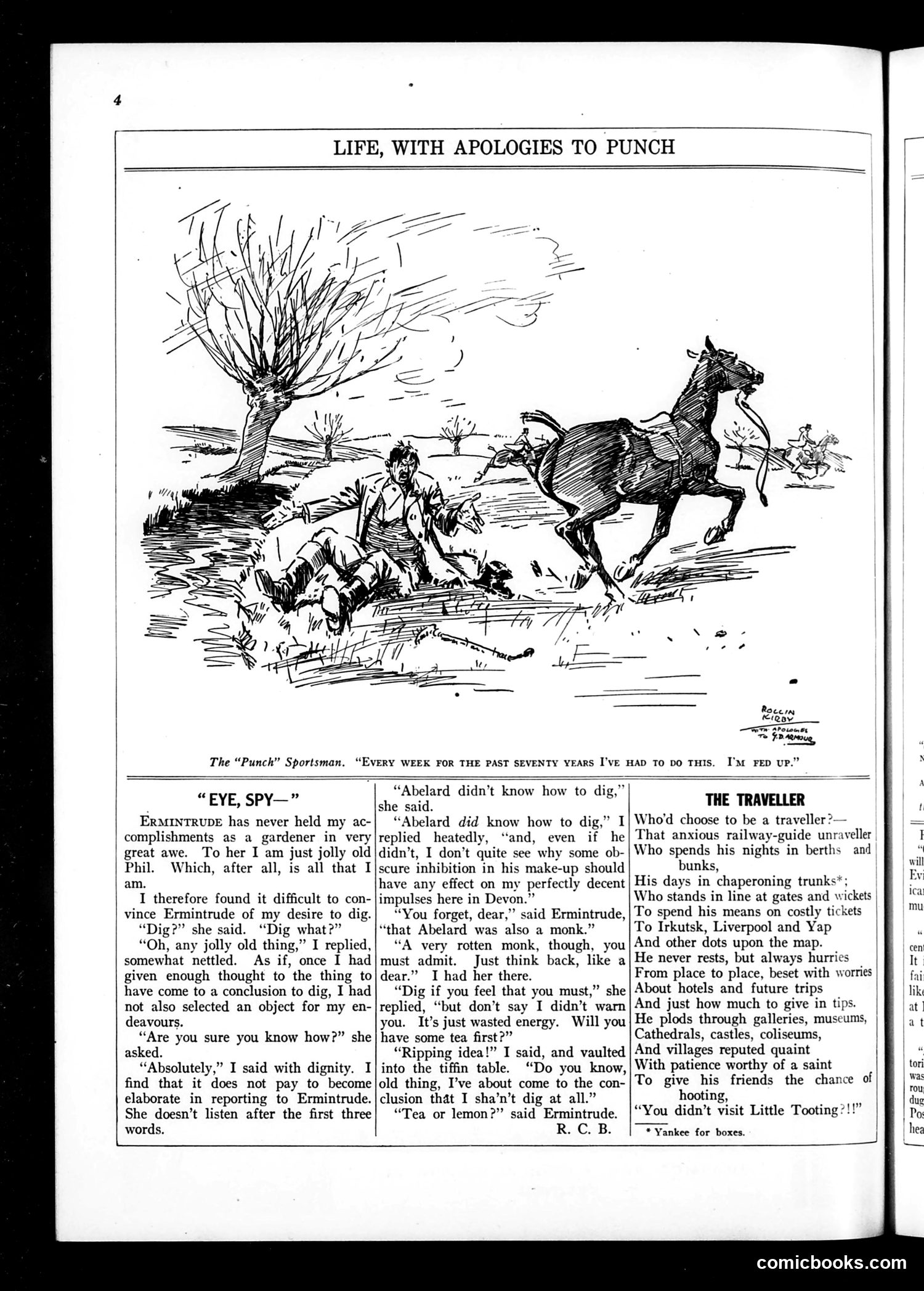
**The Main Cartoon:** The large illustration depicts a mounted sportsman riding away from a frustrated woman standing near a windswept tree, titled "The 'Punch' Sportsman." The caption reads: "Every week for the past seventy years I've had to do this. I'm fed up." **The Satire:** This mocks the predictable formula of *Punch* magazine's humor—apparently depicting the same domestic conflict scenario repeated weekly for decades. The woman appears to be Ermintrude (referenced in the text columns), suggesting the cartoon ridicules how *Punch* recycled identical marital-discord jokes as their standard comedic format. **Accompanying Text:** The page includes humorous anecdotes titled "Eye, Spy" and "The Traveller," which are unrelated short comedic pieces typical of the magazine's miscellaneous humor format.
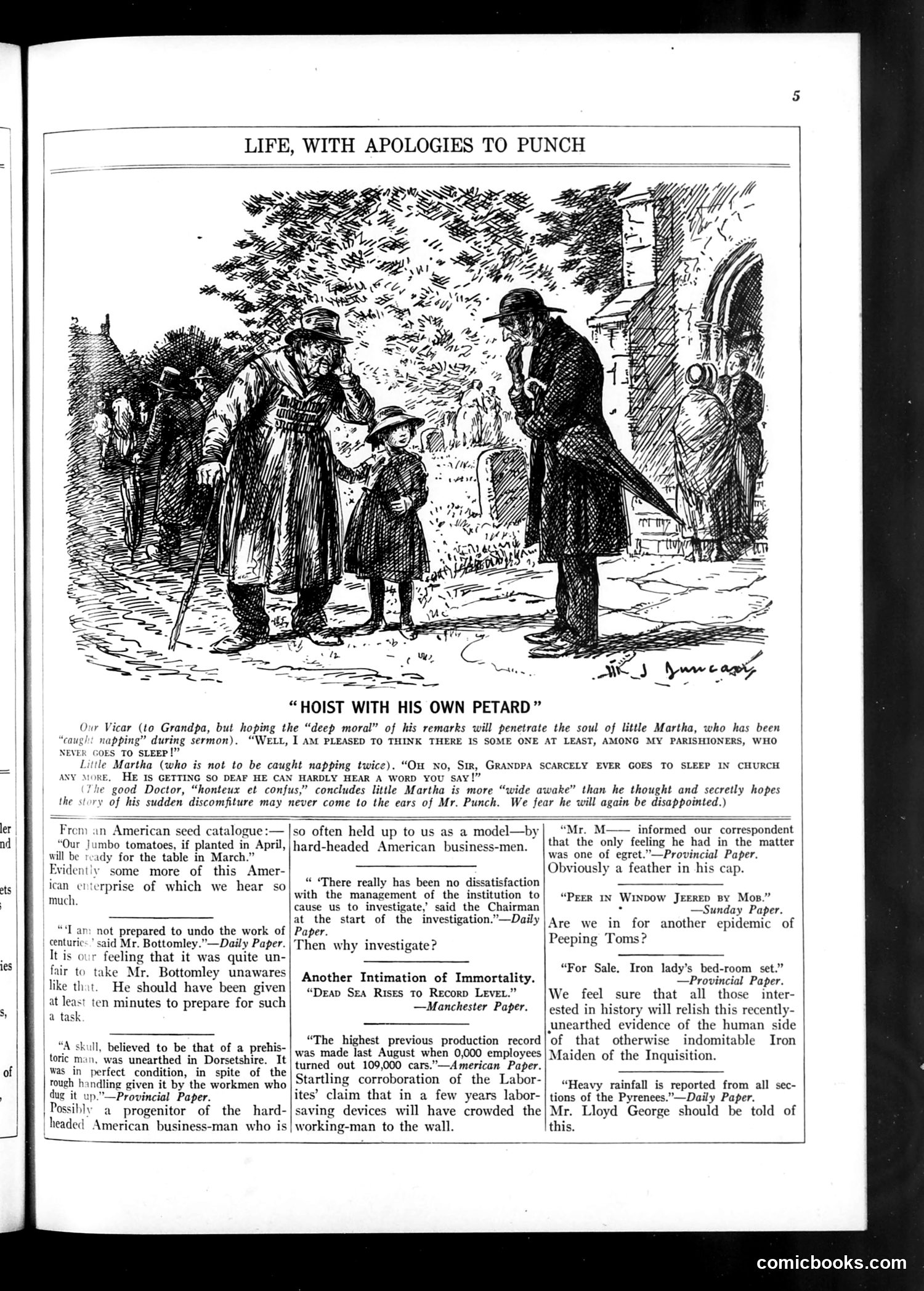
This cartoon depicts a moral lesson about hypocrisy. A Vicar (clergyman) approaches a small boy named Martha, intending to deliver sanctimonious advice about morality and sleep habits—lecturing that respectable people shouldn't nap in church. However, the caption reveals the Vicar himself "scarcely ever goes to sleep in church," undermining his credibility. The title "Hoist With His Own Petard" (meaning caught by one's own trap) emphasizes the irony: the Vicar's attempt to moralize backfires because his own behavior contradicts his message. The surrounding newspaper clippings mock various hypocrisies—hard-headed businessmen lacking moral feeling, investigations into workplace safety, and record industrial production. The satire targets Victorian-era sanctimoniousness and class-based moral posturing.
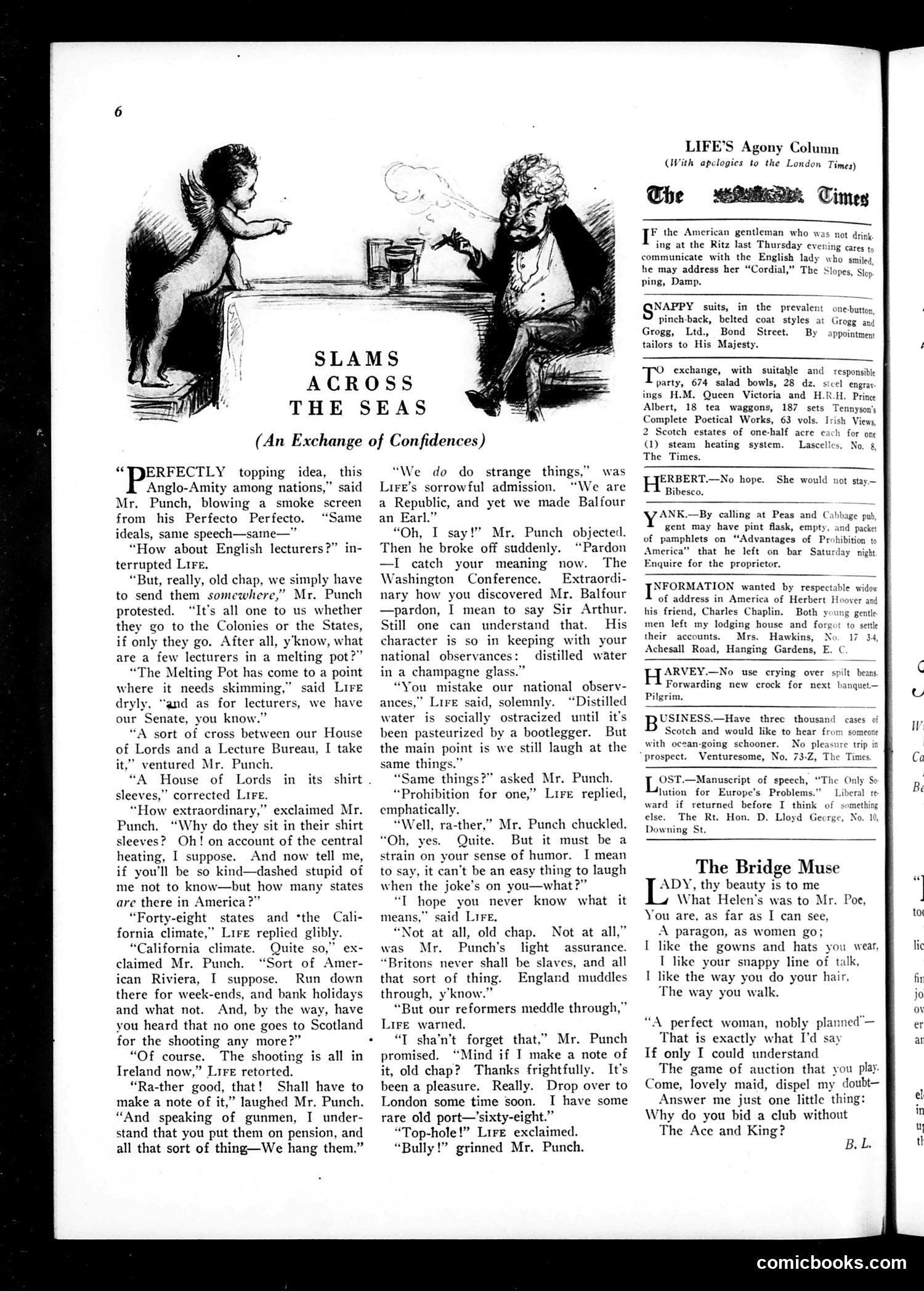
This satirical dialogue features **Mr. Punch** (the magazine's mascot, shown as a grotesque caricatured figure on the right) debating an unnamed **American gentleman** (left). The cartoon ridicules perceived American arrogance about their nation's superiority. The American boasts about America's climate and freedom, while Punch responds with British condescension and wit—particularly mocking American prohibitionism ("Prohibition for one") and suggesting Americans lack cultural refinement. The satire exemplifies Anglo-American rivalry of the era, with Punch defending British traditions (drinking, gunmanship, established order) against American claims of exceptionalism. The title's "Exchange of Confidences" frames their debate as mock-polite bickering between nations—characteristic of *Life* magazine's transatlantic humor during this period.
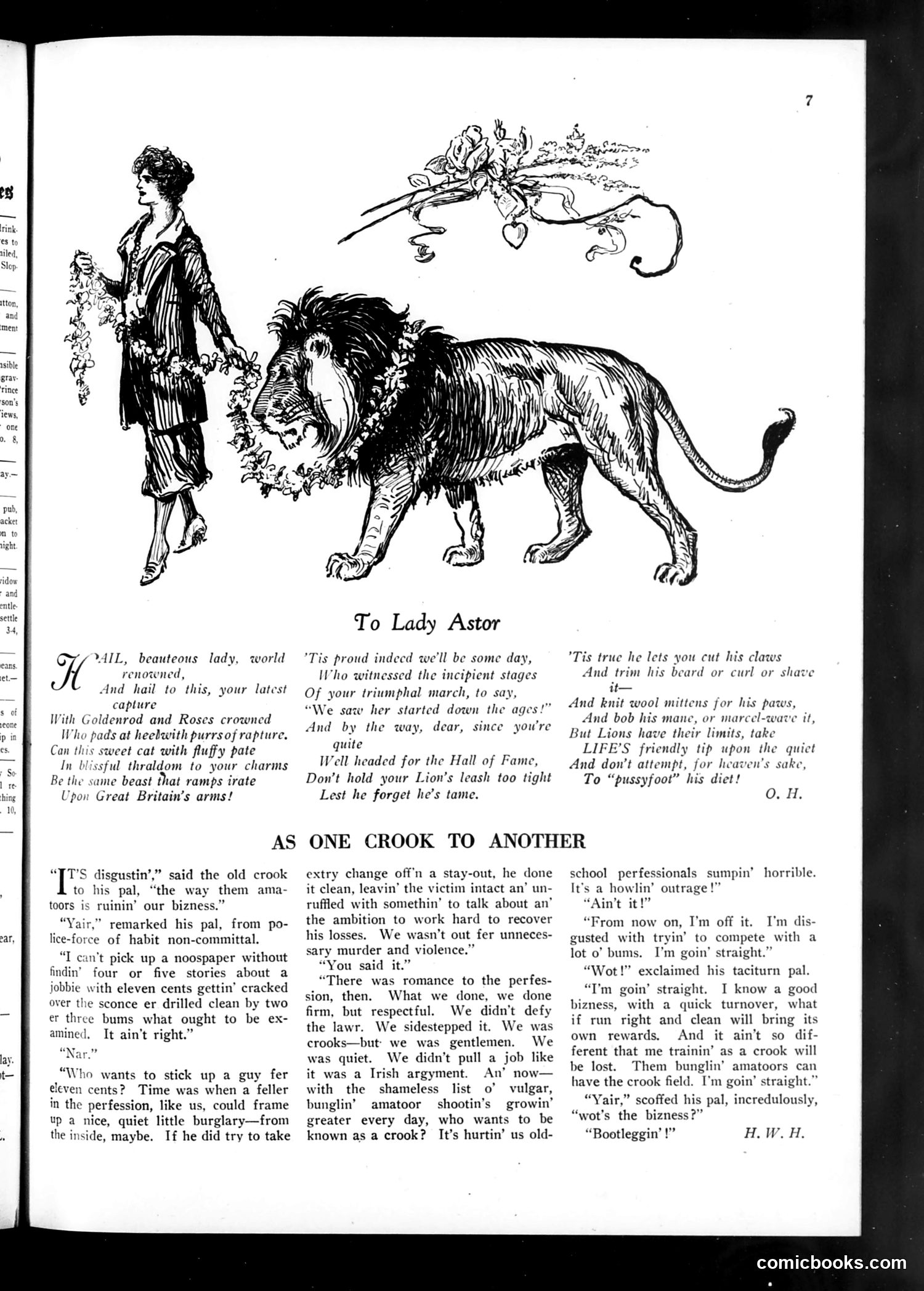
This page contains two distinct pieces: **Top illustration:** A decorative drawing titled "To Lady Astor" showing a woman with a lion wearing floral garlands. The accompanying poem celebrates Lady Astor as a prominent woman ("beauteous lady, world renowned") and uses the lion as a metaphor for British strength and pride. This appears to be a complimentary tribute rather than satire. **Bottom story:** "As One Crook to Another" depicts two criminals discussing their trade. One notes that crime is "ruinin' our bizness," complaining about excessive violence and murder affecting their profession's reputation. The dialogue satirizes criminal underworld culture by portraying thieves as "gentlemen" concerned with professional standards—the humor lies in treating criminal activity as a respectable business with ethical codes.
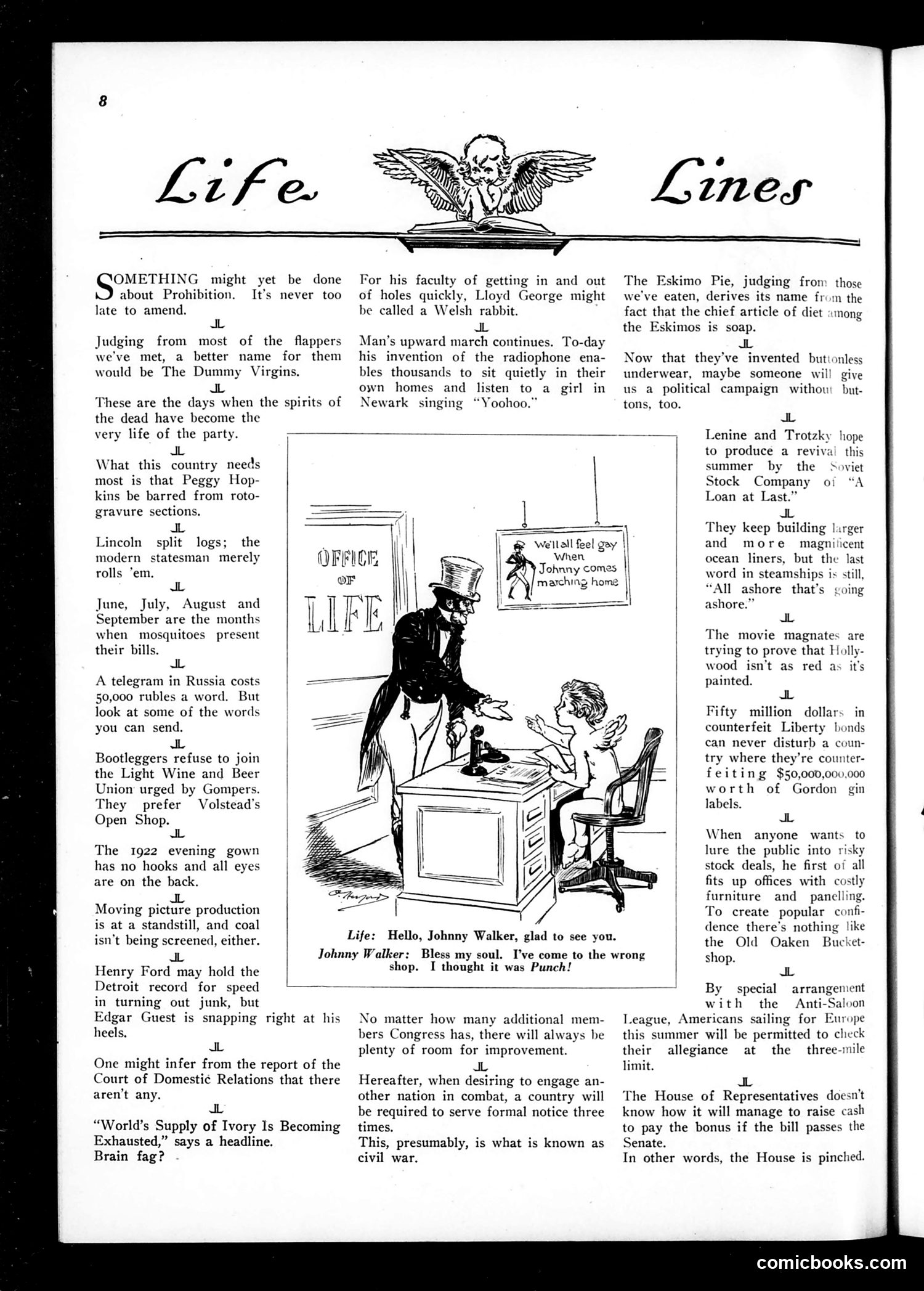
This page from *Life* magazine contains a single political cartoon showing a man in formal attire at an "Office of Life" desk speaking with a young boy. The caption indicates the man is welcoming "Johnny Walker," while Johnny mistakenly says he thought it was "Punch!" (likely referencing a rival humor magazine). The cartoon satirizes the magazine itself through self-promotion—depicting *Life*'s offices and playfully acknowledging competition from other publications. The surrounding text consists of brief satirical observations on contemporary topics: Prohibition enforcement, Congress's inefficiency, war protocols, and counterfeiting. These short items exemplify *Life*'s characteristic format of witty social and political commentary aimed at educated readers.
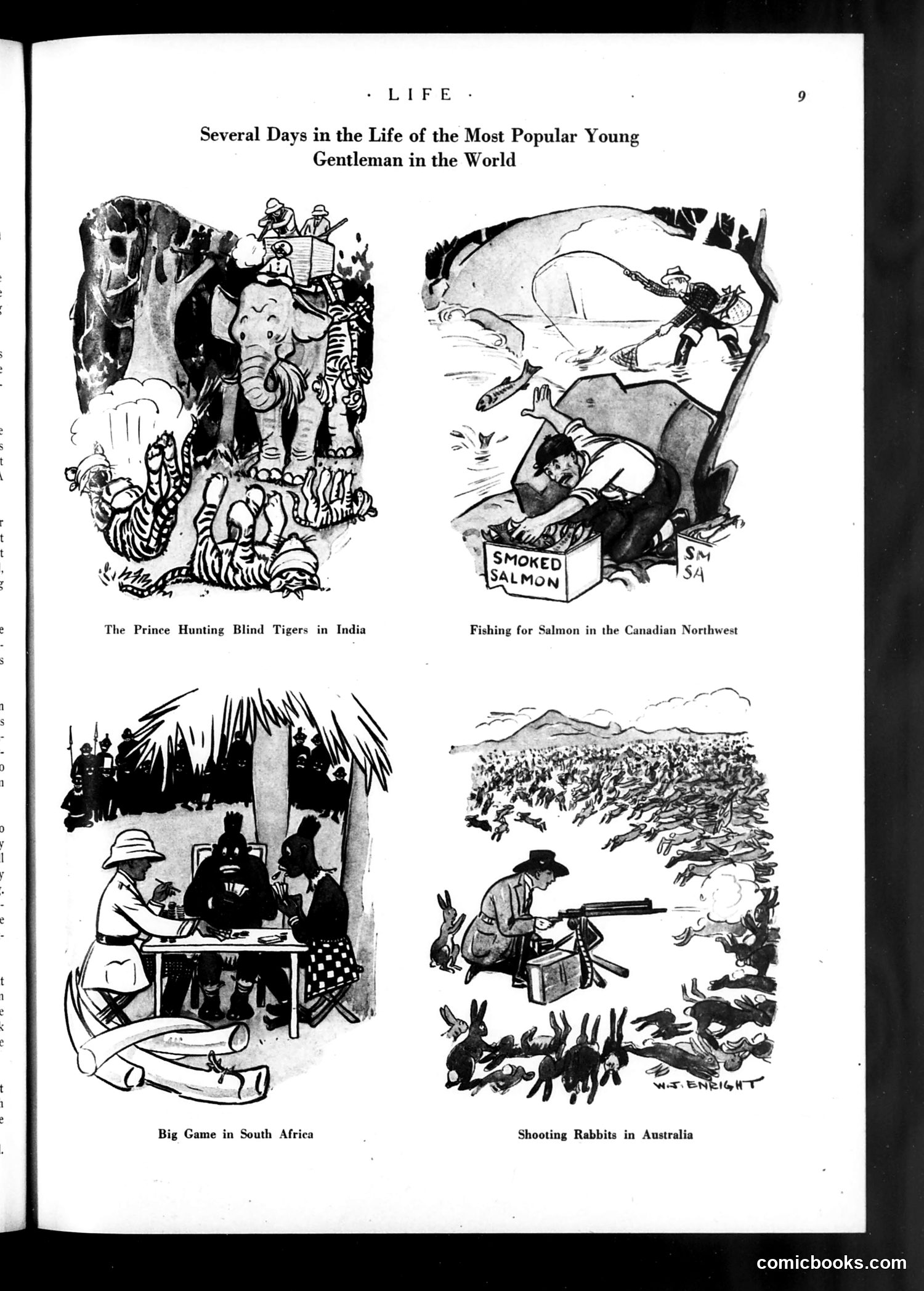
This page satirizes the lifestyle of an extremely wealthy and leisure-focused young gentleman, presenting "several days" of his activities across four cartoon panels. The satire works through contrast: each panel depicts him engaging in exotic, expensive pursuits across the globe—hunting tigers in India, fishing in Canada, big-game hunting in South Africa, and shooting rabbits in Australia. The humor derives from the absurd privilege: this young man travels the world pursuing hunting and fishing as casual entertainment. The "most popular young gentleman" appears to be someone of such extraordinary wealth that globe-trotting adventures are routine recreation. The joke satirizes both upper-class excess and the colonial-era assumption that such exotic lands existed primarily for wealthy Westerners' amusement.
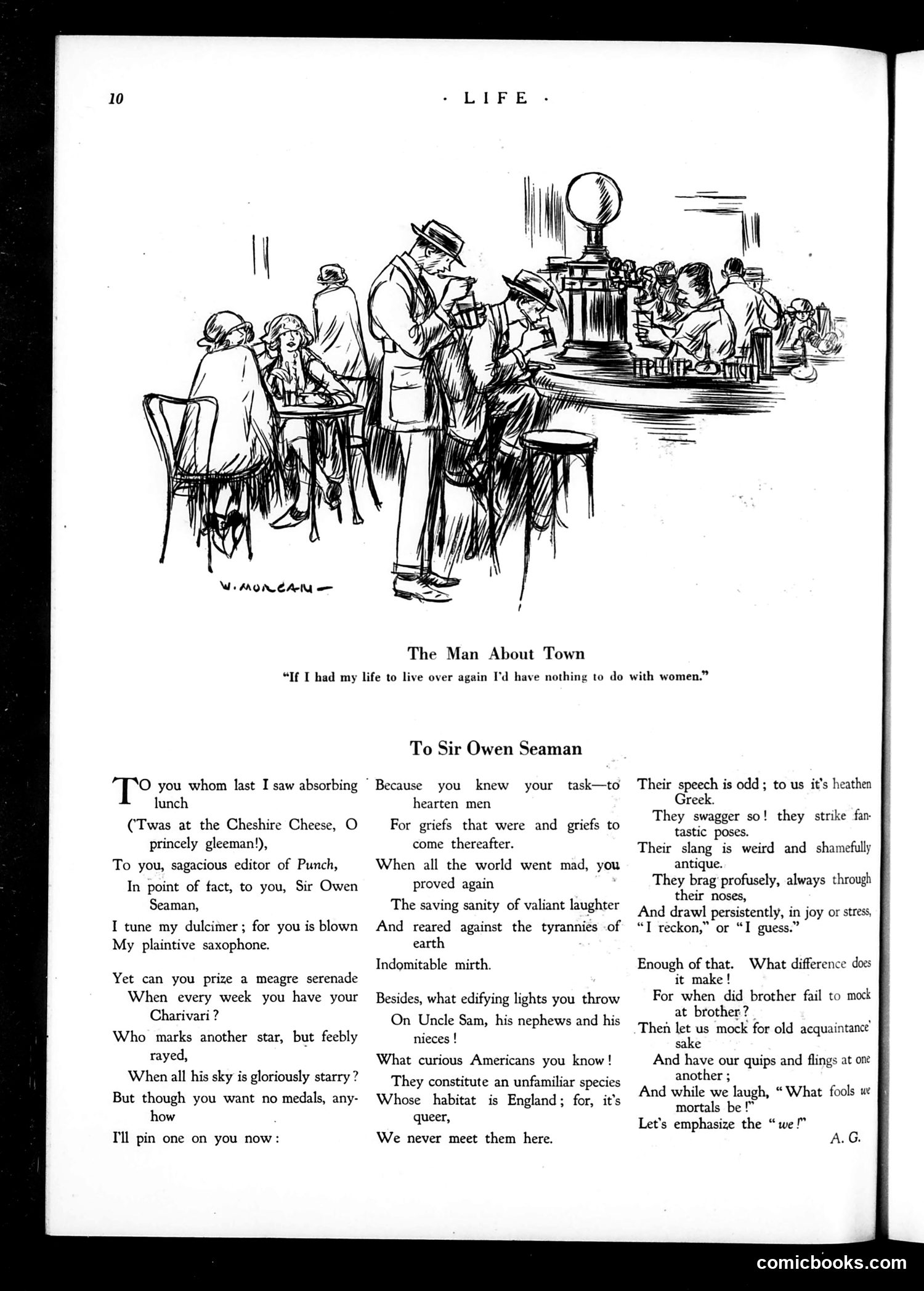
The cartoon "The Man About Town" depicts a well-dressed man at what appears to be a bar or social establishment, surrounded by drinking companions. The caption quotes him saying: "If I had my life to live over again I'd have nothing to do with women." This is a straightforward satirical joke about male regret and romantic disillusionment—a common humor theme in early 20th-century Life magazine. The cartoon mocks a typical "man about town" (a fashionable, socially active bachelor) who frequents bars and social venues, suggesting his lifestyle and romantic entanglements have left him cynical about relationships with women. The accompanying poem "To Sir Owen Seaman" appears unrelated to the cartoon, addressing the editor of *Punch* magazine with literary praise.
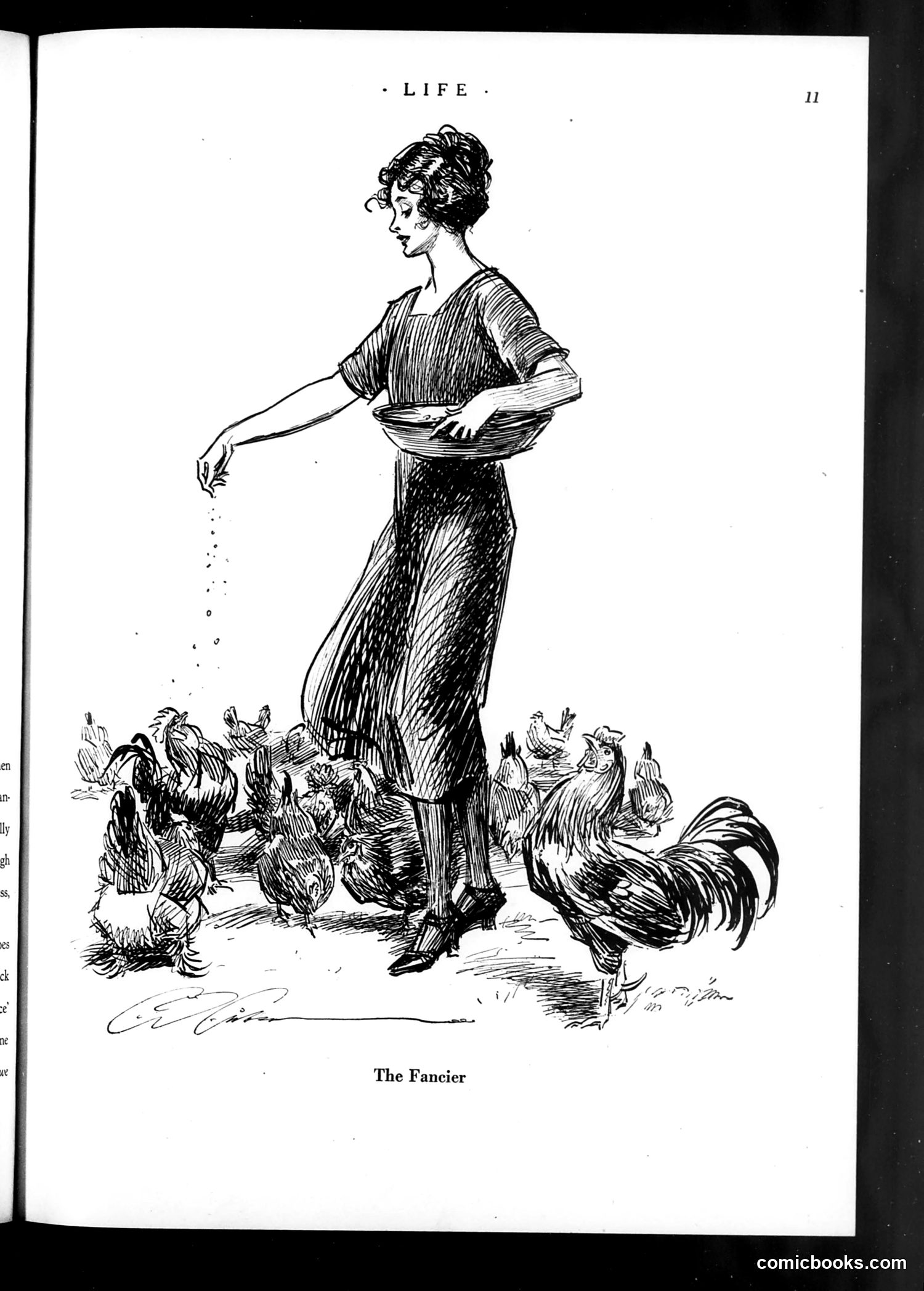
This illustration depicts a well-dressed woman feeding a group of chickens and roosters. The title "The Fancier" refers to someone who raises fancy poultry as a hobby or business. The satire likely comments on women's engagement with poultry-keeping—a popular domestic pursuit in the early 20th century. The woman's fashionable attire and refined posture contrasts humorously with the mundane task of feeding farmyard birds, suggesting either the pretensions of hobby farmers or the peculiarity of genteel women engaging in agricultural work. Without additional context from surrounding articles, the specific satirical target remains unclear, though it appears to mock either class aspirations or evolving gender roles regarding women's domestic and agricultural activities.
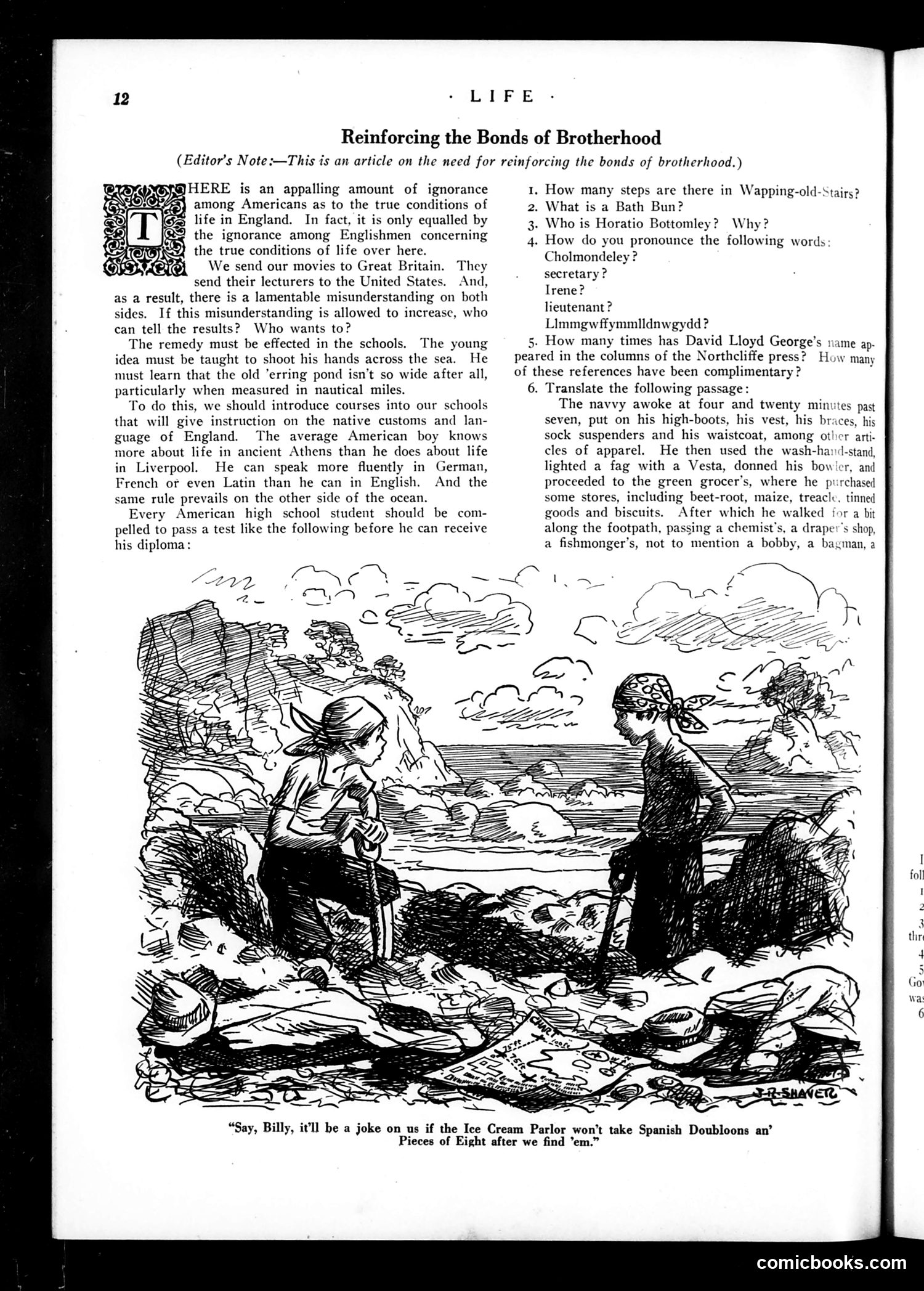
This page from *Life* magazine contains an article titled "Reinforcing the Bonds of Brotherhood" discussing American ignorance about English life conditions. The author argues American schools should teach more about England to combat mutual misunderstandings between the nations. The cartoon below depicts children at a beach finding what appears to be treasure or currency. One child says: "Say, Billy, it'll be a joke on us if the Ice Cream Parlor won't take Spanish Doubloons an' Pieces of Eight after we find 'em." The joke satirizes children's naive assumption that old foreign currency they've discovered would have modern purchasing power. It humorously illustrates the kind of ignorance the article warns against—reflecting broader themes about education gaps and practical understanding of how the world actually works.
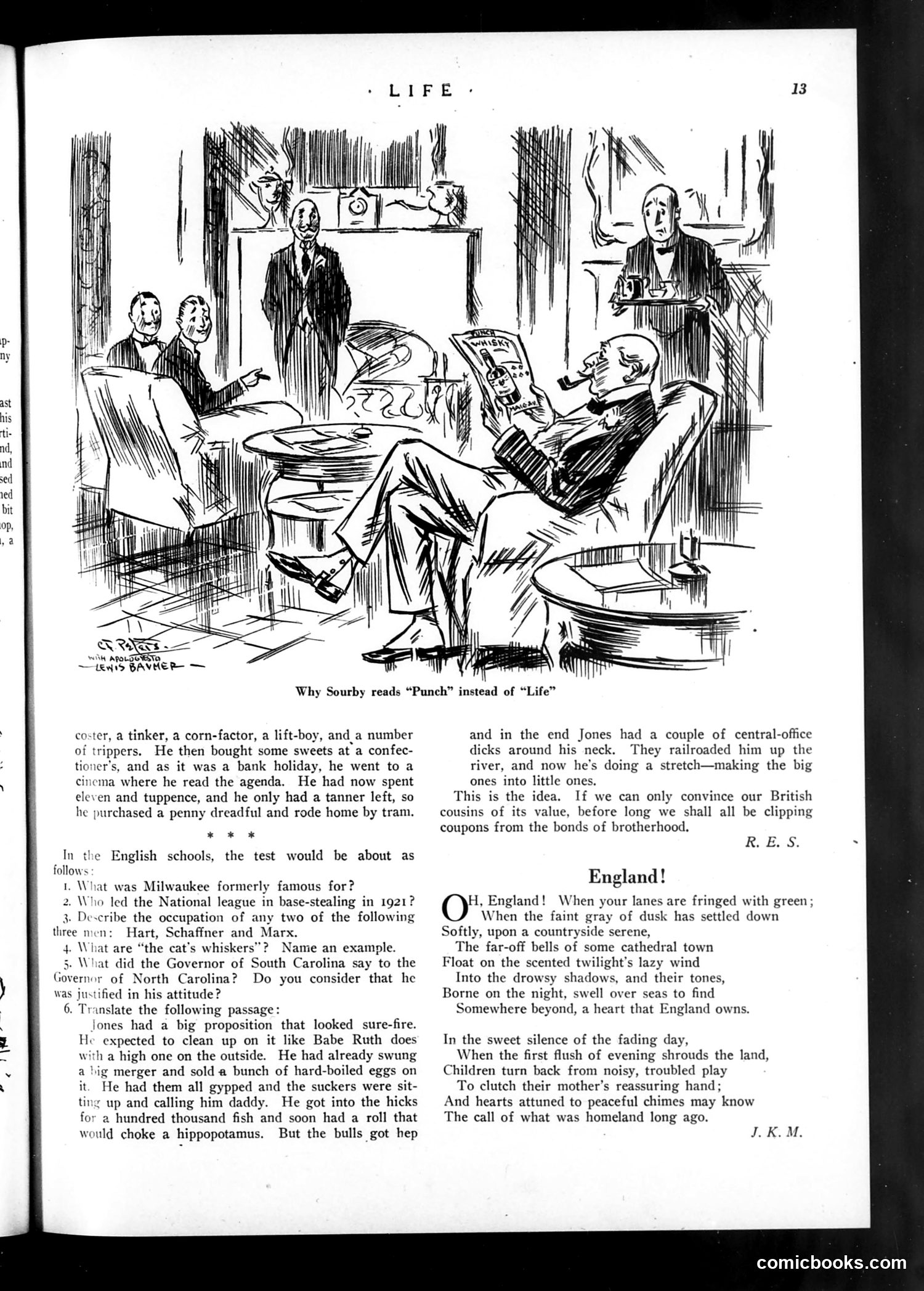
This cartoon satirizes a social gathering where a man reads the British magazine *Punch* rather than the American *Life*. The joke appears to target class pretension—the figure "Sourby" (likely a character representing affected snobbery) prefers the ostensibly more sophisticated British publication. The sketch shows him relaxing while others converse, suggesting he uses *Punch* as a status symbol. The humor lies in mocking Americans who adopt British cultural preferences to appear refined. The caption's implication is that *Life* magazine is equally entertaining but more authentically American—making *Punch* reading a pretentious affectation. This reflects early 20th-century American cultural anxiety about British superiority and domestic audiences' fascination with European sophistication.
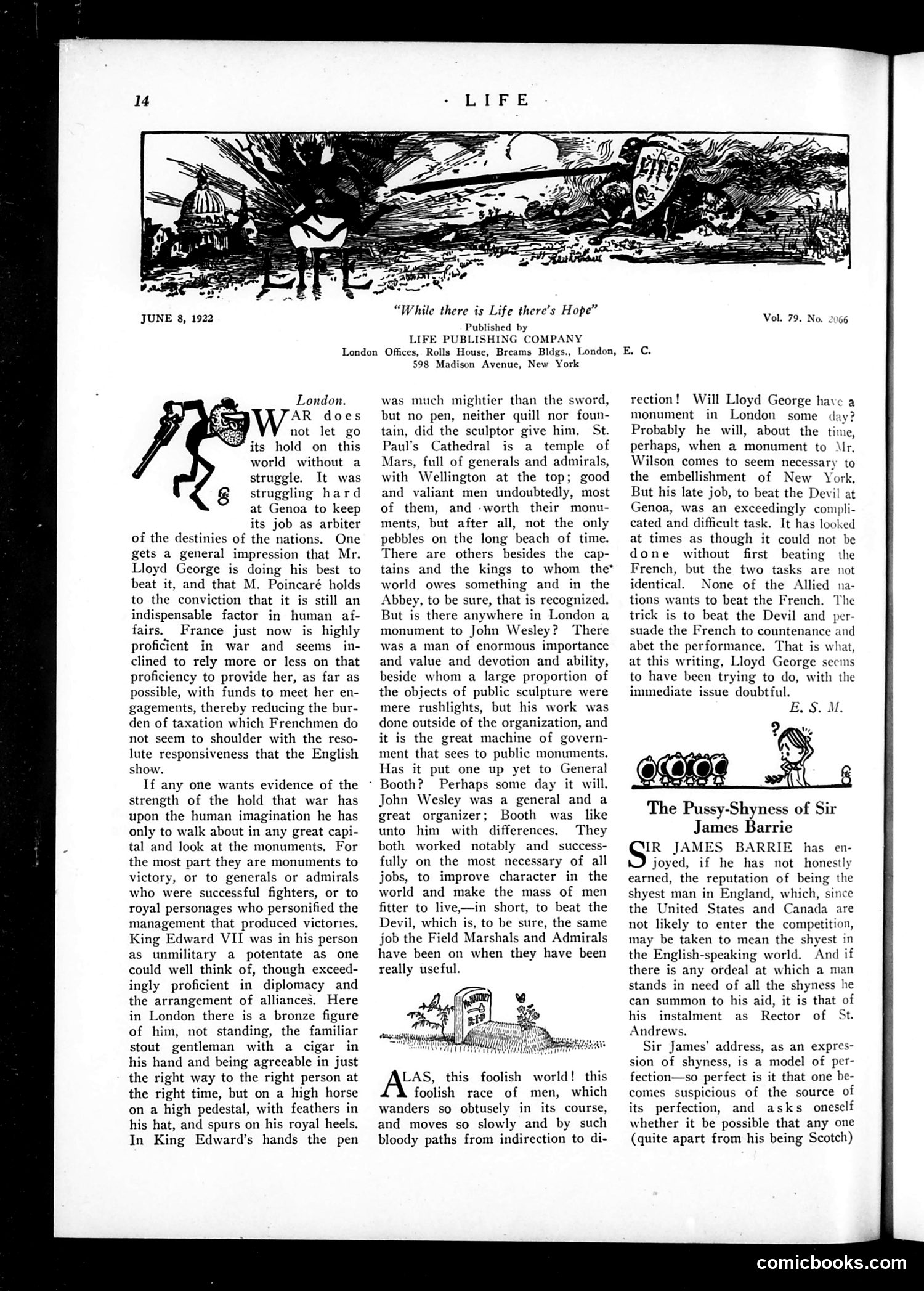
This page contains two separate pieces: **Main Article ("While there is Life there's Hope"):** A discussion of war monuments and public sculpture in London, particularly praising Lloyd George's efforts to commemorate WWI. The author argues monuments require skilled artists and that generals like Wellington and Booth deserve recognition for their organizational abilities—comparing them to successful military strategists rather than mere battlefield fighters. **Sidebar ("The Pussy-Shyness of Sir James Barrie"):** A commentary on Sir James Barrie (Scottish playwright, Peter Pan author) becoming Rector of St. Andrews University. The piece humorously discusses his shyness and perfectionism, suggesting his refined personality makes him an unlikely candidate for such a public position, despite his literary eminence. Both pieces use gentle satire about British public figures and institutions.
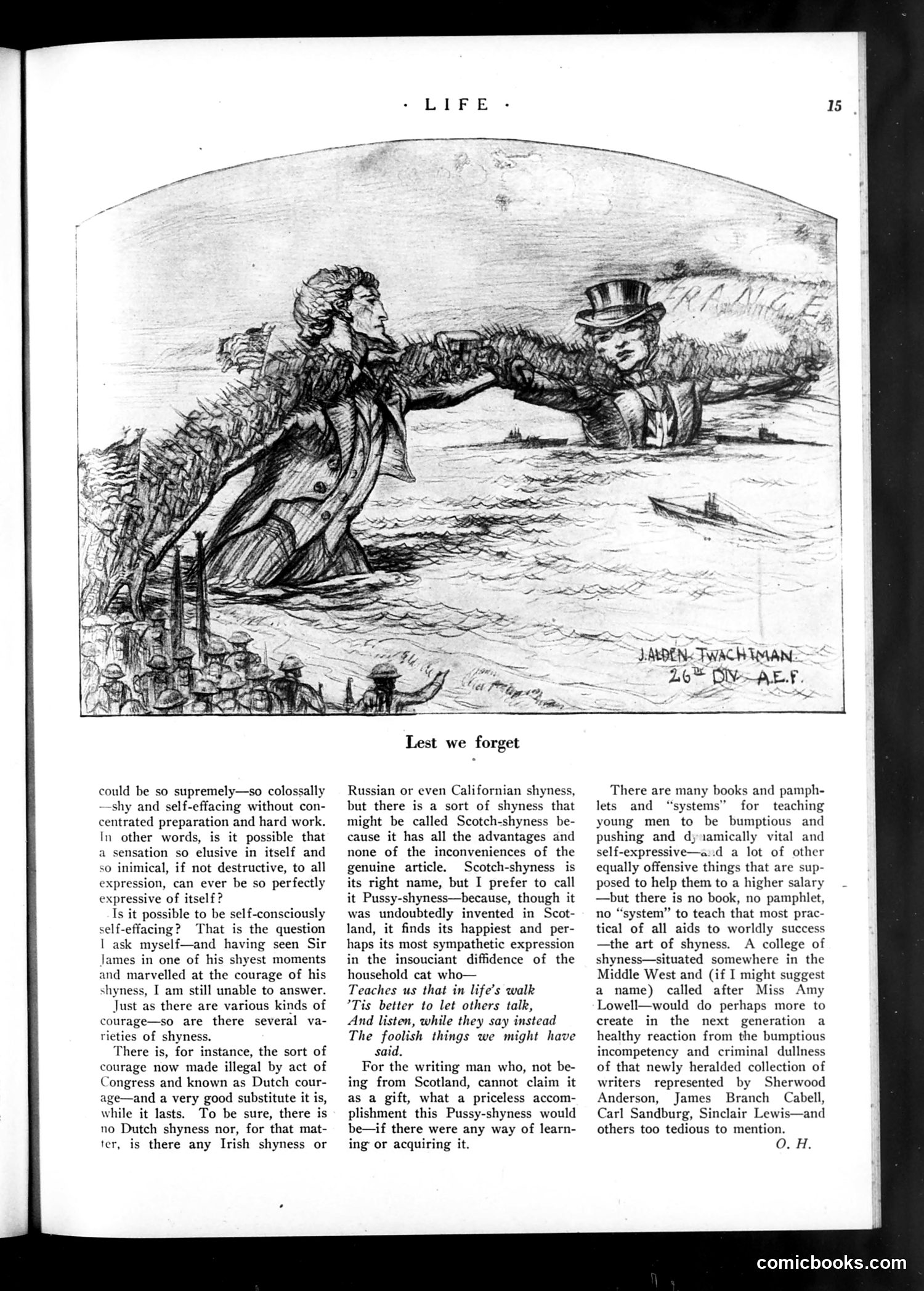
This page satirizes competing philosophies about social behavior and success. The cartoon (by Auden Twachtman) depicts two figures in water—likely representing different national temperaments—illustrating the text's discussion of "shyness" as a cultural trait. The article playfully categorizes types of shyness by nationality: Dutch courage, Irish shyness, Scotch-shyness (which the author humorously calls "Pussy-shyness," comparing it to a cat's cool indifference). The satire targets contemporary American self-help culture, which promoted aggressive "bumptious" personality traits for worldly success. The author sarcastically proposes a "college of shyness" to counter this trend, mockingly naming it after poet Amy Lowell and critiquing contemporary writers (Sinclair Lewis, Sherwood Anderson, Carl Sandburg) as representing bumptious mediocrity. The piece is a witty defense of quiet reserve as superior to the era's emphasis on assertiveness and self-promotion.
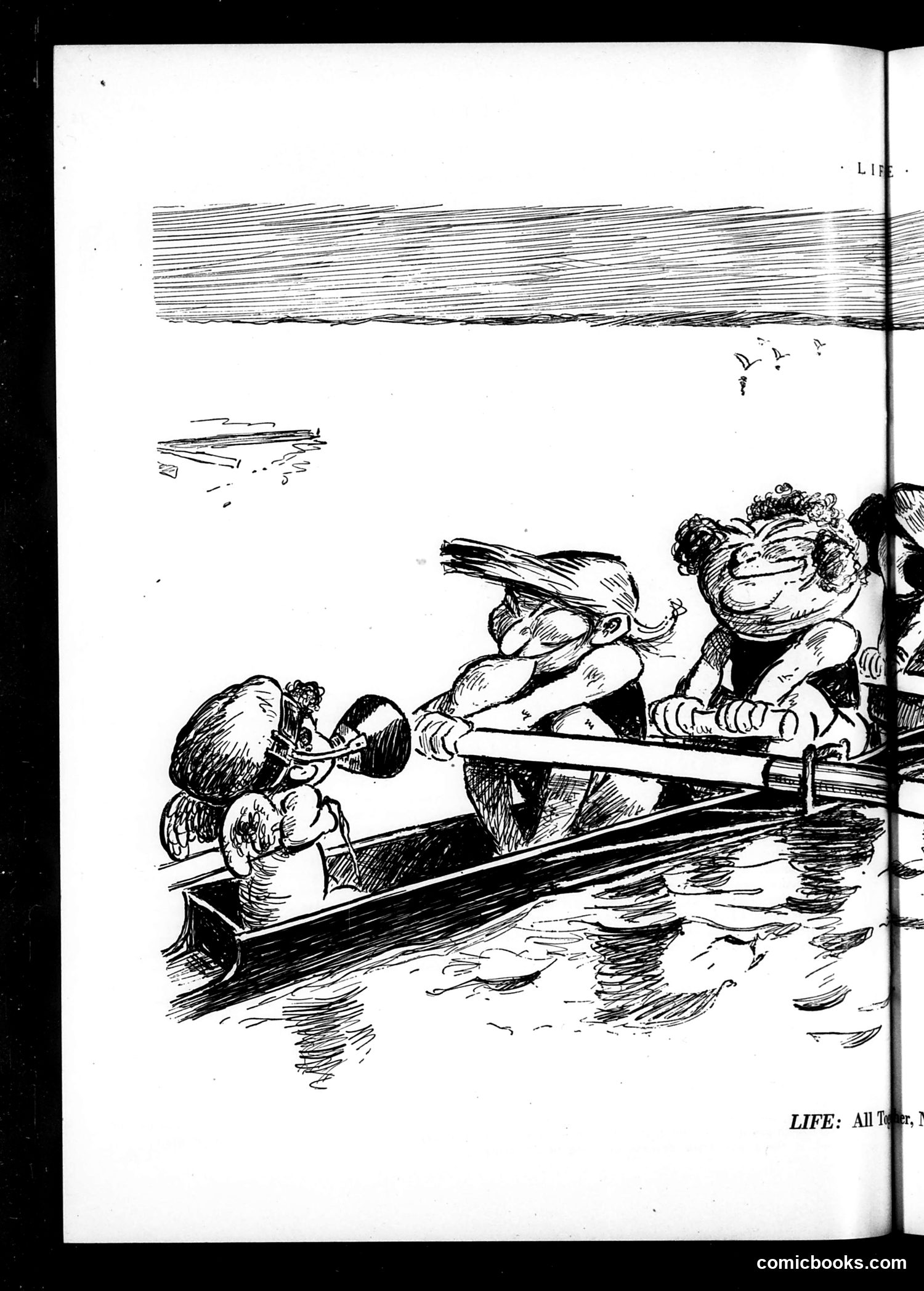
This page shows a satirical cartoon from *Life* magazine depicting what appears to be a seesaw or plank scene with exaggerated figures. The left figure has wings (suggesting an angel or cherub) and holds a large vessel or container, while two rotund figures on the right sit on a plank over water, appearing to be in a precarious balance. The cartoon likely satirizes some social or political imbalance—the seesaw mechanism suggests inequality or unstable equilibrium. The winged figure may represent virtue, justice, or an idealized principle, while the weighted figures suggest excess or vice outweighing moral considerations. However, without clearer context, article text, or visible date/caption, I cannot definitively identify the specific political event, figures, or social issue this references. The artwork style suggests early-to-mid 20th century American satire.
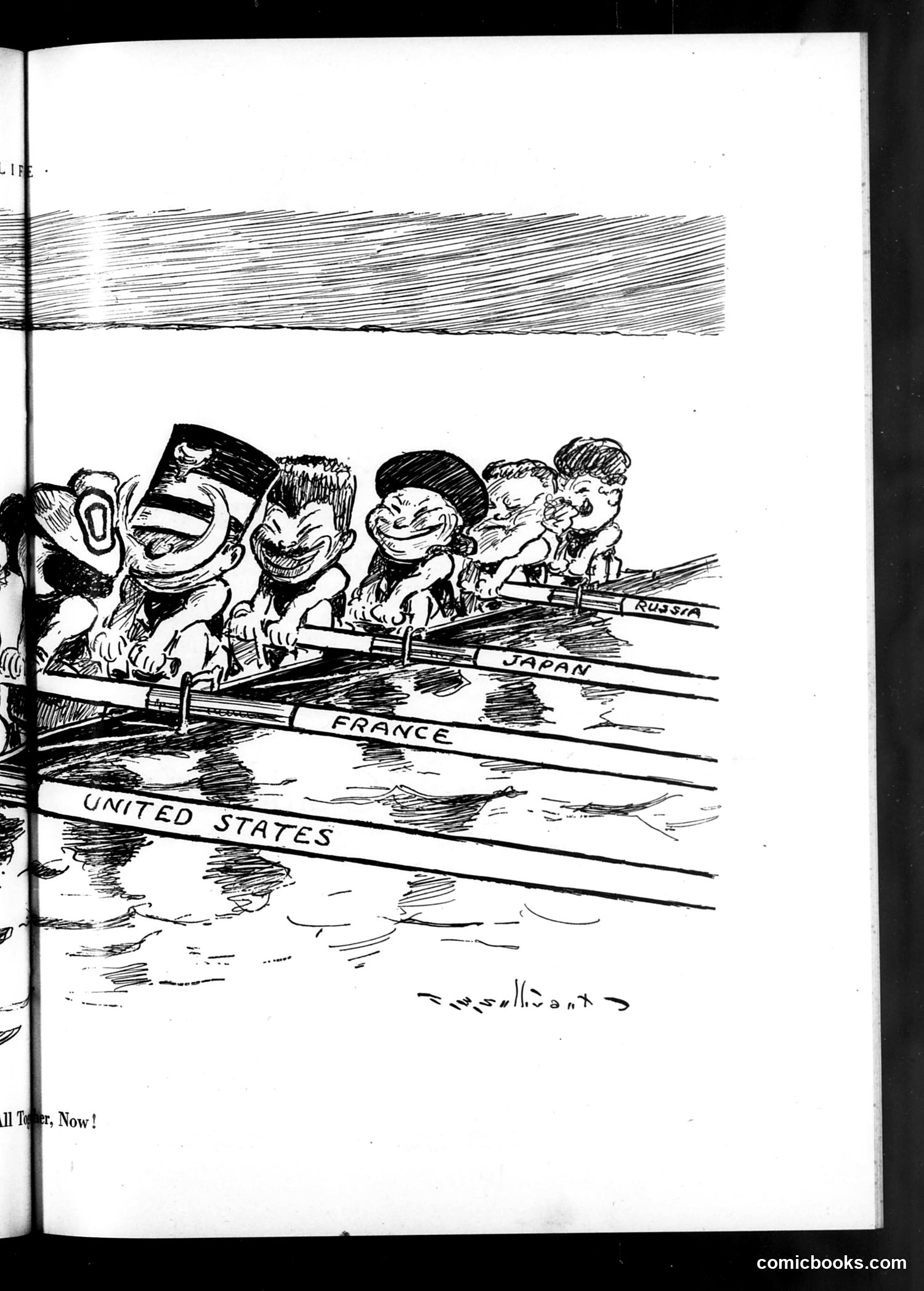
This political cartoon depicts an international rowing competition where five caricatured figures representing different nations—labeled Russia, Japan, France, and United States—are rowing together in the same boat. The cartoon appears to satirize Allied cooperation during wartime, likely from World War II era, showing these nations forced to work in unison despite their different ideologies and interests. The exaggerated facial features and grotesque style typical of propaganda cartooning emphasize the uncomfortable alliance. The partially visible text at bottom appears to reference urgency ("Now!"), suggesting the cartoon comments on the necessity of united action despite tensions between these partners. The cartoon critiques both the difficulty of maintaining such partnerships and perhaps questions their sustainability.
This page mocks Broadway productions of the early 1920s. The main satire concerns two plays: "The Rotters," described as "just about the worst show of the season," and "Abie's Irish Rose," a comedy about interfaith romance between a Jewish boy and Irish girl. The joke is that a man in Colonial costume rides through Broadway on horseback announcing that "Abie's Irish Rose" has opened—thereby displacing "The Rotters" from its position as worst play in town. The satire targets both plays' mediocrity while mocking theatrical hype. The page also reviews a revival of Sheridan's "The Rivals" by the prestigious Players Club, featuring notable actors like Tyrone Power and Robert Warwick. Below is a "Confidential Guide" listing current Broadway attractions with brief, often dismissive descriptions—typical of Life's theatrical criticism mixing genuine assessment with comedic exaggeration.
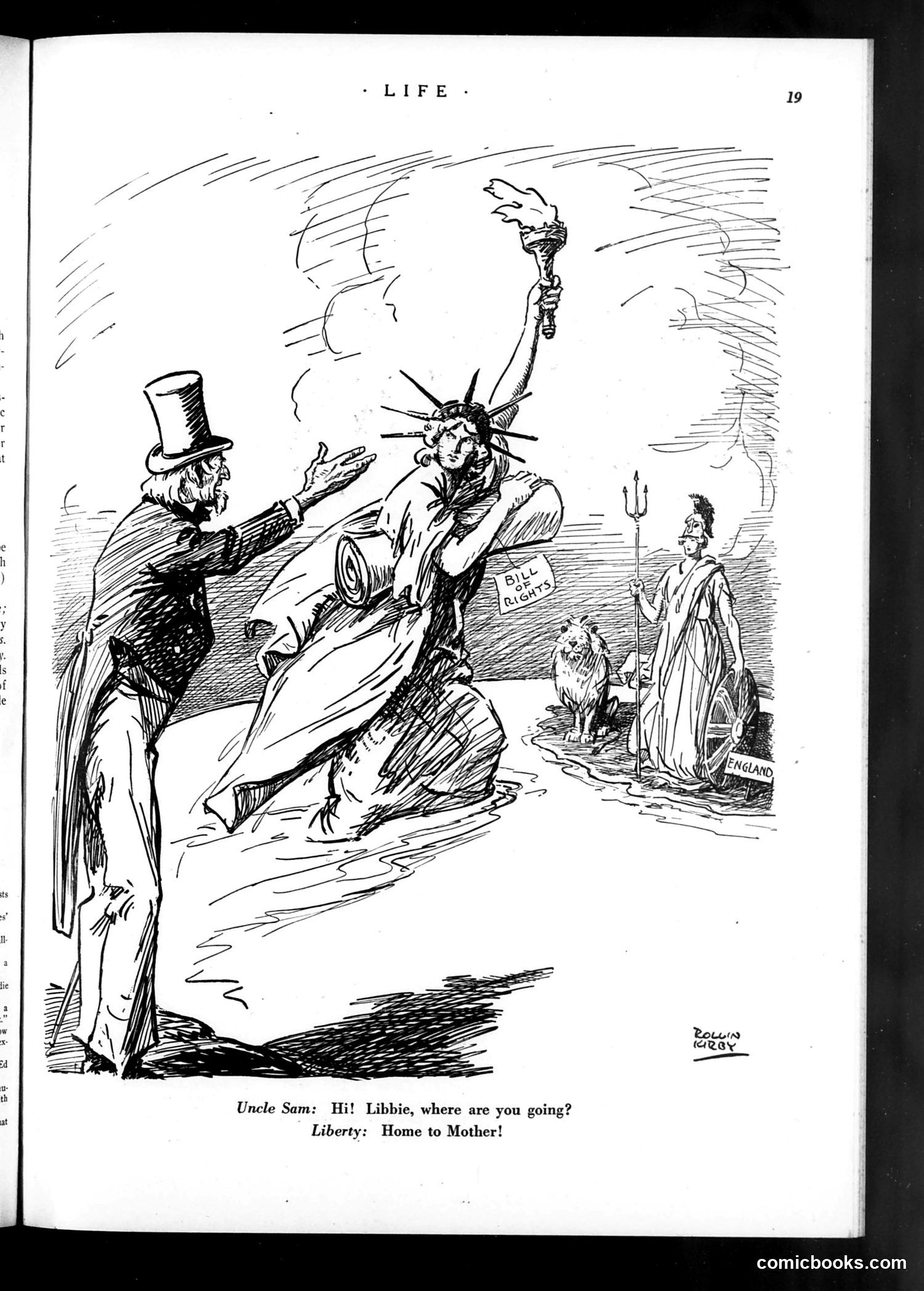
This political cartoon depicts **Uncle Sam** (representing the United States) attempting to stop the **Statue of Liberty** (labeled "Libbie") from leaving. Liberty holds a torch and wears her characteristic crown, while carrying a scroll marked "BILL OF RIGHTS." On the right stands a figure labeled "ENGLAND," holding a trident. The satire comments on American isolationism or internal political conflict—Uncle Sam tries to prevent Liberty from departing ("Home to Mother!"), suggesting anxiety that American freedoms or democratic principles are threatened or departing the nation. England's presence as "Mother" references America's British colonial origins. The cartoon likely critiques either political erosion of civil liberties or questions about American democracy during a period of domestic or international tension, though the specific historical moment requires additional context.
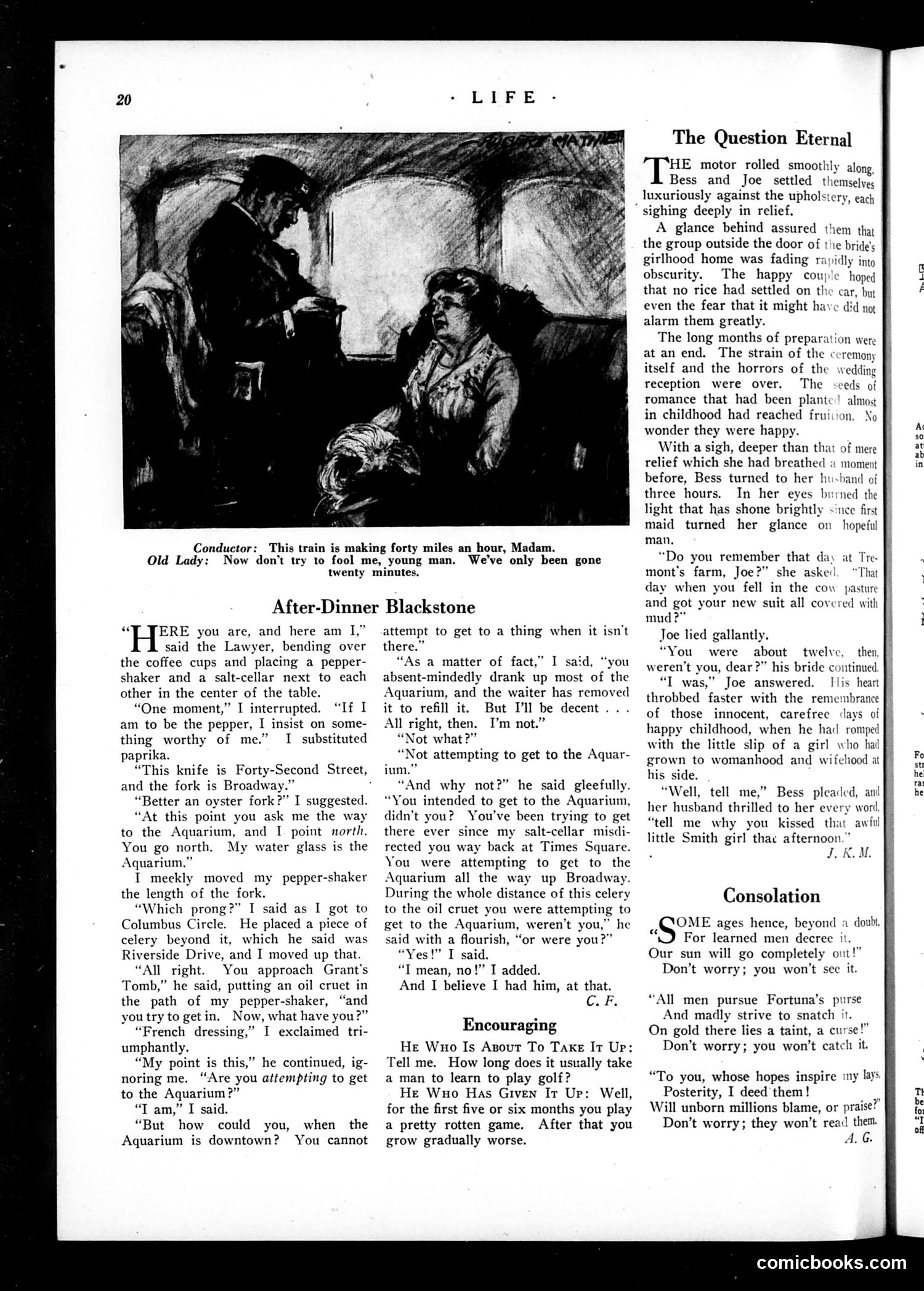
This page contains three separate pieces of satirical content: **Top cartoon:** A conductor and elderly passenger on a train. She insists they've only been gone twenty minutes despite traveling forty miles per hour, implying the journey feels impossibly short—satirizing how time perception distorts during travel or how tedious train rides feel endless. **"After-Dinner Blackstone":** A humorous dialogue where a lawyer uses tableware (salt-cellar, knife, fork, oil cruet) to create a map of New York City streets and landmarks, directing the narrator's pepper-shaker toward the Aquarium. The joke mocks overwrought after-dinner conversation and sophistic logical arguments—the lawyer ties himself in knots proving the narrator cannot reach a destination that doesn't exist (the Aquarium was "drunk"). **"The Question Eternal":** A sentimental story about newlyweds Bess and Joe departing their wedding. The narrative romanticizes their childhood romance and married happiness, contrasting sharply with the page's other satirical content. **"Encouraging" and "Consolation":** Brief humorous verses about golf frustration and life's disappointments. The page balances satire with sentiment, typical of Life magazine's approach.
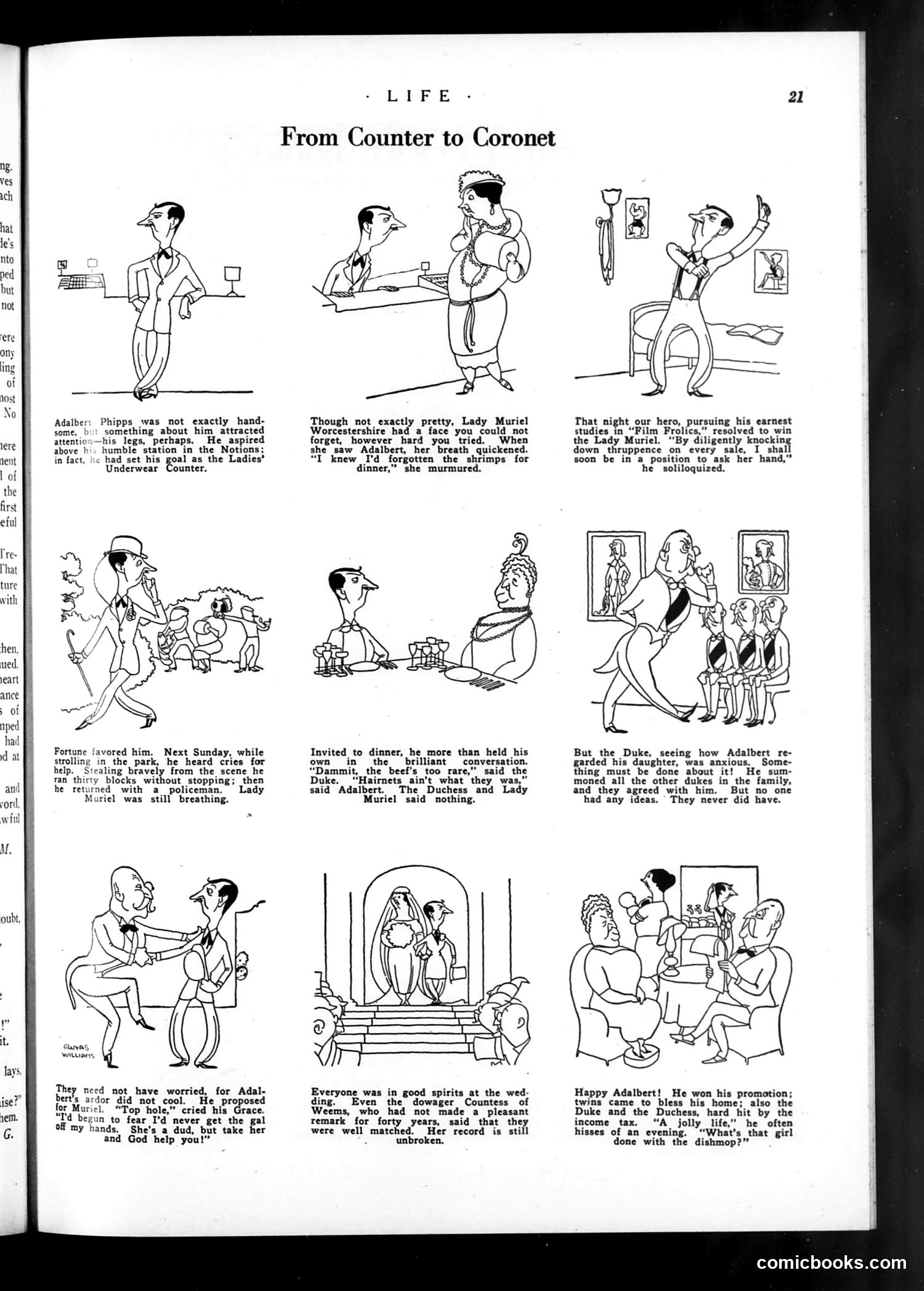
This is a serial comic strip satirizing social mobility and class pretensions in early 20th-century America. The protagonist, Adalbert Phipps, a lowly notions counter clerk, rescues Lady Muriel Worcestershire and wins her hand through sheer persistence rather than breeding or wealth. The satire targets several things: the arbitrary nature of aristocratic approval (the Duke consents despite Adalbert's obvious unsuitability), the gap between romantic ideals and reality (Muriel forgets shrimps when meeting her "rescuer"), and the ultimate leveling effect of modern life—even dukes suffer from income taxes alongside their upstart son-in-law. The comic mocks both the class system's brittleness and the nouveau riche aspirations of working-class climbers. By story's end, financial hardship unites all classes equally, suggesting social hierarchies matter less than practical survival.
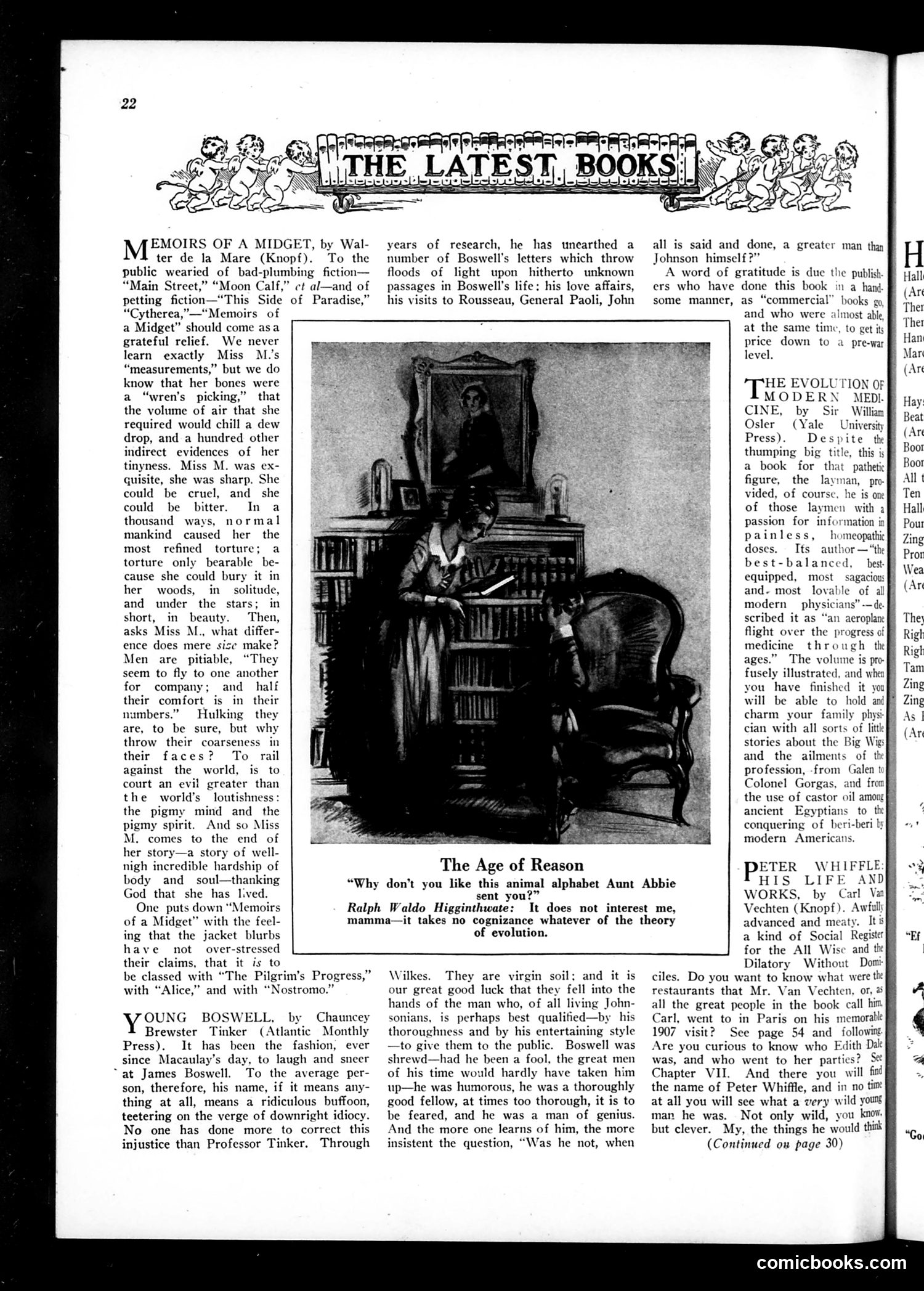
This single-panel cartoon depicts a domestic scene where an adult (labeled "Aunt Abbie") is questioned by a child about an animal alphabet book she's given. The child, identified as "Ralph Waldo Higginbotham," rejects the gift because it "takes no cognizance whatever of the theory of evolution." The satire targets the cultural anxiety of the 1920s surrounding Darwinism and its challenge to traditional religious education. The child's pretentious invocation of evolutionary theory—delivered with formal, adult-like language—mocks both the pseudo-intellectual adoption of scientific ideas by the young and the tension between Victorian moral education (represented by the innocent alphabet book) and modern scientific worldviews. The humor lies in the absurdity: a child pedantically dismissing a simple educational tool on scientific grounds, suggesting how thoroughly evolutionary theory had penetrated American discourse, even reaching those too young to genuinely understand it. The cartoon gently ridicules the era's cultural preoccupation with this debate.
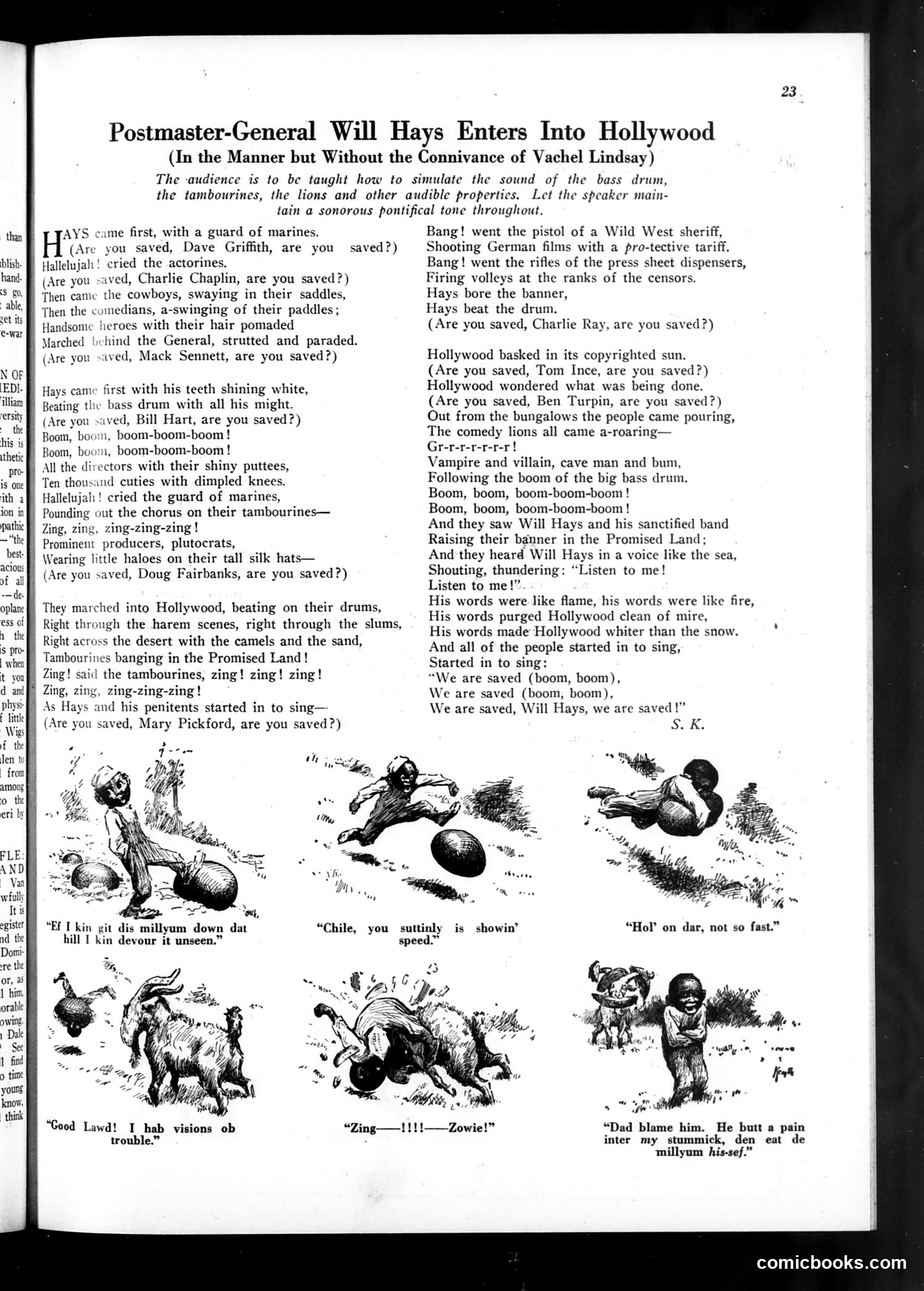
This satirical poem mocks Will Hays, newly appointed to regulate Hollywood's moral standards, as a self-righteous crusader. The piece parodies a revival meeting, depicting Hays leading major film figures (D.W. Griffith, Charlie Chaplin, Douglas Fairbanks, Mary Pickford) through Hollywood like a religious conversion campaign, "purging" the industry of moral corruption. The satire targets the censorship apparatus itself—particularly Hays's efforts to impose stricter content controls and his alliance with press censors against "German films." The accompanying cartoons (showing slapstick chaos) underscore the joke: the industry's actual content remains wild and anarchic despite Hays's sanctimonious intervention. The author (S.K., likely Samuel Koenig) ridicules both Hays's moral authority and Hollywood's hypocritical acceptance of it, suggesting the "salvation" is merely theatrical performance masking unchanged behavior beneath.
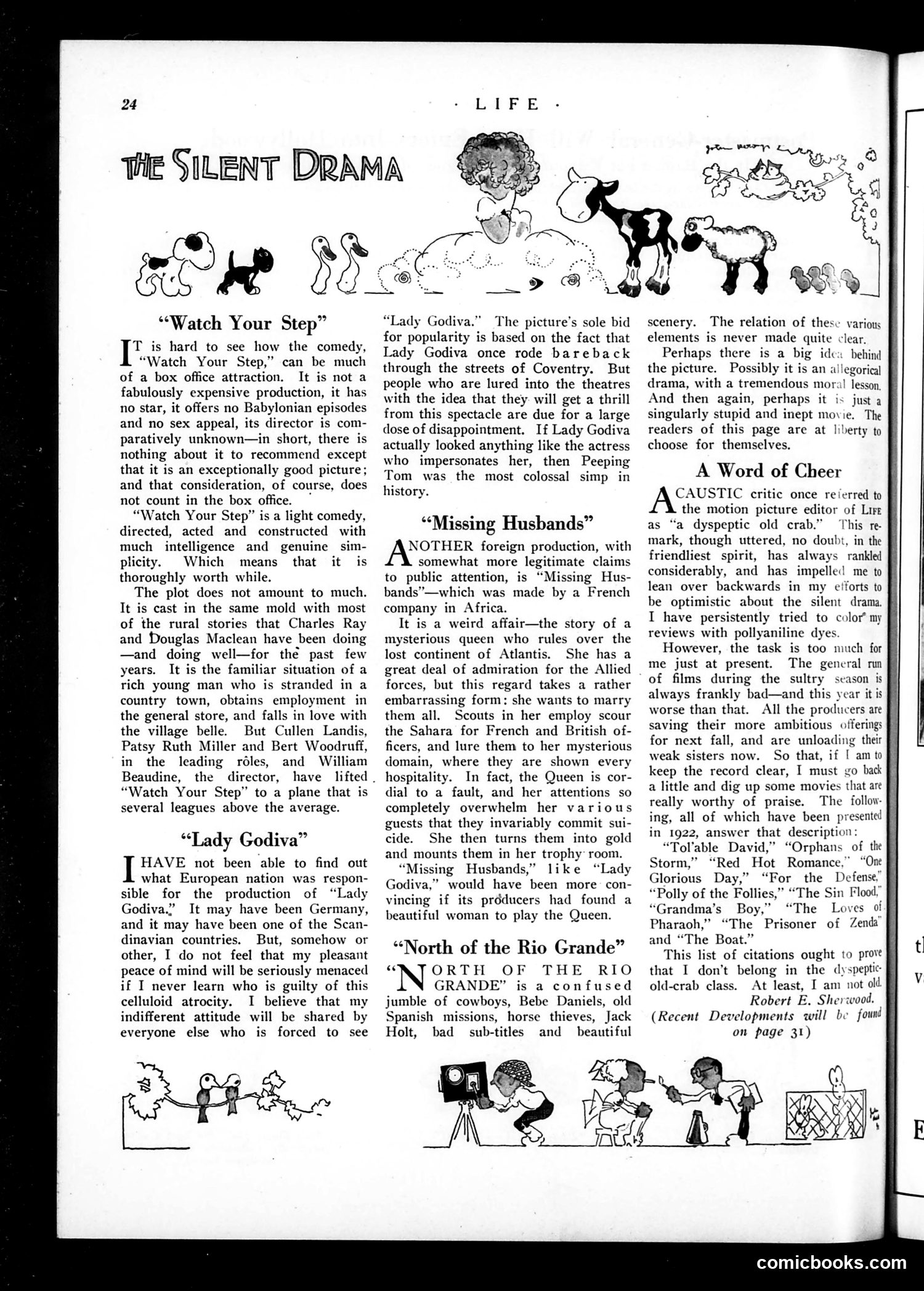
This page from *Life* magazine reviews four films, using sharp satire to criticize their quality and marketing. **The Films Reviewed:** 1. **"Watch Your Step"** — Praised as intelligent and well-made despite lacking stars, big budgets, or sexual content. The critic notes ironically that in Hollywood, being "exceptionally good" doesn't guarantee box-office success. 2. **"Lady Godiva"** — Mocked mercilessly. The film trades on the historical legend of Lady Godiva riding naked through Coventry, but the critic sarcastically suggests the actress is so unattractive that the famous scene becomes ridiculous ("Peeping Tom was the most colossal simp"). 3. **"Missing Husbands"** — A bizarre French-African production about a queen ruling lost Atlantis who seduces Allied soldiers, then kills and melts them into gold. The critic implies it's absurd and incomprehensible. 4. **"North of the Rio Grande"** — Described as a "confused jumble" with poor subtitles, suggesting it's either pretentiously allegorical or simply stupid—leaving readers to decide. The satire targets Hollywood's formulaic, poorly-made entertainment and deceptive marketing practices.
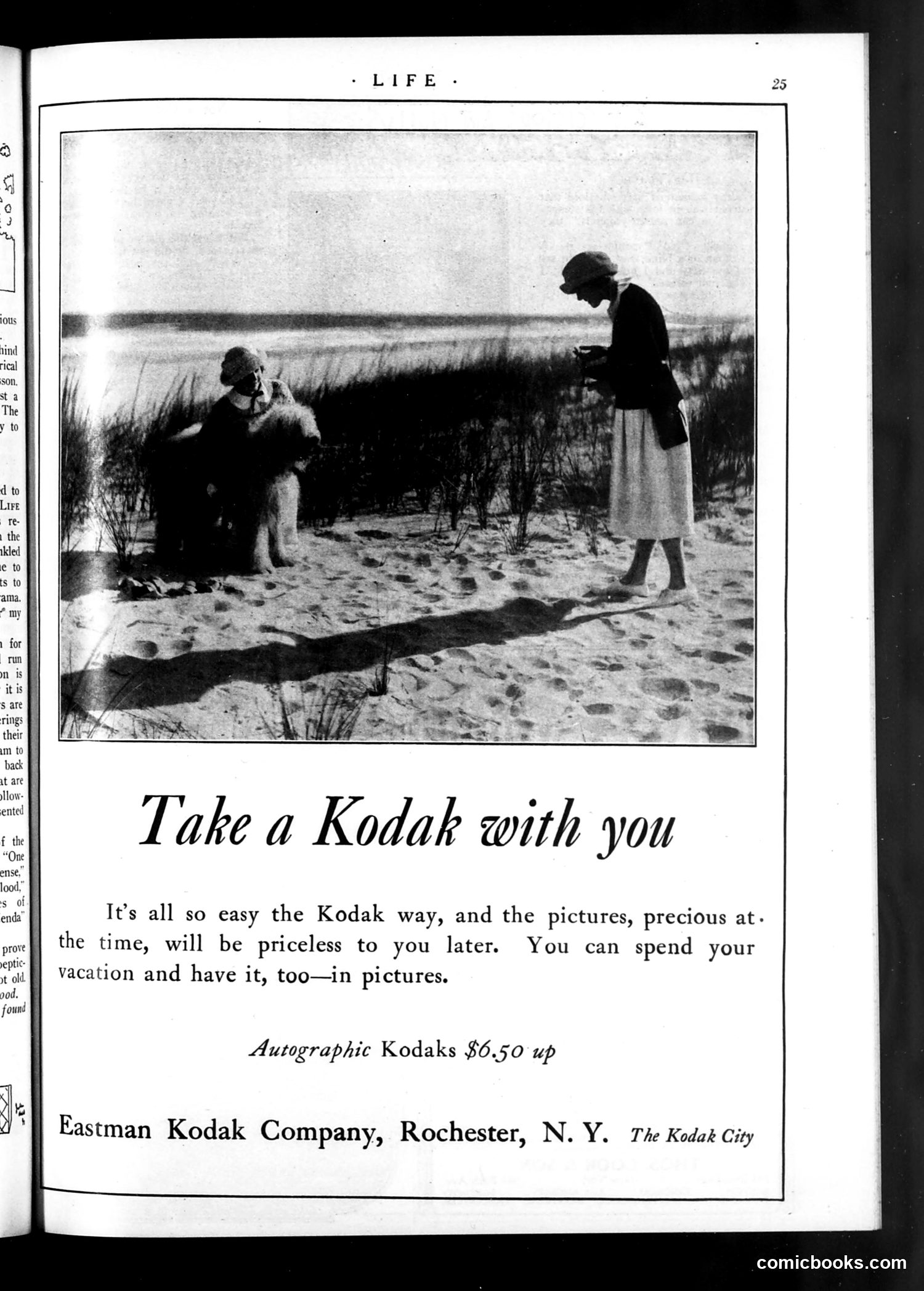
This is a Kodak camera advertisement, not a political cartoon. The page shows two women on a beach—one seated, one standing—in what appears to be a candid moment. The ad promotes "Autographic Kodaks" (cameras with a feature allowing notes on film) starting at $6.50, emphasizing that photography lets vacationers preserve memories affordably. The tagline "You can spend your vacation and have it, too—in pictures" captures the product's appeal: cameras allow people to experience leisure while simultaneously documenting it for future enjoyment. This is straightforward advertising copy typical of early 20th-century magazine marketing, with no satirical or political content.
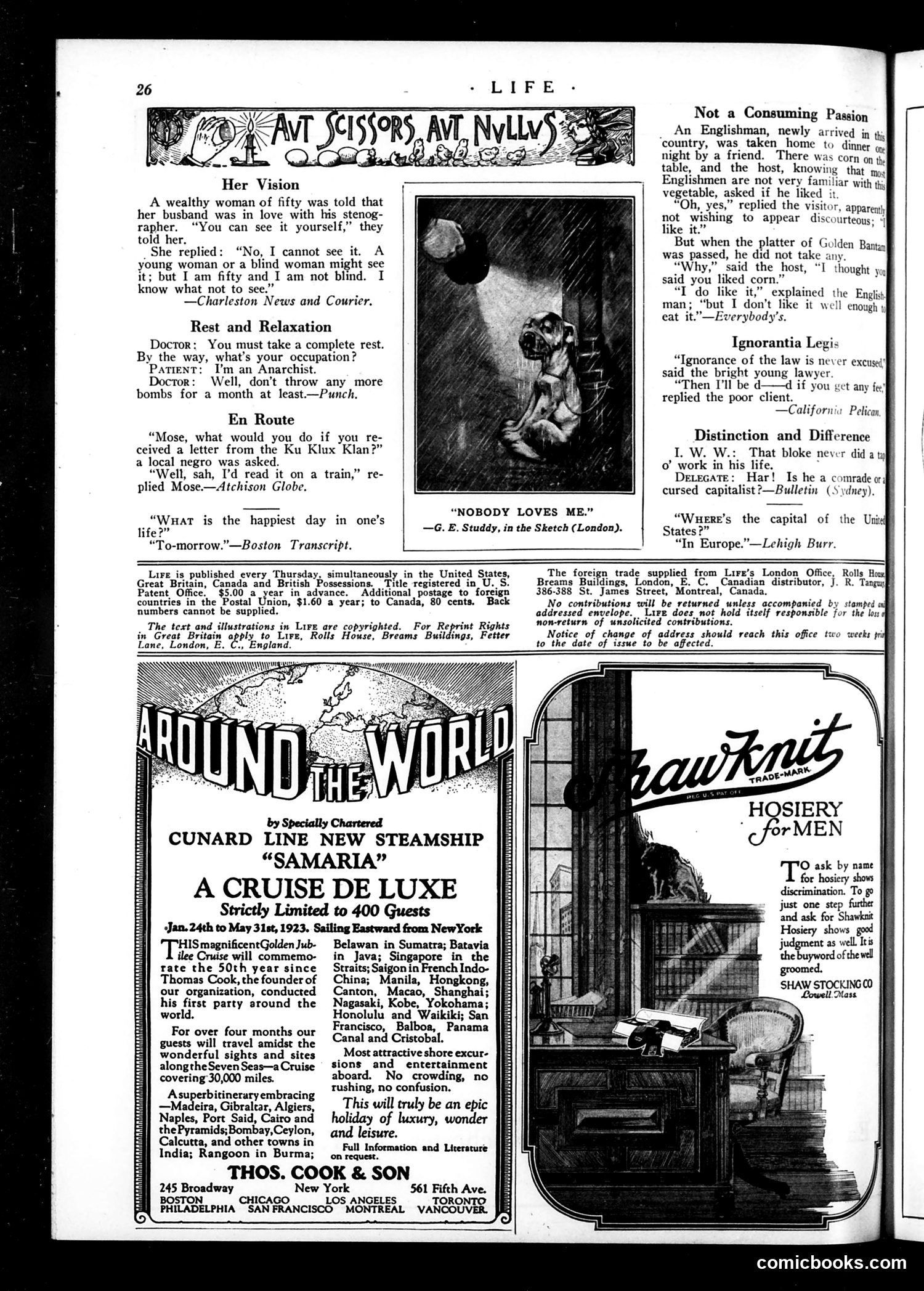
This page contains several brief humorous anecdotes typical of *Life* magazine's satirical format, plus advertisements. **"Her Vision"** jokes about a wealthy woman's deliberate blindness to her husband's infidelity with his secretary—she claims not to "see" what others point out because acknowledging it would be unpleasant. **"Nobody Loves Me,"** illustrated with a sketch of a crying dog, appears to be a sentimental cartoon about loneliness. The other brief jokes mock various subjects: an Anarchist patient told to stop bombing, a Black man's clever avoidance of a KKK letter, and a child's optimistic answer that "tomorrow" is life's happiest day. **"Ignorantia Legis"** satirizes a young lawyer whose fancy Latin phrase ("Ignorance of the law is no excuse") backfires when a poor client sarcastically accepts he won't afford legal fees anyway. The page is primarily **advertising**: a luxury Cunard steamship cruise commemorating Thomas Cook's 50th anniversary (1923), and Shawknit hosiery for men emphasizing quality and brand recognition.
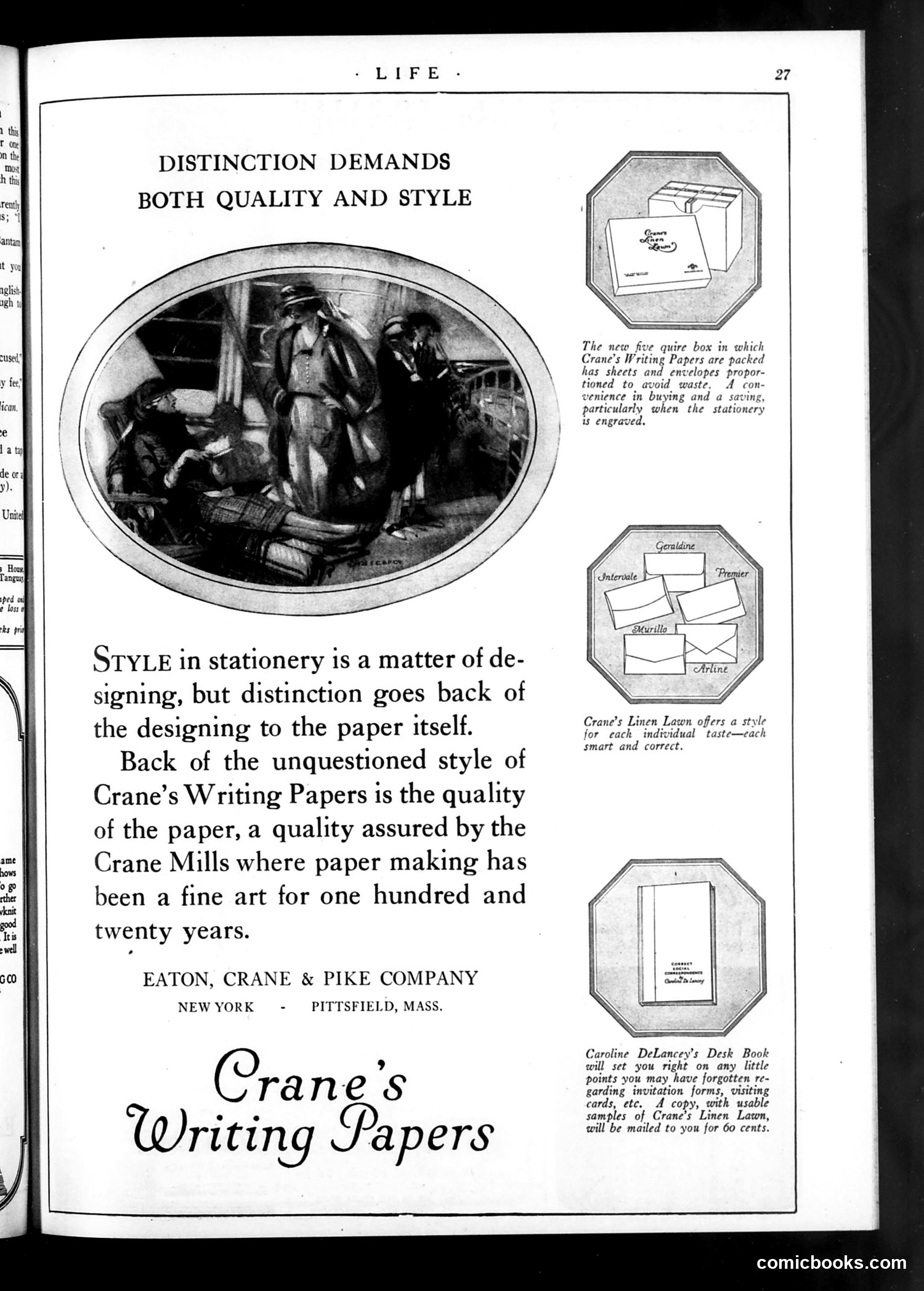
This page is **entirely an advertisement** for Crane's Writing Papers, not satire or political commentary. There are no cartoons or caricatures to interpret. The ad promotes stationery products through text and product images (boxes and desk accessories). The oval illustration depicts figures in what appears to be a historical or classical scene, likely used decoratively to evoke tradition and refinement rather than to make a specific point. The messaging emphasizes quality and social propriety—key selling points for expensive stationery in this era. References to "distinction," "style," and "Caroline DeLancey's Desk Book" (which taught proper etiquette for formal correspondence) reflect early-20th-century concerns about demonstrating social status through correct stationery choices and usage. This is a straightforward luxury goods advertisement targeting educated, middle-to-upper-class consumers.
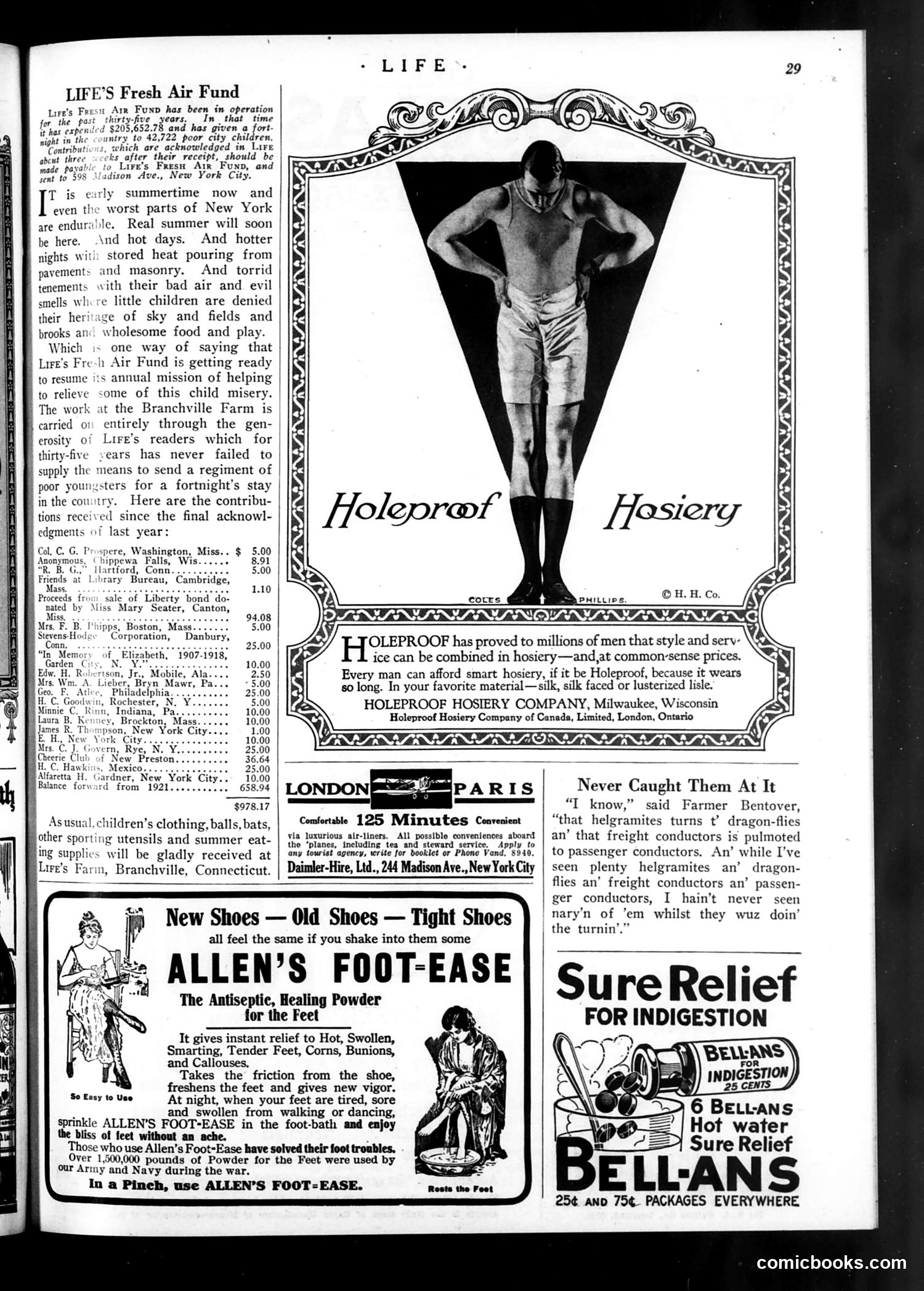
This page is primarily **advertising and charitable notices** rather than political satire. The main content includes: **Left side:** A charitable report on LIFE's Fresh Air Fund, documenting donations (totaling $978.17) sent to support poor city children's summer stays at Branchville Farm in Connecticut. The accompanying text describes summer heat in New York tenements and the fund's thirty-five-year mission. **Center:** A full-page advertisement for Holeproof Hosiery featuring a muscular male torso, emphasizing durability and affordability. **Bottom section:** Advertisements for Allen's Foot-Ease powder and a humorous anecdote titled "Never Caught Them At It"—a rural farmer's folksy observation that he's never witnessed the actual moment insects transform into other insects, a gentle joke about metamorphosis. **Additional ads:** Transportation services, Bellans indigestion remedy. The page reflects 1920s concerns: urban poverty, consumer products, and gentle Americana humor.
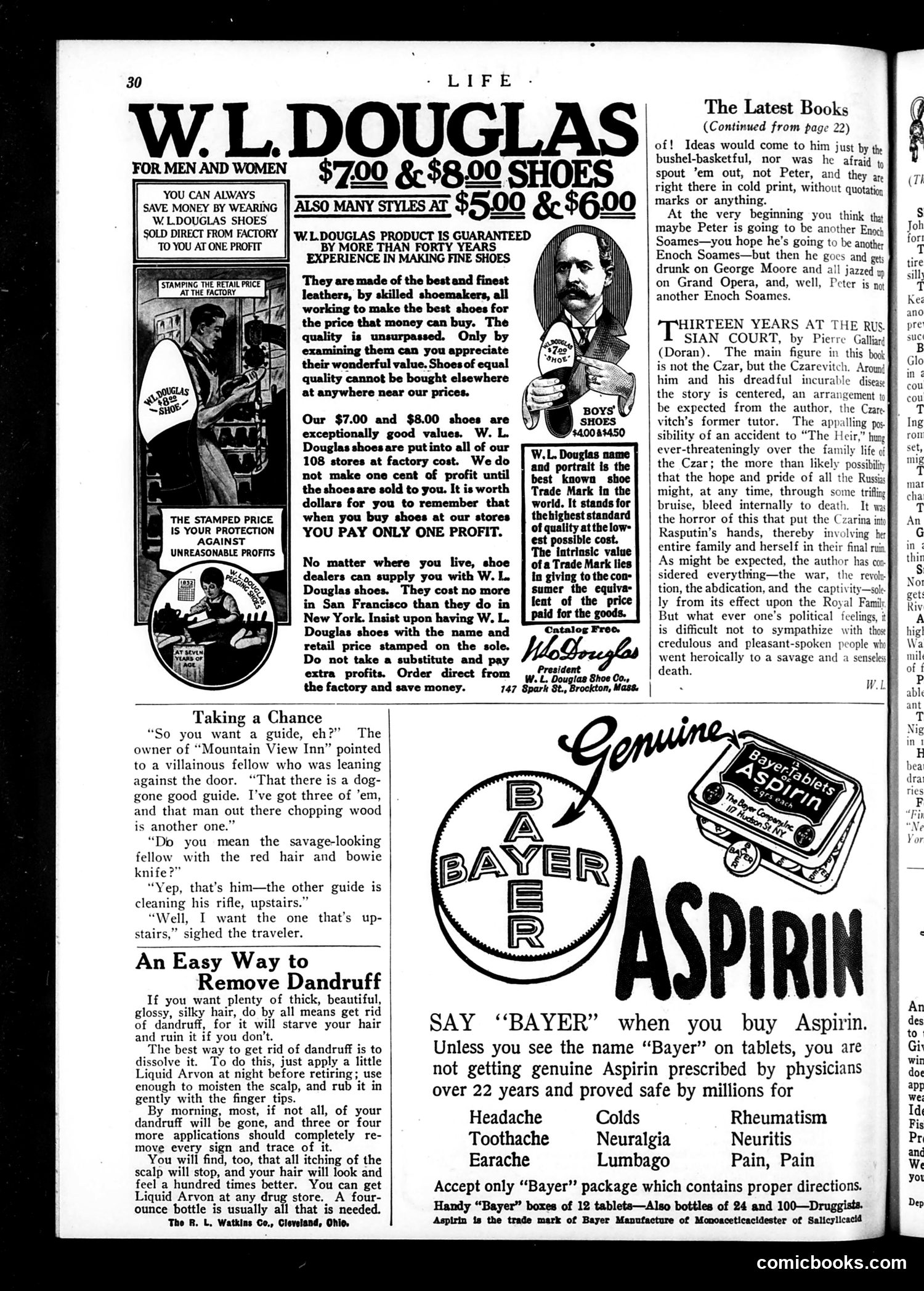
This page is primarily **advertising**, dominated by a W.L. Douglas shoe company ad promoting direct-from-factory sales at $7.00-$8.00 prices. The ad's satire targets middlemen profits—Douglas stamps retail prices on soles to prove consumers pay "only one profit" rather than markups through retailers. This reflects early 20th-century consumer awareness about manufacturing versus retail economics. The small cartoon "Taking a Chance" is a mild joke about guide selection at a mountain inn: a tourist requests "the one upstairs" (cleaning his rifle) over the "savage-looking" guide with a bowie knife, subverting expectations about which appears more dangerous. The page also includes book reviews and a Bayer Aspirin ad. Overall, this represents a typical Life magazine layout mixing satirical advertising copy with humor and editorial content—reflecting the magazine's role as both satirist and ad vehicle for modern consumer products.
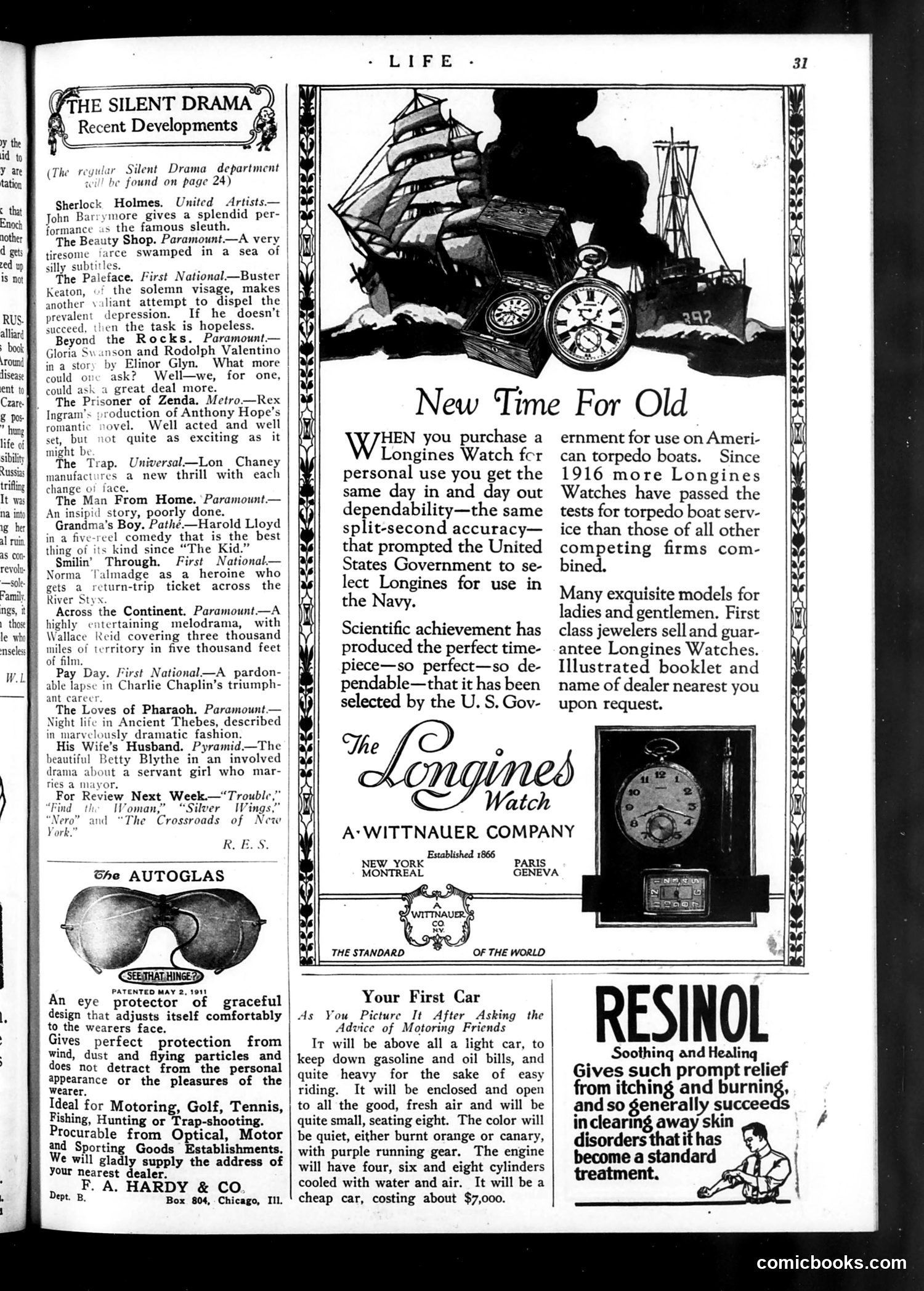
This page primarily contains **film reviews** and **advertisements** rather than political satire. The "Silent Drama" section reviews contemporary silent films (1920s), including works by stars like John Barrymore, Buster Keaton, Charlie Chaplin, and Lon Chaney. The reviews are brief critiques—some positive ("splendid performance"), others dismissive ("tiresome farce"). The advertisements include: - **Autoglas**: eyewear for motorists - **Longines Watch**: emphasizing its selection by the U.S. Navy for torpedo boats, positioning it as scientifically superior - **Resinol**: a medical product for skin conditions - **"Your First Car"**: a humorous piece satirizing conflicting advice from motoring friends (wanting a light yet heavy car, enclosed yet open, small yet seating eight) The car piece is mildly satirical—poking fun at how friends give contradictory automotive advice. Otherwise, this is a straightforward entertainment and consumer goods page typical of 1920s *Life* magazine.
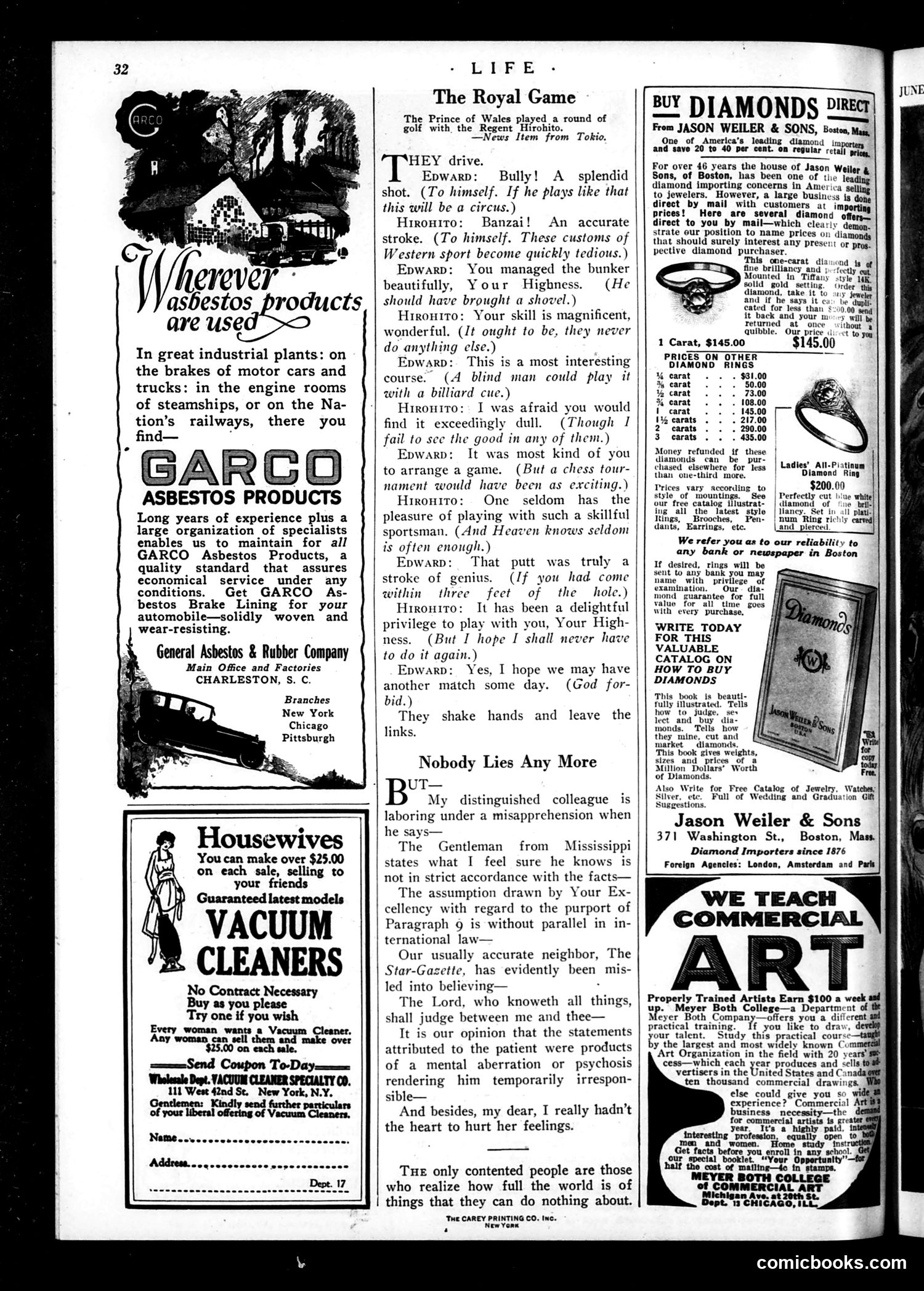
This cartoon depicts a 1920s golf game between the Prince of Wales (later Edward VIII) and Japan's Regent Hirohito. The satire works through **contrasting dialogue**: what each man says aloud versus his private thoughts, revealing mutual disinterest and diplomatic insincerity. **The joke**: Both players are bored and find golf tedious, yet they exchange effusive praise and compliments. Edward thinks Hirohito "plays like that this will be a circus" (disaster), while Hirohito finds Western sport "quickly tedious." Their private thoughts mock each other's abilities ("A blind man could play it") and the entire exercise. **The political context**: This reflects post-WWI diplomatic relations between Britain and Japan—formal, strained pleasantries masking underlying skepticism. The cartoon suggests that international relations involve performative courtesy rather than genuine connection, a common Life magazine theme critiquing diplomatic hypocrisy. The page's second piece, "Nobody Lies Any More," extends this theme into politics and everyday life, suggesting that obfuscation and indirect speech have replaced honest communication.