
Life, 1922-06-08 · page 17 of 34
Life — June 8, 1922 — page 17: what you’re looking at
What you’re looking at
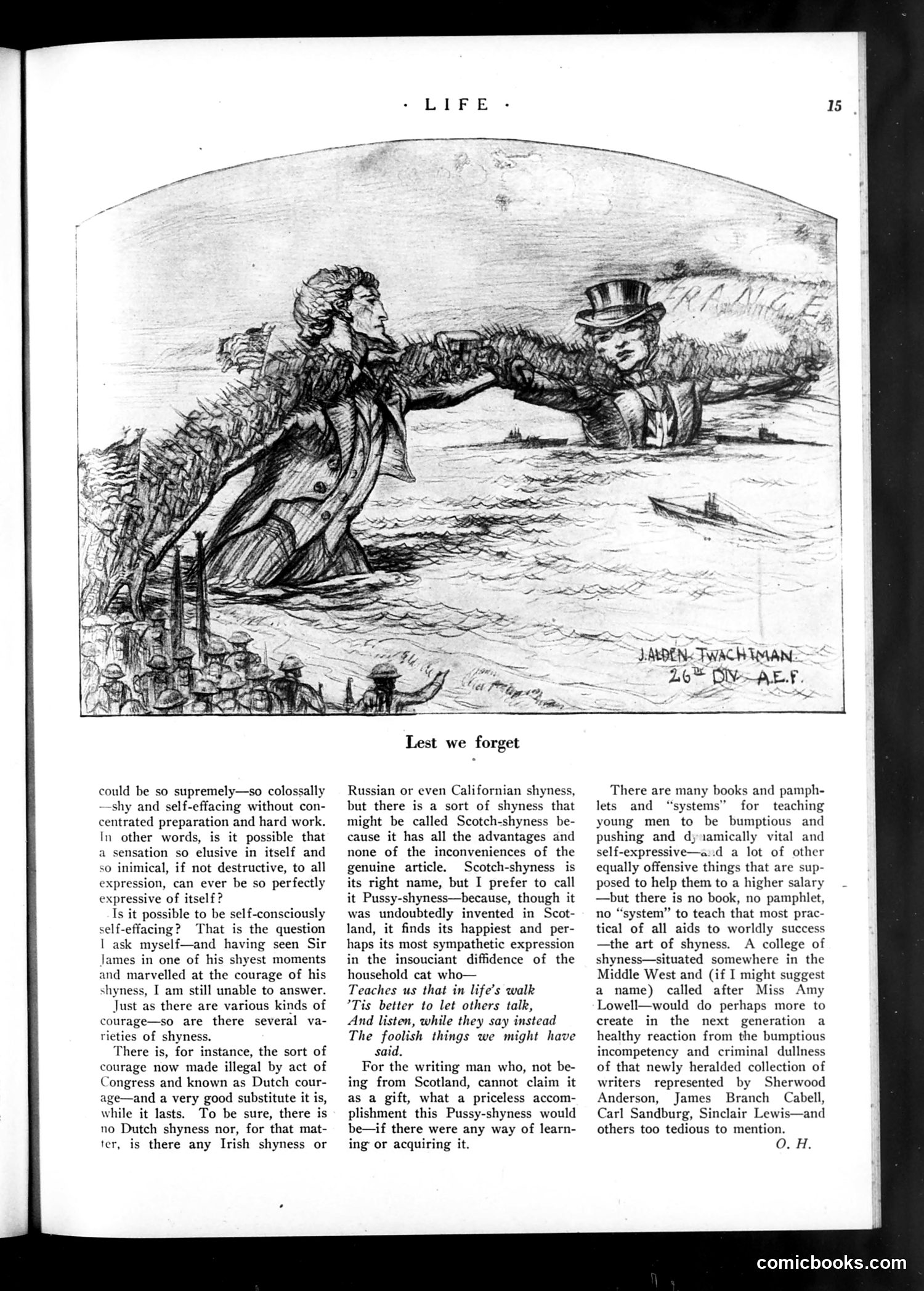
This page satirizes competing philosophies about social behavior and success. The cartoon (by Auden Twachtman) depicts two figures in water—likely representing different national temperaments—illustrating the text's discussion of "shyness" as a cultural trait. The article playfully categorizes types of shyness by nationality: Dutch courage, Irish shyness, Scotch-shyness (which the author humorously calls "Pussy-shyness," comparing it to a cat's cool indifference). The satire targets contemporary American self-help culture, which promoted aggressive "bumptious" personality traits for worldly success. The author sarcastically proposes a "college of shyness" to counter this trend, mockingly naming it after poet Amy Lowell and critiquing contemporary writers (Sinclair Lewis, Sherwood Anderson, Carl Sandburg) as representing bumptious mediocrity. The piece is a witty defense of quiet reserve as superior to the era's emphasis on assertiveness and self-promotion.
📄 Transcribed text from this page (OCR, searchable)
Machine-transcribed from the original scan — historical spelling and the odd misread are preserved.
could be so supremely—so colossally shy and self-effacing without con- centrated preparation and hard work. In other words, is it possible that a sensation so elusive in itself and so inimical, if not destructive, to all expression, can ever be so perfectly expressive of itself? Is it possible to be self-consciously self-effacing? That is the question I ask myself—and having seen Sir James in one of his shyest moments and marvelled at the courage of his shyness, I am still unable to answer. Just as there are various kinds of courage—so are there several va- ieties of shyness. There is, for instance, the sort of courage now made illegal by act of Congress and known as Dutch cour- age—and a very good substitute it is, while it lasts. To be sure, there is no Dutch shyness nor, for that mat- ter, is there any Irish shyness or Lest we forget Russian or even Californian shyness, but there is a sort of shyness that might be called Scotch-shyness be- cause it has all the advantages and none of the inconveniences of the genuine article. Scotch-shyness is its right name, but I prefer to call it Pussy-shyness—because, though it was undoubtedly invented in Scot- land, it finds its happiest and per- haps its most sympathetic expression in the insouciant diffidence of the household cat who— Teaches us that in life’s walk ’Tis better to let others talk, And listen, while they say instead The foolish things we might have said. For the writing man who, not be- ing from Scotland, cannot claim it as a gift, what a priceless accom- plishment this Pussy-shyness would be—if there were any way of learn- ing or acquiring it. ~ AUDEN TWACH MAN 26™ BVA, There are many books and pamph- lets and “systems” for teaching young men to be bumptious and pushing and dy amically vital and self-expressive—a:.d a lot of other equally offensive things that are sup- posed to help them to a higher salary —but there is no book, no pamphlet, no “system” to teach that most prac- tical of all aids to worldly success —the art of shyness. A college of shyness—situated somewhere in the Middle West and (if I might suggest a name) called after Miss Amy Lowell—would do perhaps more to create in the next generation a healthy reaction from the bumptious incompetency and criminal dullness of that newly heralded collection of writers represented by Sherwood Anderson, James Branch Cabell, Carl Sandburg, Sinclair Lewis—and others too tedious to mention. O. H. comicbooks.com