
Life, 1922-06-08 · page 20 of 34
Life — June 8, 1922 — page 20: what you’re looking at
What you’re looking at
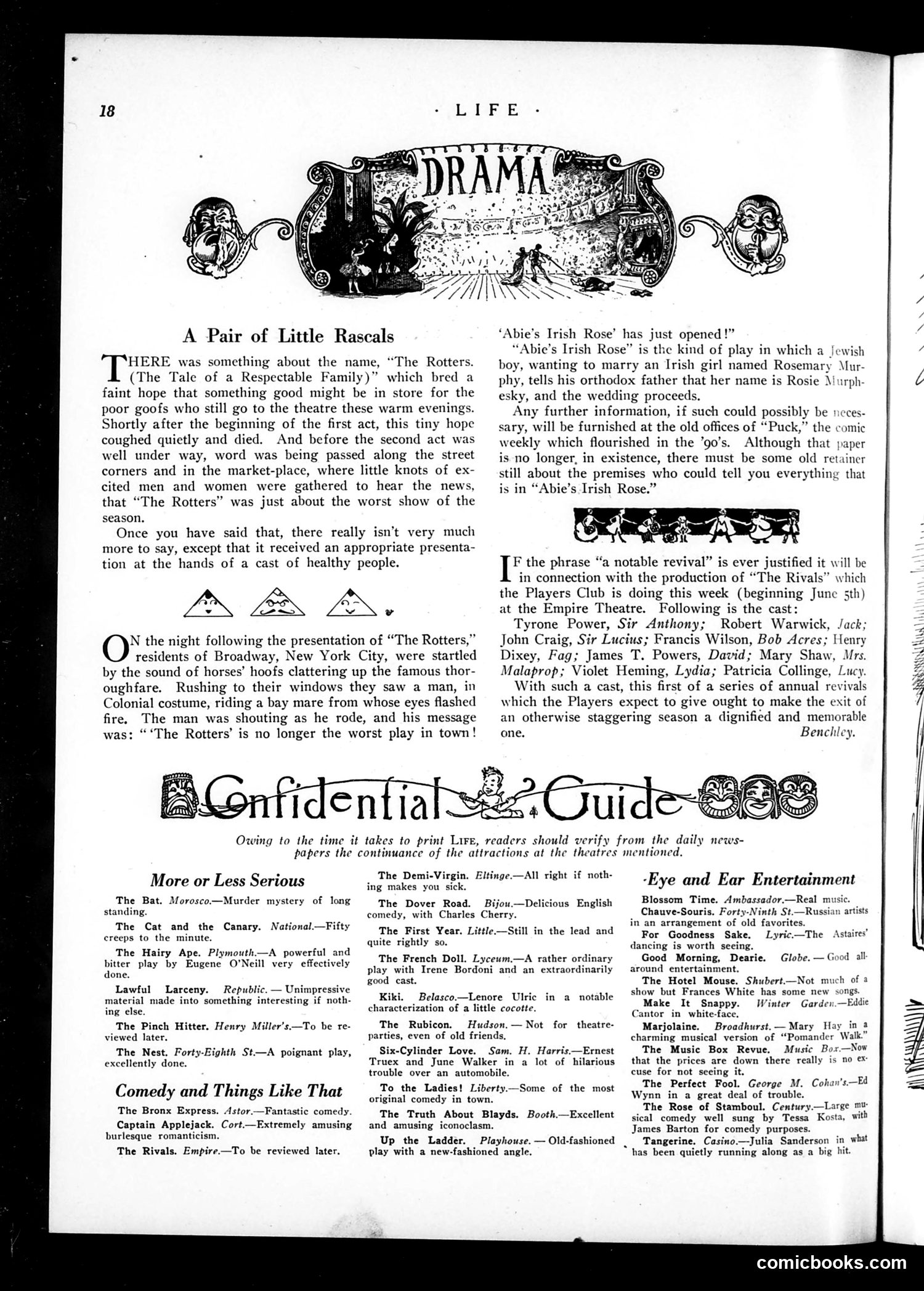
This page mocks Broadway productions of the early 1920s. The main satire concerns two plays: "The Rotters," described as "just about the worst show of the season," and "Abie's Irish Rose," a comedy about interfaith romance between a Jewish boy and Irish girl. The joke is that a man in Colonial costume rides through Broadway on horseback announcing that "Abie's Irish Rose" has opened—thereby displacing "The Rotters" from its position as worst play in town. The satire targets both plays' mediocrity while mocking theatrical hype. The page also reviews a revival of Sheridan's "The Rivals" by the prestigious Players Club, featuring notable actors like Tyrone Power and Robert Warwick. Below is a "Confidential Guide" listing current Broadway attractions with brief, often dismissive descriptions—typical of Life's theatrical criticism mixing genuine assessment with comedic exaggeration.
📄 Transcribed text from this page (OCR, searchable)
Machine-transcribed from the original scan — historical spelling and the odd misread are preserved.
A Pair of Little Rascals HERE was something about the name, “The Rotters. (The Tale of a Respectable Family)” which bred a faint hope that something good might be in store for the poor goofs who still go to the theatre these warm evenings. Shortly after the beginning of the first act, this tiny hope coughed quietly and died. And before the second act was well under way, word was being passed along the street corners and in the market-place, where little knots of ex- cited men and women were gathered to hear the news, that “The Rotters” was just about the worst show of the season. Once you have said that, there really isn’t very much more to say, except that it received an appropriate presenta- tion at the hands of a cast of healthy people. BS : N the night following the presentation of “The Rotters,” residents of Broadway, New York City, were startled by the sound of horses’ hoofs clattering up the famous thor- oughfare. Rushing to their windows they saw a man, in Colonial costume, riding a bay mare from whose eyes flashed fire. The man was shouting as he rode, and his message was: “‘The Rotters’ is no longer the worst play in town! s Irish Rose’ has just opened!” “Abie’s Irish Ros: the kind of play in which a Jewish boy, wanting to marry an Irish girl named Rosemary Mur- phy, tells his orthodox father that her name is Rosie } esky, and the wedding proceeds. Any further information, if such could possibly be neces- sary, will be furnished at the old offices of “Puck,” the comic weekly which flourished in the ’g0’s. Although that paper is no longer, in existence, there must be some old retainer still about the premises who could tell you everything that is in “Abie’s Irish Rose.” urph- F the phrase “a notable revival” is ever justified it will be in connection with the production of “The Rivals” which the Players Club is doing this week (beginning June sth) at the Empire Theatre. Following is the cast: Tyrone Power, Sir Anthony; Robert Warwick, Jack; John Craig, Sir Lucius; Francis Wilson, Bob Acres; Henry Dixey, Fag; James T. Powers, David; Mary Shaw, Mrs. Malaprop; Violet Heming, Lydia; Patricia Collinge, Luc: With such a cast, this first of a series of annual revivals which the Players expect to give ought to make the exit of an otherwise staggering season a dignified and memorable one. Owing to the time it takes to print Lire, readers should verify from the daily news- papers the continuance of the attractions at the theatres mentioned. More or Less Serious The Bat. Morosco—Murder mystery of long standing. The Cat and the Canary. National—Fifty creeps to the minute. The Hairy Ape. Plymouth. bitter play by Eugene O'Nei done. Lawful Larceny. Republic. — Unimpressive material made into something interesting if noth- ing else. The Pinch Hitter. Henry Miller’s—To be re- viewed later. -A powerful and very effectively The Nest. Forty-Eighth St—A poignant play, excellently done. Comedy and Things Like That The Bronx Express. Astor_—Fantastic comedy. Captain Applejack. Cort.—Extremely amusing burlesque romanticism. The Rivals. Empire.—To be reviewed later. The Demi-Virgin. Eltinge—All right if noth- ing makes you sick. The Dover Road. Bijou. comedy, with Charles Cherry. The First Year. Little—Still in the lead and quite rightly so. Delicious English The French Doll. Lyceum.—A rather ordinary play with Irene Bordoni and an extraordinarily good cast. Kiki. Belasco—Lenore Ulric characterization of a little cocotte. The Rubicon. Hudson.—Not for theatre- parties, even of old friends. Six-Cylinder Love. Sam. H. Harris.—Ernest Truex and June Walker in a lot of hilarious trouble over an automobile. To the Ladies! Liberty—Some of the most original comedy in town. The Truth About Blayds. Booth.—Excellent and amusing iconoclasm. Up the Ladder. Playhouse. — Old-fashioned play with a new-fashioned angle. in a_ notable -Eye and Ear Entertainment Blossom Time. Ambassador.—Real music. Chauve-Souris. Forty-Ninth St.—Russian artists in an arrangement of old favorites. For Goodness Sake. Astaires’ dancing is worth seeing. Good Morning, Dearie. around entertainment. The Hotel Mouse. Shubert—Not much of 2 show but Frances White has some new songs. Make It Snappy. Winter Garden.—Eddie Cantor in white-face, Marjolaine. Broadhurst. — Mary Hay in @ charming musical version of “Pomander Walk.” The Music Box Revue. Music Box—Now that the prices are down there really is noe cuse for not seeing it. The Perfect Fool. George M. Cohan's—Ed Wynn in a great deal of trouble. The Rose of Stamboul. Century.—Large mt- sical comedy well sung by Tessa Kosta, with James Barton for comedy purposes. Tangerine. Casino—Julia Sanderson in what Lyric.—The Globe. — Good all “has been quietly running along as a big hit. comicbooks.com