
Life, 1922-06-08 · page 15 of 34
Life — June 8, 1922 — page 15: what you’re looking at
What you’re looking at
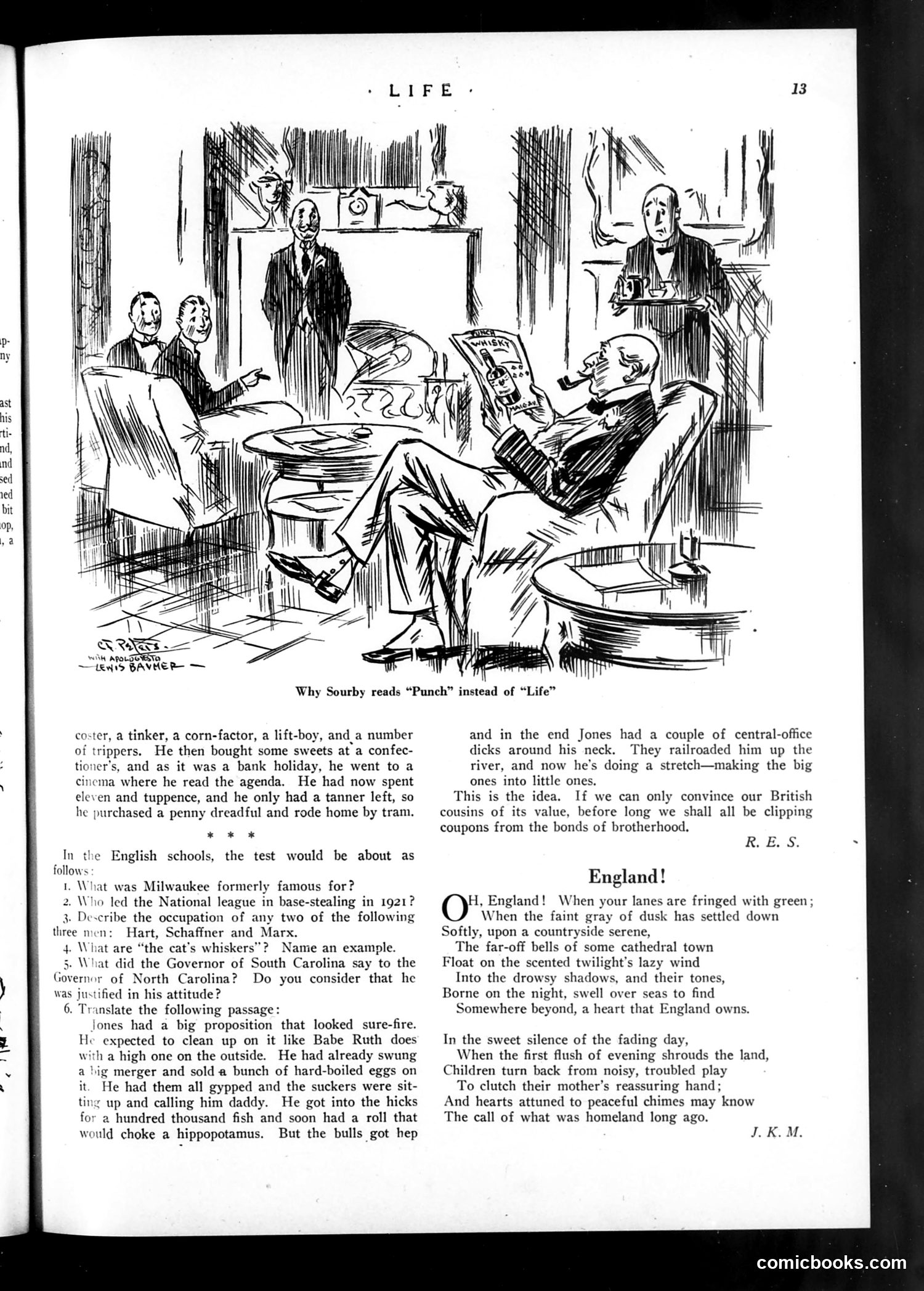
This cartoon satirizes a social gathering where a man reads the British magazine *Punch* rather than the American *Life*. The joke appears to target class pretension—the figure "Sourby" (likely a character representing affected snobbery) prefers the ostensibly more sophisticated British publication. The sketch shows him relaxing while others converse, suggesting he uses *Punch* as a status symbol. The humor lies in mocking Americans who adopt British cultural preferences to appear refined. The caption's implication is that *Life* magazine is equally entertaining but more authentically American—making *Punch* reading a pretentious affectation. This reflects early 20th-century American cultural anxiety about British superiority and domestic audiences' fascination with European sophistication.
📄 Transcribed text from this page (OCR, searchable)
Machine-transcribed from the original scan — historical spelling and the odd misread are preserved.
welt ApoLTEN 2 LENS BAVKER- i } | ra Why Sourby reads “Punch” instead of “Life” coster, a tinker, a corn-factor, a lift-boy, and a number f pers. He then bought some sweets at a confec- tioner’s, and as it was a bank holiday, he went to a cinema where he read the agenda. He had now spent eleven and tuppence, and he only had a tanner left, so he purchased a penny dreadful and rode home by tram. * * x In the English schools, the test would be about as follows 1. What was Milwaukee formerly famous for? 2. Who led the National league in base-stealing in 1921? 3. Describe the occupation of any two of the following three men: Hart, Schaffner and Marx. 4. What are “the cat's whiskers”? Namie an example. 3. What did the Governor of South Carolina say to the Governor of North Carolina? Do you consider that he was justified in his attitude? 6. Translate the following passage: jones had a big proposition that looked sure-fire. He expected to clean up on it like Babe Ruth does with a high one on the outside. He had already swung a hig merger and sold a bunch of hard-boiled eggs on it. He had them all gypped and the suckers were sit- ting up and calling him daddy. He got into the hicks for a hundred thousand fish and soon had a roll that would choke a hippopotamus. But the bulls got hep and in the end Jones had a couple of central-office dicks around his neck. They railroaded him up the river, and now he’s doing a stretch—making the big ones into little ones. This is the idea. If we can only convince our British cousins of its value, before long we shall all be clipping coupons from the bonds of brotherhood. England! H, England! When your lanes are fringed with green; When the faint gray of dusk has settled down Softly, upon a countryside serene, The far-off bells of some cathedral town Float on the scented twilight’s lazy wind Into the drowsy shadows, and their tones, Borne on the night, swell over seas to find Somewhere beyond, a heart that England owns. In the sweet silence of the fading day, When the first flush of evening shrouds the land, Children turn back from noisy, troubled play To clutch their mother’s reassuring hand; And hearts attuned to peaceful chimes may know The call of what was homeland long ago. J. K.M. comicbooks.com