
A complete issue · 34 pages · 1922
Life — February 9, 1922
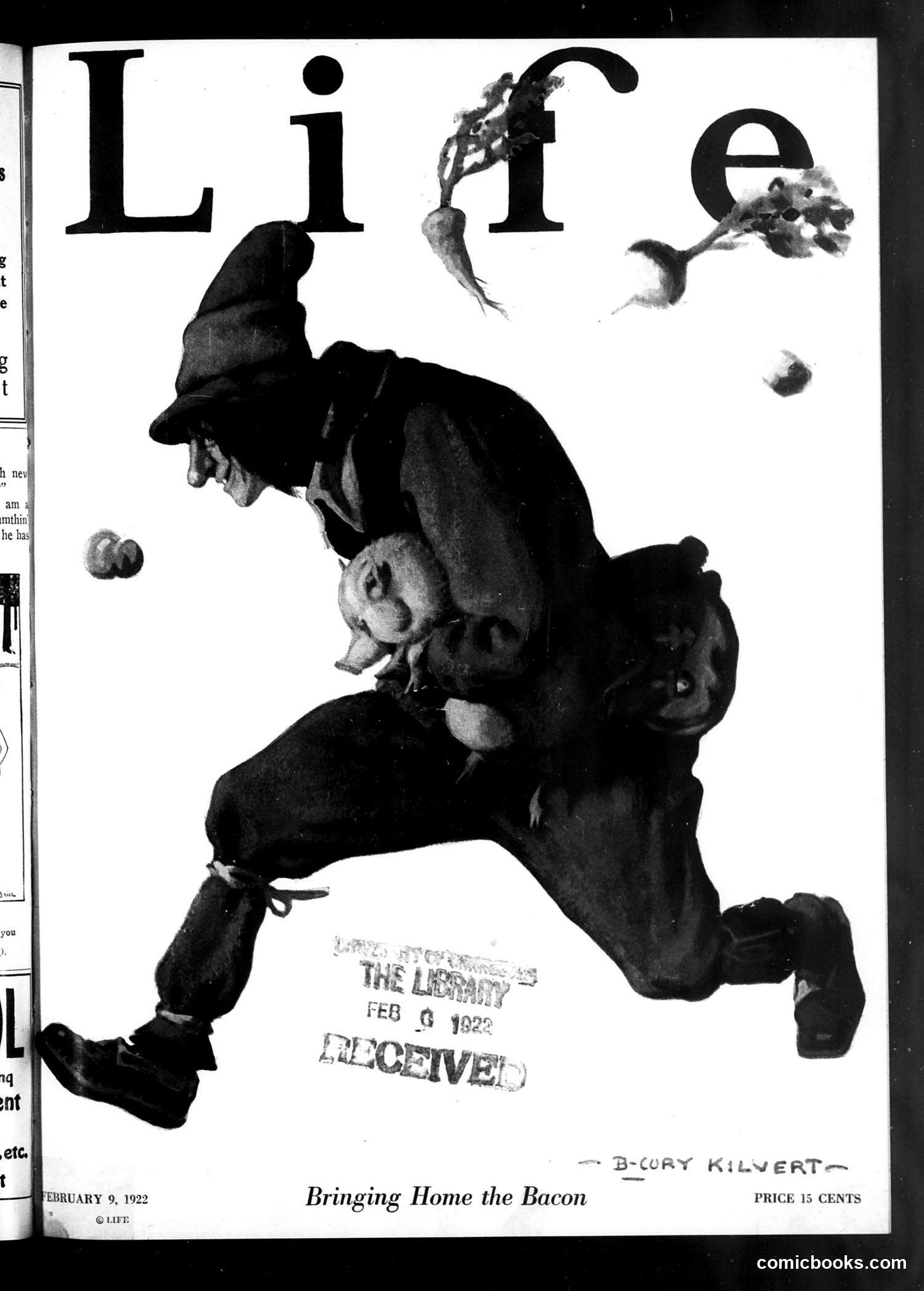
This Life magazine cover from February 9, 1922 features an illustration by B. Cory Kilvert titled "Bringing Home the Bacon." The image shows an elf or gnome-like figure juggling what appear to be pigs or pig-related items while wearing a pointed hat and dark clothing. The title and imagery play on the common expression "bringing home the bacon"—meaning earning a living or achieving success. The whimsical character juggling bacon or pigs is likely satirizing prosperity, wealth accumulation, or economic success during the post-World War I period. The playful, fantastical treatment suggests either optimism about economic recovery or possibly ironic commentary on financial aspirations of the era. Without additional context from the magazine's interior, the precise satirical target remains unclear.
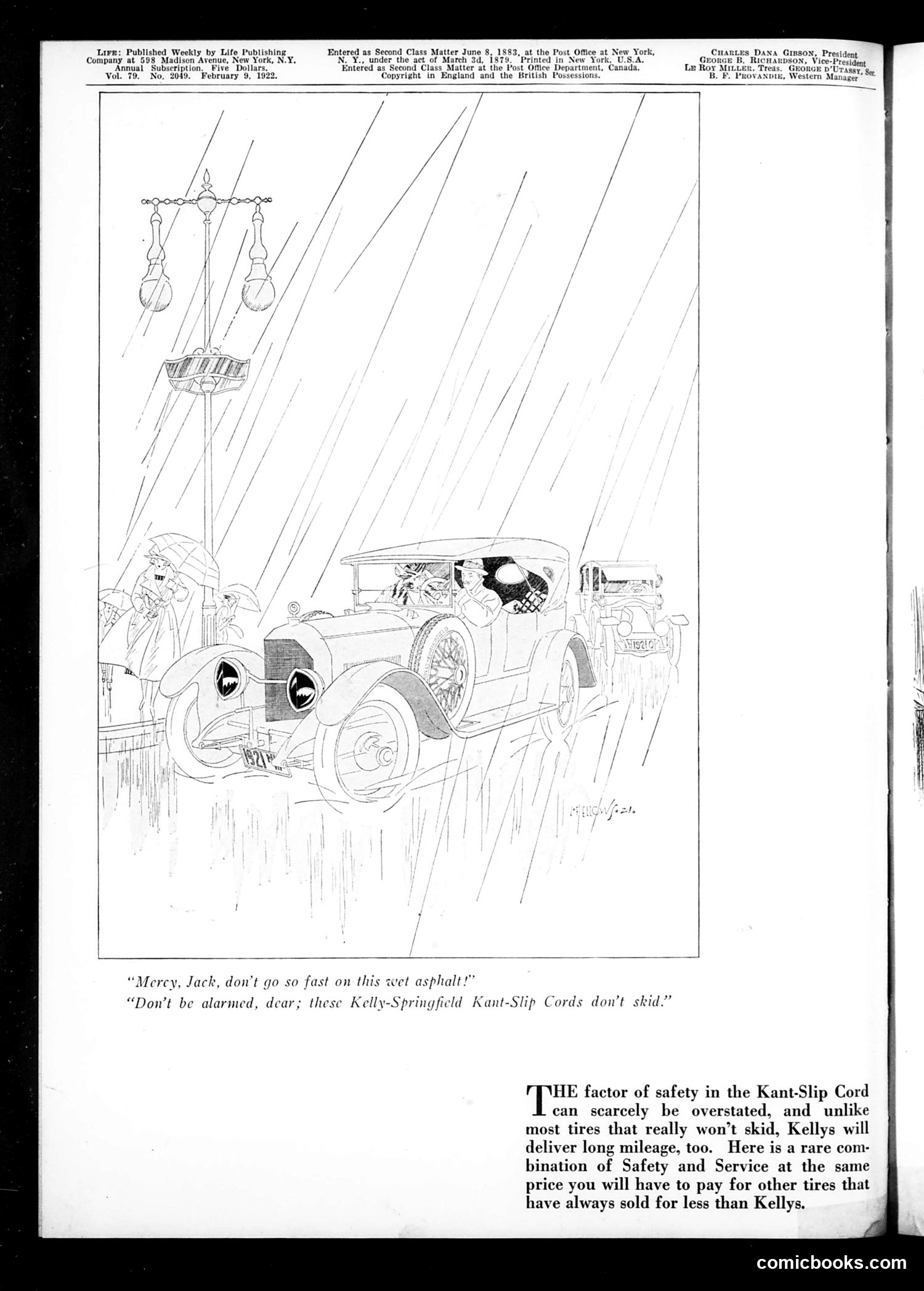
This page is primarily a **tire advertisement** for Kelly-Springfield Kant-Slip Cords, not political satire. The cartoon illustrates a domestic scene: a woman (appearing anxious) warns a male driver to slow down on wet asphalt, citing safety concerns. The man responds confidently that these Kelly tires "don't skid." The advertisement's pitch emphasizes that Kant-Slip Cords offer a rare combination of **safety and long mileage at competitive prices**—a selling point suggesting other tire brands either skid dangerously or wear out quickly. The humor is light and domestic rather than political, playing on period gender dynamics (the cautious wife, the confident driver) to sell automotive safety through tire quality.
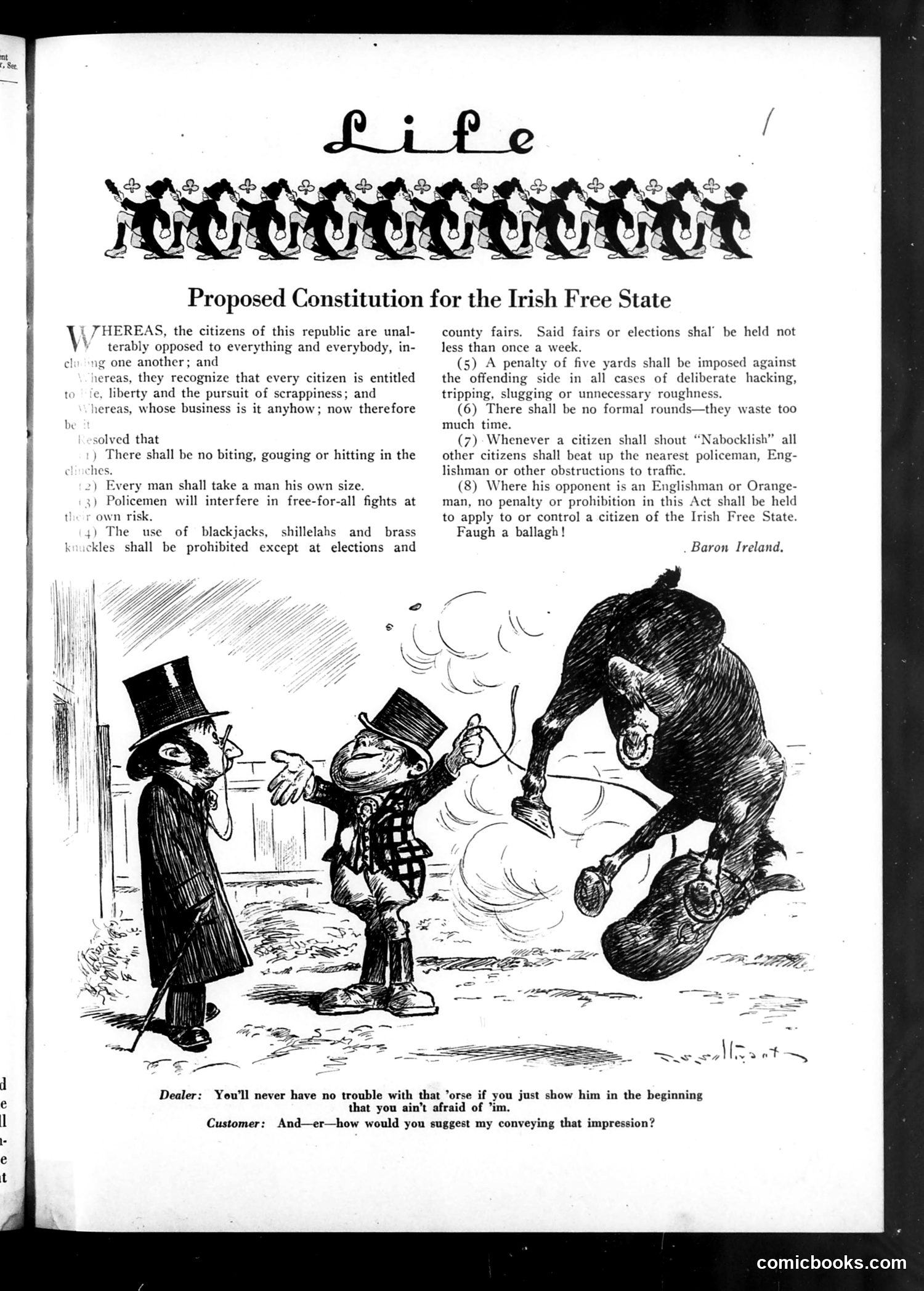
This page satirizes Irish independence and governance through two components: **"Proposed Constitution for the Irish Free State"** mockingly presents absurd laws: no biting or hitting in churches, men fighting fairly, police non-interference in street brawls, and notably, clause (8) exempting violence against "Englishmen or Orangemen" from penalties—suggesting the Irish Free State would selectively enforce laws against British enemies. **The cartoon below** shows a horse-dealer convincing a customer to buy a dangerous horse by claiming confidence prevents trouble. The caption implies the dealer is advising the customer to "show" the horse you're unafraid—a metaphor likely commenting on Irish political negotiations or governance: appearing confident masks underlying instability or danger. Together, the page satirizes Irish political incompetence and the paradoxes of the newly-formed Irish Free State (established 1922).
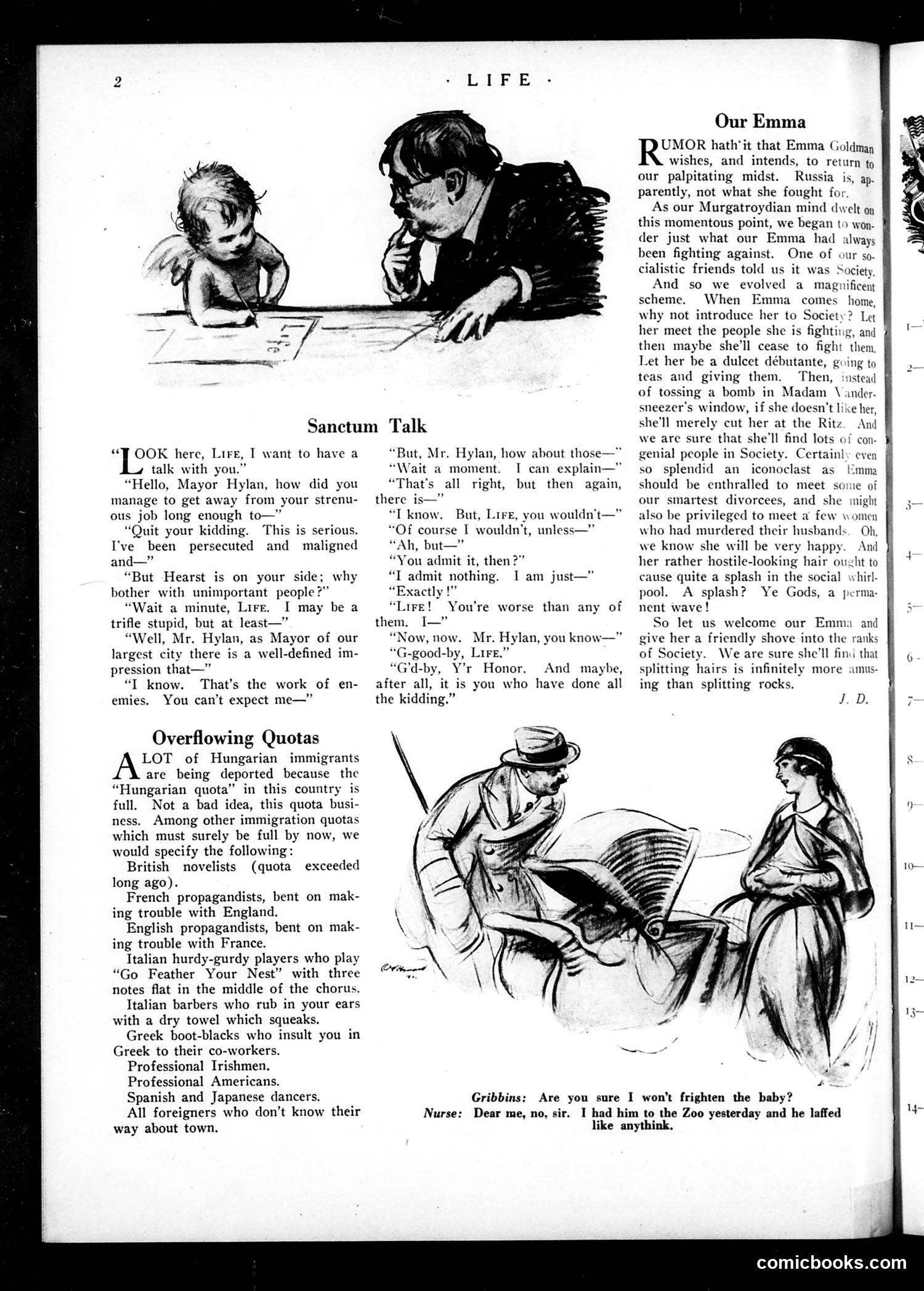
**"Sanctum Talk"** depicts a conversation between Mayor Hylan and "Life" (personified) about Emma Goldman. The dialogue satirizes Hylan's heavy-handed approach to managing the city's "enemies"—suggesting his solutions are crude and ineffective. The joke implies that inviting Goldman to Society events would be a more sophisticated (if ironic) way to neutralize her radical threat than crude suppression. **"Overflowing Quotas"** is a humorous list proposing immigration quotas for various national and ethnic groups deemed problematic: Hungarian immigrants, British/French propagandists, Italian musicians, Greek workers, Irish laborers, and others. The satire mocks nativist anxiety about foreign "types" disrupting American society during the immigration debates of this era.
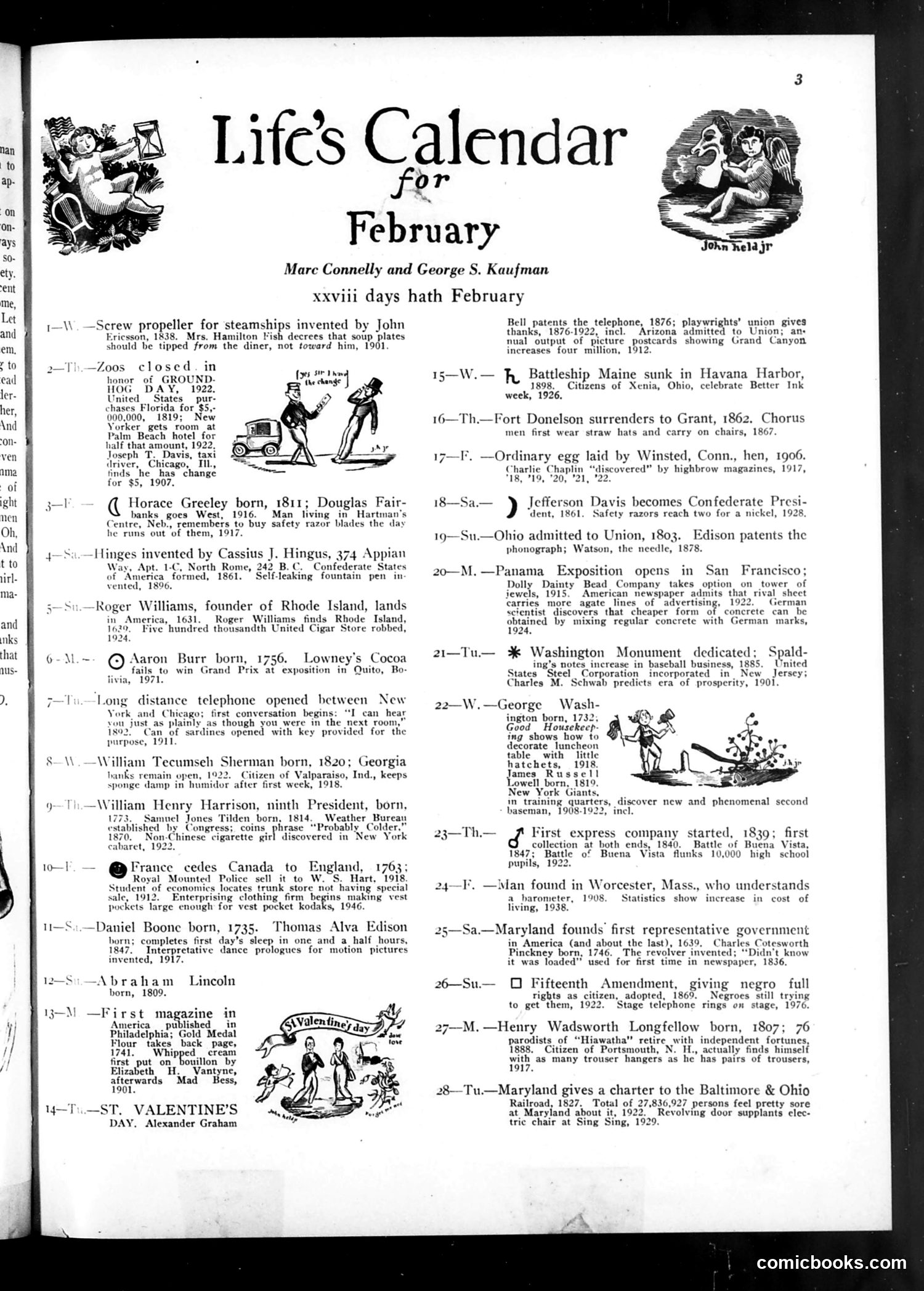
This page is primarily a historical calendar of events, not political satire. It lists significant dates in American history—inventions (screw propeller, telephone), births of notable figures (Lincoln, Aaron Burr), and major events (Fort Donelson's surrender, Panama Exposition opening). The decorative illustrations are period-appropriate Victorian engravings rather than pointed satirical cartoons. They include cherubs, a Valentine's Day couple, and a George Washington figure planting seeds—thematic to the calendar entries rather than commentaries on contemporary politics. The page appears informational and celebratory of American achievements rather than critically satirical. It represents *Life* magazine's educational function as a general-interest publication in the early 20th century.
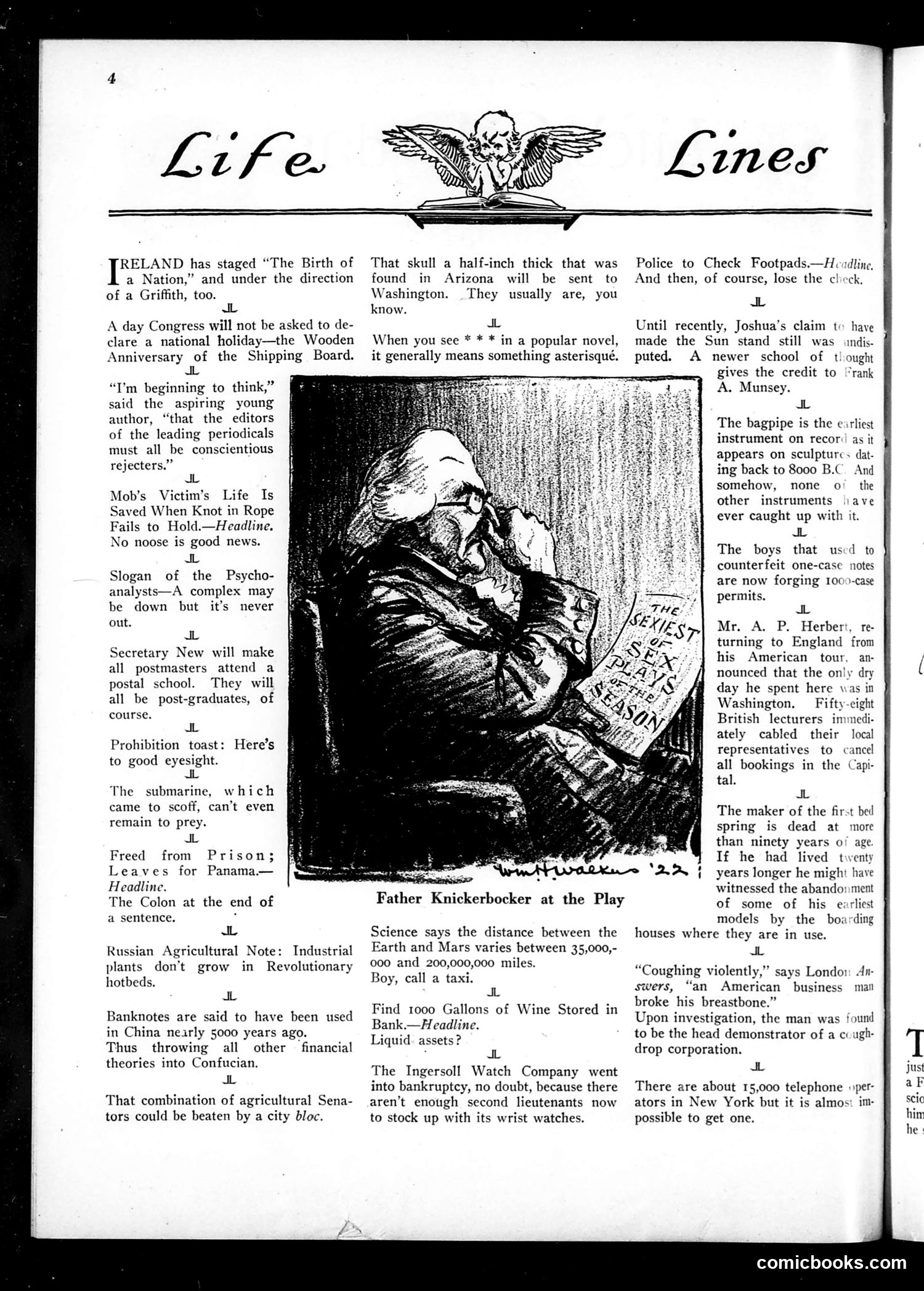
This cartoon depicts a disheveled, exhausted figure labeled as Father Knickerbocker (a personification of New York City itself, traditionally shown as a bearded Dutch colonial figure) slumped in a theater seat reading "The Seriousest Drama," appearing bored or overwhelmed. The satire targets New York's theatrical scene, likely mocking either pretentious serious drama or the exhausting demands of theater-going in the city. The figure's worn appearance suggests the city itself is worn down by cultural obligations or the quality of contemporary plays. The surrounding "Life Lines" column contains miscellaneous short jokes and observations typical of the magazine's satirical format, touching on prohibition, postal reform, and other contemporary issues, but lacks direct connection to the main cartoon.
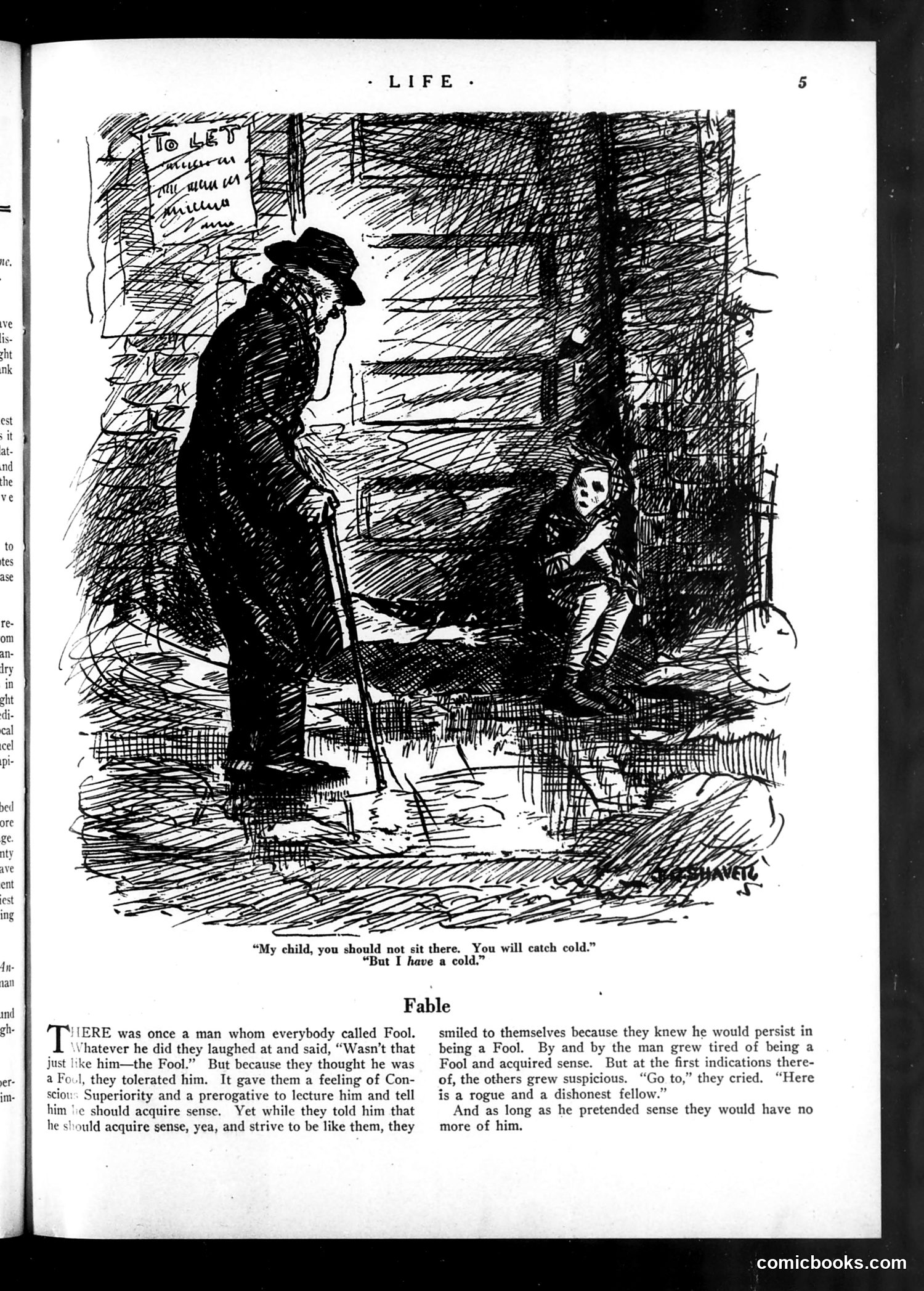
This page contains an illustration and a short fable. The sketch shows an adult and child at a doorway with a "TO LET" sign, depicting the caption's exchange: "My child, you should not sit there. You will catch cold." / "But I love a cold." The accompanying fable explains the satirical point: a man everyone called "Fool" was tolerated by his community because they believed their mockery would teach him sense. However, he grew comfortable with his foolish status and acquired a dishonest character. When the community finally rejected him as "a rogue and a dishonest fellow," it was too late—he'd internalized their low expectations. This is moral satire about how society enables dysfunction through enabling toleration, and how people can become what others assume them to be.
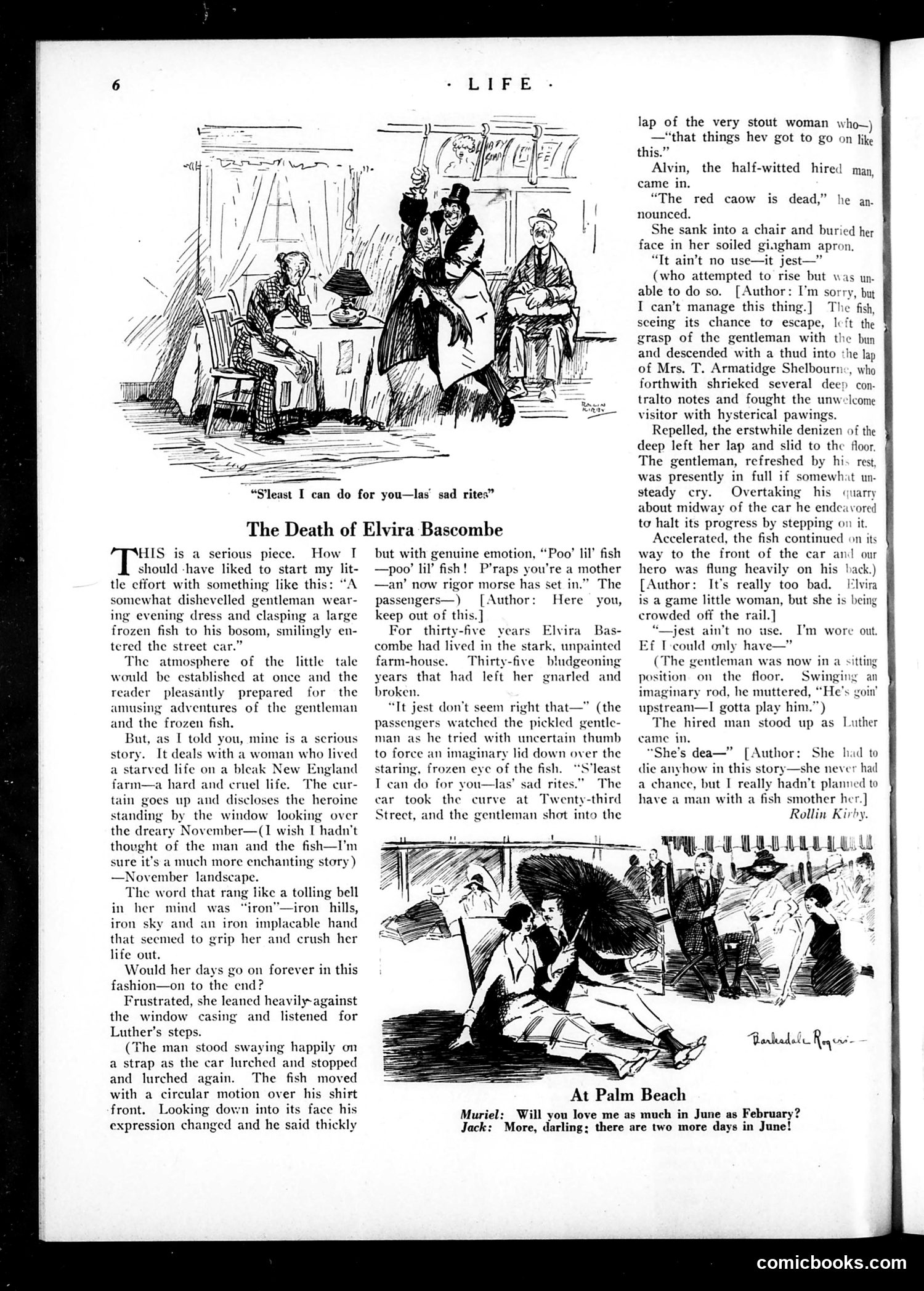
This page presents a satirical short story with accompanying illustrations. The narrative mocks Victorian sentimentality by depicting a gentleman's attempt to comfort a distraught woman over her dead pet fish. The story emphasizes the absurdity of the situation—a woman in genuine emotional distress over a frozen fish, which the author treats as both pathetic and deserving of ridicule. The satirical point targets upper-class affectation: the woman's exaggerated grief over something trivial contrasts sharply with her apparent indifference to actual human suffering. The gentleman's awkward attempts at consolation underscore the social awkwardness created by her disproportionate emotion. The cartoon's humor relies on mocking both feminine hysteria and the pretensions of polite society.
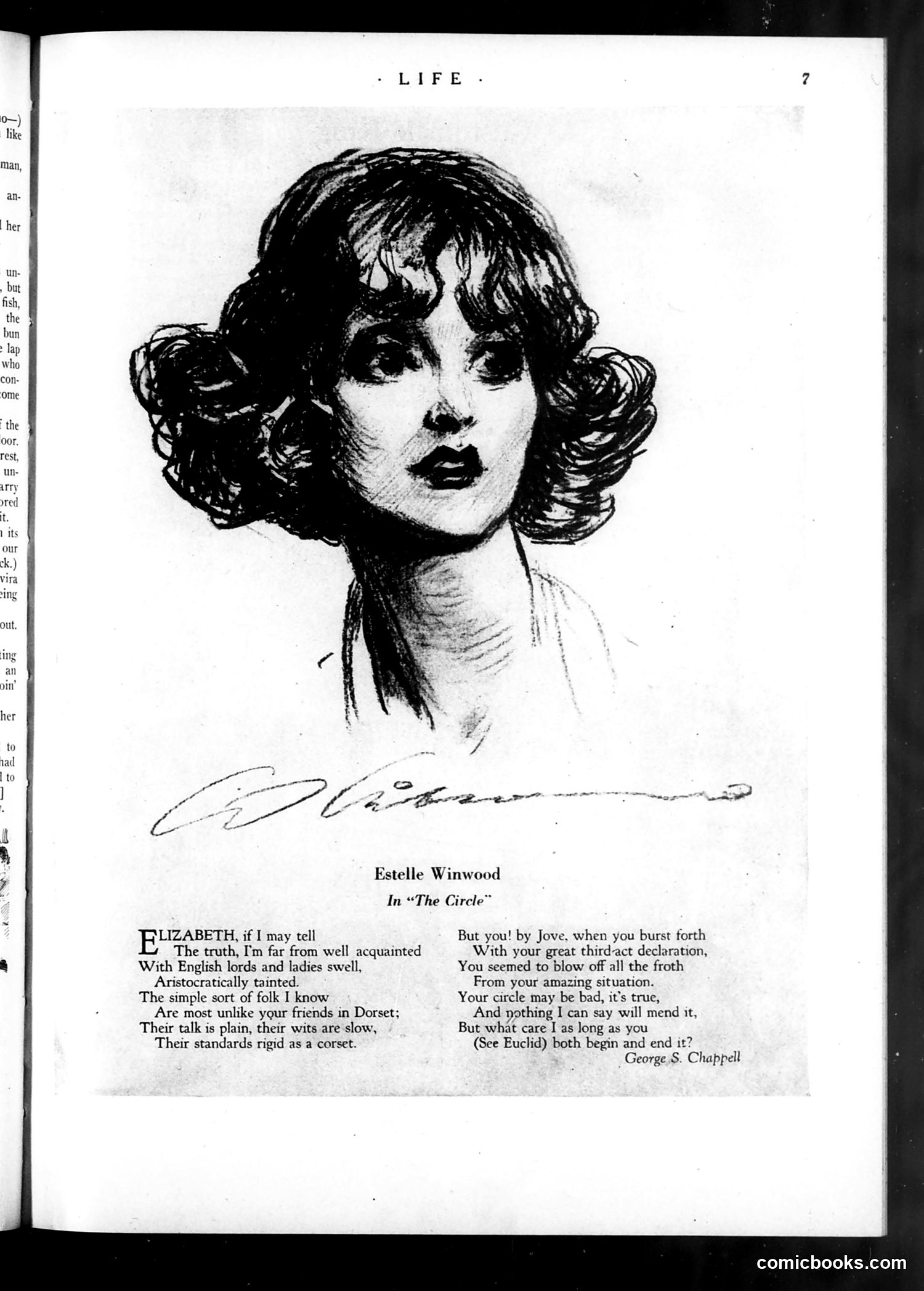
This page features a portrait and poetic tribute to actress **Estelle Winwood** in her role as "Elizabeth" from the play *The Circle*. The sketch is signed (possibly by the artist), and George S. Chappell provides accompanying verse. Chappell's poem satirizes Elizabeth's character as aristocratically snobbish and socially superior—contrasting unfavorably with her Dorset acquaintances, whose "standards rigid as a corset." The humor centers on her pretentiousness and affected superiority. The final couplet references Euclid, suggesting her character's dramatic arc follows geometric precision, beginning and ending in the same place. This is a theatrical commentary rather than political satire—typical of *Life*'s entertainment coverage.
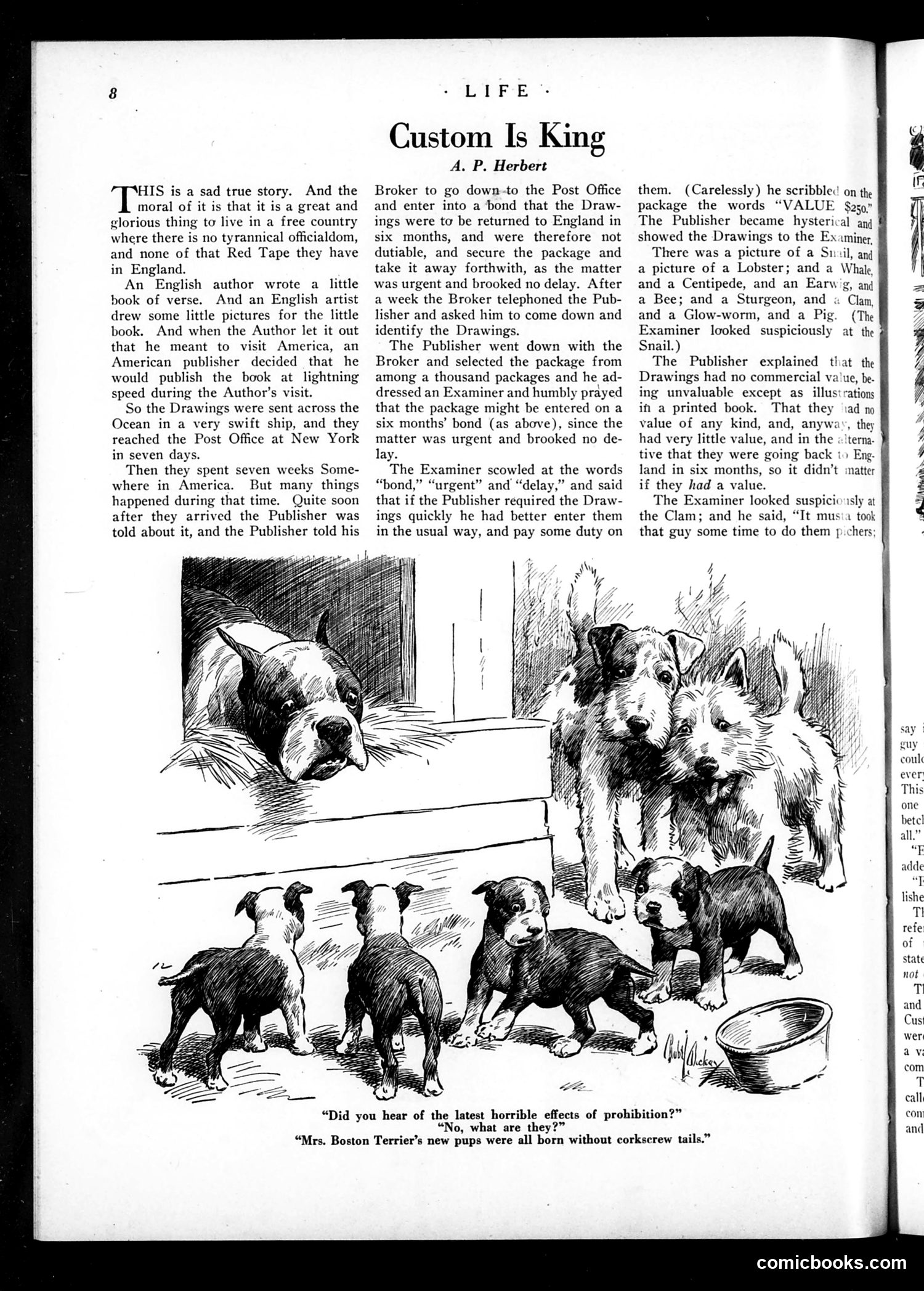
This satirical story mocks bureaucratic rigidity. An English author's illustrated book was sent to an American publisher, who shipped the drawings to England for return. The package got caught in customs red tape: the Examiner demanded a six-month bond before releasing it, citing regulations about "value." The Publisher protested the drawings were worthless as illustrations—they had no independent value. The Examiner skeptically replied they might be valuable anyway, so the bond stood. The accompanying cartoon shows dogs, with the caption referencing "Mrs. Boston Terrier's new pups were all born without corkscrew tails"—likely mocking prohibition's unintended consequences. The satire targets mindless adherence to rules regardless of practical reality.
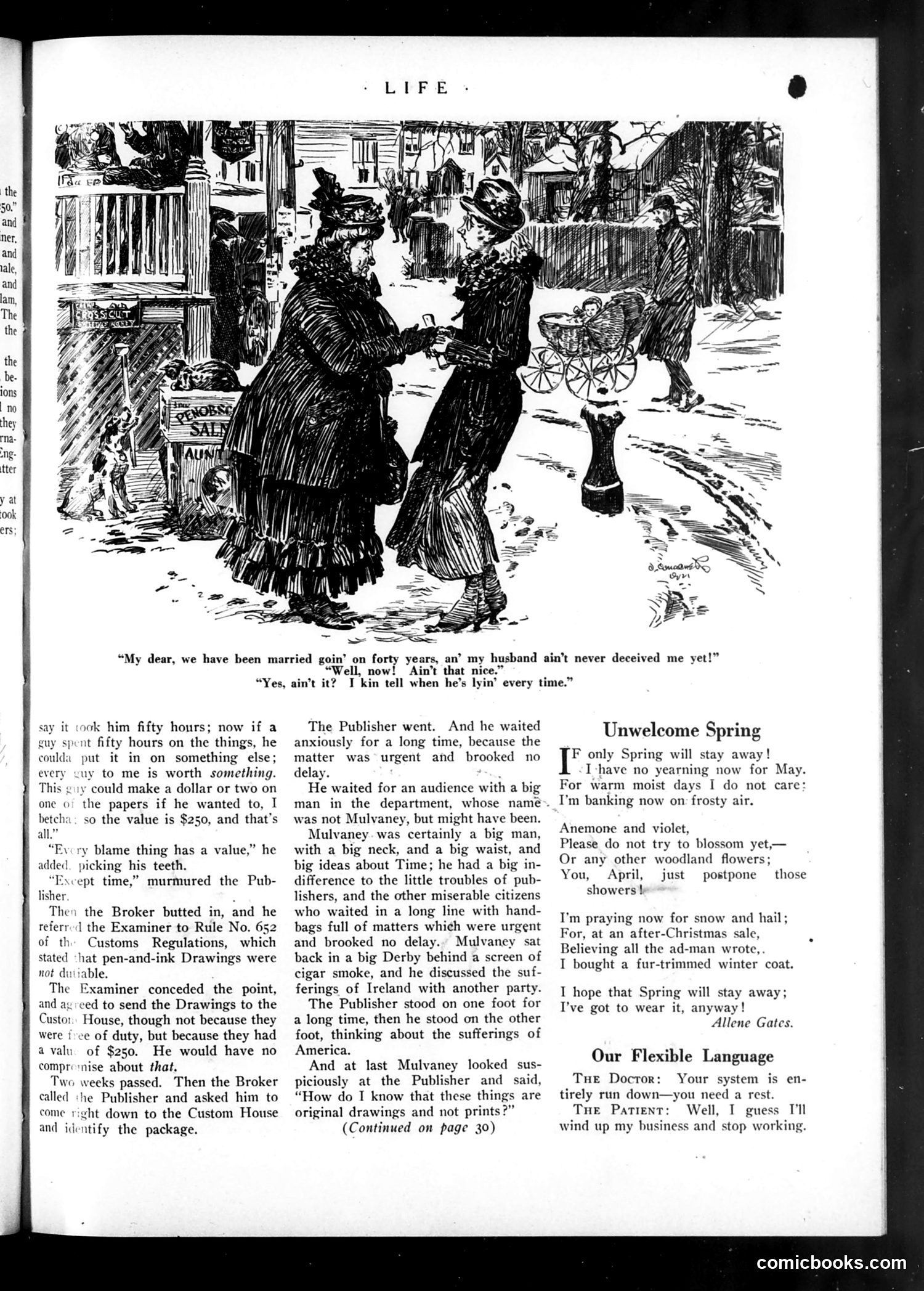
This page contains a humorous domestic cartoon about marriage longevity. Two well-dressed women meet on a street; one boasts that her husband "ain't never deceived me yet" in forty years of marriage. The other responds that her husband lies "every time." The joke satirizes the gap between marital ideals and reality—suggesting that either the first woman is deluded or her husband's dishonesty is so constant it's become invisible to her. The cartoon reflects early 20th-century attitudes about marriage as an institution where minor deceptions are expected and normalized. The page also includes poetry ("Unwelcome Spring") and a medical joke about a doctor and patient, typical filler content for *Life* magazine's satirical format.
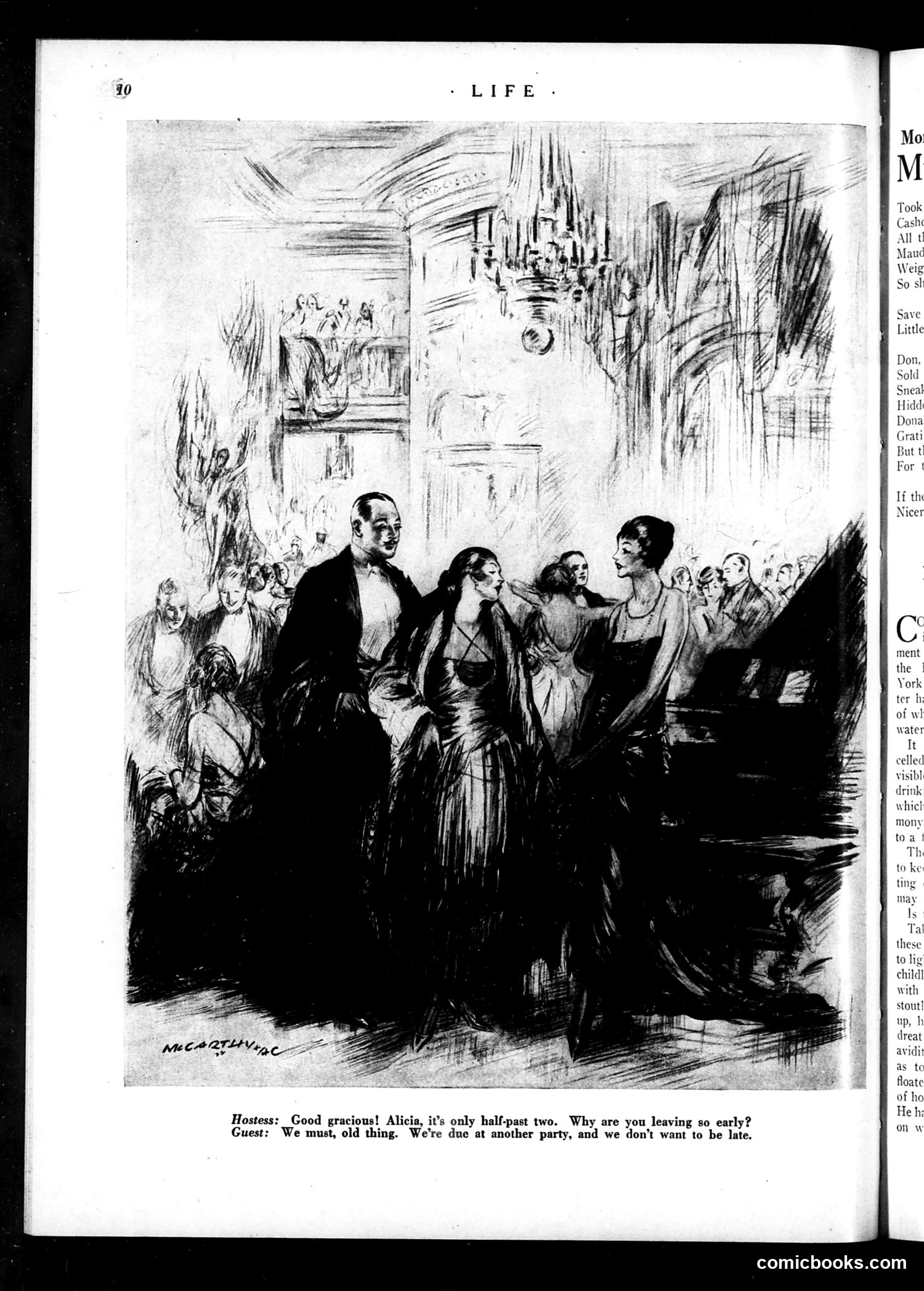
This single-panel cartoon depicts a social scene at what appears to be an upscale gathering or party. A well-dressed man and woman are departing early, with the hostess (Alicia) expressing surprise at their premature exit. The guest explains they must leave because they're attending "another party" and don't want to be late. The satire targets the social pretension and scheduling obsession of the wealthy elite—specifically, the absurdity of leaving one fashionable event to rush to another, treating high society gatherings as obligatory checklist items rather than genuine social occasions. The cartoon mocks both the guests' behavior and implicitly the hostess's expectation that guests would prioritize her party above all else.
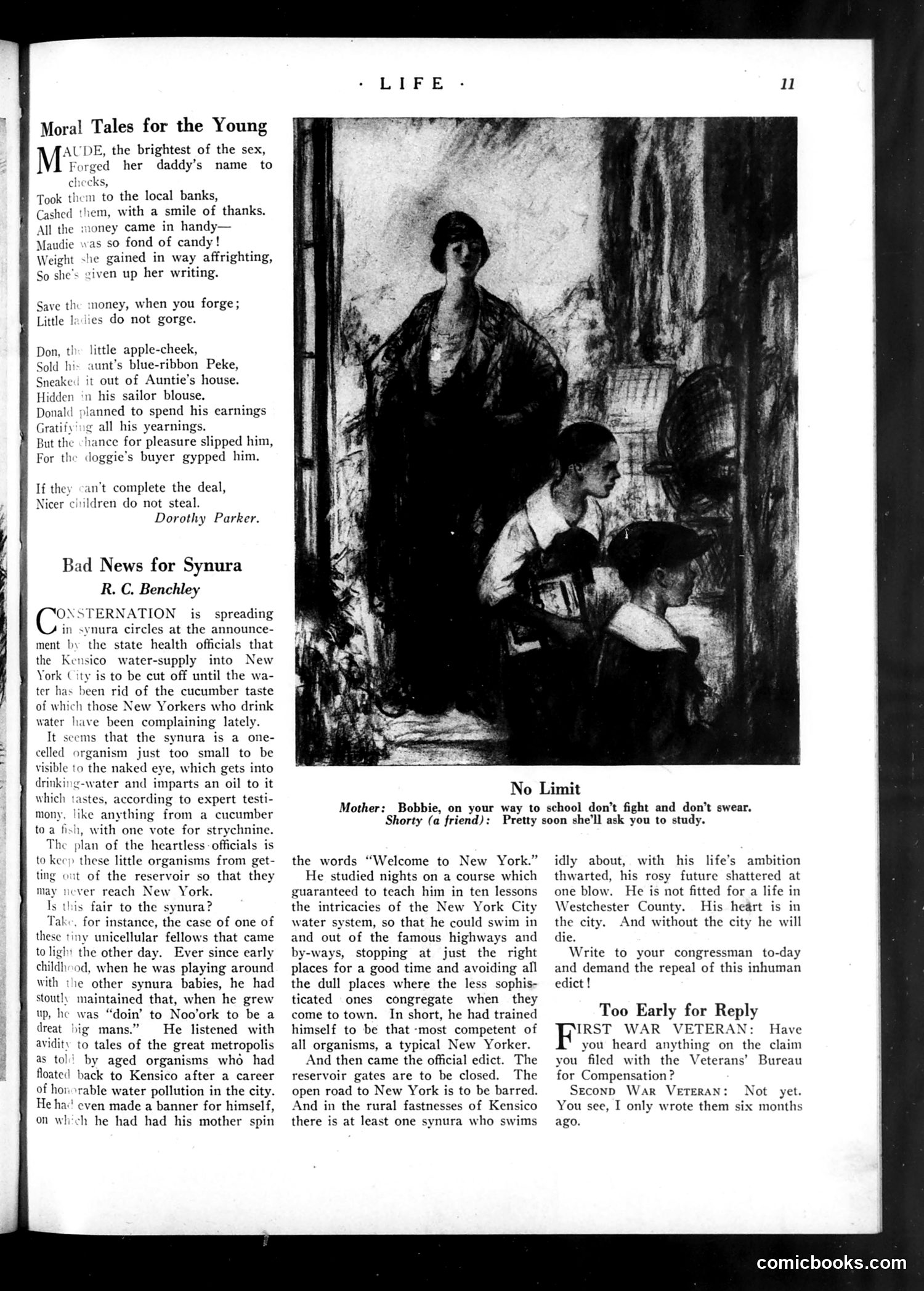
This page contains three distinct pieces: 1. **"Moral Tales for the Young"** (by Dorothy Parker): A satirical poem mocking children's moral instruction stories, depicting young people engaging in petty theft and misconduct—directly subverting the earnest didactic purpose of such tales. 2. **"Bad News for Synura"** (by R.C. Benchley): An article about New York City's water contamination by synura (a microscopic organism causing taste problems). The piece satirizes city officials' plan to filter the water supply and suggests the contamination may have actually improved New Yorkers' behavior. 3. **"No Limit"**: An illustration with caption showing two figures discussing school attendance, appearing to comment on truancy or educational expectations. The page exemplifies Life's satirical approach to contemporary urban and social issues.
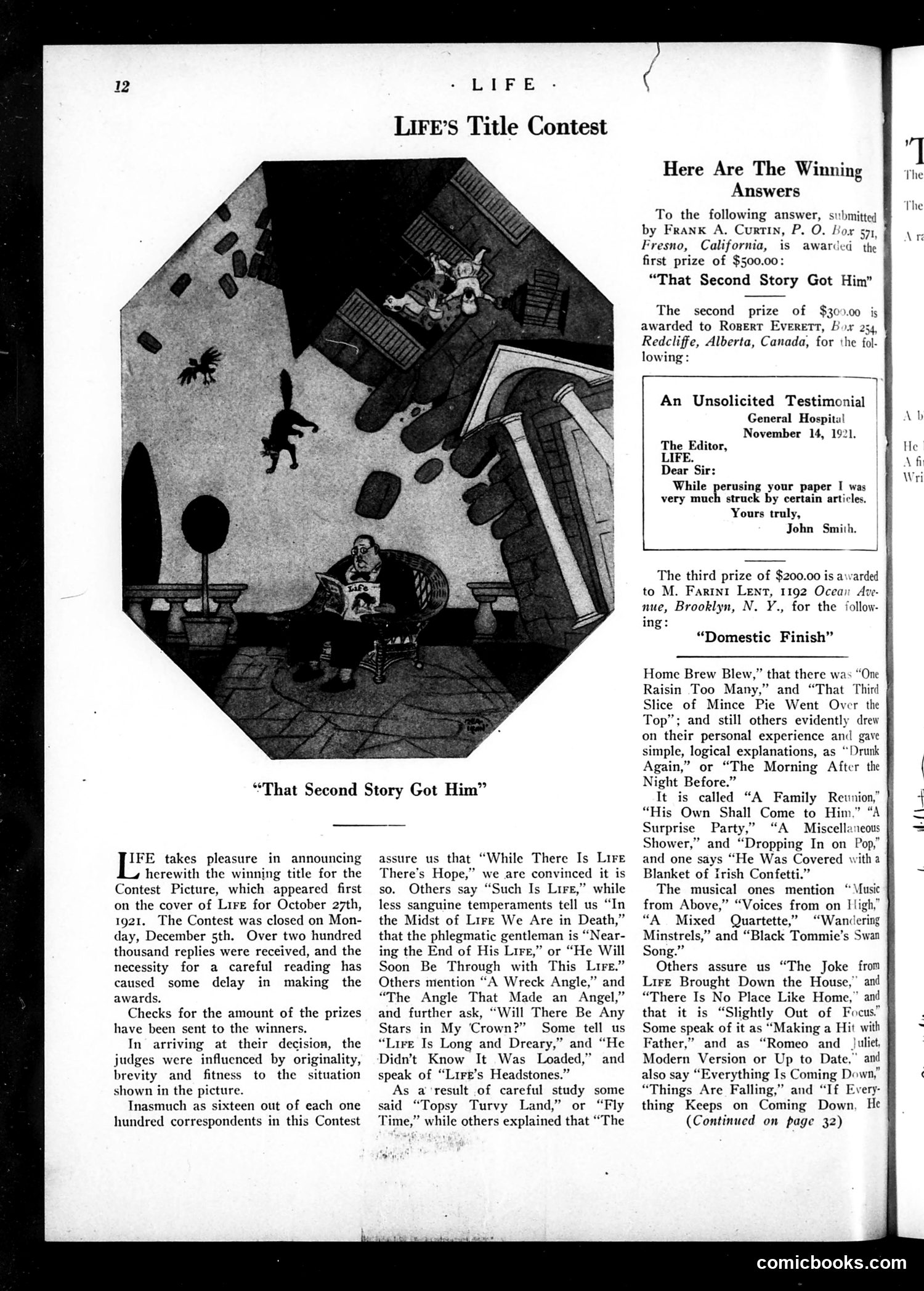
This page announces winners of Life's title-naming contest for a cover image. The octagonal illustration shows a surreal domestic scene: a man sits reading in an armchair while various impossible or absurd elements surround him—objects float, a figure dangles from above, architectural elements distort. The winning title, "That Second Story Got Him," is a visual pun: it suggests both a narrative ("the second story" of a building) and idiomatic meaning (being fooled or affected by a "story"/lie). The cartoon satirizes bewilderment or domestic chaos through impossible spatial logic—representing the surreal, disorienting nature of modern life or domestic situations that defy rational explanation. The contest itself was a popular LIFE magazine feature inviting reader participation.
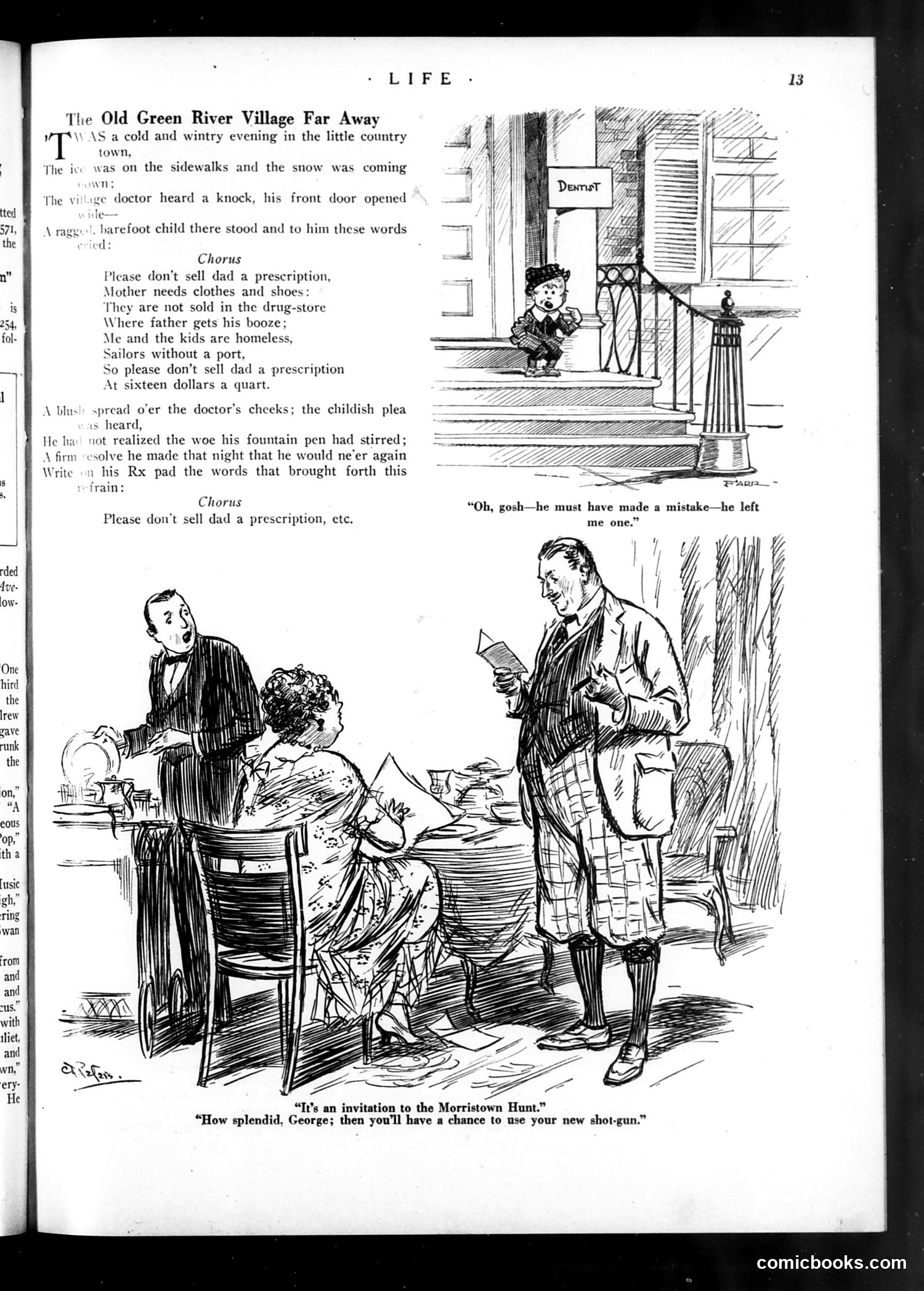
This page contains a sentimental narrative poem about a poor, barefoot child appearing at a village doctor's door on a cold night, asking him not to sell the family a prescription since they lack money for clothes and food. The chorus repeats the plea. The lower cartoon shows two well-dressed men visiting a third man (identified as "George"), presenting him with an invitation to the Morristown Hunt. One remarks, "How splendid, George; then you'll have a chance to use your new shot-gun." The satire appears to contrast rural poverty (the poem) with wealthy leisure activities (the cartoon)—both depicting different American social classes of the era.
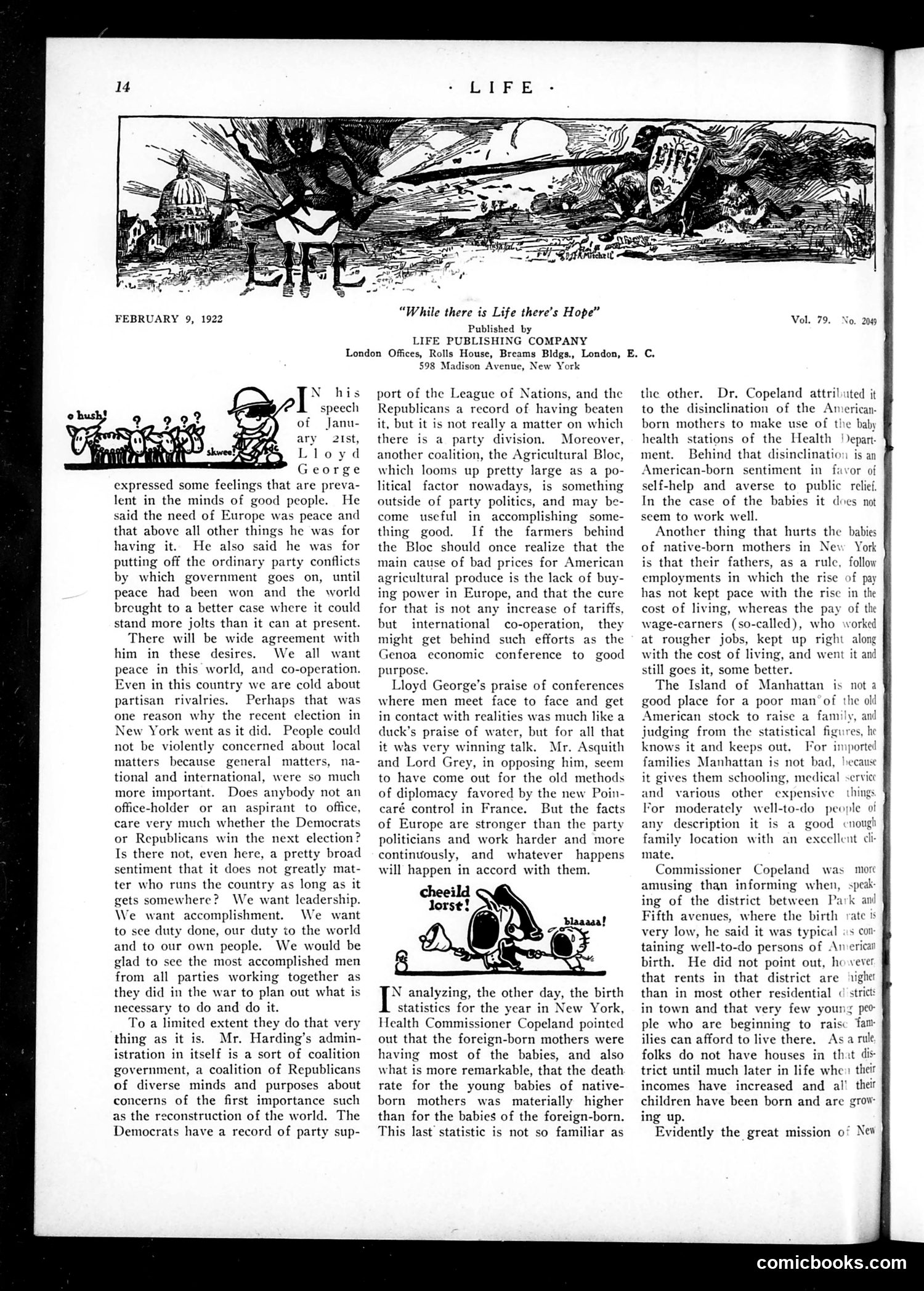
This page contains political commentary by Lloyd George (British Prime Minister) praising international conferences and cooperation for post-WWI peace efforts. The main cartoon shows a horse labeled "Deadlock" — satirizing how international negotiations, despite good intentions, produce stalemate rather than progress. The article discusses birth statistics in New York, noting that foreign-born mothers had higher infant mortality rates than native-born mothers. Commissioner Copeland is cited analyzing this disparity, attributing it partly to poor housing conditions in Manhattan's immigrant neighborhoods where rents were high relative to wages. The satire critiques both diplomatic ineffectiveness and urban inequality affecting vulnerable populations—suggesting that while politicians debate solutions, practical social problems persist unsolved.
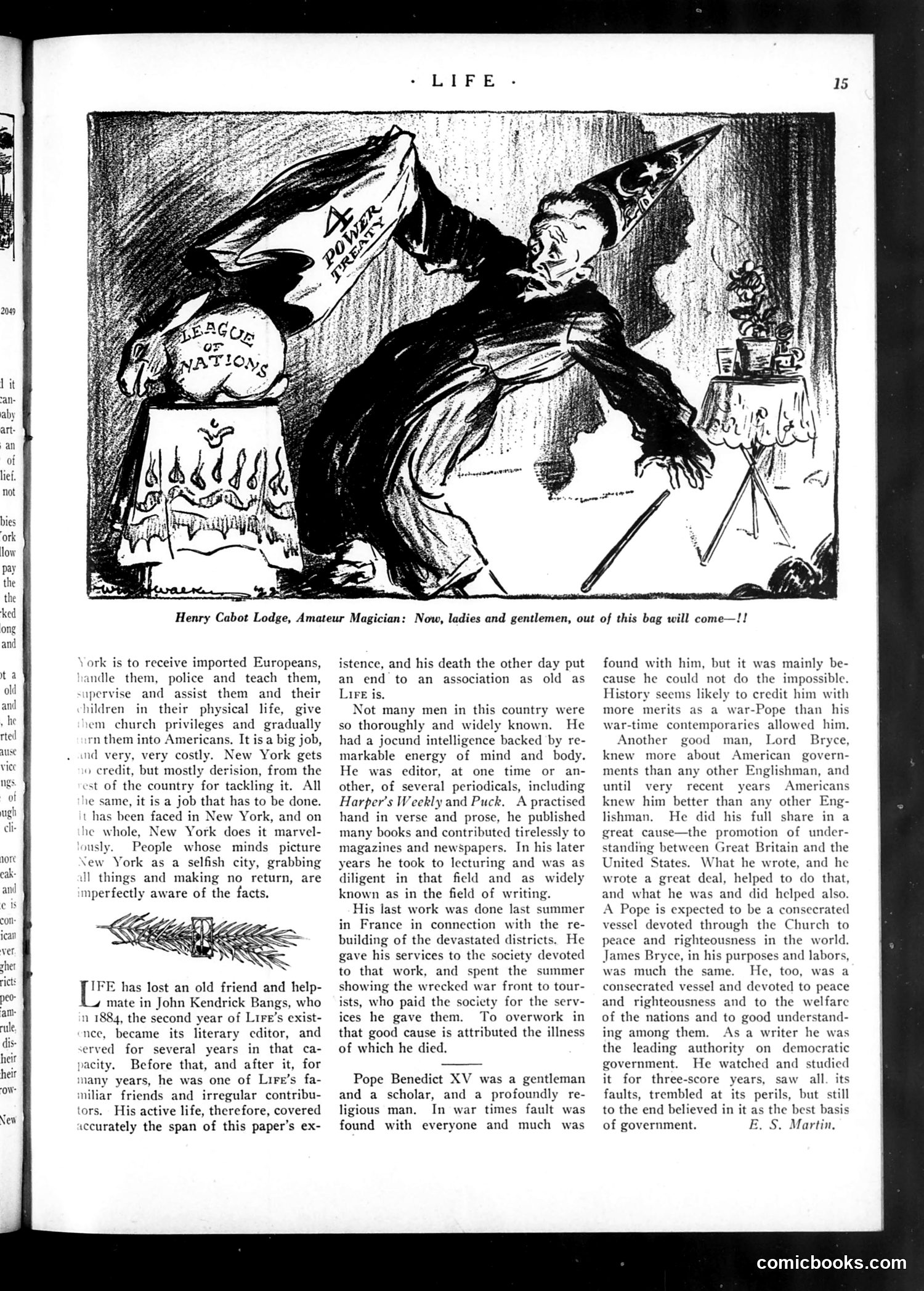
This cartoon satirizes **Henry Cabot Lodge**, a prominent U.S. Senator and diplomat, depicting him as a stage magician attempting an impossible trick. The "bag" labeled "League of Nations" sits atop a pedestal marked with flames, while Lodge gestures dramatically, promising to produce something from it. The satire references Lodge's opposition to the **League of Nations** following World War I. As a leading Republican isolationist, Lodge blocked American entry into the organization despite President Wilson's support. The cartoon mocks his political sleight-of-hand—his apparent inability or unwillingness to deliver on international cooperation while maintaining the illusion of effort. The page also contains obituaries for John Kendrick Bangs (Life's former literary editor), Pope Benedict XV, and Lord Bryce—figures who, unlike Lodge, apparently worked toward international understanding and peace during and after the war.
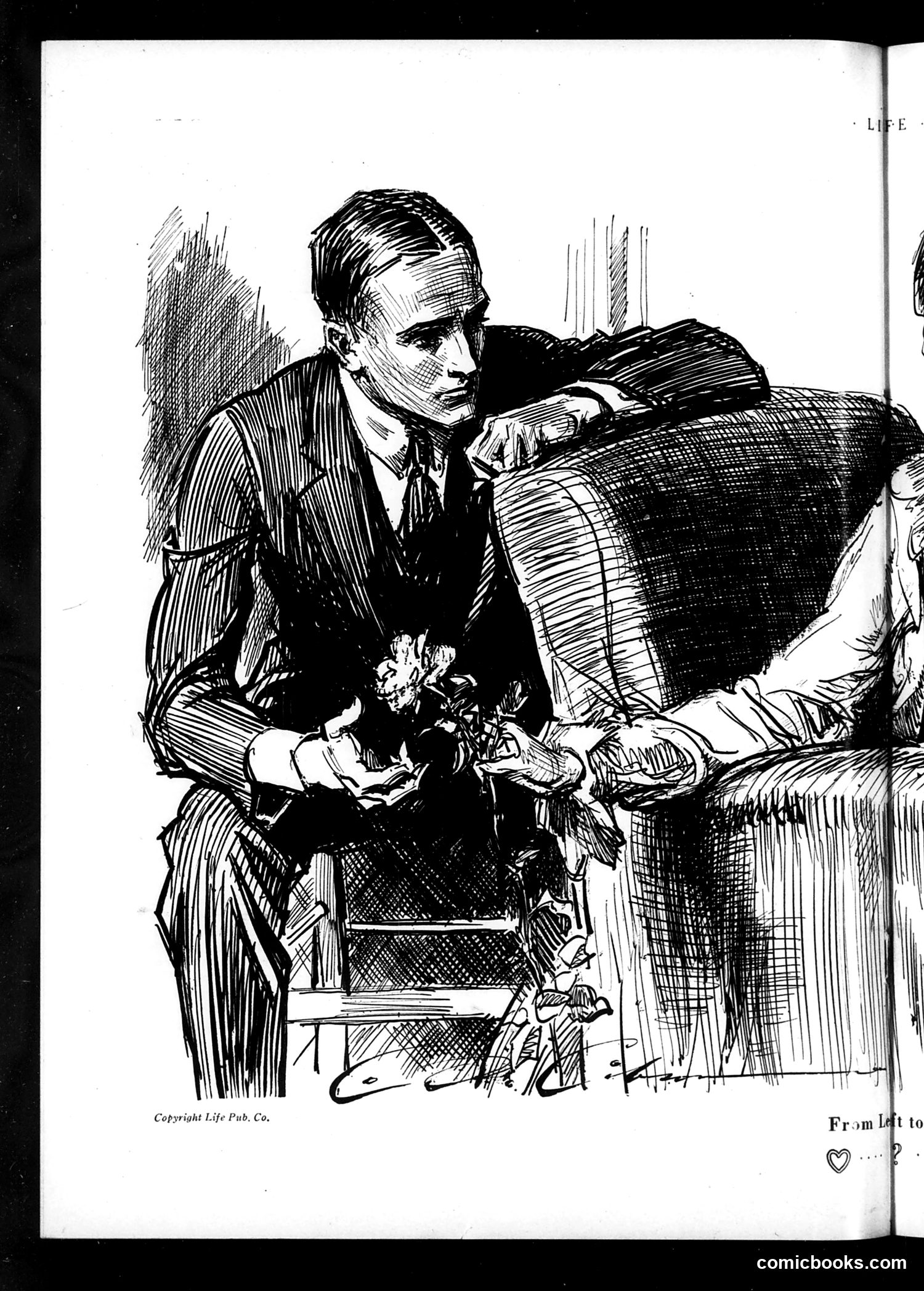
This appears to be a satirical illustration from *Life* magazine showing a well-dressed man in a pinstriped suit leaning against furniture, looking somewhat weary or contemplative. The figure holds what appears to be flowers or a small bouquet. Without clearer text identifying the specific subject, date, or political context, I cannot definitively state who this depicts or what event or policy it satirizes. The formal attire and posed attitude suggest commentary on a public or political figure, but the OCR text is too corrupted to provide the necessary context. To properly explain this cartoon's meaning, I would need: the publication date, readable caption text, or clearer identification of the figure depicted.
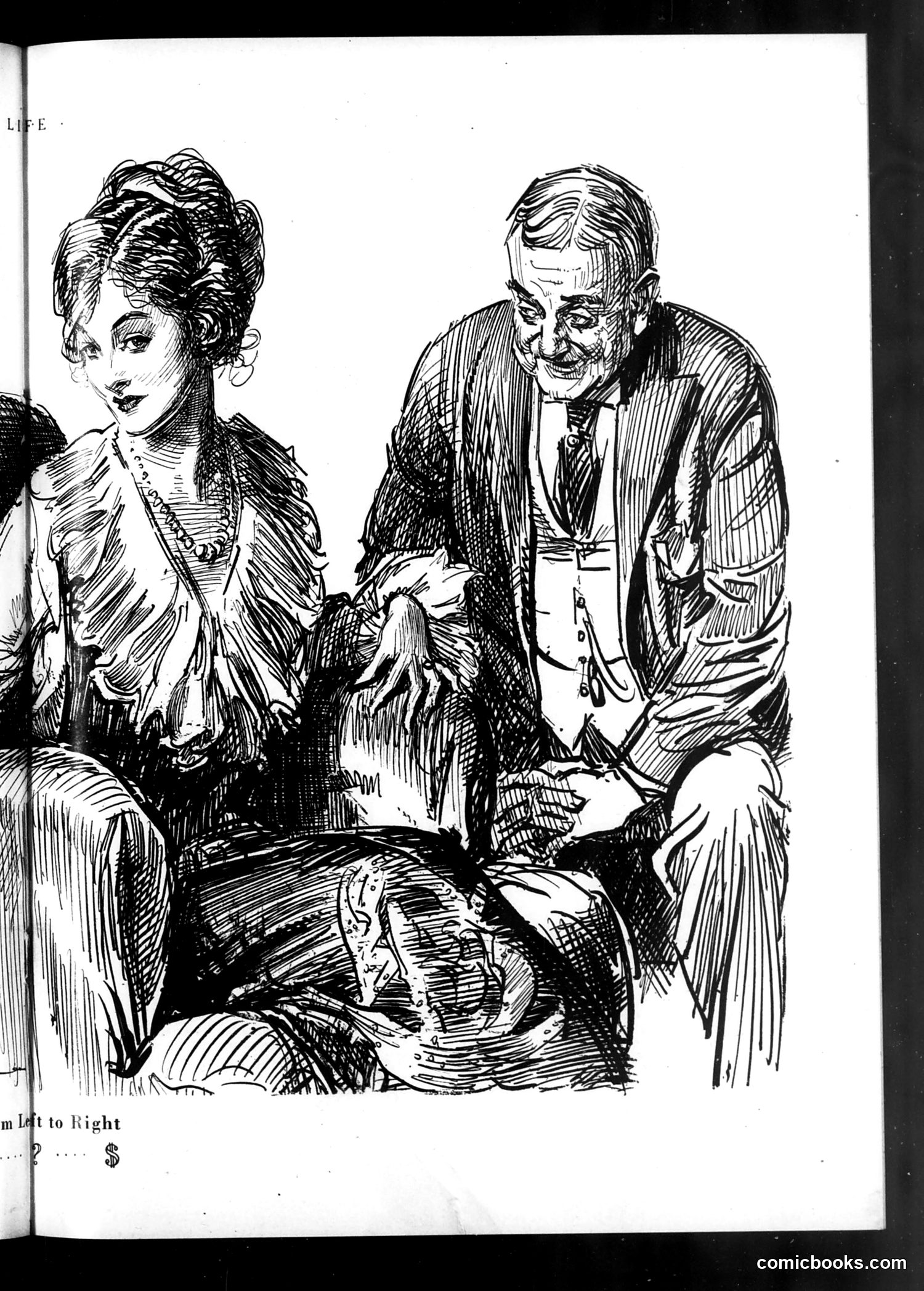
The OCR text on this page is too corrupted to read. However, the illustration itself shows three figures in early 20th-century dress: a woman on the left with elaborate upswept hair and jewelry, a man on the right in formal attire leaning forward with an interested expression, and what appears to be a child or smaller figure between them. The style suggests this is social satire, likely commenting on wealth, class dynamics, or family relationships of the period. Without legible text, I cannot identify the specific individuals being caricatured or determine the precise satirical point being made. The "LIFE" magazine header confirms this is from that publication, but the exact subject and joke remain unclear from the visual evidence alone.
This drama review critiques Mr. Manners's play "The National Anthem," which uses heavy-handed moral messaging about alcohol and jazz to depict social decay. The reviewer argues the play functions more as a temperance tract than genuine drama—every dialogue line points obviously toward catastrophe, particularly the off-stage jazz band that grows increasingly ominous, symbolizing moral corruption. The author also praises actress Laurette Taylor for elevating the material, and separately reviews the "Clavilux" or Color Organ—an experimental light-projection device by inventor Thomas Wilfred shown at the Neighborhood Playhouse. The review humorously describes an audience member so emotionally invested in seeing blue colors that she had to be taken home when her favorite hue finally appeared. The piece reflects 1920s anxieties about jazz, modernity, and prohibition-era morality debates.
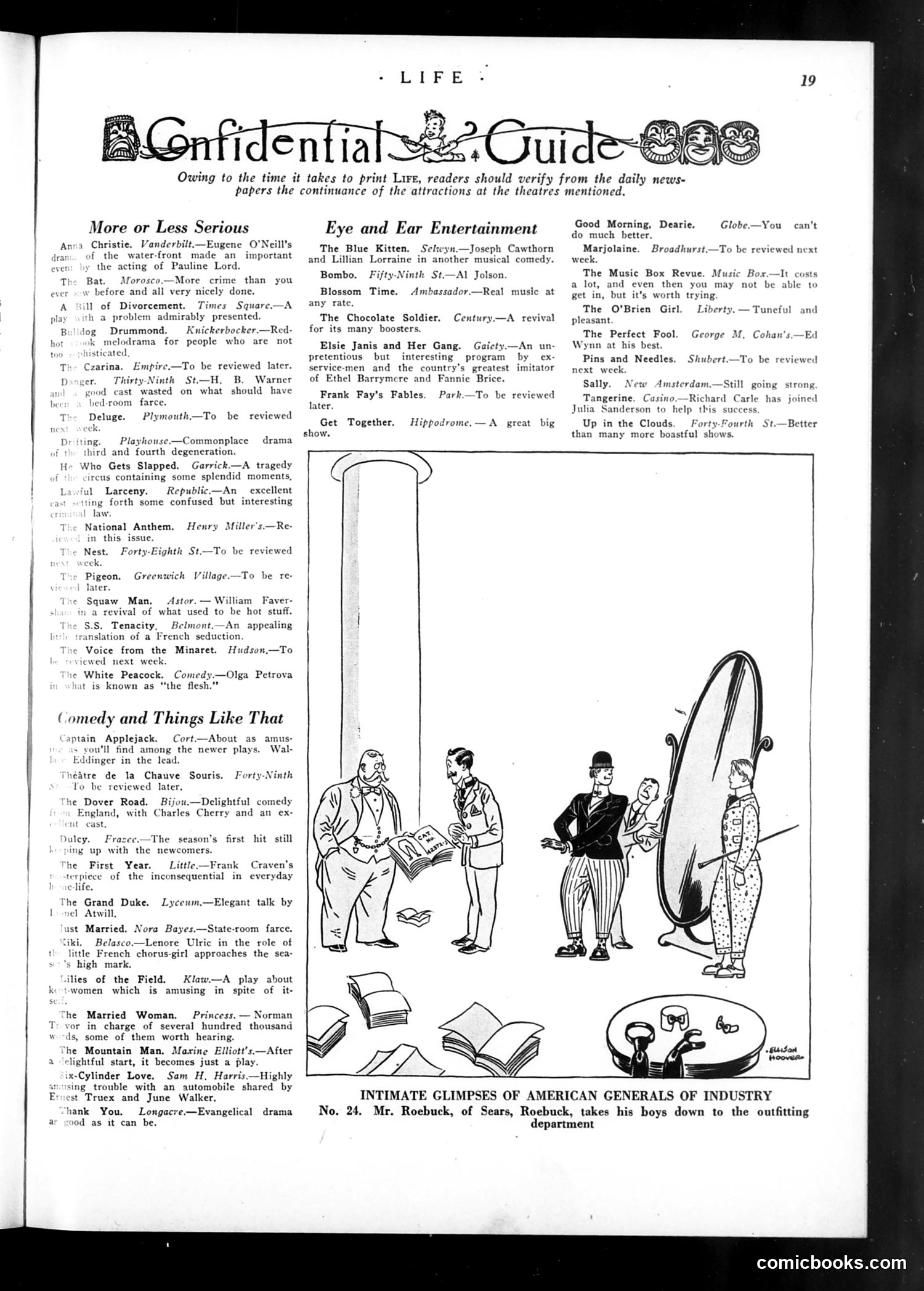
This page is a **theater guide** from *Life* magazine's "Confidential Guide" section, listing Broadway shows and reviews circa the early 1920s. The main cartoon at bottom depicts **Mr. Roebuck of Sears, Roebuck** (the mail-order catalog company) taking his sons to an "outfitting department"—likely a humorous reference to the company's role as America's premier supplier of ready-made goods and clothing. The joke plays on Roebuck as a representative of American industrial success and consumer culture. By showing him conducting his sons through an "outfitting" process, the cartoon suggests the commercialization and standardization of American life—a satirical jab at how industrial magnates and mass retailers shaped everyday American experience. The theater listings around it serve as cultural context, showing the entertainment landscape these wealthy industrialists' families would have enjoyed. The cartoon is part of *Life*'s regular "Intimate Glimpses of American Generals of Industry" series, mocking the outsized prominence of business titans in American society.
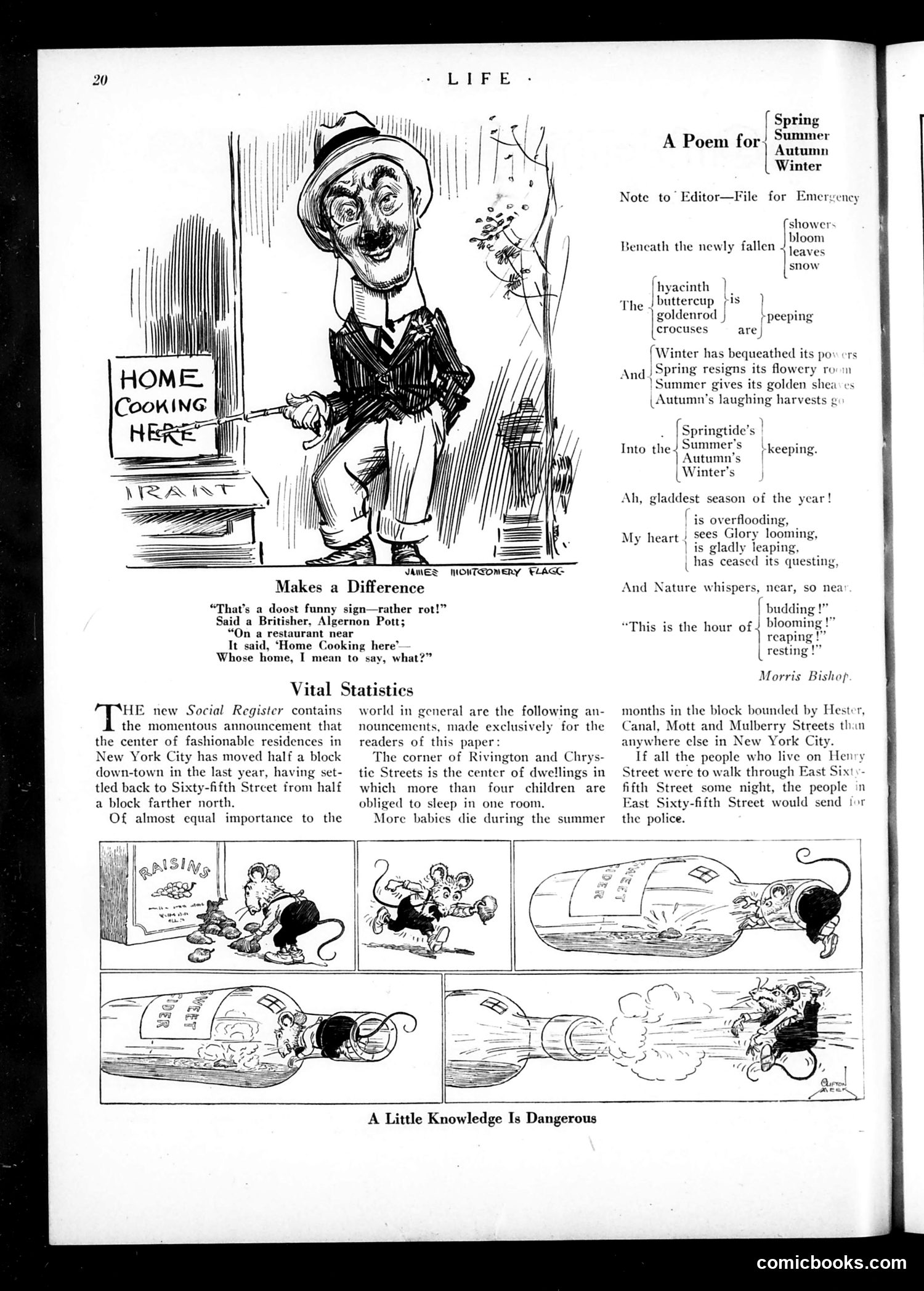
This page contains satirical social commentary typical of early 20th-century Life magazine. **Top cartoon** ("Makes a Difference"): A caricatured British character (identified as "Algernon Pott") mocks a restaurant's "Home Cooking Here" sign, questioning whose home it represents. The joke satirizes both British snobbery toward American dining and the euphemistic marketing of modest establishments. **"Vital Statistics" section**: Presents fake demographic announcements contrasting wealthy Manhattan's fashionable neighborhoods (Sixty-fifth Street) with the immigrant tenement districts (Rivington and Christie Streets, Henry Street). The satire points out gross overcrowding and mortality rates in poor neighborhoods—more babies die in summer in these blocks than wealthy areas, and the tenement population is so large they'd overwhelm police if they walked through rich neighborhoods. This is social commentary on inequality and urban poverty conditions. **Bottom comic strip** ("A Little Knowledge Is Dangerous"): Appears to show someone misusing alcohol, likely illustrating the dangers of ignorance regarding prohibition-era or general safety matters.
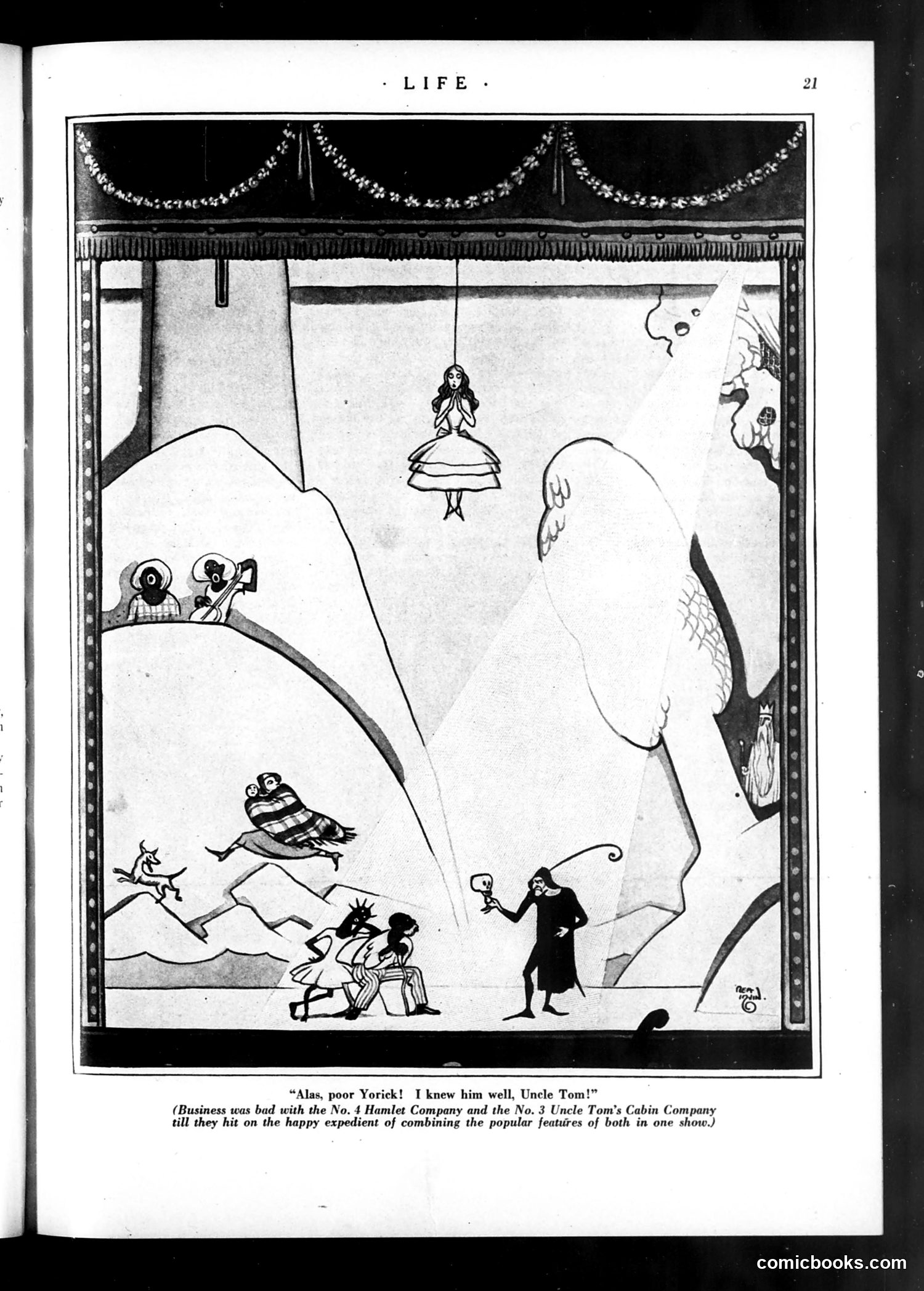
This cartoon satirizes theatrical business practices around the early 1900s. Two struggling theatrical companies—one performing *Hamlet* and another performing *Uncle Tom's Cabin*—merged their productions to boost attendance. The joke references Shakespeare's famous "Alas, poor Yorick" soliloquy, here twisted to combine *Hamlet* with *Uncle Tom's Cabin*. The surreal stage scene depicts characters and props from both plays coexisting absurdly: we see what appears to be characters from the slavery narrative mixed with Shakespearean elements. The satire mocks theatrical desperation—combining unrelated popular shows simply to attract audiences rather than maintaining artistic integrity. It's commentary on how commercial pressures force artistic compromises in entertainment.
This page contains three film reviews from Life's cinema section. The cartoonish header illustration depicts comedic silhouettes of various characters and animals, setting a lighthearted tone. **"Red-Hot Romance"** is praised as genuine satire disguised as melodrama—a rare achievement in cinema. The reviewer notes audiences will miss the joke entirely, instead applauding patriotic moments (Old Glory speech, Marines rescue) at face value. The satire apparently mocks American jingoism and interventionism. **"The Wall Flower"** criticizes actress Colleen Moore's broad comedic performance in what should be a tragic role, comparing her unfavorably to actress Louise Fazenda. **"The Man From Lost River"** examines the tired melodrama trope of rough he-man versus effete Eastern tenderfoot competing for a woman. The reviewer admits rooting for the aristocratic "wimp" despite knowing the rugged working-class hero always wins—a wry commentary on cinema's predictable class hierarchies and masculine ideals.
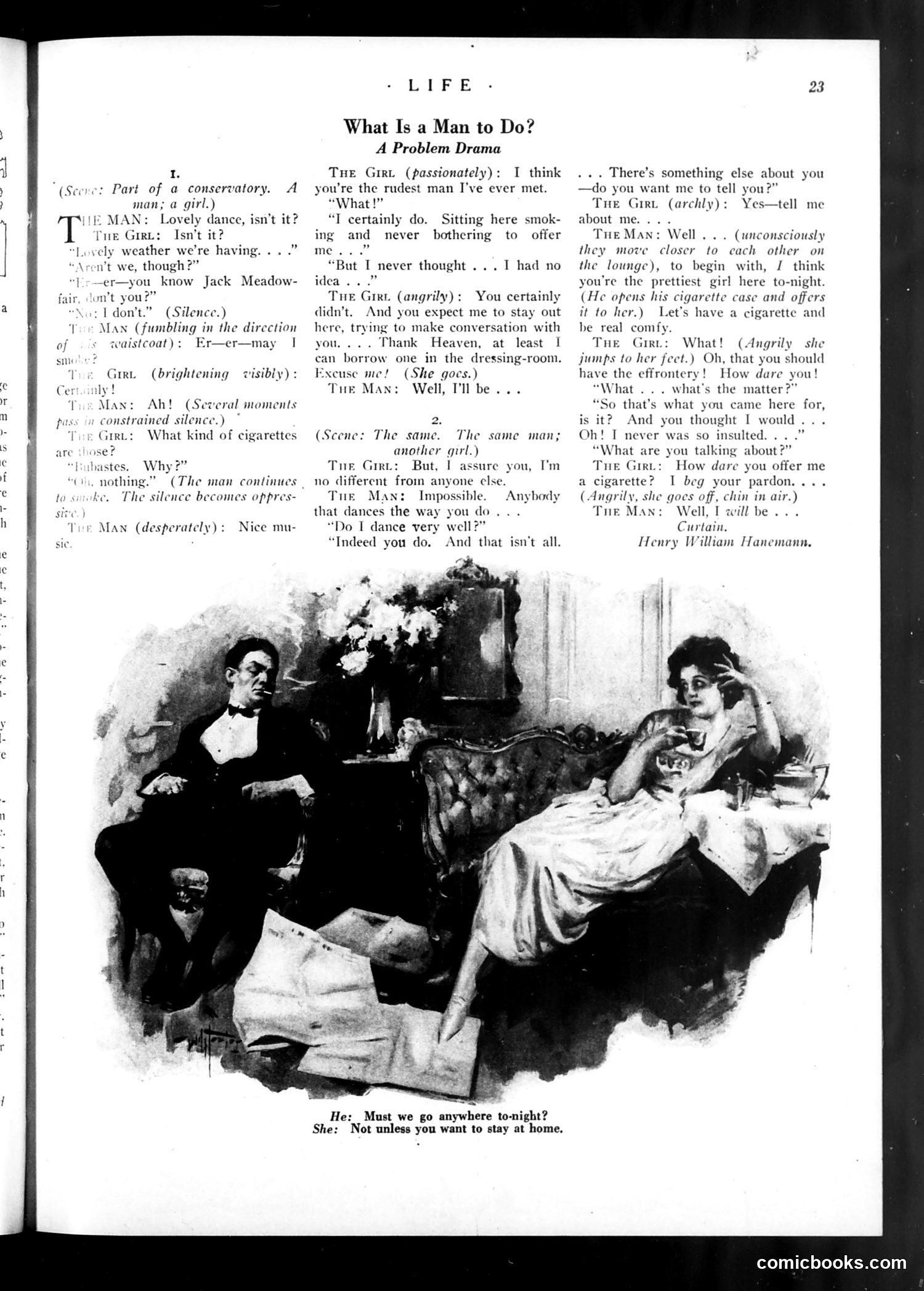
This is a two-scene problem comedy by Henry William Hanemann satirizing courtship rituals and the impossibility of male behavior in 1910s-era dating. **Scene 1:** A man attempts polite small talk with a girl at a conservatory dance—discussing weather, mutual acquaintances, offering a cigarette. She becomes furious at his negligence, accusing him of rudeness for not engaging her properly, then storms off. **Scene 2:** The same man meets another girl and actively flatters her, compliments her dancing and beauty, and offers a cigarette. She's equally outraged, interpreting his attentiveness and cigarette offer as a seduction attempt implying she's loose. **The Satire's Point:** The sketch mocks the contradictory social expectations placed on men—damned either way. Polite detachment reads as indifference; genuine interest and gallantry reads as impropriety. The final caption—"Must we go anywhere to-night? Not unless you want to stay at home"—suggests women control outcomes despite their complaints, adding another layer of social commentary on gender dynamics.
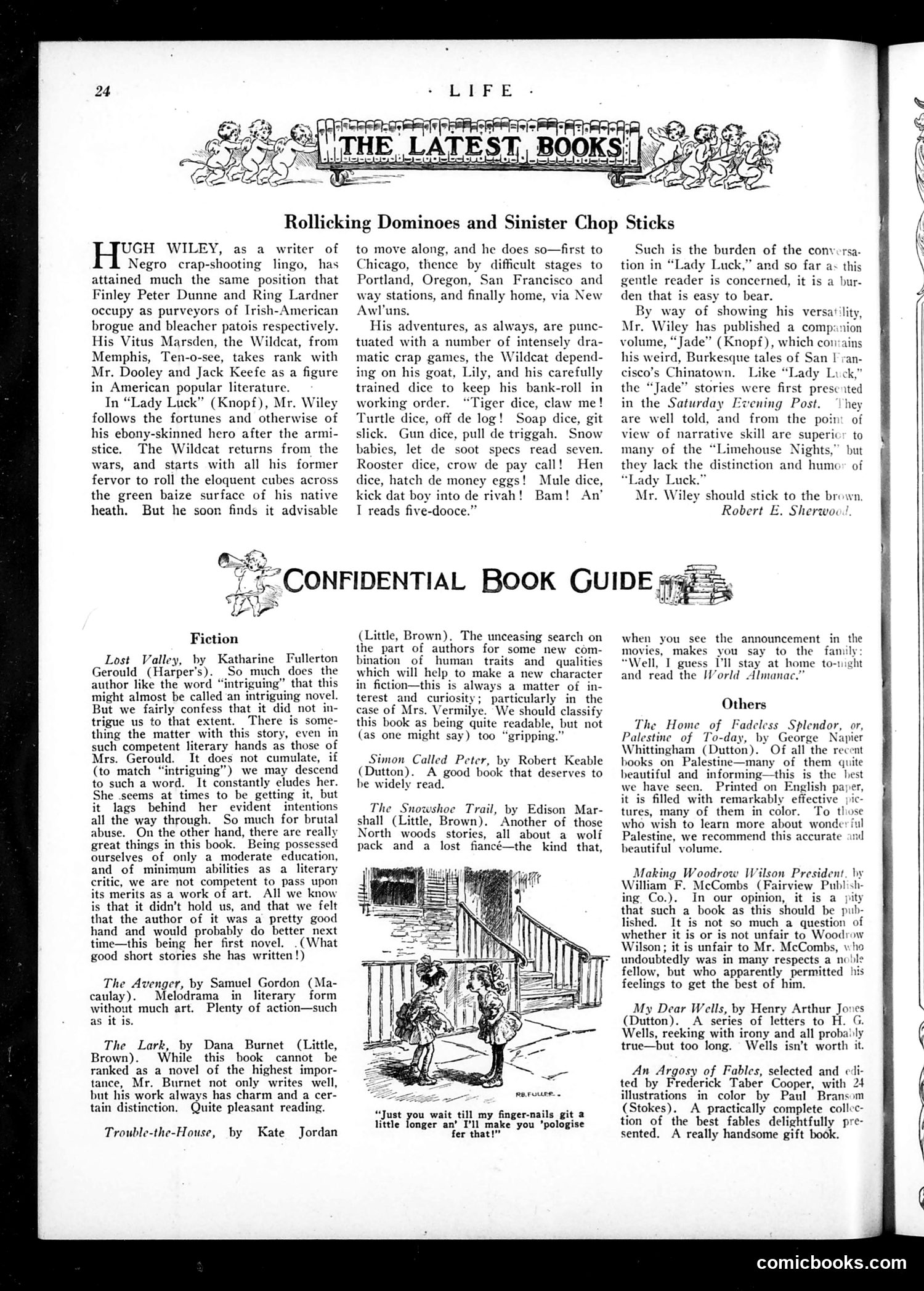
This page is primarily a **book review section** titled "The Latest Books" and "Confidential Book Guide," not a political cartoon. The main feature reviews Hugh Wiley's novel *"Lady Luck,"* featuring his popular character the Wildcat—a Black protagonist from Memphis known for crap-shooting (gambling with dice). The review notes Wiley's reputation for authentically rendering African American dialect and culture, comparing him to Irish-American writers like Finley Peter Dunne. The small illustration at bottom shows two figures in what appears to be a domestic dispute over fingernails—likely humorous, matching the satirical tone of *Life* magazine. The page reflects **early 20th-century literary attitudes**: Wiley's work is praised for entertaining racial stereotypes presented as authentic cultural documentation. Modern readers should recognize this reflects period assumptions about race, dialect representation, and entertainment that would be considered offensive today.
This is **not a cartoon or satire page** — it's a straightforward advertisement for Phoenix Hosiery, a sock/stocking brand. The page appears in *Life* magazine (page 25) as a paid advertisement. The ad uses period-typical marketing rhetoric, claiming Phoenix hosiery offers exceptional value and quality. It promises "downright worth," durability ("hosiery mileage"), and elegance for the entire family. The ornamental border is typical of early 20th-century advertising design. There is no political commentary, caricature, or satirical content visible. This is commercial advertising presented as a full-page insert in what was then a magazine mixing humor, commentary, and advertisements.
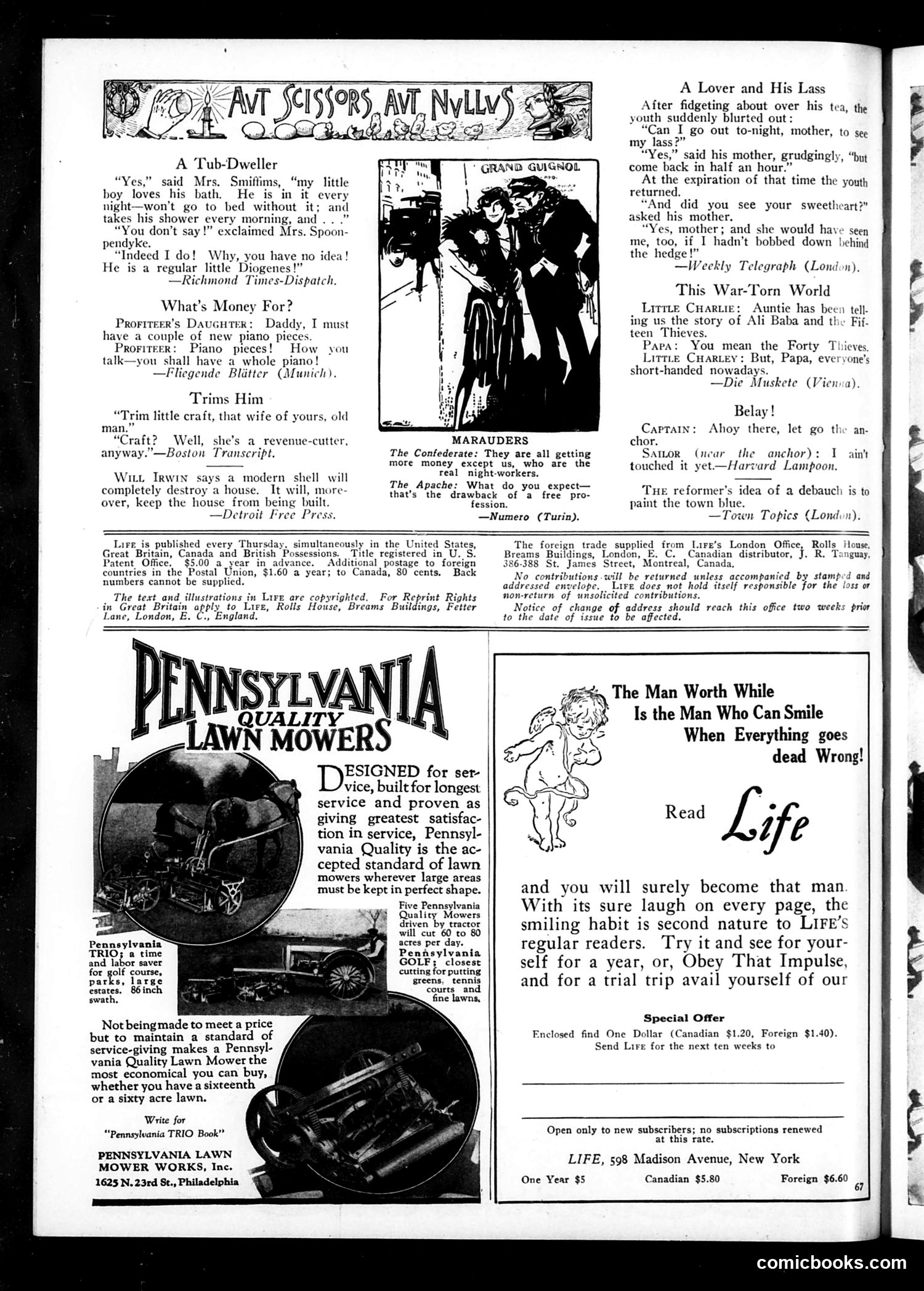
This page consists primarily of **short satirical jokes and advertisements** rather than political cartoons. The jokes mock contemporary social types and situations: a mother bragging about her child's bathing habits (referencing Diogenes' asceticism), a war profiteer's extravagant daughter, a wife who "trims" her husband's spending, and military/naval mishaps. One notable piece references **WWI-era confusion**—a child misremembering "Ali Baba and the Forty Thieves" (possibly as "Fifteen"), which the father attributes to wartime distortion of everyday facts. A recurring theme is **wartime disruption**: one joke notes modern shells destroy houses and prevent their reconstruction. Another satirizes criminals (confederates and apaches) complaining their "free profession" earns less than other night-workers. The page includes a **Pennsylvania Quality Lawn Mowers advertisement**, marketing their efficiency for large estates and golf courses. Overall, this reflects Life's typical early-20th-century format: lightweight humor targeting middle-class concerns, domestic situations, and occasional WWI references.
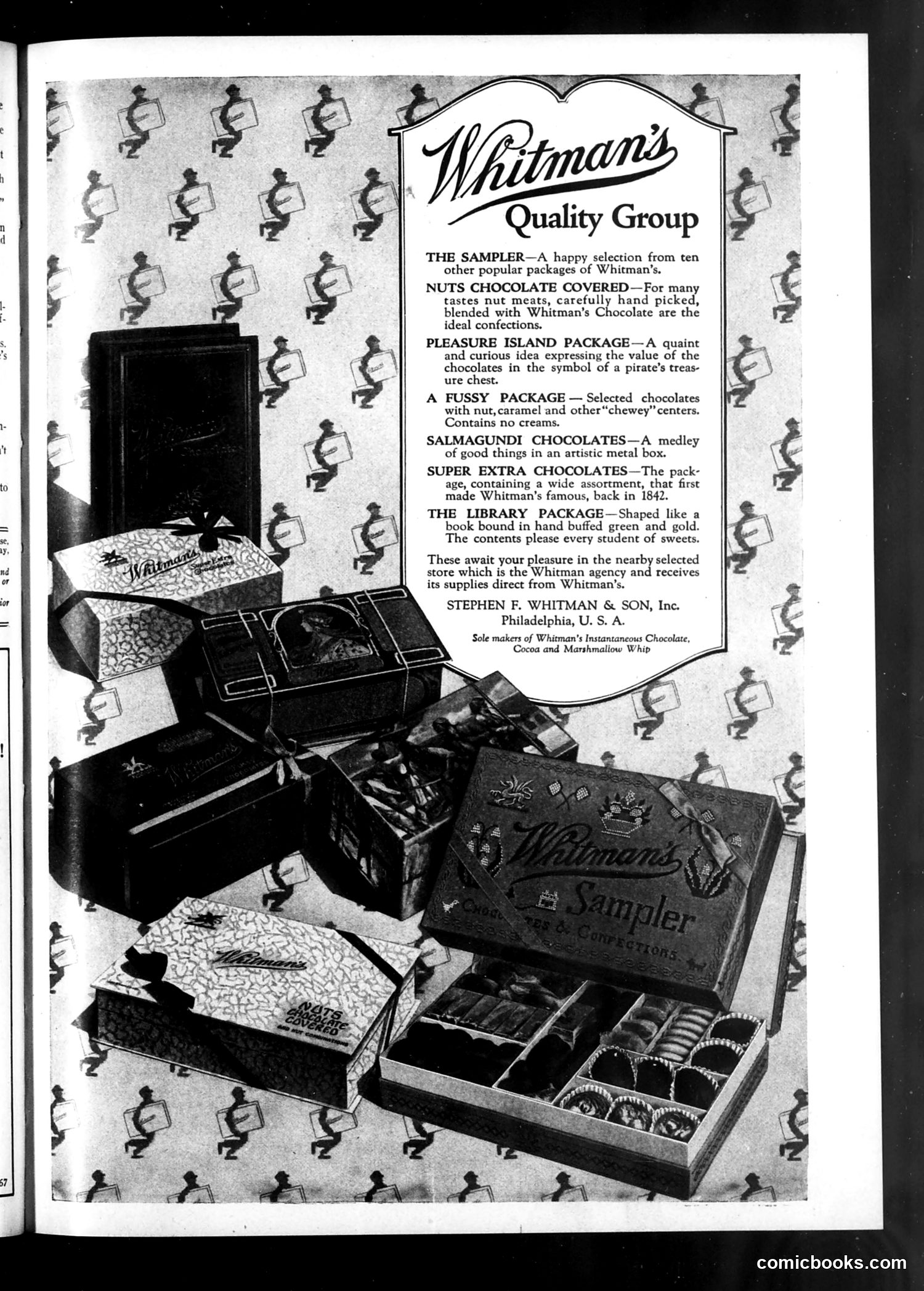
This is a full-page advertisement for Whitman's chocolates, not a political cartoon. The page displays various decorative chocolate boxes and packages arranged as product photography, with a repeating decorative pattern of small figures in the background. The ad describes Whitman's "Quality Group"—seven different chocolate assortments with themed packaging, including "Pleasure Island Package" (designed like a pirate's treasure chest), "The Library Package" (shaped like a book), and others featuring nuts, caramels, and various centers. The company emphasizes that their products are available at authorized Whitman agency stores. This represents typical early-20th-century magazine advertising, showcasing luxury confectionery as gift items. The ornate packaging designs and variety of options suggest chocolates were premium products marketed to middle and upper-class consumers. There is no satire or political content on this page—it is purely commercial promotion.
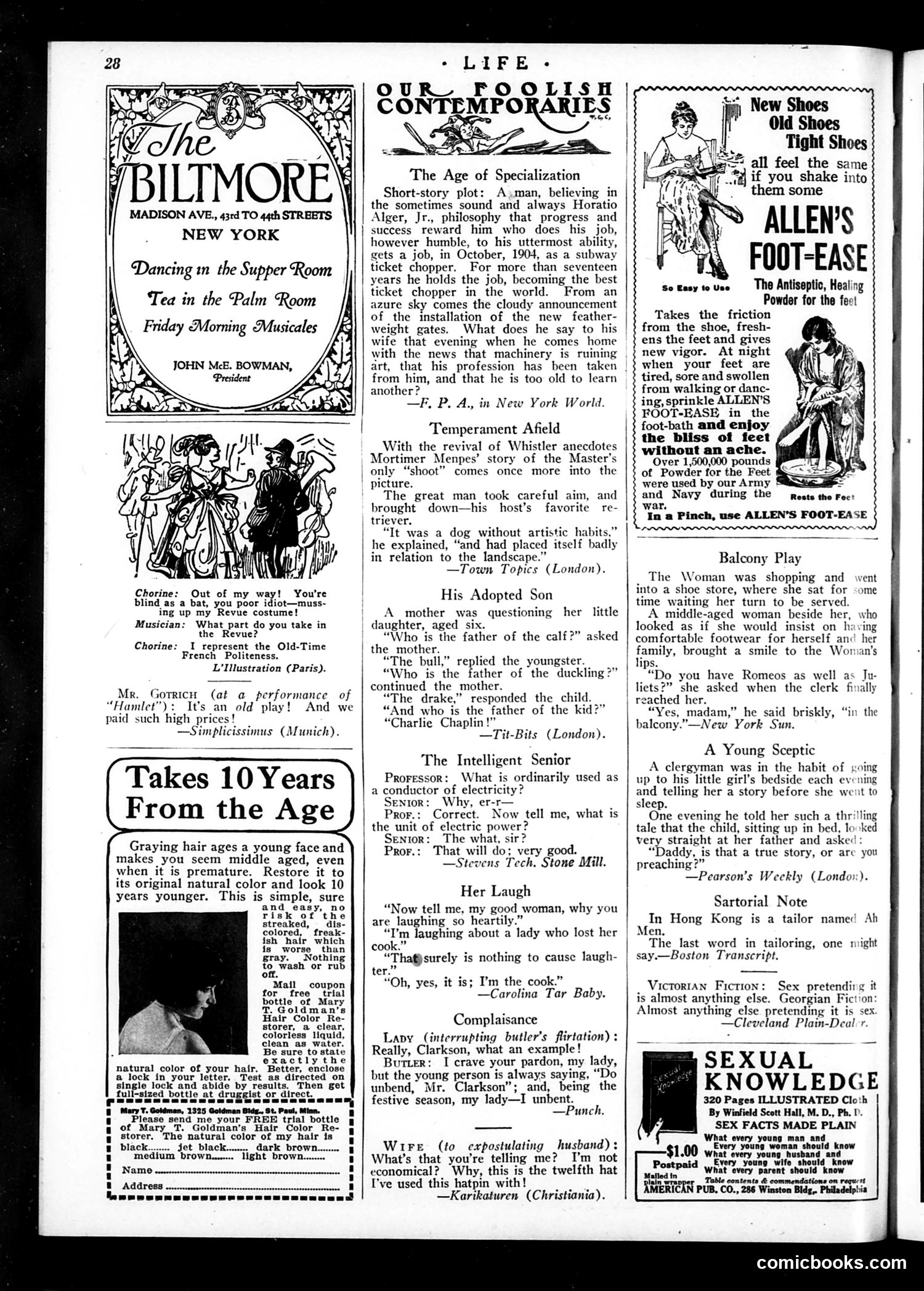
This page from *Life* magazine contains several satirical cartoons and humorous anecdotes typical of early 20th-century American humor: **The main cartoon** shows a chorus girl telling a musician she "represents the Old-Time French Politeness"—satirizing the pretension of stage performers who adopt affected sophistication while behaving rudely backstage. **Other jokes mock**: - Theatergoers complaining about "old plays" despite paying high prices - A man so specialized in one job (subway ticket collector) that he cannot adapt when machinery replaces him - Urban sophistication and manners (Whistler anecdotes, butler behavior) - Class dynamics and servant-employer relationships The page also includes advertisements for hair restoration and foot powder, typical period products. The humor relies on observational comedy about social pretension, occupational specialization, and class behavior—concerns relevant to industrial-era American society.
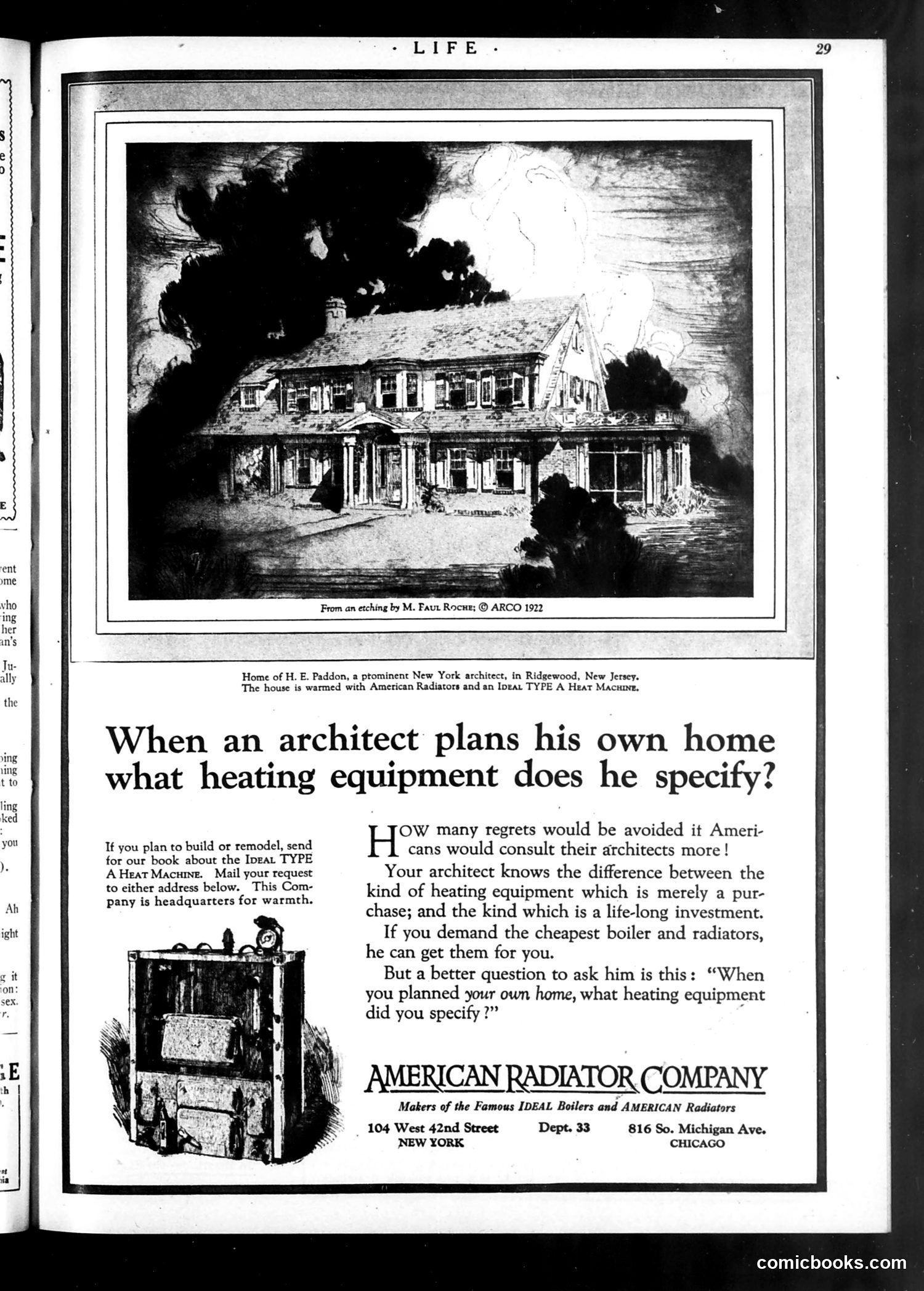
This is primarily a **1922 advertisement**, not satirical content. The page features an etching of architect H.E. Paddon's home in New Jersey and promotes American Radiator Company's heating equipment. The "satire" is subtle advertising strategy: the ad asks readers a rhetorical question—what heating equipment would *an architect* choose for his own home? The implied answer: American Radiators, because architects know quality matters beyond initial cost. The underlying message appeals to aspirational consumers: trust expert judgment over cheap alternatives. By showcasing a prominent New York architect's choice, the company suggests that buying their product aligns you with professional taste and long-term value rather than penny-pinching. The accompanying boiler illustration emphasizes the product's substance and reliability. This represents early-20th-century consumer advertising's shift toward authority endorsement and lifestyle association rather than mere product description.
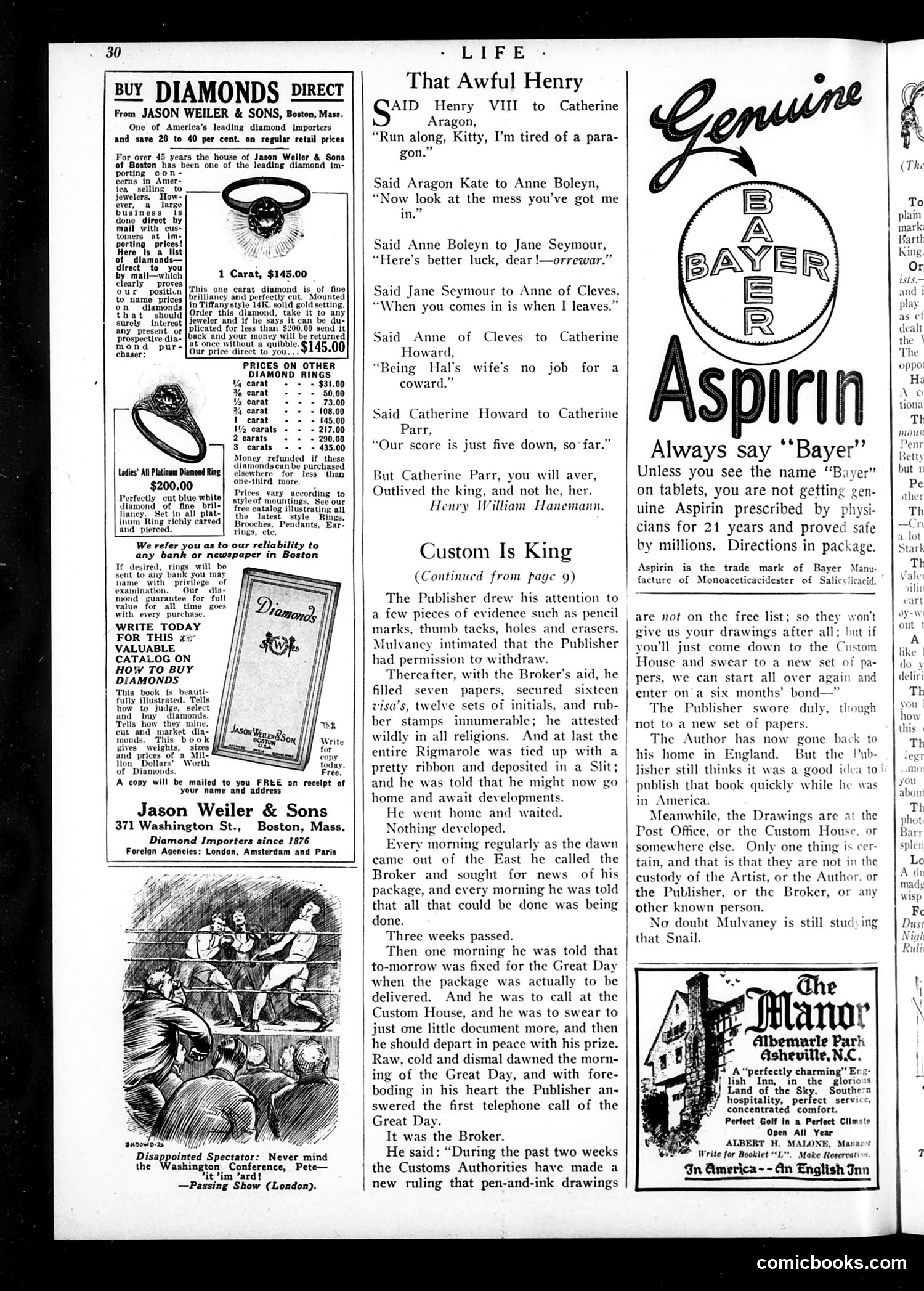
This page contains **mostly advertising** interspersed with satirical content. The main editorial piece is "That Awful Henry," a humorous poem about King Henry VIII and his six wives, presented as a chain of gossip where each wife complains to the next about their predicament. The joke relies on period knowledge—readers recognizing the historical tragedy of Henry's marriages as comedy through the wives' casual complaints ("Being Hal's wife's no job for a coward"). The cartoon at bottom left, captioned "Disappointed Spectator," references the Washington Conference (likely the 1921-1922 naval limitation talks), with a London publication's joke about someone unimpressed by diplomatic news, preferring entertainment. The bulk of the page features **diamond ring advertisements** from Jason Weiler & Sons, a Boston importer emphasizing direct mail sales at discounted prices—typical early 20th-century retail marketing.
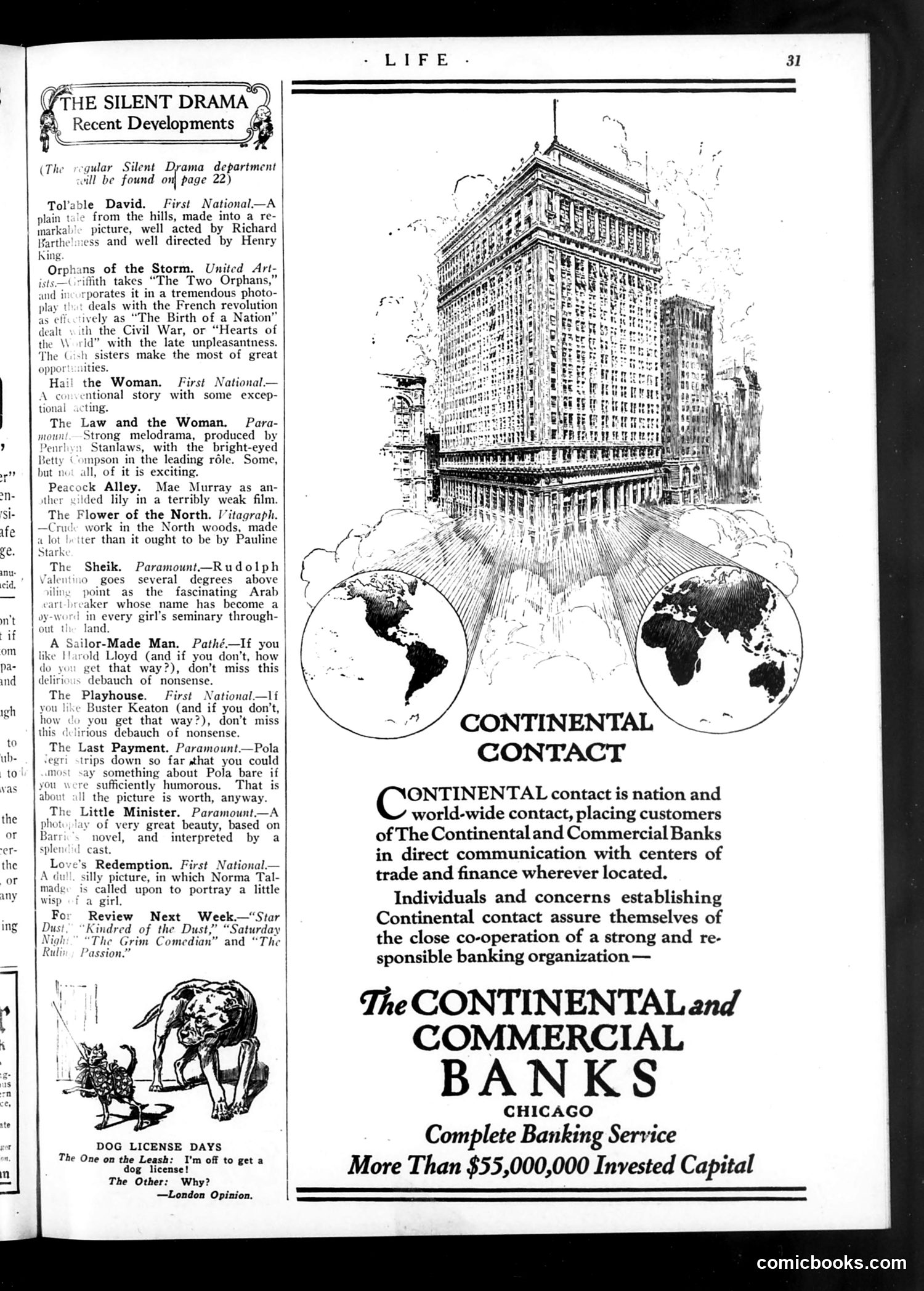
This page from *Life* magazine contains two distinct elements: **The Silent Drama Section** reviews contemporary films (likely early 1920s based on references to Rudolph Valentino and Buster Keaton). The reviews are brief, witty critiques of popular silent movies, using sarcastic language—calling some "delirious debauch of nonsense" and noting that certain films are only worthwhile if you like their stars. **The Small Cartoon** at bottom left shows a dog-licensing joke: one dog asks another why he's getting a licensed, and the reply is simply "Why?"—playing on the absurdity of bureaucratic requirements. It's attributed to *London Opinion*. **The Main Content** is a large advertisement for The Continental and Commercial Banks of Chicago, emphasizing their international banking reach and $55 million in invested capital—typical corporate advertising of the era. The page is primarily entertainment and advertising rather than political commentary.
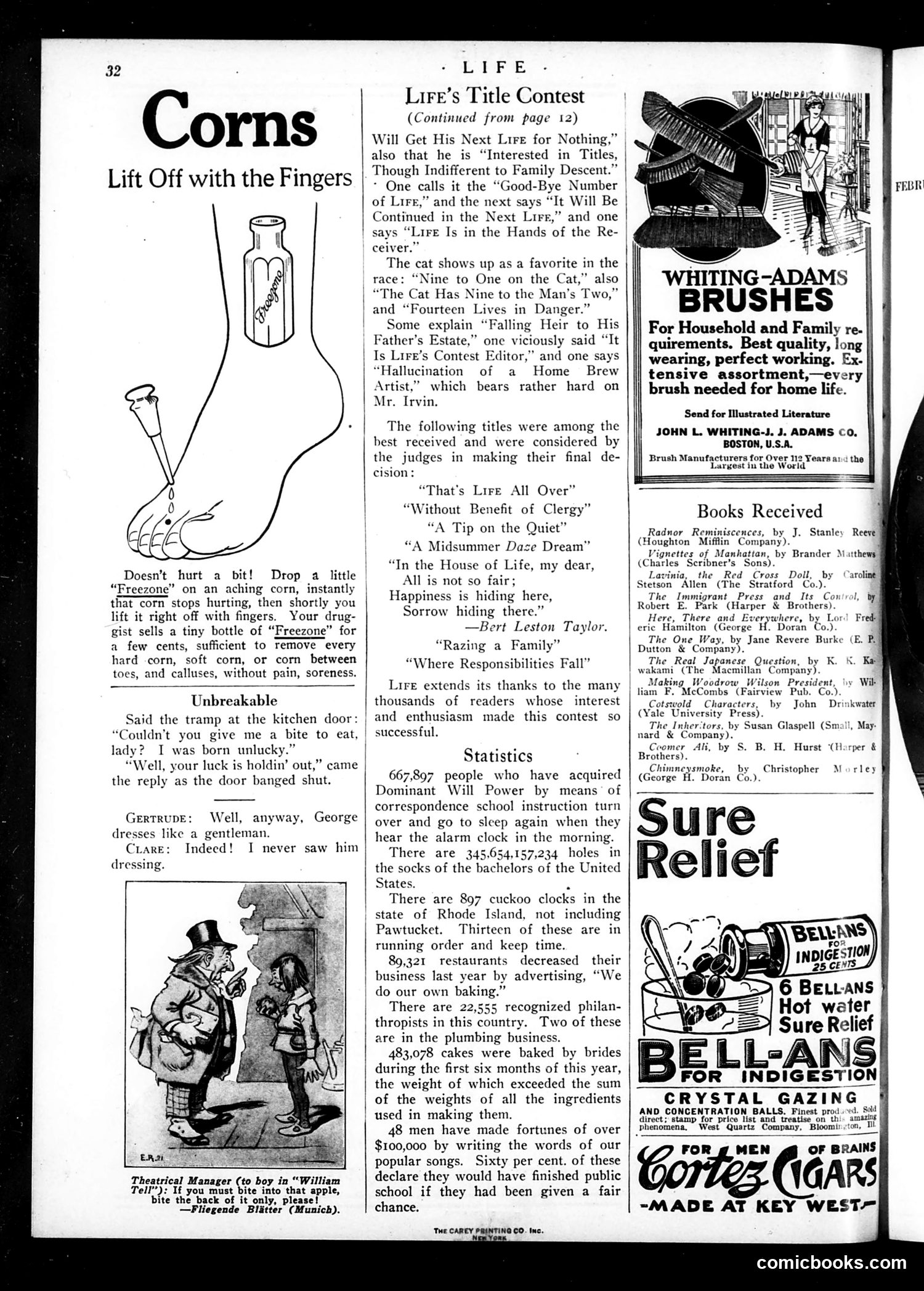
This page from *Life* magazine contains humor, advertisements, and editorial content typical of the early 20th century. The **cartoons and jokes** are light, domestic humor: a tramp applying for food gets rejected ("your luck is holding out" as a door slams); observations on gentlemen's dress; and a theatrical manager concerned about apple-biting accidents during a *William Tell* performance. The **main editorial feature** is *Life's* title-contest results. The magazine apparently solicited reader submissions for a funny caption to an illustration (a figure with a hat, unclear in reproduction). The contest attracted nearly 668,000 entries. Examples include clever wordplay: "Without Benefit of Clergy," "A Midsummer Daze Dream." The **statistics section** is satirical mock-data lampooning contemporary trends—correspondence schools, bachelor slovenliness, mediocre restaurants, and the financial success of songwriters. This reflects *Life's* satirical mission, gently mocking American society. **Advertisements** for corn removal, brushes, and indigestion remedies occupy the remaining space, typical commercial clutter of the era.