
Life, 1922-02-09 · page 17 of 34
Life — February 9, 1922 — page 17: what you’re looking at
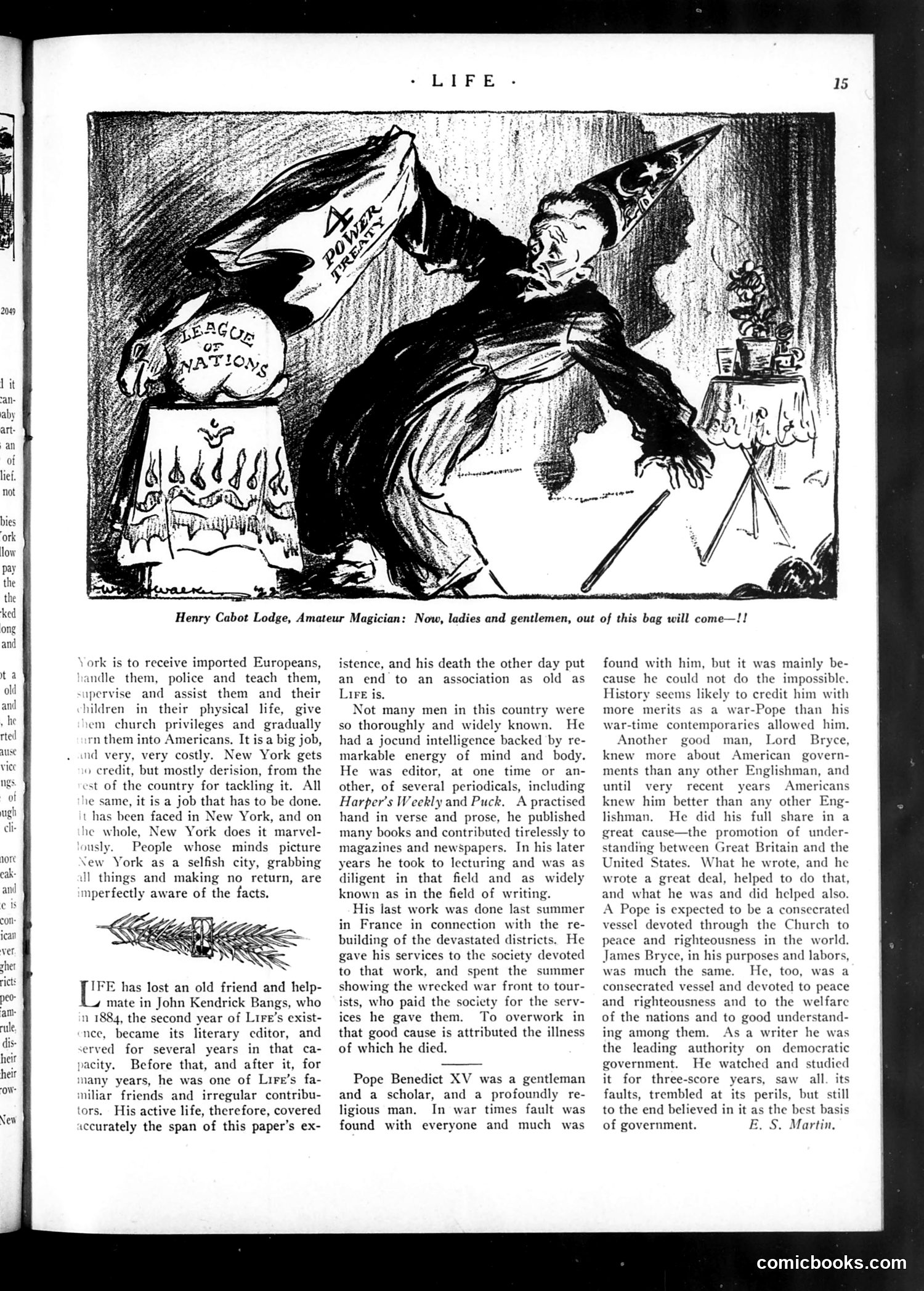
What you’re looking at
This cartoon satirizes **Henry Cabot Lodge**, a prominent U.S. Senator and diplomat, depicting him as a stage magician attempting an impossible trick. The "bag" labeled "League of Nations" sits atop a pedestal marked with flames, while Lodge gestures dramatically, promising to produce something from it. The satire references Lodge's opposition to the **League of Nations** following World War I. As a leading Republican isolationist, Lodge blocked American entry into the organization despite President Wilson's support. The cartoon mocks his political sleight-of-hand—his apparent inability or unwillingness to deliver on international cooperation while maintaining the illusion of effort. The page also contains obituaries for John Kendrick Bangs (Life's former literary editor), Pope Benedict XV, and Lord Bryce—figures who, unlike Lodge, apparently worked toward international understanding and peace during and after the war.
📄 Transcribed text from this page (OCR, searchable)
Machine-transcribed from the original scan — historical spelling and the odd misread are preserved.
Henry Cabot Lodge, Amateur Magician: Now, ladies and gentlemen, out of this bag will come—!! ork is to receive imported Europeans, iundle them, police and teach them, supervise and assist them and _ their hildren in their physical life, give em church privileges and gradually rn them into Americans. It is a big job, id very, very costly. New York gets » credit, but mostly derision, from the st of the country for tackling it. All ie same, it is a job that has to be done. t has been faced in New York, and on ie whole, New York does it marvel- vusly. People whose minds picture New York as a selfish city, grabbing Jl things and making no return, are nperfectly aware of the facts. ee has lost an old friend and help- mate in John Kendrick Bangs, who n 1884, the second year of Lire’s exist- nee, became its literary editor, and erved for several years in that ca- acity. Before that, and after it, for many years, he was one of Lire’s fa- iiliar friends and irregular contribu- tors. His active life, therefore, covered xccurately the span of this paper’s ex- istence, and his death the other day put an end to an association as old as Lire is. Not many men in this country were so thoroughly and widely known. He had a jocund intelligence backed by re- markable energy of mind and body. He was editor, at one time or an- other, of several periodicals, including Harper’s Weekly and Puck. A practised hand in verse and prose, he published many books and contributed tirelessly to magazines and newspapers. In his later years he took to lecturing and was as diligent in that field and as widely known as in the field of writing. His last work was done last summer in France in connection with the re- building of the devastated districts. He gave his services to the society devoted to that work, and spent the summer showing the wrecked war front to tour- who paid the society for the serv- ices he gave them. To overwork in that good cause is attributed the illness of which he died. Pope Benedict XV was a gentleman and a scholar, and a profoundly re- ligious man, In war times fault was found with everyone and much was found with him, but it was mainly be- cause he could not do the impossible. History seems likely to credit him with more merits as a war-Pope than his war-time contemporaries allowed him. Another good man, Lord Bryce, knew more about American govern- ments than any other Englishman, and until very recent years Americans knew him better than any other Eng- lishman. He did his full share in a great cause—the promotion of under- standing between Great Britain and the United States. What he wrote, and he wrote a great deal, helped to do that, and what he was and did helped also. A Pope is expected to be a consecrated vessel devoted through the Church to peace and righteousness in the world. James Bryce, in his purposes and labors, was much the same. He, too, was a consecrated vessel and devoted to peace and righteousness and to the welfare of the nations and to good understand- ing among them. As a writer he was the leading authority on democratic government. He watched and studied it for three-score years, saw all. its faults, trembled at its perils, but still to the end believed in it as the best basis of government. E. S. Martin. comicbooks.com