
Life, 1922-02-09 · page 8 of 34
Life — February 9, 1922 — page 8: what you’re looking at
What you’re looking at
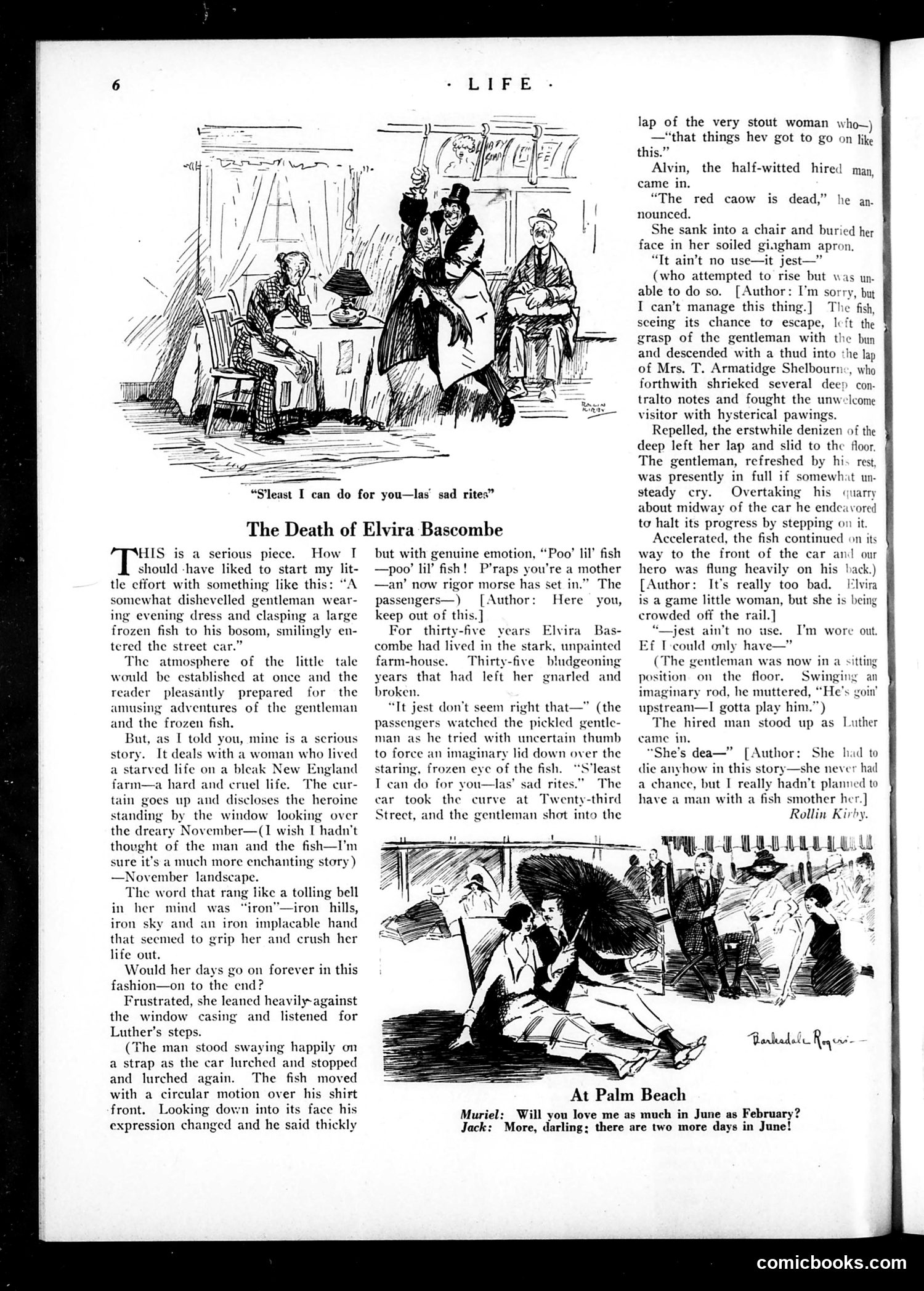
This page presents a satirical short story with accompanying illustrations. The narrative mocks Victorian sentimentality by depicting a gentleman's attempt to comfort a distraught woman over her dead pet fish. The story emphasizes the absurdity of the situation—a woman in genuine emotional distress over a frozen fish, which the author treats as both pathetic and deserving of ridicule. The satirical point targets upper-class affectation: the woman's exaggerated grief over something trivial contrasts sharply with her apparent indifference to actual human suffering. The gentleman's awkward attempts at consolation underscore the social awkwardness created by her disproportionate emotion. The cartoon's humor relies on mocking both feminine hysteria and the pretensions of polite society.
📄 Transcribed text from this page (OCR, searchable)
Machine-transcribed from the original scan — historical spelling and the odd misread are preserved.
“S'least I can do for you—las’ sad rites” The Death of Elvira Bascombe HIS is a serious piece. How IT hould -have liked to start my lit- tle effort with something like this: “A somewhat dishevelled gentleman wear- ing evening dress and clasping a large frozen fish to his b tered the street car.” The atmosphere of the little tale would be established at once and the reader pleasantly prepared for the amusing adventures of the gentleman and the frozen fish. But, as I told you, mine is a serious story. It deals with a woman who lived arved life on a bleak New England ard and cruel The cur- up and discloses the heroine by the window looking over the dreary November—(1 wish I hadn't thought of the man and the fish—I’m sure it’s a much more enchanting story) —November landscape. The word that rang like a tolling bell in her mind was “iron”—iron hills, iron sky and an iron implacable hand that seemed to grip her and crush her life out. Would her days go on forever in this fashion—on to the end? Frustrated, she leaned heavily-against the window casing and listened for Luther’s steps. (The man stood swaying happily on a strap as the car lurched and stopped and lurched again. The fish moved with a circular motion over his shirt front. Looking down into its face his expression changed and he said thickly som, sinilingly en- but with genuine emotion, ‘Poo’ lil’ fish —poo’ lil’ fish! P’raps you're a mother —an’ now rigor morse has set in.” The passengers—) [Author: Here you, keep out of thi For thirty-five years Elvira Bas- combe had lived in the stark, unpainted farm-house. Thirty-five bludgeoning years that had left her gnarled and broken. “It jest don’t seem right that—" (the passengers watched the pickled gentle- man as he tried with uncertain thumb to force an imaginary lid down over the staring, frozen eye of the fish. “S'least IT can do for you—las’ sad rites.” The car took the curve at Twenty-third Strect, and the gentleman shot into the lap of the very stout woman who-) —‘that things hev got to go on like this.” Alvin, came in. “The red caow is dead,” he an. nounced. She sank into a chair and buried her face in her soiled giagham apron, “Tt ain’t no use—it jest—” (who attempted to rise but was un- able to do so. [Author: I’m sorry, but I can’t manage this thing.] T seeing its chance to escape, | grasp of the gentleman with the bun and descended with a thud into the lap of Mrs, T. Armatidge Shelbourne, who forthwith shrieked several deep con- tralto notes and fought the unwelcome visitor with hysterical pawings. Repelled, the erstwhile denizen of the deep left her lap and slid to the floor, The gentleman, refreshed by his rest was presently in full if somewhat un- steady cry. Overtaking his quarry about midway of the car he endeavored to halt its progress by stepping on it. Accelerated, the fish continued on its way to the front of the car ani our hero was flung heavily on his back.) {Author: It’s really too bad. ra is a game little woman, but she is being crowded off the rail.] “—jest ain't no use. Ef T-could only have—” (The gentleman was now in a sitting position on the floor, Swinging an imaginary rod, he muttered, “He’s goin’ upstream—lI gotta play him.”) The hired man stood up as Luther came in. “She's dea—” [Author: She had to die anyhow in this story—she never had a chance, but I really hadn’t planned to have a man with a fish smother her.] Rollin Kirby. the half-witted hired man, I’m wore out. At Palm Beach Muriel: Will you love me as much in June as February? Jack: More, darling: there are two more days in June! comicbooks.com