
Life, 1922-02-09 · page 26 of 34
Life — February 9, 1922 — page 26: what you’re looking at
What you’re looking at
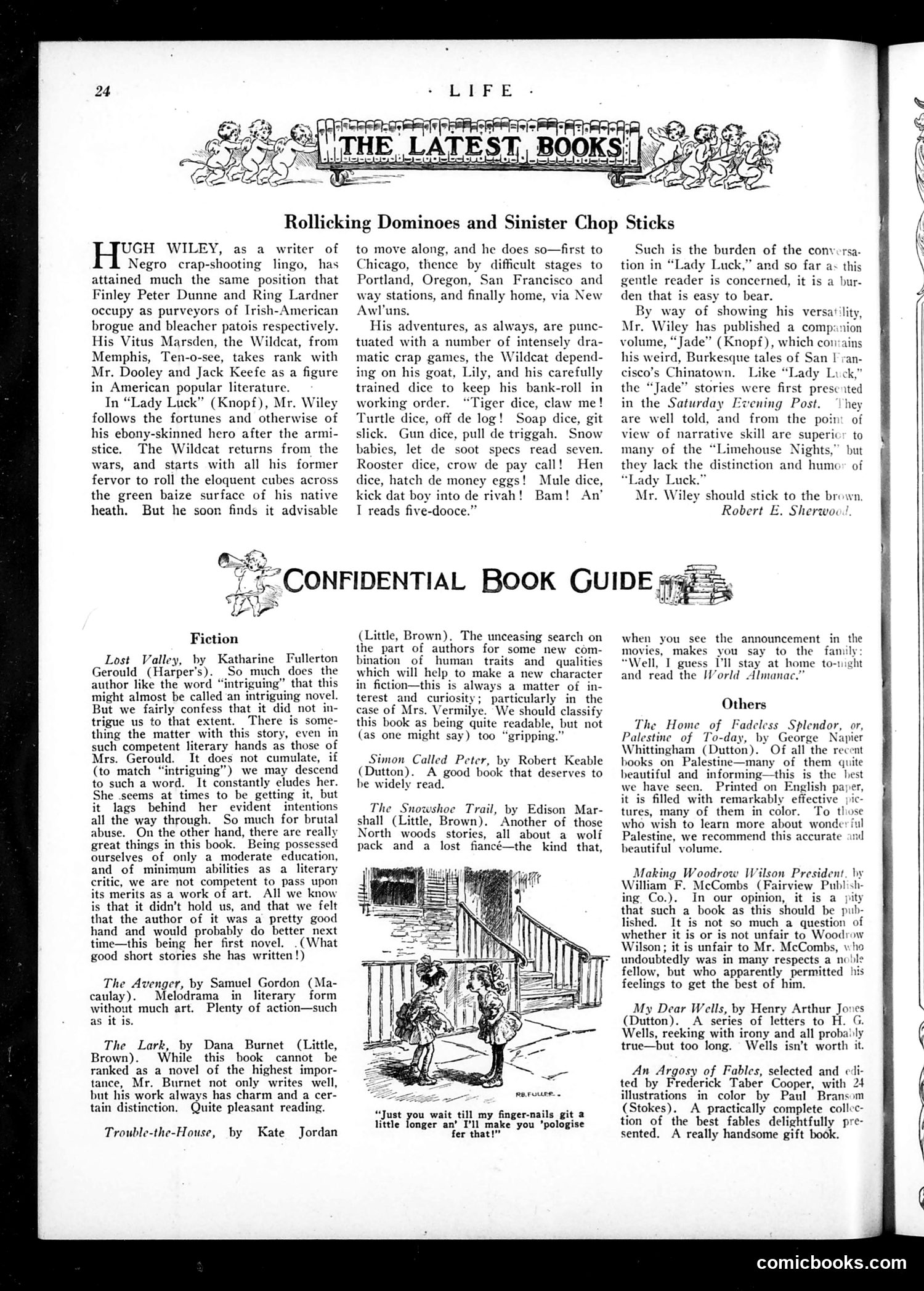
This page is primarily a **book review section** titled "The Latest Books" and "Confidential Book Guide," not a political cartoon. The main feature reviews Hugh Wiley's novel *"Lady Luck,"* featuring his popular character the Wildcat—a Black protagonist from Memphis known for crap-shooting (gambling with dice). The review notes Wiley's reputation for authentically rendering African American dialect and culture, comparing him to Irish-American writers like Finley Peter Dunne. The small illustration at bottom shows two figures in what appears to be a domestic dispute over fingernails—likely humorous, matching the satirical tone of *Life* magazine. The page reflects **early 20th-century literary attitudes**: Wiley's work is praised for entertaining racial stereotypes presented as authentic cultural documentation. Modern readers should recognize this reflects period assumptions about race, dialect representation, and entertainment that would be considered offensive today.
📄 Transcribed text from this page (OCR, searchable)
Machine-transcribed from the original scan — historical spelling and the odd misread are preserved.
Rollicking Dominoes and Sinister Chop Sticks UGH WILEY, as a writer of Negro crap-shooting lingo, has attained much the same position that Finley Peter Dunne and Ring Lardner occupy as purveyors of Irish-American brogue and bleacher patois respectively. His Vitus Marsden, the Wildcat, from Memphis, Ten-o-see, takes rank with Mr. Dooley and Jack Keefe as a figure in American popular literature. In “Lady Luck” (Knopf), Mr. Wiley follows the fortunes and otherwise of his ebony-skinned hero after the armi- stice. The Wildcat returns from the wars, and starts with all his former fervor to roll the eloquent cubes across the green baize surface of his native heath. But he soon finds it advisable eae Be Fiction Lost Valley, by Katharine Fullerton Gerould (Harper's). So much does the author like the word “ “intriguing” that this might almost be called an intriguing novel. But we fairly confess that it did not in- trigue us to that extent. There is some- thing the matter with this story, even in such competent literary hands as those of Mrs. Gerould. It does not cumulate, if (to match “intriguing”) we may descend to such a word. It constantly eludes her. She .seems at times to be getting it, but it lags behind her evident intentions all the way through. So much for brutal abuse. On the other hand, there are really great things in this book. Being possessed ourselves of only a moderate education, and of minimum abilities as a literary critic, we are not competent to pass upon its merits as a work of art. All we know is that it didn’t hold us, and that we felt that the author of it was a pretty good hand and would probably do better next time—this being her first novel. .(What good short stories she has written!) The Avenger, by Samuel Gordon (Ma- caulay). Melodrama in literary form without much art. Plenty of action—such as it is. The Lark, by Dana Burnet (Little, Brown). While this book cannot be ranked as a novel of the highest impor- tance, Mr. Burnet not only writes well, but his work always has charm and a cer- tain distinction. Quite pleasant reading. Trouble-the-House, by Kate Jordan to move along, and he does so—first to Chicago, thence by difficult stages to Portland, Oregon, San Francisco and way stations, and finally home, via New Awl'uns. His adventures, as always, are punc- tuated with a number of intensely dra- matic crap games, the Wildcat depend- ing on his goat, Lily, and his carefully trained dice to keep his bank-roll in working order. “Tiger dice, claw me! Turtle dice, off de log! Soap dice, git slick. Gun dice, pull de triggah. Snow babies, let de soot specs read seven. Rooster dice, crow de pay call! Hen dice, hatch de money eggs! Mule dice, kick dat boy into de rivah! Bam! An’ I reads five-dooce.” (Little, Brown). The unceasing search on the part of authors for some new com- bination of human traits and qualities which will help to make a new character in fiction—this is always a matter of in- terest and curios’ particularly in the case of Mrs. Vermilye. We should classify this book as being quite readable, but not (as one might say) too “gripping.” Simon Called Peter, by Robert Keable (Dutton). A good book that deserves to he widely read. The Snowshoe Trail, by Edison Mar- shall (Little, Brown). Another of those North woods stories, all about a wolf pack and a lost fiancé—the kind that, Reroure . “Just you wait till my finger-nails git a little longer an’ I’ll make you 'pologise fer that!” Such is the burden of the cony tion in “Lady Luck,” and so far as gentle reader is concerned, it is a den that is easy to bear. By way of showing his versat Mr. Wiley has published a companion volume, “ “Jade” (Knopf), which con:ains his weird, Burkesque tales of San | ran cisco’s Chinatown. Like “Lady Luck,” the “Jade” stories were first presented in the Saturday Evening Post. ‘Vhey are well told, and from the poin: of view of narrative skill are supericr to many of the “Limehouse Nights,” but they lack the distinction and humo» of “Lady Luck.” Mr. Wiley should stick to the brown. Robert E. Sherwoo.! CONFIDENTIAL BOOK GUIDE ggi2s, when you see the announcement in the movies, makes you say to the family “Well, I guess I'll stay at home to-night and read the World Almanac.” Others The, Home of Fadeless Splendor, or, Palestine of To-day, by George Napier Whittingham (Dutton). Of all the recent hooks on Palestine—many of them quite beautiful and informing—this is the hest we have seen. Printed on English paper, it is filled with remarkably effective pic- tures, many of them in color. To those who wish to learn more about wonder itl Palestine, we recommend this accurate and beautiful volume. Making Woodrow Wilson President. by William F. McCombs (Fairview Pub! ing Co.). In our opinion, it is a that such a book as this should be pub- lished. It is not so much a question of whether it is or is not unfair to Woodrow Wilson ; it is unfair to Mr. McCombs, who undoubtedly was in many respects a no)! fellow, but who apparently permitted feelings to get the best of him. My Dear Wells, by Henry Arthur Jones (Dutton). A series of letters to H. G. Wells, reeking with irony and all proba!ily true—but too long. Wells isn’t worth it. An Argosy of Fables, selected and edi- ted by Frederick Taber Cooper, with 24 illustrations in color by Paul Bransom (Stokes). A practically complete collec- tion of the best fables delightfully pre- sented. A really handsome gift book. comicbooks.com