
Life, 1922-02-09 · page 20 of 34
Life — February 9, 1922 — page 20: what you’re looking at
What you’re looking at
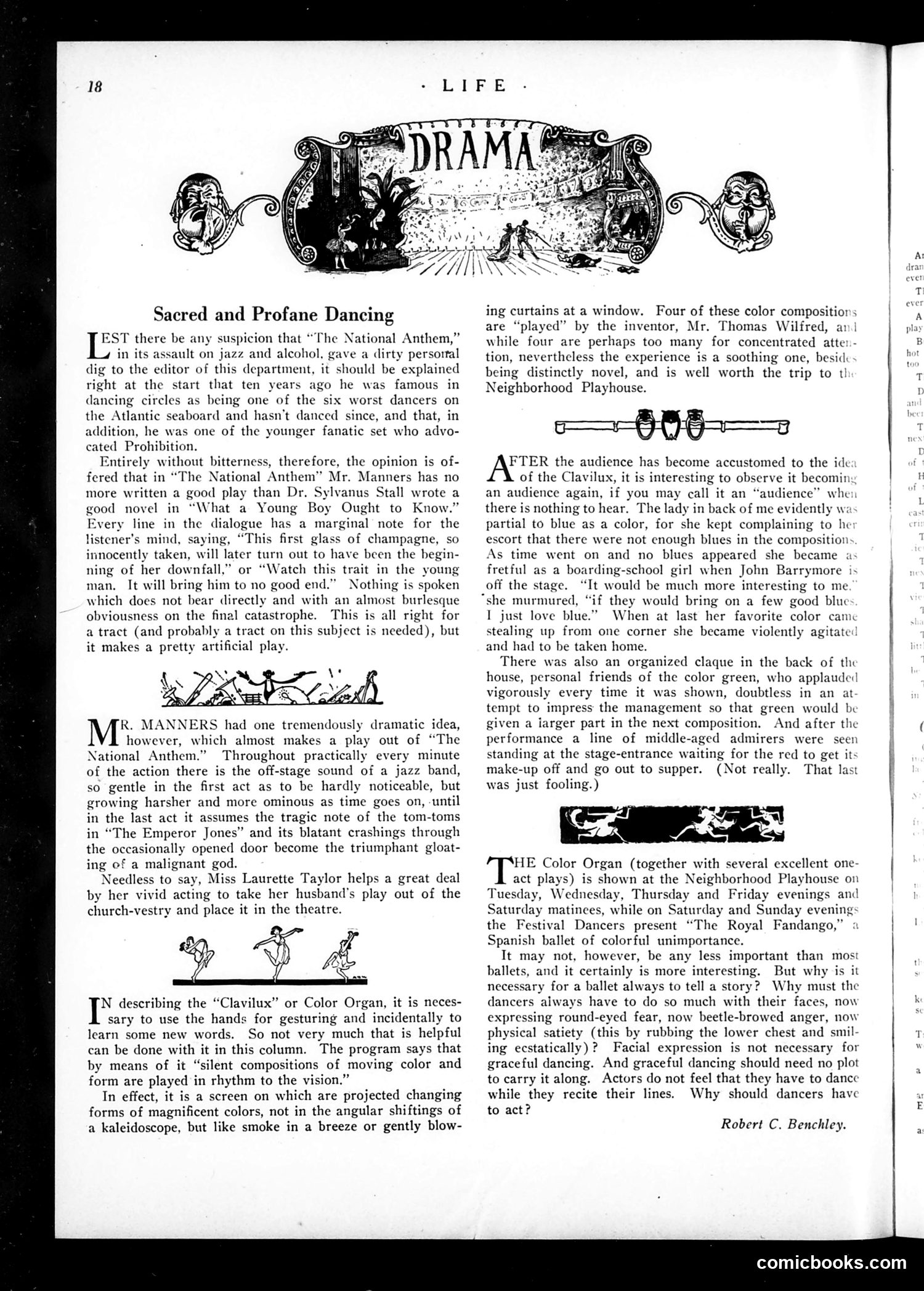
This drama review critiques Mr. Manners's play "The National Anthem," which uses heavy-handed moral messaging about alcohol and jazz to depict social decay. The reviewer argues the play functions more as a temperance tract than genuine drama—every dialogue line points obviously toward catastrophe, particularly the off-stage jazz band that grows increasingly ominous, symbolizing moral corruption. The author also praises actress Laurette Taylor for elevating the material, and separately reviews the "Clavilux" or Color Organ—an experimental light-projection device by inventor Thomas Wilfred shown at the Neighborhood Playhouse. The review humorously describes an audience member so emotionally invested in seeing blue colors that she had to be taken home when her favorite hue finally appeared. The piece reflects 1920s anxieties about jazz, modernity, and prohibition-era morality debates.
📄 Transcribed text from this page (OCR, searchable)
Machine-transcribed from the original scan — historical spelling and the odd misread are preserved.
Sacred and Profane Dancing [LE T there be any suspicion that “The National Anthem,” in its assault on jazz and alcohol, gave a dirty persortal dig to the editor of this department, it should be explained right at the start that ten years ago he was famous in dancing circles as being one of the six worst dancers on the Atlantic seaboard and hasn't danced since, and that, in addition, he was one of the younger fanatic set who advo- cated Prohibition. Entirely without bitterness, therefore, the opinion is of- fered that in “The National Anthem” Mr. Manners has no more written a good play than Dr. Sylvanus Stall wrote a good novel in “What a Young Boy Ought to Know.” Every line in the dialogue has a marginal note for the listener’s mind, saying, “This first glass of champagne, so innocently taken, will later turn out to have been the begin- ning of her downfall,” or “Watch this trait in the young man. It will bring him to no good end.” Nothing is spoken which does not bear directly and with an almost burlesque obviousness on the final catastrophe. This all right for a tract (and probably a tract on this subject is needed), but it makes a pretty artificial play. R. MANNERS had one tremendously dramatic idea, however, which almost makes a play out of “The National Anthem.” Throughout practically every minute of the action there is the off-stage sound of a jazz band, so gentle in the first act as to be hardly noticeable, but growing harsher and more ominous as time goes on, until in the last act it assumes the tragic note of the tom-toms in “The Emperor Jones” and its blatant crashings through the occasionally opened door become the triumphant gloat- ing of a malignant god. Needless to say, Miss Laurette Taylor helps a great deal by her vivid acting to take her husband’s play out of the church-vestry and place it in the theatre. N describing the “Clavilux” or Color Organ, it is neces- sary to use the hands for gesturing and incidentally to learn some new words. So not very much that is helpful can be done with it in this column. The program says that by means of it “silent compositions of moving color and form are played in rhythm to the vision.” In effect, it is a screen on which are projected changing forms of magnificent colors, not in the angular shiftings of a kaleidoscope, but like smoke in a breeze or gently blow- ing curtains at a window. Four of these color compositions are “played” by the inventor, Mr. Thomas Wilfred, while four are perhaps too many for concentrated atten- tion, nevertheless the experience is a soothing one, besick being distinctly novel, and is well worth the trip to t! Neighborhood Playhouse. SG FTER the audience has become accustomed to the ide of the Clavilux, it is interesting to observe it becominy an audience again, if you may call it an “audience” whe there is nothing to hear. The lady in back of me evidently w: partial to blue as a color, for she kept complaining to he escort that there were not enough blues in the composition As time went on and no blues appeared she became a fretful as a boarding-school girl when John Barrymore i off the stage. “It would be much more interesting to me “she murmured, “if they would bring on a few good bluc 1 just love blue.” When at last her favorite color came stealing up from one corner she became violently agitated and had to be taken home. There was also an organized claque in the back of th: house, personal friends of the color green, who applauded vigorously every time it was shown, doubtless in an at- tempt to impress the management so that green would be given a iarger part in the next composition. And after the performance a line of middle-aged admirers were seen standing at the stage-entrance waiting for the red to get its make-up off and go out to supper. (Not really. That last was just fooling.) nde HE Color Organ (together with several excellent one- act plays) is shown at the Neighborhood Playhouse on Tuesday, Wednesday, Thursday and Friday evenings and Saturday matinees, while on Saturday and Sunday evenings the Festival Dancers present “The Royal Fandango,” Spanish ballet of colorful unimportance. It may not, however, be any less important than most ballets, and it certainly is more interesting. But why necessary for a ballet always to tell a story? Why must the dancers always have to do so much with their faces, now expressing round-eyed fear, now beetle-browed anger, now physical satiety (this by rubbing the lower chest and smil- ing ecstatically)? Facial expression is not necessary for graceful dancing. And graceful dancing should need no plot to carry it along. Actors do not feel that they have to dancc while they recite their lines. Why should dancers have to act? Robert C. Benchl comicbooks.com