
A complete issue · 34 pages · 1922
Life — January 19, 1922
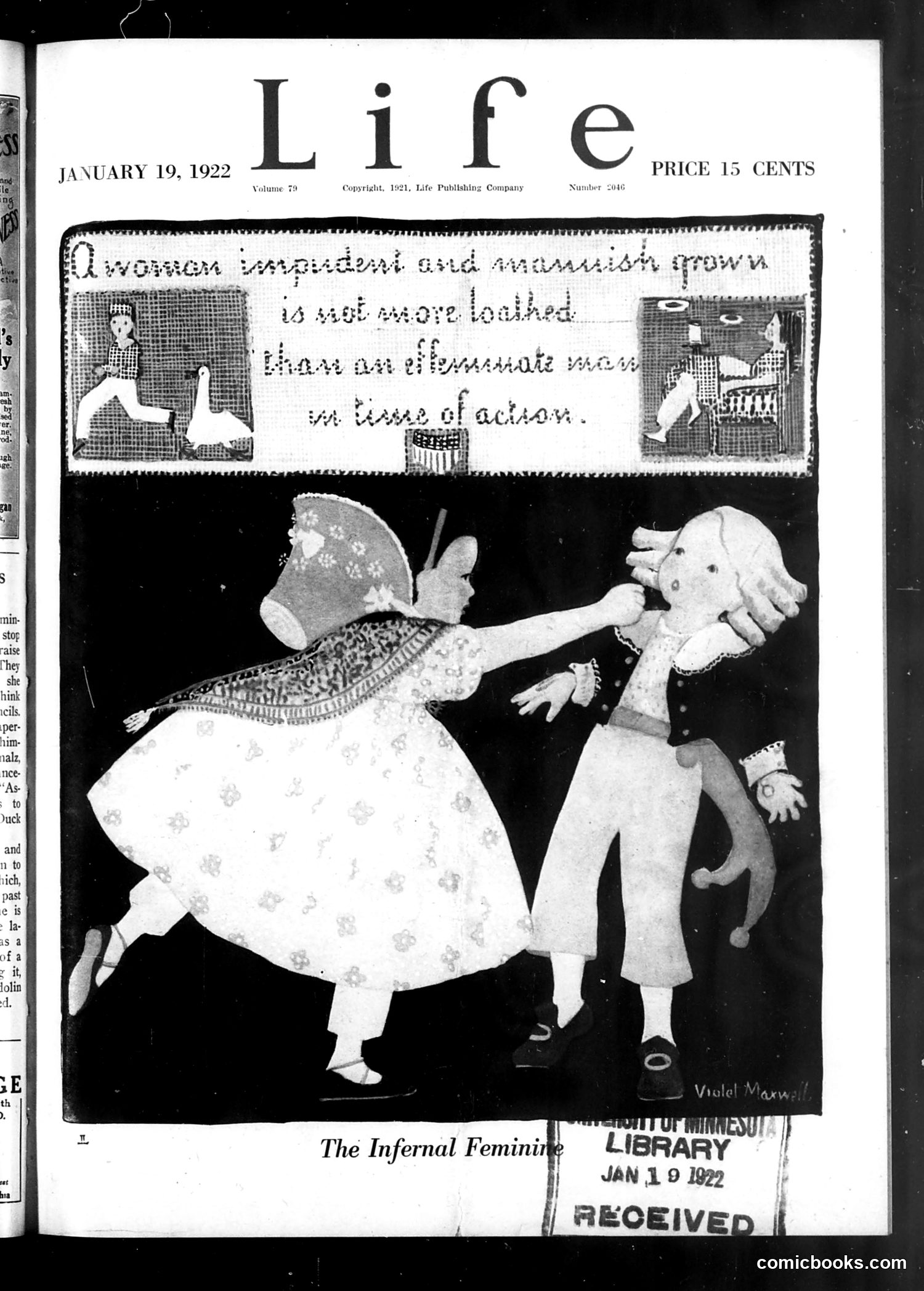
This 1922 *Life* cartoon satirizes modern women's behavior through a humorous scene. A woman in a bonnet and patterned dress holds up a large fish, displaying it triumphantly to a young boy. The caption at top reads: "A woman impudent and amusingly grown / is not more loaded / than an effeminate man / in issue of action." The joke appears to target the perceived boldness and assertiveness of modern women—specifically their willingness to engage in traditionally male activities like fishing or hunting. The "infernal feminine" title suggests satirical criticism of women's changing social roles in the 1920s, likely referencing the post-suffrage era when women were gaining greater independence and challenging traditional gender expectations. The cartoon mocks this shift through exaggerated, playful imagery.
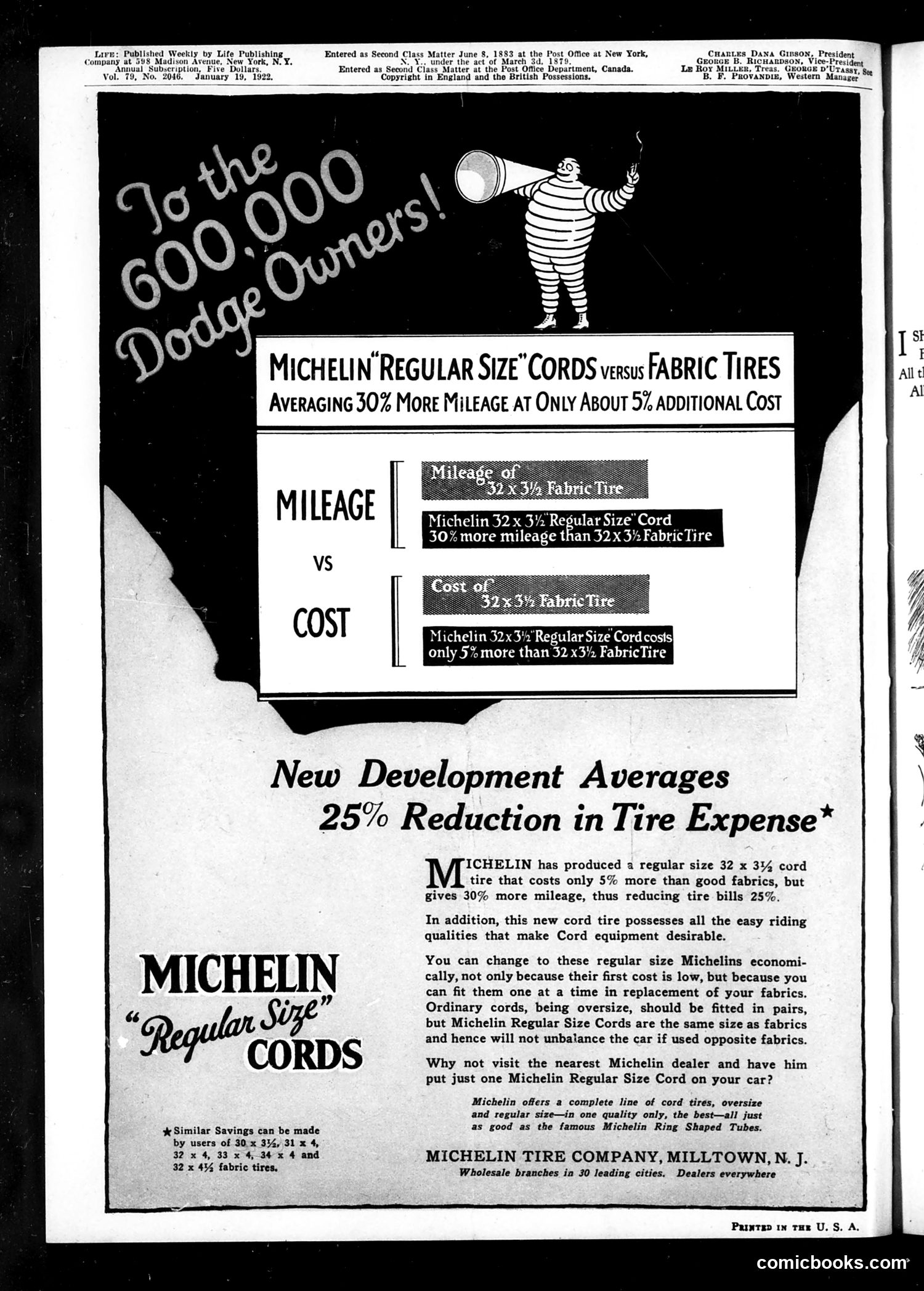
This page is **primarily an advertisement**, not a political cartoon. It's a Michelin Tire Company advertisement from Life magazine, targeted at the "600,000 Dodge Owners" mentioned in the headline. The ad features a rotund character in striped clothing (appearing to be Michelin's mascot, Bibendum) holding a megaphone, promoting Michelin's new "Regular Size" cord tires. The advertisement makes a commercial argument: these tires cost only 5% more than fabric alternatives but deliver 30% greater mileage, allegedly reducing tire expenses by 25%. The piece is essentially a product pitch comparing tire durability and cost-effectiveness—marketing rather than satire or political commentary. No caricatures or social references are present; it's straightforward commercial messaging typical of early 20th-century magazine advertising.
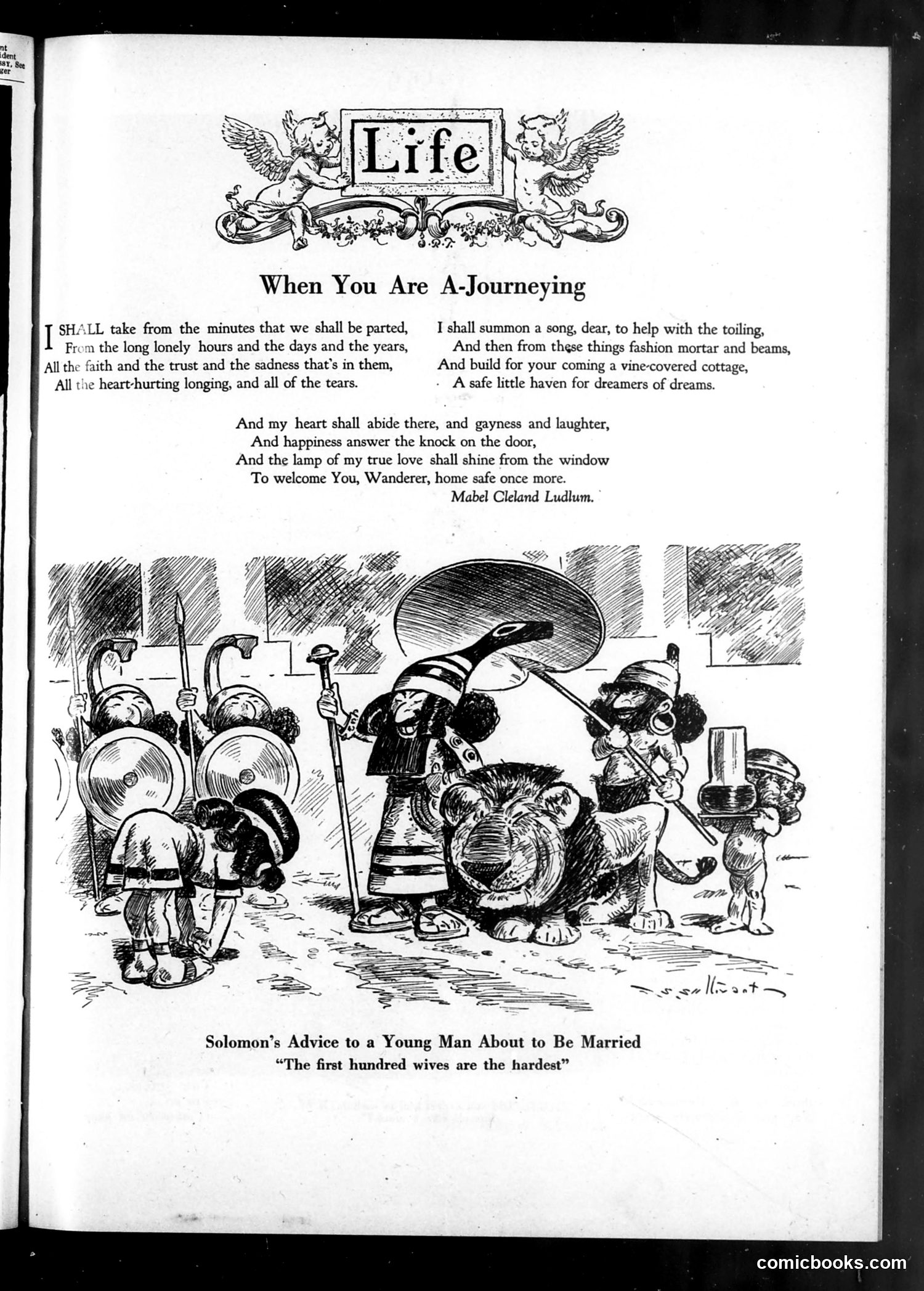
This page contains two distinct pieces: **Top:** "When You Are A-Journeying," a sentimental poem by Mabel Cleland Ludlum about separation and faithful love, decorated with cherubs—typical of Life's literary content. **Bottom:** A humorous cartoon illustrating "Solomon's Advice to a Young Man About to Be Married: 'The first hundred wives are the hardest.'" The joke invokes the biblical Solomon, famous for having numerous wives, to mock marriage difficulties through hyperbole. The cartoon depicts what appears to be a bewildered groom surrounded by caricatured figures (possibly representing wives or marital chaos)—soldiers, portly characters, and other comedic types in period dress. The satire suggests that marriage is an overwhelming, chaotic endeavor, with the Solomon reference implying even extreme polygamy might be preferable to dealing with a single wife's demands. This reflects early 20th-century anti-marriage humor common in satirical magazines.
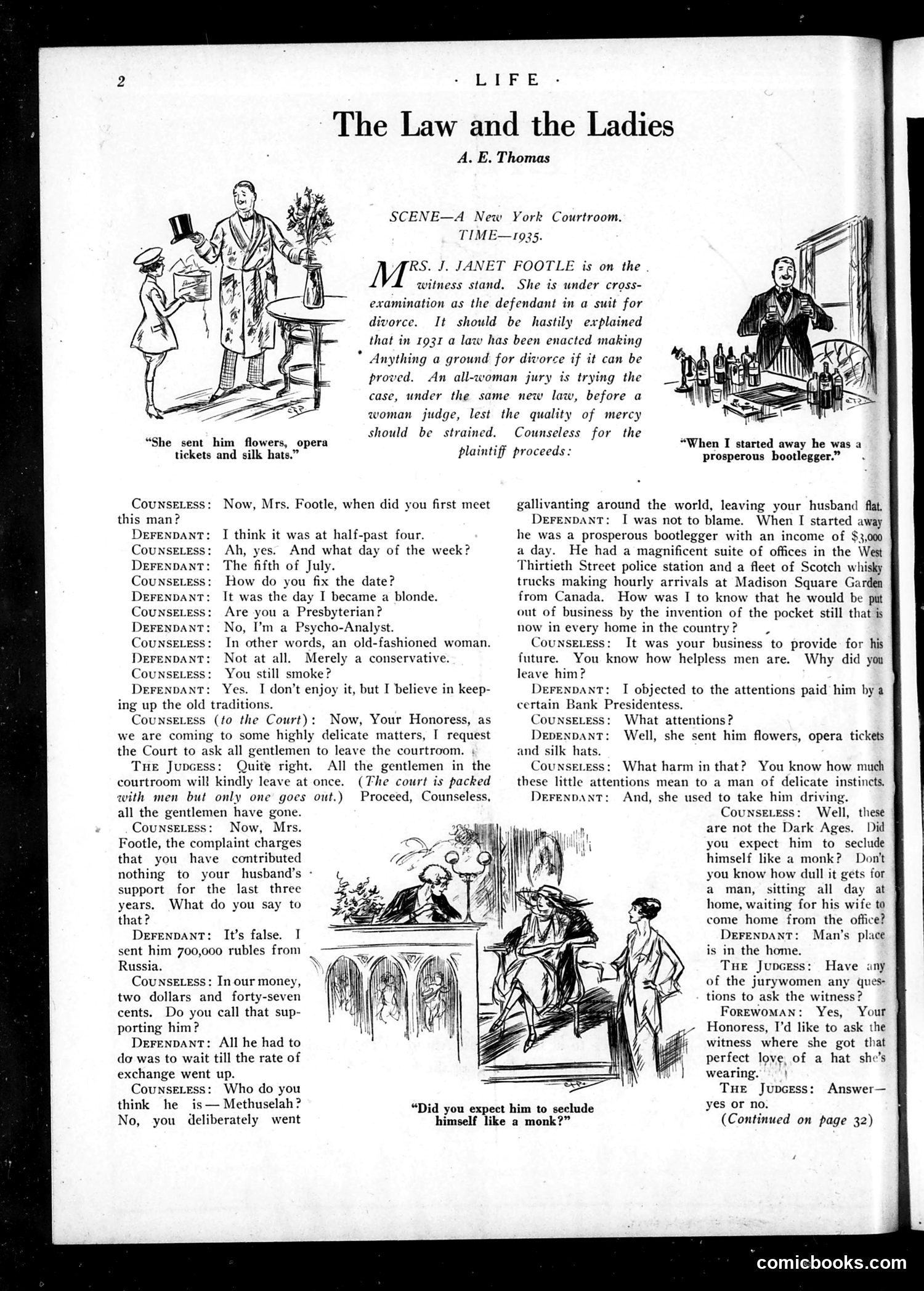
This 1935 courtroom satire depicts a divorce case where Mrs. Janet Footle testifies against her husband. The humor centers on gender role expectations: the defendant (a bootlegger) claims his wife failed to provide a proper home, while the counselless argues that men's domestic duties are equally important. The satire mocks both legal arguments and contemporary attitudes. The cartoon suggests absurdity in blaming women for husbands' failures—the defendant earned income illegally ("prosperous bootlegger") yet expects wifely devotion. The male judge and female jurors highlight the new 1935 law allowing women judges to decide divorce cases. The joke: both spouses use ridiculous justifications (flowers and opera tickets as support), exposing how divorce litigation weaponizes outdated gender expectations.
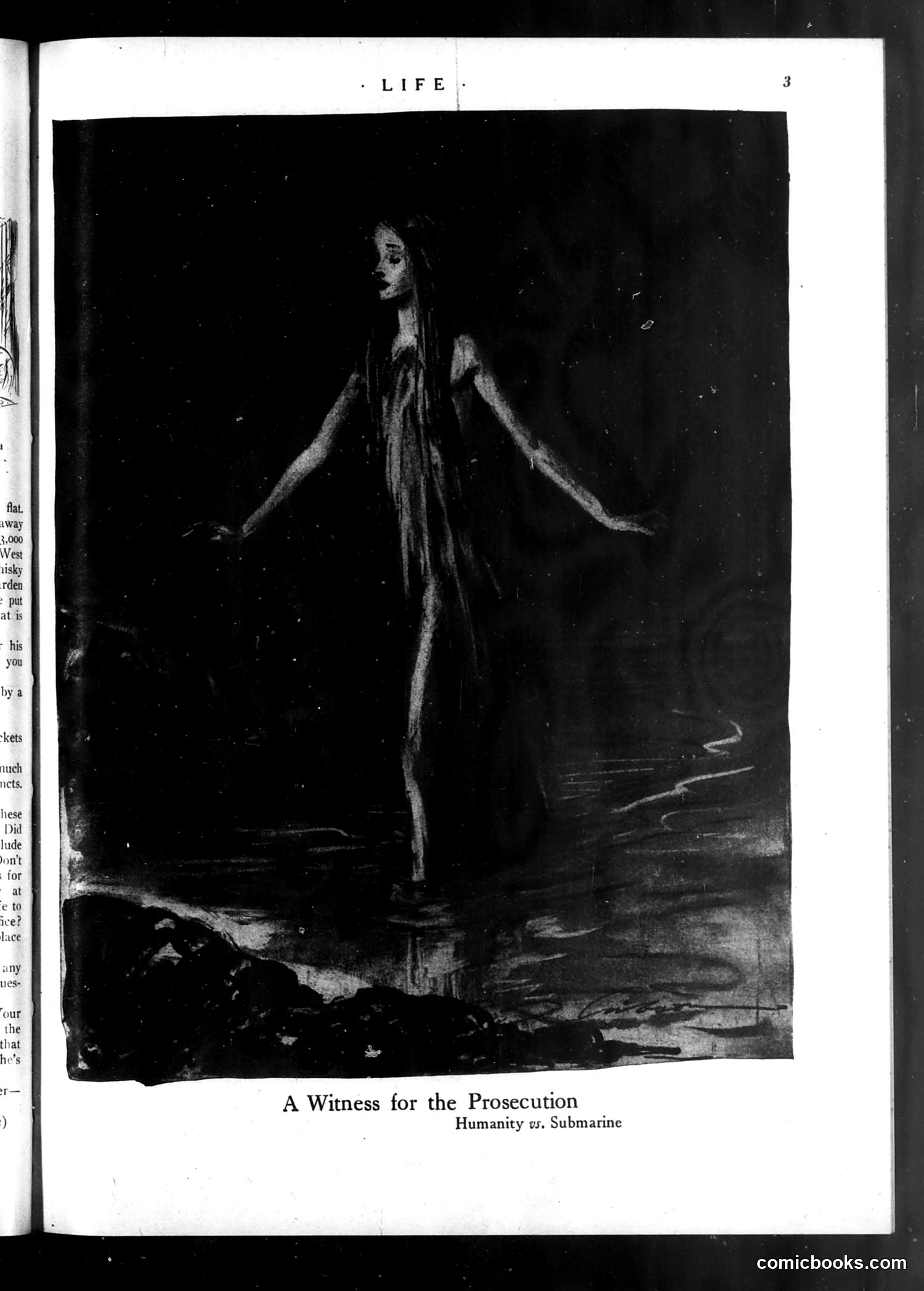
This page from *Life* magazine features an artistic illustration titled "A Witness for the Prosecution: Humanity vs. Submarine." The image depicts a ethereal female figure—representing "Humanity"—standing over what appears to be wreckage or corpses. Her outstretched arms suggest accusation or bearing witness. The composition uses her as an allegorical representation of human suffering. The subtitle "Humanity vs. Submarine" indicates this addresses submarine warfare, likely referencing World War I, when German U-boat attacks on civilian vessels caused significant casualties and provoked American outrage. The image positions Humanity as a witness testifying against the submarine as a weapon of war, critiquing its indiscriminate destruction of civilian life. This reflects *Life's* satirical anti-war stance and moral commentary on modern warfare's humanitarian costs.
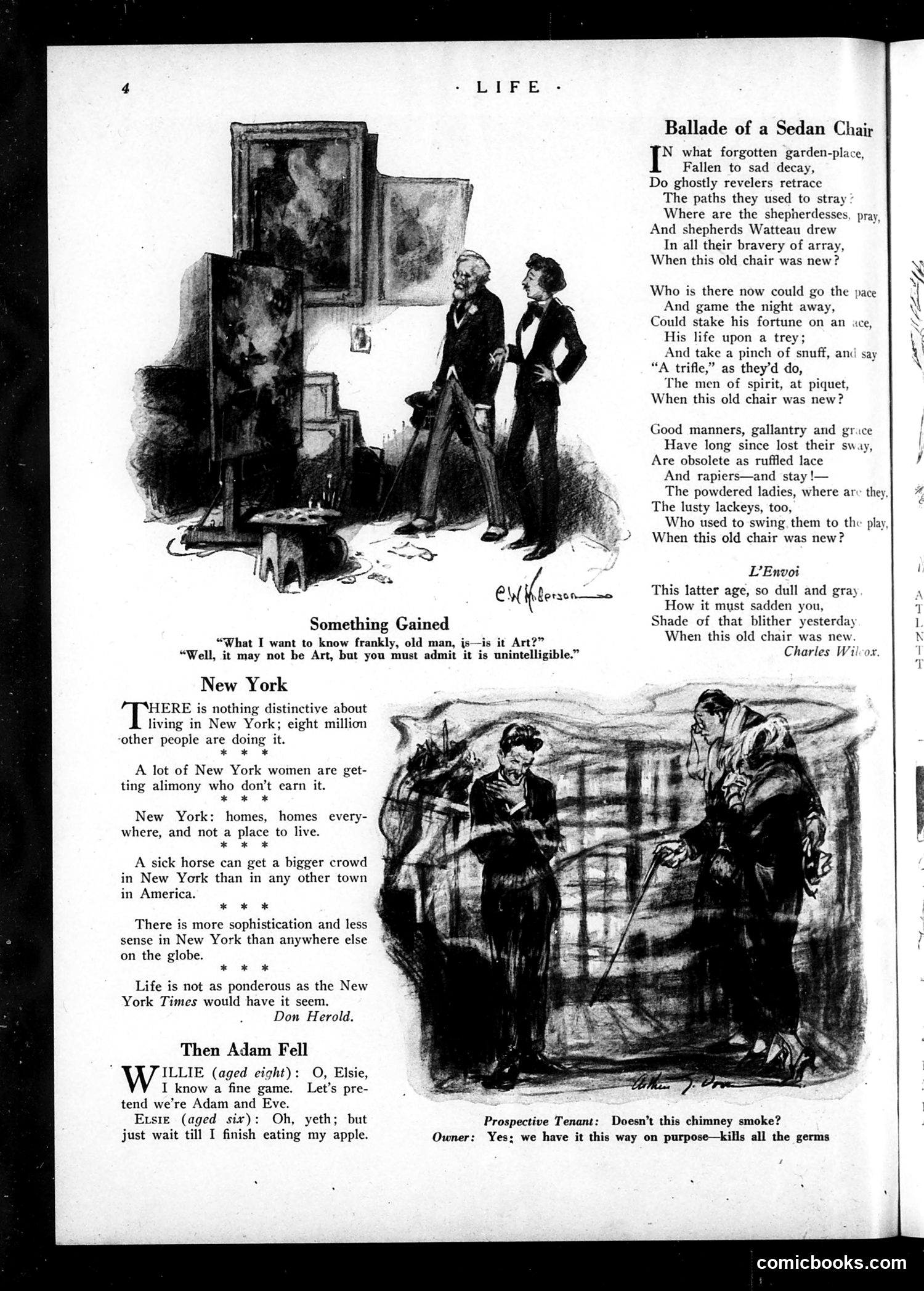
This page contains three satirical pieces: 1. **"Something Gained"**: Two men examine an old sedan chair in ruins. The joke plays on changing social values—the chair once symbolized wealth and status, but now that luxury has become commonplace, it's worthless. The quote questions whether society has gained anything by democratizing luxury. 2. **"New York"**: A series of witty observations mocking New York City life, attributed to Don Herold. These attack urban excess, social climbing among women, overcrowding, and perceived lack of genuine culture—typical satirical complaints about 1920s Manhattan sophistication. 3. **"Then Adam Fell"**: A brief dialogue between children (Willie and Elsie) innocently discussing waiting to "pretend we're Adam and Eve," interrupted by eating an apple—a mild joke about childhood innocence and biblical references. The page represents Life's characteristic urban satire.
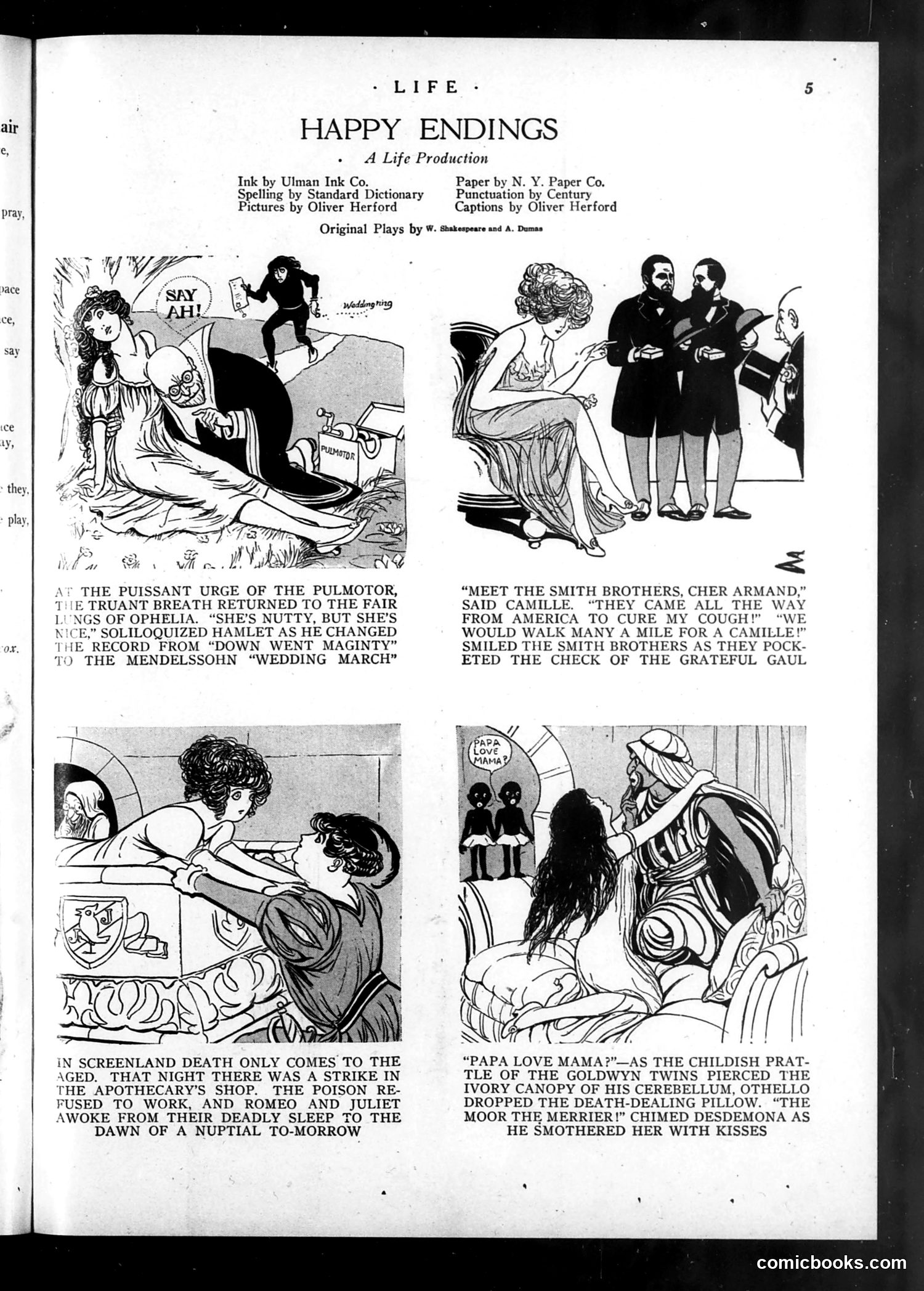
This page from *Life* magazine presents four cartoon panels spoofing classic theatrical "happy endings" by reimagining famous plays with absurd or darkly comedic twists. The cartoons reference: - **Hamlet**: A woman declares "Say Ah!" while examining the protagonist, treating the tragedy comedically - **The Smith Brothers**: A reference to a popular cough drop brand, joking about commercial tie-ins - **Screenland death scenes**: Mocking how cinema romanticizes death, contrasting artifice with reality - **The Goldwyn Twins**: An apparent reference to film producer Samuel Goldwyn, satirizing Hollywood's saccharine storytelling The satire targets both high theatrical tragedy and commercial popular entertainment, suggesting that "happy endings" are artificial constructs imposed on naturally darker narratives. The crude ink drawings emphasize the humor through exaggeration and visual incongruity.
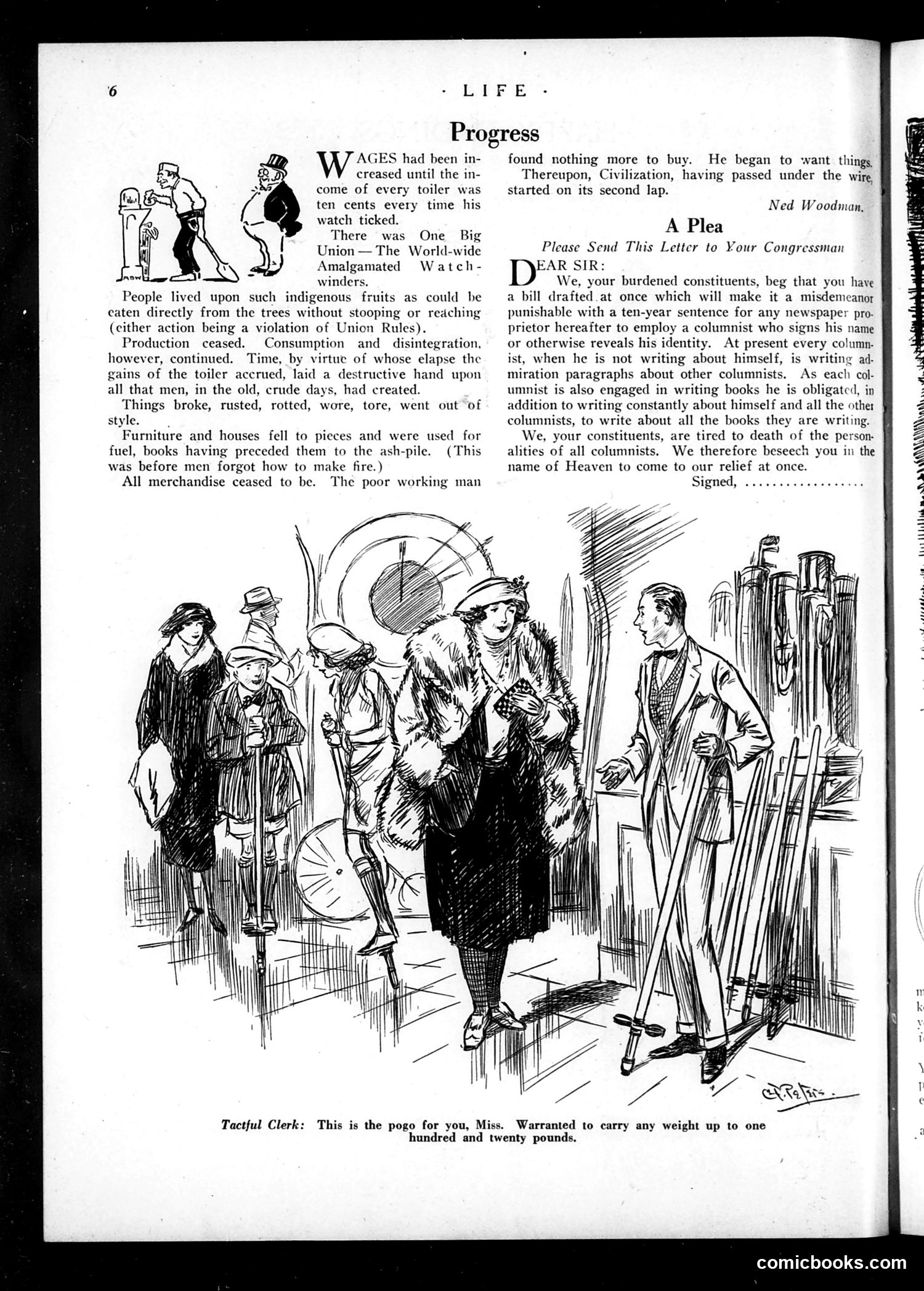
This satirical piece critiques industrial-era labor exploitation. The text describes how wages increased only ten cents per toiler's watch—a pittance—while civilization supposedly "progressed" on its "second lap." The irony is sharp: workers' lives deteriorated as production ceased, consumption collapsed, and furniture was burned for fuel. The old promise that industrial gains would benefit laborers proved false. The sketch below shows a "Tactful Clerk" presenting a pogo stick ("warranted to carry any weight up to one hundred and twenty pounds") to a woman—likely mocking how cheap distractions or frivolous goods were offered to workers as compensation for genuine economic hardship. The overall message: "progress" benefited capitalists, not workers.
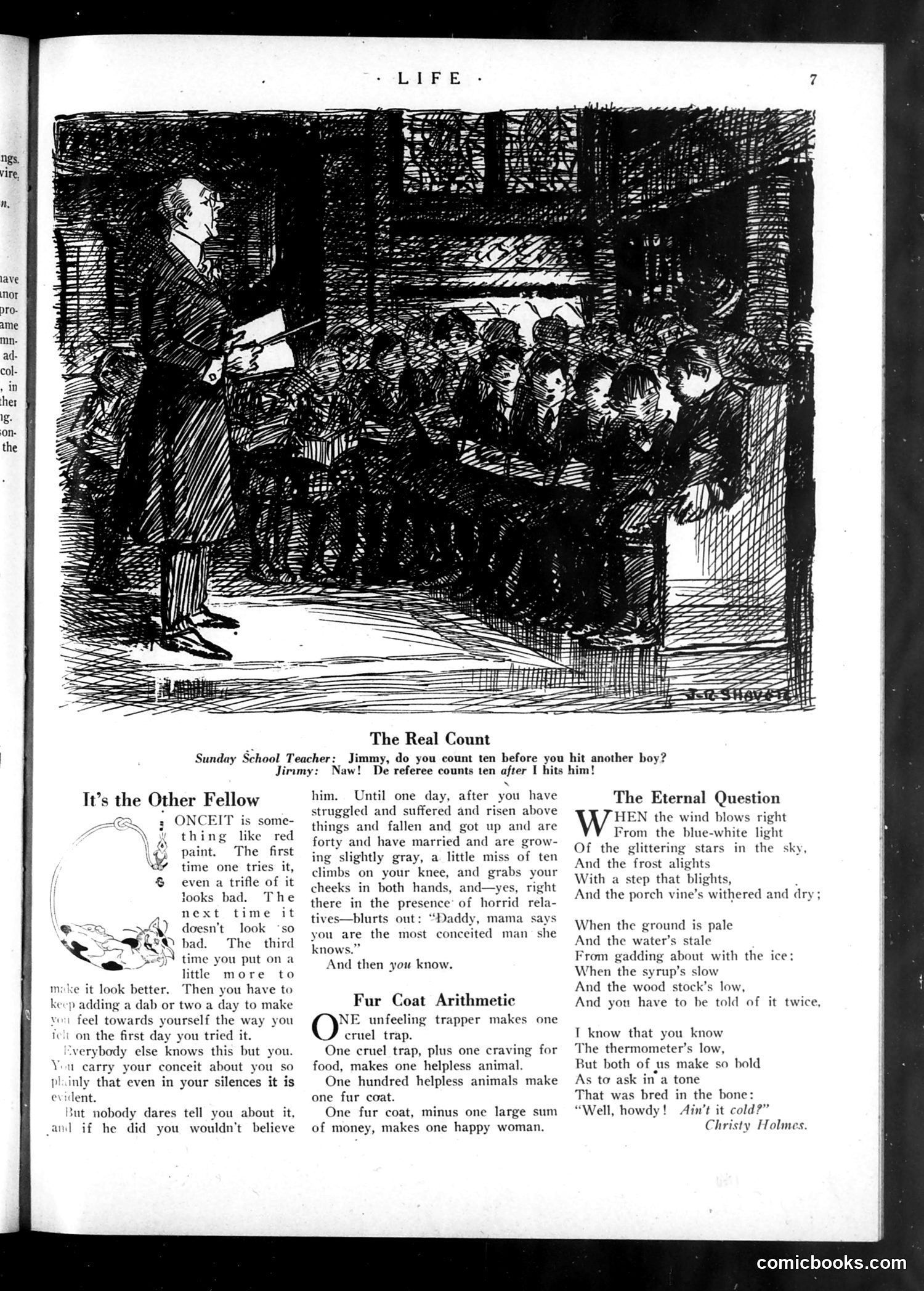
The top cartoon depicts a Sunday school teacher asking a student named Jimmy if he counts to ten before hitting another boy. Jimmy replies that "the referee counts ten after I hit him." The satire mocks the contradiction between Sunday school's moral teaching (restraint, counting to ten before acting) and the boxing culture Jimmy actually experiences. The joke relies on the assumption that children—particularly boys—are more familiar with boxing rules than religious instruction. The "referee counts" reference suggests early 20th-century boxing was culturally prominent enough that even children knew its conventions better than traditional virtue lessons. The remaining page contains three unrelated humorous pieces: "It's the Other Fellow," "Fur Coat Arithmetic," and "The Eternal Question," which are brief satirical quips on conceit, materialism, and courtship.
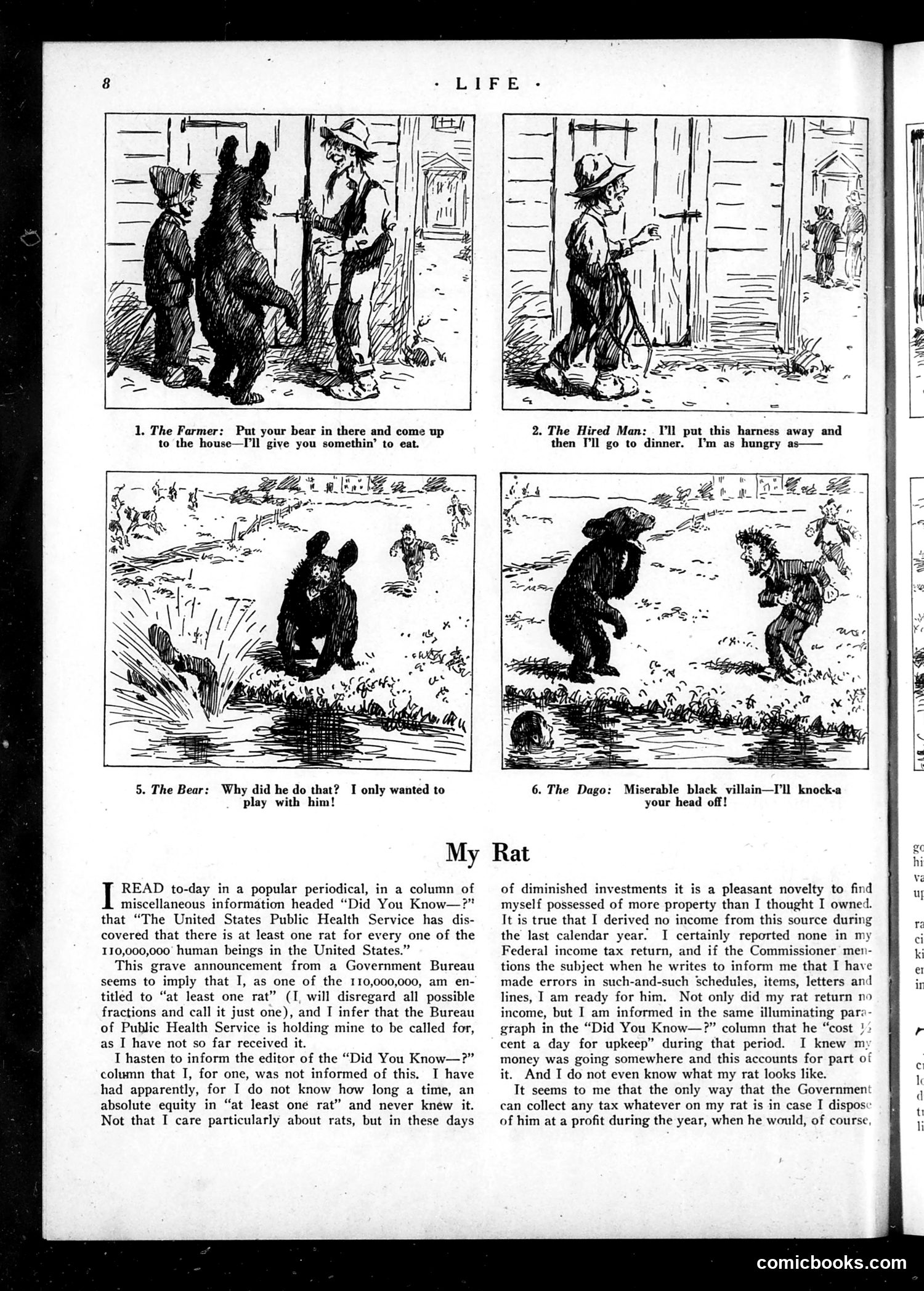
This page contains two distinct items: **Top: A four-panel comic strip** about a farmer who hires a man to work and then puts a bear in the house as a "joke." The hired man discovers the bear, flees in panic, and the farmer's bear chases him away. The final panel shows the farmer's dog attacking the bear. It's a simple slapstick narrative with no political content—just physical comedy about a prank gone wrong. **Bottom: An essay titled "My Rat"** where the author humorously describes owning an undocumented rat, claiming it generates unreported income. The piece satirizes government taxation and the difficulty of accounting for all assets, suggesting the author has more property than he's declared to tax authorities. It's gentle satire about tax evasion and bureaucratic absurdity rather than serious political commentary.
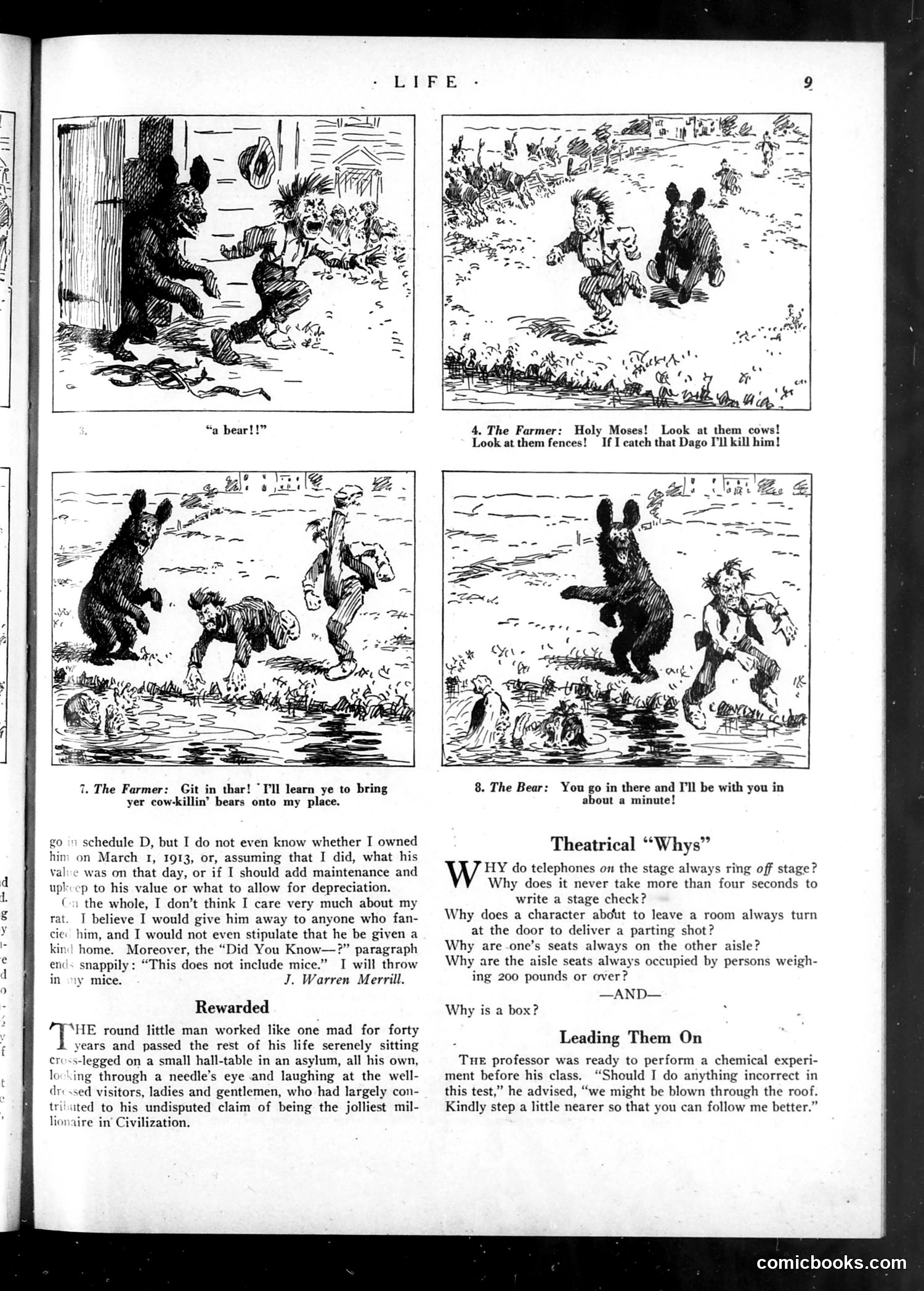
This page contains a four-panel comic strip depicting a farmer, his dog, and a bear. The narrative shows the farmer discovering a bear near his livestock ("look at them cows!"), then the farmer and bear engaging in a physical confrontation near water. The comic appears to be a humorous adventure story rather than political satire. Below the comic strips are three short pieces: an anecdote about a man who worked one job for forty years; a section titled "Theatrical 'Whys'" asking humorous questions about theater conventions (why do stage phones always ring offstage, why are aisle seats occupied by heavy people, etc.); and a brief classroom anecdote about a chemistry professor. The page represents typical early-20th-century Life magazine humor—lighthearted domestic comedy and theatrical observations without overt political content.
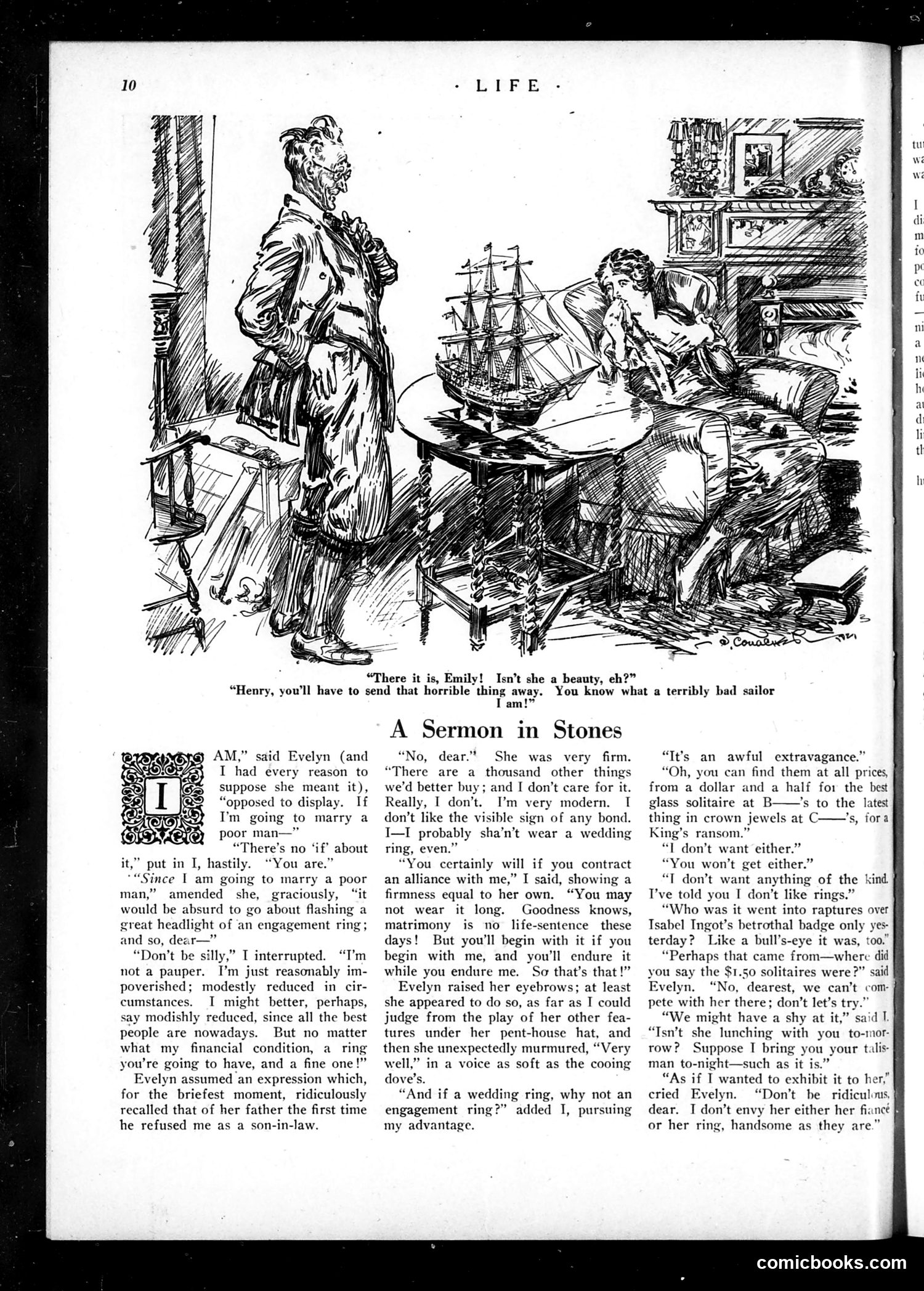
This page contains a short story about marriage and engagement rings, illustrated with a sketch showing a man and woman in what appears to be a domestic interior, with a model sailing ship visible. The narrative centers on Evelyn's refusal to wear an engagement ring, which her fiancé finds troubling. She argues that rings are unnecessary displays and that she prefers a "modern" approach to matrimony. The man counters that rings are traditional symbols of commitment, while she insists she doesn't want visible signs of being bound. The satire targets early 20th-century debates about women's independence and marriage customs. Evelyn represents the "modern woman" rejecting traditional feminine expectations, while the male character defends conventional courtship rituals—a common tension in Life magazine's social commentary of this era.
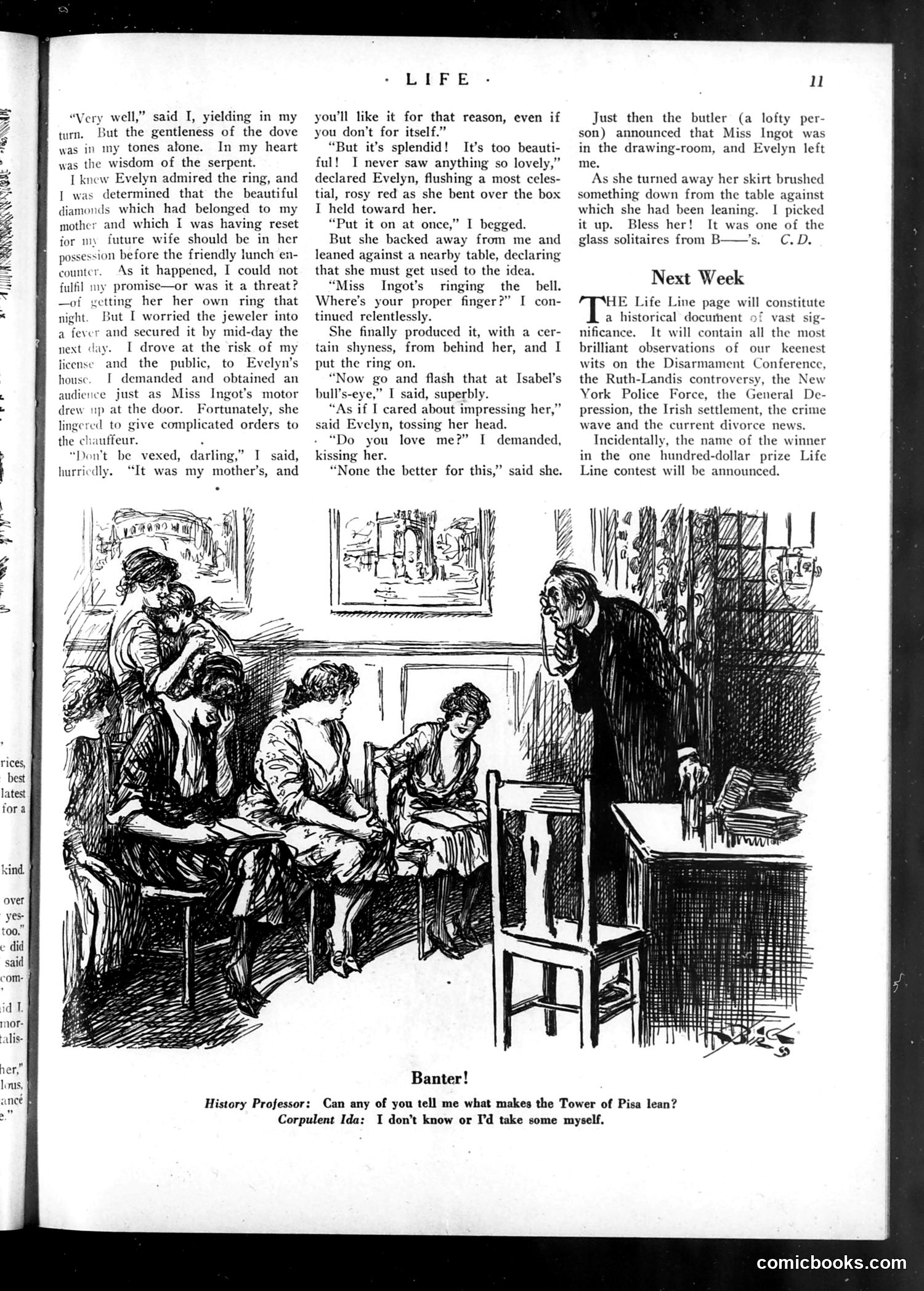
This cartoon depicts a humorous classroom scene where a history professor asks students to explain what causes the Tower of Pisa to lean. A student named Ida responds that she "doesn't know or I'd take some myself." The joke relies on a double meaning: while the Tower of Pisa physically leans due to uneven foundation settling, Ida's quip suggests "lean" as slang for being thin or underfed. Her flippant response implies she'd use whatever causes the tower's lean to lose weight—a casual joke about female body consciousness and dieting. The upper portion contains an unrelated romantic narrative about a ring and engagement. The cartoon satirizes classroom dynamics and student attitudes rather than any specific political event.
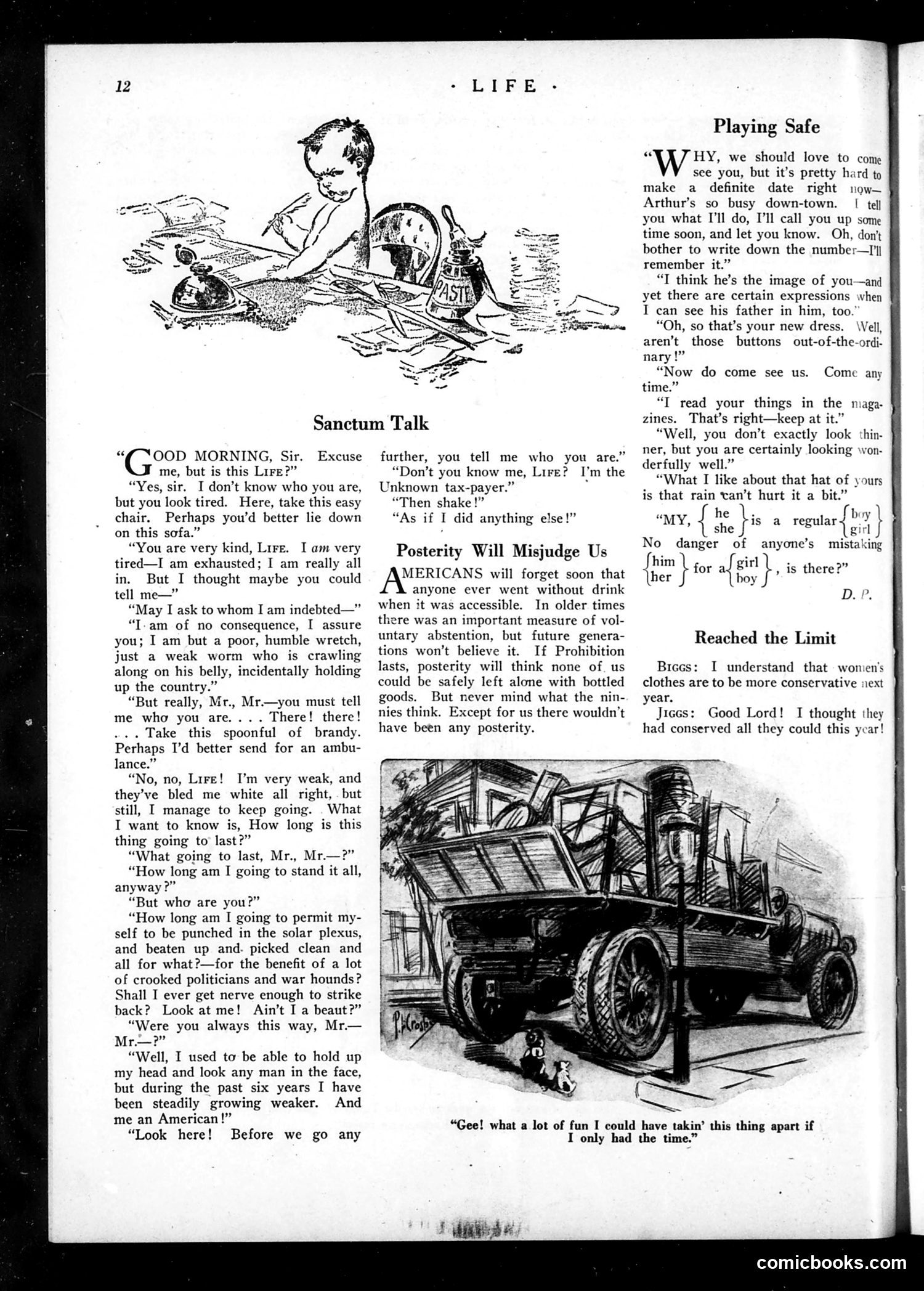
This page contains three separate satirical pieces: 1. **"Sanctum Talk"**: A dialogue between an exhausted visitor and "Life" personified. The tired man seeks rest and asks about his duration of suffering, seemingly referencing post-WWI hardship or economic strain. The exchange is darkly comedic about endurance and weakness. 2. **"Posterity Will Misjudge Us"**: Commentary on Prohibition's likely historical misinterpretation. The piece sarcastically suggests future generations won't understand how Americans functioned without accessible alcohol, predicting historians will wrongly believe Prohibition caused societal collapse. 3. **"Reached the Limit"**: A brief joke about women's fashion conservatism, with a character surprised clothing won't become more daring next year after wartime restrictions. 4. **Car illustration**: Shows a child with a disassembled automobile, captioning desire to explore mechanics if time permitted—likely promoting automobiles to readers.
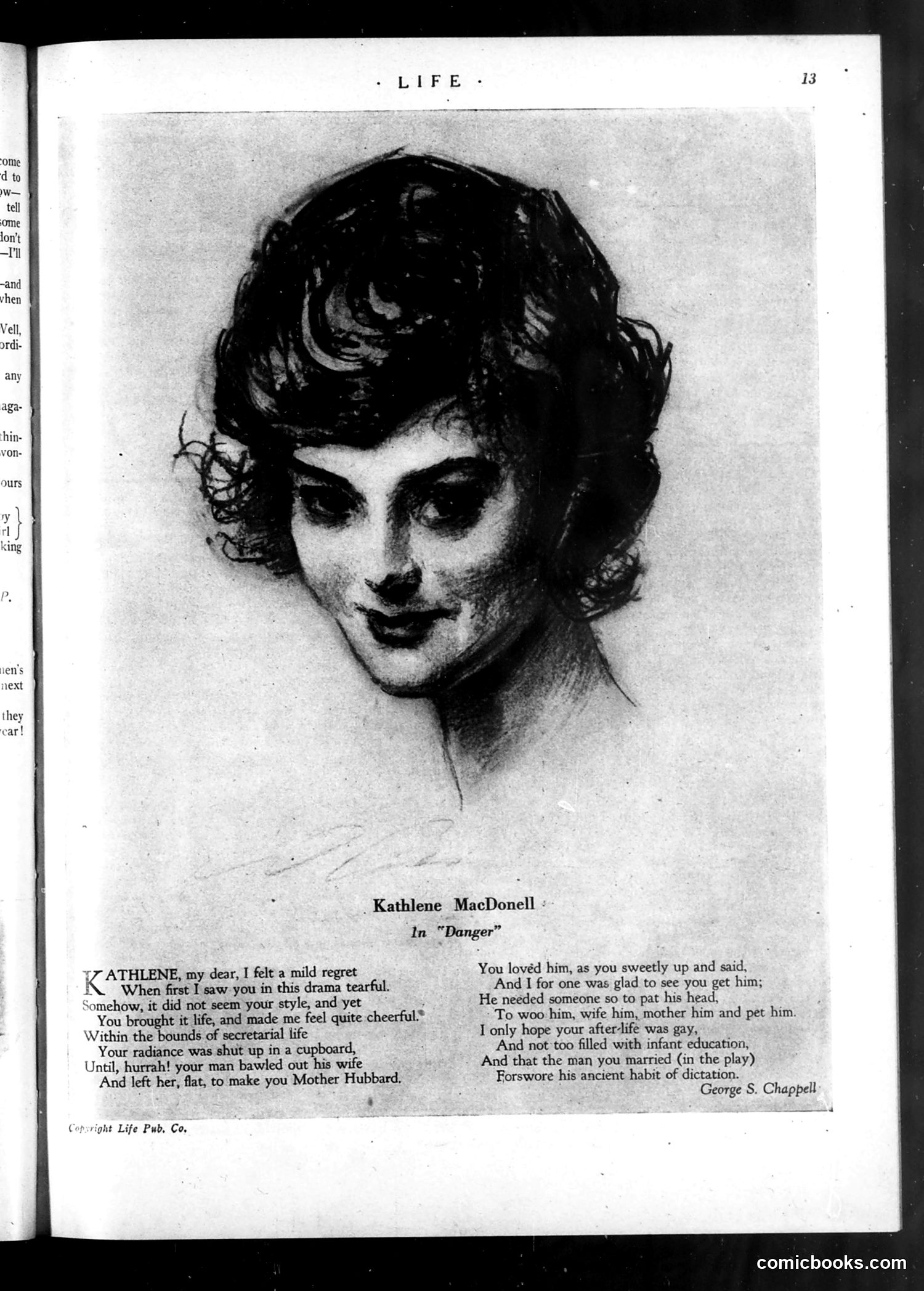
This page features a portrait of actress Kathlene MacDonell, labeled as appearing in a production called "Danger." Below the portrait is a poem by George S. Chappell addressing "Kathlene, my dear." The poem appears to be a romantic or sentimental tribute, referencing her performance in the drama and her character's emotional arc—specifically mentioning themes of love, marriage, motherhood, and domestic life. The verse suggests her character in "Danger" dealt with relationships and family matters in a tearful dramatic context. This is not political satire but rather entertainment coverage typical of Life magazine's arts and culture section, promoting a theatrical production through both portrait and verse. The content celebrates the actress and her dramatic role.
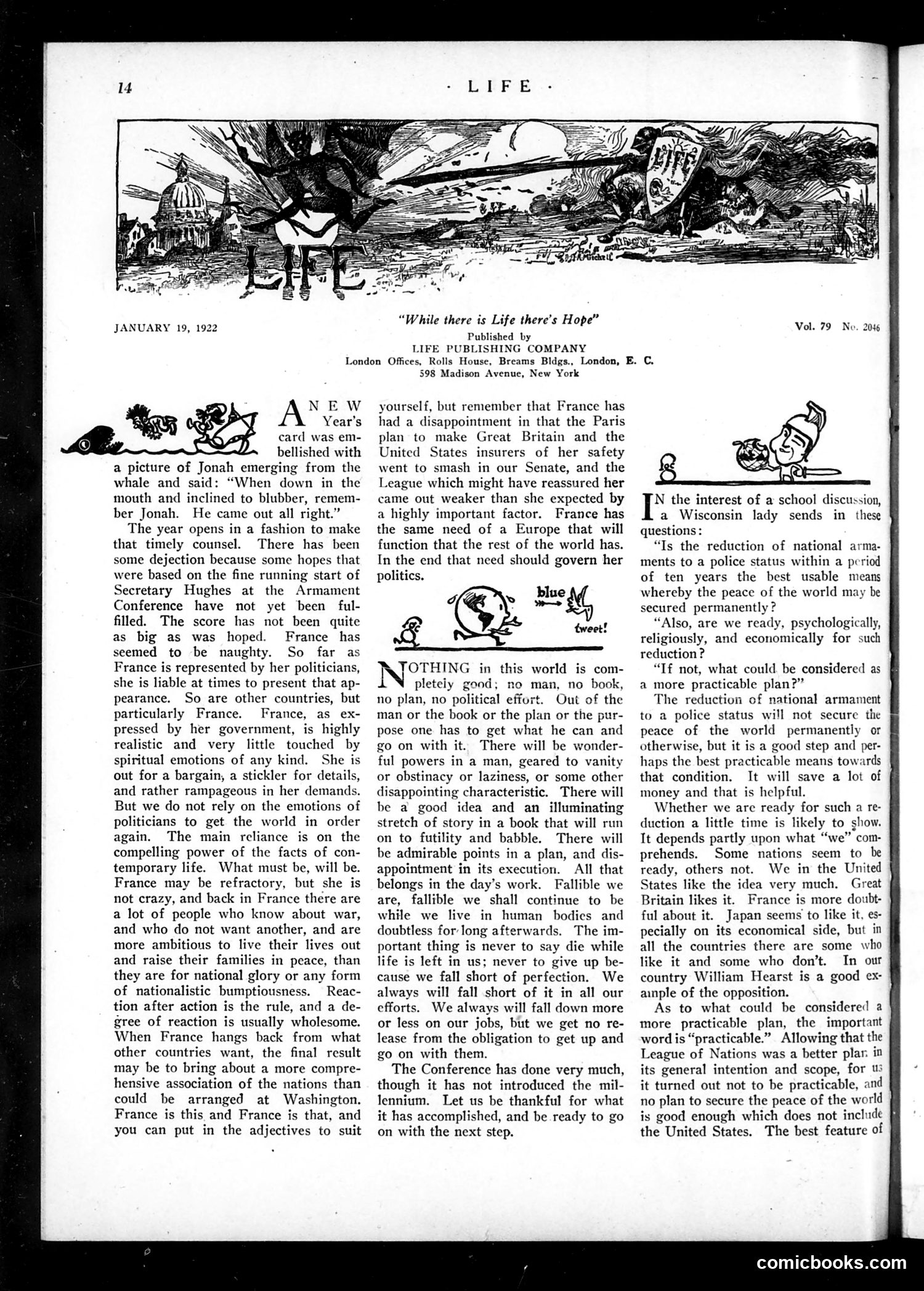
This January 19, 1922 *Life* page discusses post-war disarmament and international relations. The opening illustration depicts Jonah emerging from a whale, comparing France's situation to biblical salvation—France faces disappointment that Britain and the U.S. won't enforce the Paris peace plan as expected. The main text critiques idealistic disarmament proposals, arguing that reducing national armaments won't secure world peace without enforcement mechanisms. The author suggests the League of Nations failed because it wasn't "practicable"—lacking U.S. participation (the U.S. never joined the League). The piece advocates pragmatic, step-by-step disarmament rather than sweeping idealistic plans. It reflects post-WWI skepticism about whether international cooperation could actually prevent future conflicts without military backing.
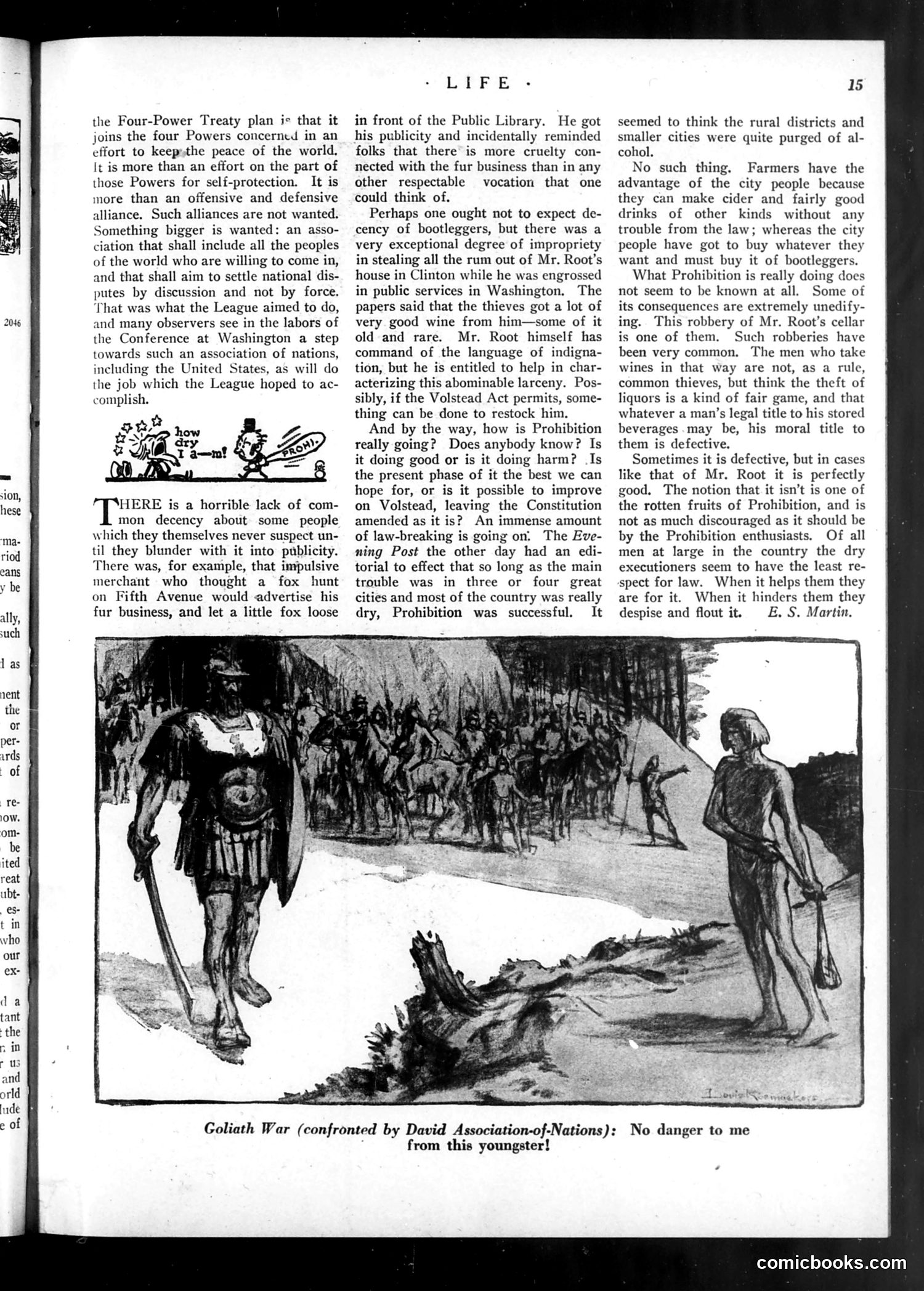
This Life magazine page critiques Prohibition's practical failures and moral consequences. The main text discusses the theft of alcohol from Elihu Root's (prominent statesman) home in Clinton while he served in Washington, arguing this exemplifies Prohibition's corrosive effects on law-abiding citizens and respect for property. The author notes Prohibition enforcement is inconsistent and hypocritical: rural farmers legally make cider while city residents must buy from criminals; Prohibition's "dry executioners" selectively respect law based on convenience. The piece questions whether Prohibition actually works, noting widespread lawbreaking and that stolen liquor is increasingly rationalized as a "fair game" rather than theft—a moral rot the author blames on Prohibition itself. The accompanying cartoon ("Goliath War") depicts the biblical David-and-Goliath story, likely symbolizing the League of Nations (small David figure) confronting larger national powers, relating to the earlier text discussing the Four-Power Treaty and international peacekeeping efforts.
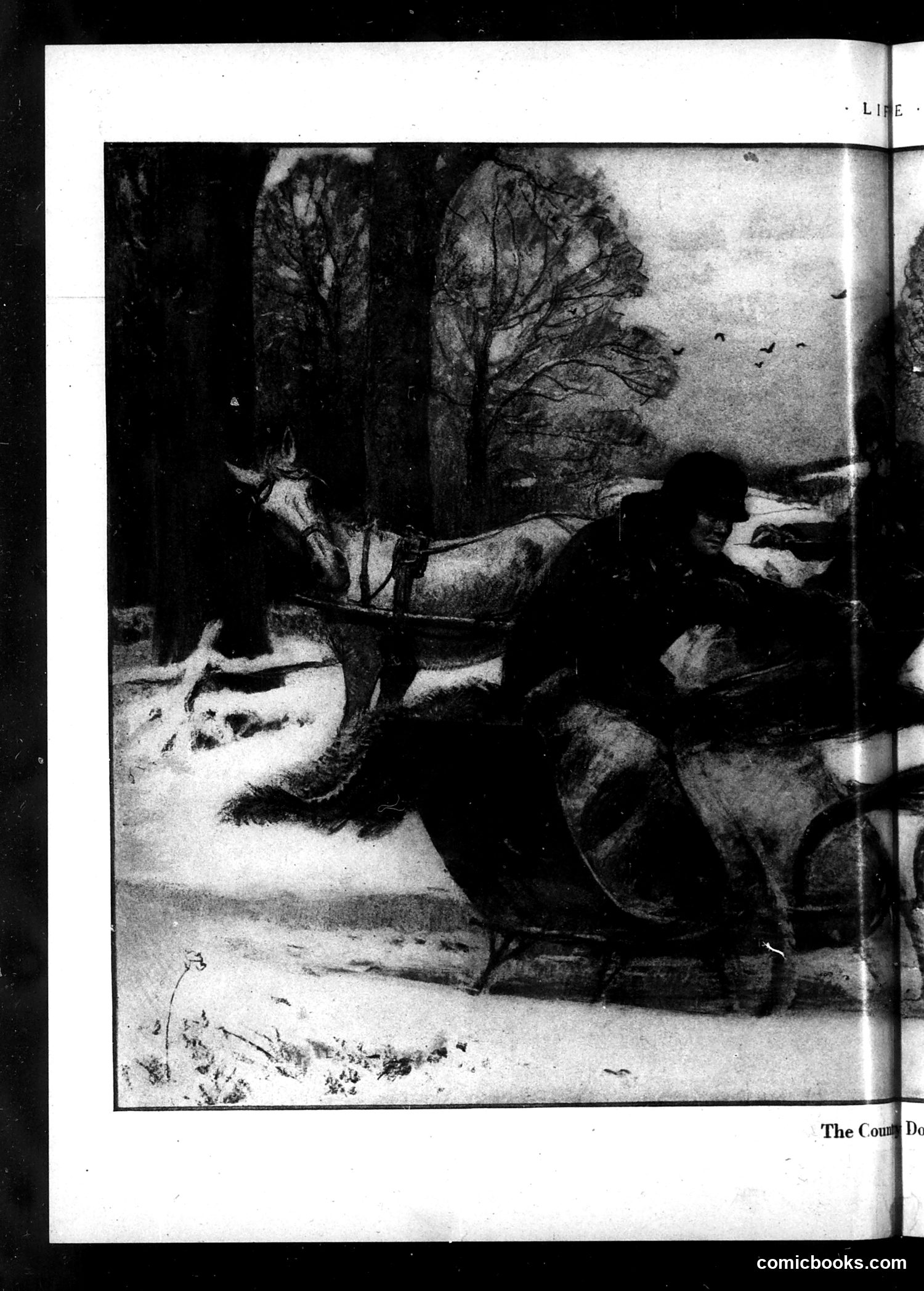
This black and white image appears to be a scene from an illustrated story or comic rather than a political cartoon. It depicts a figure in dark clothing crouching or bending over in a snowy landscape, with bare trees and what appears to be a deer or similar animal in the background. The scene has a dramatic, possibly suspenseful quality. Without clearer OCR text (the visible text reads only "The Cou" and appears cut off), I cannot definitively identify the specific story, characters, or satirical point being made. The image alone doesn't clearly reveal political or social commentary that would be obvious to modern readers. More complete text would be necessary to explain this page's meaning accurately.
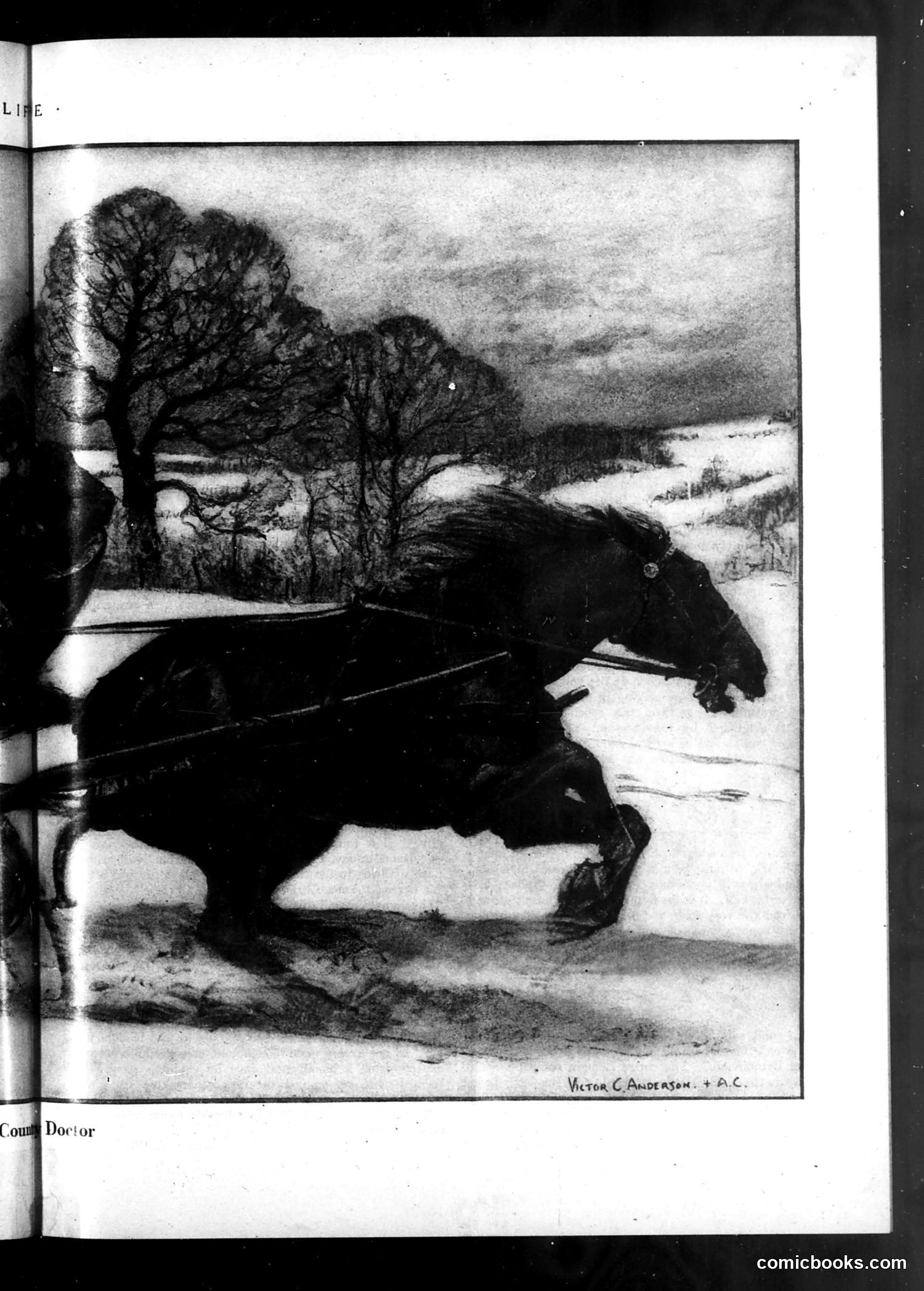
This appears to be an illustration by Victor C. Anderson (signed at bottom) titled "Country Doctor," showing a horse-drawn sleigh in a snowy winter landscape with bare trees. A figure in dark clothing appears to be operating or guiding the sleigh. The image likely satirizes rural medical practice in early 20th-century America—specifically the hardship of country doctors who traveled by horse and sleigh through harsh winters to treat patients in remote areas. The stark, dramatic composition emphasizes the isolation and difficult conditions these physicians endured compared to urban practitioners. Without additional context from surrounding page content, the specific satirical point remains somewhat unclear, though the mood suggests commentary on rural healthcare challenges or professional sacrifice.
This is a theater review page from Life magazine (circa 1921, based on references to "1921 two more revivals"). The decorative header features theatrical masks and the word "DRAMA." The page reviews several Broadway productions: - **"Captain Applejack"** by Walter Hackett, praised for originality despite conventional plot elements - **"Bulldog Drummond"**, a melodrama starring A.E. Matthews, celebrated for self-aware humor about its own absurdity - **"The White Peacock"**, written by and starring actress Olga Petrova The reviews also contain **criticism of theatrical theft**: the author calls out vaudeville performer Downey for copying Joe Jackson's famous tramp-bicycle act—comparing it unfavorably to the Mona Lisa theft scandal, sarcastically suggesting the bicycle act deserves equal protection. The tone is witty, gossipy, and aimed at theatergoers. No political content is present; this is purely entertainment criticism from the Jazz Age theater scene.
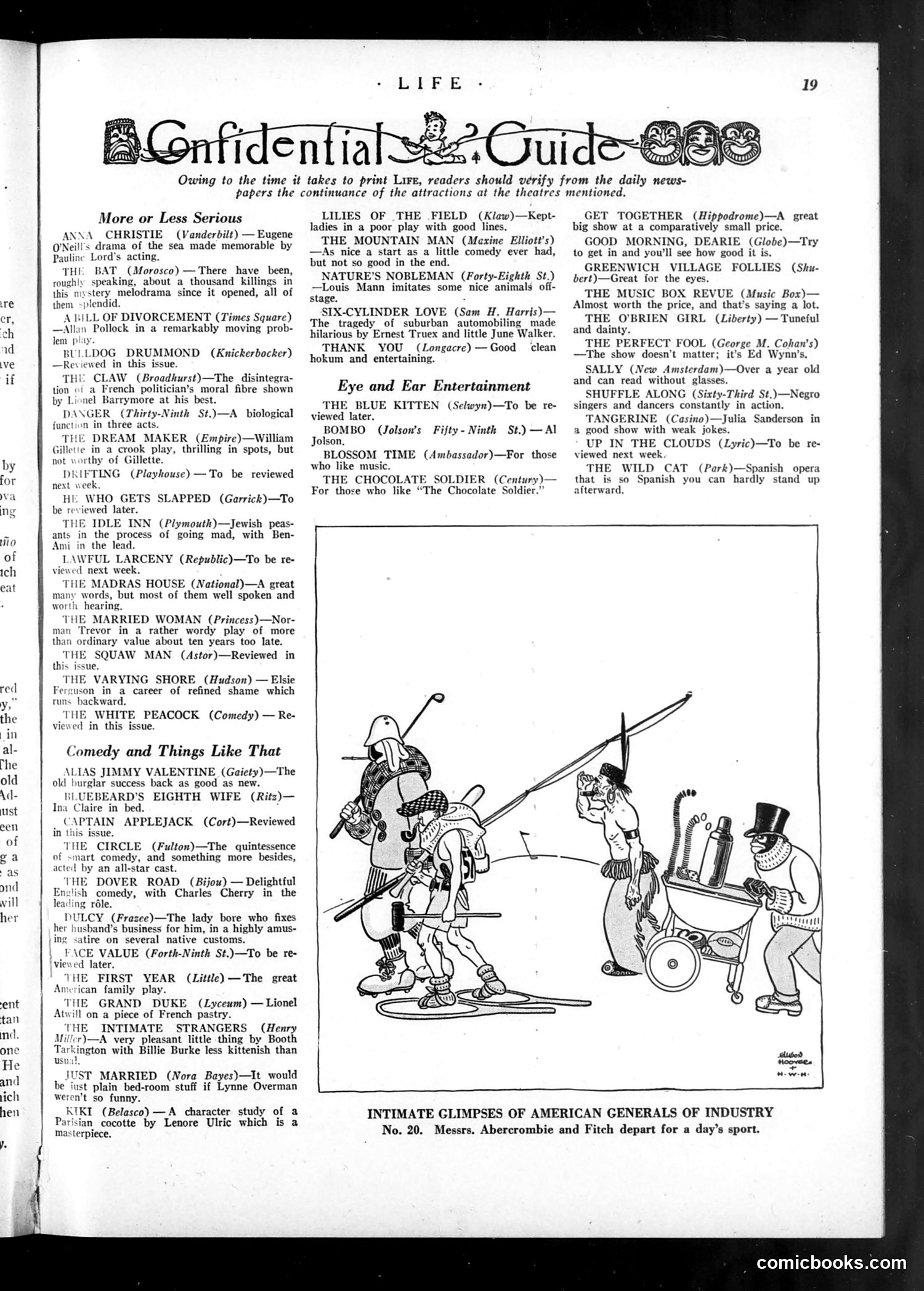
This page is a **theater guide and review section** from Life magazine, listing Broadway shows with brief critical assessments. The text appears to be theater reviews circa the early 1920s (based on references to performers like Al Jolson and shows like "Bombo"). The **cartoon illustration** at the bottom depicts what the caption identifies as "Intimate Glimpses of American Generals of Industry No. 20. Messrs. Abercrombie and Fitch depart for a day's sport." The drawing shows two well-dressed gentlemen (caricatured with exaggerated features typical of the era) departing on what appears to be a sporting expedition, laden with elaborate equipment—suggesting satire about wealthy industrialists and their leisure pursuits. The humor likely mocks the pretentious, overly-equipped nature of wealthy businessmen's recreational activities. The page itself functions primarily as **entertainment/cultural commentary** rather than political satire—typical of Life's role as a sophisticated humor and culture magazine for educated audiences.
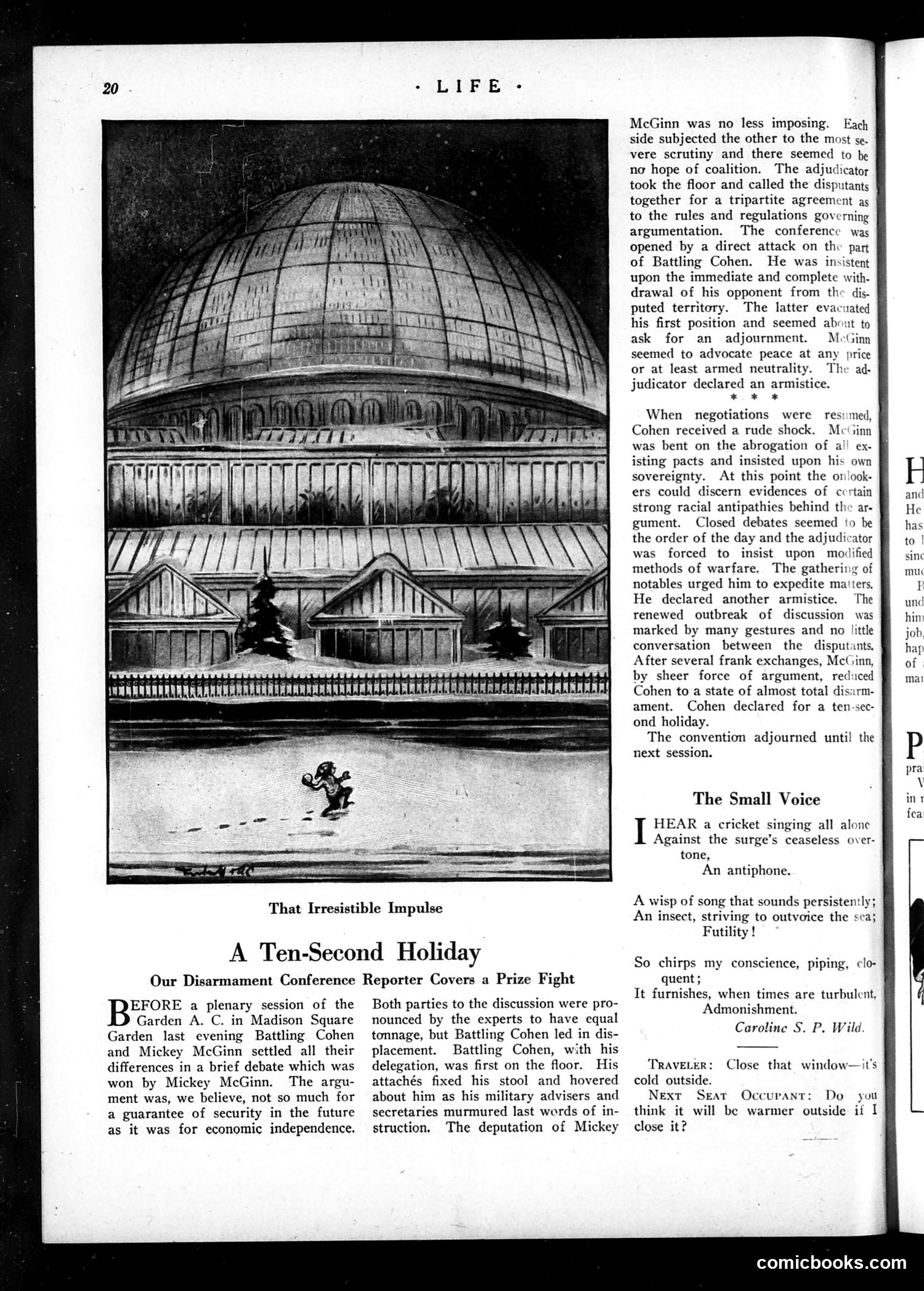
This Life magazine article satirizes the 1920s disarmament conference by framing an actual boxing match between "Battling Cohen" and "Mickey McGinn" using the formal diplomatic language of international peace negotiations. The satire mocks disarmament talks by comparing them to a prizefight: both sides deploy "attachés" and "advisers," negotiate "rules," declare "armistices," and eventually reach only temporary truces. The article suggests that diplomatic negotiations—like boxing matches—are really just ritualized combat driven by self-interest and "economic independence," not genuine peace-seeking. The cartoon illustration depicts the boxing arena as a grand domed building (resembling an official government chamber), with two fighters engaged below, emphasizing how absurdly the magazine equates international diplomacy with brutal physical combat. The message: disarmament conferences produce only superficial agreements, not lasting peace, because nations fundamentally distrust each other—much like prizefighters do.
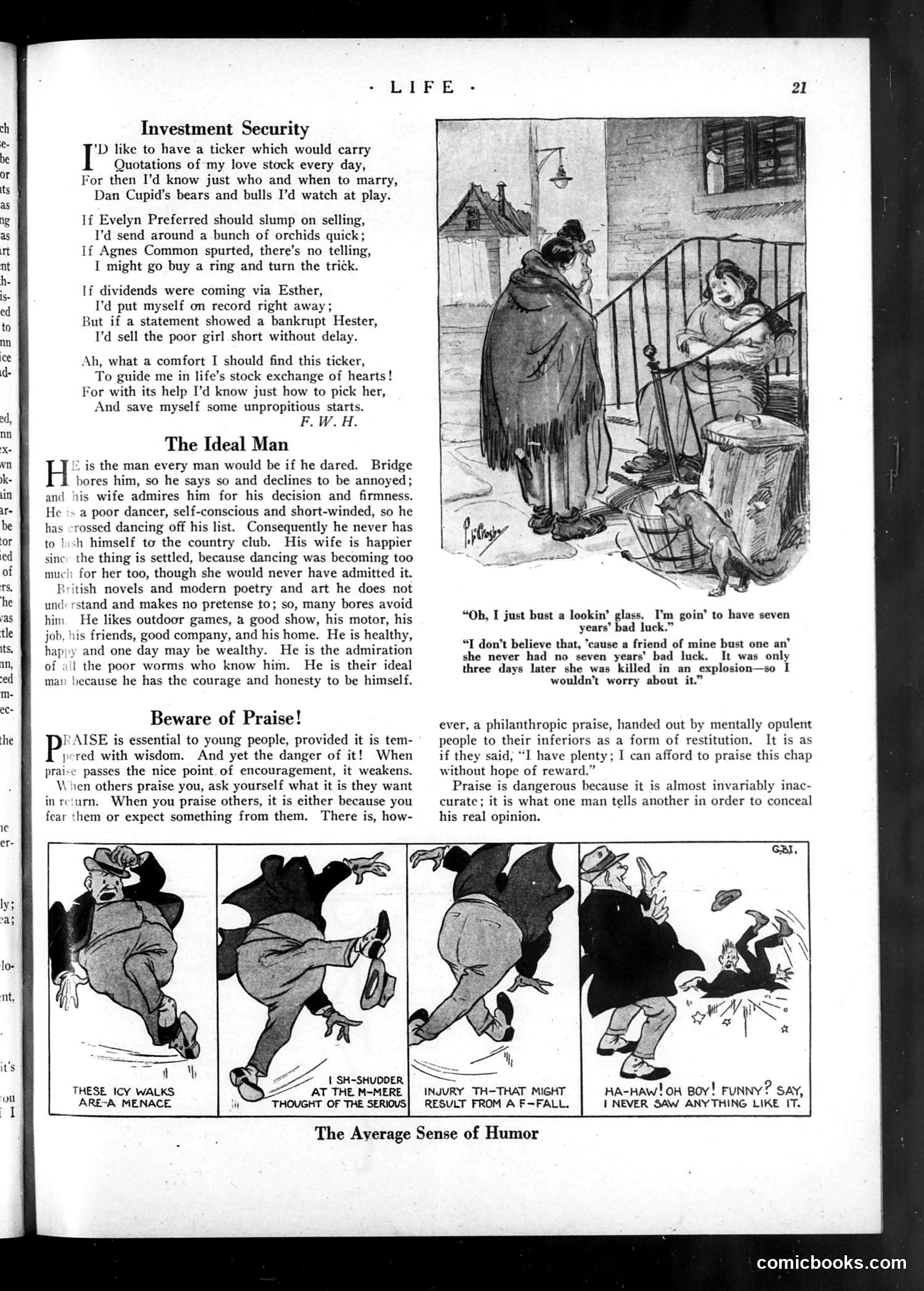
**"Investment Security"** (top poem): This satirizes the stock market craze of the 1920s by extending Wall Street metaphors to romance. The speaker wishes for a "ticker" to track women's "love stock"—treating courtship like securities trading, with references to "bears and bulls," "preferred" stocks, and "selling short." The joke mocks how financial language and speculation had permeated American culture, suggesting men approach marriage with the same calculating, risk-assessment mentality as investors. **"The Average Sense of Humor"** (bottom comic strip): This four-panel sequence demonstrates darkly ironic working-class humor. A person breaks a mirror and claims seven years' bad luck; their friend reveals they broke one and suffered only three days before being killed in an explosion—so "wouldn't worry about it." The punchline's absurd logic (death trumps superstition) exemplifies how ordinary people found grim comedy in fate and misfortune, illustrating early 20th-century popular humor styles among the lower classes.
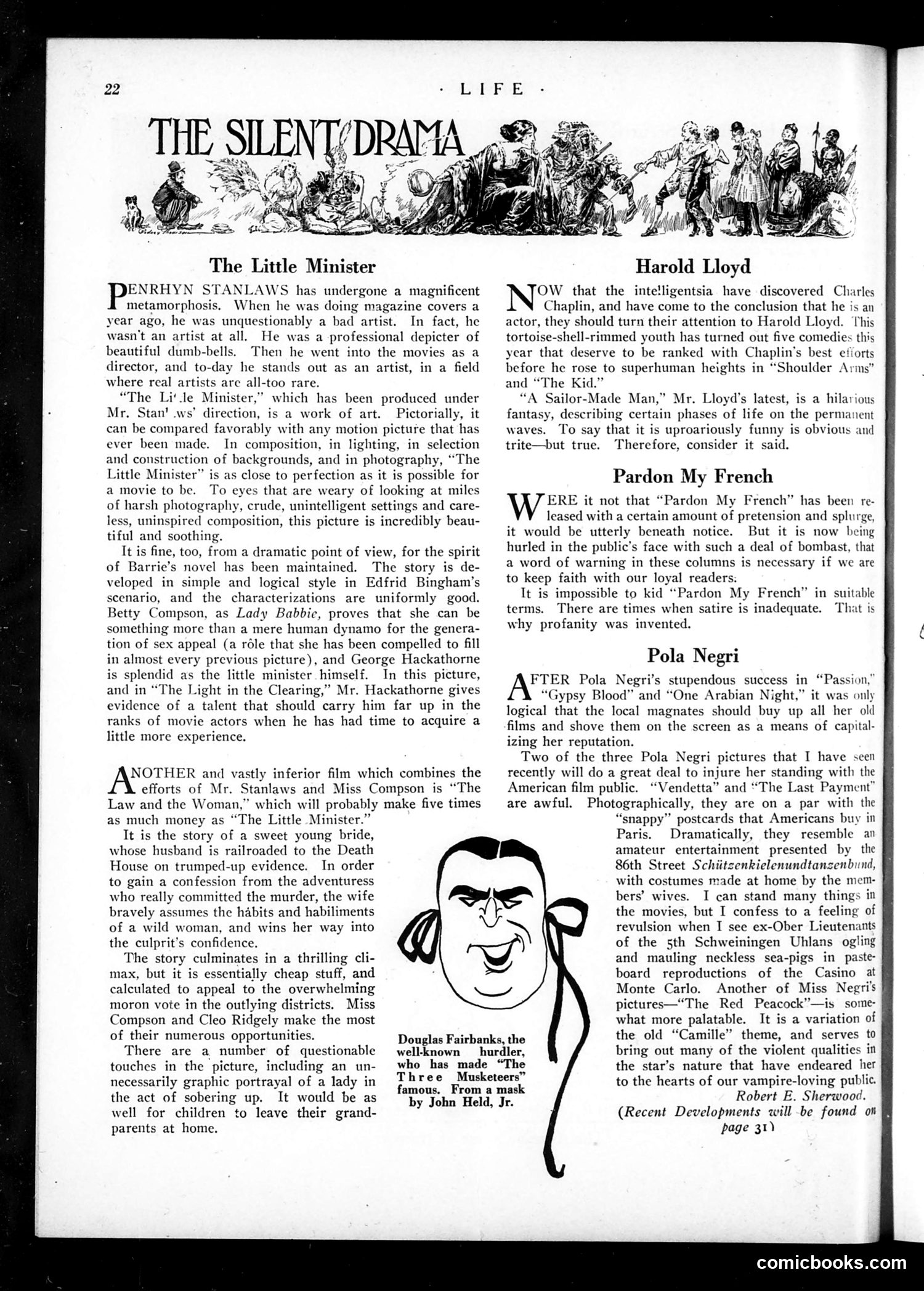
This page from *Life* magazine contains reviews of several silent films, featuring a caricature of **Douglas Fairbanks** (identified in the caption as "the well-known hurdler"). The cartoon exaggerates his distinctive features in John Held Jr.'s typical style. The reviews discuss: 1. **"The Little Minister"** — praising director Penrhyn Stanlaws's artistic transformation from mediocre magazine illustrator to serious filmmaker, and Betty Compson's performance 2. **"The Law and the Woman"** — dismissing it as cheap entertainment designed for "the overwhelming moron vote in the outlying districts," criticizing its graphic depictions 3. **Harold Lloyd** — championing the "tortoise-shell-rimmed youth" as deserving recognition alongside Charlie Chaplin for his comedies 4. **"Pardon My French"** — briefly noting it's overmarketed but inadequate The tone is sophisticated and somewhat elitist, distinguishing between artful cinema and mass-market entertainment for rural audiences.
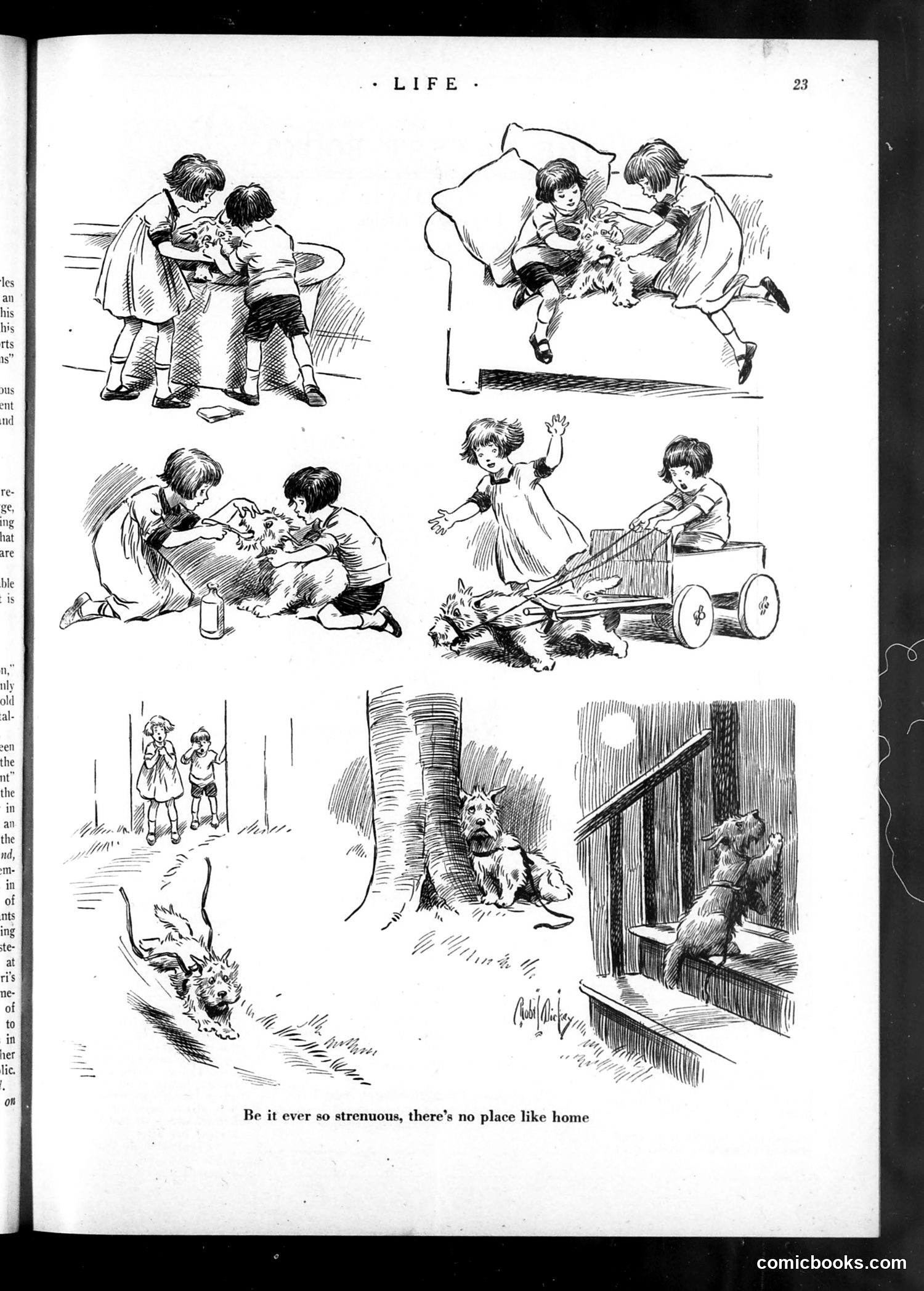
This page presents a series of domestic scenes featuring children and pets engaged in various activities—playing with dolls, chasing each other on beds, pulling toys, exploring outdoors, and interacting with dogs. The caption "Be it ever so strenuous, there's no place like home" is a playful twist on the popular saying "Be it ever so humble, there's no place like home." The satire appears gentle rather than political: it humorously depicts childhood as inherently chaotic and energetic ("strenuous"), contrasting the idealized notion of home as a peaceful refuge with the reality of children's boisterous play and mischief. The various vignettes—some indoors, some outdoors—show the constant activity and messiness of domestic life with youngsters, suggesting that "home" involves considerable commotion despite its sentimental associations.
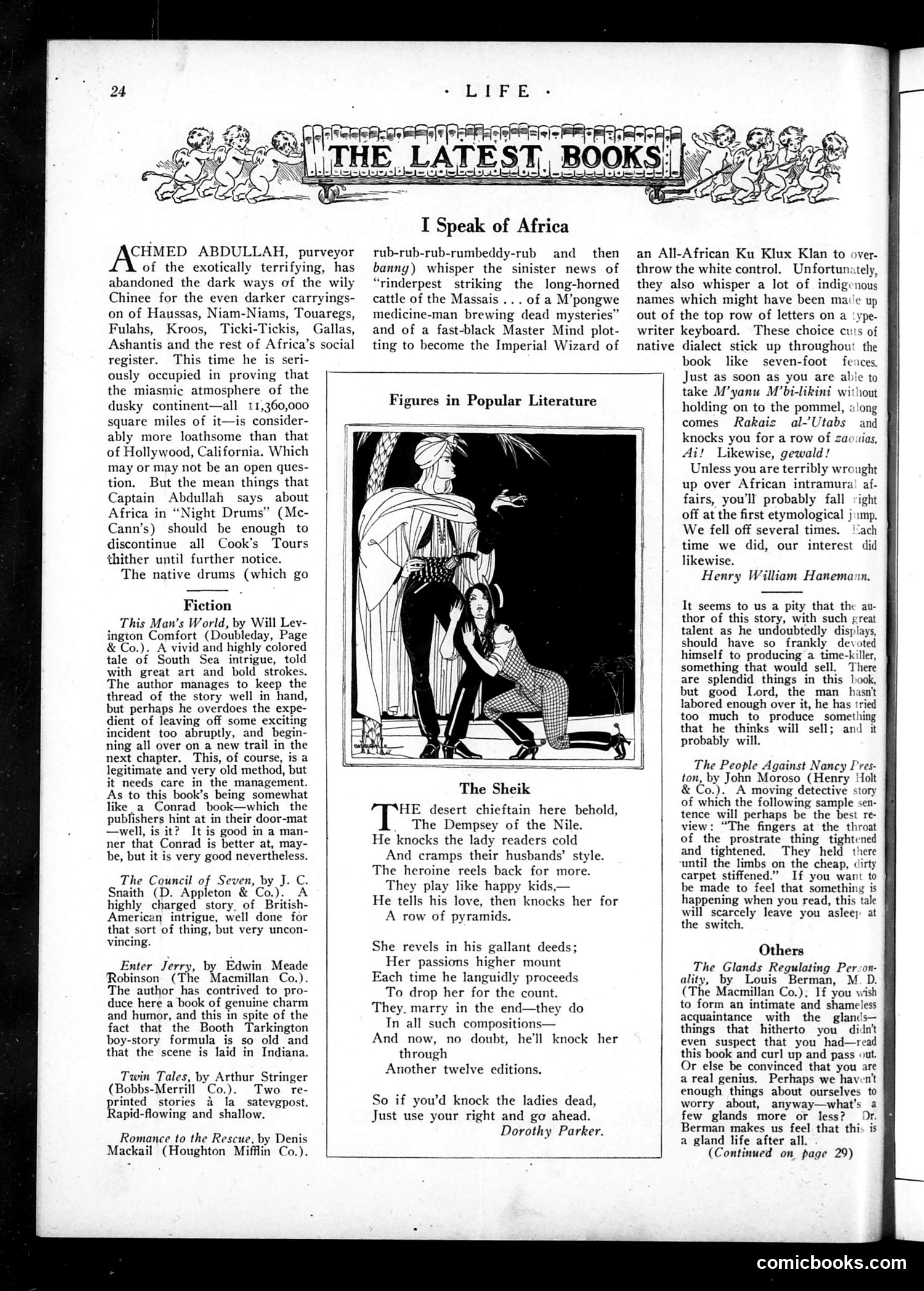
This page reviews new books, with particular focus on "I Speak of Africa," a work by "Achmed Abdullah" critiquing sensationalist African fiction. The reviewer mocks Abdullah's novel "Night Drums" for trafficking in racist stereotypes—exaggerated "native" names pulled from typewriter keys, portrayal of Africa as inherently sinister, and inclusion of a plot about an "All-African Ku Klux Klan." The accompanying illustration depicts "The Sheik," referencing the popular 1921 Rudolph Valentino film. The satirical poem mocks formulaic romance fiction where exotic male characters seduce European women through physical dominance ("knocks the lady readers cold"). The satire targets both the sensationalist adventure novels themselves and their audiences' appetite for racist exoticism—whether African "savagery" or Arabian masculinity. The review suggests such works prioritize commercial appeal over literary merit or truthfulness.
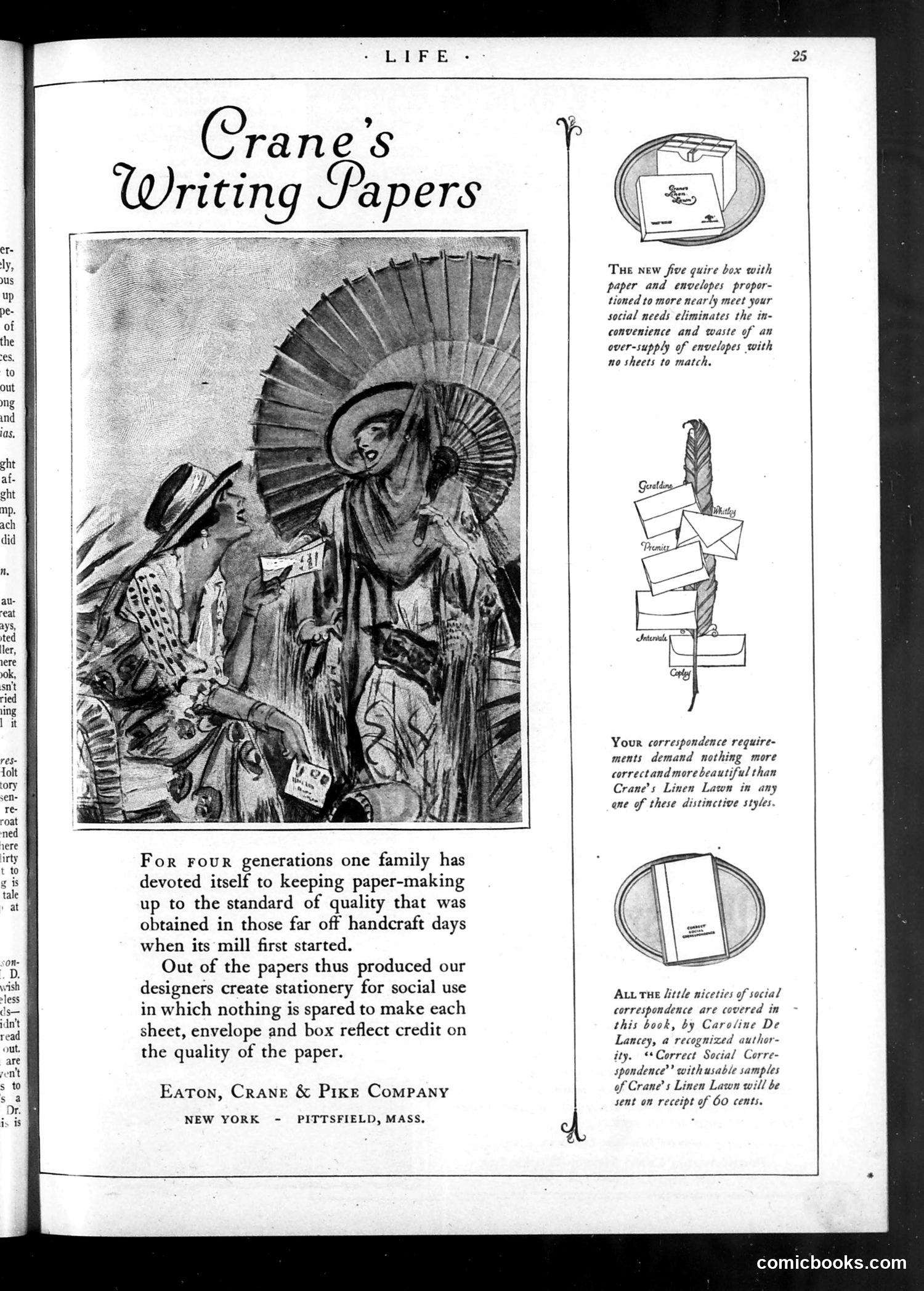
This is a **full-page advertisement**, not satire or political commentary. It promotes Crane's Writing Papers, a stationery company claiming four generations of quality papermaking. The large illustration depicts an 18th-century figure in period dress (tricorn hat, fancy coat) examining correspondence—a historical reference suggesting the company's tradition and craftsmanship dating to handcraft origins. The ad emphasizes practical benefits: matched paper and envelope quantities eliminating waste, and premium "Linen Lawn" stationery for social correspondence. Right-side panels showcase product boxes and reference a guide titled "Correct Social Correspondence" by Caroline De Lancey, positioning Crane's as essential for proper etiquette. The company (Eaton, Crane & Pike) operated from New York and Pittsfield, Massachusetts. This represents typical early-20th-century prestige advertising targeting middle-to-upper-class consumers concerned with social propriety and quality goods.
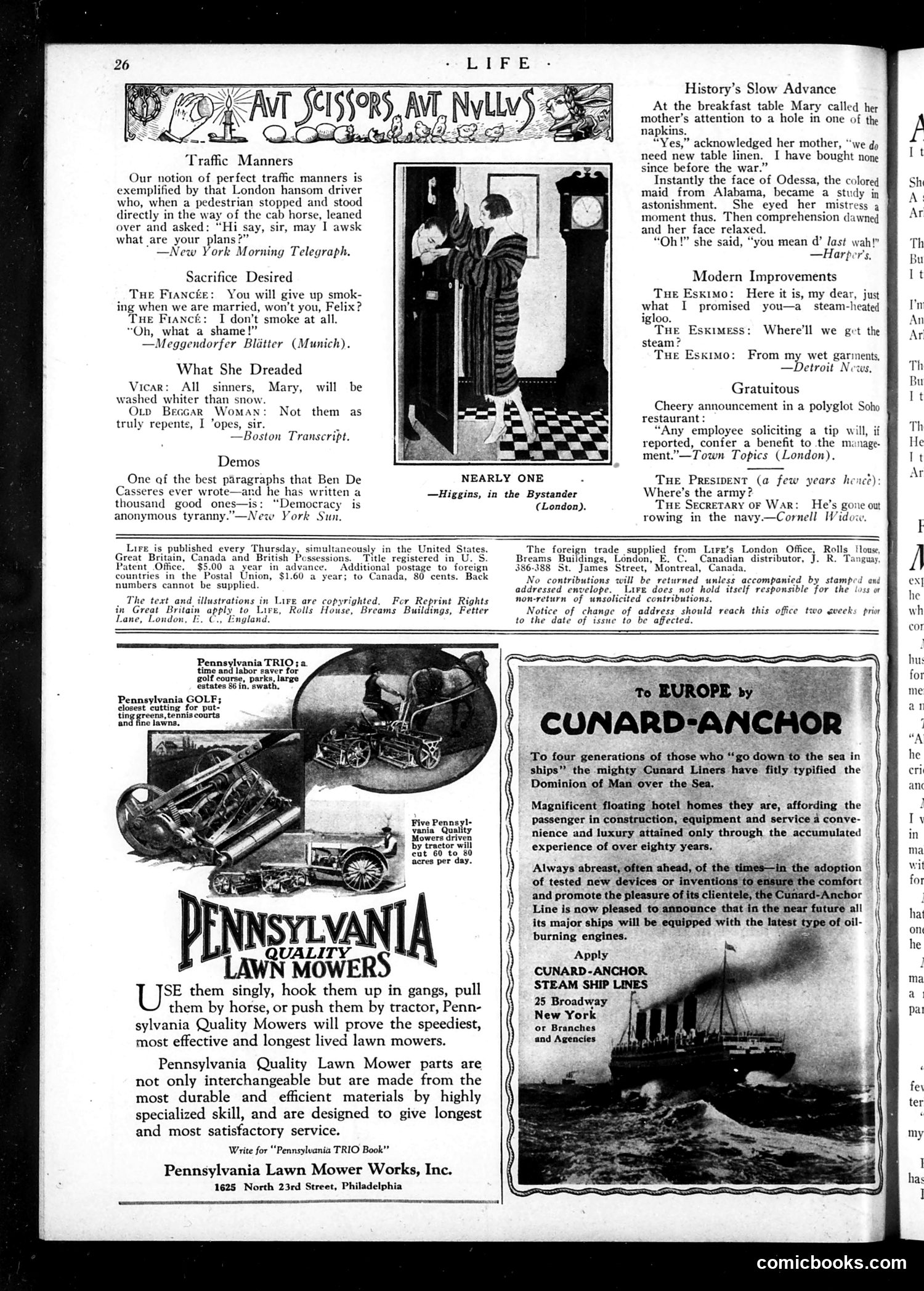
This page contains brief humorous anecdotes ("Ant Scissors, Ant Nulls") typical of Life's satirical format, plus advertisements. **The jokes mock social conventions:** - "Traffic Manners" satirizes British politeness through a London cab driver's exaggerated courtesy - "Sacrifice Desired" jokes that a woman is disappointed her fiancé already doesn't smoke—removing her ability to reform him - "What She Dreaded" uses a vicar's sermon about sinners being "washed whiter than snow" to satirize racial attitudes (the punchline suggests the Black maid fears losing her identity) - "History's Slow Advance" presents a Black servant's delayed realization that her white employer hasn't bought linens since before WWI—commenting on both post-war scarcity and racial dynamics **"Modern Improvements"** humorously contrasts Eskimo ingenuity with absurdity (heating an igloo with wet garments). The remaining content consists of **advertisements** for Pennsylvania lawn mowers and Cunard-Anchor steamship lines, typical of period magazine revenue.
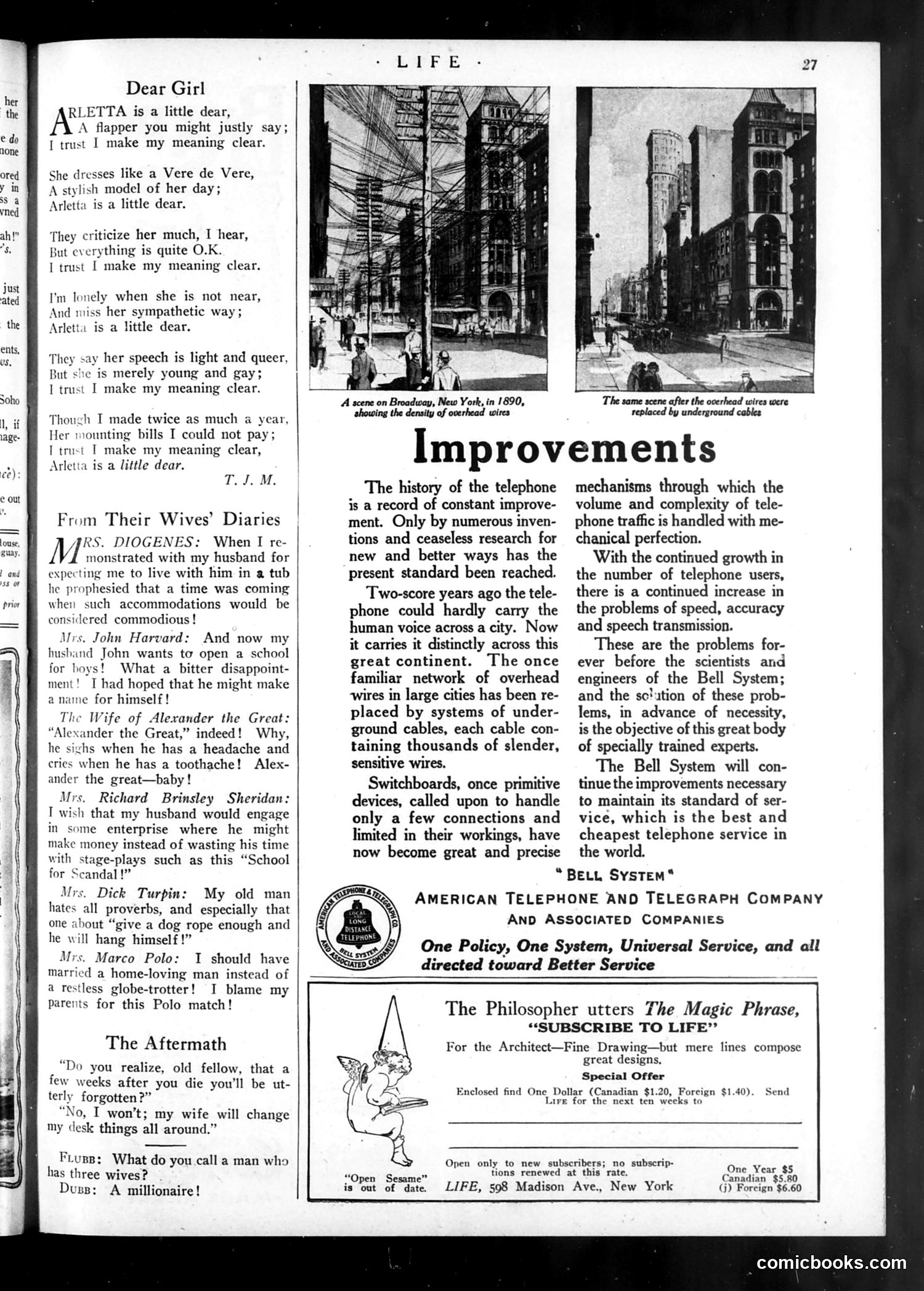
This page combines poetry, historical humor, and advertising. The "Dear Girl" poem satirizes a modern young man infatuated with "Arletta," a 1920s flapper—a fashionable but expensive woman whose "mounting bills" he cannot afford. The poem gently mocks both the flapper lifestyle and male romantic vulnerability. "From Their Wives' Diaries" presents humorous historical reversals where famous men's wives complain about their husbands' ambitions. Mrs. John Harvard resents his desire to open a school; Alexander the Great's wife calls him a "baby." The satire inverts heroic reputation, suggesting great men appear less impressive to their spouses. The page's centerpiece is a Bell System advertisement featuring before-and-after photographs of Broadway (1890 versus present day), celebrating telephone infrastructure improvements—overhead wires replaced by underground cables. This celebrates technological progress and serves as corporate messaging about Bell's modernization efforts. The humor and advertising reflect Life's role as both satirical commentary on contemporary social changes and a vehicle for corporate promotion.
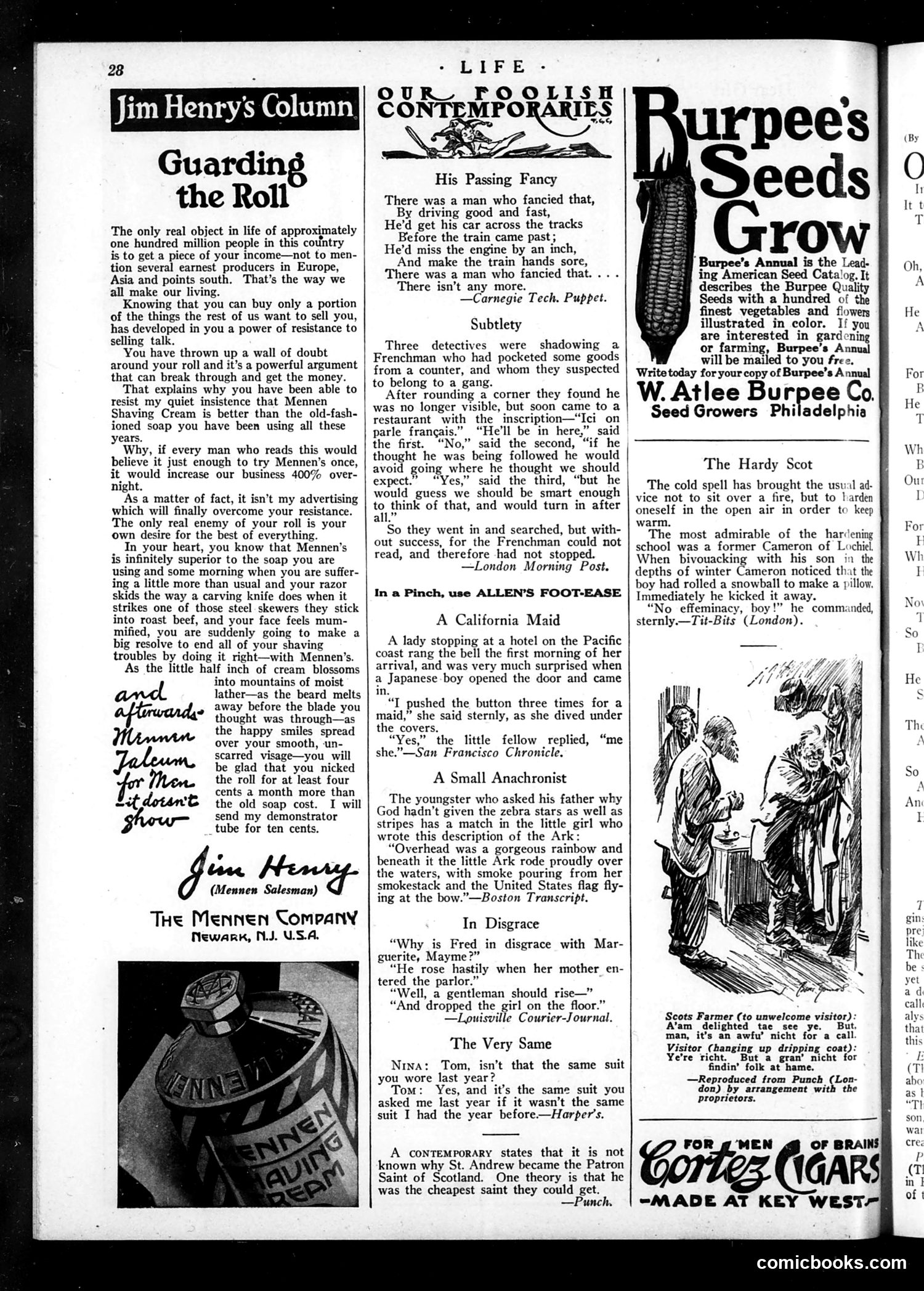
This page from *Life* magazine contains three main humor pieces: **"His Passing Fancy"** satirizes reckless drivers who attempt to cross railroad tracks ahead of oncoming trains. The poem's punchline—"There isn't any more"—darkly suggests the driver's fatal miscalculation. This reflects early-20th-century concerns about automobile safety and the intersection of new transportation technologies. **"Subtlety"** is a logic puzzle about three detectives pursuing a French theft suspect. The joke hinges on over-thinking: each detective assumes the suspect will anticipate their reasoning, leading to paralysis. The French man ultimately succeeds not through cleverness but by being illiterate and thus unable to read the restaurant sign—a stereotypical ethnic joke. **"A California Maid"** plays on language confusion: a woman, expecting a female maid, receives a Japanese male servant instead and is mortified. The humor relies on period racial/ethnic stereotyping and awkwardness. The dominant content is actually the lengthy **Mennen Shaving Cream advertisement** in Jim Henry's voice, which uses pseudo-philosophical sales rhetoric to convince readers to purchase their product over traditional soap.
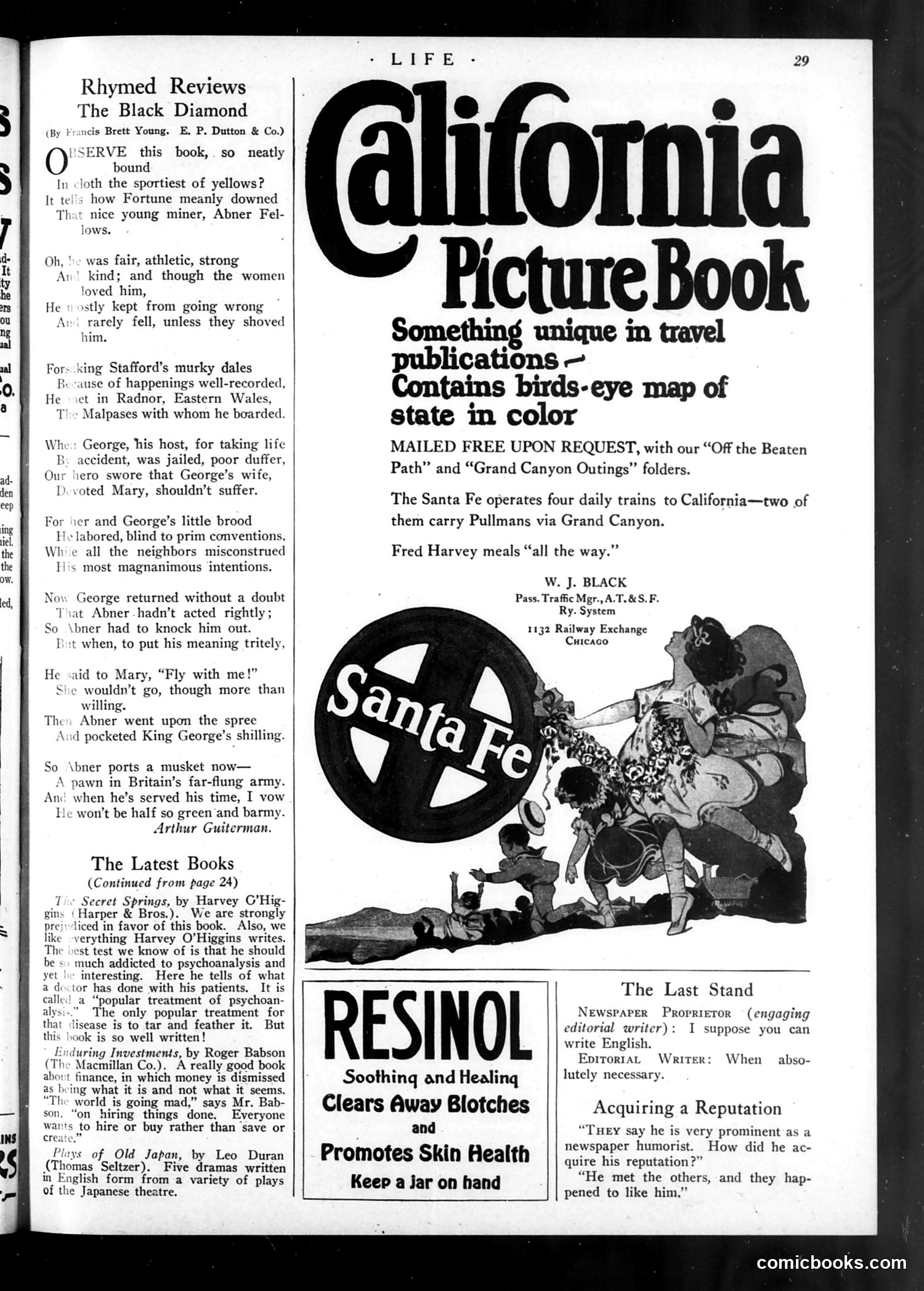
This page contains literary reviews, advertisements, and two short satirical dialogues. **"The Black Diamond" Review**: A rhymed book review by Arthur Guiterman about a novel by Francis Brett Young. The poem narrates a young miner named Abner Fellows who remains virtuous despite temptation, but ultimately enlists in the British Army after a romantic disappointment. The satire lies in the ironic conclusion: the "nice young man" becomes a soldier—suggesting that preserving one's morality may lead to greater danger than vice. **"The Last Stand" Dialogue**: A brief comic exchange mocking newspaper editors. An editor hiring a writer asks only that he "write English," implying that proper grammar is the sole requirement for journalism—satirizing the low intellectual standards of the profession. The page is primarily filler content around advertisements for California travel, Resinol skincare, and book announcements, typical of Life magazine's mixed editorial-advertising format from this era.
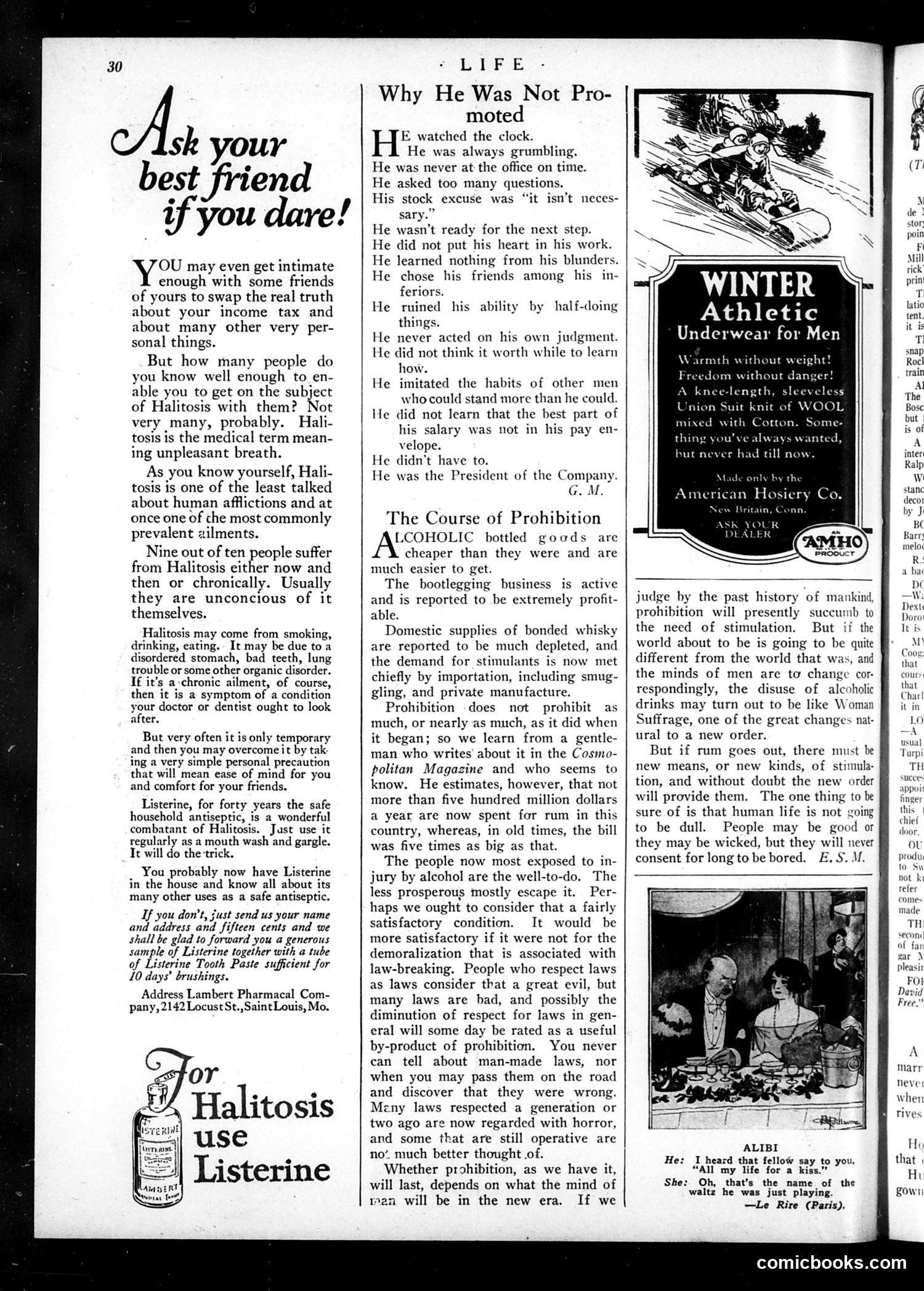
This page contains period advertising and social commentary from the Prohibition era (1920s-early 1930s). **The Cartoons/Content:** 1. **"Ask Your Best Friend If You Dare"** – A Listerine mouthwash ad using social embarrassment as a sales tactic, implying halitosis (bad breath) is so shameful people won't discuss it even with close friends. 2. **"Why He Was Not Promoted"** – A satirical workplace commentary listing reasons an employee wasn't advanced, culminating in the punchline: he was the President—suggesting incompetent leadership often goes unaccountable. 3. **"The Course of Prohibition"** – Social commentary on Prohibition's failure, noting that despite the alcohol ban (in effect since 1920), bootlegging thrives, supplies remain available, and spending on illegal alcohol continues substantially. The author argues Prohibition hasn't actually prohibited much, merely shifted consumption patterns and created law-breaking culture. The page reflects 1920s anxieties about workplace dynamics, personal hygiene stigma, and growing skepticism about Prohibition's effectiveness.
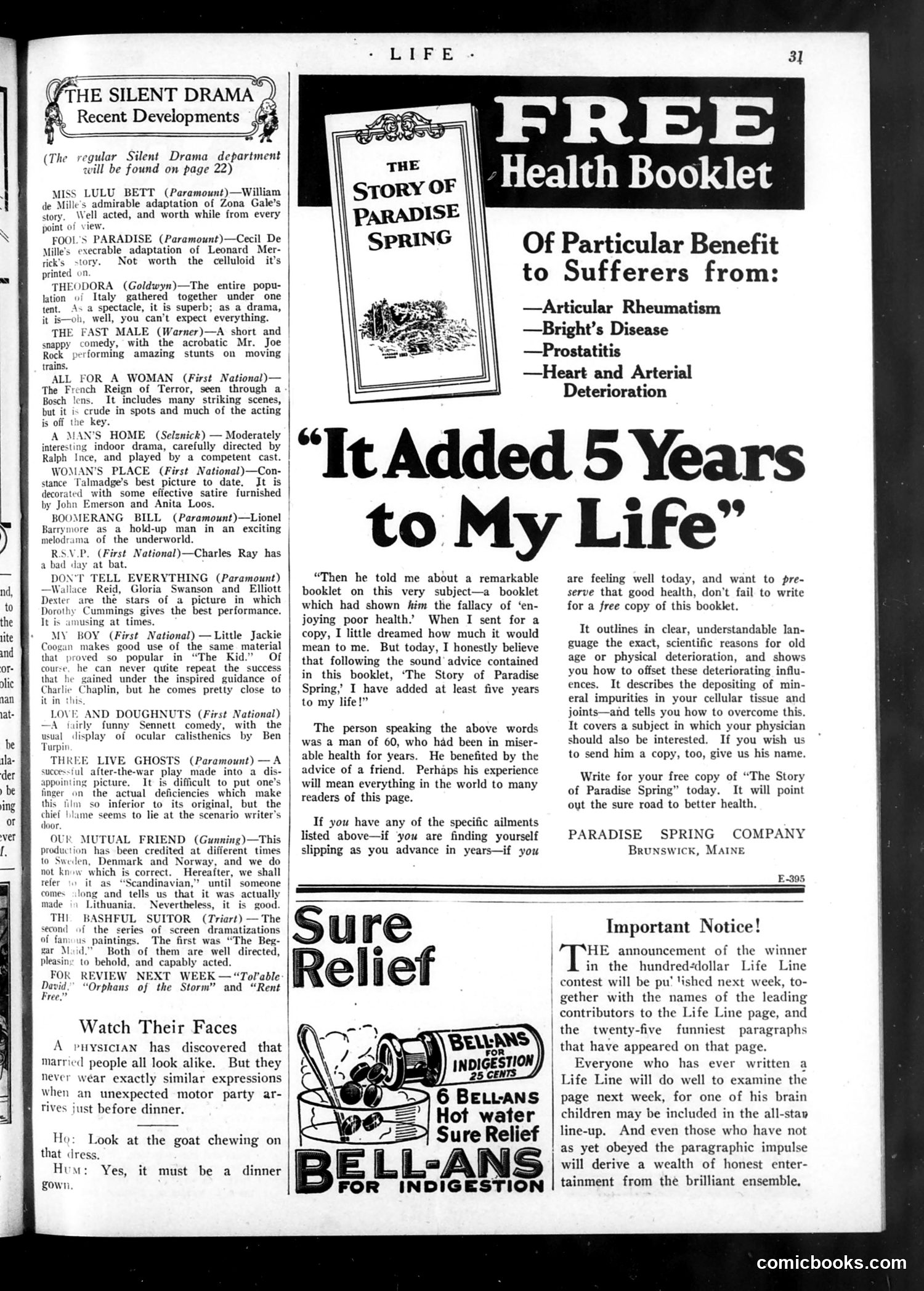
This page contains **film reviews** (left column) and **health supplement advertising** (right side). **The Film Reviews:** Life magazine critiques silent films from major studios (Paramount, Goldwyn, Warner Bros., etc.), evaluating acting, direction, and storytelling. The tone is witty and dismissive—Cecil DeMille's "Fool's Paradise" is called "execrable," while "Theodora" is spectacle without substance. **The Advertisement:** The "Story of Paradise Spring" is a patent medicine booklet claiming to cure arthritis, kidney disease, prostatitis, and heart problems—common health claims of the 1920s before modern FDA regulation. A testimonial claims it added five years to a 60-year-old man's life. **The Humor Section** ("Watch Their Faces") jokes that married couples look alike, then observes a goat chewing during dinner—suggesting absent-minded observation during social situations. This reflects 1920s media: serious arts criticism alongside completely unregulated medical advertising making miraculous claims.
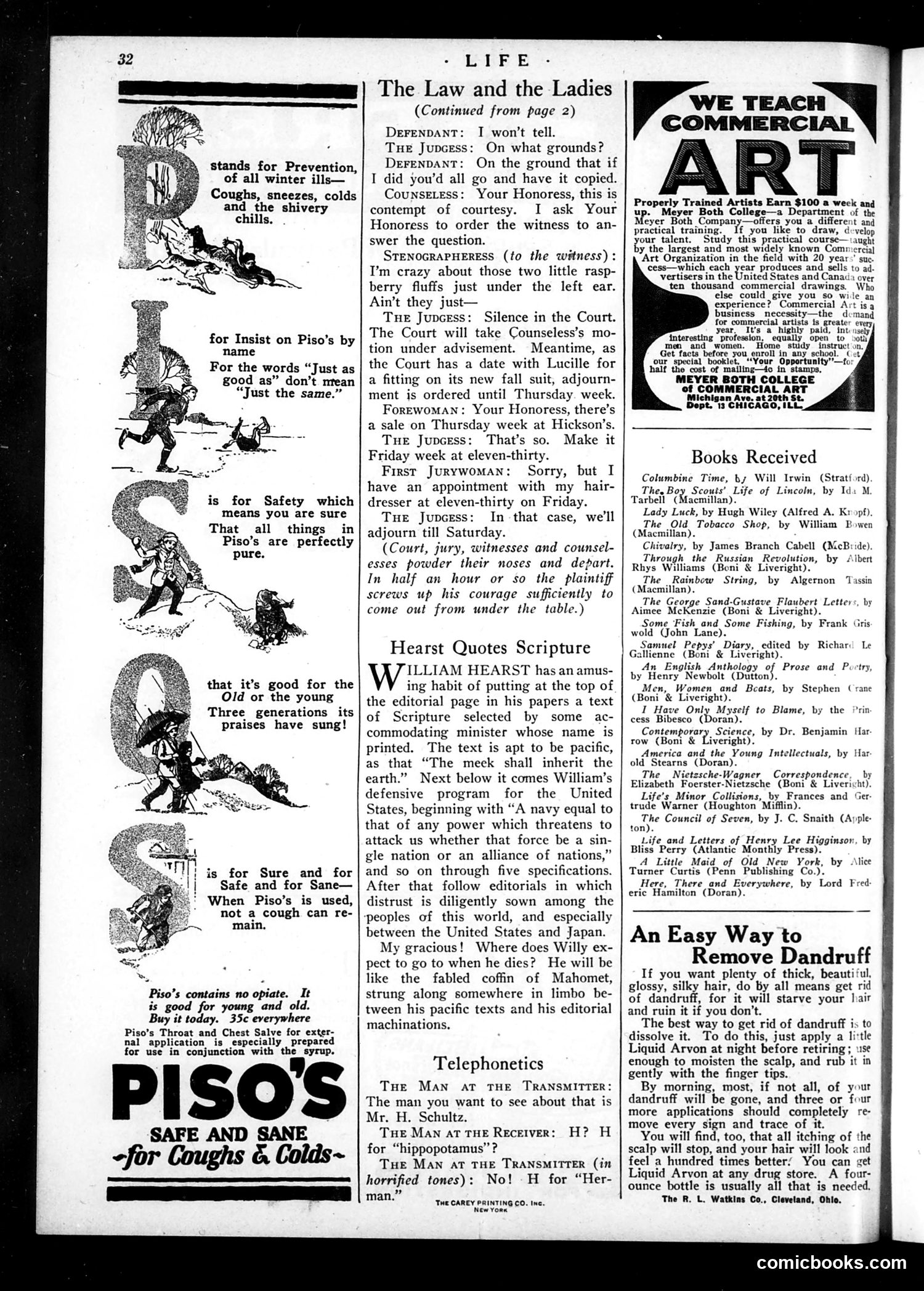
This satirical piece mocks the then-novel concept of women serving in the legal system—as judges, jurors, stenographers, and lawyers. The cartoon depicts a courtroom where all participants are women, portrayed as comically unfit for serious legal work. The humor relies on sexist stereotypes: the female judge abandons proceedings for shopping sales and hair appointments; the stenographer ogles the defendant's appearance rather than recording testimony; jurors powder their noses instead of deliberating. The defendant literally hides under a table, suggesting the proceedings are farcical. The accompanying text sarcastically refers to "Counseless," "Jurywoman," and "Stenographeress"—mocking feminized titles for professional roles. The implication is that women cannot separate personal vanity and social obligations from judicial duty, rendering the entire legal system absurd. This reflects early-20th-century opposition to women's professional advancement and voting rights.