
Life, 1922-01-19 · page 23 of 34
Life — January 19, 1922 — page 23: what you’re looking at
What you’re looking at
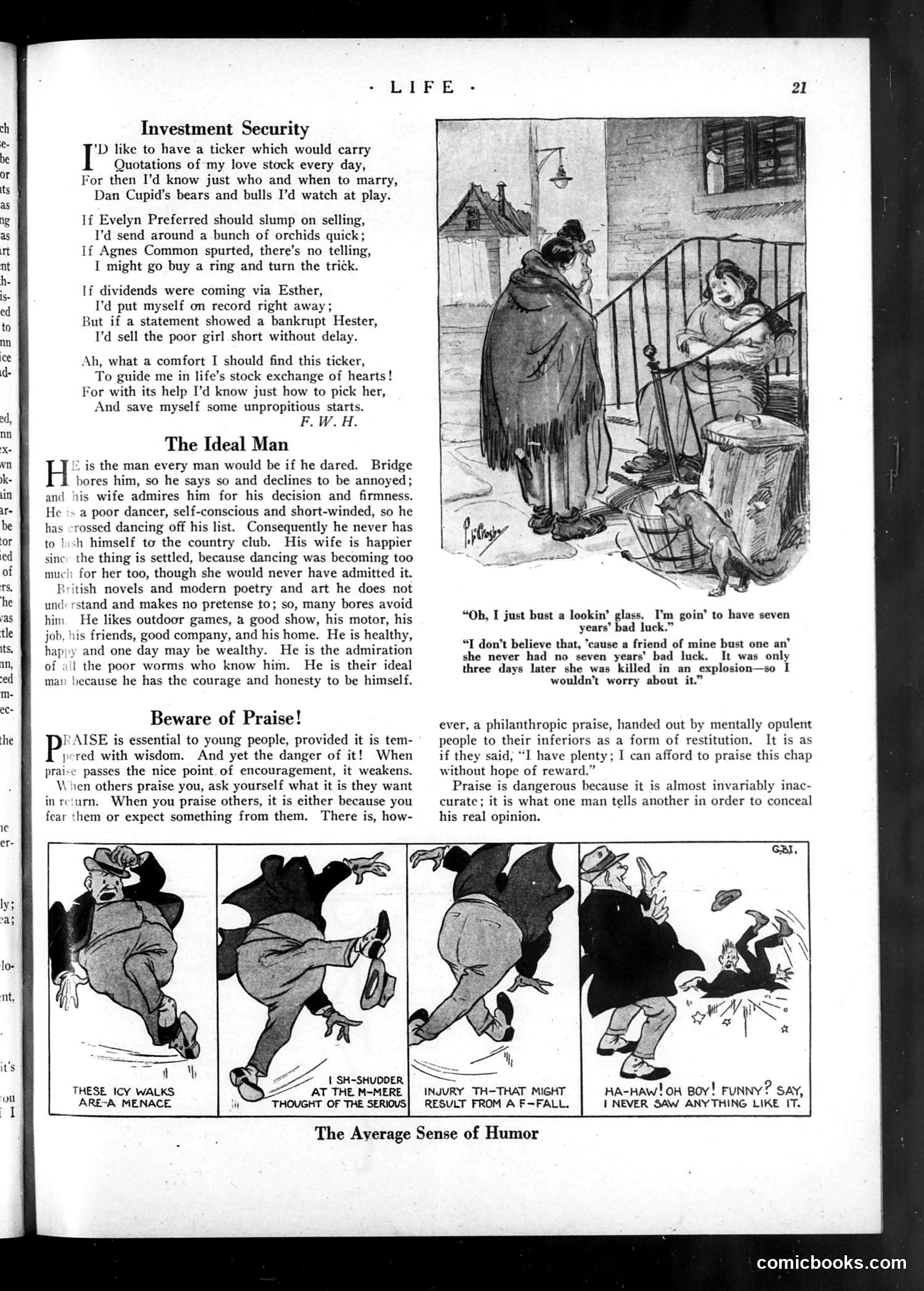
**"Investment Security"** (top poem): This satirizes the stock market craze of the 1920s by extending Wall Street metaphors to romance. The speaker wishes for a "ticker" to track women's "love stock"—treating courtship like securities trading, with references to "bears and bulls," "preferred" stocks, and "selling short." The joke mocks how financial language and speculation had permeated American culture, suggesting men approach marriage with the same calculating, risk-assessment mentality as investors. **"The Average Sense of Humor"** (bottom comic strip): This four-panel sequence demonstrates darkly ironic working-class humor. A person breaks a mirror and claims seven years' bad luck; their friend reveals they broke one and suffered only three days before being killed in an explosion—so "wouldn't worry about it." The punchline's absurd logic (death trumps superstition) exemplifies how ordinary people found grim comedy in fate and misfortune, illustrating early 20th-century popular humor styles among the lower classes.
📄 Transcribed text from this page (OCR, searchable)
Machine-transcribed from the original scan — historical spelling and the odd misread are preserved.
Investment Security [” like to have a ticker which would carry Quotations of my love stock every day, For then I’d know just who and when to marry, Dan Cupid’s bears and bulls I’d watch at play. If Evelyn Preferred should slump on selling, I’d send around a bunch of orchids quick; If Agnes Common spurted, there’s no telling, I might go buy a ring and turn the trick. If dividends were coming via Esther, I'd put myself on record right away; But if a statement showed a bankrupt Hester, I’d sell the poor girl short without delay. Ah, what a comfort I should find this ticker, To guide me in life’s stock exchange of hearts! For with its help I’d know just how to pick her, And save myself some unpropitious starts. FLW. H. The Ideal Man ’ is the man every man would be if he dared. Bridge bores him, so he says so and declines to be annoyed; and his wife admires him for his decision and firmness. He :s a poor dancer, self-conscious and short-winded, so he has crossed dancing off his list. Consequently he never has to lish himself to the country club. His wife is happier sinc. the thing is settled, because dancing was becoming too much for her too, though she would never have admitted it. British novels and modern poetry and art he does not und: rstand and makes no pretense to; so, many bores avoid him. He likes outdoor games, a good show, his motor, his job, his friends, good company, and his home. He is healthy, happy and one day may be wealthy. He is the admiration of ail the poor worms who know him. He is their ideal mat because he has the courage and honesty to be himself. Beware of Praise! RAISE is essential to young people, provided it is tem- pered with wisdom. And yet the danger of it! When praise passes the nice point of encouragement, it weakens. When others praise you, ask yourself what it is they want in rciurn. When you praise others, it is either because you fear them or expect something from them. There is, how- gt Te \SH-SHUDDER cS AT THE M-MERE The Average Sense of Humor THESE ICY WALKS ARE-A MENACE “Oh, I just bust a lookin’ glass. I’m goin’ to have seven years’ bad luck.” “I don’t believe that, cause a friend of mine bust one an’ she never had no seven years’ bad luck. It was only three days later she was killed in an explosion—so I wouldn’t worry about it.” ever, a philanthropic praise, handed out by mentally opulent people to their inferiors as a form of restitution. It is as if they said, “I have plenty; I can afford to praise this chap without hope of reward.” Praise is dangerous because it is almost invariably inac- curate; it is what one man tells another in order to conceal his real opinion. HA-HAW!OH Boy! FUNNY? SAY, I NEVER SAW ANYTHING LIKE IT. comicbooks.com