
Life, 1922-01-19 · page 20 of 34
Life — January 19, 1922 — page 20: what you’re looking at
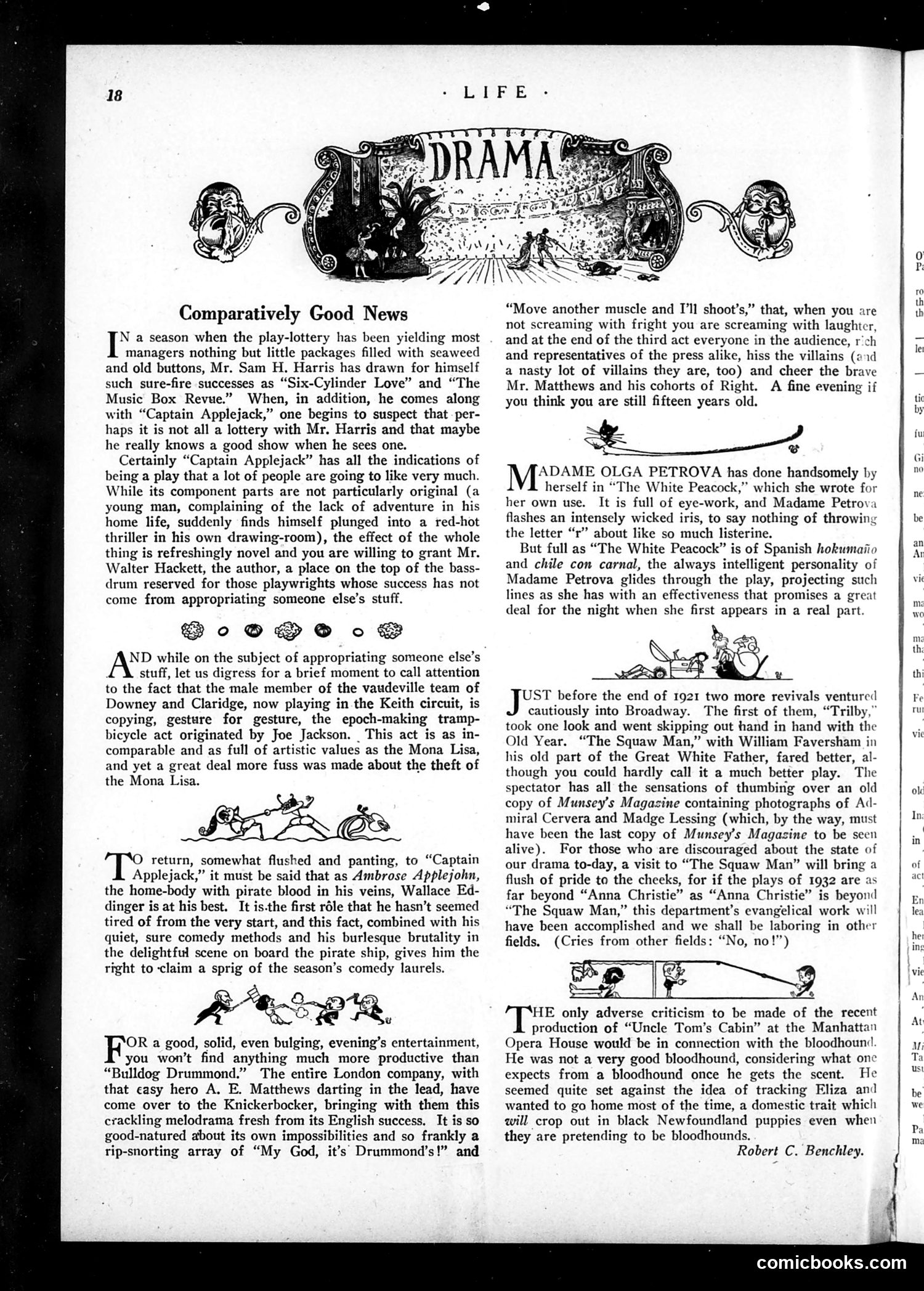
What you’re looking at
This is a theater review page from Life magazine (circa 1921, based on references to "1921 two more revivals"). The decorative header features theatrical masks and the word "DRAMA." The page reviews several Broadway productions: - **"Captain Applejack"** by Walter Hackett, praised for originality despite conventional plot elements - **"Bulldog Drummond"**, a melodrama starring A.E. Matthews, celebrated for self-aware humor about its own absurdity - **"The White Peacock"**, written by and starring actress Olga Petrova The reviews also contain **criticism of theatrical theft**: the author calls out vaudeville performer Downey for copying Joe Jackson's famous tramp-bicycle act—comparing it unfavorably to the Mona Lisa theft scandal, sarcastically suggesting the bicycle act deserves equal protection. The tone is witty, gossipy, and aimed at theatergoers. No political content is present; this is purely entertainment criticism from the Jazz Age theater scene.
📄 Transcribed text from this page (OCR, searchable)
Machine-transcribed from the original scan — historical spelling and the odd misread are preserved.
Comparatively Good News N a season when the play-lottery has been yielding most managers nothing but little packages filled with seaweed and old buttons, Mr. Sam H. Harris has drawn for himself such sure-fire successes as “Six-Cylinder Love” and “The Music Box Revue.” When, in addition, he comes along with “Captain Applejack,” one begins to suspect that per- haps it is not all a lottery with Mr. Harris and that maybe he really knows a good show when he sees one. Certainly “Captain Applejack” has all the indications of being a play that a lot of people are going to like very much. While its component parts are not particularly original (a young man, complaining of the lack of adventure in his home life, suddenly finds himself plunged into a red-hot thriller in his own drawing-room), the effect of the whole thing is refreshingly novel and you are willing to grant Mr. Walter Hackett, the author, a place on the top of the bass- drum reserved for those playwrights whose success has not come from appropriating someone else’s stuff. Boe Mo oS ND while on the subject of appropriating someone else’s stuff, let us digress for a brief moment to call attention to the fact that the male member of the vaudeville team of Downey and Claridge, now playing in the Keith circuit, is copying, gesture for gesture, the epoch-making tramp- bicycle act originated by Joe Jackson. This act is as in- comparable and as full of artistic values as the Mona Lisa, and yet a great deal more fuss was made about the theft of the Mona Lisa. SAPO» i ee return, somewhat flushed and panting, to “Captain Applejack,” it must be said that as Ambrose Applejohn, the home-body with pirate blood in his veins, Wallace Ed- dinger is at his best. It is-the first réle that he hasn’t seemed tired of from the very start, and this fact, combined with his quiet, sure comedy methods and his burlesque brutality in the delightful scene on board the pirate ship, gives him the right to claim a sprig of the season’s comedy laurels. FCB R, OR a good, solid, even bulging, evening’s entertainment, you won’t find anything much more productive than “Bulldog Drummond.” The entire London company, with that easy hero A. E. Matthews darting in the lead, have come over to the Knickerbocker, bringing with them this crackling melodrama fresh from its English success. It is so good-natured about its own impossibilities and so frankly a rip-snorting array of “My God, it’s Drummond’s!” and “Move another muscle and I’ll shoot’s,” that, when you are not screaming with fright you are screaming with laughter, and at the end of the third act everyone in the audience, r'ch and representatives of the press alike, hiss the villains (and a nasty lot of villains they are, too) and cheer the brave Mr. Matthews and his cohorts of Right. A fine evening if you think you are still fifteen years old. & ADAME OLGA PETROVA has done handsomely by herself in “The White Peacock,” which she wrote for her own use. It is full of eye-work, and Madame Petrova flashes an intensely wicked iris, to say nothing of throwing the letter “r” about like so much listerine. But full as “The White Peacock” is of Spanish hokumaiio and chile con carnal, the always intelligent personality of Madame Petrova glides through the play, projecting such lines as she has with an effectiveness that promises a great deal for the night when she first appears in a real part. pl fees before the end of 1921 two more revivals ventured cautiously into Broadway. The first of them, “Trilby,” took one look and went skipping out hand in hand with the Old Year. “The Squaw Man,” with William Faversham in his old part of the Great White Father, fared better, al- though you could hardly call it a much better play. The spectator has all the sensations of thumbing over an old copy of Munsey’s Magazine containing photographs of Ad- miral Cervera and Madge Lessing (which, by the way, must have been the last copy of Munsey’s Magazine to be seen alive). For those who are discouraged about the state of our drama to-day, a visit to “The Squaw Man” will bring a flush of pride to the cheeks, for if the plays of 1932 are as far beyond “Anna Christie” as “Anna Christie” is beyond “The Squaw Man,” this department’s evangelical work will have been accomplished and we shall be laboring in other fields. (Cries from other fields: “No, no!”) ee |F ~~ HE only adverse criticism to be made of the recent production of “Uncle Tom’s Cabin” at the Manhattan Opera House would be in connection with the bloodhoun( He was not a very good bloodhound, considering what one expects from a bloodhound once he gets the scent. He seemed quite set against the idea of tracking Eliza and wanted to go home most of the time, a domestic trait which will crop out in black Newfoundland puppies even when they are pretending to be bloodhounds. Robert C. Benchley. tic by fu Gi no ne be comicbooks.com