
Life, 1922-01-19 · page 24 of 34
Life — January 19, 1922 — page 24: what you’re looking at
What you’re looking at
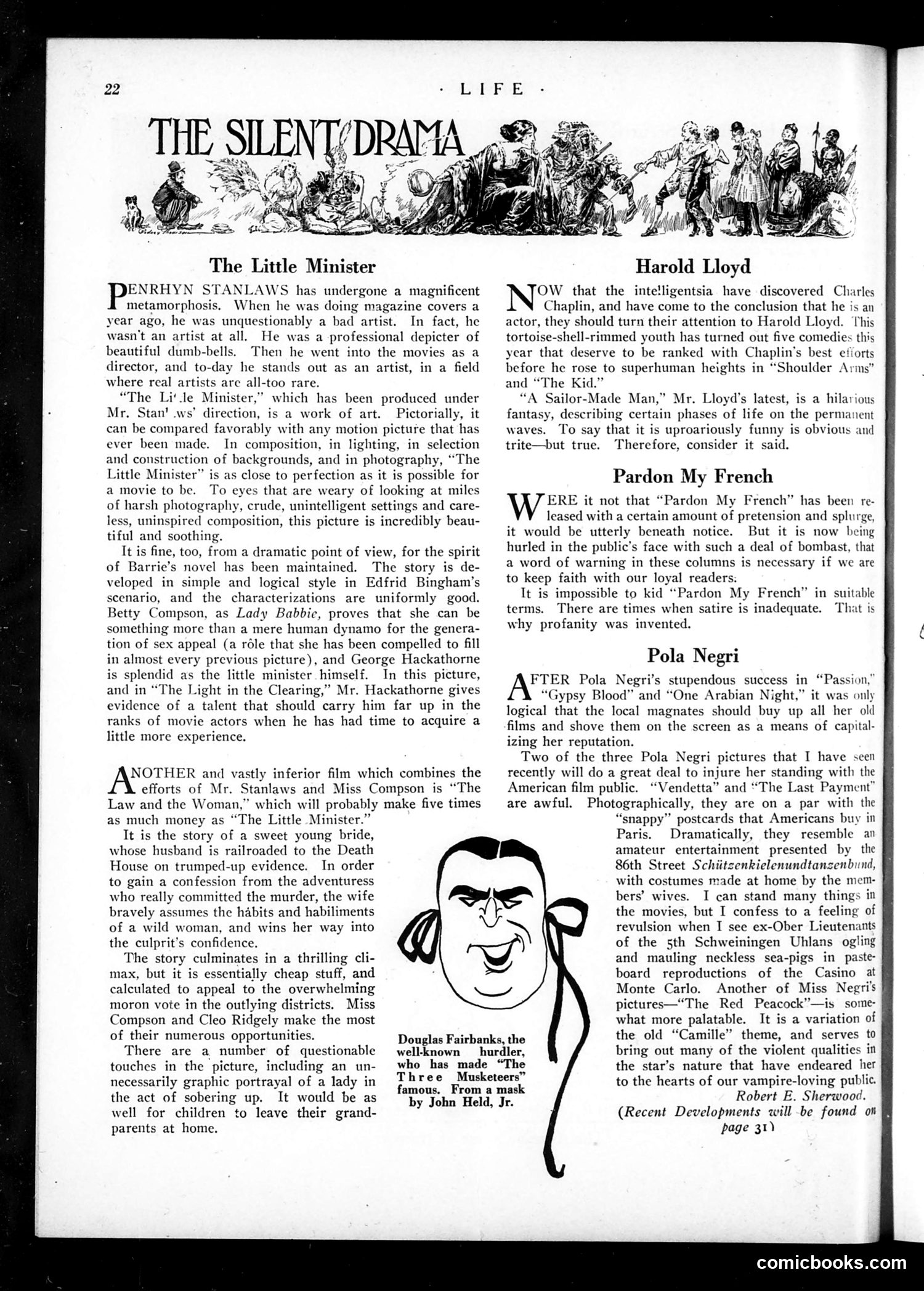
This page from *Life* magazine contains reviews of several silent films, featuring a caricature of **Douglas Fairbanks** (identified in the caption as "the well-known hurdler"). The cartoon exaggerates his distinctive features in John Held Jr.'s typical style. The reviews discuss: 1. **"The Little Minister"** — praising director Penrhyn Stanlaws's artistic transformation from mediocre magazine illustrator to serious filmmaker, and Betty Compson's performance 2. **"The Law and the Woman"** — dismissing it as cheap entertainment designed for "the overwhelming moron vote in the outlying districts," criticizing its graphic depictions 3. **Harold Lloyd** — championing the "tortoise-shell-rimmed youth" as deserving recognition alongside Charlie Chaplin for his comedies 4. **"Pardon My French"** — briefly noting it's overmarketed but inadequate The tone is sophisticated and somewhat elitist, distinguishing between artful cinema and mass-market entertainment for rural audiences.
📄 Transcribed text from this page (OCR, searchable)
Machine-transcribed from the original scan — historical spelling and the odd misread are preserved.
The Little Minister NRHYN STANLAWS has undergone a magnificent metamorphosis. When he was doing magazine covers a year ago, he was unquestionably a bad artist. In fact, he wasn't an artist at all. He was a professional depicter of beautiful dumb-bells. Then he went into the movies as a director, and to-day he stands out as an artist, in a field where real artists are all-too rare. “The Li‘le Minister,” which has been produced under Mr. Stan’ .ws’ direction, is a work of art. Pictorially, it can be compared favorably with any motion picture that has ever been made. In composition, in lighting, in selection and construction of backgrounds, and in photography, “The Little Minister” is as close to perfection as it is possible for a movie to be. To eyes that are weary of looking at miles of harsh photography, crude, unintelligent settings and care- less, uninspired composition, this picture is incredibly beau- tiful and soothing. It is fine, too, from a dramatic point of view, for the spirit of Barrie’s novel has been maintained. The story is de- veloped in simple and logical style in Edfrid Bingham’s scenario, and the characterizations are uniformly good. Betty Compson, as Lady Babbie, proves that she can be something more than a mere human dynamo for the genera- tion of sex appeal (a réle that she has been compelled to fill in almost every previous picture), and George Hackathorne is splendid as the little minister himself. In this picture, and in “The Light in the Clearing,” Mr. Hackathorne gives evidence of a talent that should carry him far up in the ranks of movie actors when he has had time to acquire a little more experience. NOTHER and vastly inferior film which combines the efforts of Mr. Stanlaws and Miss Compson is “The Law and the Woman,” which will probably make five times as much money as “The Little Minister.” It is the story of a sweet young bride, whose husband is railroaded to the Death House on trumped-up evidence. In order to gain a confession from the adventuress who really committed the murder, the wife bravely assumes the habits and habiliments of a wild woman, and wins her way into the culprit’s confidence. The story culminates in a thrilling cli- max, but it is essentially cheap stuff, and calculated to appeal to the overwhelming moron vote in the outlying districts. Miss Compson and Cleo Ridgely make the most of their numerous opportunities. There are a number of questionable touches in the picture, including an un- necessarily graphic portrayal of a lady in the act of sobering up. It would be as well for children to leave their grand- parents at home. well-known Douglas Fairbanks, the hurdler, who has made “The Three Musketeers” famous. From a mask by John Held, Jr. Harold Lloyd OW that the intetligentsia have discovered Charles Chaplin, and have come to the conclusion that he is an actor, they should turn their attention to Harold Lloyd. This tortoise-shell-rimmed youth has turned out five comedies this year that deserve to be ranked with Chaplin's best etiorts before he rose to superhuman heights in “Shoulder Arms” and “The Kid.” “A Sailor-Made Man,” Mr. Lloyd's latest, is a hilarious fant describing certain ph: of life on the permanent waves. To say that it is uproariously funny is obvious and trite—but true. Therefore, consider it said. Pardon My French RE it not that “Pardon My French” has been re- leased with a certain amount of pretension and splurge, it would be utterly beneath notice. But it is now being hurled in the public’s face with such a deal of bombast, that a word of warning in these columns is necessary if we are to keep faith with our loyal readers: It is impossible to kid “Pardon My French” in suitable terms. There are times when satire is inadequate. why profanity was invented. Pola Negri AGS Pola Negri’s stupendous success in “Passion,” “Gypsy Blood” and “One Arabian Night,” it was only logical that the local magnates should buy up all her old films and shove them on the screen as a means of capital- izing her reputation. Two of the three Pola Negri pictures that I have seen recently will do a great deal to injure her standing with the American film public. “Vendetta” and “The Last Payment” are awful. Photographically, they are on a par with the “snappy” postcards that Americans buy in Paris. Dramatically, they resemble an amateur entertainment presented by the 86th Street Schiitsenkielenundtanzenbind, with costumes made at home by the mem- bers’ wives. I can stand many things in the movies, but I confess to a feeling of revulsion when I see ex-Ober Lieutenants of the sth Schweiningen Uhlans ogling and mauling neckless sea-pigs in paste board reproductions of the Casino at Monte Carlo. Another of Miss Negri’s pictures—“The Red Peacock’ what more palatable. It is a variation of the old “Camille” theme, and serves to bring out many of the violent qualities in the star’s nature that have endeared her to the hearts of our vampire-loving public. Robert E. Sherwood. (Recent Developments will be found on page 31) comicbooks.com —