
Life, 1922-01-19 · page 17 of 34
Life — January 19, 1922 — page 17: what you’re looking at
What you’re looking at
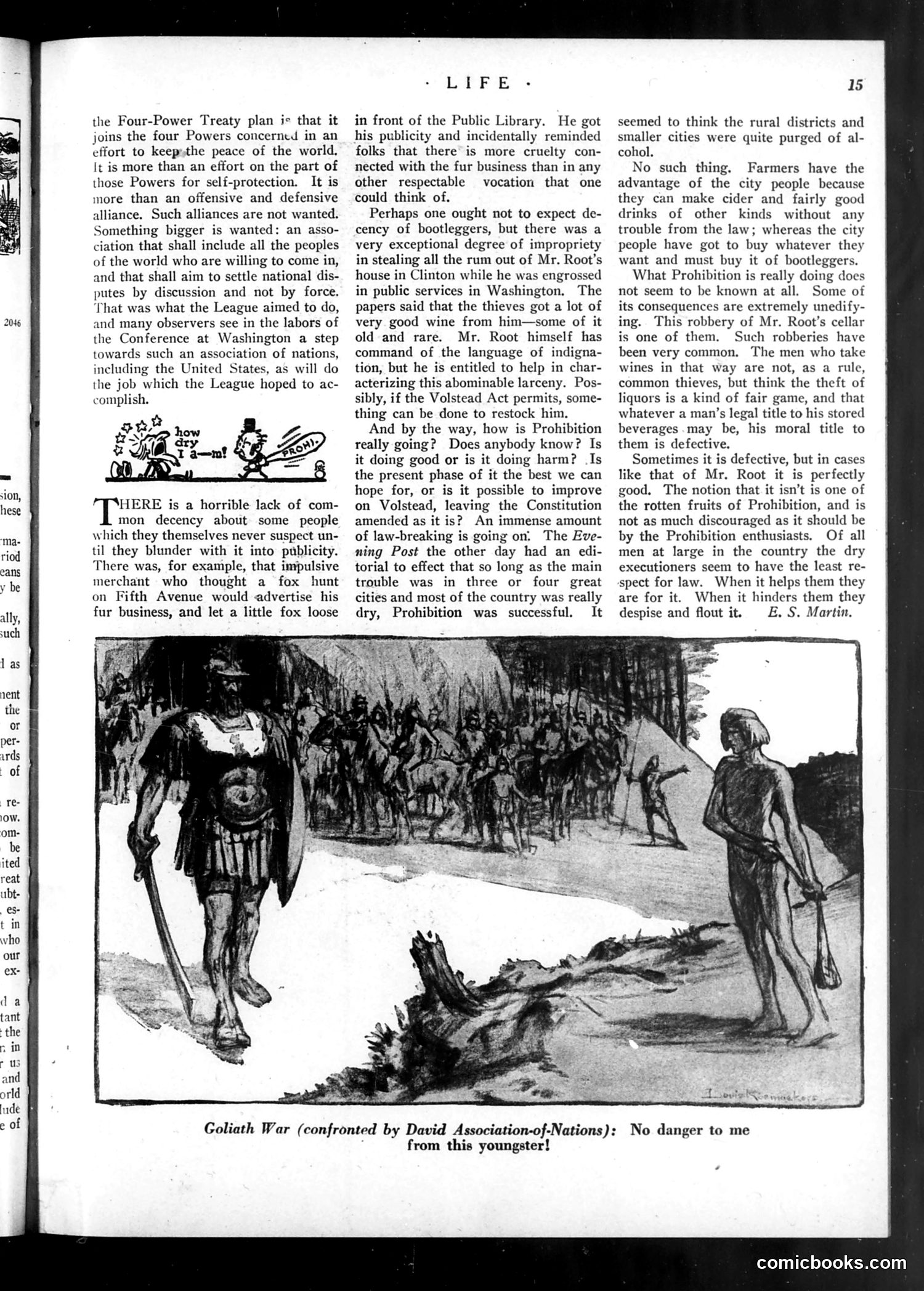
This Life magazine page critiques Prohibition's practical failures and moral consequences. The main text discusses the theft of alcohol from Elihu Root's (prominent statesman) home in Clinton while he served in Washington, arguing this exemplifies Prohibition's corrosive effects on law-abiding citizens and respect for property. The author notes Prohibition enforcement is inconsistent and hypocritical: rural farmers legally make cider while city residents must buy from criminals; Prohibition's "dry executioners" selectively respect law based on convenience. The piece questions whether Prohibition actually works, noting widespread lawbreaking and that stolen liquor is increasingly rationalized as a "fair game" rather than theft—a moral rot the author blames on Prohibition itself. The accompanying cartoon ("Goliath War") depicts the biblical David-and-Goliath story, likely symbolizing the League of Nations (small David figure) confronting larger national powers, relating to the earlier text discussing the Four-Power Treaty and international peacekeeping efforts.
📄 Transcribed text from this page (OCR, searchable)
Machine-transcribed from the original scan — historical spelling and the odd misread are preserved.
2046 sion, hese ‘ma- riod eans y be ally, such 1 as nent the or per- urds of the Four-Power Treaty plan is that it joins the four Powers concerned in an effort to keep»the peace of the world. it is more than an effort on the part of those Powers for self-protection. It is more than an offensive and defensive alliance. Such alliances are not wanted. Something bigger is wanted: an asso- ciation that shall include all the peoples of the world who are willing to come in, and that shall aim to settle national dis- putes by discussion and not by force. ‘That was what the League aimed to do, and many observers see in the labors of the Conference at Washington a step towards such an association of nations, including the United States, as will do the job which the League hoped to ac- complish. HERE is a horrible lack of com- mon decency about some people which they themselves never suspect un- til they blunder with it into publicity. There was, for example, that impulsive merchant who thought a fox hunt on Fifth Avenue would advertise his fur business, and let a little fox loose LIFE - in front of the Public Library. He got his publicity and incidentally reminded folks that there is more cruelty con- nected with the fur business than in any other respectable vocation that one could think of. Perhaps one ought not to expect de- cency of bootleggers, but there was a very exceptional degree of impropriety in stealing all the rum out of Mr. Root’s house in Clinton while he was engrossed in public services in Washington. The papers said that the thieves got a lot of very good wine from him—some of it old and rare. Mr. Root himself has command of the language of indigna- tion, but he is entitled to help in char- acterizing this abominable larceny. Pos- sibly, if the Volstead Act permits, some- thing can be done to restock him. And by the way, how is Prohibition really going? Does anybody know? Is it doing good or is it doing harm? Is the present phase of it the best we can hope for, or is it possible to improve on Volstead, leaving the Constitution amended as it is? An immense amount of law-breaking is going on: The Eve- ning Post the other day had an edi- torial to effect that so long as the main trouble was in three or four great cities and most of the country was really dry, Prohibition was successful. It 15 seemed to think the rural districts and smaller cities were quite purged of al- cohol. No such thing. Farmers have the advantage of the city people because they can make cider and fairly good drinks of other kinds without any trouble from the law; whereas the city people have got to buy whatever they want and must buy it of bootleggers. What Prohibition is really doing does not seem to be known at all. Some of its consequences are extremely unedify- ing. This robbery of Mr. Root’s cellar is one of them. Such robberies have been very common, The men who take wines in that way are not, as a rule, common thieves, but think the theft of liquors is a kind of fair game, and that whatever a man’s legal title to his stored beverages.may be, his moral title to them is defective. Sometimes it is defective, but in cases like that of Mr. Root it is perfectly good, The notion that it isn’t is one of the rotten fruits of Prohibition, and is not as much discouraged as it should be by the Prohibition enthusiasts. Of all men at large in the country the dry executioners seem to have the least re- spect for law. When it helps them they are for it. When it hinders them they despise and flout it. E. S. Martin, Goliath War (confronted by David Association-of-Nations): No danger to me from this youngster! comicbooks.com