
A complete issue · 35 pages · 1921
Life — December 29, 1921
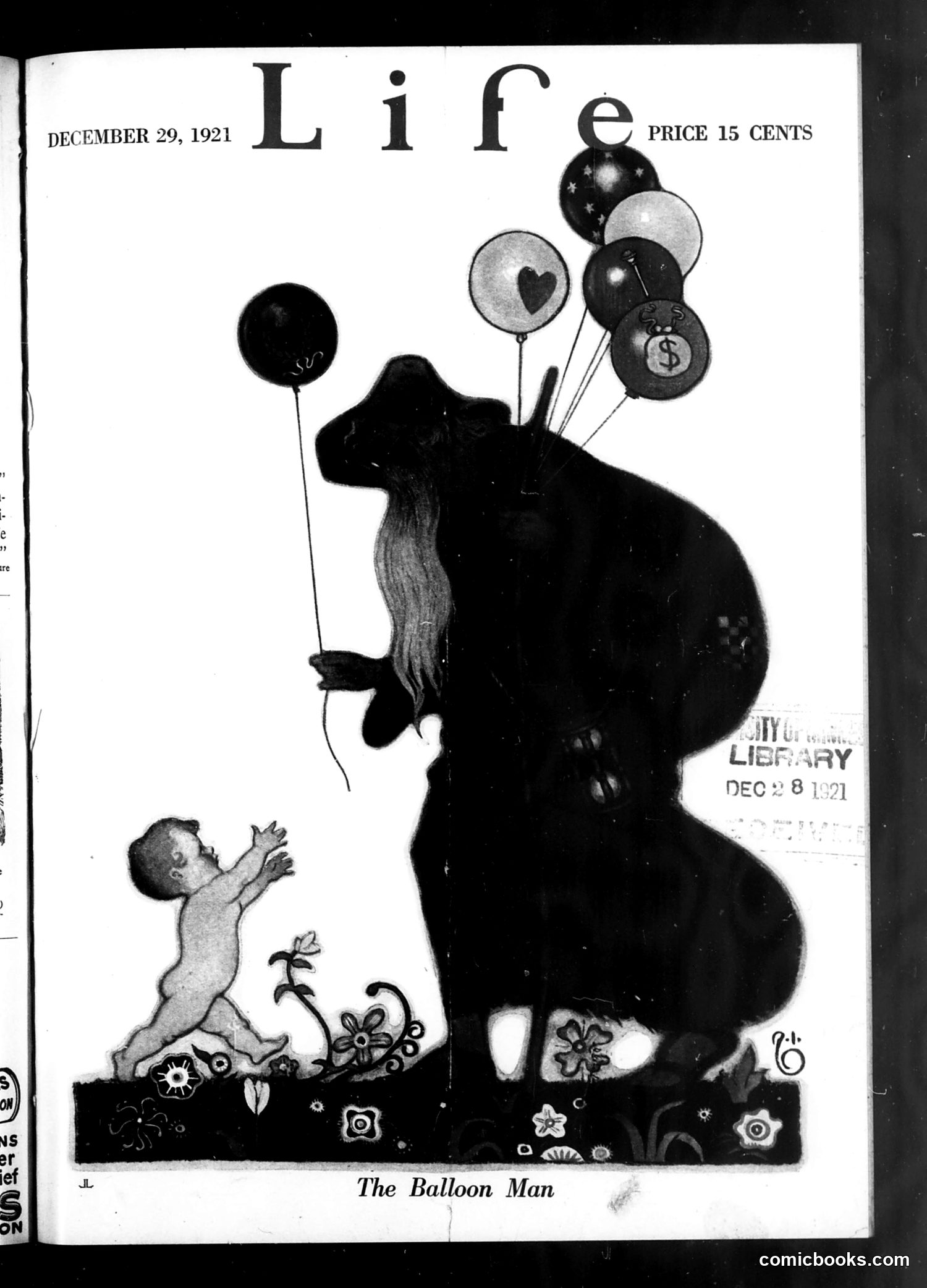
This cover illustrates a common Depression-era anxiety about economic instability. A large, dark figure (appearing to represent a wealthy person or capitalist) holds multiple balloons—symbols of inflated value or speculation. The balloons display various symbols: a heart, a dollar sign, and stars, suggesting different forms of wealth and aspiration. A small child below reaches upward, representing ordinary people or the working class. The precarious nature of balloons—fragile and easily burst—satirizes how economic prosperity of the era rested on unstable speculation rather than solid foundations. The cartoon warns that the balloon-man's promised riches could deflate instantly, leaving common people vulnerable.
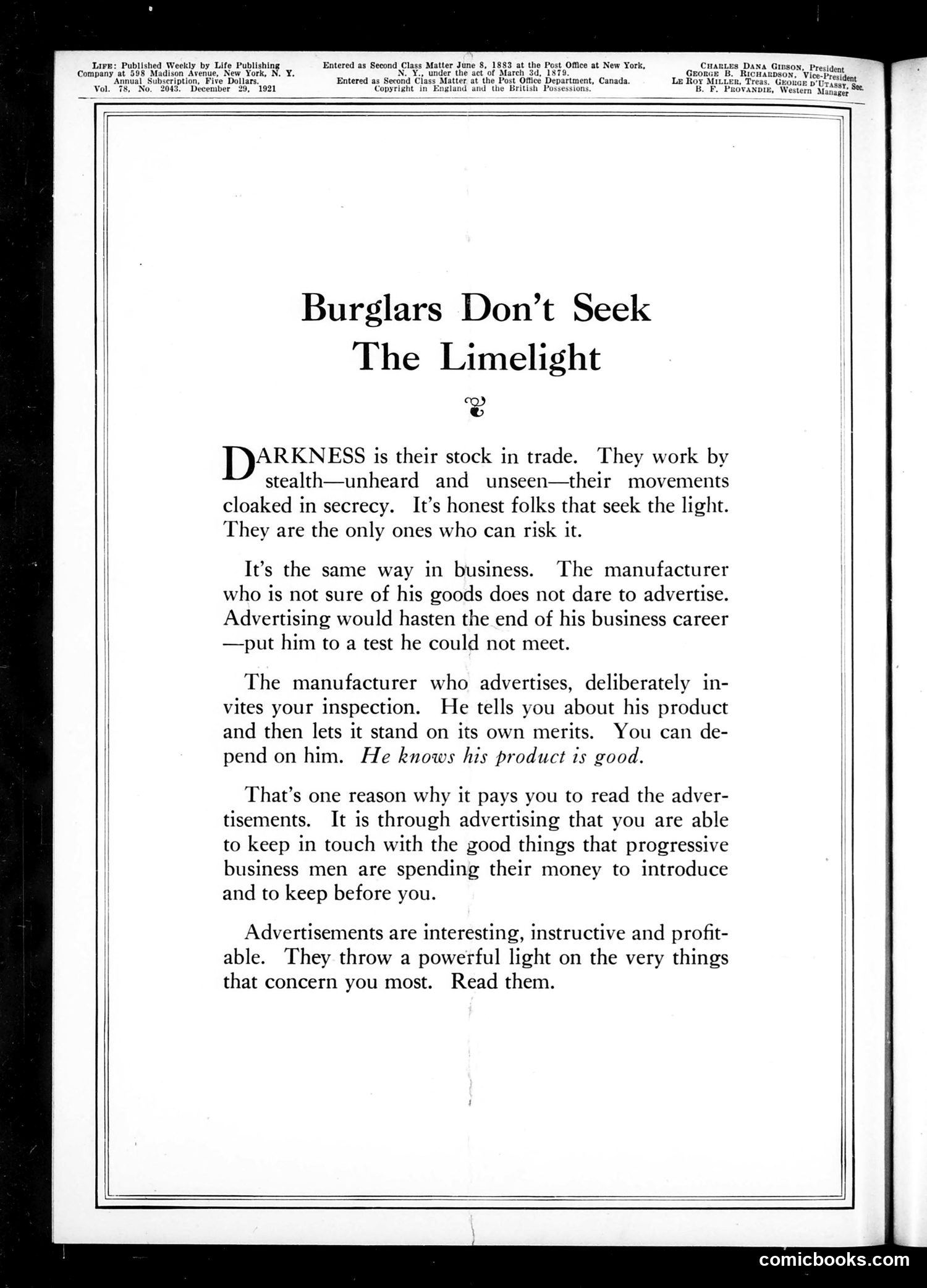
This is not a cartoon but an **editorial advertisement** — a full-page essay promoting the value of advertising itself. Published December 29, 1921, the piece uses an extended metaphor comparing dishonest manufacturers to burglars: both operate in darkness and secrecy. By contrast, reputable companies advertise openly, inviting public scrutiny. The argument positions advertising as a **trust signal** — only confident businesses with genuinely good products dare publicize themselves. The piece encourages readers to trust and read advertisements, framing them as informative guides to "progressive business" innovations. This is **meta-advertising**: the magazine uses editorial space to justify why people should pay attention to the advertisements that fund publications like *Life*.
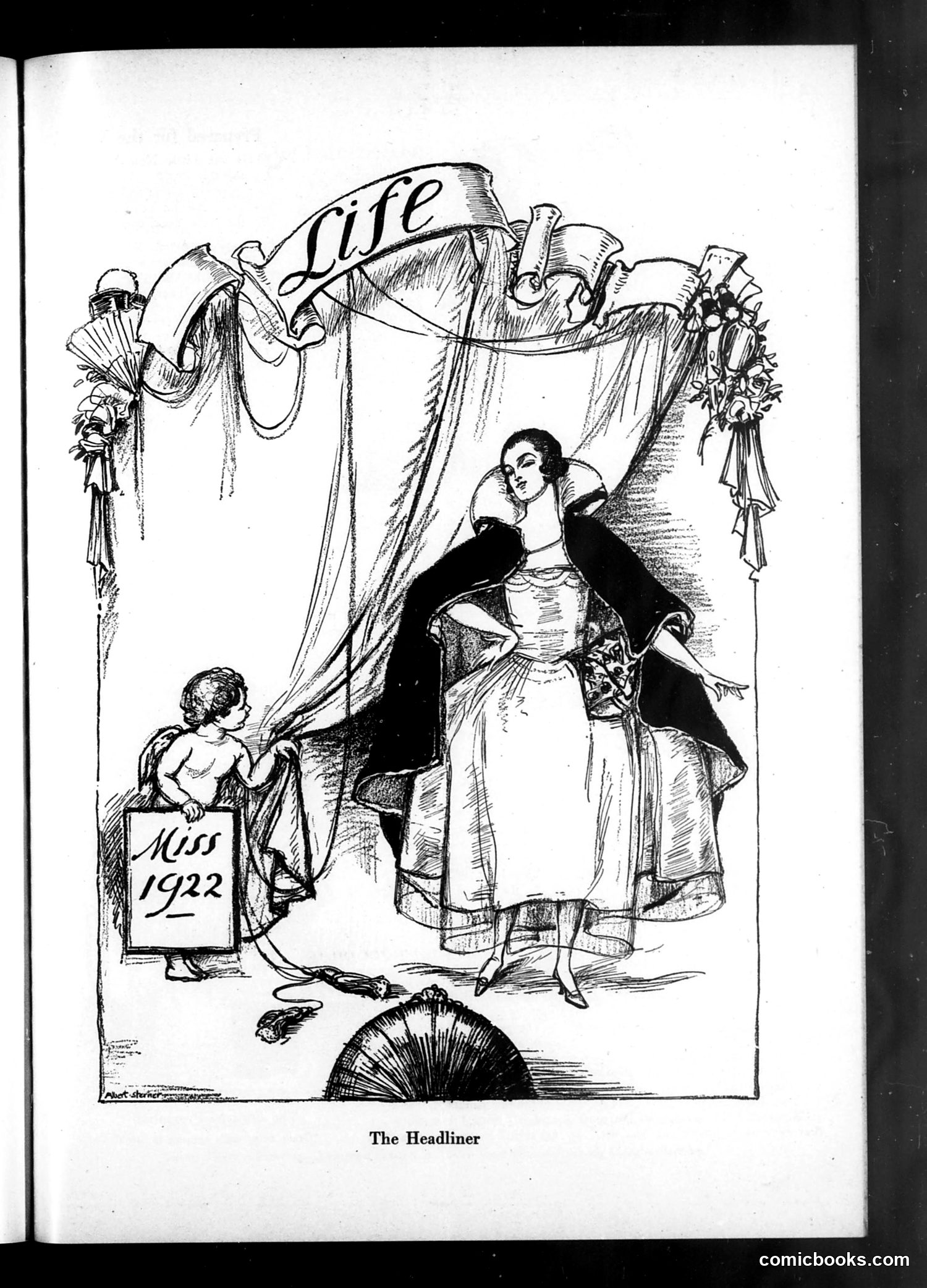
This cartoon satirizes the commodification of beauty pageants and celebrity culture in the 1920s. A cherub labeled "Miss 1922" is presented as a product being "unveiled" under theatrical drapery labeled "Life," suggesting the magazine itself was promoting beauty pageants as entertainment spectacles. The elegant woman in the foreground appears to be a beauty pageant winner or contestant being presented to the public. The dramatic staging—with flowing curtains, floral arrangements, and theatrical presentation—mocks the grandiose marketing surrounding these competitions. The satire critiques how young women were packaged and displayed as consumer products for public consumption, reflecting broader 1920s anxieties about commercialism, celebrity manufacture, and the commodification of femininity during the Jazz Age era.
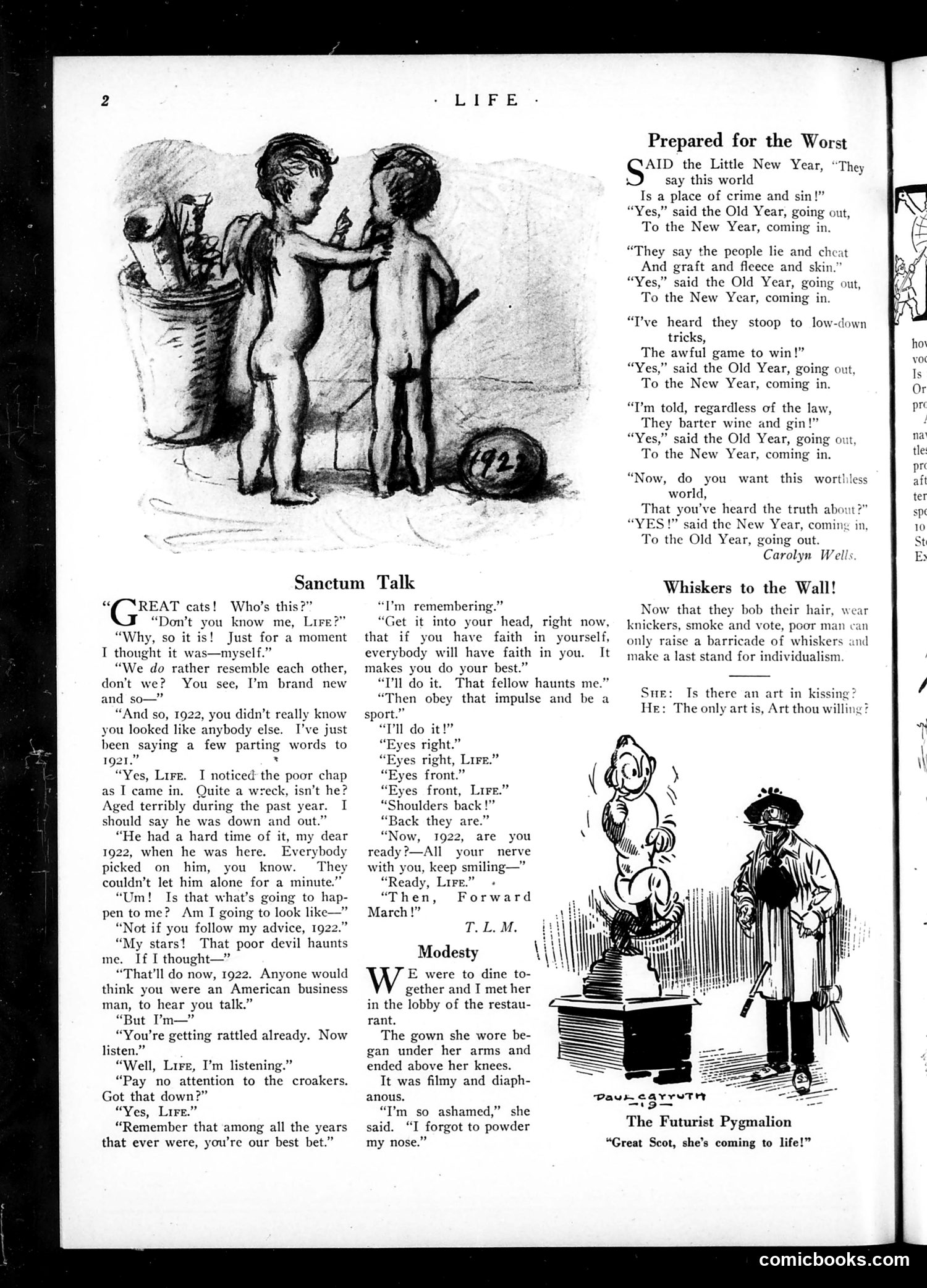
**"Prepared for the Worst"** (top): A poem satirizing the Old Year departing and New Year arriving, cataloging society's perceived moral failures—crime, sin, lying, cheating, low-down tricks, bartering wine and gin, lawlessness. The personified years embody cynicism about human nature and social decay. **"Sanctum Talk"**: A dialogue between LIFE (the magazine personified) and a cat, discussing a poor man's hardship in 1922. The conversation emphasizes faith and perseverance as solutions, reflecting contemporary advice literature. **"Whiskers to the Wall!"**: A humorous exchange about kissing as art. **"Modesty"**: A brief anecdote mocking a woman who forgets to powder her nose despite wearing an immodest dress. These pieces use satire and humor to comment on 1920s social values, morality, and gender norms.
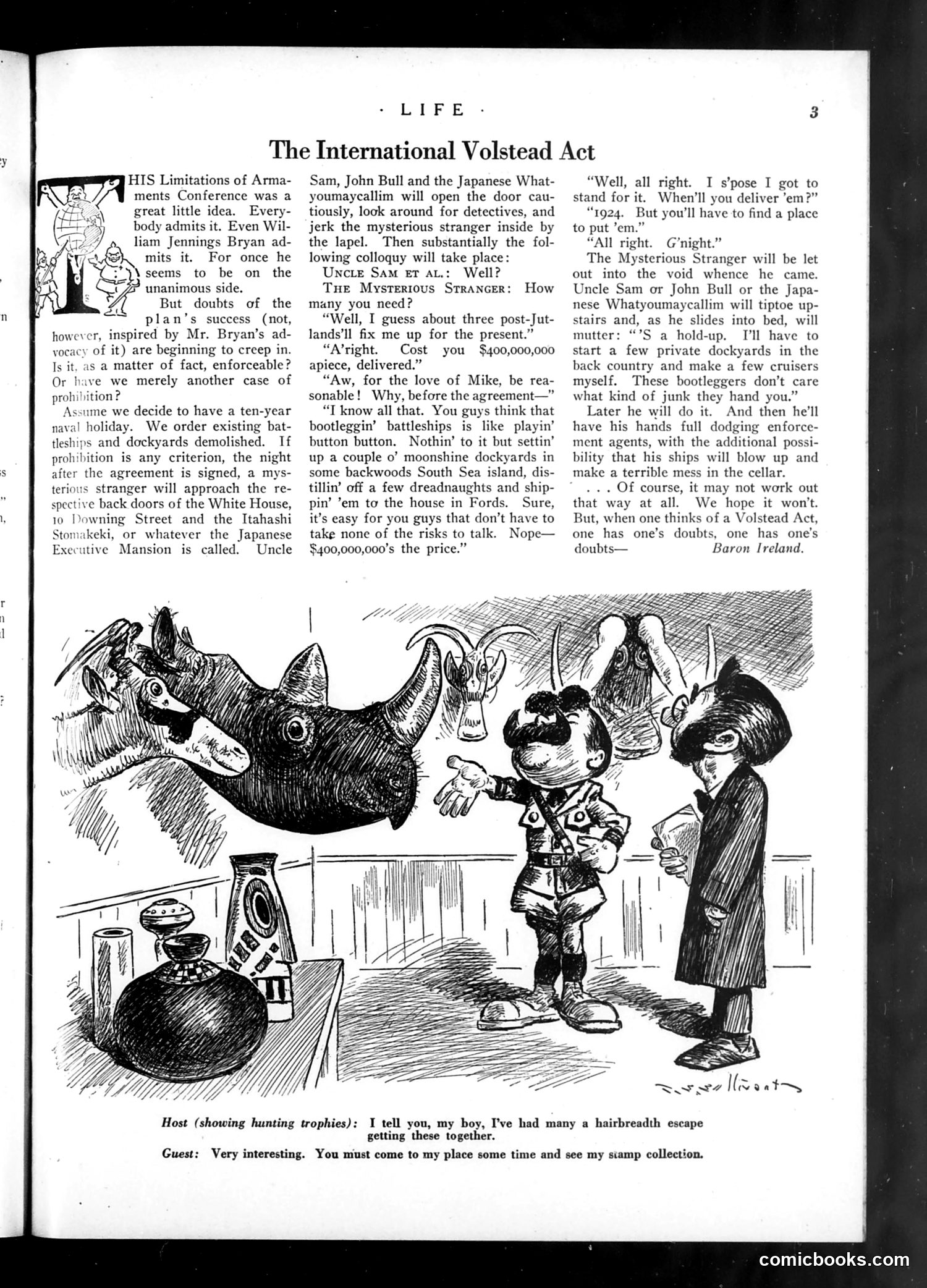
This page satirizes the Armaments Conference and naval disarmament debates of the early 1920s. The title references the Volstead Act (Prohibition legislation), cleverly comparing international weapons treaties to alcohol prohibition. The main cartoon depicts a host showing hunting trophies to a guest—appearing to represent Uncle Sam (America) displaying naval vessels/weaponry. The dialogue suggests skepticism about disarmament agreements: characters discuss converting battleships into "moonshine dockyards" and worry such treaties won't actually work, expecting nations will cheat and secretly maintain military power. The satire mocks the naive optimism of international disarmament efforts, suggesting countries cannot be trusted to honor weapons-reduction agreements—they'll find sneaky ways around the rules, much like bootleggers circumvent Prohibition.
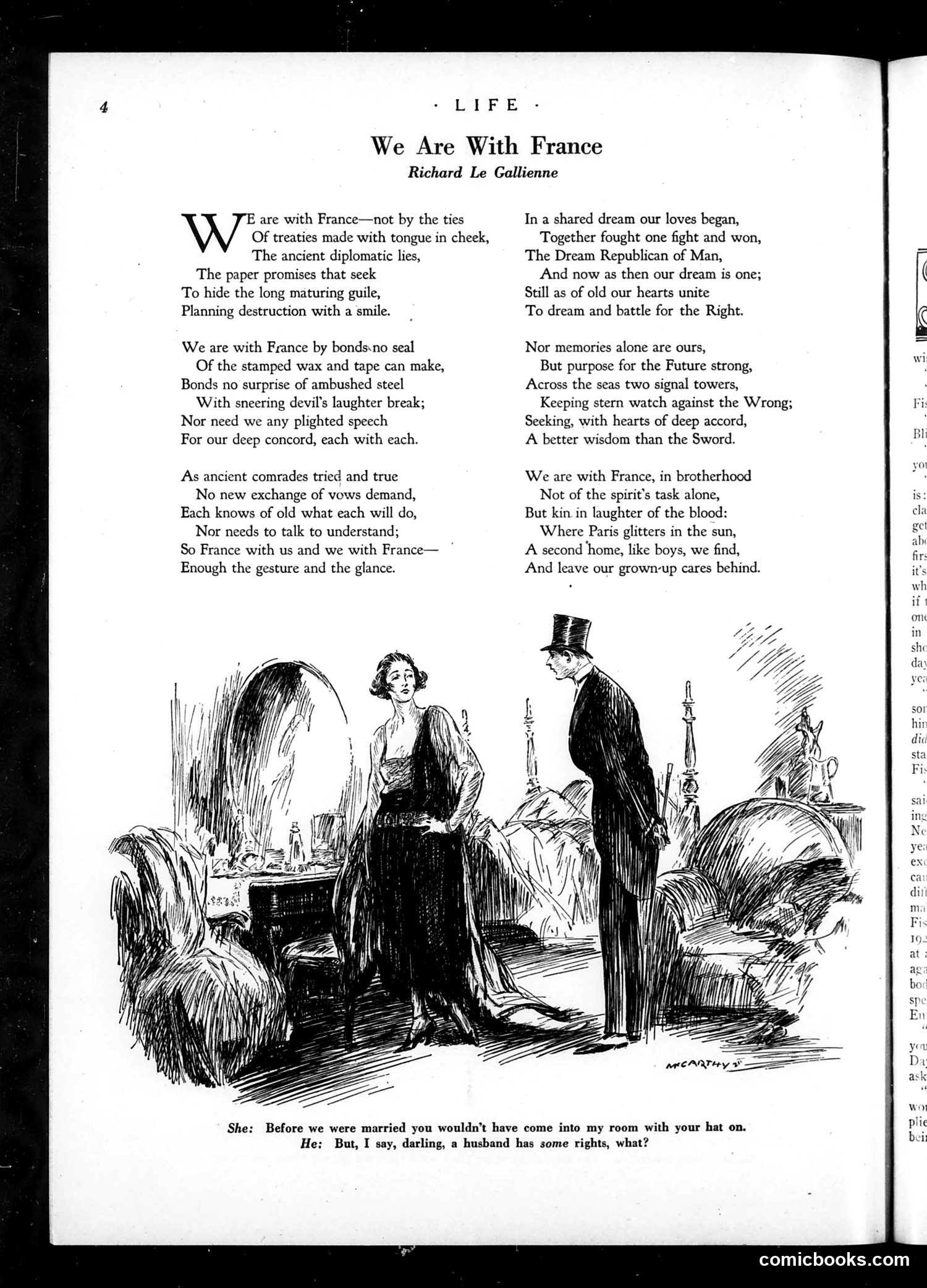
This page features a patriotic poem by Richard Le Gallienne supporting American-French alliance, likely from World War I era (based on the rhetoric about shared democratic ideals and "the Dream Republican of Man"). The illustration depicts a domestic marital scene with satirical undertones. The caption reveals the joke: a husband enters his wife's room wearing a top hat, and she protests that before their marriage he would never have presumed such familiarity. His response—"a husband has some rights, what?"—suggests the cartoon mocks husbands asserting newfound domestic authority. The connection to the poem appears ironic: while the text celebrates noble Franco-American brotherhood and shared purpose, the cartoon undermines male-female relations through crude power dynamics, suggesting tension between romantic ideals and practical realities.
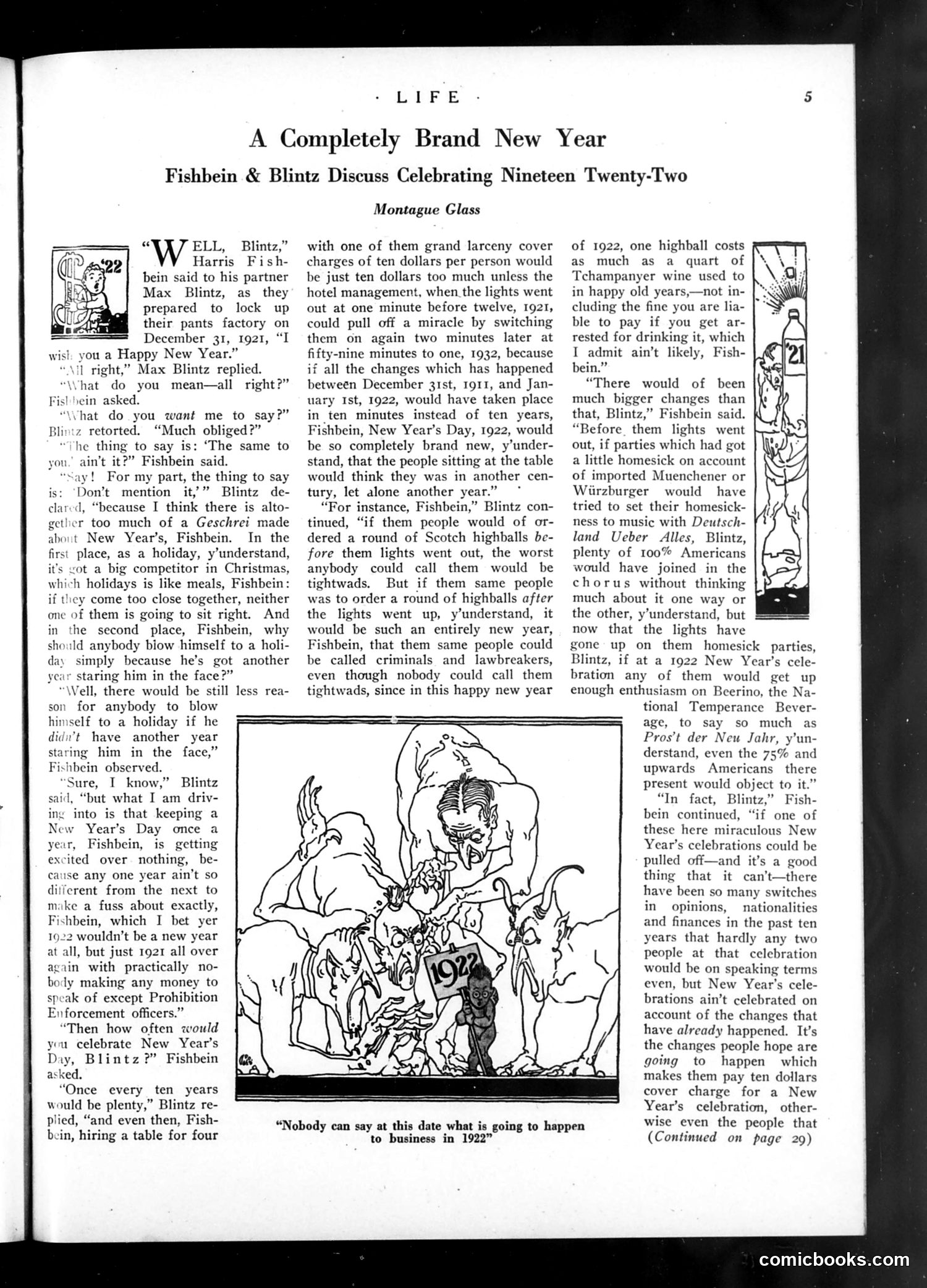
This satirical piece features a dialogue between Harris Fishbein and Max Blintz discussing New Year's Eve 1921 celebrations. The main cartoon depicts a chaotic party scene labeled "1922," showing revelers in festive disarray. The satire targets the extravagance of high-society New Year's parties. Fishbein and Blintz debate whether such celebrations constitute genuine change or merely cyclical excess. They reference specific luxuries (imported Muenchener beer, highballs, "Deutscheland Ueber Alles") to mock wealthy revelers' pretensions. The joke hinges on the irony that despite the passage of time and symbolic "brand new year," nothing fundamentally changes—the same people engage in identical behaviors annually. The cartoon's wild imagery emphasizes the chaos and predictability of elite celebration culture during the Jazz Age.
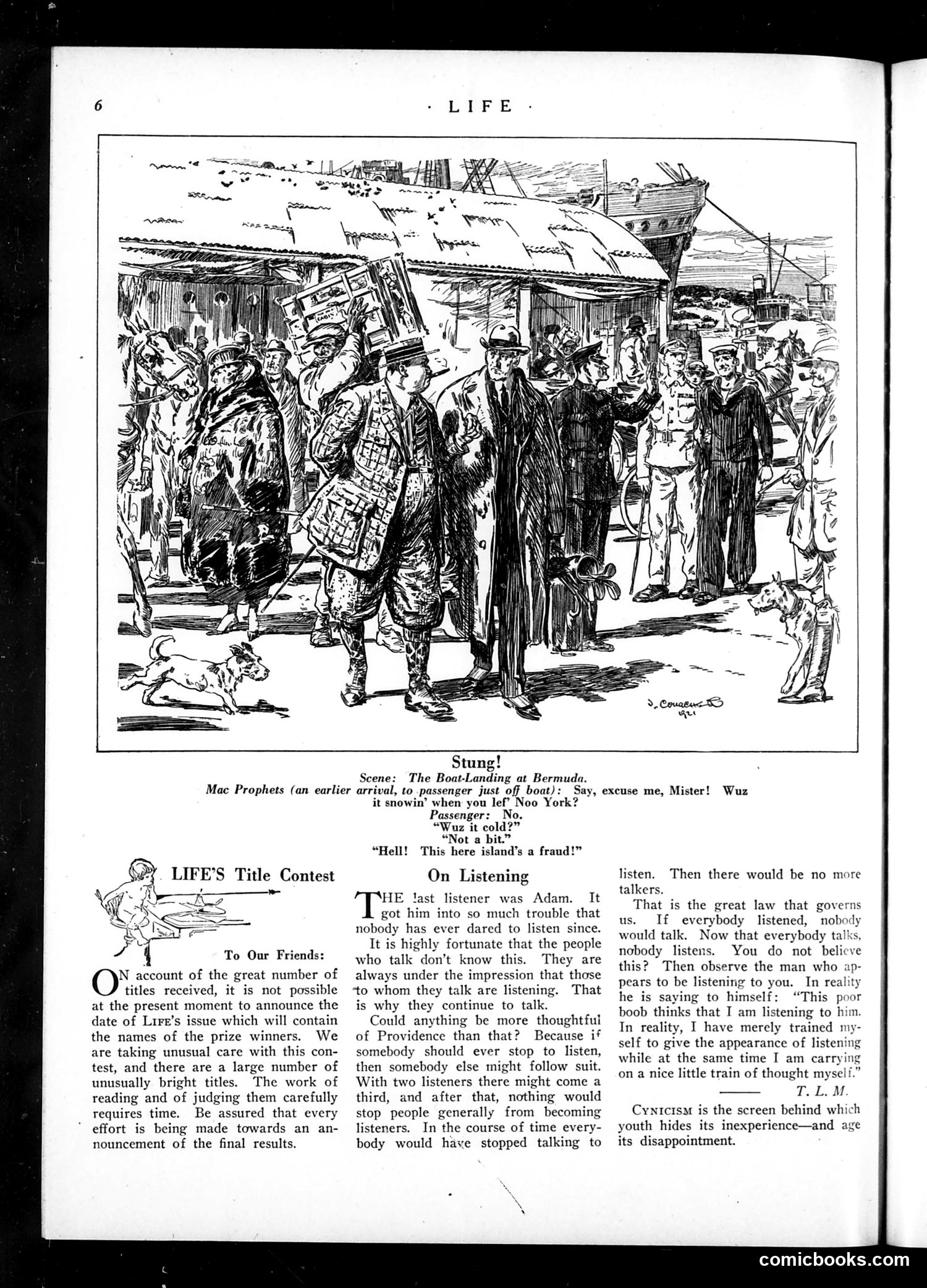
This cartoon satirizes a common travel complaint. A Mac Prophet (an early arrival to the passenger dock) greets a newcomer with "Say, excuse me, Mister! Wuz it snowin' when you left New York?" The passenger replies "No," then adds "Wuz it cold? Not a bit. Hell! This here island's a fraud!" The joke targets tourists who arrive in Bermuda expecting tropical warmth but find disappointing weather. The "Mac Prophet" character—who warns travelers—represents someone offering unsolicited travel advice to arriving passengers at the dock. The accompanying essay "On Listening" is unrelated to the cartoon, discussing how few people truly listen to others, using Adam as history's "last listener."
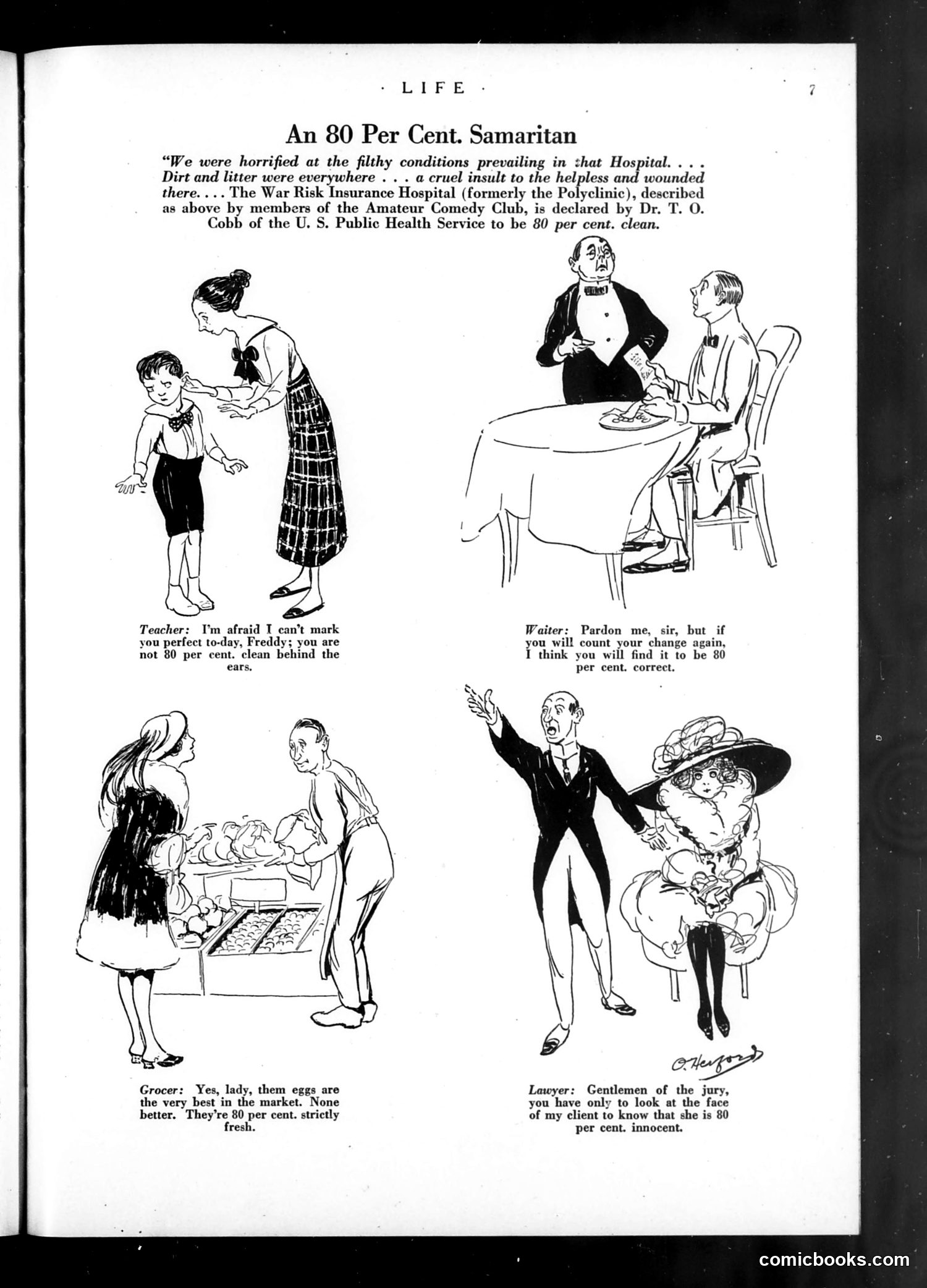
This satirical cartoon critiques claims that the War Risk Insurance Hospital (formerly the Polyclinic) had been cleaned up to "80 per cent." cleanliness by Dr. T.O. Cobb of the U.S. Public Health Service. The four scenes mock the absurdity of this partial-cleanliness claim by showing people applying "80 per cent." logic to everyday situations: a teacher giving a student an incomplete grade for being "not 80 per cent. clean," a waiter promising imperfect service, a grocer selling eggs claimed to be "80 per cent. strictly fresh," and a lawyer defending a client as "80 per cent. innocent." The joke exposes how ridiculous it is to accept substandard conditions in a hospital using this fraction, suggesting the facility remains fundamentally unsanitary despite official reassurances.
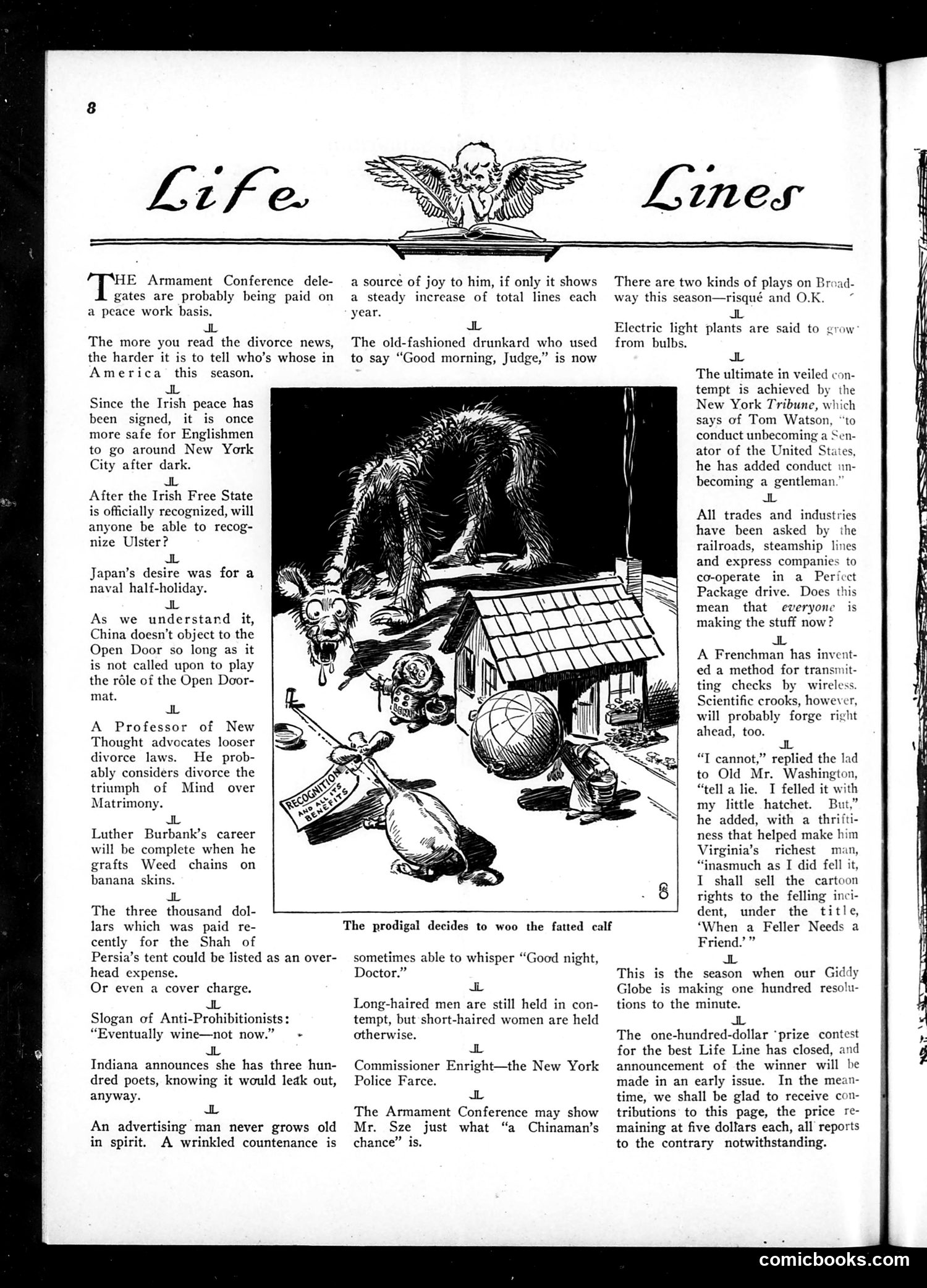
This political cartoon depicts a disheveled, ape-like figure attempting to seduce a calf, surrounded by scattered items suggesting debauchery or excess. The caption references the Biblical parable of the prodigal son. The satire appears to critique someone (identity unclear from image alone) attempting to win favor through degrading or absurd means. The animalistic caricature suggests moral degeneracy. The "fatted calf" likely represents wealth, power, or a nation being courted. Without the publication date visible, the specific political target remains uncertain, though the style suggests early-to-mid 20th century satire. The surrounding "Life Lines" commentary pieces address various social and political topics of that era—Prohibition, Irish independence, and naval policy—suggesting this cartoon fits within broader contemporary debates.
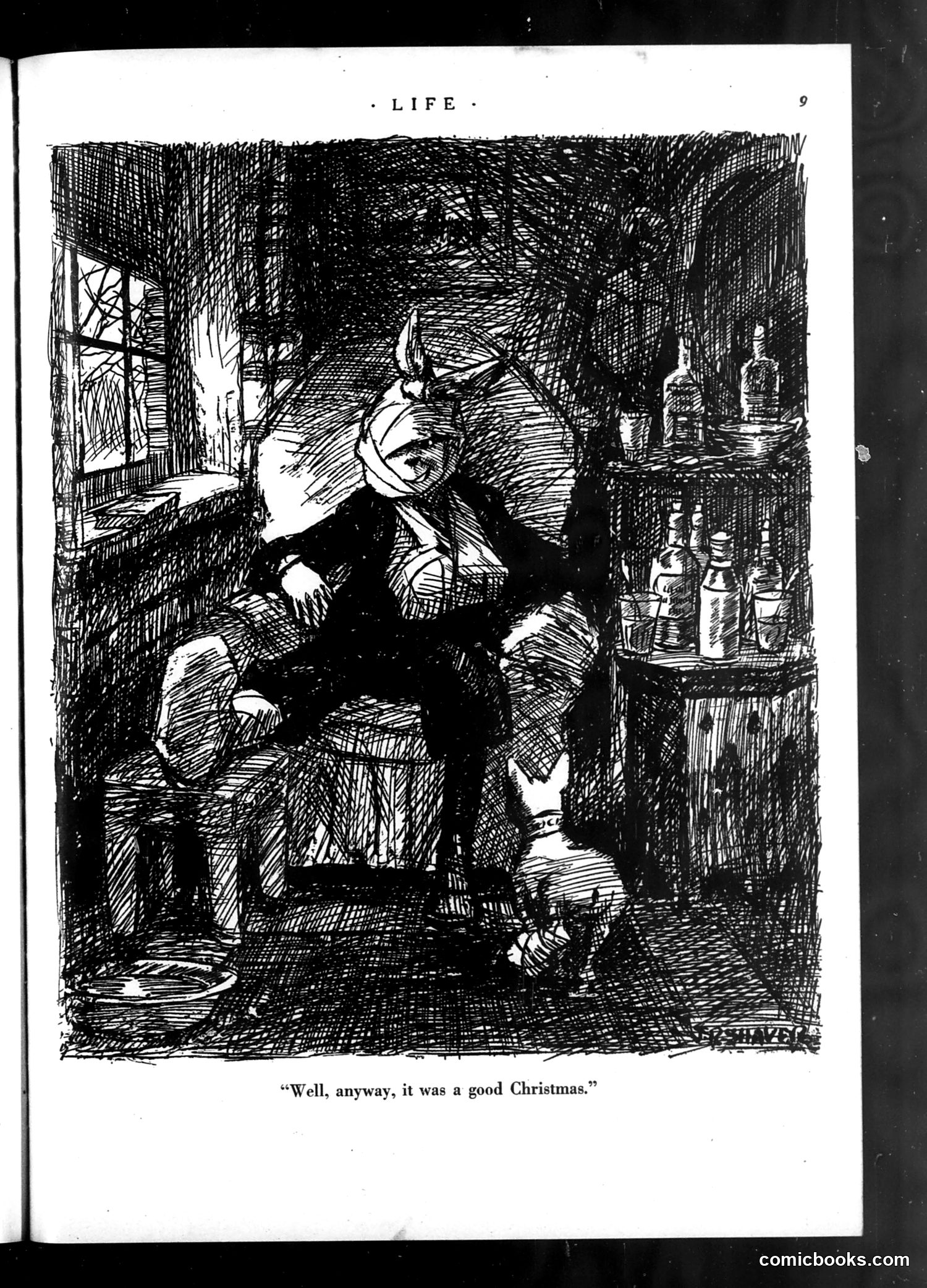
This is a single-panel cartoon showing a woman in an elegant dress and bonnet seated in what appears to be a modest, sparsely furnished room. She gazes out a window while bottles sit on a shelf behind her. The caption reads: "Well, anyway, it was a good Christmas." The satire appears to comment on economic hardship or disappointed expectations during the Christmas season. The contrast between the woman's refined appearance and her humble surroundings suggests either diminished social circumstances or unmet holiday expectations. Her resigned comment—"it was a good Christmas" despite evident modest conditions—uses ironic understatement to critique either lower-class life or the gap between holiday aspirations and reality. The bottles on the shelf may suggest alcohol as a coping mechanism. This reflects early 20th-century social commentary on class and holiday sentimentality.
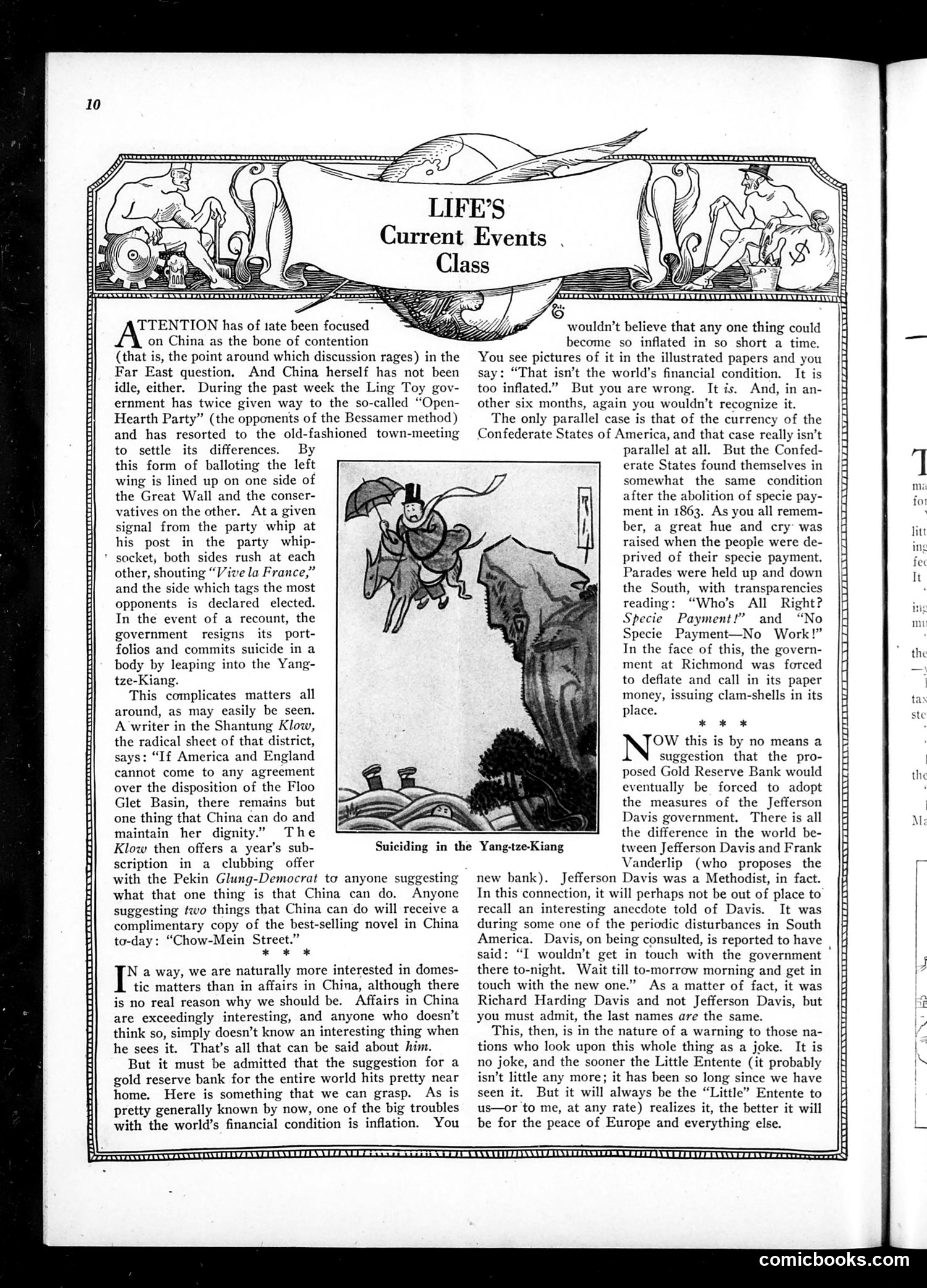
This page from Life magazine satirizes China's internal political strife during the early 20th century. The main illustration depicts "Suiciding in the Yang-tze-Kiang" — a darkly comic reference to Chinese officials' desperate responses to political instability. The text discusses the "Open Hearth Party" faction disputes within China's government, where competing sides resort to extreme measures including suicide when facing defeat. The satire compares this chaos to America's financial troubles, suggesting both nations struggle with internal crises — China through violent political upheaval, America through currency inflation and banking failures. The joke targets how absurdly dysfunctional both systems appear: China's officials literally kill themselves over political disagreements, while America's financial system collapses from abstract economic problems. Both represent governance breakdown.
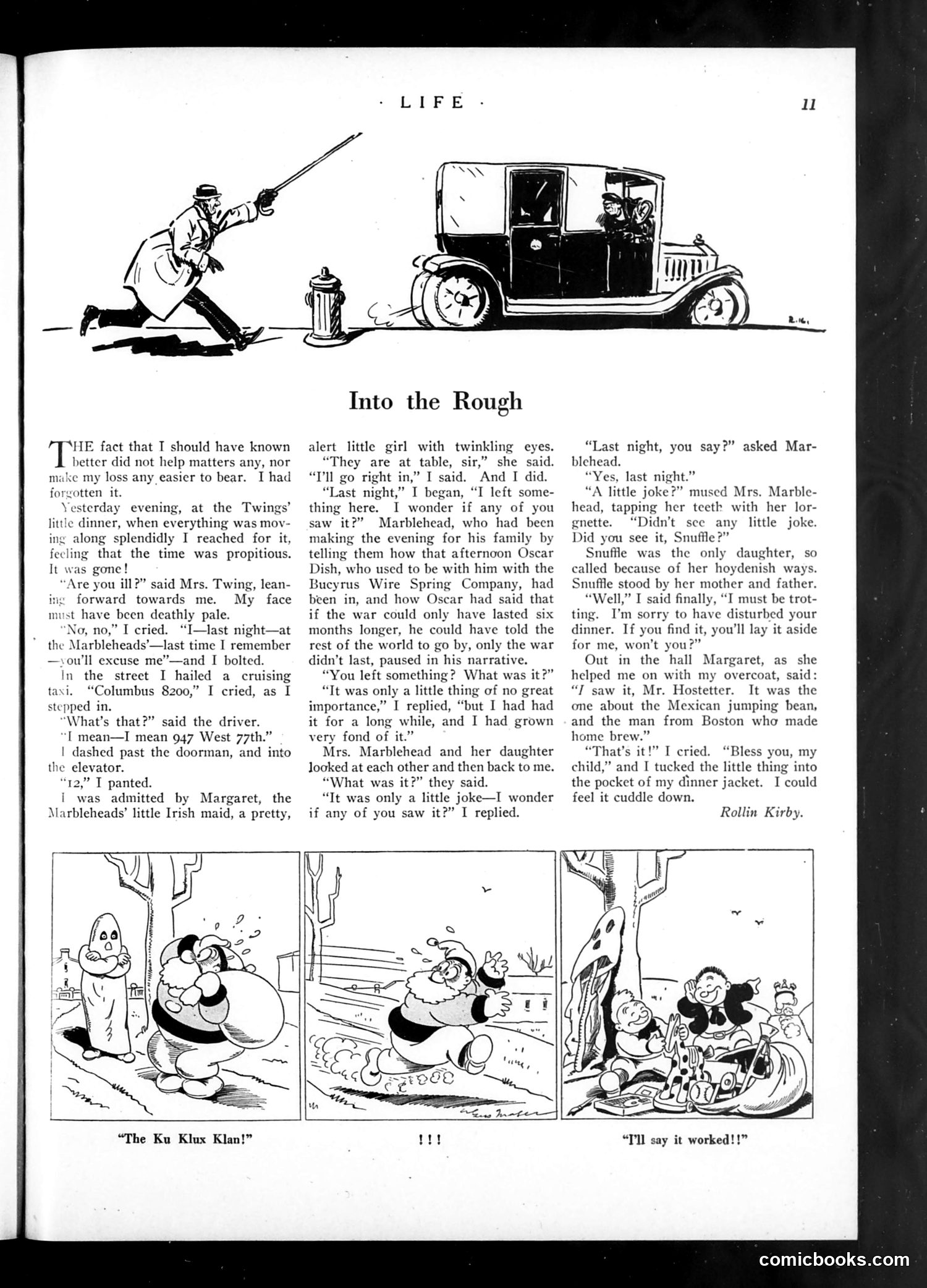
This page contains a short story by Rollin Kirby alongside three comic panels below. The top illustration satirizes a man frantically trying to extinguish a fire at a fire hydrant while a car passes by—a visual pun on "into the rough" (golf terminology). The three panels below appear to be unrelated slapstick comics featuring a rotund character. The captions—"The Ku Klux Klan!", "!!!", and "I'll say it worked!!"—suggest these are mocking the KKK, likely depicting the organization as ridiculous or ineffectual through physical comedy rather than direct political critique. The story itself concerns a dinner party anecdote about Oscar Dish and family matters, written in early-20th-century satirical style typical of *Life* magazine's social commentary.
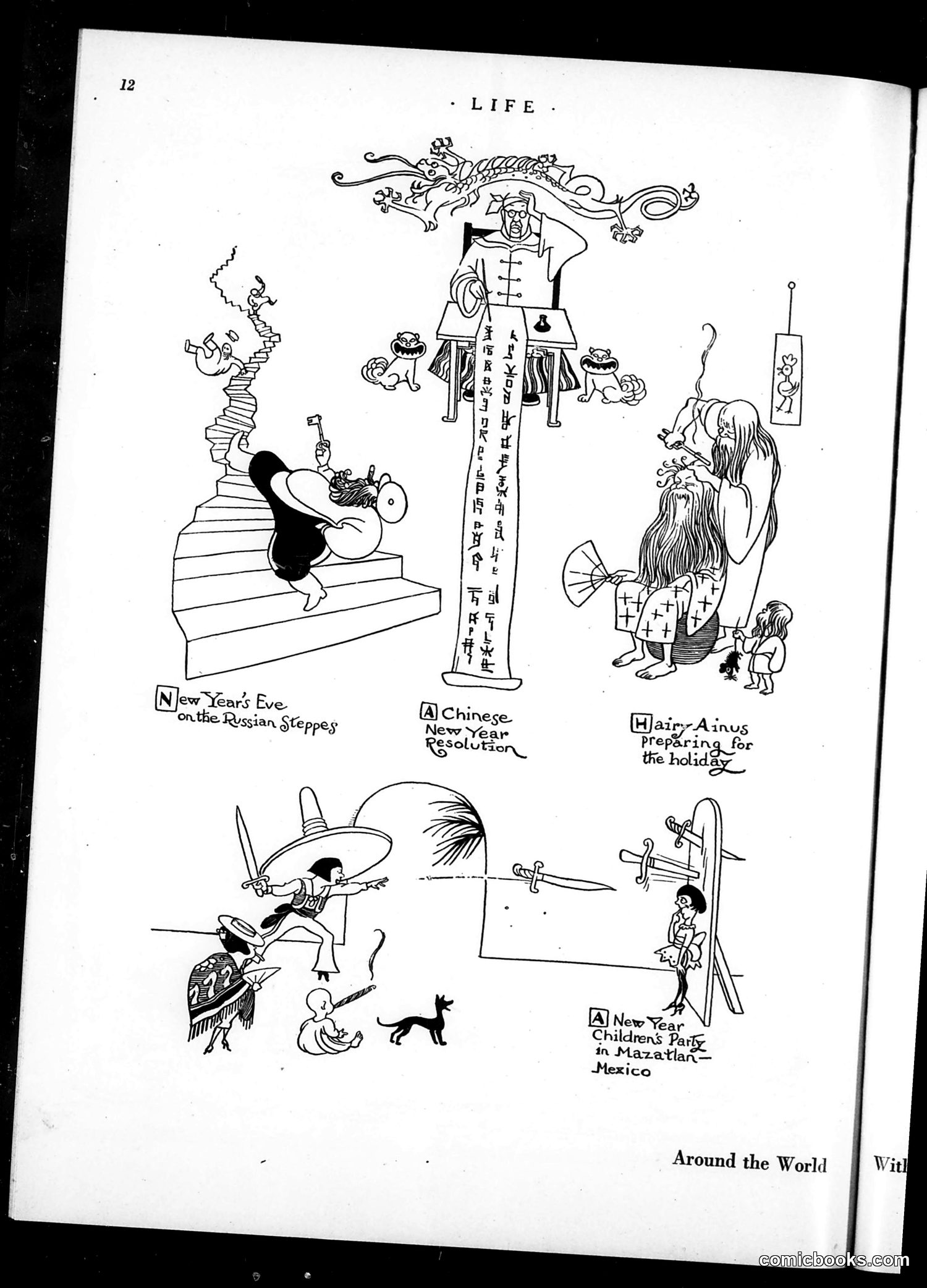
This page from *Life* magazine presents five satirical vignettes titled "Around the World," depicting New Year's celebrations in different cultures: 1. **"New Year's Eve on the Russian Steppes"**: A figure in black fur plays a stringed instrument atop a pyramid of stacked people, satirizing Russian cultural practices. 2. **"A Chinese New Year Resolution"**: A figure holds a scroll with Chinese characters, mocking cultural stereotypes about New Year's resolutions. 3. **"Hairy Ainus preparing for the holiday"**: Indigenous Ainu people are depicted with exaggerated features. 4. **"A New Year Children's Party in Mazatlan, Mexico"**: Shows a Mexican figure in a sombrero with children and animals. The cartoons employ ethnic caricature and stereotypes typical of early 20th-century American humor, presenting non-Western cultures as exotic, primitive, or comical for domestic audiences.
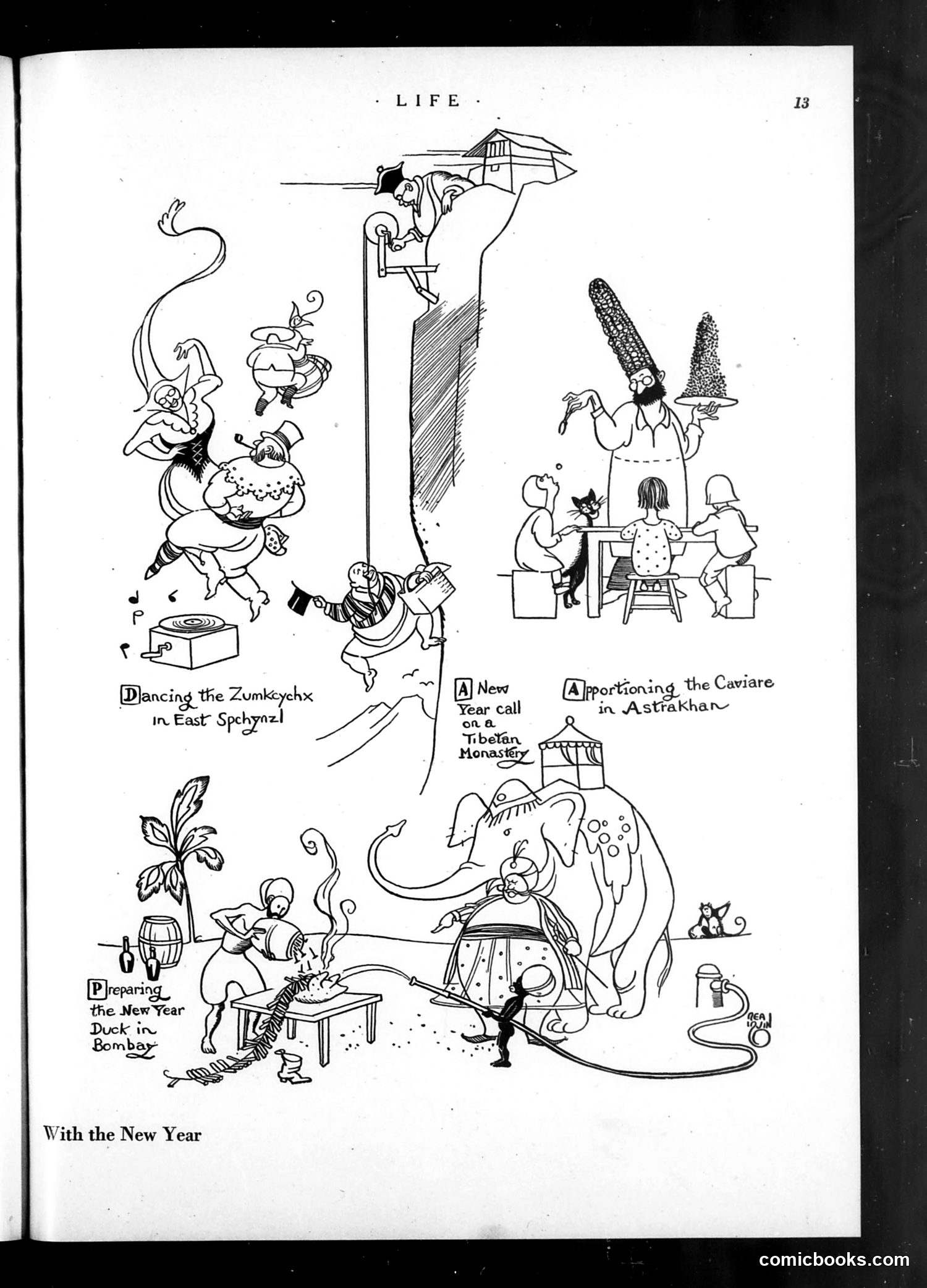
This page presents four humorous vignettes about New Year's celebrations across different cultures and contexts: 1. **"Dancing the Zumkycbyx in East Spchynz"** - Satirizes exotic foreign customs with invented place names and nonsensical dance names, mocking Western fascination with "authentic" international traditions. 2. **"A New Year call on a Tibetan Monastery"** - References actual Tibetan Buddhist practices, humorously depicting Western visitors encountering unfamiliar religious customs. 3. **"Apportioning the Caviare in Astrakhan"** - Depicts Russian wealth/luxury stereotypes through caviar distribution. 4. **"Preparing the New Year Duck in Bombay"** - Shows Indian celebration practices with exotic animals (elephant). The overall theme satirizes how different societies celebrate New Year through exaggerated, often stereotypical cultural representations—typical of early 20th-century American humor's treatment of foreign cultures.
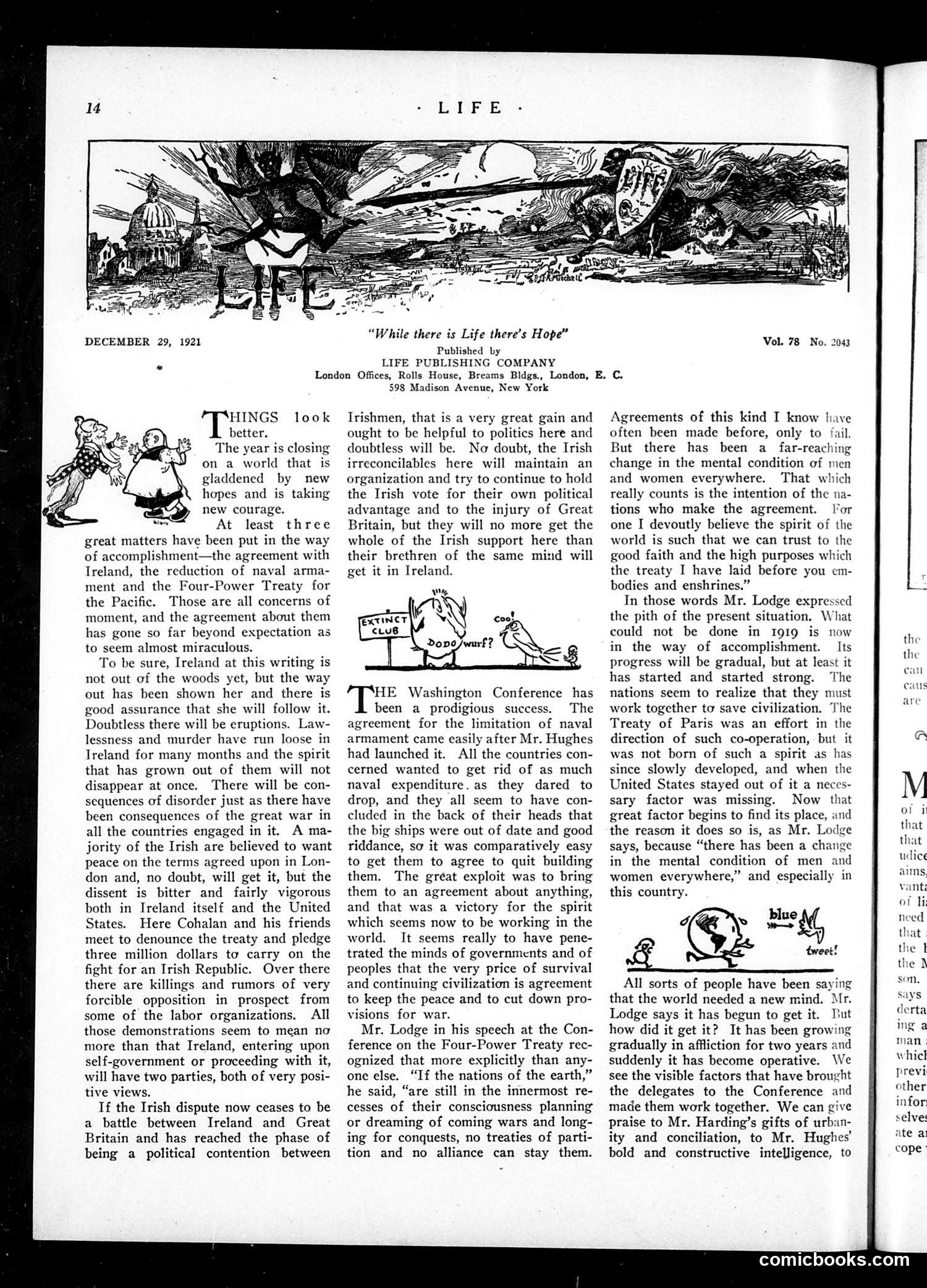
This page contains editorial commentary on recent international agreements, particularly the Washington Conference on naval armament and the Four-Power Treaty regarding the Pacific. The small cartoon (bottom left) appears to show a figure labeled "Instinct" speaking to another character about "Dope," likely satirizing how nations' base instincts drive militarism rather than reason. The text praises these treaties as progress toward peace, noting they've successfully reduced naval spending and military tensions. The author expresses optimism that civilizations can survive through agreement rather than war. A separate illustrated element shows what appears to be a mascot character labeled "blue" saying "Gee!", likely serving as the magazine's recurring decorative feature. The overall tone celebrates diplomatic achievement in averting further conflict.
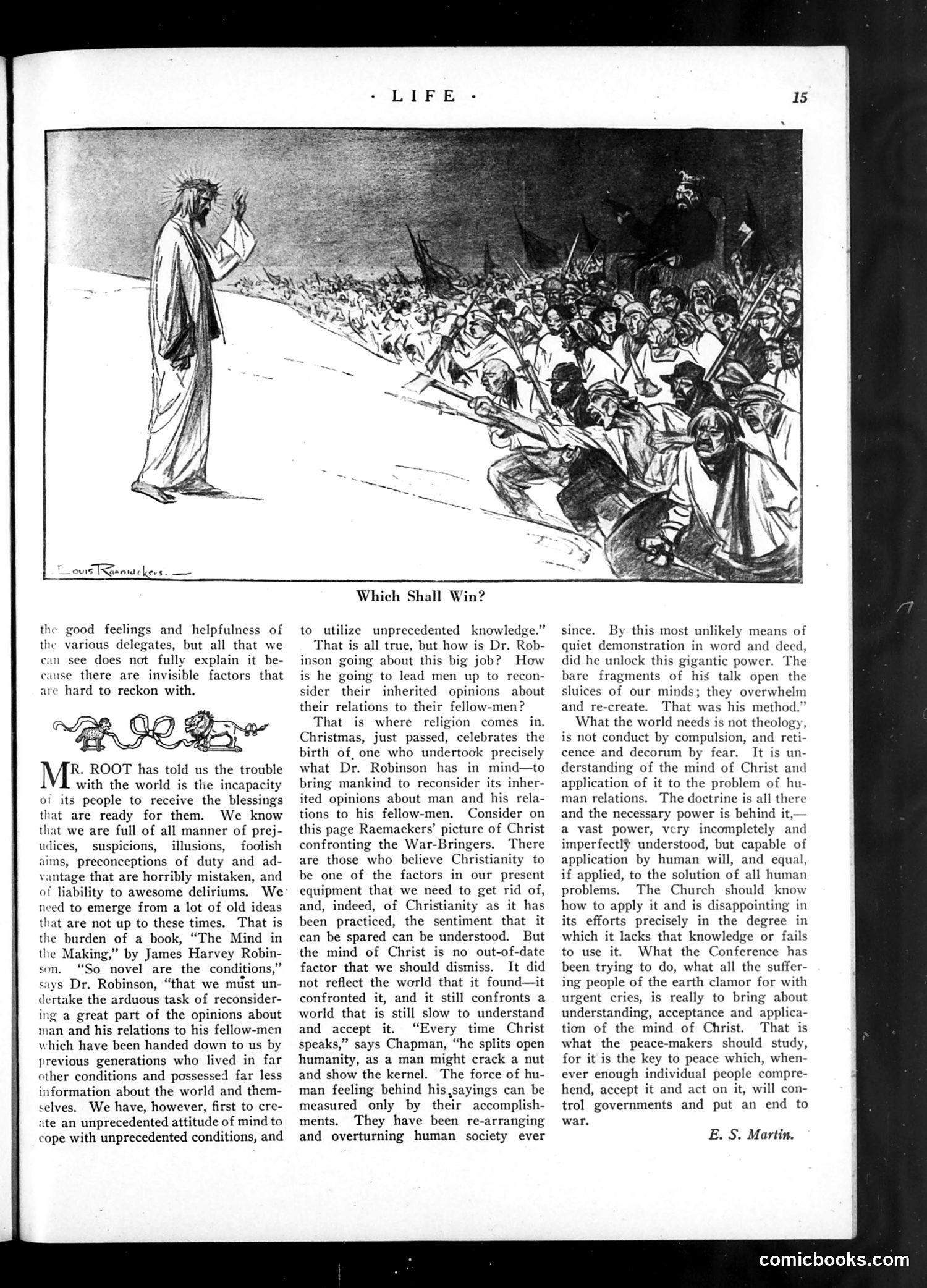
This page features a stark political cartoon by Louis Raemackers depicting Christ standing alone on the left, confronting a massive crowd of armed soldiers and war-makers on the right. The accompanying article discusses whether humanity will follow Christ's teachings of compassion and reconciliation or continue with militarism and violence. The context: Written post-World War I, the piece cites James Harvey Robinson's book advocating that modern society must reconsider inherited ideas in light of "unprecedented conditions." The author argues Christianity—specifically Christ's method of transforming human relations through word and deed rather than force—offers the solution to war and conflict. The cartoon's message is clear: Christ's peaceful doctrine faces opposition from entrenched military and nationalist forces. The "Which Shall Win?" title poses the central question: will humanity embrace Christ's revolutionary compassion, or will war-makers prevail? It's an appeal for post-war society to fundamentally reorganize itself around Christian principles rather than returning to pre-war militarism.
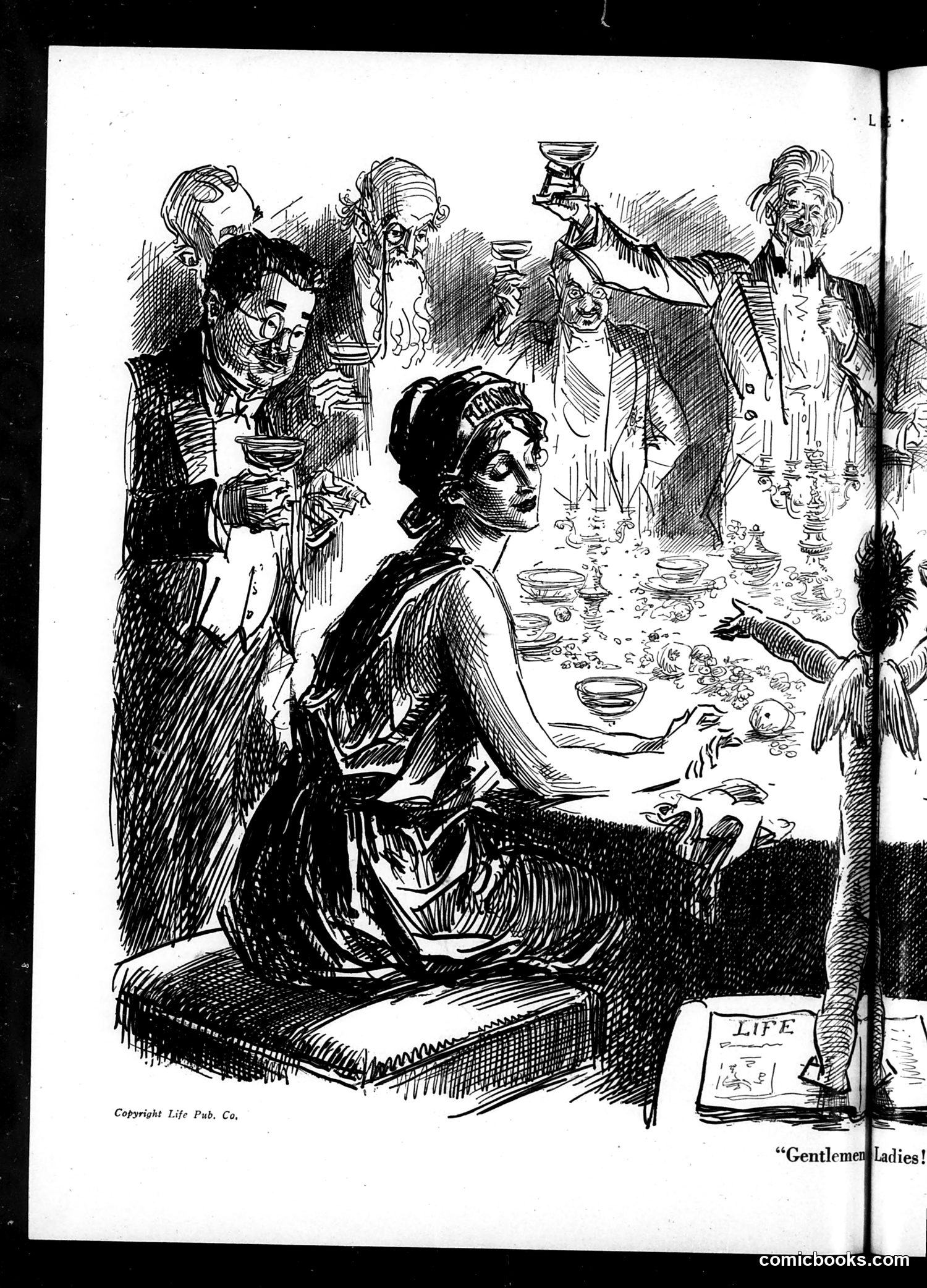
This is a satirical cartoon from *Life* magazine showing a formal dinner party. A woman sits prominently in the foreground while well-dressed men stand behind, raising glasses in toast. The caption reads "Gentlemen Ladies!"—which appears to be ironic commentary on social etiquette or gender dynamics. The cartoon likely satirizes either: the awkwardness of mixed-gender formal gatherings during a period when such events were uncommon or controversial, or the tension between traditional male-dominated social spaces and women's increasing social participation. The exaggerated expressions and caricatured faces suggest the scene is meant as social commentary on changing gender relations and propriety in high society. Without additional context about the specific issue date, identifying the particular figures or events referenced remains unclear.
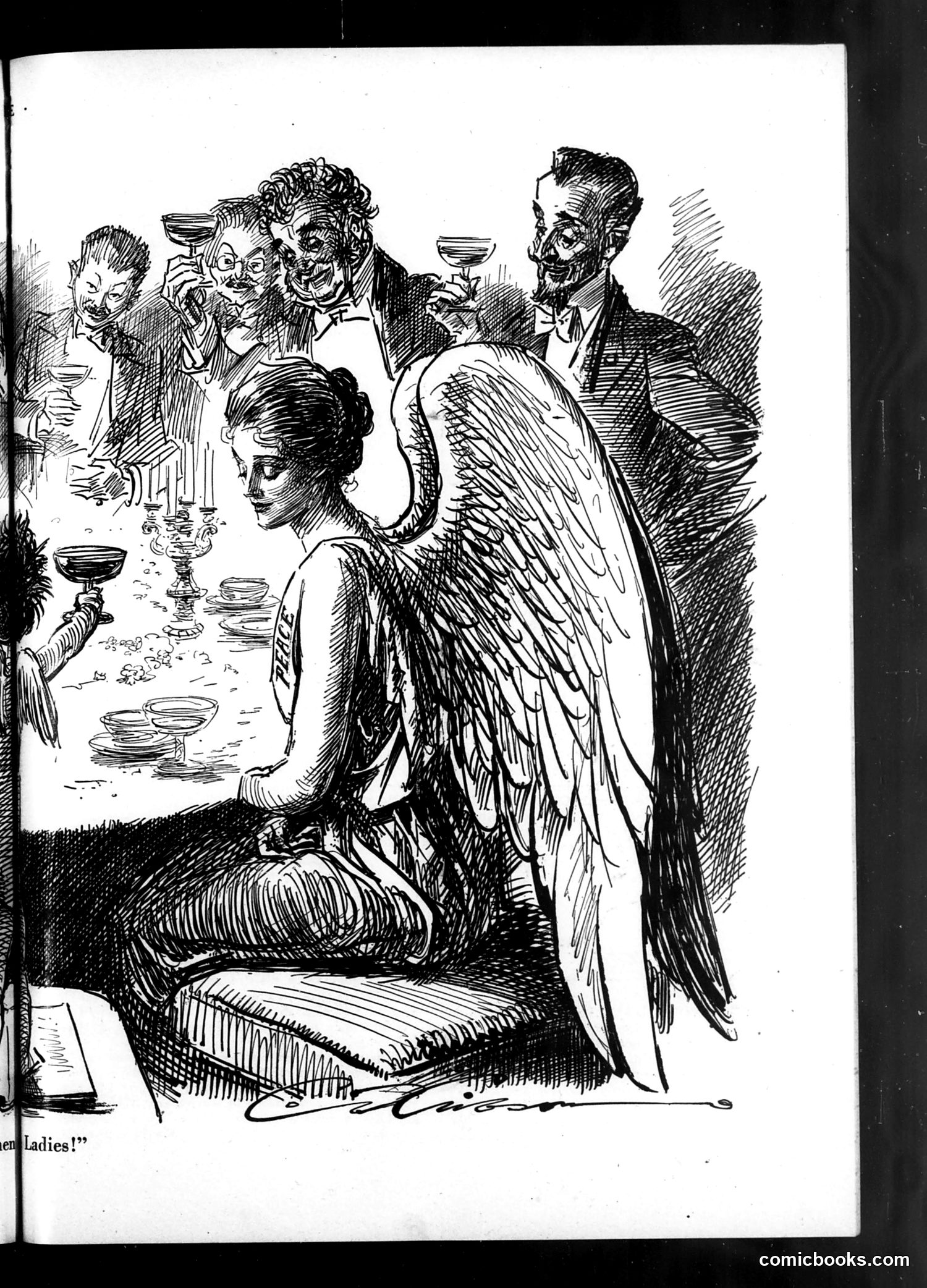
This is a satirical sketch depicting a winged female figure (likely representing an allegorical concept such as Victory, Peace, or Justice) seated among well-dressed gentlemen at what appears to be a formal dinner or social gathering. The men are holding cocktails and appear jovial, while the angelic figure sits apart, looking downward with a contemplative or sorrowful expression. The satire likely critiques how society treats idealistic concepts—represented by the winged woman—by incorporating or ignoring her amid frivolous social indulgence. The contrast between the men's cheerful revelry and the figure's somber demeanor suggests disillusionment with how ideals are marginalized in favor of material pleasure and social convention. The partial text visible ("...en Ladies!") suggests this may be part of a larger caption or dialogue.
This theater review critiques Broadway revivals during a season with many theatrical failures. The author discusses two December revivals: "Alias Jimmy Valentine" (praised as holding up well, with strong performances by Emmett Corrigan and Otto Kruger) and "Bought and Paid For" (criticized overall, though Frank Craven's comedic role—now played by William Harrigan—remains worthwhile). The piece also mocks "The Chocolate Soldier" operetta, arguing its tedious recitatives and weak libretto don't merit revival. The author humorously complains about opera's repetitive singing of single words on two notes ("that revolver, that revolver..."), satirizing high-art pretension while defending popular entertainment standards. The critique reflects early 1900s Broadway tastes and the recurring industry problem of recycling old plays with modern slang rather than creating original works.
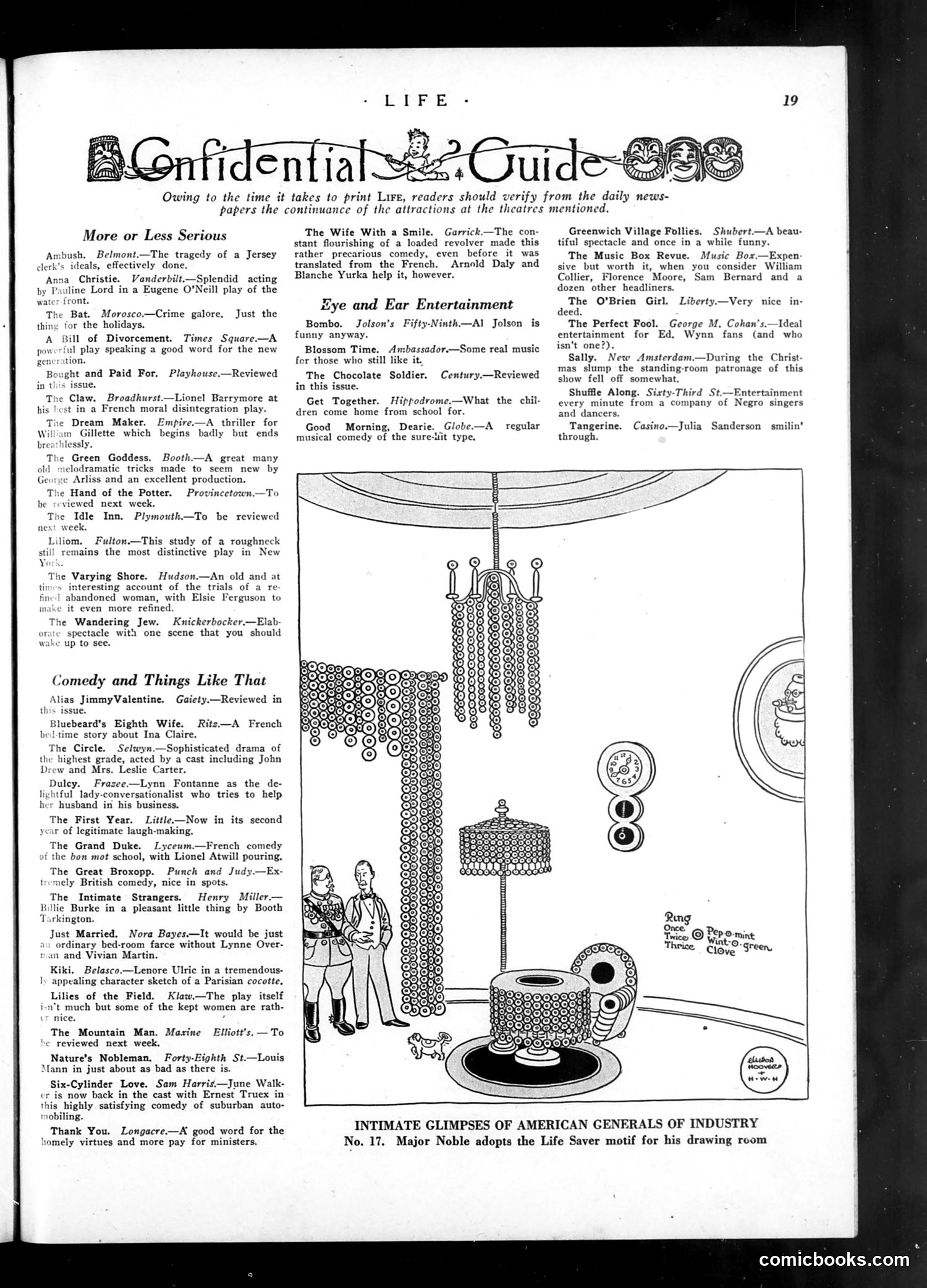
This page is a **theater review column** from Life magazine, not a political cartoon. It provides brief critical assessments of Broadway shows currently running. The reviews span musicals ("Bombo" with Al Jolson, "Blossom Time"), comedies ("The Circle," "Six-Cylinder Love"), and serious dramas ("Anna Christie," "Liliom"). Reviews are sardonic but straightforward—praising strong productions and mocking weak ones. The illustration on the right depicts a decorative chandelier or stage prop labeled "Ring," showing ornamental design elements typical of theater set decoration. **Context for modern readers:** This represents early 1920s Broadway, when Life functioned as a cultural guide for educated, theater-going audiences. The column assumes readers attend live theater regularly and need quick verdicts on what's worth seeing—a function now served by online reviews.
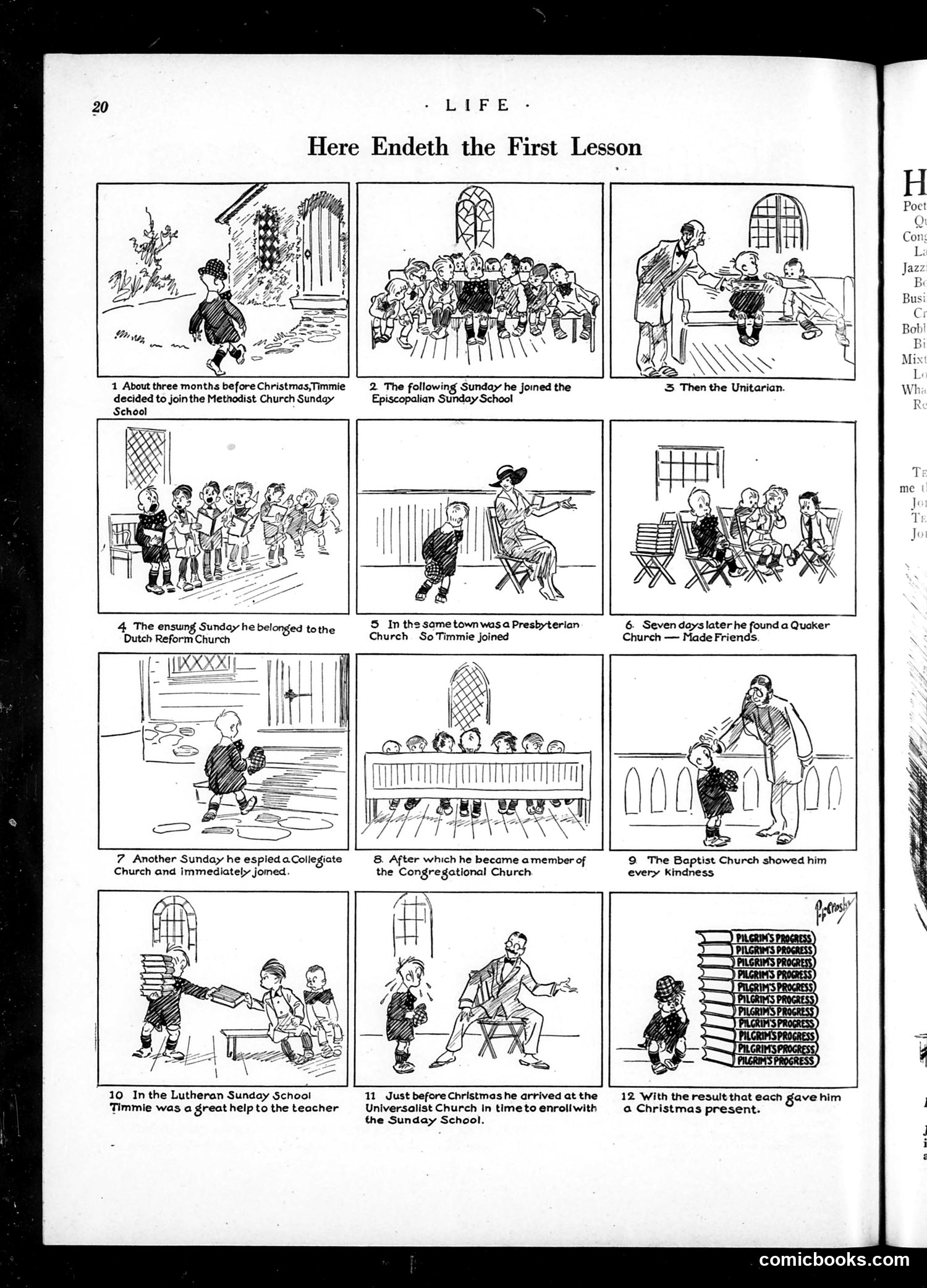
This is a satirical comic strip mocking the proliferation of Protestant denominations in early 20th-century America. The protagonist, Timmie, systematically joins a different Christian church every Sunday—Methodist, Episcopalian, Dutch Reformed, Presbyterian, Quaker, Collegiate, Congregational, Baptist, Lutheran, and Universalist. The satire's point: despite theological differences, all these churches are functionally identical in practice, and Timmie exploits this by attending each one, receiving a Christmas present from each congregation. The joke critiques both the fragmentation of American Christianity into competing sects and the sentimental materialism of church charity. The title "Here Endeth the First Lesson" is ironic—the real lesson isn't religious instruction but rather how to game the system through religious shopping.
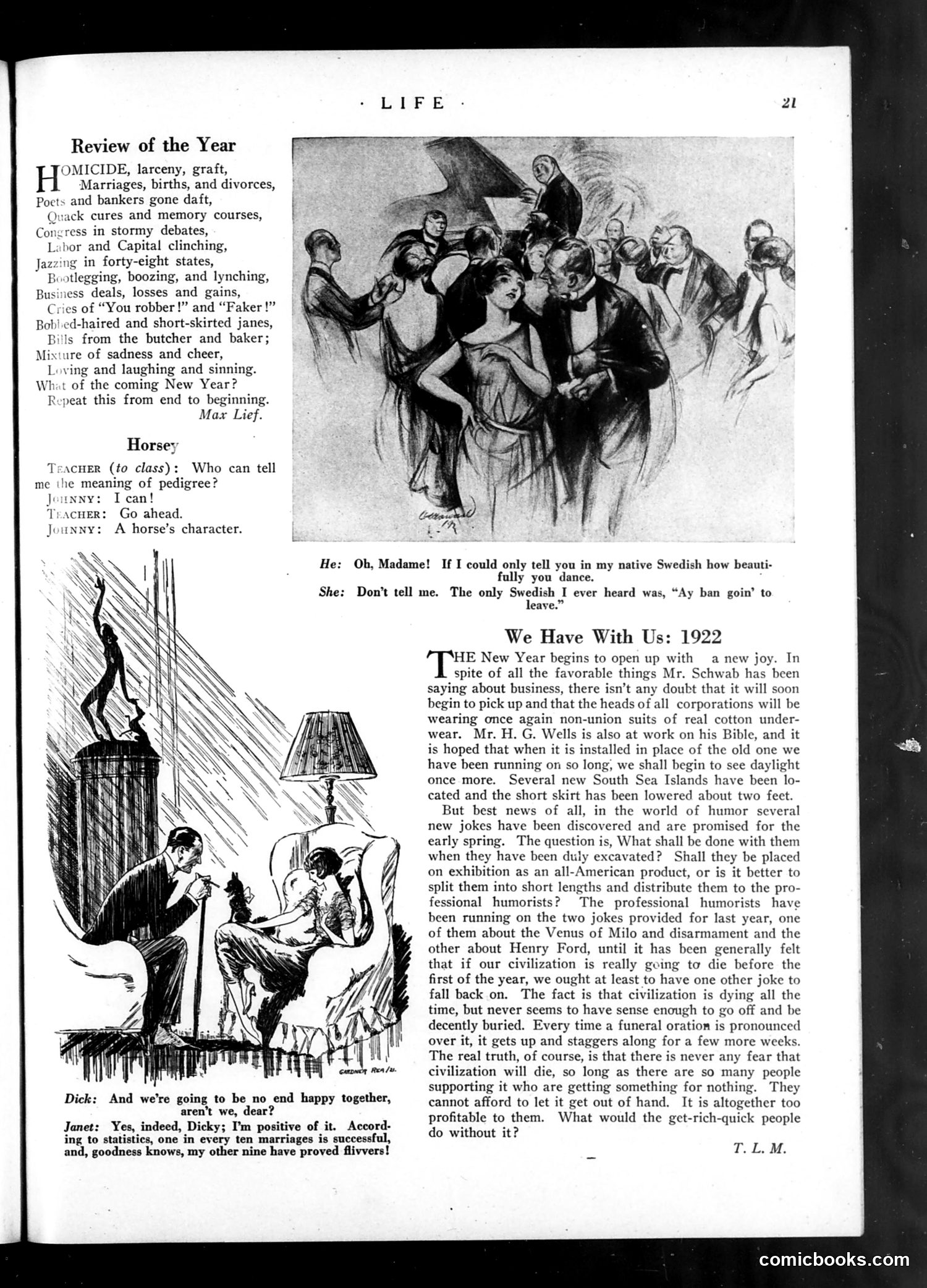
This page lampoons 1922 American life through multiple satirical pieces: **"Review of the Year"** poem catalogs the era's chaos: Prohibition ("bootlegging, boozing"), labor unrest, jazz culture, sexual liberation ("bobbed-haired and short-skirted janes"), and financial uncertainty. It's a cynical summary treating serious social upheaval with comedic detachment. **"Horsey"** joke plays on "pedigree"—a student defines it as "a horse's character," a crude double-meaning. **The romantic sketch** satirizes foreign immigrants; a Swedish man attempts seduction but the woman dismisses Swedes, recalling only one phrase: "Ay ban goin' to leave"—ethnic stereotype humor about departing immigrants. **"We Have With Us: 1922"** offers pessimistic commentary: business recovery seems unlikely despite optimistic claims; civilization is dying but refuses to stay dead because too many profit from its decline. References to H.G. Wells updating the Bible and new South Sea discoveries add satirical absurdity. The marriage joke at bottom continues the cynicism: only 1-in-10 marriages succeed, but the woman's previous nine were "flivvers" (failures)—slang term also meaning cheap cars.
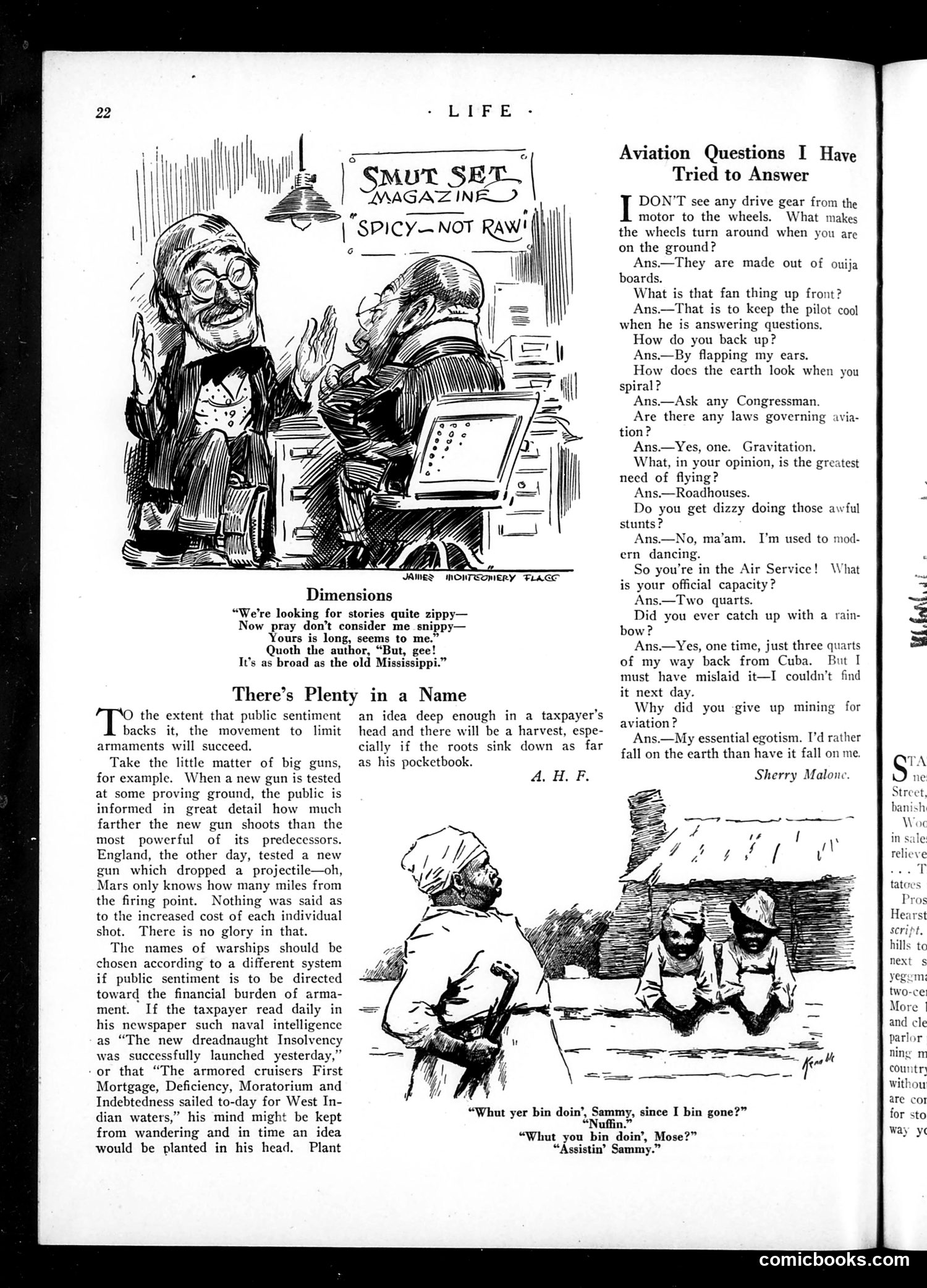
This page contains three satirical pieces from an early 20th-century American humor magazine: **"Dimensions"** mocks editorial gatekeeping—an editor rejecting a manuscript as "too long" while the author defends its breadth, using the Mississippi River as a humorous measure. **"There's Plenty in a Name"** proposes renaming warships with financially transparent names like "Insolvency," "Deficiency," and "Moratorium" to make taxpayers aware of military spending costs. It's political satire arguing that honest naming would build public opposition to armament budgets. **"Aviation Questions I Have Tried to Answer"** is absurdist humor mocking early aviation ignorance through fake Q&A—wheels made of "Ouija boards," pilots cooled by fans, backing up by "flapping ears." This ridicules both public confusion about new aircraft technology and perhaps overconfident pilots. The bottom cartoon depicts Black laborers in dialect, appearing to be a separate comedic vignette typical of the era's problematic humor conventions.
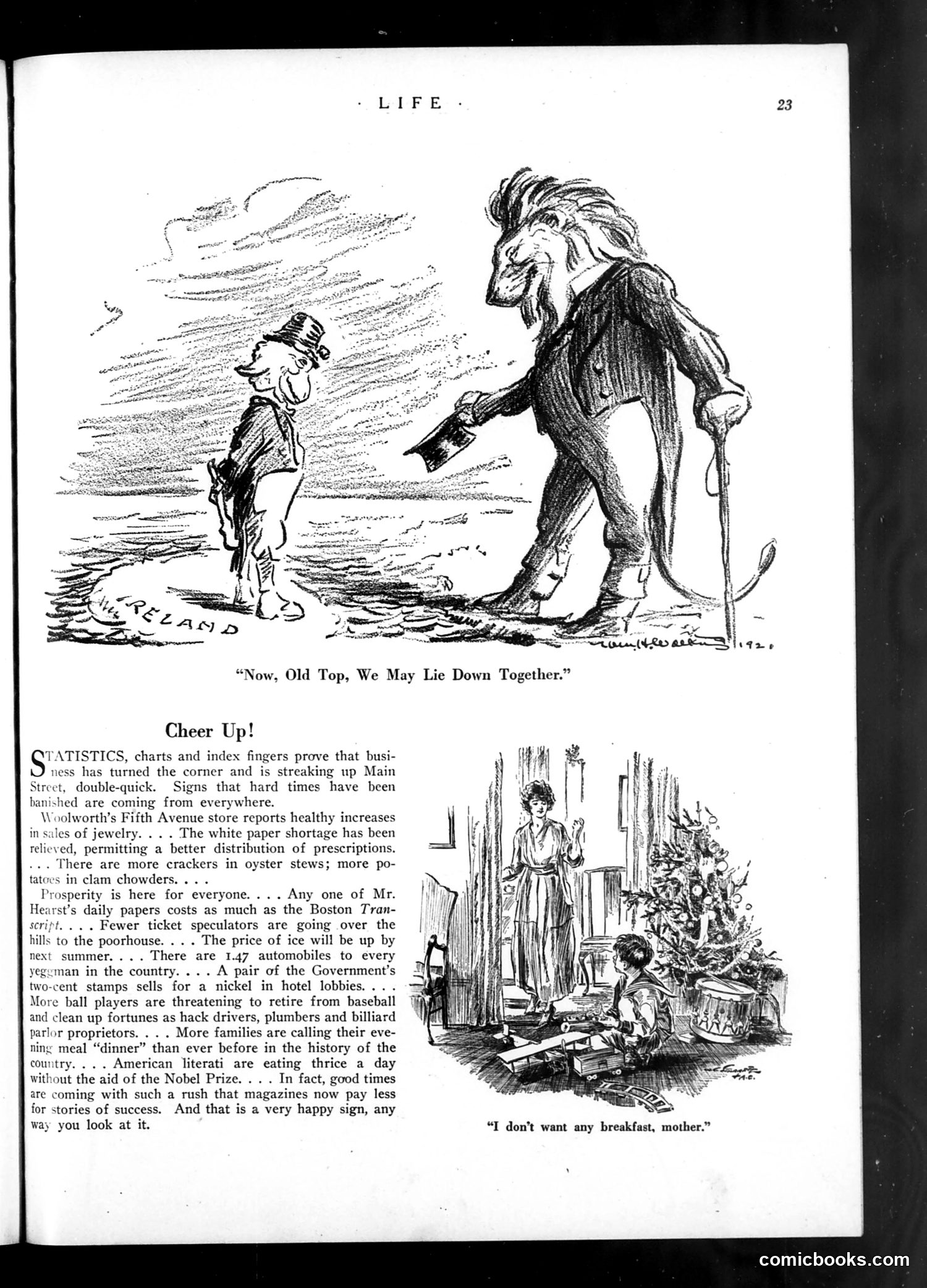
**Top Cartoon:** Shows a small figure labeled "IRELAND" confronting a large, menacing figure (likely representing Britain or a creditor). The caption "Now, Old Top, We May Lie Down Together" uses dark irony—suggesting reconciliation or peace while the imagery conveys threat and domination. This references Irish independence struggles and British-Irish relations of the period. **"Cheer Up!" Article:** This is satirical commentary on economic optimism. The text lists absurd "signs of prosperity"—like more potatoes in chowder, ball players becoming plumbers, and Americans eating without Nobel Prize support. The satire mocks hollow cheerleading about economic recovery by presenting trivial or ridiculous "evidence" of improvement. **Bottom Cartoon:** Depicts a child refusing breakfast, captioned "I don't want any breakfast, mother." This likely illustrates the article's point: actual prosperity remains elusive for ordinary families despite official optimism. The hungry child contradicts the "good times are coming" narrative. Together, the page satirizes government and media cheerleading disconnected from ordinary people's economic reality.
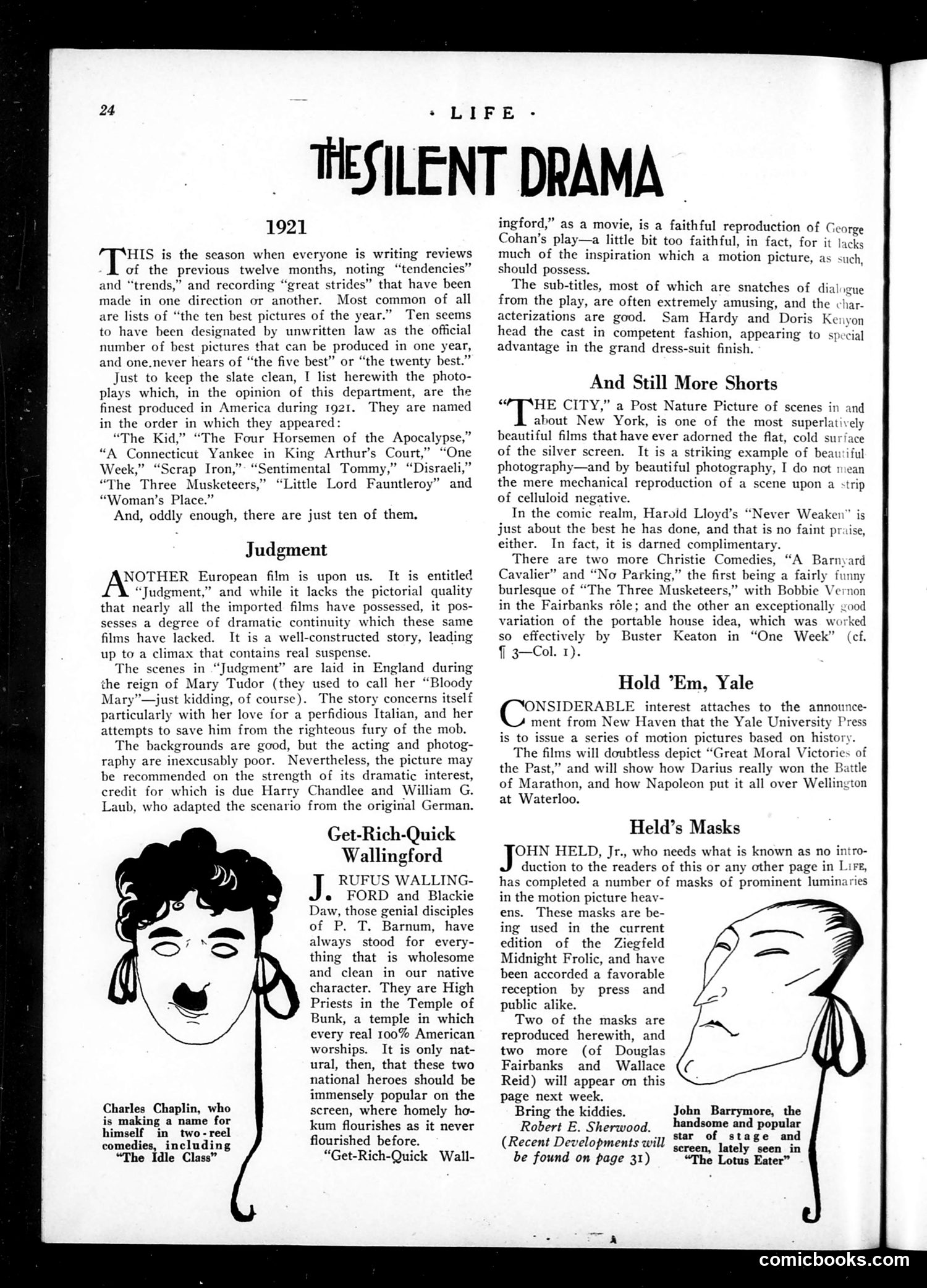
This 1921 *Life* magazine page reviews that year's best films. The cartoons illustrate two silent-film stars: **Charlie Chaplin** (left caricature): Noted for his "two-reel comedies" including "The Idle Class." The exaggerated features—mustache, baggy appearance—reference his iconic "Tramp" character, though the text suggests he was still building his reputation in 1921. **John Barrymore** (right caricature): Identified as "handsome and popular star of stage and screen, lately seen in 'The Lotus Eater.'" The drooping, melancholic expression satirizes his dramatic acting style. The page's main content discusses 1921's "ten best pictures," including Chaplin's "The Kid" and films starring Harold Lloyd. The satire lies in the arbitrary "ten best" tradition itself—the author notes this unwritten rule while ironically producing exactly ten films, mocking the predictability of critical consensus during cinema's early decades.
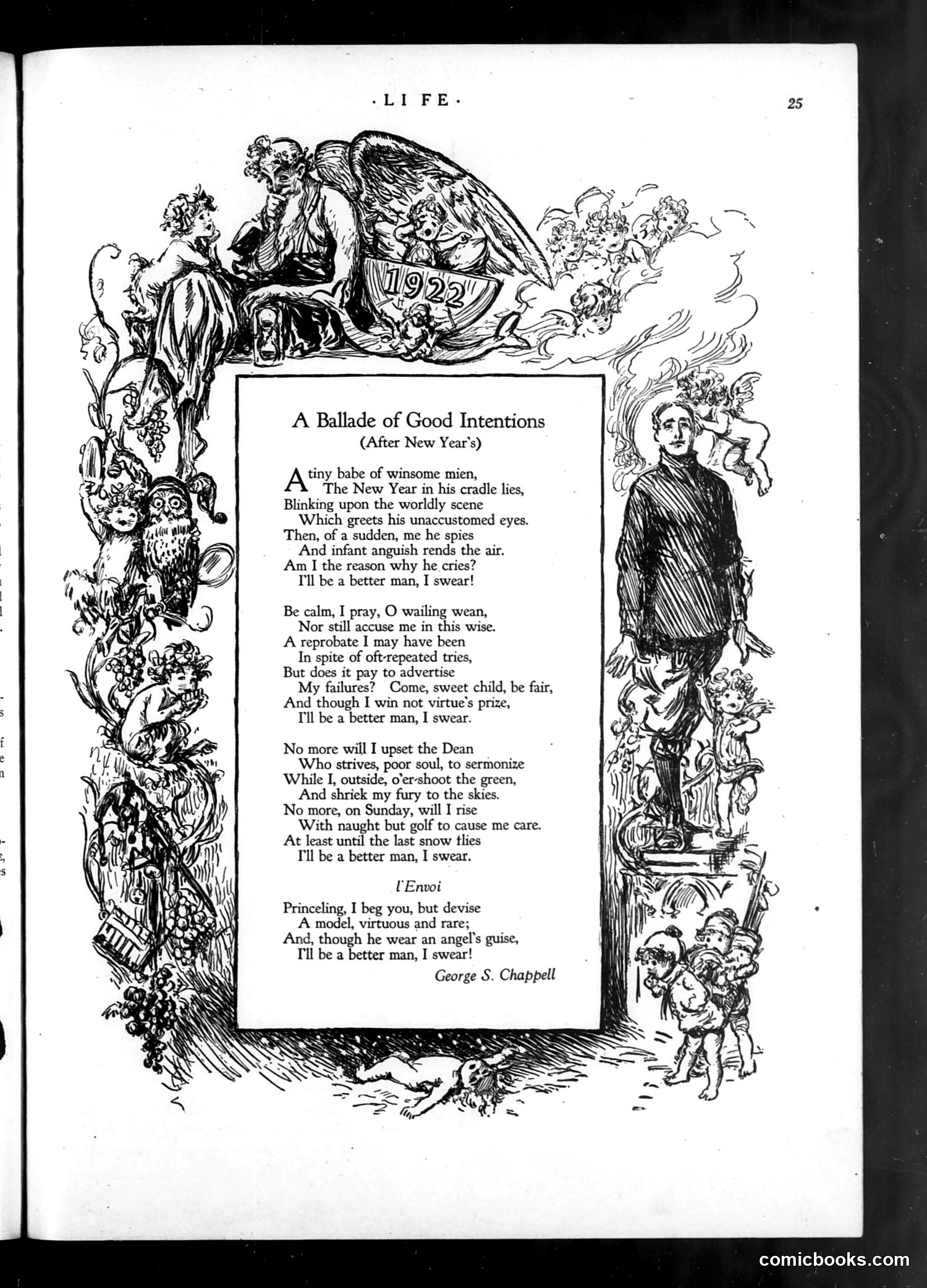
This 1922 *Life* magazine page presents a humorous poem by George S. Chappell mocking New Year's resolutions. The poem depicts a man confronting the infant New Year (personified as a baby in a cradle marked "1922"), who cries upon seeing him—implying the man's poor character. The satire centers on the speaker's transparently insincere promises: he'll be "a better man," yet immediately undermines himself with qualifications and excuses. He promises to stop upsetting the Dean during sermons (implying he disrupts church), to abandon Sunday golf binges, and to stop advertising his failures—all while making the same vows he's apparently made repeatedly before. The joke targets the universal human tendency to make grandiose but hollow New Year's pledges. The ornate decorative border with cherubs and classical imagery frames the self-deluding protagonist, emphasizing the mock-serious tone of his transparently hollow commitments.
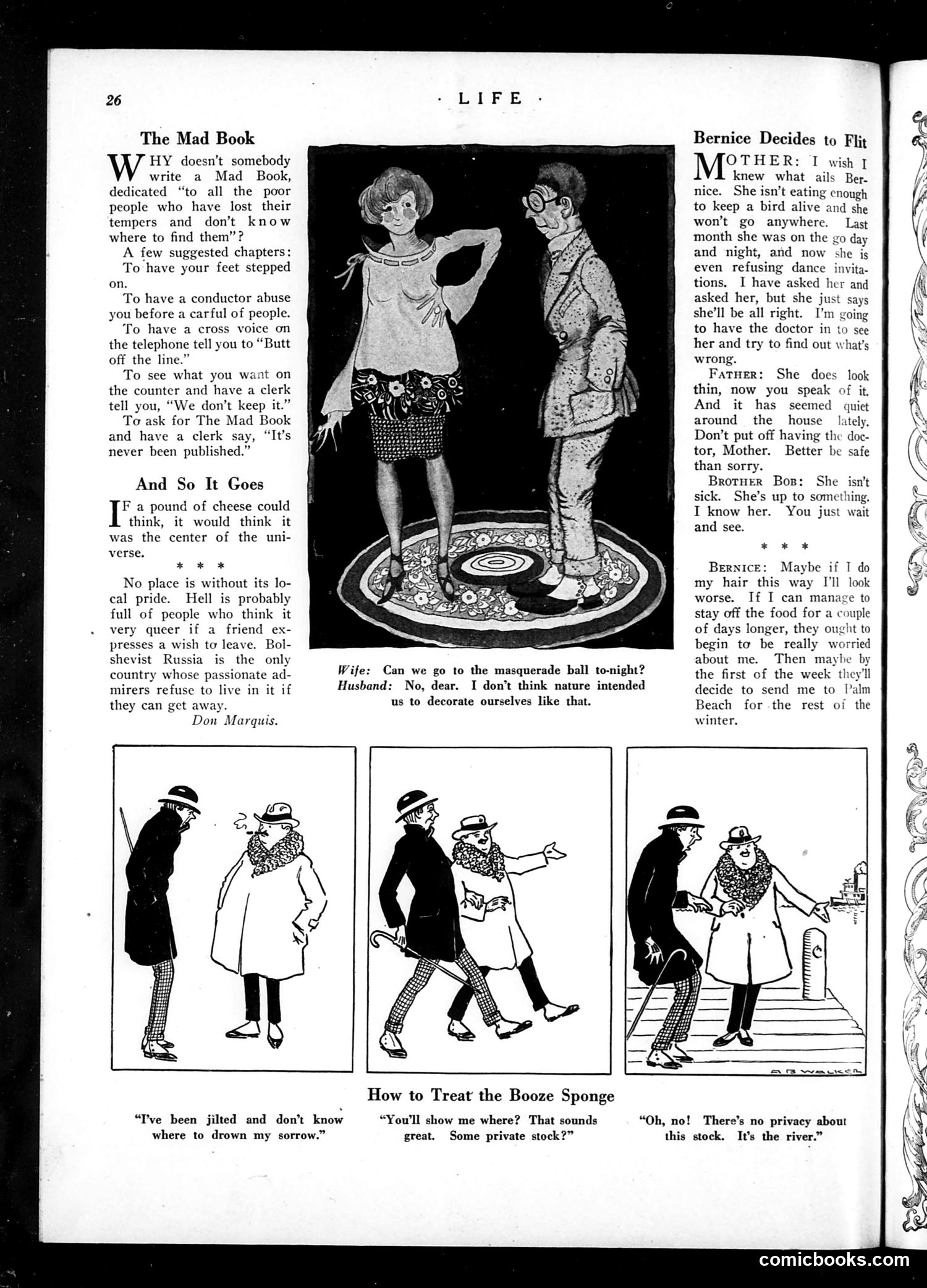
This *Life* magazine page contains several satirical pieces typical of early 20th-century American humor: **"The Mad Book"** mocks everyday frustrations—rude clerks, abusive conductors, frustrating customer service—anticipating modern complaints by decades. **"And So It Goes"** features a philosophical quote by Don Marquis about local pride and people's irrational attachments to unpleasant places (with a jab at Bolshevik Russia, reflecting anti-Communist sentiment of the era). **"How to Treat the Booze Sponge"** is a three-panel comic about a man seeking sympathy for romantic rejection, apparently hoping to access someone's private alcohol supply. The punchline suggests taking him to the river instead—dark humor about disposing of the unwanted drunk. **"Bernice Decides to Flit"** depicts a young woman feigning illness (refusing food, declining social invitations) to manipulate her parents into sending her to a beach resort—satirizing both youth manipulation and parental anxiety. The magazine's humor relies on recognizing social pretense and human weakness.
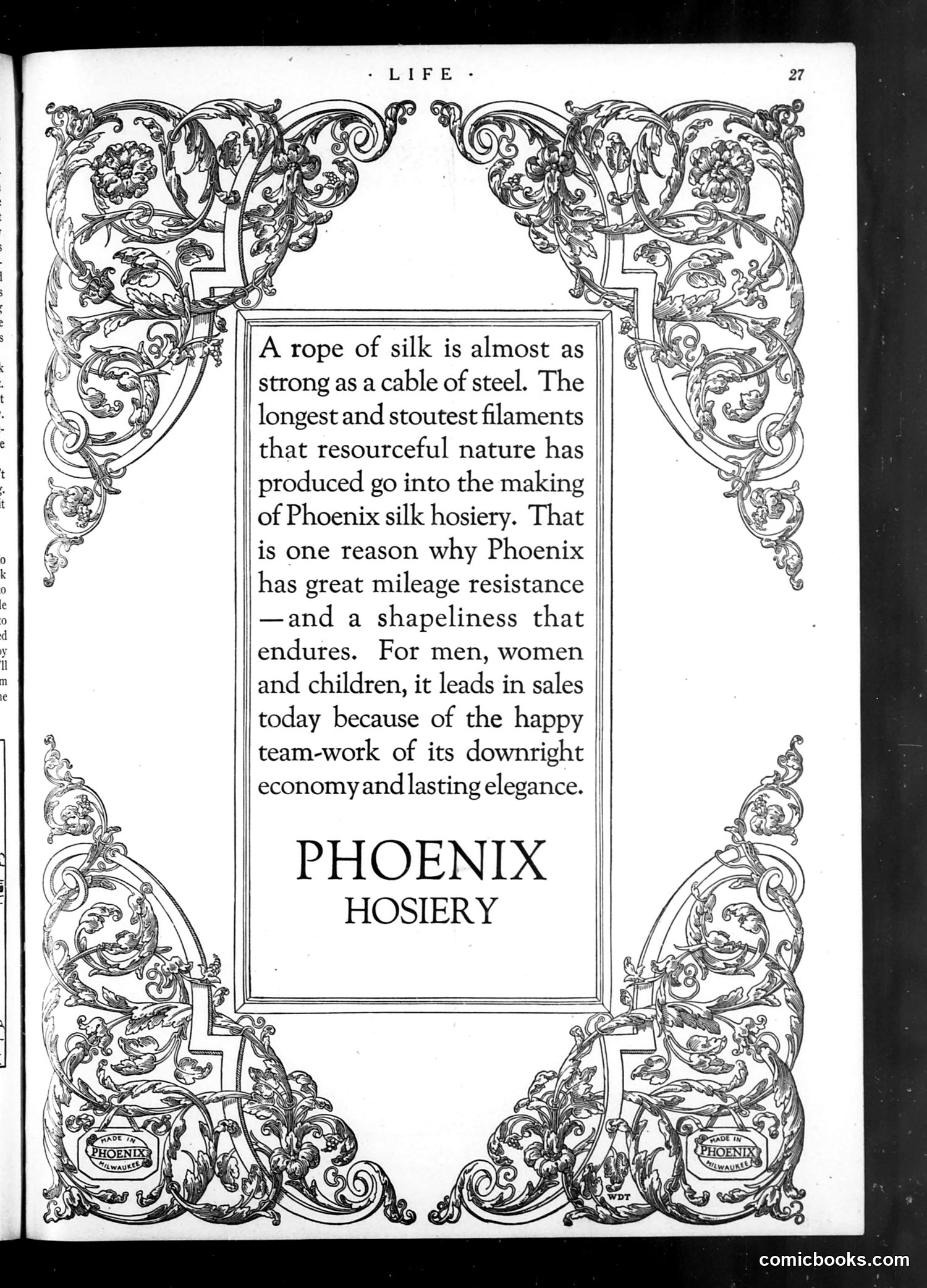
This is a **full-page advertisement**, not satire or political commentary. It promotes Phoenix brand silk hosiery, appearing in *Life* magazine (page 27). The ad uses ornate decorative borders featuring scrollwork and nature motifs—typical of early 20th-century luxury advertising design. The text makes product claims: silk rope is strong as steel; Phoenix hosiery uses the finest filaments and offers durability ("mileage resistance") plus elegance. It targets all demographics (men, women, children) and emphasizes value through "economy and lasting elegance." The elaborate framing and formal typography convey premium quality to appeal to middle-class consumers. This is straightforward commercial messaging, not social commentary.
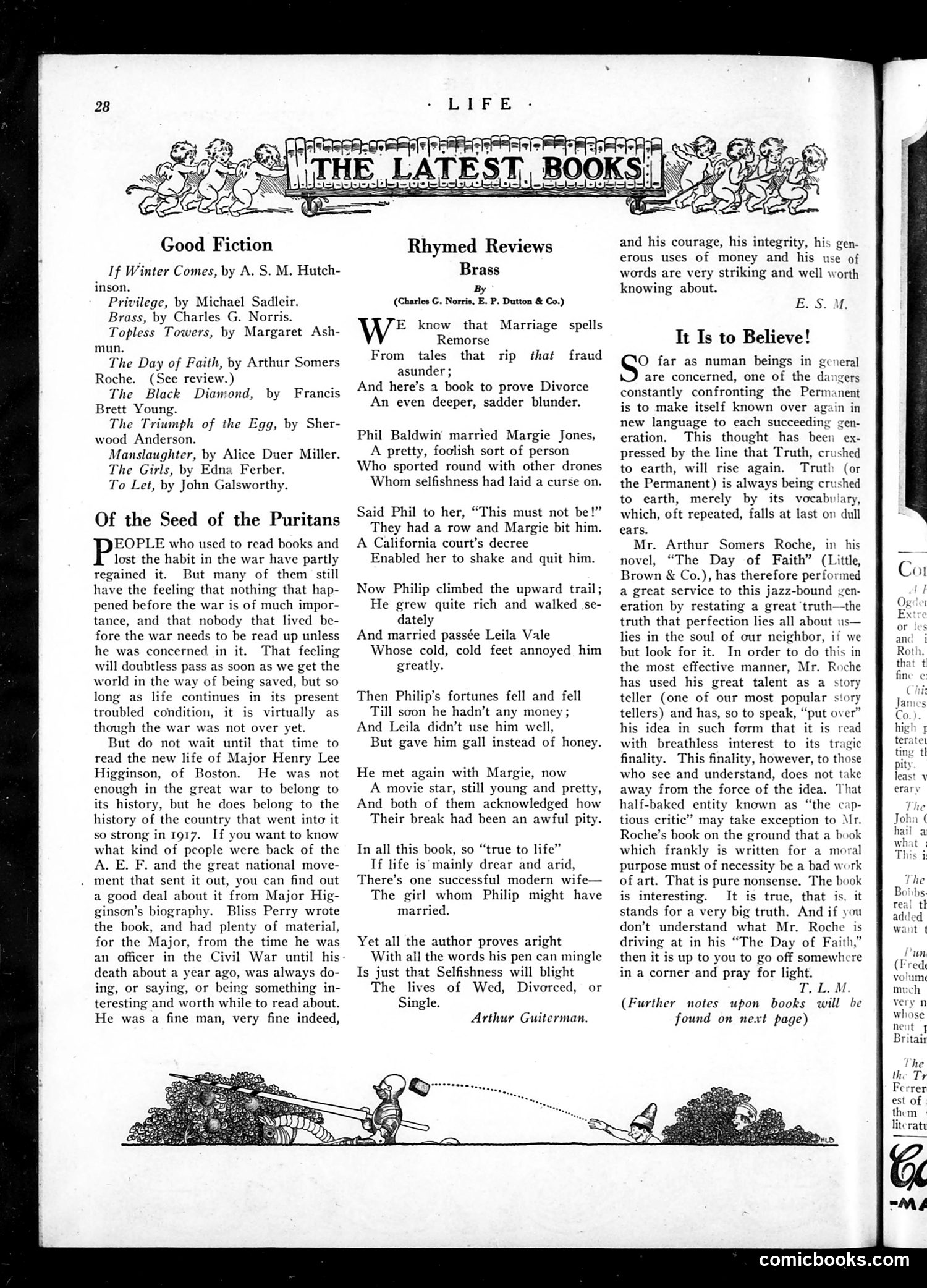
This page presents **book reviews and literary criticism** rather than political cartoons. The content includes: **"Good Fiction"** — A straightforward list of contemporary novels (1920s-era works by Hutchinson, Sadleir, Norris, Anderson, Ferber, Galsworthy). **"Of the Seed of the Puritans"** — An essay encouraging post-WWI readers to engage with older literature, specifically recommending a biography of Major Henry Lee Higginson, a Boston figure who served in the Civil War and remained influential through the Great War. **"Rhymed Reviews: Brass"** — A comic verse review by Arthur Guiterman summarizing Charles G. Norris's novel about marriage and divorce. The satirical poem traces Phil Baldwin's failed marriages, ultimately arguing that the book's moral lesson—that "Selfishness will blight / The lives of Wed, Divorced, or Single"—proves predictable. **"It Is to Believe!"** — A philosophical essay about how timeless truths (the "Permanent") lose cultural impact when expressed in stale vocabulary. The page contains no political cartoons—it's a literary review section typical of Life's cultural commentary.
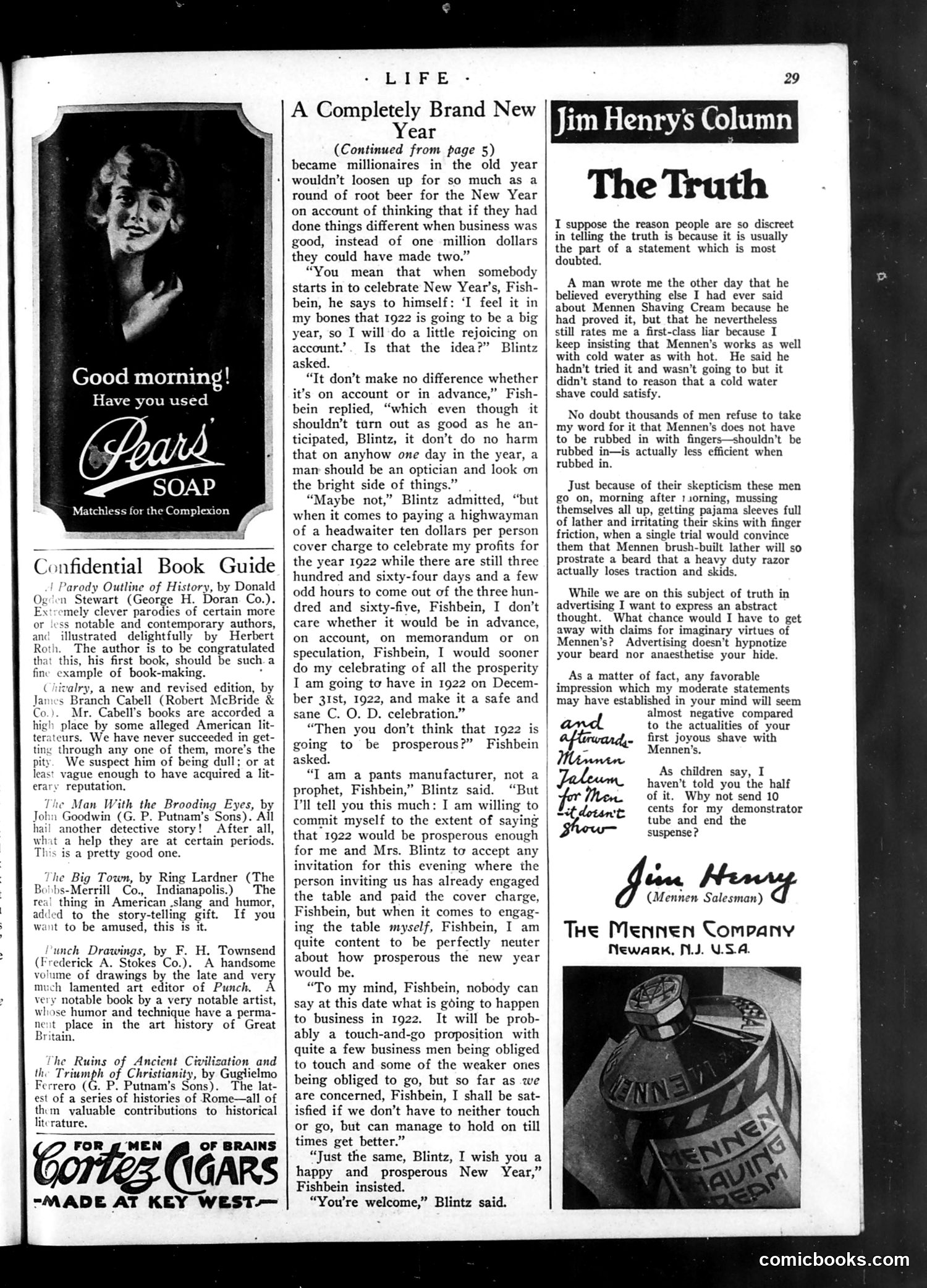
This page features a **satirical dialogue between two Jewish characters, Fishbein and Blintz**, discussing New Year's celebrations and economic optimism for 1922. The humor derives from Blintz's working-class skepticism about prosperity—he refuses to pay expensive cover charges at restaurants to celebrate a year that hasn't proven profitable yet. He'll only celebrate *after* 1922 proves successful, and only if someone else pays. The satire targets **post-WWI American economic anxiety**: despite optimism about the "new year," ordinary businessmen like a pants manufacturer remain cautious about spending. The joke relies on Yiddish-inflected dialogue and character types common in 1920s American comedy. The page also includes book reviews and advertisements typical of *Life* magazine's format—a mix of satirical commentary and commercial content. The Mennen shaving cream advertisement appears alongside Jim Henry's column, representing the publication's advertising revenue model.
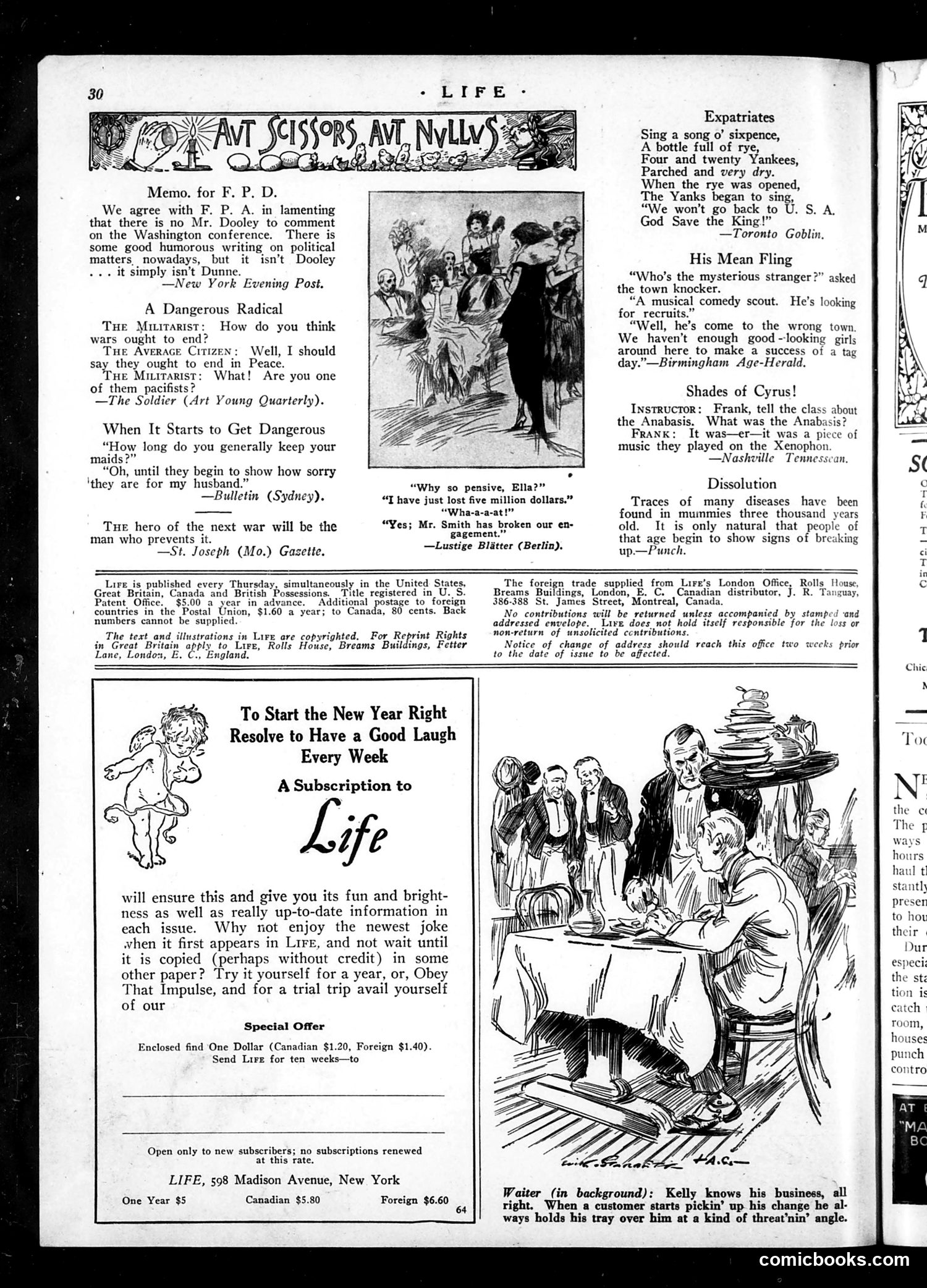
This page from *Life* magazine (undated but likely early 1920s, based on references to "Washington conference") collects brief satirical jokes and social commentary typical of the era's humor publications. **Key content:** The opening memo laments the absence of Mr. Dooley (a famous Irish-American newspaper character created by Finley Peter Dunne), suggesting contemporary political commentary lacks his wit. Several jokes mock pacifism as radical ("Are you one of them pacifists?"), gender dynamics in domestic service, and post-war expatriate culture—Americans drinking in foreign countries and resisting return home ("God Save the King!"). A recurring theme is American cultural pretension: a musical-comedy scout seeking "good-looking girls" for a show, a student confusing classical literature with music. The page is primarily **advertising for Life subscriptions**, promoting weekly humor and "up-to-date information" for one dollar. The illustration shows a domestic dinner scene with a waiter observing a customer's behavior—typical gentle social satire. The humor reflects post-WWI American attitudes: skepticism toward pacifism, fascination with European life, and amusement at cultural misunderstandings.
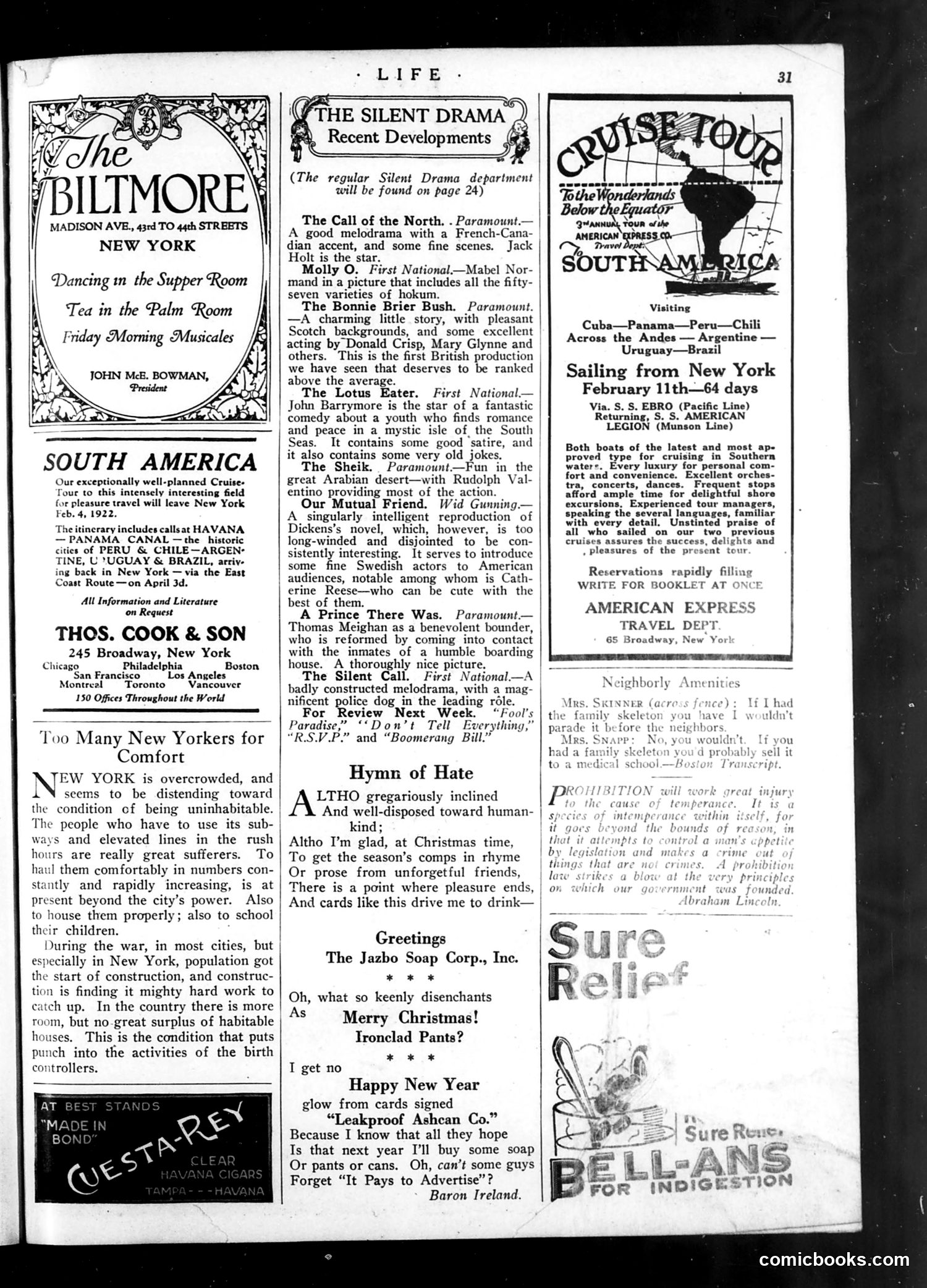
This page is primarily advertising and editorial content from Life magazine, circa 1922, with minimal political cartoons or satire. **Key content:** The main editorial piece, "Too Many New Yorkers for Comfort," argues that New York City's population has outpaced construction capacity. The author criticizes overcrowded subways and elevated trains, inadequate housing, and poor schools. Notably, this piece references the "birth controllers"—a reference to the early 20th-century birth control movement, which the author appears to blame for helping address population pressure rather than infrastructure expansion. The post-WWI setting is significant; population boomed during wartime but construction lagged behind. **Advertising dominates:** The Biltmore hotel, cruise tours to South America, and Thomas Cook travel services occupy substantial space. The "Silent Drama" section reviews contemporary films with stars like Rudolph Valentino and Mabel Normand. This reflects cinema's major cultural role in the 1920s. **No significant political cartoons appear.** The page is primarily commercial material reflecting 1920s leisure and travel aspirations.
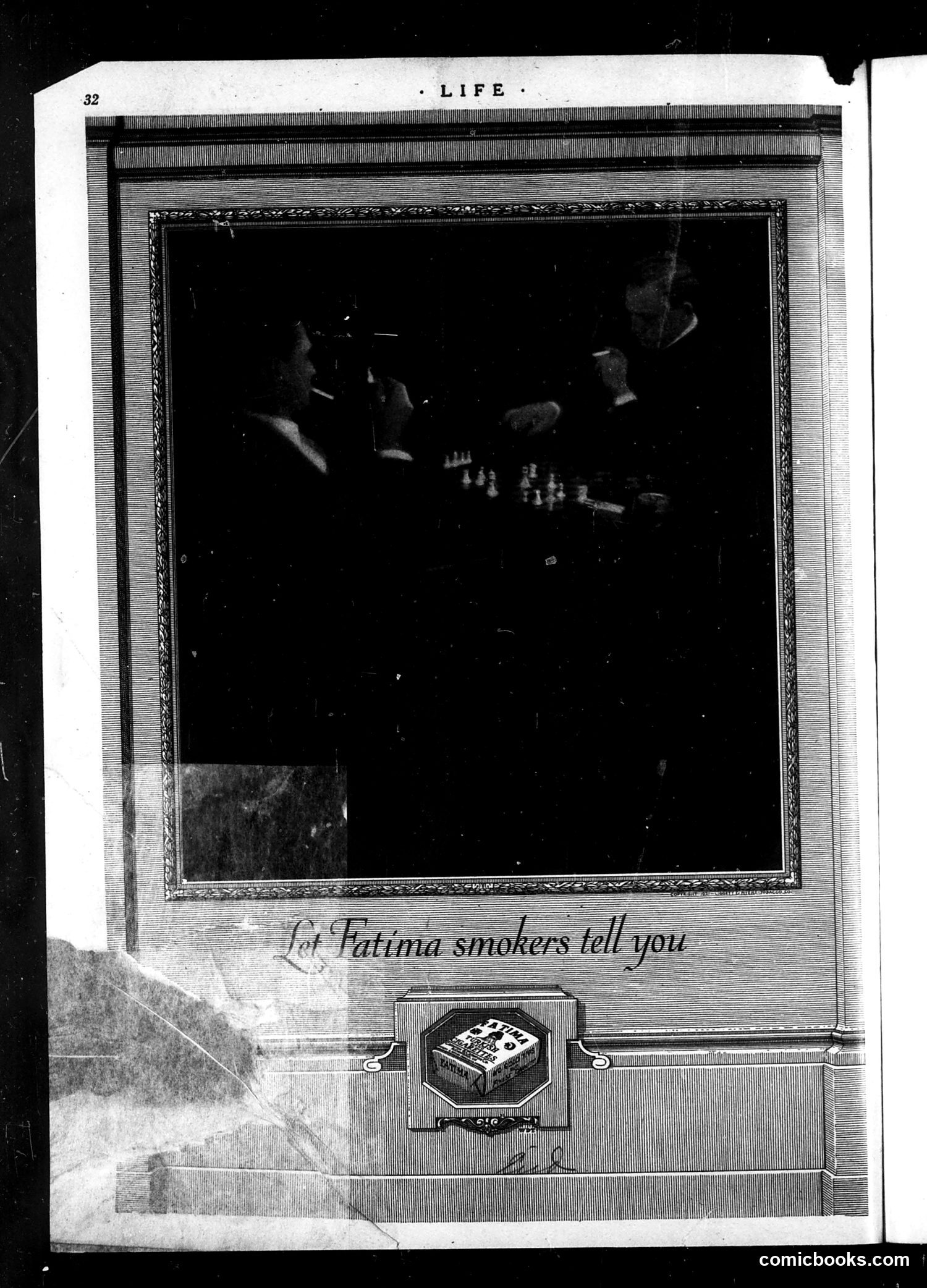
This is a cigarette advertisement for Fatima brand cigarettes. The image shows two men playing chess in dim lighting, with the accompanying text "Let Fatima smokers tell you." The advertisement's message suggests that Fatima cigarettes are favored by intelligent, sophisticated men—chess being portrayed as a game of intellect and refinement. This was a common advertising strategy of the early 20th century, associating a consumer product with status, intelligence, and masculinity. The visual darkness and serious demeanor of the players reinforce an image of contemplative sophistication. The ad appears designed to appeal to readers' aspirations toward cultured, intellectual leisure.

I can see this is a blank or nearly blank page from what appears to be a Life magazine issue, with only "comicbooks.com" visible at the bottom right. The page contains no discernible cartoon, illustration, text content, or other material that would allow me to identify figures, political references, or satirical meaning. Without visible content to analyze, I cannot explain what this page was intended to communicate to contemporary or modern readers. This appears to be either a blank page, a scanning error, or a page that has not reproduced clearly in this digital format.