
Life, 1921-12-29 · page 30 of 35
Life — December 29, 1921 — page 30: what you’re looking at
What you’re looking at
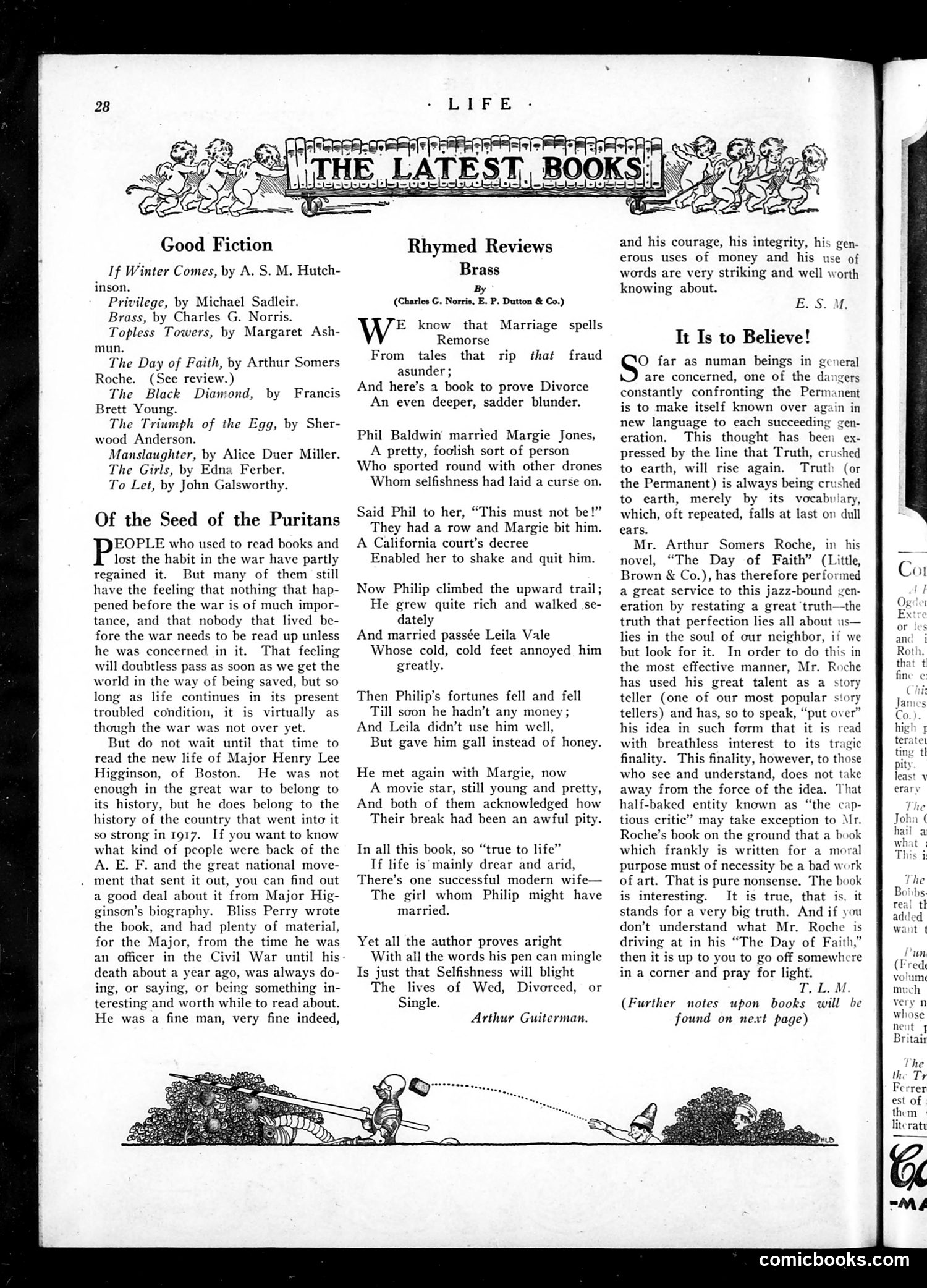
This page presents **book reviews and literary criticism** rather than political cartoons. The content includes: **"Good Fiction"** — A straightforward list of contemporary novels (1920s-era works by Hutchinson, Sadleir, Norris, Anderson, Ferber, Galsworthy). **"Of the Seed of the Puritans"** — An essay encouraging post-WWI readers to engage with older literature, specifically recommending a biography of Major Henry Lee Higginson, a Boston figure who served in the Civil War and remained influential through the Great War. **"Rhymed Reviews: Brass"** — A comic verse review by Arthur Guiterman summarizing Charles G. Norris's novel about marriage and divorce. The satirical poem traces Phil Baldwin's failed marriages, ultimately arguing that the book's moral lesson—that "Selfishness will blight / The lives of Wed, Divorced, or Single"—proves predictable. **"It Is to Believe!"** — A philosophical essay about how timeless truths (the "Permanent") lose cultural impact when expressed in stale vocabulary. The page contains no political cartoons—it's a literary review section typical of Life's cultural commentary.
📄 Transcribed text from this page (OCR, searchable)
Machine-transcribed from the original scan — historical spelling and the odd misread are preserved.
Good Fiction If Winter Comes, by A. S. M. Hutch- inson. Privilege, by Michael Sadleir. Brass, by Charles G. Norris. Topless Towers, by Margaret Ash- mun. The Day of Faith, by Arthur Somers Roche. (See review.) The Black Diamond, by Brett Young. The Triumph of the Egg, by Sher- wood Anderson. Manslaughter, by Alice Duer Miller. The Girls, by Edna Ferber. To Let, by John Galsworthy. Of the Seed of the Puritans EOPLE who used to read books and lost the habit in the war have partly regained it. But many of them still have the feeling that nothing that hap- pened before the war is of much impor- tance, and that nobody that lived be- fore the war needs to be read up unless he was concerned in it. That feeling will doubtless pass as soon as we get the world in the way of being saved, but so long as life continues in its present troubled condition, it is virtually as though the war was not over yet. But do not wait until that time to read the new life of Major Henry Lee Higginson, of Boston. He was not enough in the great war to belong to its history, but he does belong to the history of the country that went into it so strong in 1917. If you want to know what kind of people were back of the A. E. F. and the great national move- . ment that sent it out, you can find out a good deal about it from Major Hig- ginson’s biography. Bliss Perry wrote the book, and had plenty of material, for the Major, from the time he was an officer in the Civil War until his death about a year ago, was always do- ing, or saying, or being something in- teresting and worth while to read about. He was a fine man, very fine indeed, Francis Rhymed Reviews Brass By (Charles G. Norris, E. P. Dutton & Co.) E know that Remorse From tales that rip asunder; And here’s a book to prove Divorce An even deeper, sadder blunder. Marriage spells that fraud Phil Baldwin married Margie Jones, A pretty, foolish sort of person Who sported round with other drones Whom selfishness had laid a curse on. Said Phil to her, “This must not be!” They had a row and Margie bit him. A California court’s decree Enabled her to shake and quit him. Now Philip climbed the upward trail; He grew quite rich and walked se- dately And married passée Leila Vale Whose cold, cold feet annoyed him greatly. Then Philip’s fortunes fell and fell Till soon he hadn’t any money; And Leila didn’t use him well, But gave him gall instead of honey. He met again with Margie, now A movie star, still young and pretty, And both of them acknowledged how Their break had been an awful pity. In all this book, so “true to life” If life is mainly drear and arid, There’s one successful modern wife— The girl whom Philip might have married. Yet all the author proves aright With all the words his pen can mingle Is just that Selfishness will blight The lives of Wed, Divorced, or Single. Arthur Guiterman, and his courage, his integrity, his gen- erous uses of money and his use of words are very striking and well worth knowing about. E. S. M. It Is to Believe! O far as numan beings in general are concerned, one of the dangers constantly confronting the Permanent is to make itself known over again in new language to each succeeding gen- eration. This thought has been ex- pressed by the line that Truth, crushed to earth, will rise again. Truth (or the Permanent) is always being crushed to earth, merely by its vocabulary, which, oft repeated, falls at last on dull ears. Mr. Arthur Somers Roche, in his novel, “The Day of Faith” (Little, Brown & Co.), has therefore performed a great service to this jazz-bound gen- eration by restating a great ‘truth—the truth that perfection lies all about us— lies in the soul of our neighbor, if we but look for it. In order to do this in the most effective manner, Mr. Roche has used his great talent as a story teller (one of our most popular story tellers) and has, so to speak, “put over” his idea in such form that it is read with breathless interest to its tragic finality. This finality, however, to those who see and understand, does not take away from the force of the idea. That half-baked entity known as “the cap- tious critic” may take exception to Mr. Roche’s book on the ground that a book which frankly is written for a moral purpose must of necessity be a bad work of art. That is pure nonsense. The book is interesting. It is true, that is, it stands for a very big truth. And if you don’t understand what Mr. Roche is driving at in his “The Day of Faith,” then it is up to you to go off somewhere in a corner and pray for light. TaEM. (Further notes upon books will be found on next page) (Fred volume much very n whose nent Britais he the Tr Ferrer est of them literaty & ~Mé comicbooks.com