
Life, 1921-12-29 · page 7 of 35
Life — December 29, 1921 — page 7: what you’re looking at
What you’re looking at
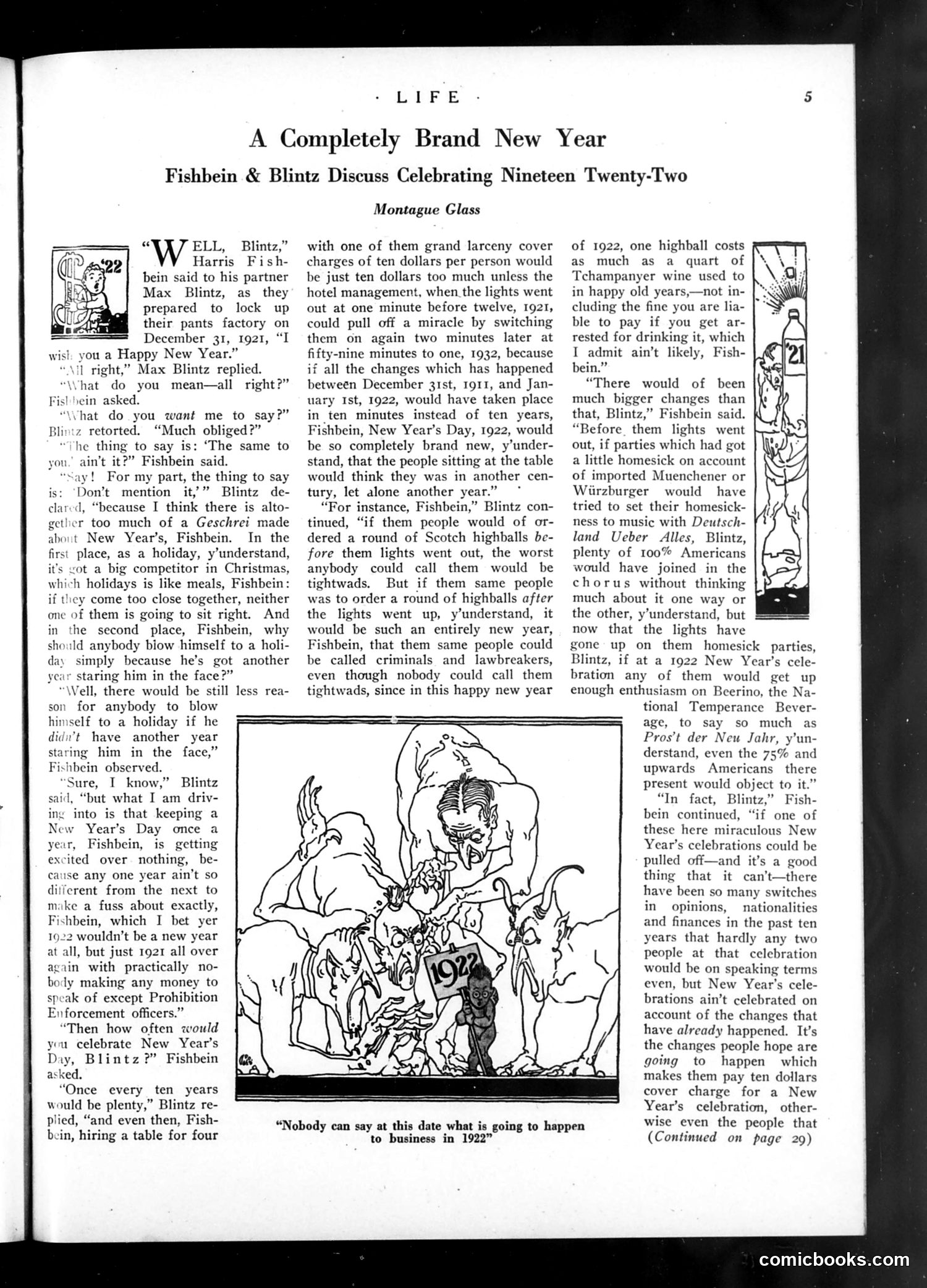
This satirical piece features a dialogue between Harris Fishbein and Max Blintz discussing New Year's Eve 1921 celebrations. The main cartoon depicts a chaotic party scene labeled "1922," showing revelers in festive disarray. The satire targets the extravagance of high-society New Year's parties. Fishbein and Blintz debate whether such celebrations constitute genuine change or merely cyclical excess. They reference specific luxuries (imported Muenchener beer, highballs, "Deutscheland Ueber Alles") to mock wealthy revelers' pretensions. The joke hinges on the irony that despite the passage of time and symbolic "brand new year," nothing fundamentally changes—the same people engage in identical behaviors annually. The cartoon's wild imagery emphasizes the chaos and predictability of elite celebration culture during the Jazz Age.
📄 Transcribed text from this page (OCR, searchable)
Machine-transcribed from the original scan — historical spelling and the odd misread are preserved.
LIFE A Completely Brand New Year Fishbein & Blintz Discuss Celebrating Nineteen Twenty-Two “ ELL, Blintz,” Harris Fish- bein said to his partner Max Blintz, as they prepared to lock up their pants factory on December 31, 1921, “I wisl. you a Happy New Year.” “All right,” Max Blintz replied. “\Vhat do you mean—all right?” js} bein asked. “\Vhat do you want me to say?” z retorted. “Much obliged?” he thing to say is: ‘The same to ain't it?” Fishbein said. say! For my part, the thing to say is: Don’t mention it,’” Blintz de- clared, “because I think there is alto- gether too much of a Geschrei made about New Year’s, Fishbein. In the first place, as a holiday, y’understand, it's got a big competitor in Christmas, which holidays is like meals, Fishbein: if they come too close together, neither one of them is going to sit right. And in the second place, Fishbein, why should anybody biow himself to a holi- day simply because he’s got another ye aring him in the face?” “Well, there would be still less rea- son for anybody to blow himself to a holiday if he didn’t have another year staring him in the face,” Fishbein observed. “Sure, I know,” Blintz said, “but what I am driv- ing into is that keeping a New Year’s Day once a rt, Fishbein, is getting ited over nothing, be- ‘aise any one year ain't so diferent from the next to mike a fuss about exactly, Fishbein, which I bet yer 1922 wouldn’t be a new year at all, but just 1921 all over again with practically no- body making any money to speak of except Prohibition Enforcement officers.” “Then how often would you celebrate New Year's Day, Blintz ?” Fishbein asked. “Once every ten years would be plenty,” Blintz re- plied, “and even then, Fish- bein, hiring a table for four Montague Glass with one of them grand larceny cover charges of ten dollars per person would be just ten dollars too much unless the hotel management, when_the lights went out at one minute before twelve, 1921, could pull off a miracle by switching them on again two minutes later at fifty-nine minutes to one, 1932, because if all the changes which has happened between December 31st, 1911, and Jan- uary Ist, 1922, would have taken place in ten minutes instead of ten years, Fishbein, New Year’s Day, 1922, would be so completely brand new, y’under- stand, that the people sitting at the table would think they was in another cen- tury, let alone another year.” “For instance, Fishbein,” Blintz con- tinued, “if them people would of or- dered a round of Scotch highballs be- fore them lights went out, the worst anybody could call them would be tightwads. But if them same people was to order a round of highballs after the lights went up, y’understand, it would be such an entirely new year, Fishbein, that them same people could be called criminals and lawbreakers, even though nobody could call them tightwads, since in this happy new year “Nobody can say at this date what is going to happen to business in 1922” of 1922, one highball costs as much as a quart of Tchampanyer wine used to in happy old years,—not in- cluding the fine you are lia- ble to pay if you get ar- rested for drinking it, which I admit ain’t likely, Fish- bein.” “There would of been much bigger changes than that, Blintz,” Fishbein said. “Before. them lights went out, if parties which had got a little homesick on account of imported Muenchener or Wiirzburger would have tried to set their homesick- ness to music with Deutsch- land Ueber Alles, Blintz, plenty of 100% Americans would have joined in the chorus without thinking much about it one way or the other, y’understand, but now that the lights have gone up on them homesick parties, Blintz, if at a 1922 New Year’s cele- bration any of them would get up enough enthusiasm on Beerino, the Na- tional Temperance Bever- age, to so much as Pros’t der Neu Jahr, y’un- derstand, even the 75% and upwards Americans there present would object to it.” “In fact, Blintz,” Fish- bein continued, “if one of these here miraculous New Year's celebrations could be pulled off—and it’s a good thing that it can’t—there have been so many switches in opinions, nationalities and finances in the past ten years that hardly any two people at that celebration would be on speaking terms even, but New Year's cele- brations ain’t celebrated on account of the changes that have already happened. It’s the changes people hope are going to happen which makes them pay ten dollars cover charge for a New Year’s celebration, other- wise even the people that (Continued on page 29) comicbooks.com