
Life, 1921-12-29 · page 26 of 35
Life — December 29, 1921 — page 26: what you’re looking at
What you’re looking at
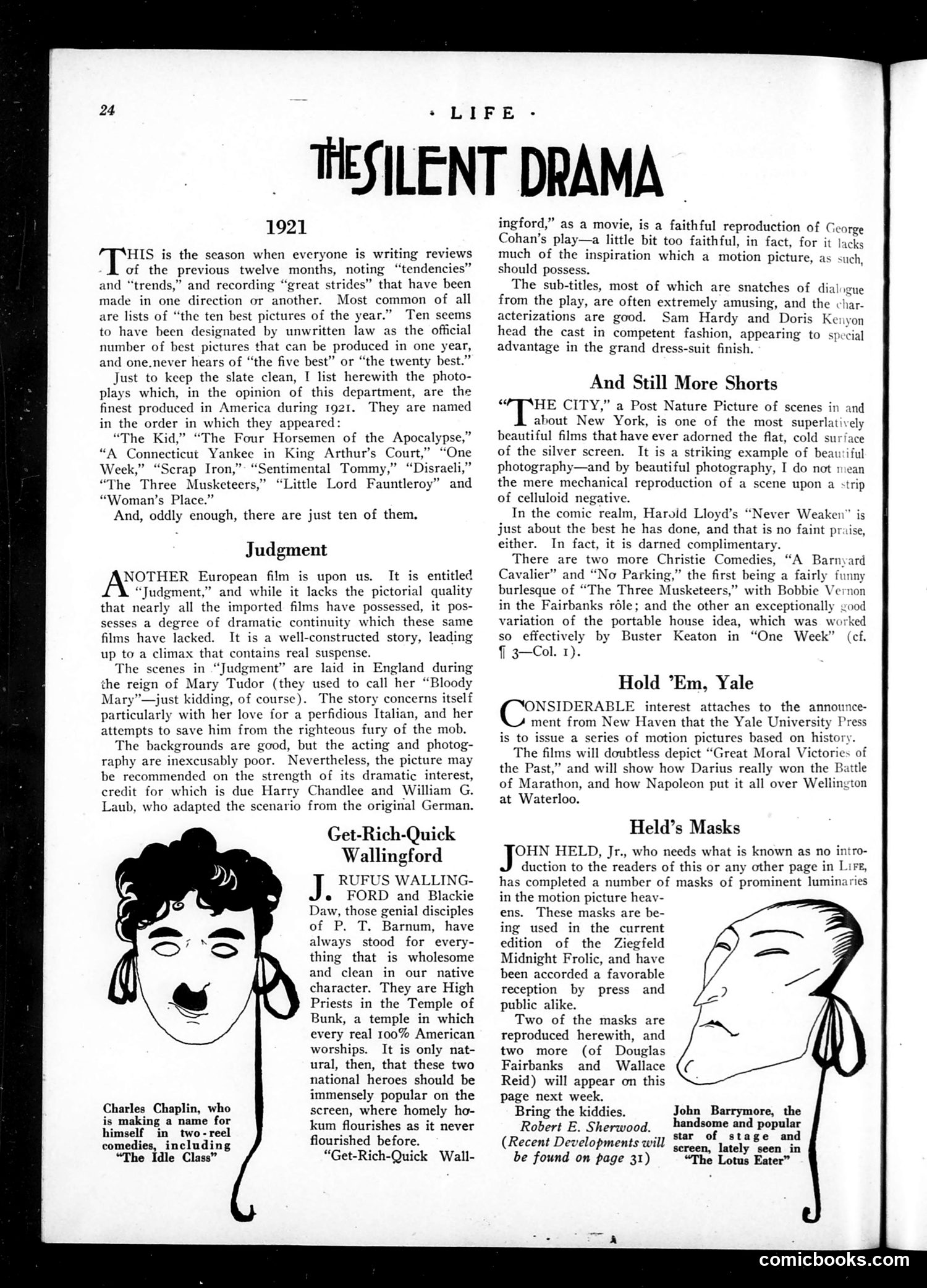
This 1921 *Life* magazine page reviews that year's best films. The cartoons illustrate two silent-film stars: **Charlie Chaplin** (left caricature): Noted for his "two-reel comedies" including "The Idle Class." The exaggerated features—mustache, baggy appearance—reference his iconic "Tramp" character, though the text suggests he was still building his reputation in 1921. **John Barrymore** (right caricature): Identified as "handsome and popular star of stage and screen, lately seen in 'The Lotus Eater.'" The drooping, melancholic expression satirizes his dramatic acting style. The page's main content discusses 1921's "ten best pictures," including Chaplin's "The Kid" and films starring Harold Lloyd. The satire lies in the arbitrary "ten best" tradition itself—the author notes this unwritten rule while ironically producing exactly ten films, mocking the predictability of critical consensus during cinema's early decades.
📄 Transcribed text from this page (OCR, searchable)
Machine-transcribed from the original scan — historical spelling and the odd misread are preserved.
* LIFE - _ WESILENT DRAMA 1921 HIS is the season when everyone is writing reviews of the previous twelve months, noting “tendencies” and “trends,” and recording “great strides” that have been made in one direction or another. Most common of all are lists of “the ten best pictures of the year.” Ten seems to have been designated by unwritten law as the official number of best pictures that can be produced in one year, and one.never hears of “the five best” or “the twenty best.” Just to keep the slate clean, I list herewith the photo- plays which, in the opinion of this department, are the finest produced in America during 1921. They are named in the order in which they appeared: “The Kid,” “The Four Horsemen of the Apocalypse,” “A Connecticut Yankee in King Arthur’s Court,” “One Week,” “Scrap Iron,” entimental Tommy,” “Disraeli,” “The Three Musketeers,” “Little Lord Fauntleroy” and “Woman's Place.” And, oddly enough, there are just ten of them, Judgment NOTHER European film is upon us. It is entitled “Judgment,” and while it lacks the pictorial quality that nearly all the imported films have possessed, it pos- sesses a degree of dramatic continuity which these same films have lacked. It is a well-constructed story, leading up to a climax that contains real suspense. The scenes in “Judgment” are laid in England during the reign of Mary Tudor (they used to call her “Bloody Mary”—just kidding, of course). The story concerns itself particularly with her love for a perfidious Italian, and her attempts to save him from the righteous fury of the mob. The backgrounds are good, but the acting and photog- raphy are inexcusably poor. Nevertheless, the picture may be recommended on the strength of its dramatic interest, credit for which is due Harry Chandlee and William G. Laub, who adapted the scenario from the original German. Get-Rich-Quick Wallingford RUFUS WALLING- FORD and Blackie Daw, those genial disciples of P. T. Barnum, have always stood for every- thing that is wholesome and clean in our native character. They are High Priests in the Temple of Bunk, a temple in which every real 100% American worships. It is only nat- ural, then, that these two national heroes should be immensely popular on the screen, where homely ho- kum flourishes as it never flourished before. “Get-Rich-Quick Wall- Charles Chaplin, who is making a name for himself in two-reel comedies, includi “The Idle Class’ ingford,” as a movie, is a faithful reproduction of George Cohan’s play—a little bit too faithful, in fact, for it lacks much of the inspiration which a motion picture, as such should possess. , The sub-titles, most of which are snatches of dial gue from the play, are often extremely amusing, and the char- acterizations are good. Sam Hardy and Doris Kenyon head the cast in competent fashion, appearing to special advantage in the grand dress-suit finish. And Still More Shorts “ HE CITY,” a Post Nature Picture of scenes in and about New York, is one of the most superlatively beautiful films that have ever adorned the flat, cold suriace of the silver screen. It is a striking example of beautiful photography—and by beautiful photography, I do not mean the mere mechanical reproduction of a scene upon a strip of celluloid negative. In the comic realm, Harold Lloyd’s “Never Weaken” is just about the best he has done, and that is no faint pr either. In fact, it is darned compliment: There are two more Christie Comedie: Cavalier” and “No Parking,” the first being a fairly burlesque of “The Three Musketeers,” with Bobbie Ve in the Fairbanks réle; and the other an exceptionally variation of the portable house idea, which was so effectively by Buster Keaton in “One Week” (cf. { 3—Col. 1). Hold ’Em, Yale 'ONSIDERABLE interest attaches to the announce- ment from New Haven that the Yale University Press is to issue a series of motion pictures based on history. The films will doubtless depict “Great Moral Victories of the Past,” and will show how Darius really won the Be of Marathon, and how Napoleon put it all over Welli at Waterloo. Held’s Masks OHN HELD, Jr., who needs what is known as no intro- duction to the readers of this or any other page in Lire, has completed a number of masks of prominent luminaries in the motion picture heav- ens. These masks are be- ing used in the current edition of the Ziegfeld Midnight Frolic, and have been accorded a favorable reception by press and public alike. Two of the masks are reproduced herewith, and two more (of Douglas Fairbanks and Wallace Reid) will appear on this page next week. Bring the kiddies. Robert E. Sherwood. (Recent Developments will be found on page 31) John Barrymore, the handsome and popular star of stage and screen, lately seen in “The Lotus Eater” comicbooks.com