
Life, 1921-12-29 · page 12 of 35
Life — December 29, 1921 — page 12: what you’re looking at
What you’re looking at
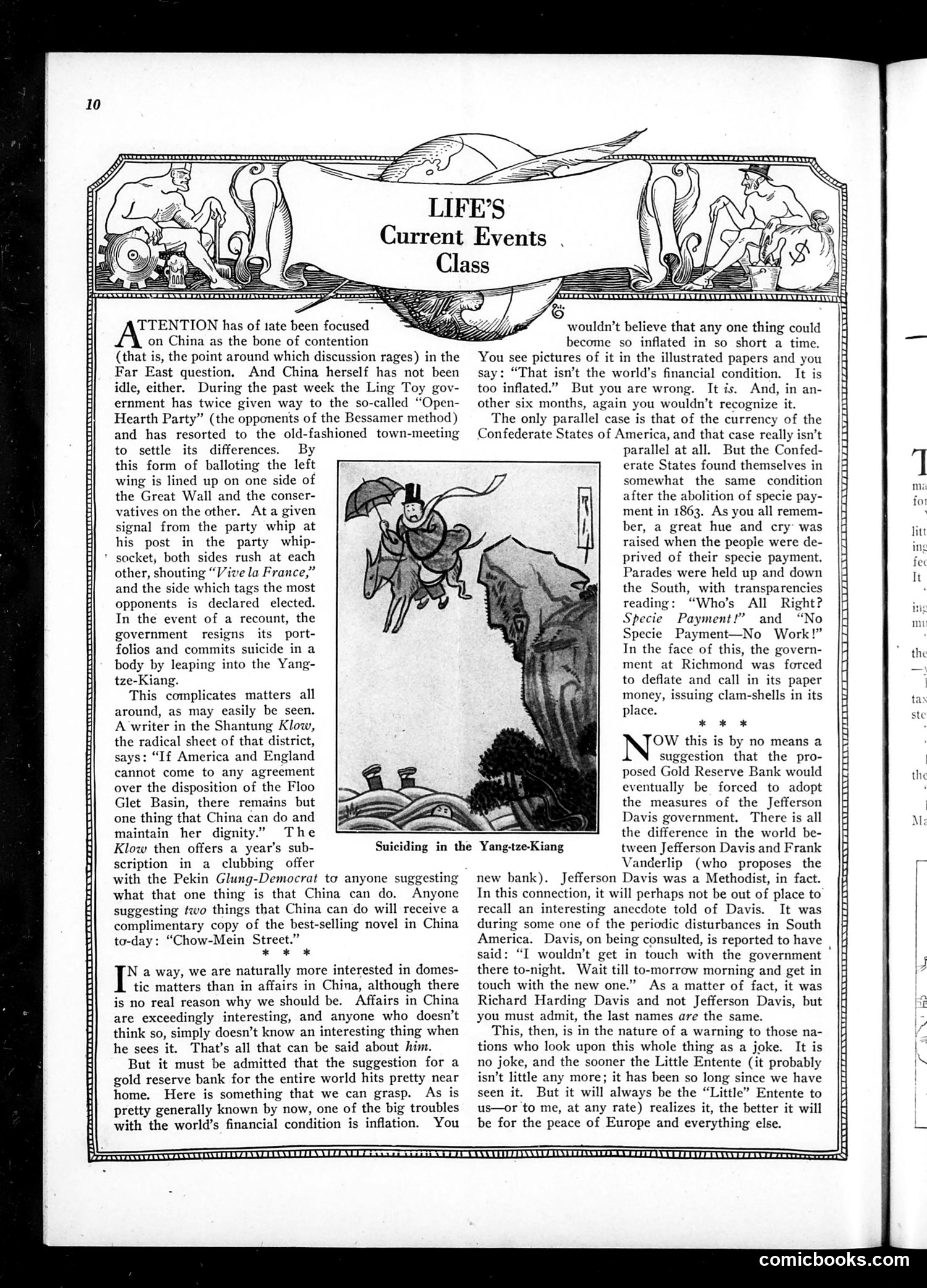
This page from Life magazine satirizes China's internal political strife during the early 20th century. The main illustration depicts "Suiciding in the Yang-tze-Kiang" — a darkly comic reference to Chinese officials' desperate responses to political instability. The text discusses the "Open Hearth Party" faction disputes within China's government, where competing sides resort to extreme measures including suicide when facing defeat. The satire compares this chaos to America's financial troubles, suggesting both nations struggle with internal crises — China through violent political upheaval, America through currency inflation and banking failures. The joke targets how absurdly dysfunctional both systems appear: China's officials literally kill themselves over political disagreements, while America's financial system collapses from abstract economic problems. Both represent governance breakdown.
📄 Transcribed text from this page (OCR, searchable)
Machine-transcribed from the original scan — historical spelling and the odd misread are preserved.
LIFE’S Current Events TTENTION has of tate been focused on China as the bone of contention (that is, the point around which discussion rages) in the Far East question, And China herself has not been idle, either. During the past week the Ling Toy gov- ernment has twice given way to the so-called “Open- Hearth Party” (the opponents of the Bessamer method) and has resorted to the old-fashioned town-meeting to settle its differences. By wouldn’t believe that any one thing could become so inflated in so short a time. You see pictures of it in the illustrated papers and you say: “That isn’t the world’s financial condition. It is too inflated.” But you are wrong. It is. And, in an- other six months, again you wouldn’t recognize it. The only parallel case is that of the currency of the Confederate States of America, and that case really isn’t parallel at all. But the Confed- this form of balloting the left wing is lined up on one side of the Great Wall and the conser- vatives on the other. Ata given signal from the party whip at his post in the party whip- * socket, both sides rush at each other, shouting “Vive la France,” and the side which tags the most opponents is declared elected. In the event of a recount, the government resigns its port- folios and commits suicide in a body by leaping into the Yang- tze-Kiang. This complicates matters all around, as may easily be seen. A writer in the Shantung Klow, the radical sheet of that district, says: “If America and England cannot come to any agreement over the disposition of the Floo Glet Basin, there remains but one thing that China can do and maintain her dignity.” The Klow then offers a year’s sub- scription in a clubbing offer with the Pekin Glung-Democrat to anyone suggesting what that one thing is that China can do. Anyone suggesting ‘wo things that China can do will receive a complimentary copy of the best-selling novel in China to-day: “Chow-Mein Street.” + * & N a way, we are naturally more interested in domes- tic matters than in affairs in China, although there is no real reason why we should be. Affairs in China are exceedingly interesting, and anyone who doesn’t think so, simply doesn’t know an interesting thing when he sees it. That’s all that can be said about him. But it must be admitted that the suggestion for a gold reserve bank for the entire world hits pretty near home. Here is something that we can grasp. As is pretty generally known by now, one of the big troubles with the world’s financial condition is inflation. You waa CRWTRUSSTT RT Suiciding in the Yang-tze-Kiang erate States found themselves in somewhat the same condition after the abolition of specie pay- ment in 1863. As you all remem- ber, a great hue and cry was raised when the people were de- prived of their specie payment. Parades were held up and down the South, with transparencies reading: “Who’s All Right? Specie Payment!” and “No Specie Payment—No Work!” In the face of this, the govern- ment at Richmond was forced to deflate and call in its paper money, issuing clam-shells in its place. * ok x OW this is by no means a suggestion that the pro- posed Gold Reserve Bank would eventually be forced to adopt the measures of the Jefferson Davis government. There is all the difference in the world be- tween Jefferson Davis and Frank Vanderlip (who proposes the new bank). Jefferson Davis was a Methodist, in fact. In this connection, it will perhaps not be out of place to recall an interesting anecdote told of Davis. It was during some one of the periodic disturbances in South America. Davis, on being consulted, is reported to have said: “I wouldn’t get in touch with the government there to-night. Wait till to-morrow morning and get in touch with the new one.” As a matter of fact, it was Richard Harding Davis and not Jefferson Davis, but you must admit, the last names are the same. This, then, is in the nature of a warning to those na- tions who look upon this whole thing as a joke. It is no joke, and the sooner the Little Entente (it probably isn’t little any more; it has been so long since we have seen it. But it will always be the “Little” Entente to us—or to me, at any rate) realizes it, the better it will be for the peace of Europe and everything else. SCL Lee ee comicbooks.com mi for litt ing fe It ‘s | |