
Life, 1921-12-29 · page 17 of 35
Life — December 29, 1921 — page 17: what you’re looking at
What you’re looking at
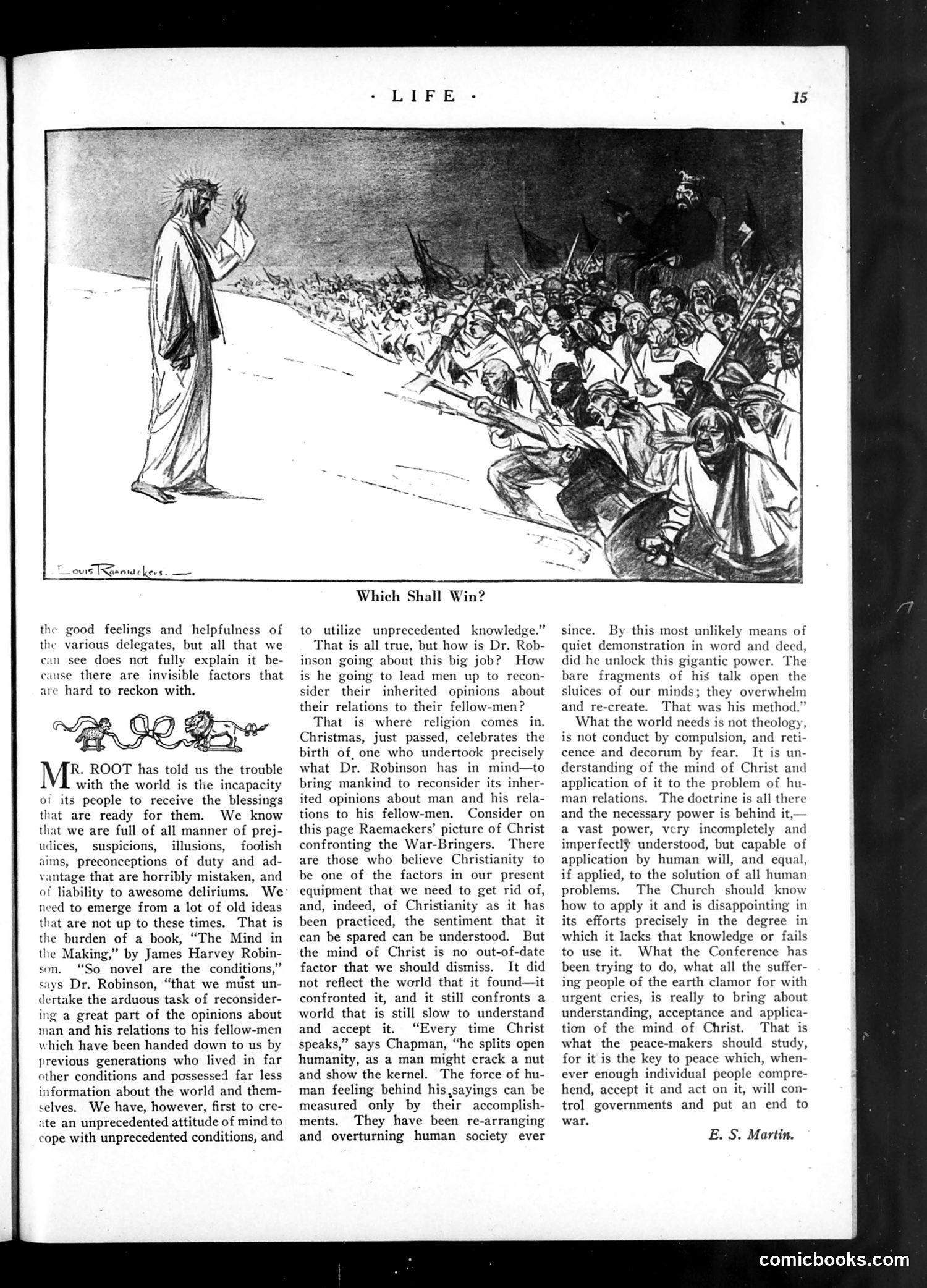
This page features a stark political cartoon by Louis Raemackers depicting Christ standing alone on the left, confronting a massive crowd of armed soldiers and war-makers on the right. The accompanying article discusses whether humanity will follow Christ's teachings of compassion and reconciliation or continue with militarism and violence. The context: Written post-World War I, the piece cites James Harvey Robinson's book advocating that modern society must reconsider inherited ideas in light of "unprecedented conditions." The author argues Christianity—specifically Christ's method of transforming human relations through word and deed rather than force—offers the solution to war and conflict. The cartoon's message is clear: Christ's peaceful doctrine faces opposition from entrenched military and nationalist forces. The "Which Shall Win?" title poses the central question: will humanity embrace Christ's revolutionary compassion, or will war-makers prevail? It's an appeal for post-war society to fundamentally reorganize itself around Christian principles rather than returning to pre-war militarism.
📄 Transcribed text from this page (OCR, searchable)
Machine-transcribed from the original scan — historical spelling and the odd misread are preserved.
ours Feaentackers. —— the good feelings and helpfulness of the various delegates, but all that we see does not fully explain it be- cause there are invisible factors that are hard to reckon with. R. ROOT has told us the trouble with the world is the incapacity oi its people to receive the blessings that are ready for them. We know that we are full of all manner of prej- udices, suspicions, illusions, foolish aims, preconceptions of duty and ad- vantage that are horribly mistaken, and of liability to awesome deliriums. We need to emerge from a lot of old ideas that are not up to these times. That is the burden of a book, “The Mind in the Making,” by James Harvey Robin- som. “So novel are the conditions,” says Dr. Robinson, “that we must un- dertake the arduous task of reconsider- ing a great part of the opinions about man and his relations to his fellow-men which have been handed down to us by previous generations who lived in far other conditions and possessed far less information about the world and them- selves. We have, however, first to cre- ate an unprecedented attitude of mind to cope with unprecedented conditions, and Which Shall Win? to utilize unprecedented knowledge.” That is all true, but how is Dr. Rob- inson going about this big job? How is he going to lead men up to recon- sider their inherited opinions about their relations to their fellow-men? That is where religion comes in. Christmas, just passed, celebrates the birth of, one who undertook precisely what Dr. Robinson has in mind—to bring mankind to reconsider its inher- ited opinions about man and his rela- tions to his fellow-men. Consider on this page Raemackers’ picture of Christ confronting the War-Bringers. There are those who believe Christianity to be one of the factors in our present equipment that we need to get rid of, and, indeed, of Christianity as it has been practiced, the sentiment that it can be spared can be understood. But the mind of Christ is no out-of-date factor that we should dismiss. It did not reflect the world that it found—it confronted it, and it still confronts a world that is still slow to understand and accept it. “Every time Christ speaks,” says Chapman, “he splits open humanity, as a man might crack a nut and show the kernel. The force of hu- man feeling behind his,sayings can be measured only by their accomplish- ments. They have been re-arranging and overturning human society ever since. By this most unlikely means of quiet demonstration in word and deed, did he unlock this gigantic power. The bare fragments of his talk open the sluices of our minds; they overwhelm and re-create. That was his method.” What the world needs ot theology, is not conduct by compulsion, and reti- cence and decorum by fear. It is un- derstanding of the mind of Christ and application of it to the problem of hu- man relations. The doctrine is all there and the necessary power is behind it,— a vast power, very incompletely and imperfectl}? understood, but capable of application by human will, and equal, if applied, to the solution of all human problems. The Church should know how to apply it and is disappointing in its efforts precisely in the degree in which it lacks that knowledge or fails to use it. What the Conference has been trying to do, what all the suffer- ing people of the earth clamor for with urgent cries, is really to bring about understanding, acceptance and applica- tion of the mind of Christ. That is what the peace-makers should study, for it is the key to peace which, when- ever enough individual people compre- hend, accept it and act on it, will con- trol governments and put an end to war. E, S. Martin. comicbooks.com