
Life, 1921-12-29 · page 20 of 35
Life — December 29, 1921 — page 20: what you’re looking at
What you’re looking at
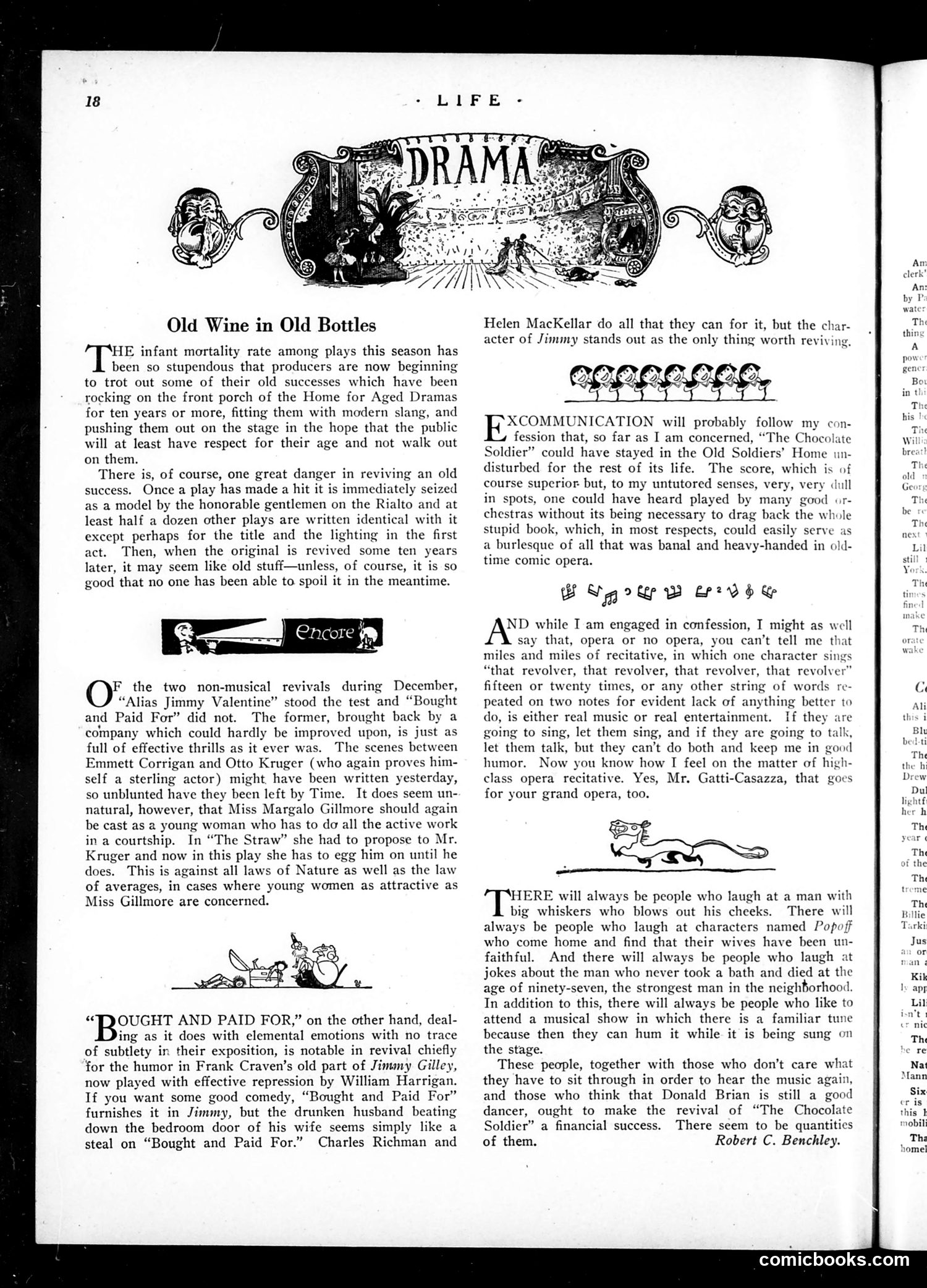
This theater review critiques Broadway revivals during a season with many theatrical failures. The author discusses two December revivals: "Alias Jimmy Valentine" (praised as holding up well, with strong performances by Emmett Corrigan and Otto Kruger) and "Bought and Paid For" (criticized overall, though Frank Craven's comedic role—now played by William Harrigan—remains worthwhile). The piece also mocks "The Chocolate Soldier" operetta, arguing its tedious recitatives and weak libretto don't merit revival. The author humorously complains about opera's repetitive singing of single words on two notes ("that revolver, that revolver..."), satirizing high-art pretension while defending popular entertainment standards. The critique reflects early 1900s Broadway tastes and the recurring industry problem of recycling old plays with modern slang rather than creating original works.
📄 Transcribed text from this page (OCR, searchable)
Machine-transcribed from the original scan — historical spelling and the odd misread are preserved.
Old Wine in Old Bottles ‘HE infant mortality rate among plays this season has been so stupendous that producers are now beginning to trot out some of their old successes which have been rocking on the front porch of the Home for Aged Dramas for ten years or more, fitting them with modern slang, and pushing them out on the stage in the hope that the public will at least have respect for their age and not walk out on them. There is, of course, one great danger in reviving an old success. Once a play has made a hit it is immediately seized as a model by the honorable gentlemen on the Rialto and at least half a dozen other plays are written identical with it except perhaps for the title and the lighting in the first act. Then, when the original is revived some ten years later, it may seem like old stuff—unless, of course, it is so good that no one has been able to spoil it in the meantime. F the two non-musical revivals during December, “Alias Jimmy Valentine” stood the test and “Bought and Paid For” did not. The former, brought back by a company which could hardly be improved upon, is just as full of effective thrills as it ever was. The scenes between Emmett Corrigan and Otto Kruger (who again proves him- self a sterling actor) might have been written yesterday, so unblunted have they been left by Time. It does seem un- natural, however, that Miss Margalo Gillmore should again be cast as a young woman who has to do all the active work in a courtship. In “The Straw” she had to propose to Mr. Kruger and now in this play she has to egg him on until he does. This is against all laws of Nature as well as the law of averages, in cases where young women as attractive as Miss Gillmore are concerned. _ wa “TQ OUGHT AND PAID FOR,” on the other hand, deal- ing as it does with elemental emotions with no trace of subtlety in their exposition, is notable in revival chiefly for the humor in Frank Craven’s old part of Jimmy Gilley, now played with effective repression by William Harrigan. If you want some good comedy, “Bought and Paid For” furnishes it in Jimmy, but the drunken husband beating down the bedroom door of his wife seems simply like a steal on “Bought and Paid For.” Charles Richman and Helen MacKellar do all that they can for it, but the char- acter of Jimmy stands out as the only thing worth reviving. <COMMUNICATION will probably follow my con- fession that, so far as I am concerned, “The Chocolate Soldier” could have stayed in the Old Soldiers’ Home un- disturbed for the rest of its life. The score, which is of course superior but, to my untutored senses, very, very «ull in spots, one could have heard played by many good wr- chestras without its being necessary to drag back the whole stupid book, which, in most respects, could easily serve as a burlesque of all that was banal and heavy-handed in old- time comic opera. BMgre Ww vee xe while I am engaged in confession, I might as well say that, opera or no opera, you can’t tell me that miles and miles of recitative, in which one character sings “that revolver, that revolver, that revolver, that revolver" fifteen or twenty times, or any other string of words re- peated on two notes for evident lack of anything better to do, is either real music or real entertainment. If they are going to sing, let them sing, and if they are going to talk, let them talk, but they can’t do both and keep me in good humor. Now you know how I feel on the matter of high- class opera recitative. Yes, Mr. Gatti-Casazza, that goes for your grand opera, too. ‘HERE will always be people who laugh at a man with big whiskers who blows out his cheeks. There will always be people who laugh at characters named Popoff who come home and find that their wives have been un- faithful. And there will always be people who laugh at jokes about the man who never took a bath and died at the age of ninety-seven, the strongest man in the neighborhood. In addition to this, there will always be people who like to attend a musical show in which there is a familiar tune because then they can hum it while it is being sung on the stage. These people, together with those who don’t care what they have to sit through in order to hear the music again, and those who think that Donald Brian is still a good dancer, ought to make the revival of “The Chocolate Soldier” a financial success. There seem to be quantities of them. Robert C. Benchley. this 1 obili The homel comicbooks.com