
Life, 1921-12-29 · page 16 of 35
Life — December 29, 1921 — page 16: what you’re looking at
What you’re looking at
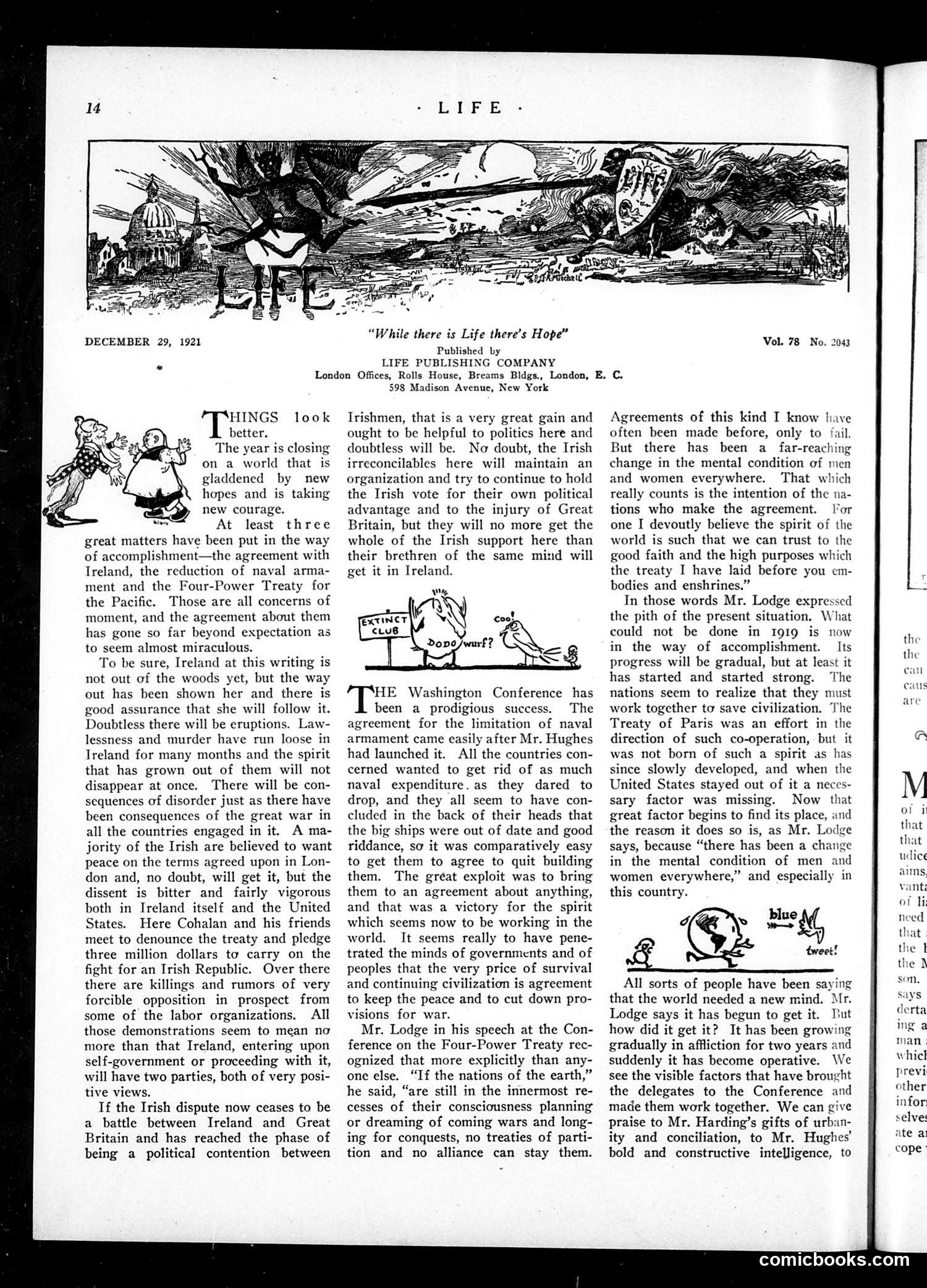
This page contains editorial commentary on recent international agreements, particularly the Washington Conference on naval armament and the Four-Power Treaty regarding the Pacific. The small cartoon (bottom left) appears to show a figure labeled "Instinct" speaking to another character about "Dope," likely satirizing how nations' base instincts drive militarism rather than reason. The text praises these treaties as progress toward peace, noting they've successfully reduced naval spending and military tensions. The author expresses optimism that civilizations can survive through agreement rather than war. A separate illustrated element shows what appears to be a mascot character labeled "blue" saying "Gee!", likely serving as the magazine's recurring decorative feature. The overall tone celebrates diplomatic achievement in averting further conflict.
📄 Transcribed text from this page (OCR, searchable)
Machine-transcribed from the original scan — historical spelling and the odd misread are preserved.
DECEMBER 29, 1921 “While there is Life there’s Hope” Published by LIFE PUBLISHING COMPANY Vol. 78 No. 2043 London Offices, Rolls House, Breams Bldgs., London, E. C. HINGS better. The year is closing on a world that is gladdened by new hopes and is taking new courage. At least three great matters have been put in the way of accomplishment—the agreement with Ireland, the reduction of naval arma- ment and the Four-Power Treaty for the Pacific. Those are all concerns of look moment, and the agreement about them has gone so far beyond expectation as to seem almost miraculous. To be sure, Ireland at this writing is not out of the woods yet, but the way out has been shown her and there is good assurance that she will follow it. Doubtless there will be eruptions. Law- lessness and murder have run loose in Ireland for many months and the spirit that has grown out of them will not disappear at once. There will be con- sequences of disorder just as there have been consequences of the great war in all the countries engaged in it. A ma- jority of the Irish are believed to want peace on the terms agreed upon in Lon- don and, no doubt, will get it, but the dissent is bitter and fairly vigorous both in Ireland itself and the United States. Here Cohalan and his friends meet to denounce the treaty and pledge three million dollars to carry on the fight for an Irish Republic. Over there there are killings and rumors of very forcible opposition in prospect from some of the labor organizations. All those demonstrations seem to mean no more than that Ireland, entering upon self-government or proceeding with it, will have two parties, both of very posi- tive views. If the Irish dispute now ceases to be a battle between Ireland and Great Britain and has reached the phase of being a political contention between 598 Madison Avenue, New York Irishmen, that is a very great gain and ought to be helpful to politics here and doubtless will be. No doubt, the Irish irreconcilables here will maintain an organization and try to continue to hold the Irish vote for their own political advantage and to the injury of Great Britain, but they will no more get the whole of the Irish support here than their brethren of the same mind will get it in Ireland. ‘HE Washington Conference has been a prodigious success. The agreement for the limitation of naval armament came easily after Mr. Hughes had launched it. All the countries con- cerned wanted to get rid of as much naval expenditure. as they dared to drop, and they all seem to have con- cluded in the back of their heads that the big ships were out of date and good riddance, so it was comparatively easy to get them to agree to quit building them. The great exploit was to bring them to an agreement about anything, and that was a victory for the spirit which seems now to be working in the world. It seems really to have pene- trated the minds of governments and of peoples that the very price of survival and continuing civilization is agreement to keep the peace and to cut down pro- visions for war. Mr. Lodge in his speech at the Con- ference on the Four-Power Treaty rec- ognized that more explicitly than any- one else. “If the nations of the earth,” he said, “are still in the innermost re- cesses of their consciousness planning or dreaming of coming wars and long- ing for conquests, no treaties of parti- tion and no alliance can stay them. Agreements of this kind I know have often been made before, only to fail. But there has been a far-reaching change in the mental condition of men and women everywhere. That which really counts is the intention of the na- tions who make the agreement. For one I devoutly believe the spirit of the world is such that we can trust to the good faith and the high purposes which the treaty I have laid before you em- bodies and enshrines.” In those words Mr. Lodge expressed the pith of the present situation, What could not be done in 1919 is now in the way of accomplishment. Its progress will be gradual, but at least it has started and started strong. The nations seem to realize that they must work together to save civilization. The Treaty of Paris was an effort in the direction of such co-operation, but it was not born of such a spirit as has since slowly developed, and when the United States stayed out of it a neces- sary factor was missing. Now that great factor begins to find its place, and the reason it does so is, as Mr. Lodge says, because “there has been a change in the mental condition of men and women everywhere,” and especially in this country. gq p =i g Oe. All sorts of people have been saying that the world needed a new mind. Mr. Lodge says it has begun to get it. Dut how did it get it? It has been growing gradually in affliction for two years and suddenly it has become operative. We see the visible factors that have brought the delegates to the Conference and made them work together. We can give praise to Mr. Harding’s gifts of urban- ity and conciliation, to Mr. Hughes’ bold and constructive intelligence, to the the ol 1 that that udice aims, vant of lit says derta ing a man | whicl previ other infor selve: ate ai cope comicbooks.com