
A complete issue · 34 pages · 1921
Life — November 24, 1921
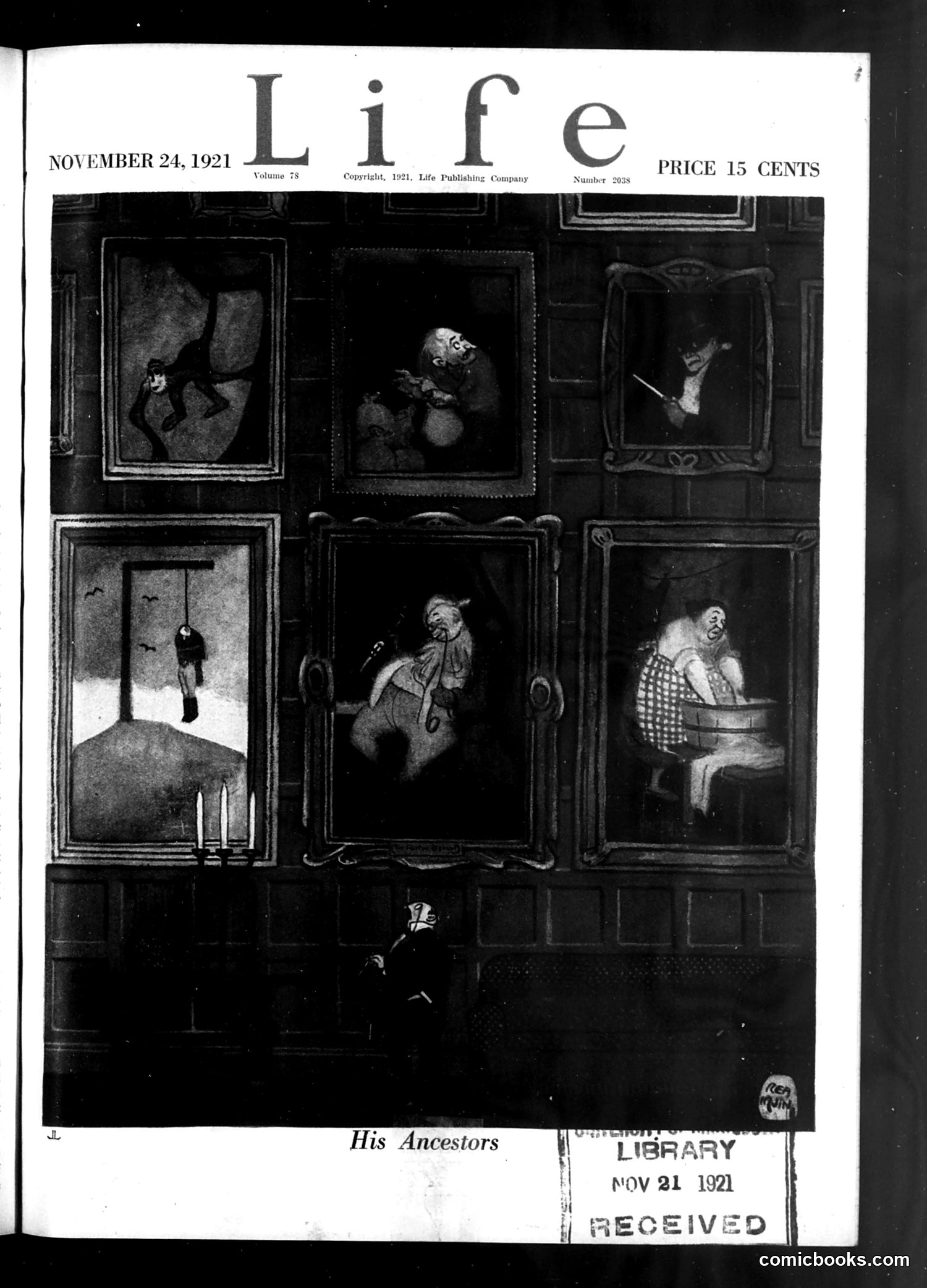
This cartoon satirizes a man's family lineage by depicting six framed portraits arranged like a gallery display, with a small figure gazing up at them from below. The title "His Ancestors" suggests commentary on inherited traits or social status. The portraits appear to show progressively crude or animalistic figures, likely referencing evolutionary theory or suggesting the subject comes from dubious or lowly origins. This was a common satirical device in 1921 to mock someone's background or social pretensions. Without identifying the specific individual targeted, the cartoon's humor relies on the visual degradation evident in the ancestral portraits, implying the subject's family tree is less distinguished than claimed. The work reflects period attitudes about heredity and class.
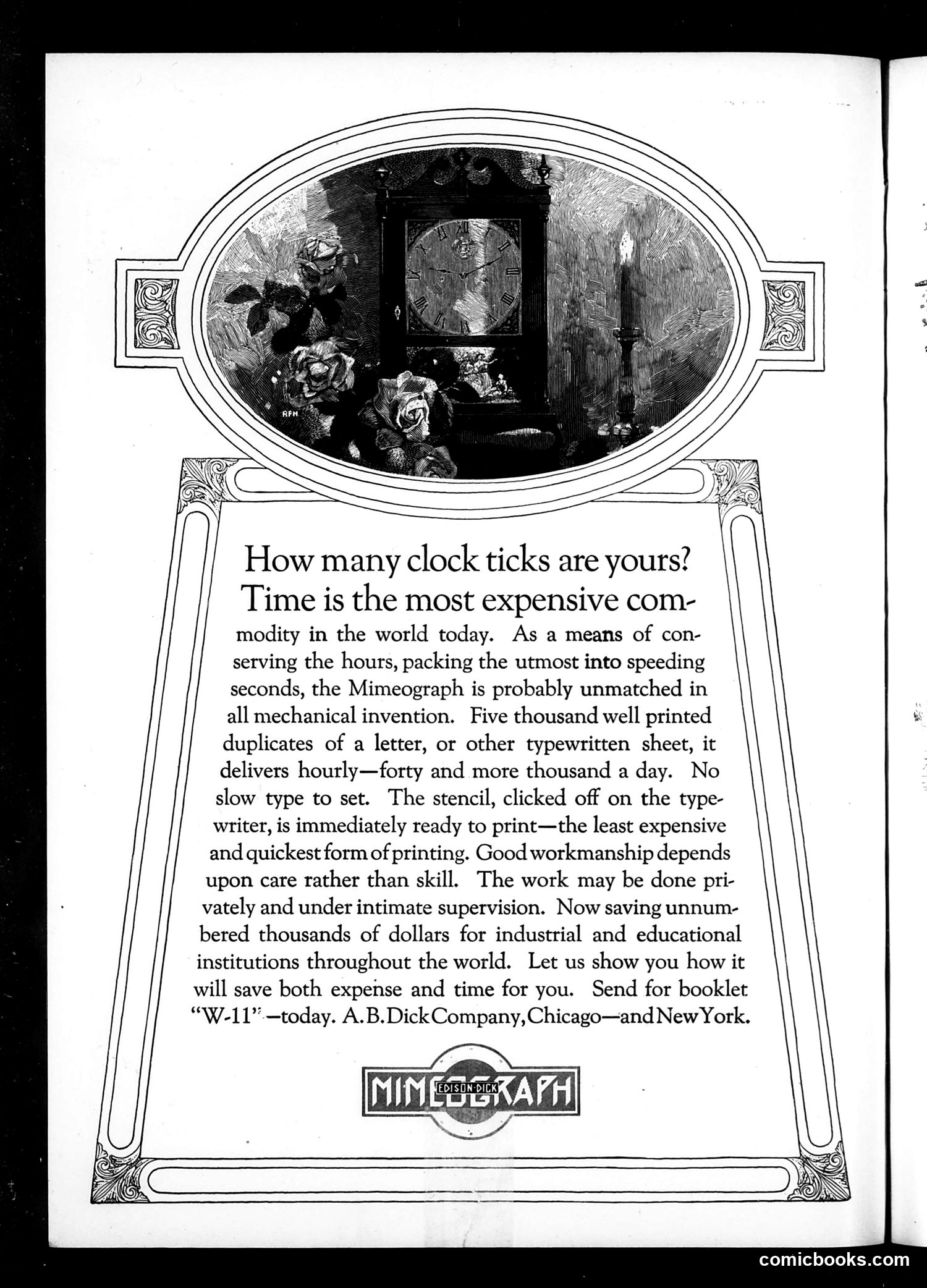
This page is primarily **advertising, not satire or political commentary**. It's a A.B. Dick Company advertisement for the Mimeograph copying machine. The ad's headline—"How many clock ticks are yours?"—uses time as a metaphor for value. The message claims the Mimeograph saves institutions money and labor by enabling fast, inexpensive duplication of documents. The ad promises it can produce "forty and more thousand a day" without requiring skilled setup. The decorative engraved illustration shows an interior scene with flowers and what appears to be office or domestic furnishings, meant to convey quality and respectability. The ornamental border styling suggests this is from the early 20th century, when such decorative advertising was standard. This reflects the period's emphasis on efficiency and industrial mechanization as progress.
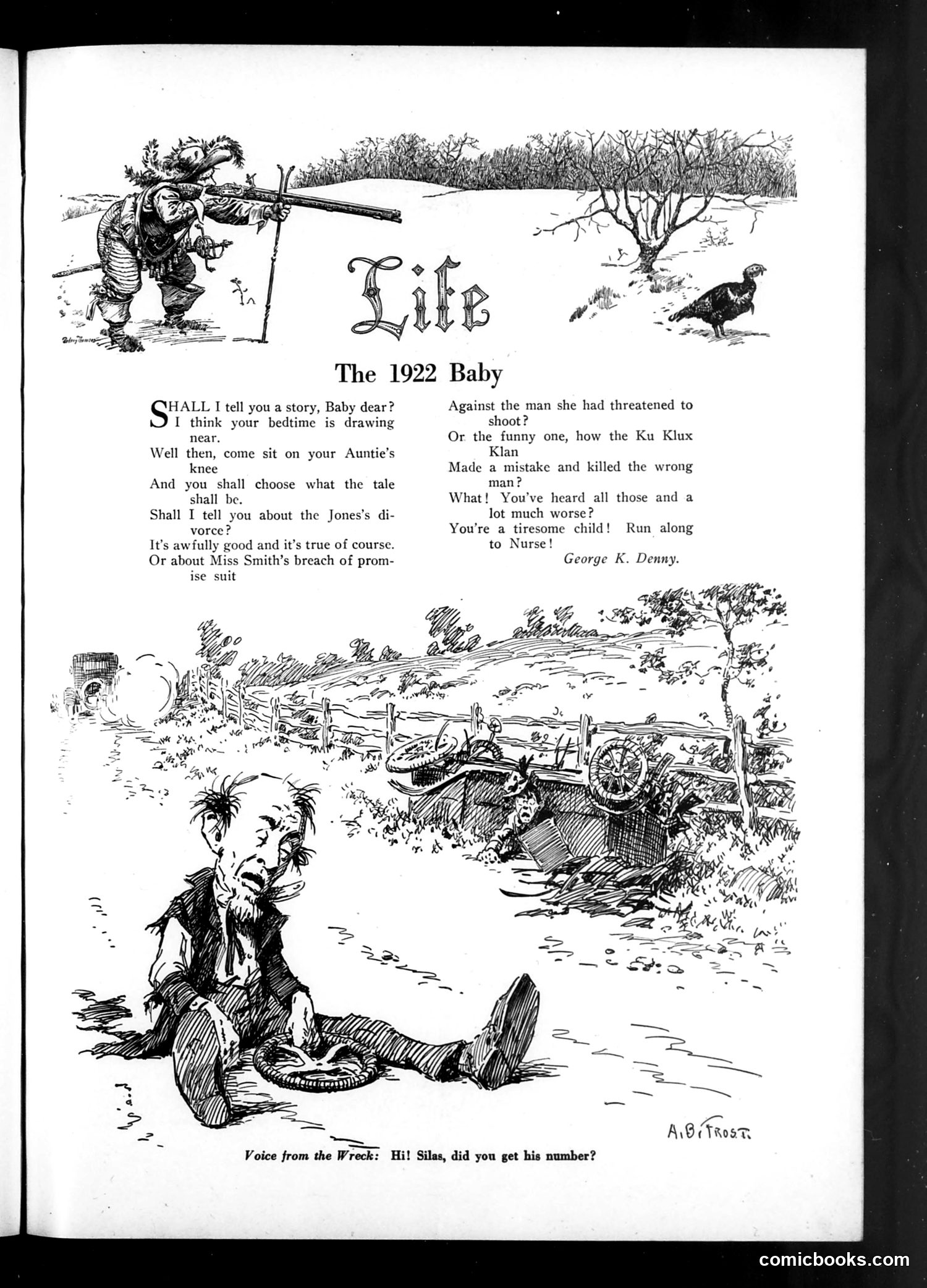
This page satirizes post-WWI American anxieties about moral decline. The poem presents an adult offering a child increasingly scandalous bedtime stories: divorce, the Ku Klux Klan's violence (including murders), and implied worse content. The child's nurse cuts off the storytelling, calling the child "tiresome." The accompanying illustration shows a man sitting dazed beside a wrecked car—visualizing society's damage from these modern ills. The caption "Voice from the Wreck: Hi! Silas, did you get his number?" sarcastically references insurance claims and normalcy amid chaos. The satire critiques how 1920s American culture exposed children to shocking contemporary problems—Klan violence, divorce scandals, automobile accidents—treating them as casual bedtime conversation while society spiraled into disorder.
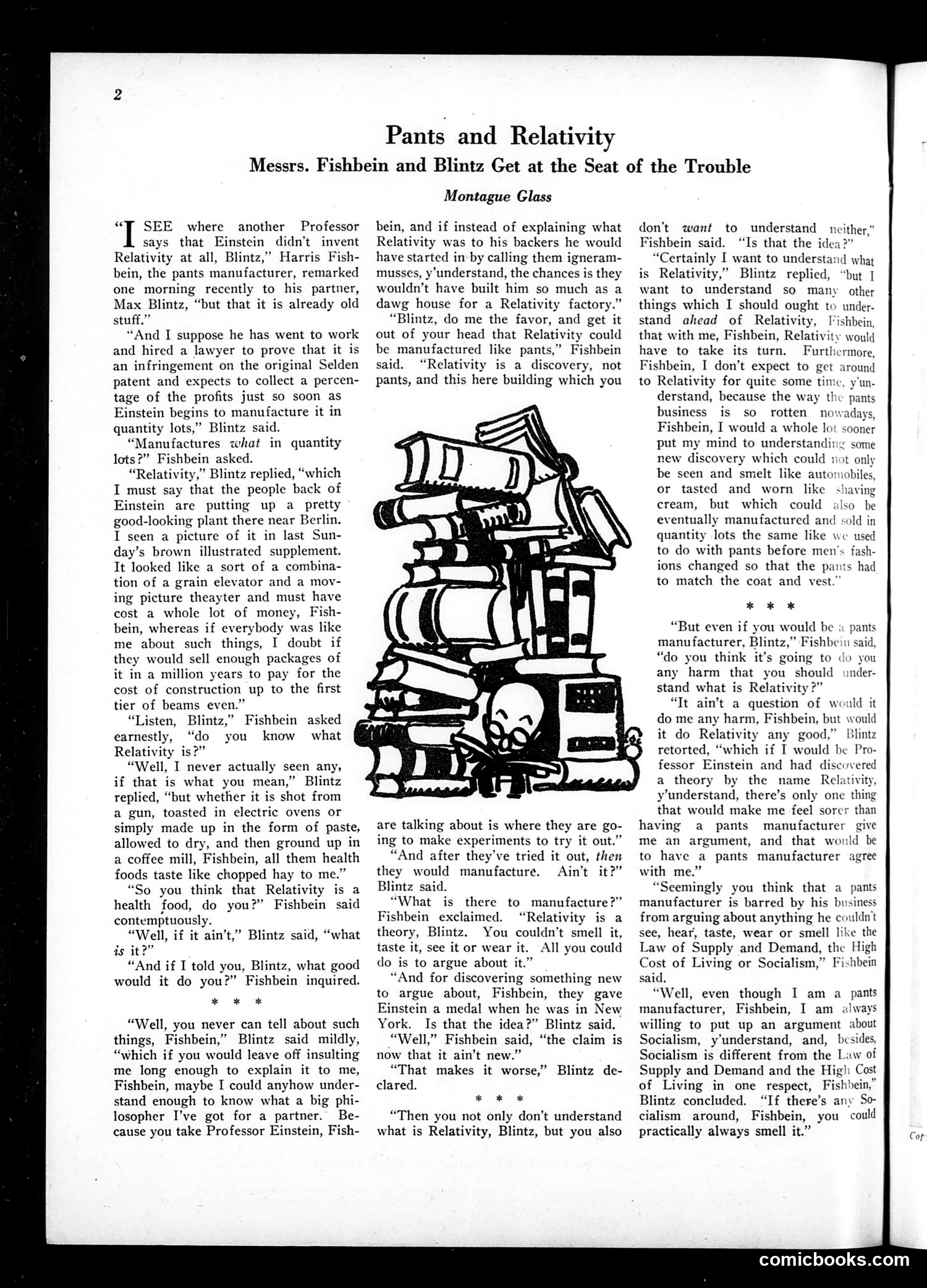
This satirical piece mocks the debate around Einstein's Theory of Relativity circa 1920s. Two characters—Fishbein (a pants manufacturer) and Blintz—argue about whether Relativity has practical value. The cartoon's humor derives from Fishbein's literal-minded incomprehension: he conflates Einstein's abstract physical theory with literal pants manufacturing. When Blintz suggests Relativity could be "manufactured like pants," Fishbein takes him seriously, unable to grasp the conceptual distinction between theoretical physics and commercial production. The satire targets public confusion about Einstein's increasingly famous but poorly understood theory. By showing an intelligent businessman completely missing the point, Life mocks both popular scientific illiteracy and the gap between abstract intellectual achievement and everyday American commerce. The pants metaphor emphasizes how remote theoretical physics seemed to ordinary business interests.
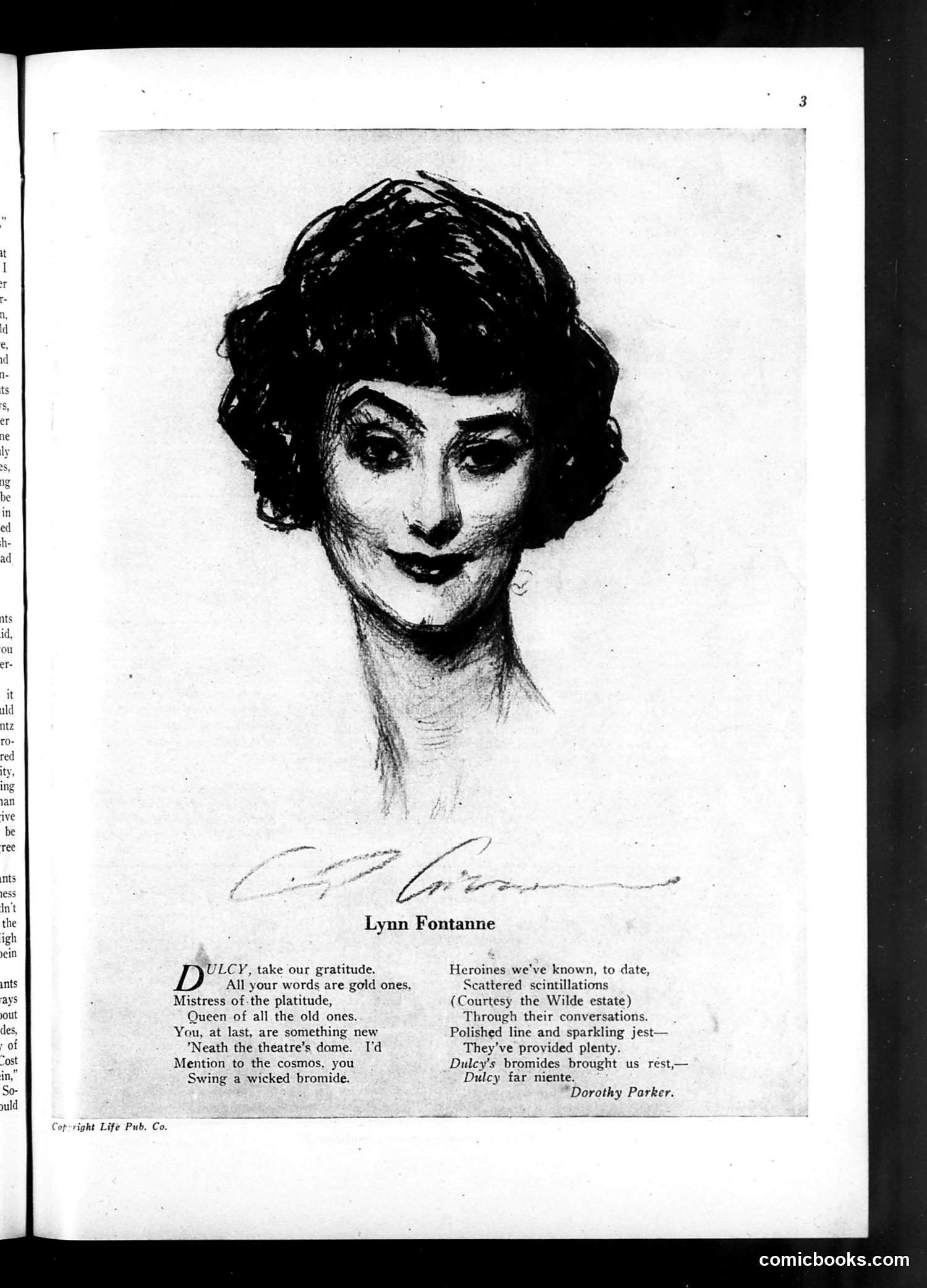
This page celebrates actress **Lynn Fontanne** with a portrait sketch and a tribute poem by **Dorothy Parker**, a prominent satirist and critic of the era. The poem, addressed to "Dulcy," references Fontanne's theatrical role in a play called *Dulcy* (likely a comedy). Parker praises Fontanne as a "Queen of all the old ones"—suggesting she's a leading actress—and commends her wit and stage presence ("sparkling jest"). The reference to "Dulcy's bromides" and her ability to entertain indicates the character was comedic, possibly known for witty one-liners. This appears to be a **Life magazine feature celebrating a successful theatrical performer**, typical of how the publication promoted Broadway talent to its readers.
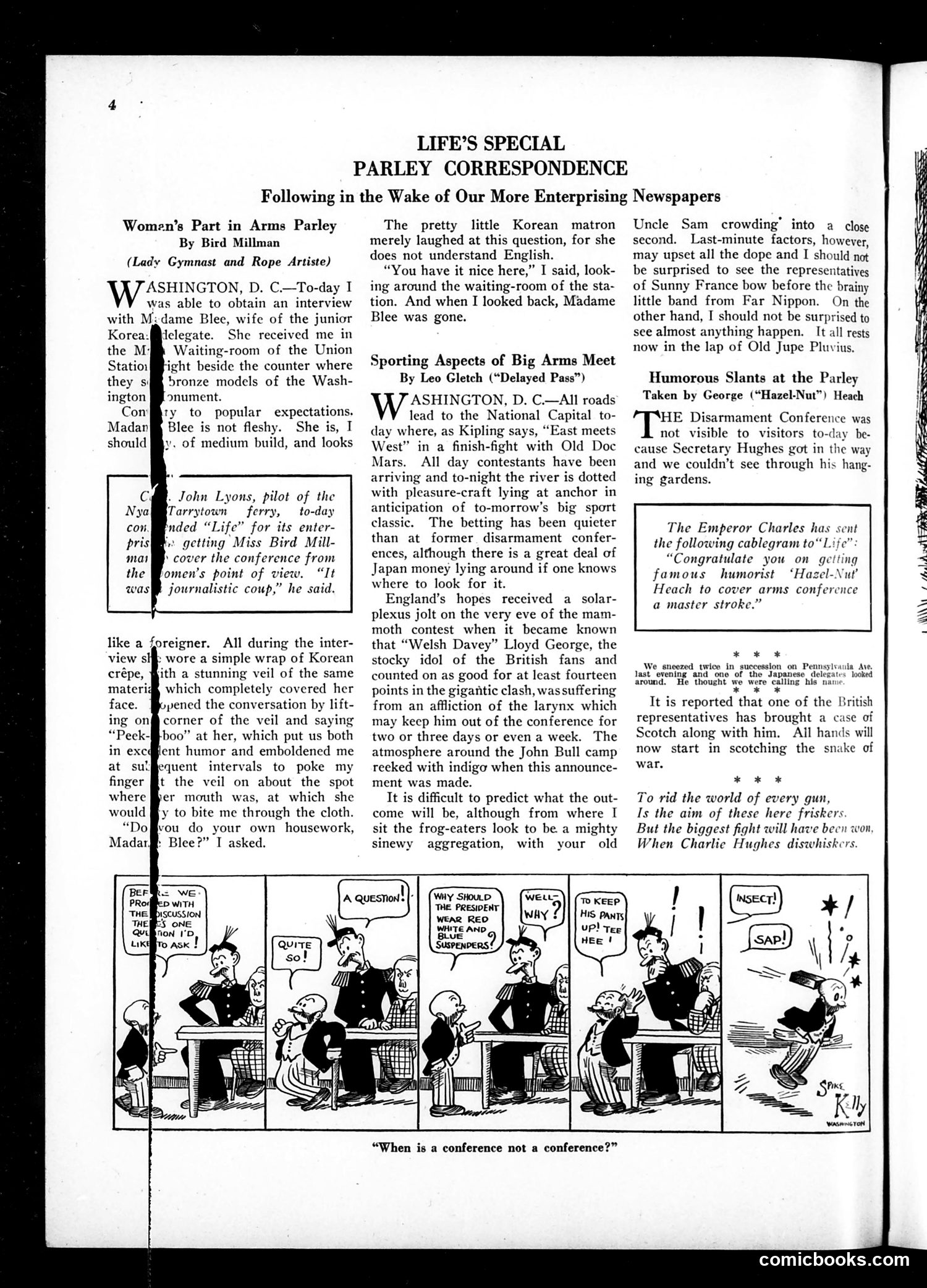
This page contains three separate pieces about the Washington Disarmament Conference (appearing to be from the early 1920s based on context clues). The top sections feature correspondence about women's involvement and sporting aspects of the conference. The main comic strip at bottom, titled "When is a conference not a conference?", satirizes the endless talking and bureaucratic inefficiency of the actual negotiations. It shows military officers at a desk becoming increasingly frustrated through multiple panels, with dialogue about "quoting" positions and keeping "his mind up" — suggesting delegates endlessly repeat predetermined statements without genuine negotiation or progress. The final panel shows a figure literally flying away, implying the futility has become unbearable. The joke mocks how formal diplomatic conferences devolve into performative repetition rather than substantive problem-solving.
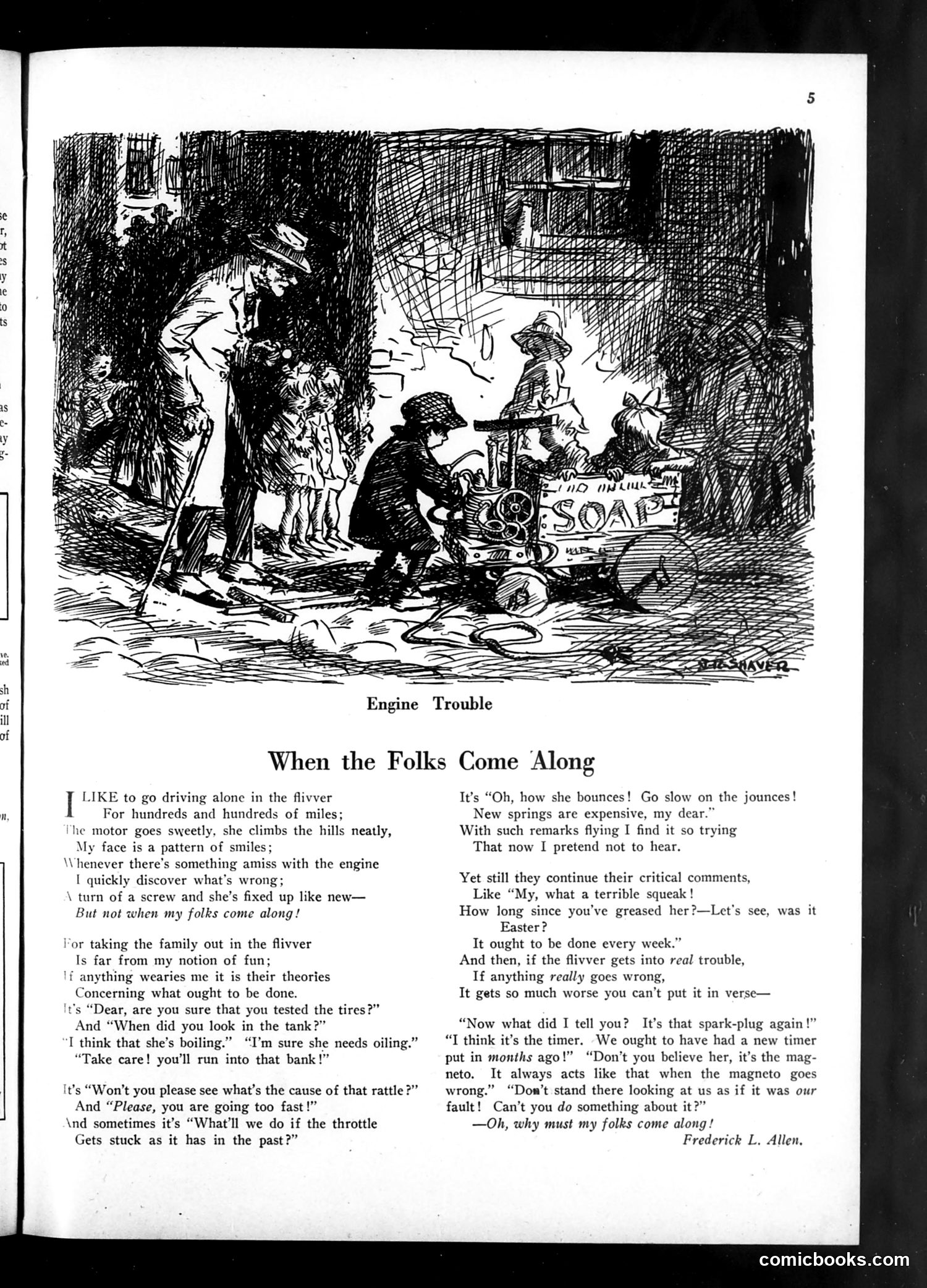
This page satirizes the experience of early automobile ownership. The cartoon depicts a driver broken down on the roadside with their car, surrounded by pedestrians offering unsolicited advice and criticism. The poem by Frederick L. Allen mocks the presumed-helpful comments from passersby—suggestions about loose bolts, oiling, tire pressure, spark plugs, and timing. The satire targets not the car itself but the social phenomenon of strangers stopping to offer amateur mechanical diagnoses, often contradicting each other ("Don't you believe her, it's the magneto"). The humor lies in the driver's frustration that these critical "folks" offer no actual assistance, only theories and complaints about the car's performance, while making the experience worse rather than better.
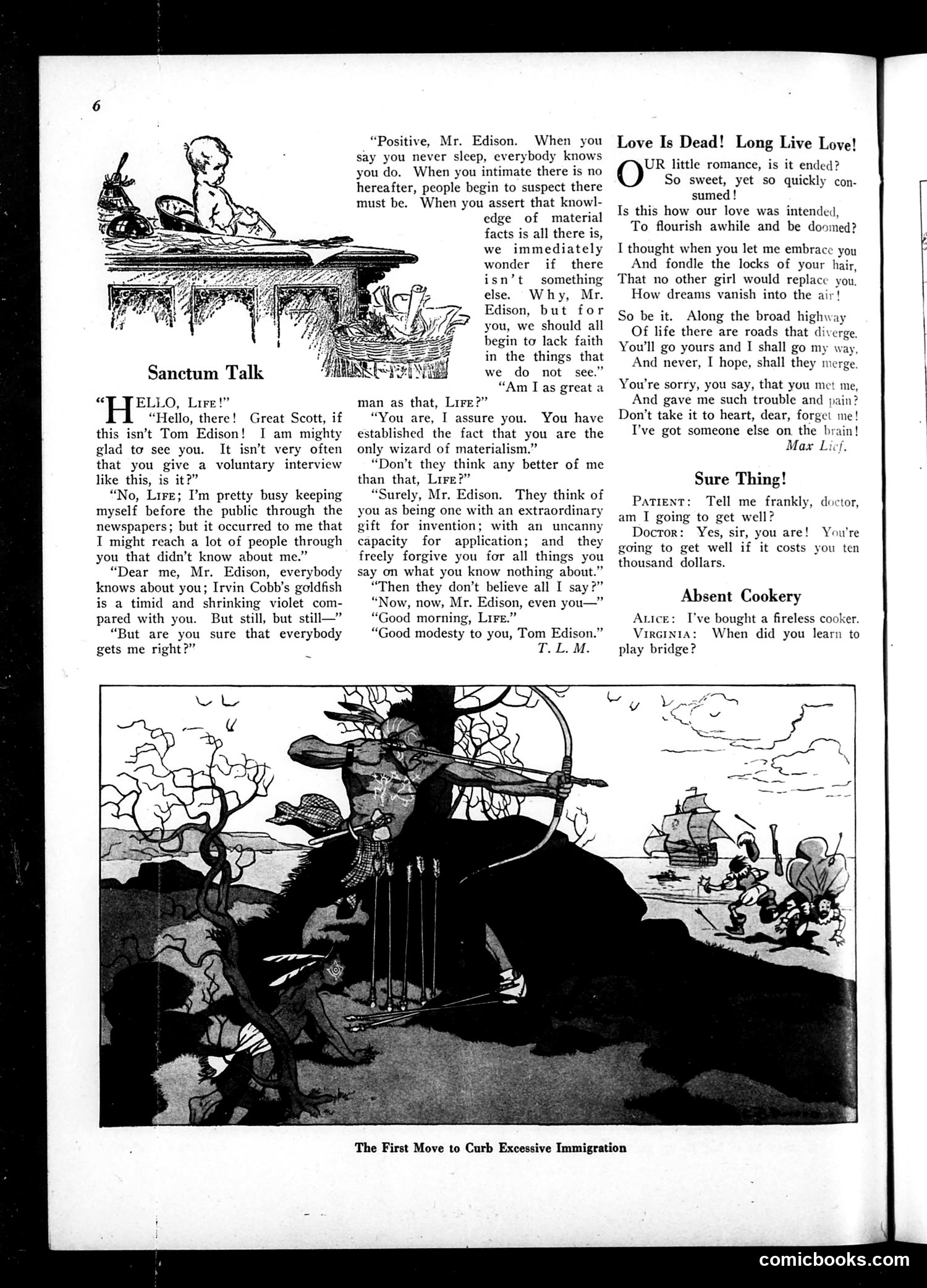
**"Sanctum Talk" Section:** A humorous interview between "Life" (the magazine personified) and Thomas Edison. Edison defends his public prominence and materialist philosophy against Life's gentle mockery. The piece satirizes Edison's tendency to pronounce on subjects beyond his expertise, with Life quipping that Edison thinks "you as being with an extraordinary gift for invention; with an uncanny capacity for applications" while being willing to opine on anything. **Bottom Cartoon:** Titled "The First Move to Curb Excessive Immigration," this depicts a large archer figure (likely representing America or policy-makers) aiming arrows at a distant shore with ships, symbolizing restrictive immigration policy. The silhouetted archer is the focal point of anti-immigration sentiment. The page also contains brief humorous exchanges like "Love Is Dead! Long Live Love!" and "Sure Thing!" and "Absent Cookery"—typical satirical content mocking social conventions and domestic life.
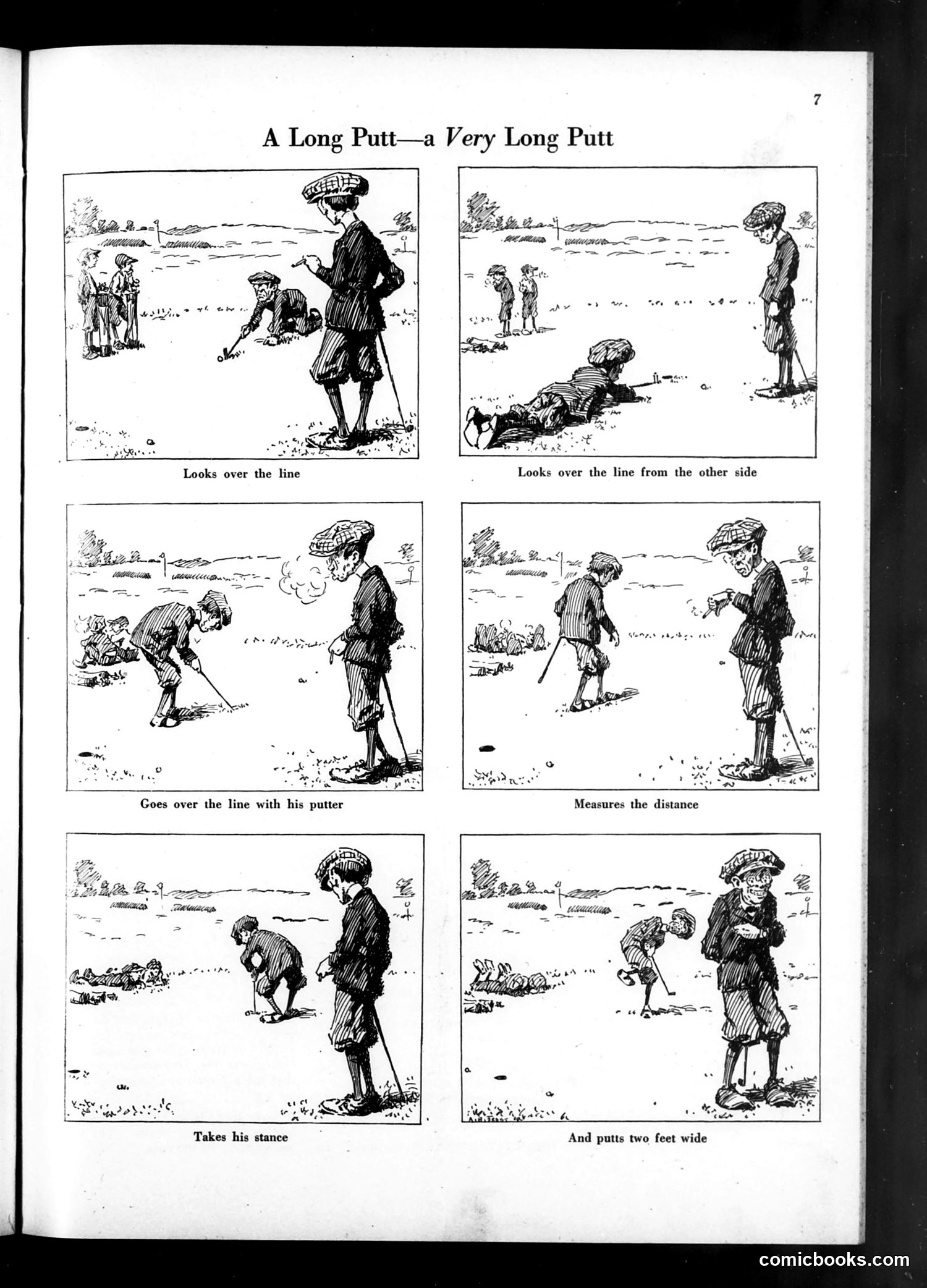
This is a humorous six-panel comic strip about golf. It depicts a golfer attempting an extremely long putt on what appears to be a golf course or links. The sequence shows: the golfer sizing up the shot, examining the line from different angles, using his putter to test the distance, measuring with his body, taking his stance, and finally putting the ball two feet wide—missing after all that elaborate preparation. The satire is straightforward: it mocks golfers who overcomplicate their game through excessive analysis and ritual before ultimately failing. The joke plays on the contrast between meticulous preparation and poor execution—a timeless source of golf humor. The comic requires no political or historical context; it's simply observational humor about human nature and sport.
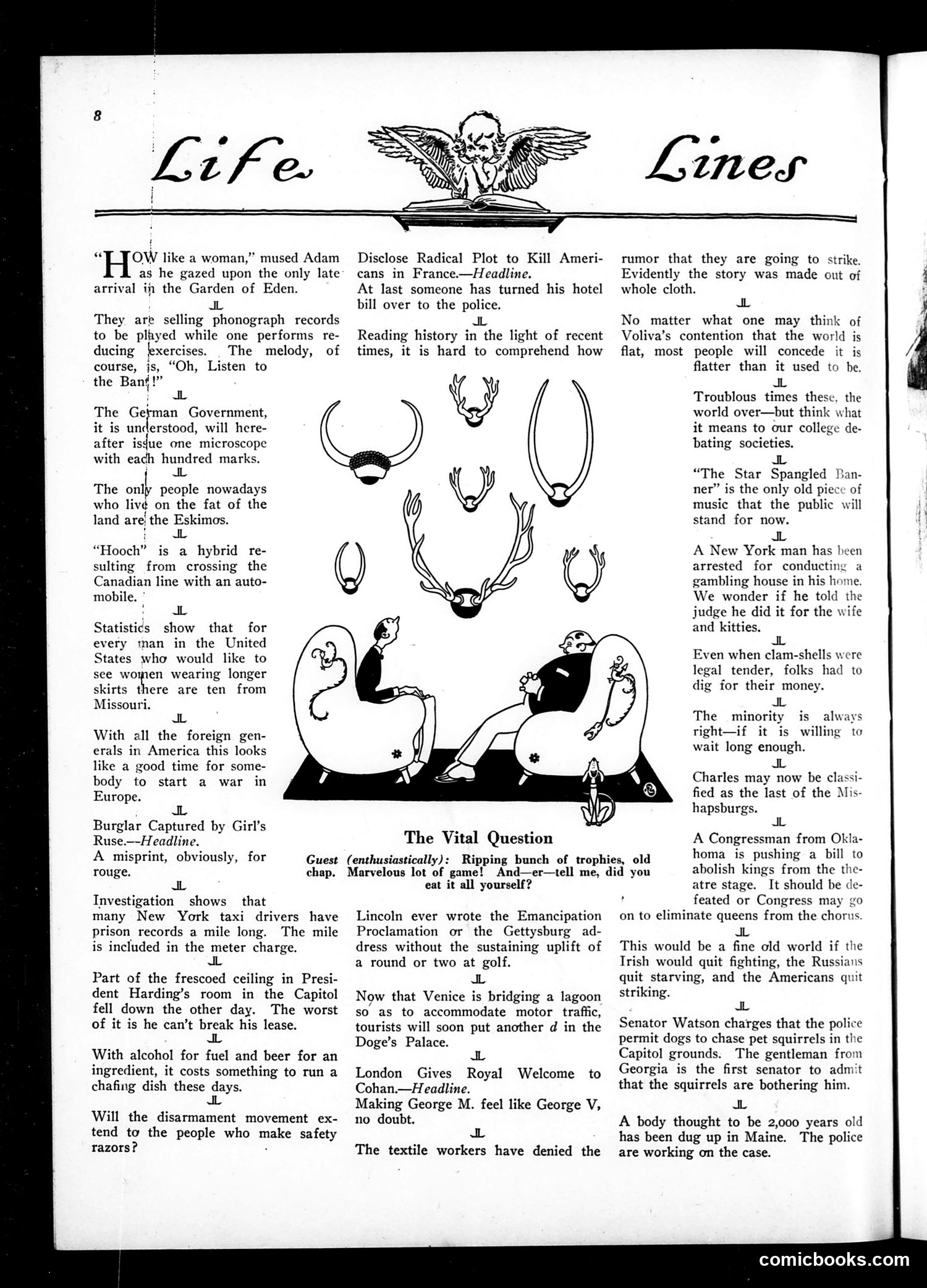
This single-panel cartoon depicts two figures reclining on what appears to be ornate furniture, surrounded by hunting trophies (antlers and animal heads). The caption suggests they are wealthy hunters or sportsmen engaged in conversation about their exploits. The caption reads: "Guest (enthusiastically): Ripping bunch of trophies, old chap. Marvelous lot of game! And—er—tell me, did you eat it all yourself?" The satire targets wealthy sportsmen who accumulate hunting trophies as status symbols while potentially wasting game. The guest's pointed question—asking whether they actually consumed the animals—mocks the disconnect between trophy-hunting pretension and practical use. This reflects early 20th-century debates about conservation and conspicuous consumption among the wealthy leisure class.
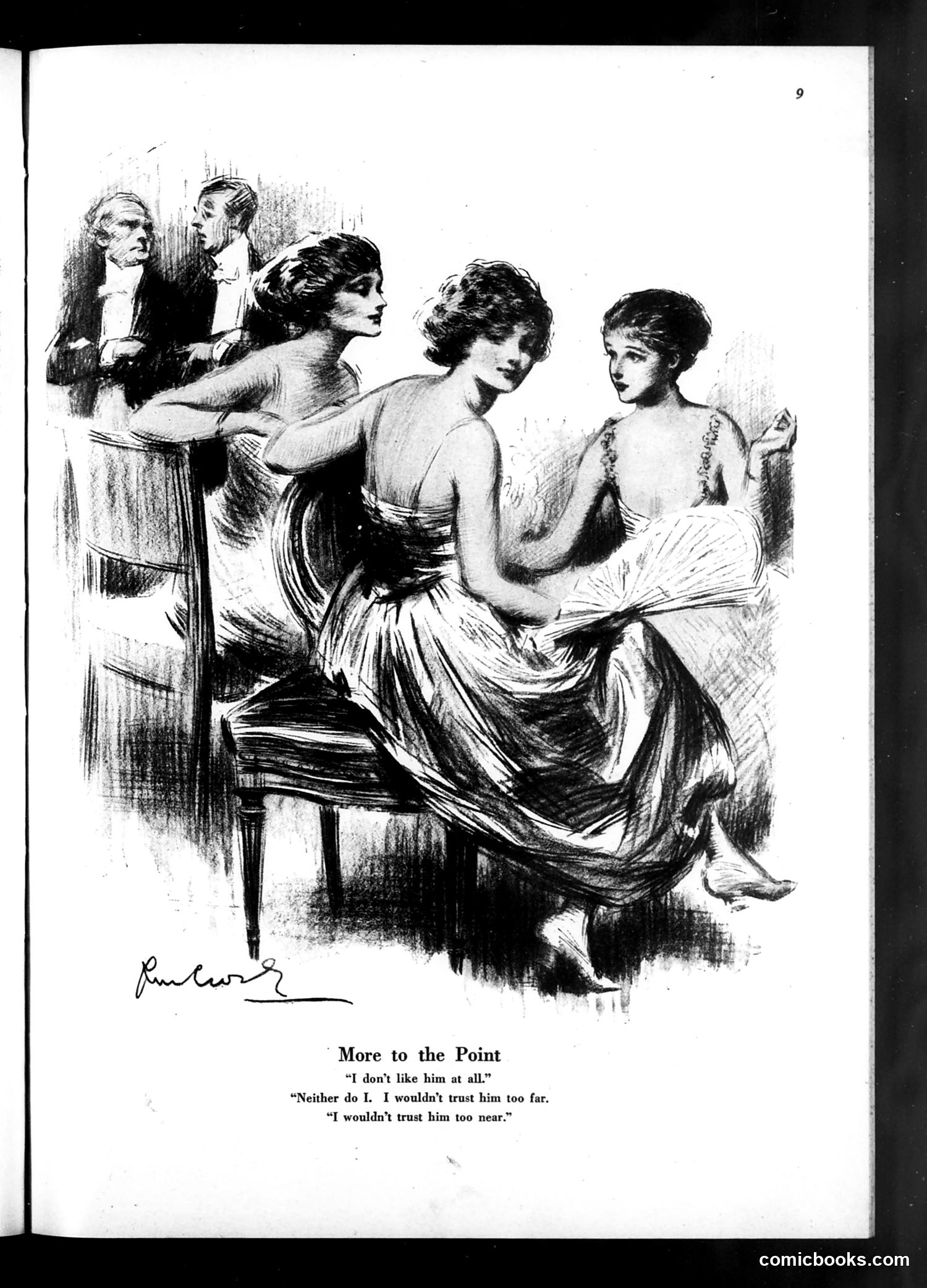
This is a social satire cartoon about distrust between women. Three elegantly dressed women are seated together, while two men observe from behind. The caption presents a gossipy conversation where the women express mutual suspicion: - "I don't like him at all." - "Neither do I. I wouldn't trust him too far." - "I wouldn't trust him too near." The joke relies on women's supposed cattiness and competitive distrust—a common satirical trope in early 20th-century humor. The cartoon mocks both male behavior (presumably the man discussed is untrustworthy) and female social dynamics, suggesting women bond through shared suspicion and backstabbing. The title "More to the Point" suggests this bitchy commentary is the "real" unfiltered truth beneath polite society.
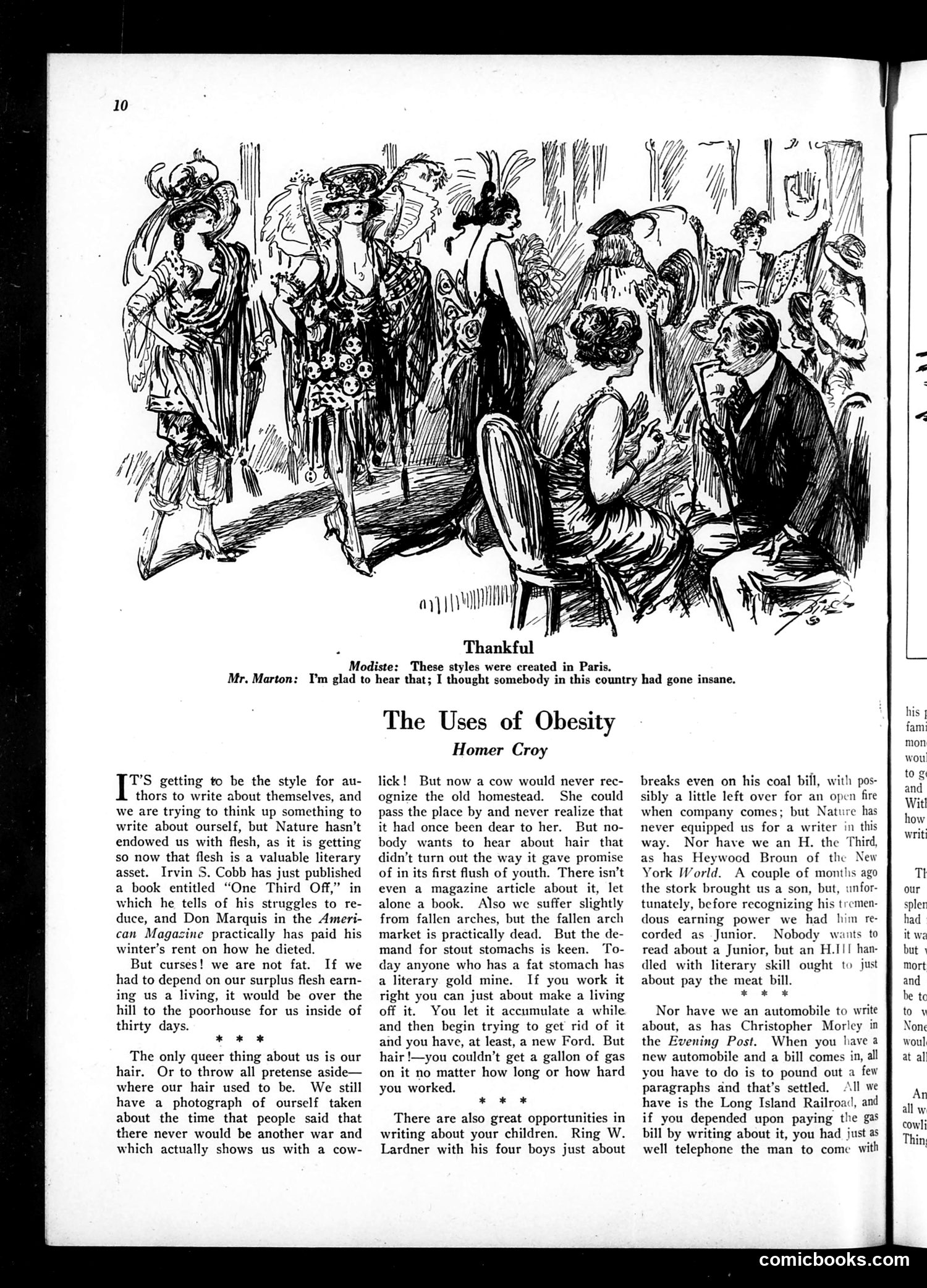
This satirical essay mocks the commercialization of weight and appearance in early 20th-century America. Croy criticizes how obesity has become a "valuable literary asset"—writers exploit their own struggles with weight for magazine articles and book deals. He notes the irony that while magazines profit from weight-loss advice, obesity remains fashionable in high society. The cartoon above depicts a fashionable Parisian salon scene, illustrating the essay's opening: that excessive flesh was becoming a desirable status symbol among the wealthy elite. The dialogue references Paris fashion trends, suggesting Americans are imitating European excess. Croy argues that obesity has become simultaneously profitable to write about and socially acceptable to possess—a contradiction he finds absurd.
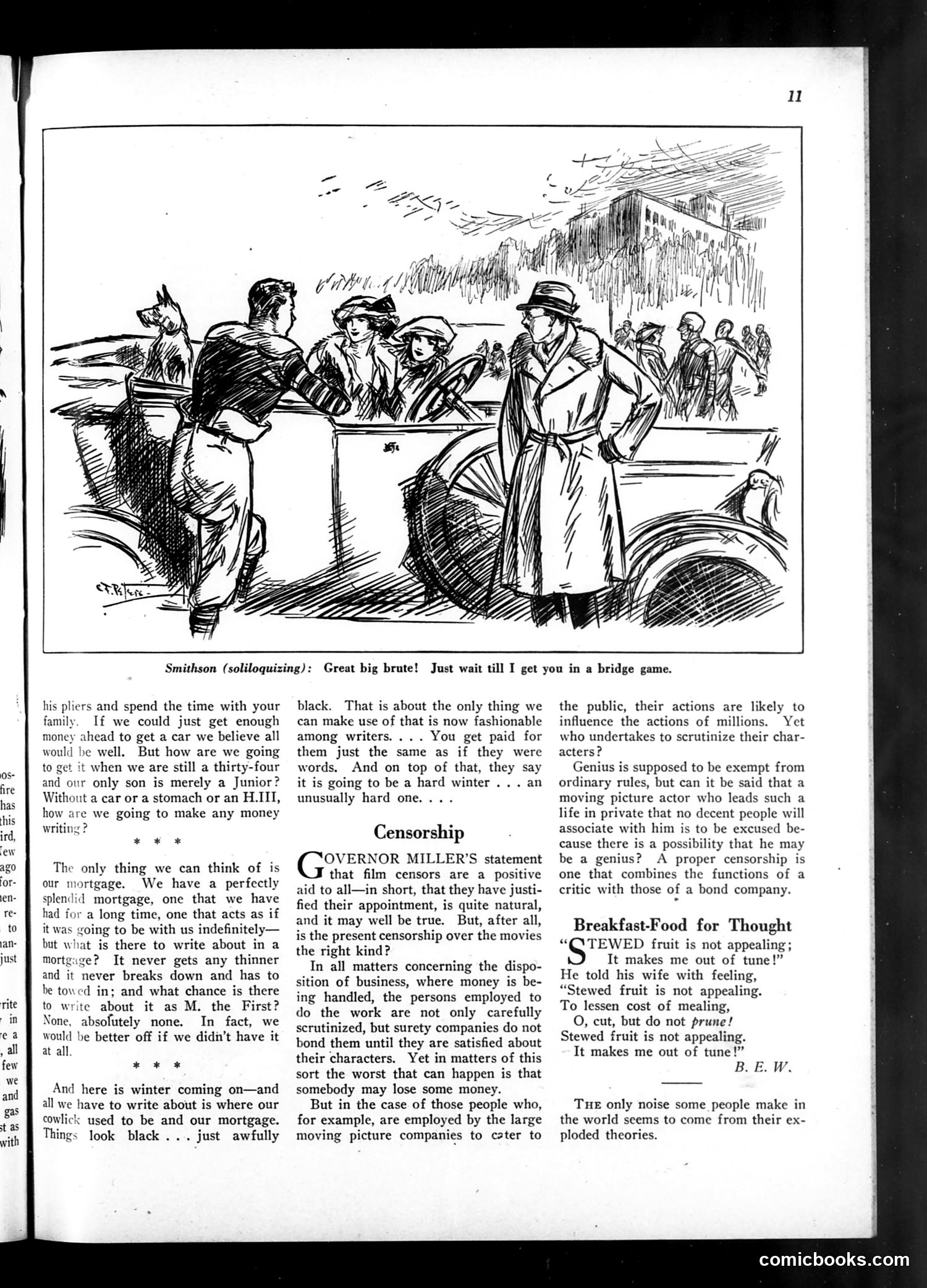
The cartoon depicts a social scene at what appears to be a golf or country club. A man (labeled "Smithson") is accosting another man, threatening to "get you in a bridge game"—implying he'll beat him at cards as revenge for some prior slight. The satire targets upper-class leisure culture and competitive social hierarchies among wealthy men. Bridge was a fashionable card game among the affluent, and the cartoon mocks how seriously these men took recreational competition, treating card games as venues for social dominance and settling scores. The accompanying text discusses financial hardships and writing careers, suggesting broader commentary on economic anxiety during this period, contrasting the frivolous concerns of the wealthy with ordinary people's serious money troubles.
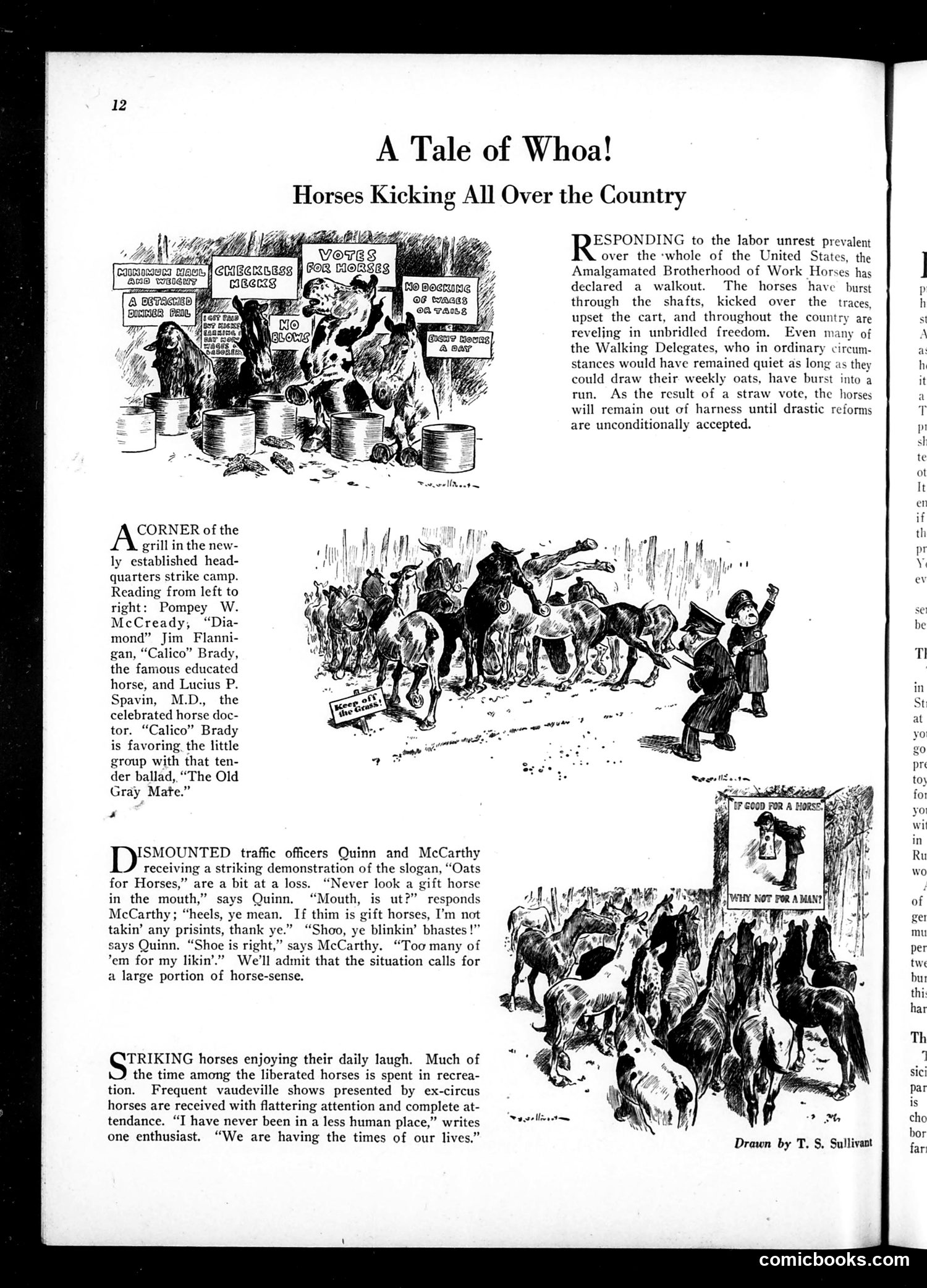
This satirical piece mocks a labor strike by the Brotherhood of Locomotive Engineers' horses. The cartoon depicts horses literally kicking over the country in protest—a visual pun on the phrase "raising hell." The top illustration shows horses at a meeting with signs about "votes for horses" and labor demands, parodying human labor organizing. The text references actual strikers like "Diamond" Jim Hannigan and "Calico" Brady, though these appear to be caricatured as horses for comedic effect. The satire ridicules labor activism by literally depicting horses as the striking workers, suggesting the strikers' demands are absurd or animalistic. The joke relies on the contrast between dignified labor organizing and these chaotic, kicking animals causing destruction across America—implying strikers are unreasonable and uncivilized.
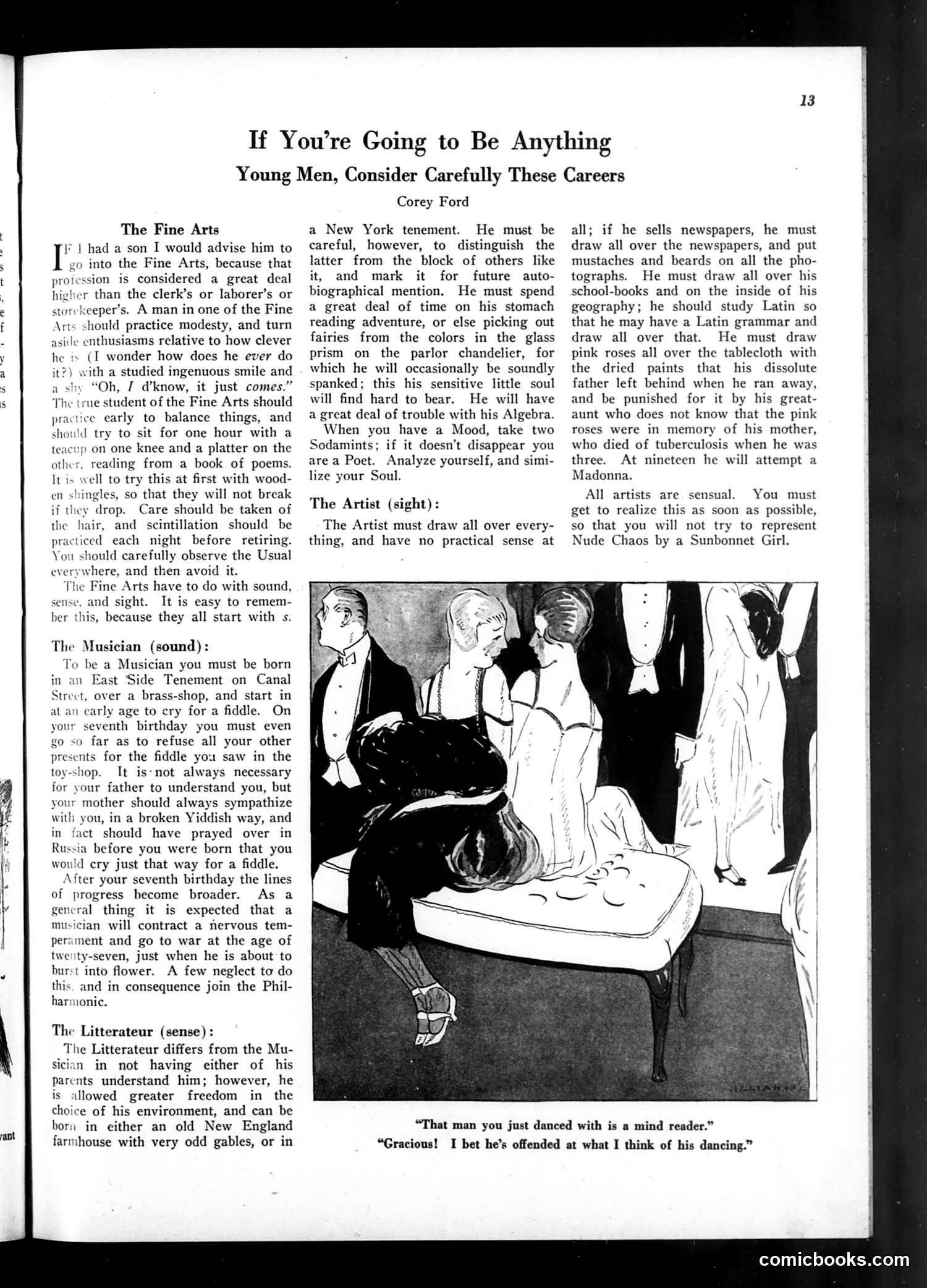
This 1920s satire by Corey Ford mocks various artistic careers through exaggerated stereotypes. The main cartoon depicts a "mind reader" at what appears to be a social gathering, with the caption joke: a man just danced with someone, and the mind reader claims to know offensive thoughts about his dancing. The accompanying text offers mock career advice for aspiring artists—musicians, fine artists, and litterateurs—using absurdist humor. It satirizes stereotypes: musicians must be born in East Side tenements; fine artists are "sensual" and draw poorly; litterateurs are allowed more freedom but come from quirky New England farmhouses. The satire targets pretentious artistic culture and class assumptions about where "real" artists originate, suggesting these career paths attract eccentric, often dysfunctional personalities.
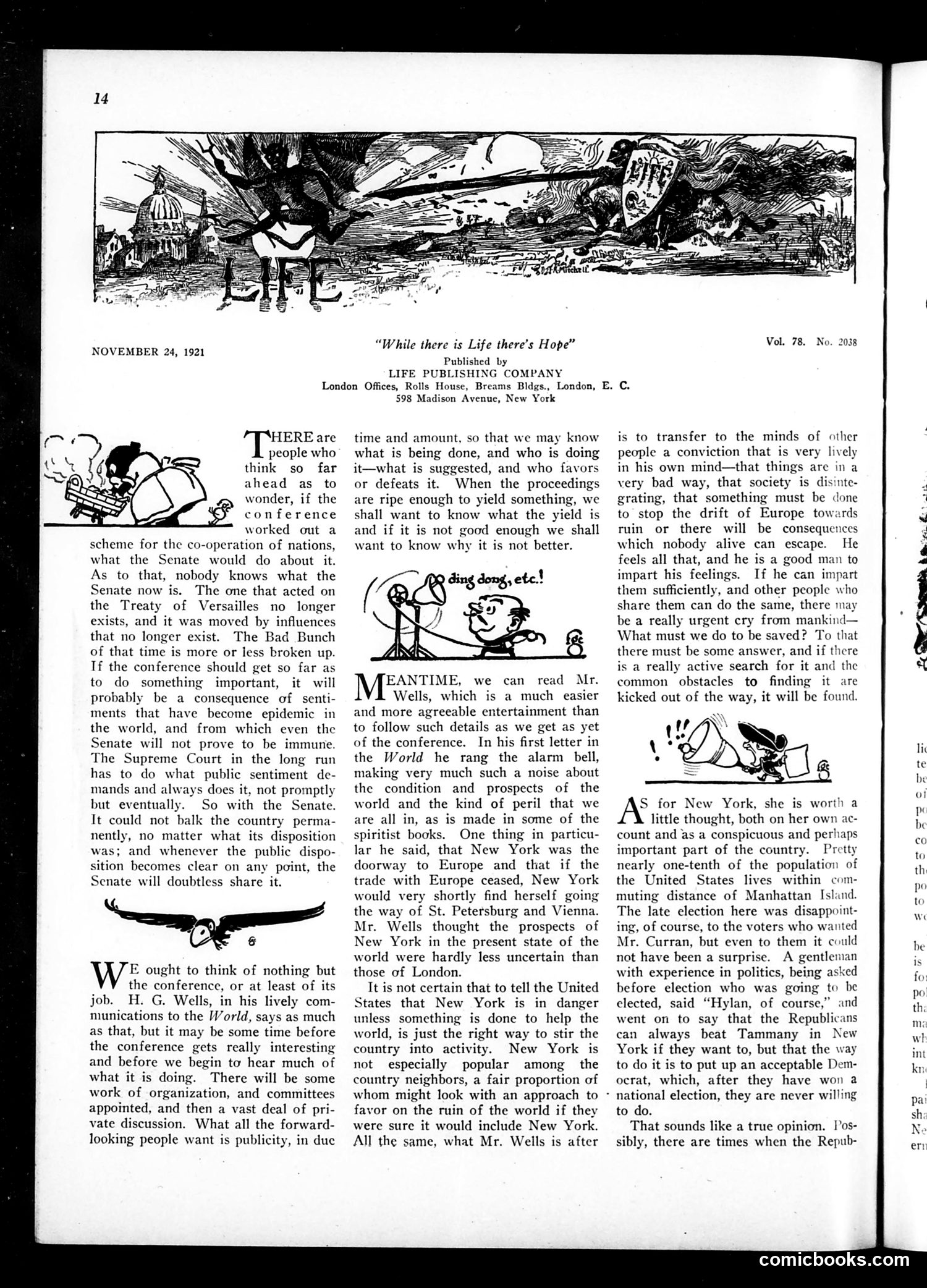
This page contains editorial commentary on the Washington Naval Conference (referenced in the text). The small cartoons illustrate the article's discussion of international cooperation and diplomatic negotiations. The first cartoon shows a figure at what appears to be a conference table or podium, making a proclamation—likely satirizing the verbose nature of diplomatic speeches at the conference. The second cartoon depicts a figure appearing distressed or animated, possibly mocking political reactions to conference proceedings. The text references H.G. Wells and discusses concerns about New York's role in international affairs, European stability, and Republican politics. The commentary suggests skepticism about whether diplomatic conferences actually produce meaningful results, while acknowledging their importance for public perception and international stability. The tone is characteristically sardonic about political process.
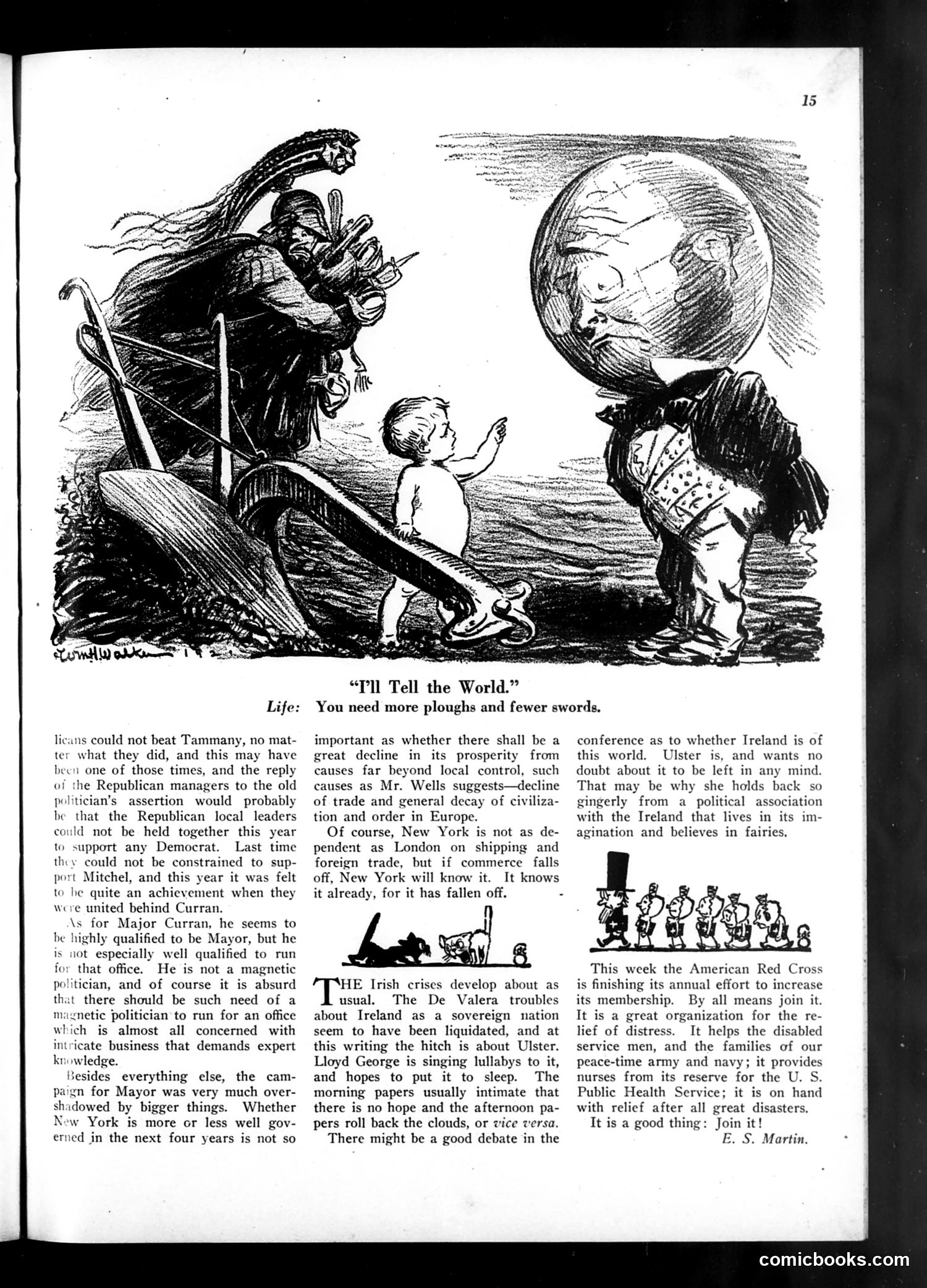
The main cartoon depicts a disheveled, aggressive figure (likely representing war, militarism, or destructive ideology) looming over two small children, with the caption "You need more ploughs and fewer swords." **The satire:** This is anti-war propaganda, likely from the post-WWI era (references to Lloyd George and Irish troubles suggest early 1920s). The image contrasts military aggression with peaceful agriculture and childhood innocence. The message argues that society should prioritize constructive tools (ploughs/farming) over weapons. **Context:** The accompanying text discusses New York mayoral politics (Curran vs. Tammany Hall), Irish independence negotiations regarding Ulster, and a Red Cross membership drive. The editorial suggests these local concerns pale beside larger issues—economic decline and European instability—implying the real threat is geopolitical disorder, not local governance. The cartoon reinforces this hierarchy of concerns: petty politics matter little when civilization itself faces destruction from militarism and war.
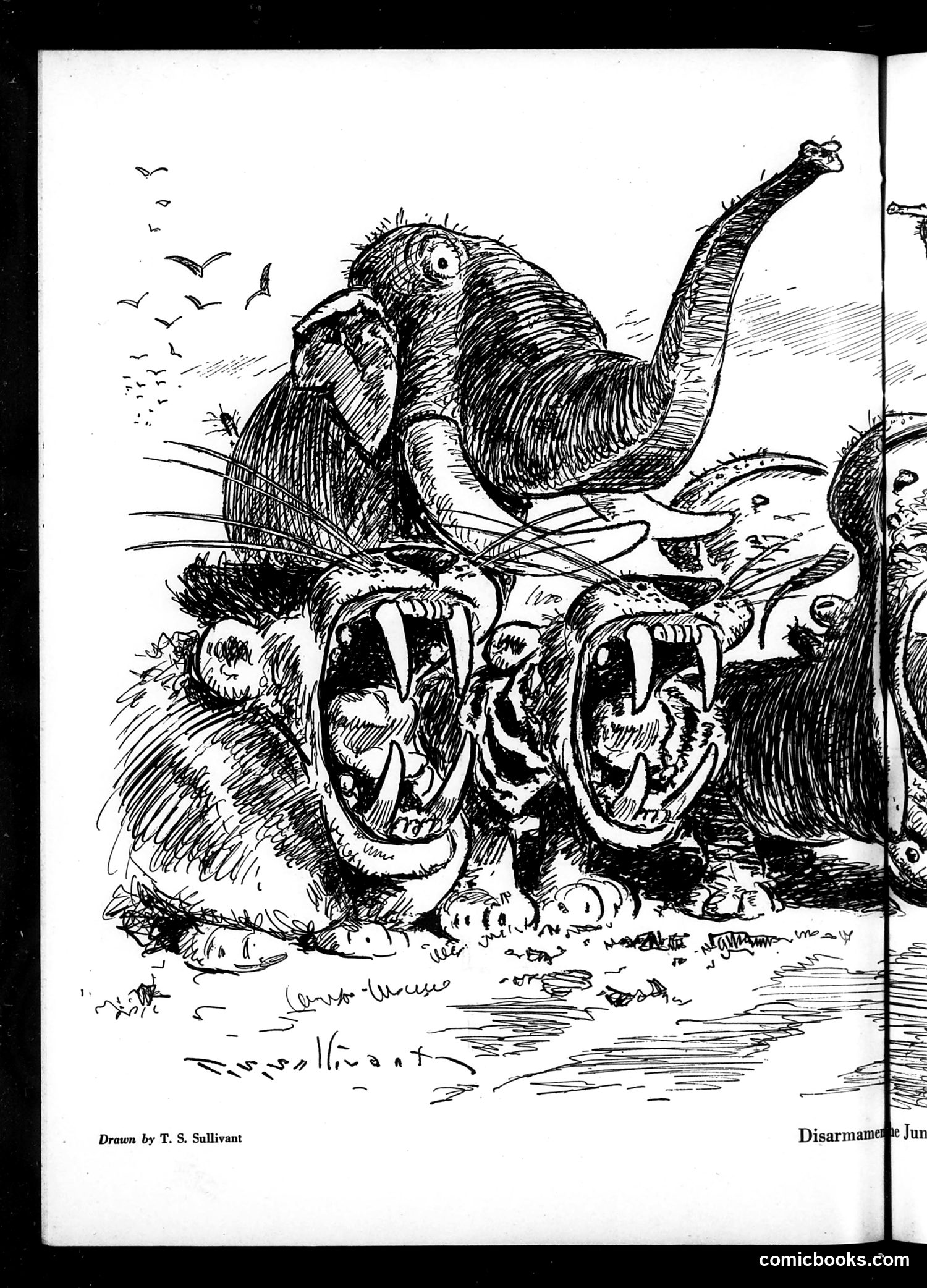
This T.S. Sullivant cartoon depicts a group of fierce, snarling lions with their mouths wide open in aggressive poses. The title "Disarma[ment]" (partially visible) indicates this is satirizing disarmament discussions. The lions likely represent nations or military powers refusing to reduce their weapons and aggression despite international calls for disarmament. Their bared teeth and confrontational stances suggest these countries remain hostile and unwilling to cooperate peacefully, making disarmament efforts futile. The cartoon critiques the gap between diplomatic rhetoric about reducing arms and the actual hostile postures nations maintain. Without identifying specific countries, Sullivant mocks how military powers continue threatening behavior while supposedly negotiating peace—a common satirical target of 1920s-1930s political cartoons during interwar disarmament conferences.
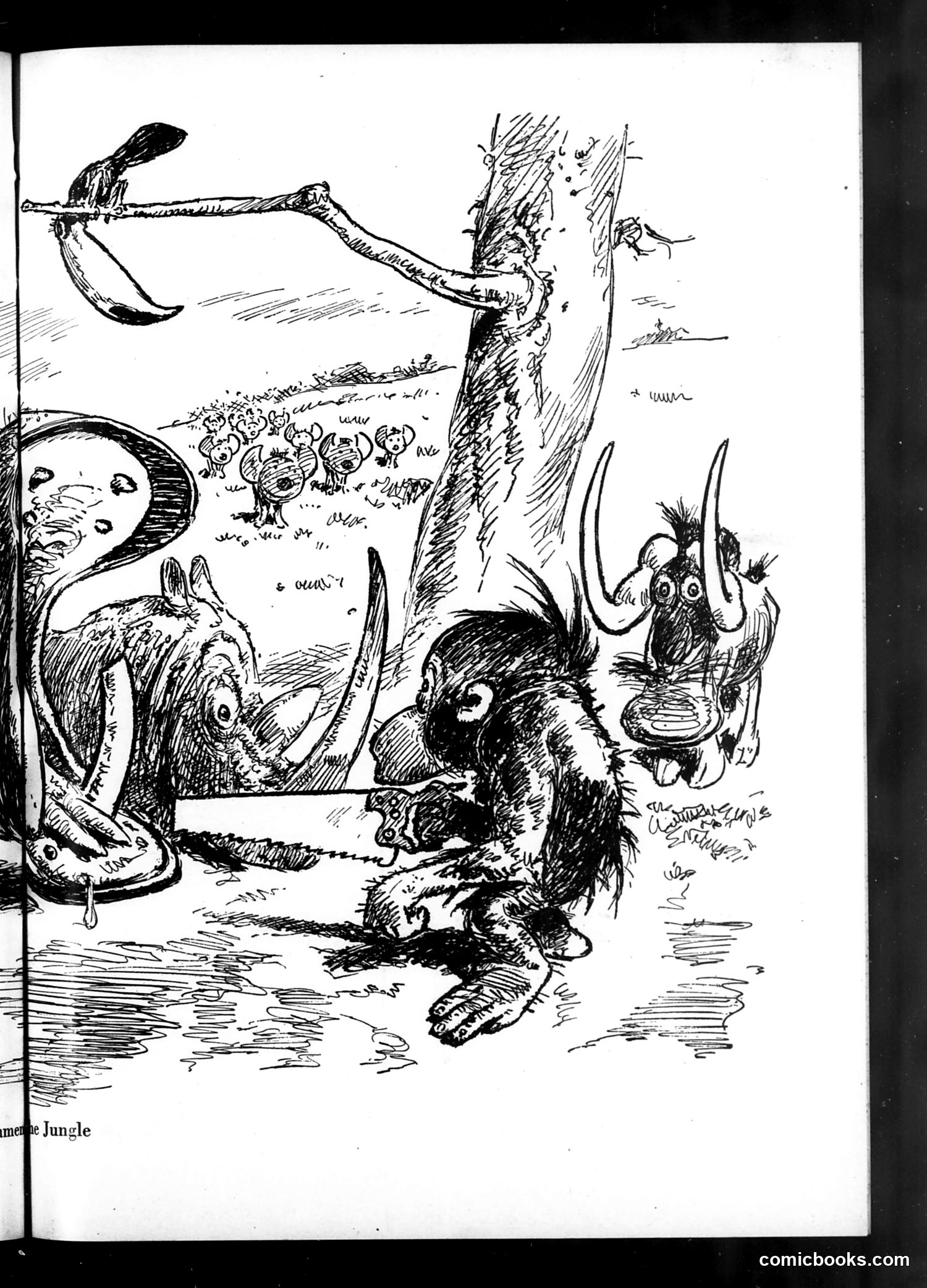
This is a satirical cartoon from Life magazine titled "Jungle" (visible at page bottom). It depicts what appears to be a chaotic scene with several grotesque, ape-like creatures in a primitive setting. One figure on the left wears what looks like formal attire despite its monstrous appearance, while others display exaggerated features typical of period caricature. Without clearer context or caption text, the specific political targets remain unclear. However, the style suggests early-to-mid 20th century satire using animal caricature—a common technique for mocking politicians, foreign leaders, or social groups. The "jungle" setting likely carries satirical commentary about civilization versus barbarism, though the intended subject(s) cannot be definitively identified from the image alone.
This is a theater review column covering three Broadway productions. The critic discusses: **"The Grand Duke"** — A French comedy by Sacha Guitry, translated by Captain Achmed Abdullah. The reviewer finds it artificially philosophical with shallow wit ("Does she tell the truth? Of course not, she is a woman"). Actor Lionel Atwill performs competently but visibly as an actor rather than disappearing into his role. **"Anna Christie"** — Eugene O'Neill's play starring Pauline Lord. The critic praises Lord's acting as genuinely transformative but faults O'Neill's plot: the second act's romance happens in convenient fog, and the third act delivers an uncharacteristic happy ending the reviewer considers weak. **"Golden Days"** — A youth-oriented comedy (review cuts off mid-sentence). The page contains no political cartoons—just standard theatrical criticism typical of Life's drama section. The decorative "Drama" header and small ornamental illustrations are typical period magazine design, not satirical content.
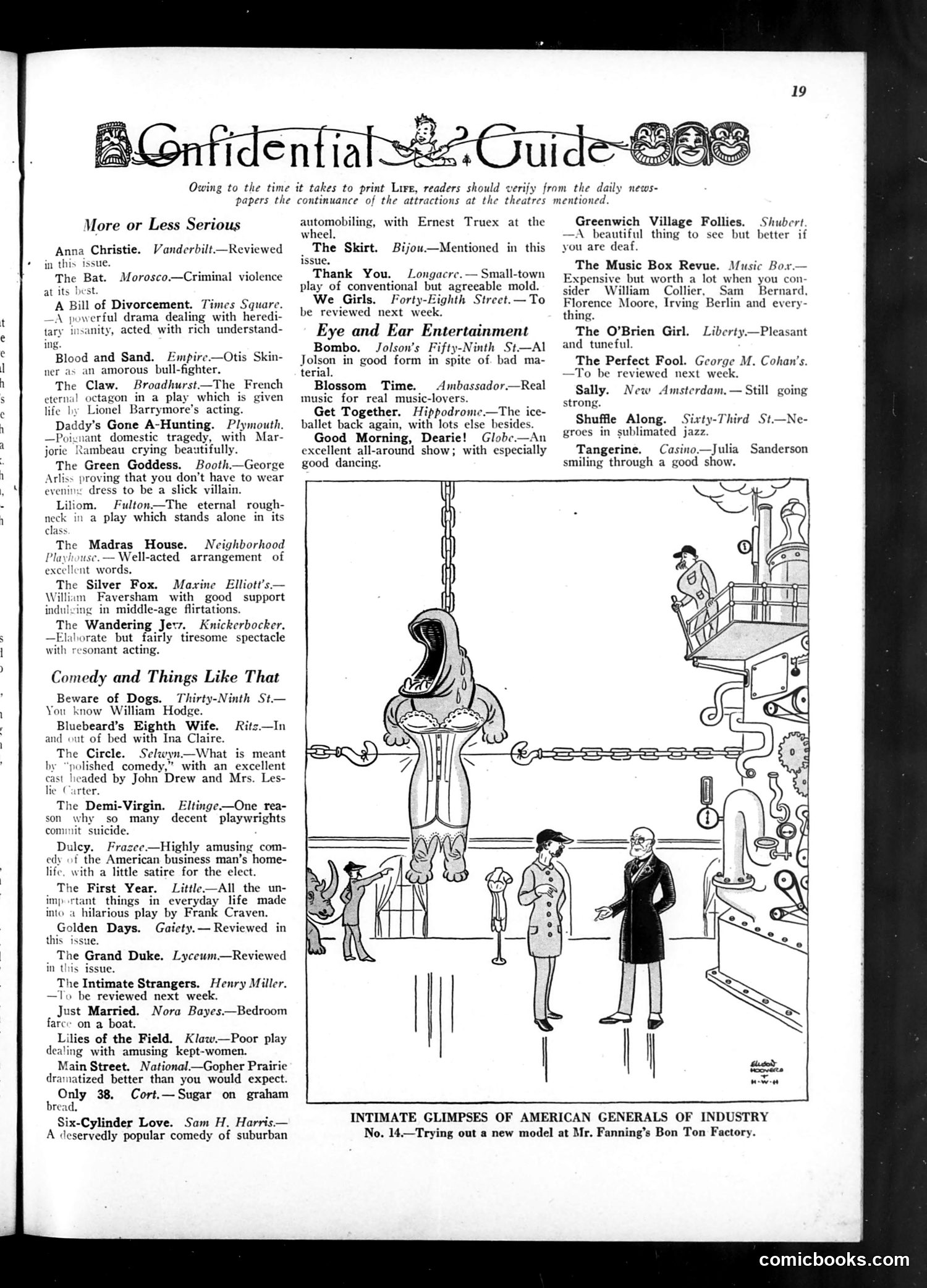
This page from *Life* magazine is primarily a **theater guide** listing Broadway shows currently playing, with brief critical notes. The reviews use witty, sometimes cruel commentary typical of the era—praising actors like George Arliss and John Drew, while mocking plays like "The Demi-Virgin" (suggesting it causes playwrights to commit suicide). The single cartoon at bottom, captioned "Intimate Glimpses of American Generals of Industry," depicts a **fashion factory scene**. A large mechanical dummy or mannequin is suspended from chains while well-dressed men (presumably factory owners or designers) examine it. The joke appears to satirize the **dehumanization of industrial labor**—treating workers or models like mechanical objects—or possibly mocks the artificiality of fashion manufacturing itself. The "Bon Ton Factory" reference suggests haute couture production. The cartoon's title frames industrial magnates as "generals," ironically elevating their commercial enterprise to military grandeur, a common satirical technique of the 1920s.
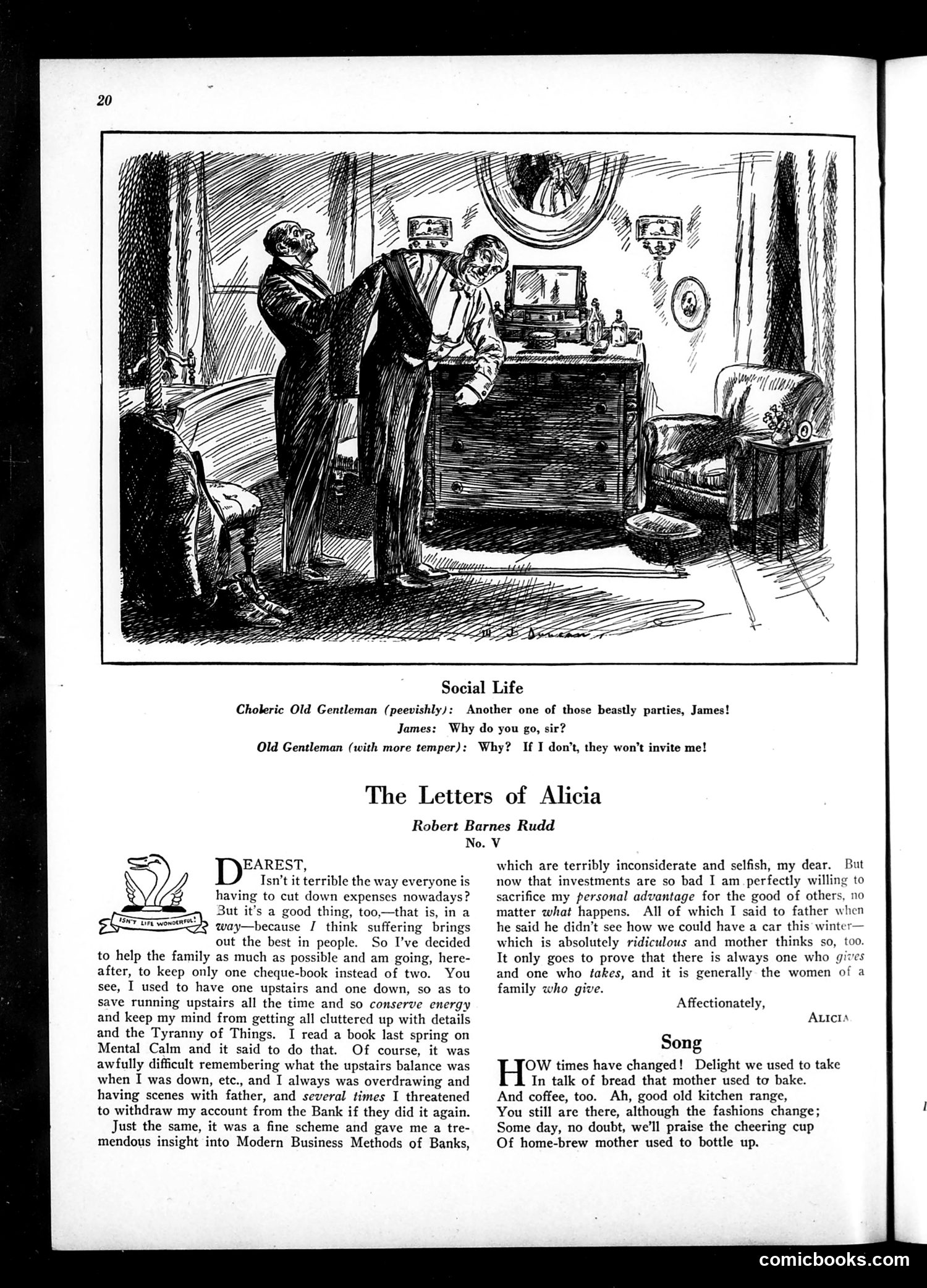
**The Top Cartoon** depicts a social paradox: a choleric old gentleman complains to his servant James about attending "beastly parties," yet when asked why he goes, he reveals the answer—social obligation and fear of exclusion. The humor lies in the absurdity: he attends events he dislikes simply to maintain his social standing and ensure continued invitations. This satirizes early 20th-century upper-class social conventions where appearances and inclusion mattered more than genuine enjoyment. **"The Letters of Alicia"** by Robert Barnes Rudd is satirical social commentary on wealthy women's hypocrisy. Alicia claims to sacrifice her personal advantage during economic hardship (keeping one checkbook instead of two), yet simultaneously demands a car despite her father's refusal. The satire exposes how people—particularly privileged women—use rhetoric of self-sacrifice while maintaining their luxurious expectations. The "Song" nostalgically contrasts past domestic simplicity with modern consumer desires.
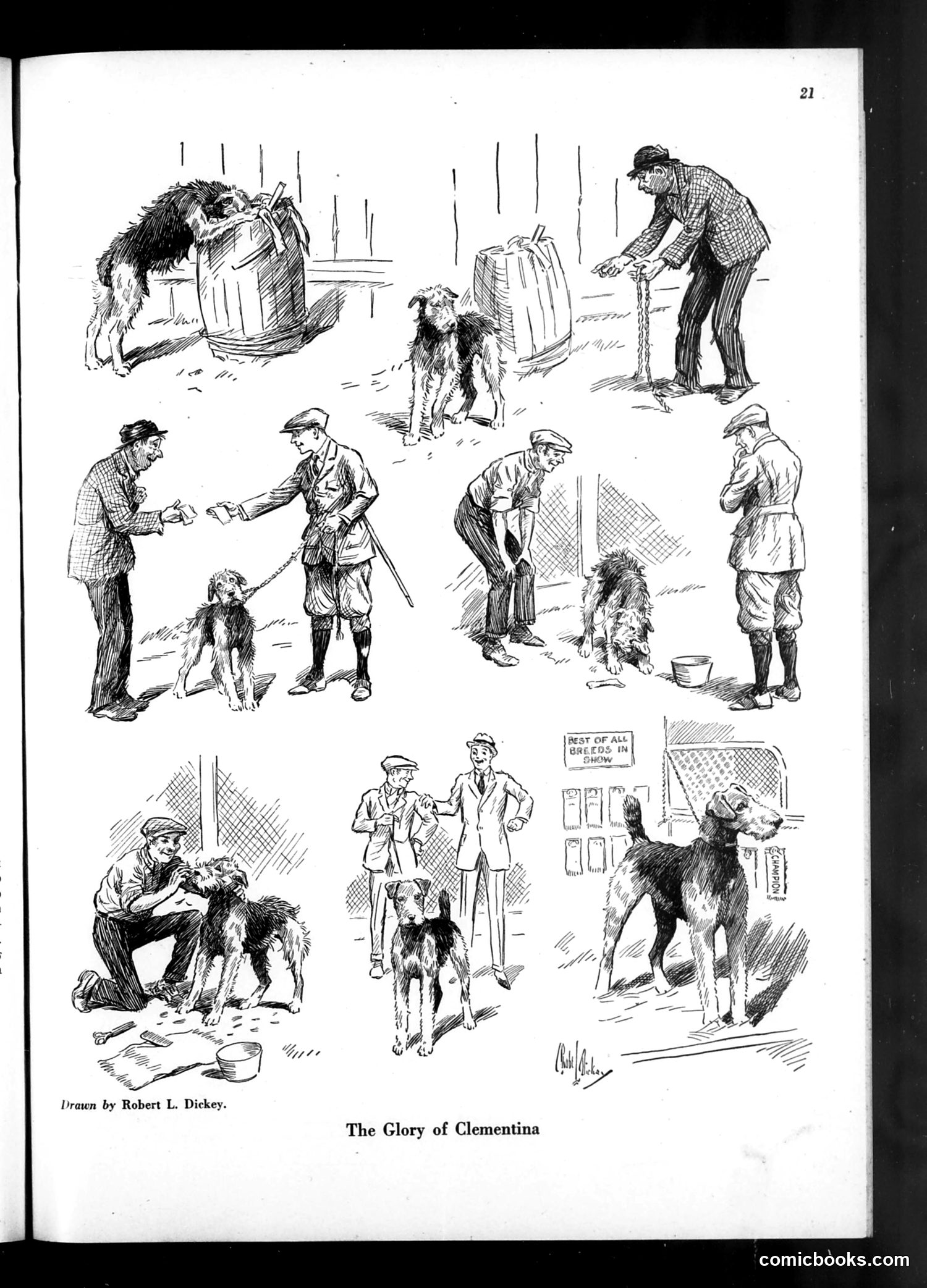
This page consists of six illustrated panels depicting dog show scenes, drawn by Robert L. Dickey. The title "The Glory of Clementina" suggests the narrative follows a dog (likely named Clementina) through various show activities. The panels show: handlers presenting dogs to judges, dogs being groomed and prepared, examination at what appears to be a show booth labeled "BEST OF ALL BREEDS IN SHOW," and interaction between handlers and judges. The satire likely mocks the pretension and formality of dog show culture—the meticulous preparation, the self-important judging, and handlers' competitive pride over their animals. This appears to be gentle social humor about how seriously people take dog shows, treating ordinary dogs with excessive ceremony and concern.
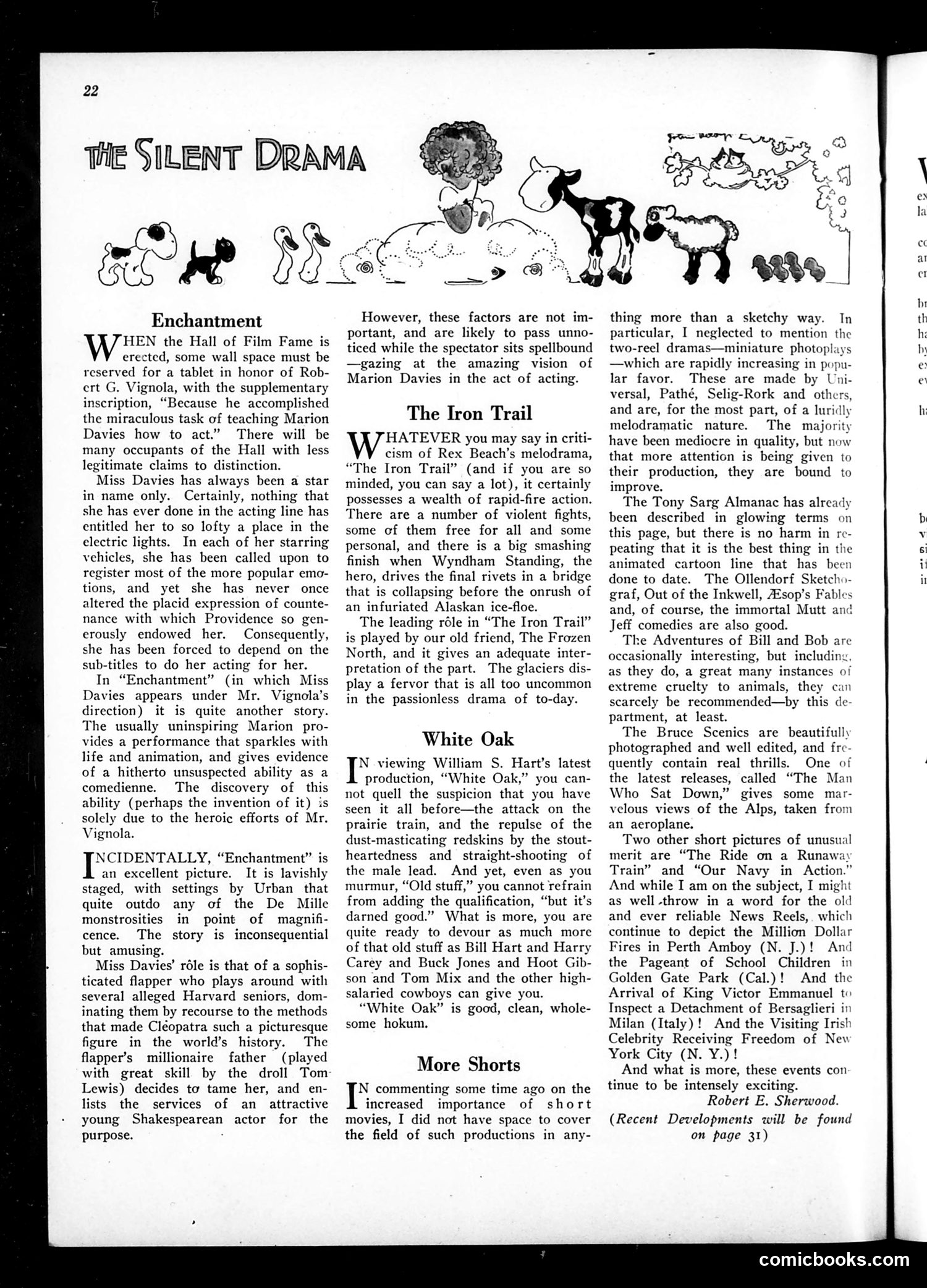
This page reviews several silent films from the 1920s. The opening section mocks actress Marion Davies, calling her a "star in name only" whose acting ability was so wooden that subtitles had to carry her performances. The reviewer credits director Robert G. Vignola with miraculous work in making her appear competent in "Enchantment"—backhanded praise suggesting her previous films relied entirely on intertitles rather than her performance. The cartoon strip at the top ("Enchantment") humorously illustrates this through animal characters, likely a visual pun on the film. Other reviews discuss Rex Beach's action-heavy melodrama "The Iron Trail," praising its spectacle, and William S. Hart's Western "White Oak," which the critic acknowledges as familiar but enjoyable "hokum"—predictable cowboy-versus-Indians material that audiences apparently relished despite its formulaic nature. The tone throughout is witty mockery of both performers and audiences.
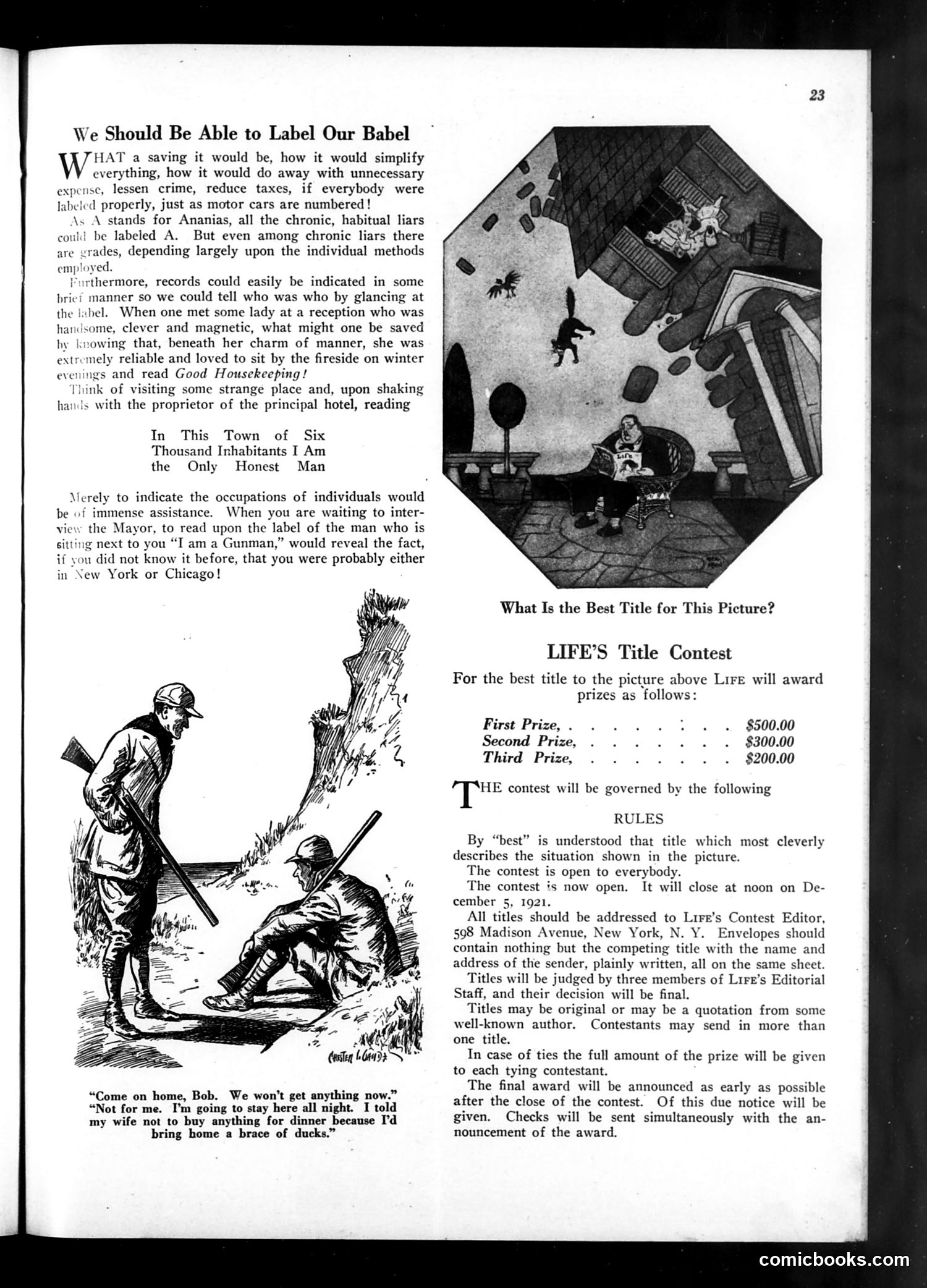
**Main Editorial Satire**: "We Should Be Able to Label Our Babel" proposes a darkly humorous system of labeling people like automobiles—marking chronic liars as "A," identifying gunmen, etc. The satire mocks both bureaucratic classification schemes and urban social anxiety. References to "New York or Chicago" evoke 1920s concerns about gangsterism and corruption in major cities. **The Cartoon**: Below shows two hunters with a catch of ducks. The dialogue ("I'm going to stay here all night...bring home a brace of ducks") appears to be a joke playing on "brace" (a pair) and domestic tension—the hunter prefers staying out hunting rather than facing home and dinner. **Context**: This 1921 Life issue reflects post-WWI American society's fascination with order, categorization, and anxieties about urban crime and social trustworthiness. The piece satirizes the era's faith in systematic labeling as a solution to social problems.
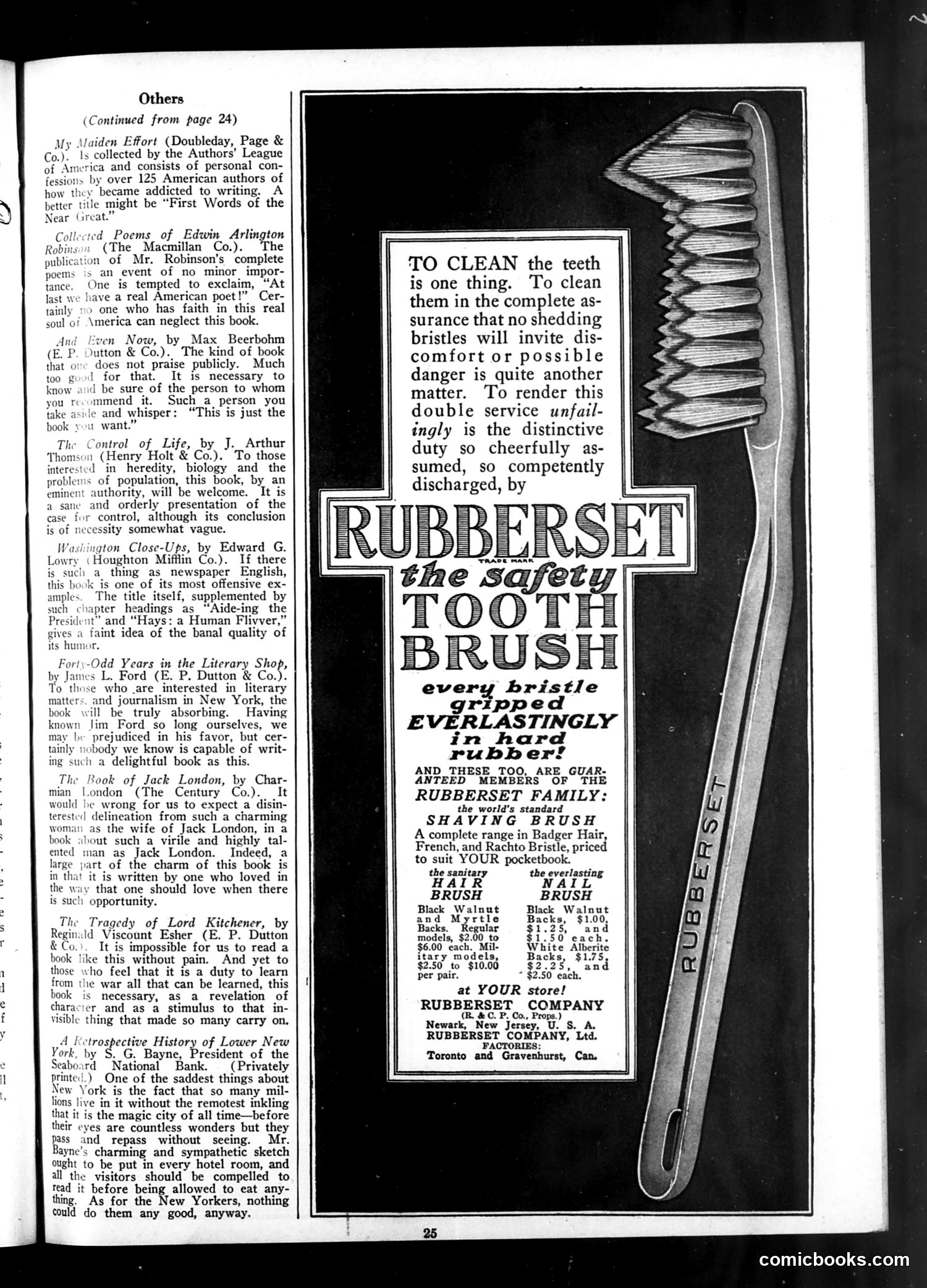
This page contains book reviews on the left and a full-page advertisement on the right, with no political cartoon. The left side reviews recently published books, mostly favorably. Notable mentions include Edwin Arlington Robinson's collected poems (praised as genuinely American), Max Beerbohm's "Even Now" (described as too good to recommend publicly), and works on biology, journalism, and Jack London. The reviews are brief, witty assessments typical of *Life* magazine's literary coverage. The right side is entirely a Rubberset toothbrush advertisement. It emphasizes that the brush cleans teeth *safely*—specifically, that its bristles won't shed and cause discomfort or danger. The ad highlights the brush's "hard rubber" construction and lists various models (shaving brush, hair brush, nail brush) available at stores. This reflects early-20th-century consumer concerns about product durability and safety in daily goods.
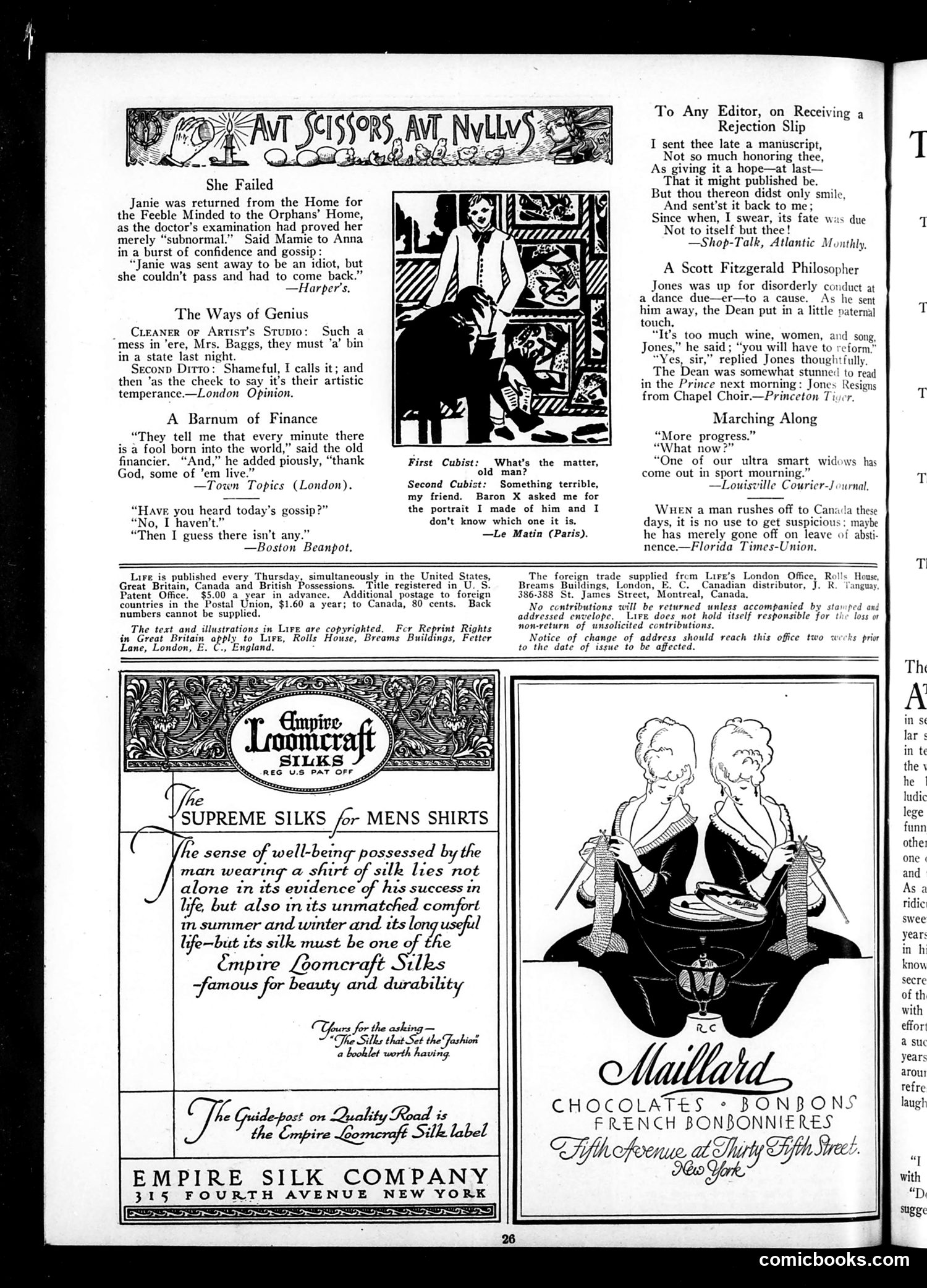
This page from *Life* magazine contains brief satirical pieces and advertisements typical of early 20th-century humor journalism. The cartoons mock social pretensions and human folly: one jokes about a woman rejected from an institution for the "feeble-minded" as merely "subnormal"; another satirizes artists' messiness; a third mocks financiers' cynicism about human nature. A cubist painter cannot identify his own portrait of a client, poking fun at modernist art's incomprehensibility. The section "A Scott Fitzgerald Philosopher" references a college student disciplined for drunkenness who then resigns from the chapel choir—satirizing performative respectability. Other brief jokes mock manuscript rejection, Prohibition-era disappearances to Canada, and fashion-conscious widows. The advertisements for Empire Loomcraft Silks and Maillard Chocolates are period luxury goods marketing, not satirical content. Overall, this represents *Life*'s trademark blend of social satire targeting middlebrow pretension and modern absurdities.
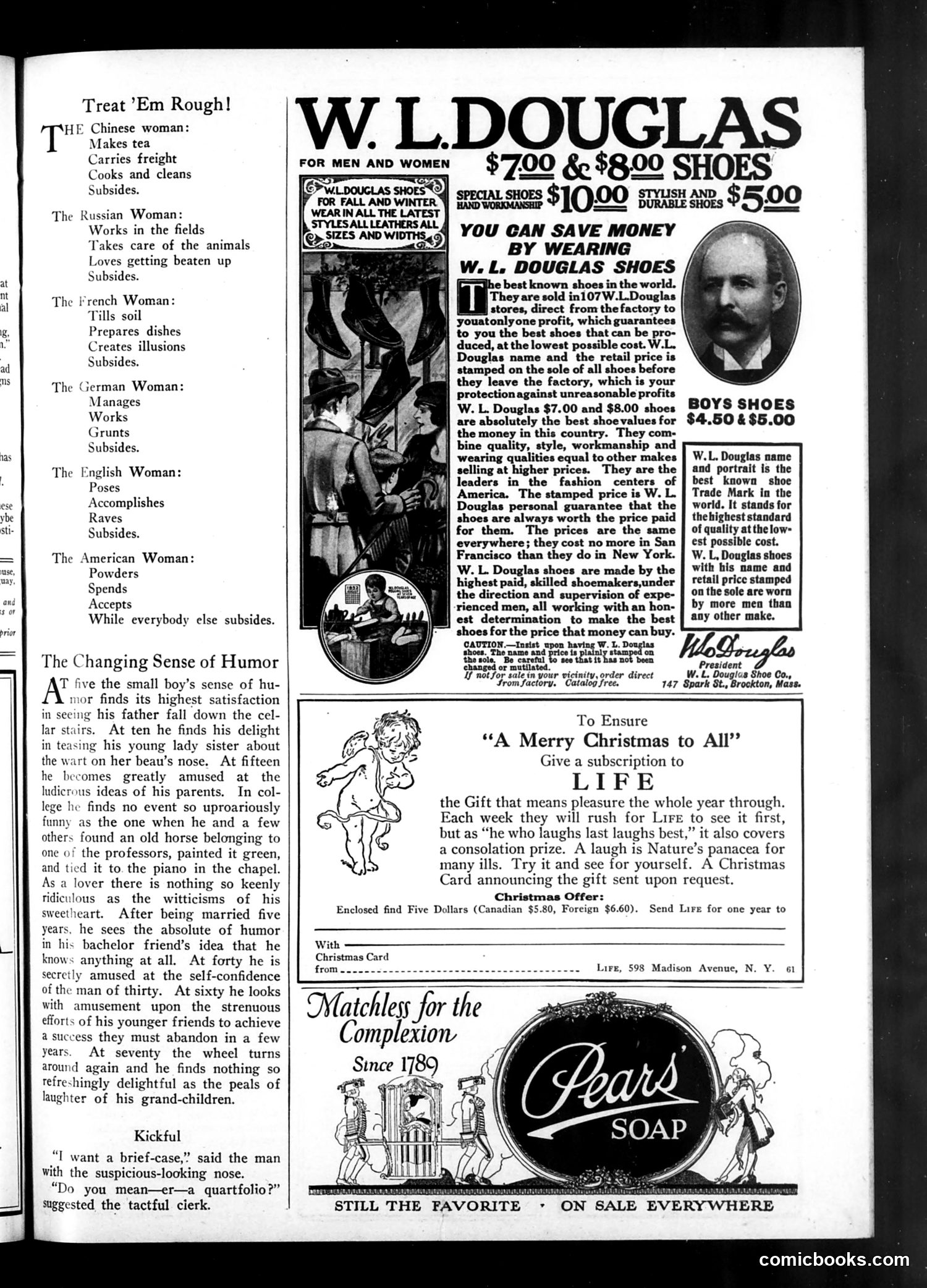
**"Treat 'Em Rough!"** is a satirical ethnic stereotype cartoon mocking women from different nations. Each entry lists reductive caricatures: Chinese women "subsides," Russian women "love getting beaten up," French women "create illusions," German women "grunt," English women "pose," and American women merely "powder" and "spend." The satire targets both foreigners AND American women—suggesting American women are frivolous spenders while implying other nationalities are intellectually or culturally inferior. This reflects early 20th-century xenophobia and misogyny common in American satirical magazines. **"The Changing Sense of Humor"** traces how men's humor supposedly matures from childhood pranks through old age, ending with grandfatherly sentimentality—a gentle observation about aging rather than biting satire. The page is otherwise dominated by W.L. Douglas shoe advertisements and Pears Soap promotion, typical of Life magazine's mixed editorial and advertising content.
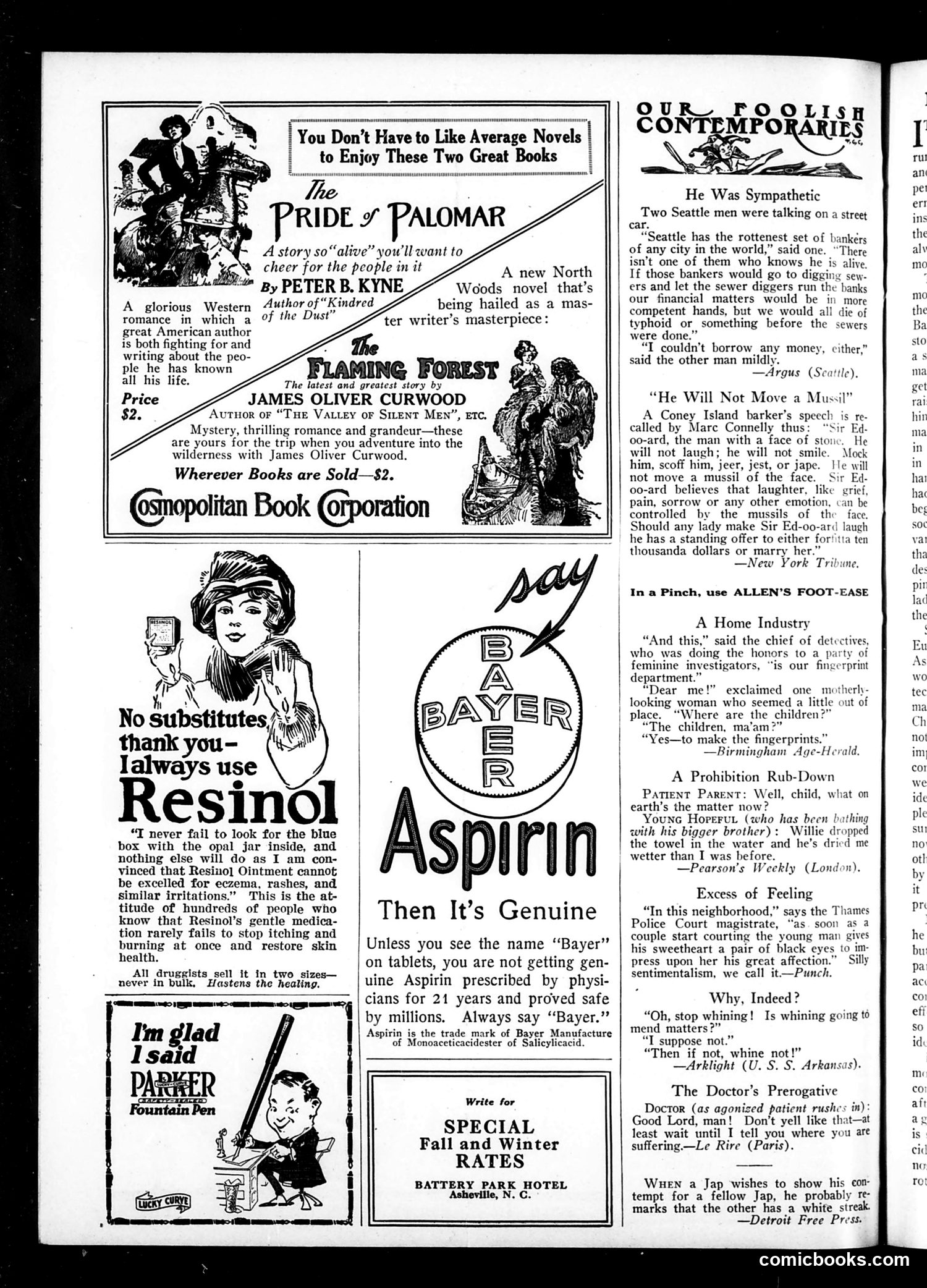
This page is primarily **advertising and humor content** from Life magazine, not political commentary. The advertisements promote novels ("The Pride of Palomar," "The Flaming Forest"), Resinol ointment, Bayer Aspirin, and a hotel—typical early 20th-century magazine ads emphasizing brand authenticity ("Unless you see the name 'Bayer'..."). The humor section, titled "OUR CONTEMPORARIES," collects brief jokes from other publications. These include: - A banker joke (Seattle bankers so incompetent, sewer diggers should replace them) - A Coney Island carnival barker's pitch about an emotionless performer - A detective story mixing children and fingerprints (unclear punchline) - Prohibition-era humor about bathing mishaps - British court anecdotes about excessive romantic displays **No political satire is evident**—these are genteel, family-friendly jokes reflecting 1920s life: banking frustrations, amusement parks, detective work, and Prohibition's social effects.
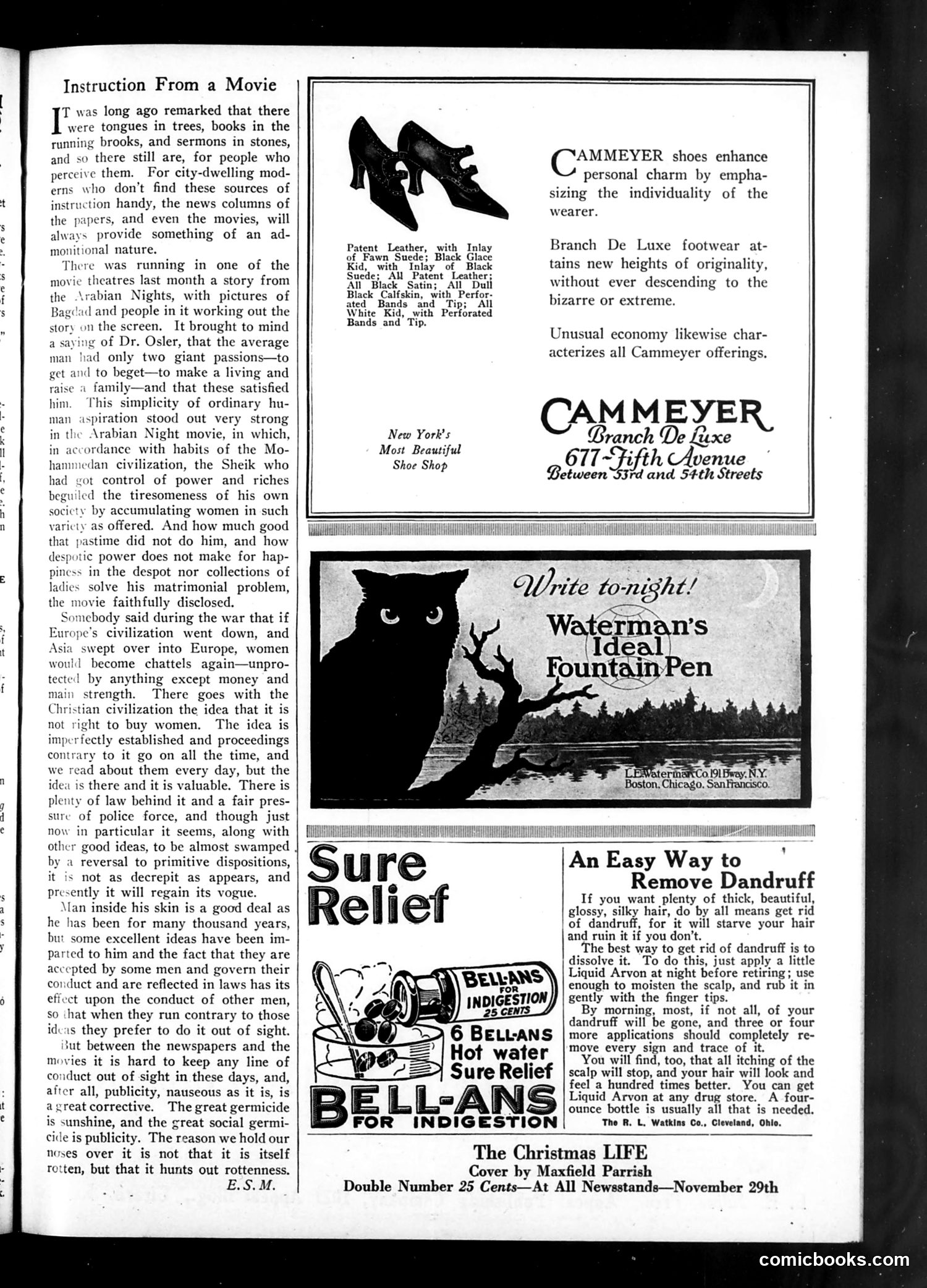
This page combines a serious editorial essay with period advertisements. **The Main Essay ("Instruction From a Movie"):** The author argues that modern city-dwellers should learn from cinema. He describes an Arabian Nights film depicting a Sheik who accumulates women to alleviate boredom—yet finds no happiness. The essay uses this to illustrate that raw power and possession don't bring contentment. The author then pivots to a broader social argument: Western Christian civilization's principle that women shouldn't be "bought" (treated as property) is valuable, though imperfectly practiced. He warns that if European civilization collapsed during WWI, women would revert to chattels. However, he argues that **publicity and transparency** (through newspapers and movies) are society's "germicide"—exposing misconduct and forcing better behavior. **The Advertisements** are period-typical: Cammeyer shoes, Waterman fountain pens, and Bellans indigestion remedy—unrelated to the editorial. The piece reflects post-WWI anxieties about civilization's fragility and emerging faith in media as a social corrective.
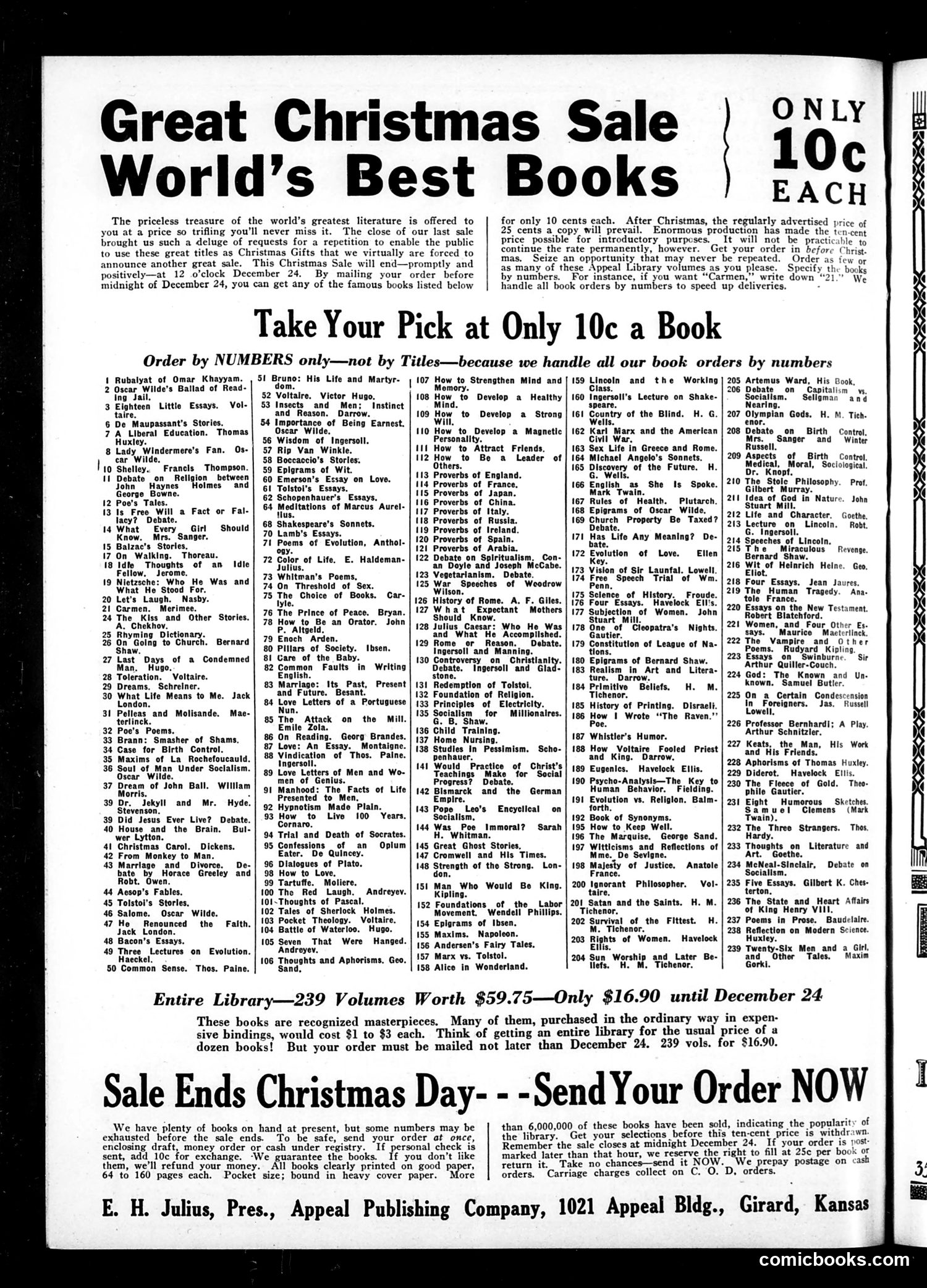
This page is **not a political cartoon**—it's a Christmas mail-order advertisement from Appeal Publishing Company in Girard, Kansas, circa early 1900s. The company is selling a "Great Christmas Sale" offering classic literature and essays at 10 cents per book (normally 25 cents). The catalog lists 239 volumes of "world's best books"—classics like *Rubaiyat of Omar Khayyam*, works by Oscar Wilde, Tolstoy, and Emerson, plus debate pamphlets on topics like religion, birth control, and marriage. The framing emphasizes **affordability for ordinary readers**: "a price so trifling you'll never miss it." The entire 239-volume library costs $16.90 (versus $59.75 regular price). This reflects Progressive Era values—making serious literature and intellectual debate widely accessible to working-class Americans. Note the inclusion of controversial topics (birth control, socialism) suggests this was a left-leaning publisher promoting public enlightenment and critical thinking.
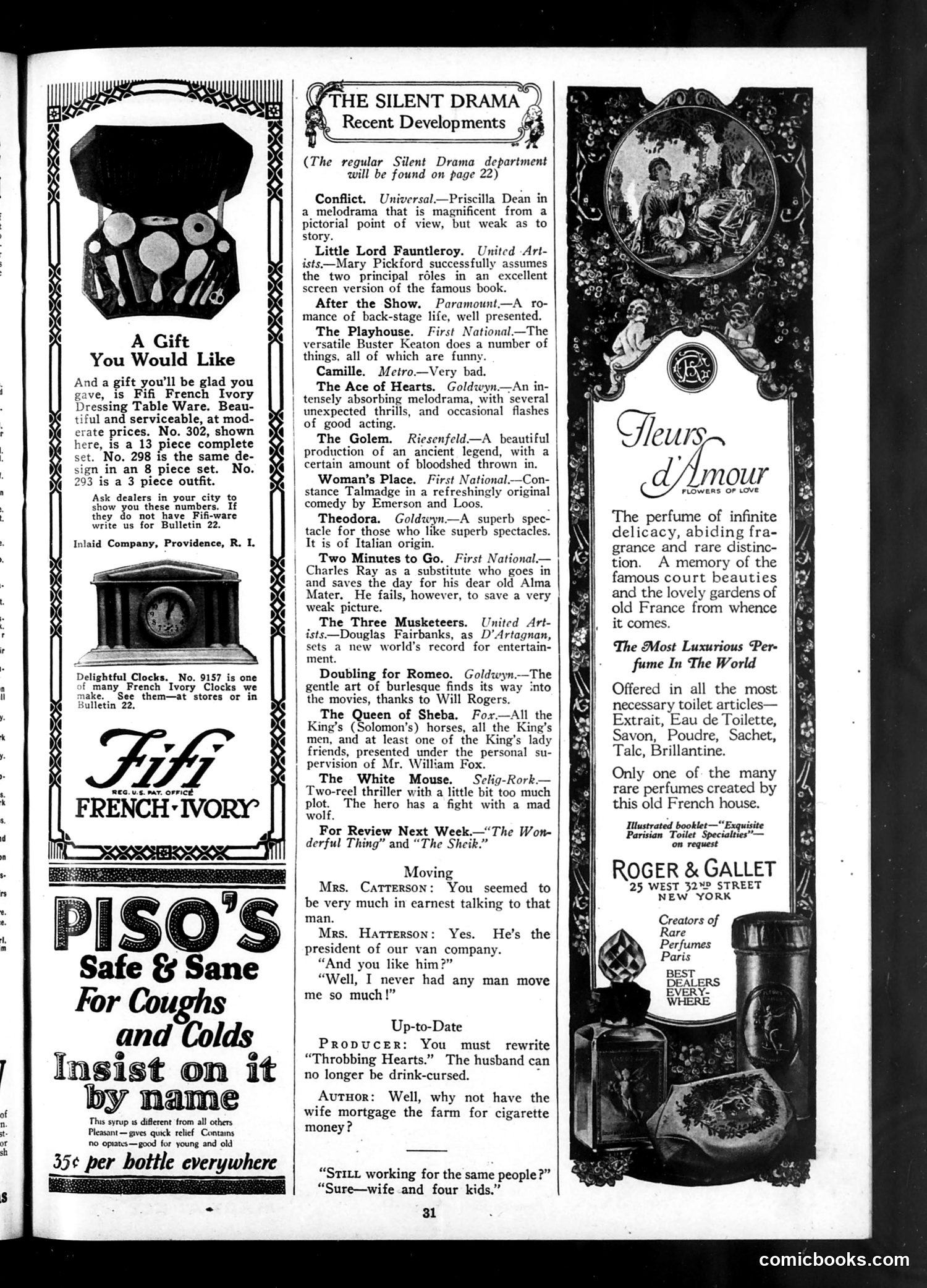
This page is primarily **advertising and entertainment reviews** from an early 1920s Life magazine. **The cartoons/humor:** The small dialogue exchanges ("Moving," "Up-to-Date") are brief satirical jokes about contemporary life. The "Moving" bit jokes that a woman found a moving van company president so persuasive he literally moved her—wordplay on "moving." The "Up-to-Date" section mocks how film censorship is forcing screenwriters to adapt: since husbands can no longer be depicted as alcoholics ("drink-cursed"), the author suggests making wives spend money on cigarettes instead—satirizing both changing moral standards and marital dynamics. **Context:** These reflect 1920s Prohibition-era concerns and emerging feminist anxieties about women's spending habits and independence. **The bulk of the page** consists of movie reviews (silent films featuring Mary Pickford, Buster Keaton, Douglas Fairbanks) and period advertisements for French Ivory dressing table sets, Piso's cough syrup, and "Fleurs d'Amour" perfume—luxury goods marketed to affluent readers.
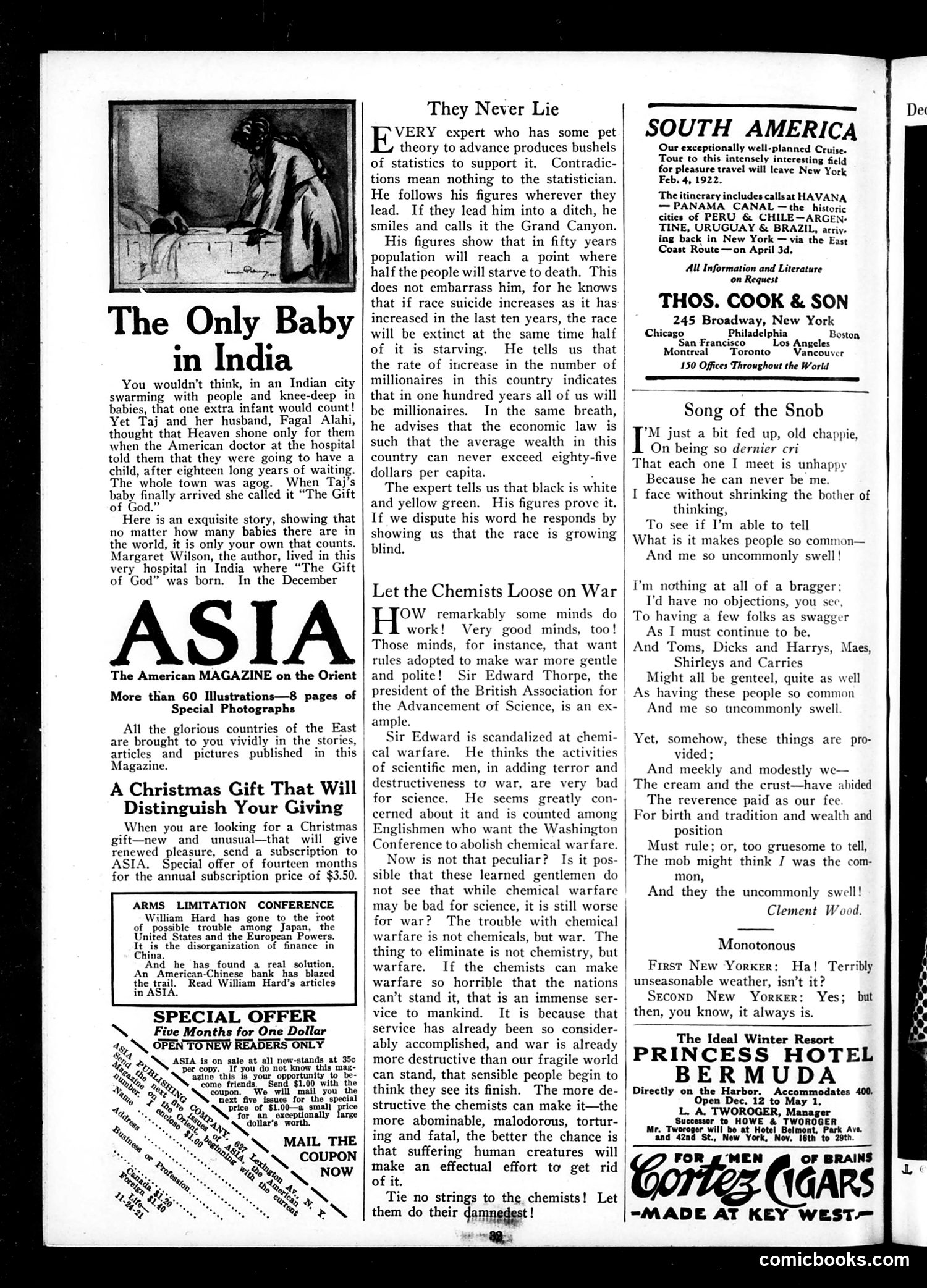
This page satirizes **expert statisticians and their manipulative use of data**. The cartoon depicts an "expert" presenting contradictory statistics with equal confidence—claiming simultaneously that the population will starve to death in fifty years AND that everyone will become millionaires within a century. The satire's point: experts cherry-pick statistics to support predetermined theories, then dismiss logical objections as evidence that critics are "blind" to the facts. The second article mocks **Sir Edward Thorpe and peace advocates** who want chemical weapons banned from warfare on scientific grounds. Life's satirist argues this is absurdly backwards: the problem isn't that chemical weapons are "bad for science," but that they're bad for *war itself*. If chemists made warfare horrifying enough, nations might abolish it entirely—which would actually serve the cause of peace better than genteel restrictions. Both pieces critique pseudo-intellectual reasoning presented with false authority.