
Life, 1921-11-24 · page 17 of 34
Life — November 24, 1921 — page 17: what you’re looking at
What you’re looking at
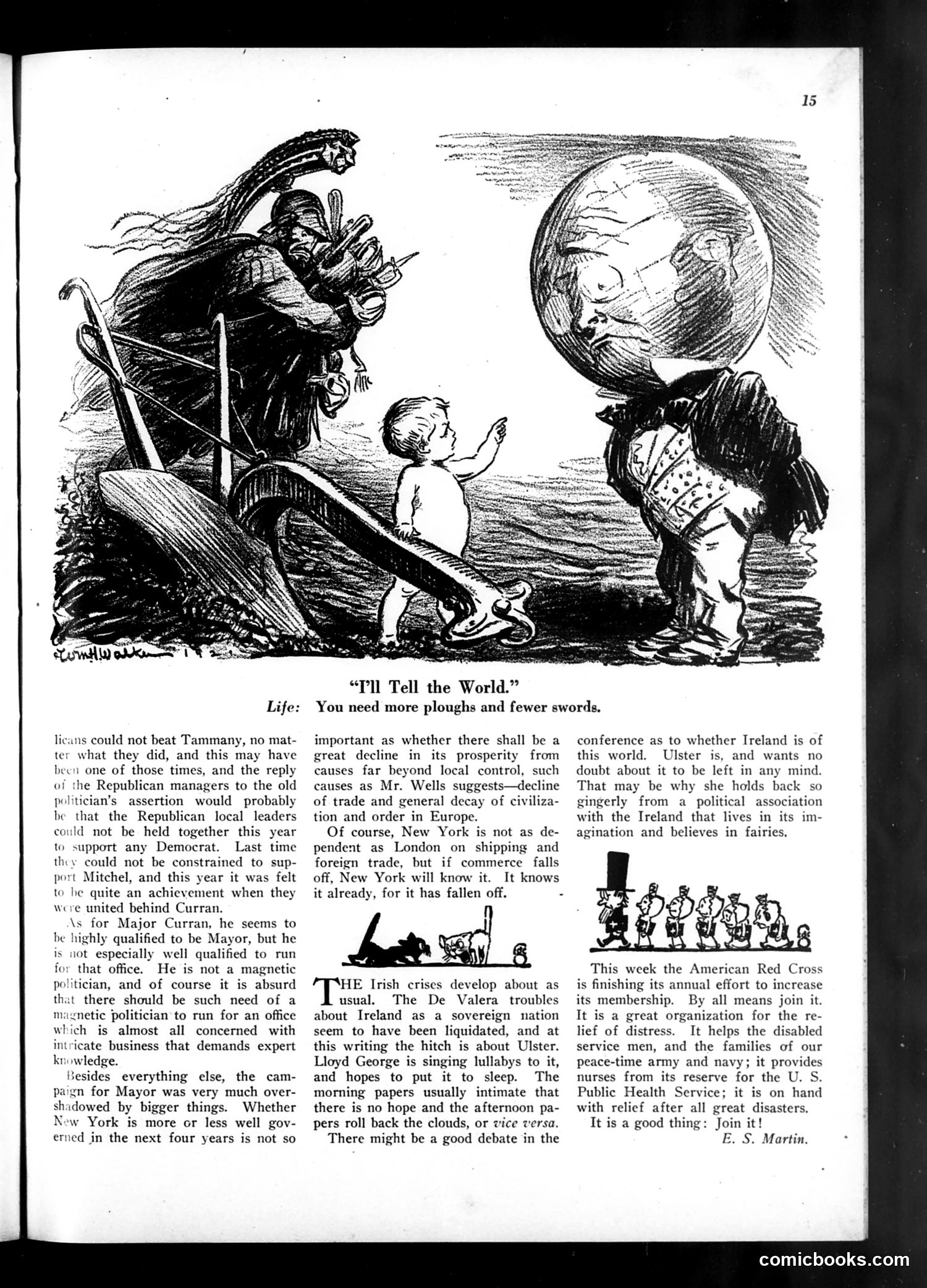
The main cartoon depicts a disheveled, aggressive figure (likely representing war, militarism, or destructive ideology) looming over two small children, with the caption "You need more ploughs and fewer swords." **The satire:** This is anti-war propaganda, likely from the post-WWI era (references to Lloyd George and Irish troubles suggest early 1920s). The image contrasts military aggression with peaceful agriculture and childhood innocence. The message argues that society should prioritize constructive tools (ploughs/farming) over weapons. **Context:** The accompanying text discusses New York mayoral politics (Curran vs. Tammany Hall), Irish independence negotiations regarding Ulster, and a Red Cross membership drive. The editorial suggests these local concerns pale beside larger issues—economic decline and European instability—implying the real threat is geopolitical disorder, not local governance. The cartoon reinforces this hierarchy of concerns: petty politics matter little when civilization itself faces destruction from militarism and war.
📄 Transcribed text from this page (OCR, searchable)
Machine-transcribed from the original scan — historical spelling and the odd misread are preserved.
Life: licans could not beat Tammany, no mat- ter what they did, and this may have been one of those times, and the reply of the Republican managers to the old politician’s assertion would probably be that the Republican local leaders could not be held together this year to support any Democrat. Last time they could not be constrained to sup- port Mitchel, and this year it was felt to he quite an achievement when they were united behind Curran. \s for Major Curran, he seems to be highly qualified to be Mayor, but he is not especially well qualified to run for that office. He is not a magnetic politician, and of course it is absurd that there should be such need of a magnetic politician to run for an office which is almost all concerned with intricate business that demands expert knowledge. Besides everything else, the cam- paign for Mayor was very much over- shadowed by bigger things. Whether New York is more or less well gov- erned in the next four years is not so “TIl Tell the World.” You need more ploughs and fewer swords. important as whether there shall be a great decline in its prosperity from causes far beyond local control, such causes as Mr. Wells suggests—decline of trade and general decay of civiliza- tion and order in Europe. Of course, New York is not as de- pendent as London on shipping and foreign trade, but if commerce falls off, New York will know it. It knows it already, for it has fallen off. ‘HE Irish crises develop about as usual. The De Valera troubles about Ireland as a sovereign nation seem to have been liquidated, and at this writing the hitch is about Ulster. Lloyd George is singing lullabys to it, and hopes to put it to sleep. The morning papers usually intimate that there is no hope and the afternoon pa- pers roll back the clouds, or vice versa. There might be a good debate in the conference as to whether Ireland is of this world. Ulster is, and wants no doubt about it to be left in any mind. That may be why she holds back so gingerly from a political association with the Ireland that lives in its im- agination and believes in fairies, This week the American Red Cross is finishing its annual effort to increase its membership. By all means join it. It is a great organization for the re- lief of distress. It helps the disabled service men, and the families of our peace-time army and navy; it provides nurses from its reserve for the U. S. Public Health Service; it is on hand with relief after all great disasters. It is a good thing: Join it! E, S. Martin. comicbooks.com